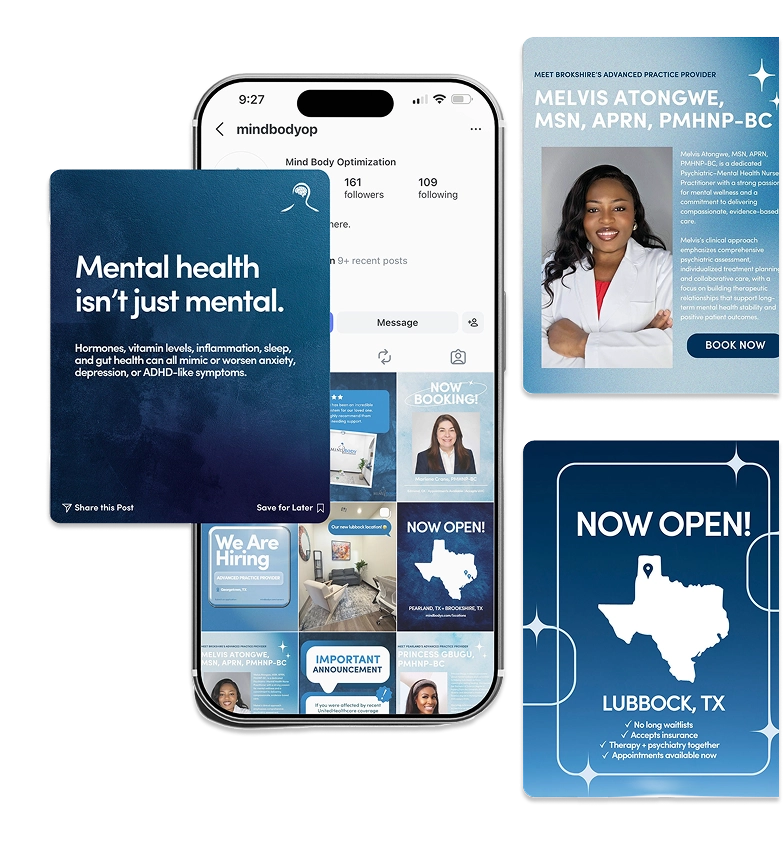
Posting Consistently but Not Seeing Engagement?
Establish a strong online presence that showcases your expertise and builds trust with our social media and reputation management strategies, made for mental + behavioral health providers.
Driving Sustainable Growth
Years of Experience
Award
Why Choose Beacon For Social Media?
Full-Funnel Social Strategy
Purpose-Driven Content + Creative
Collaborative + Efficient Workflow
Engagement + Reputation Management
Climb Aboard With a Customized Marketing Plan
Are you ready to take your mental or behavioral health practice to its next stage of growth? Let’s partner up and build a strategy that gets you there now.
Are Your Social Posts Just Not Connecting?
Seamless Review Process
Many of our clients opt to be hands-on with their marketing and review social media posts before publishing. We utilize user- friendly software that makes it easy to review and schedule all posts.
Social Media Strategy
Whether you’re focused on increasing your following, driving traffic, or generating leads for your practice, we'll develop a strategy that will draw in the most engagement for your mental + behavioral health brand.
Reputation Management
Your online reputation can influence a decision long before someone reaches out. We help you monitor reviews, strengthen credibility, and create a more positive digital presence that builds trust with prospective clients and customers.
What Our Clients Say About Us
“Thank you, Beacon, for being the partner that we needed to growth and scale our practice. Michelle and the Team at Beacon have provided guidance and direction along with incredible results.”

Elisabeth Gulotta
NYC Therapeutic Wellness
“We are so thrilled with the content calendar, training, quality of writing, and responsiveness of your team. The results speak for themselves. We couldn’t be more happy. Thank you!”

Miranda Barker, Executive Producer
Ellie Mental Health
“The flexibility and patience with the onboarding process were exceptional. Everything has turned out so much better than I even imagined. I’m so thrilled with the growth.”

Christina Zampitella, Psy.D., FT
Center for Grief & Trauma
“The new website has streamlined intakes through the new layout and SEO plan, which has been fantastic. Intakes have increased dramatically and overall much more consistent and retention has been pretty high as a result.”

Meghan McArville, MA, LMFT
Holistic CFT
“The Beacon Media + Marketing team was the perfect choice for our small non-profit. They listened to our vision and helped craft an outstanding message that we’re proud of.”

Ali Tolman
Let Every Woman Know–Alaska
“The team at Beacon is amazing! They are able to transfer the heart and personality of our business into their marketing. They listen and respect any concerns. Our business even during the pandemic has grown thanks to Beacon Marketing! Highly recommend this company!”

Dr. Robin Ridinger
Premier Health & Holistic Medicine
“Beacon Media + Marketing has far exceeded our expectations with this campaign and in bringing our efforts in the community to light. We have received positive results and reactions from community members and more importantly, a significant increase in our fundraising efforts for these important causes.”

Michelle Engelke
Denali Express Chevron Network
“I love the website soooo much! Please make sure your team knows how incredible of a job they did! It’s wildly impressive and I’m thrilled that it’s for the CCC – ahhhh! Absolutely amazing! The design, the intuitiveness, the content, everything. I can tell how much work went into it and I couldn’t be happier!”

Janelle Anderson, Founder
Collective Care Counselling
Explore Our Insights
Take a closer look at the tools, tips, and strategies that help your practice grow with confidence.
Social media often gets treated like the lighter side of a behavioral health marketing strategy.
It’s where practices share team photos, awareness-month graphics, inspirational quotes, and the occasional educational post. Those efforts may support brand recognition, but really only scratch the surface of how social platforms influence prospective patients.
For many people, social media has become part of the way they search for information, learn about mental health and decide which sources they trust. They may watch a therapist explain a symptom, save a post about treatment options or repeatedly see content from a local practice before they are ready to seek care.
By the time that person visits your website or submits an inquiry, social media may have already shaped how familiar, credible and relevant your organization feels.
Are your social channels helping prospective patients understand and trust your practice? Talk with Beacon about building a stronger behavioral health social media strategy.
At a Glance
- Social media can influence patient decisions long before someone contacts a practice.
- Educational content helps prospective patients understand symptoms, treatment options and what seeking care may look like.
- Consistent, useful posts can make a practice feel familiar when someone is ready to choose a provider.
- Different audiences use different platforms, so the right strategy depends on who the practice serves.
- Strong social content can continue appearing through search results, shares and other online platforms after it is originally posted.
Are Patients Really Using Social Media to Search?
Prospective patients may not always open Instagram, TikTok or YouTube and type “behavioral health provider near me,” but they do use these platforms to look for answers.
People search for information about anxiety, depression, trauma, relationships, parenting, substance use and treatment. They follow clinicians, listen to personal experiences and save content that helps them make sense of what they are feeling or decide whether professional support may be helpful.
Research continues to show that social media plays a role in how people find and use health information. One recent study found that many participants in an under-resourced community used social platforms to access health information, with Instagram, Snapchat and TikTok associated with researching health topics before and after receiving care.
Patients shouldn’t rely on social media as a replacement for clinical guidance, but behavioral health organizations still need to recognize that these platforms are part of the research process. A practice that consistently shares accurate, accessible information has an opportunity to help prospective patients better understand their needs and available care options.
What Role Does Social Media Play in the Patient Journey?
Social media may influence several stages of the patient journey, even when it’s not the final source attached to an inquiry.
It Helps People Recognize a Need
A person may come across a post describing signs of burnout, trauma responses, or symptoms of anxiety that they had not previously understood.
These interactions can gradually make treatment feel more relevant and approachable. A single post may not lead directly to an inquiry, but it can become one of several moments that move someone closer to seeking support.
It Introduces the Practice
Prospective patients may first encounter your organization through a shared post, short video, clinician profile or local community account. They may follow the page, save the content or simply remember the practice’s name for later.
That early interaction still matters because it gives the patient a starting point. When they encounter the practice again through search, a directory or a recommendation, the name may already feel familiar.
It Helps Patients Decide Whether a Practice Feels Approachable
Behavioral health websites need to communicate a large amount of information, including services, credentials, insurance, treatment approaches and locations. Social media gives practices more room to present that information in a way that feels personal and accessible.
A clinician answering a common question on video can help someone understand how that provider communicates. A post explaining the first appointment can reduce uncertainty, while a thoughtful response to a comment can show that the organization is attentive and respectful.
Together, these interactions help prospective patients form an impression of the practice before they ever speak with a staff member.
It Reinforces a Decision
A patient may discover the practice somewhere else and check its social profiles before making contact.
They may look for signs that the organization is active, credible and aligned with what they need. Recent posts, consistent messaging and helpful information can reinforce that they are considering a legitimate practice.
An inactive or neglected profile can create the opposite impression, especially when the information is outdated.
What Type of Social Content Builds Patient Trust?
Posting consistently helps, but consistency alone does not make content useful.
The strongest behavioral health content answers real questions, reduces uncertainty and gives the audience a clearer understanding of the practice.
Educational Content
Educational posts can help people better understand symptoms, diagnoses and treatment options without overwhelming them with clinical language.
A helpful post might answer questions such as:
- How can anxiety show up physically?
- What is the difference between stress and burnout?
- What happens during a first therapy appointment?
- How does outpatient treatment work?
- When should someone consider seeking professional support?
Content like this gives prospective patients useful information while showing that the practice understands their concerns.
Content That Explains the Care Experience
Many people delay contacting a behavioral health provider because they don’t know what to expect.
Practices can make the process feel more manageable by explaining:
- How intake works
- What information patients need to provide
- How insurance verification is handled
- What the first appointment may include
- How telehealth appointments work
- What happens after someone submits a form
These topics may feel basic to the practice, but they can make a significant difference to someone seeking care for the first time.
Clinician-Led Content
Clinician-led posts can put a knowledgeable and human face behind the practice. Short videos, written insights and answers to common questions give prospective patients a sense of a provider’s expertise and communication style.
The content doesn’t need to be heavily produced to be effective. Clear audio, a focused topic and a natural delivery often feel more approachable than a video that seems overly polished or scripted.
Clinicians should remain within appropriate ethical and privacy boundaries, but they can still share useful information in a way that feels warm, clear and credible.
Content That Reflects the People You Serve
Generic mental health content can make it difficult for a practice to stand out.
Social posts should reflect the populations, conditions and communities the organization actually serves. A practice specializing in adolescent care should sound different from one focused on older adults, couples or substance use treatment.
Specific content helps the right audience recognize that the practice understands their experiences.

Does Every Practice Need to Follow Social Media Trends?
Trends can help content reach more people, but they shouldn’t determine the entire strategy.
Behavioral health organizations have a greater responsibility than many other brands to protect credibility and communicate with care. A format that works well for a restaurant, retail brand or personal creator may feel inappropriate when applied to a sensitive mental health topic.
Before using a trend, consider whether the format genuinely supports the message. A popular video structure may offer a clear way to address a misconception, while a trending audio clip may distract from the topic or make it feel less serious than intended.
Practices should choose formats that feel natural for the brand and respectful of the people they serve. Over time, a steady stream of clear, relevant content will usually create more value than reacting to every trend that appears.
How Does Social Media Support Broader Online Visibility?
Social media content does not always stay within the platform where it was originally posted. Posts may be shared, linked to, discussed in online communities or surfaced through search engines.
Videos from YouTube, TikTok and other platforms can appear in search results, while patients may encounter social profiles when researching a practice’s name. A post may also be shared by a community organization, clinician or patient advocate, introducing the practice to people who were not already following it.
This broader reach makes social media part of the practice’s overall digital footprint. Every public channel contributes information that patients and digital platforms can use to understand the organization.
Accuracy and consistency matter across all of those touchpoints. Provider names, services, locations, links, and contact information should align with the website, directories, and other online profiles. When the information matches, patients can move between platforms without questioning whether they have found the correct practice.
What Should Behavioral Health Marketers Prioritize?
A strong social media strategy starts with clear goals and a realistic understanding of the audience.
Choose Platforms Based on Your Audience
Social media use varies significantly by age, demographics and personal preferences. YouTube and Facebook continue to reach broad audiences, while Instagram, TikTok and Reddit are especially common among younger adults.
Those differences should shape the strategy. A practice serving adolescents and young adults may prioritize different platforms and formats than one focused on older adults, caregivers or families.
Trying to maintain the same level of activity everywhere can quickly stretch a marketing team too thin. Your time is better spent building a consistent presence on the platforms your audience actually uses and understanding how each one contributes to awareness, trust and patient discovery.
Build Content Around Patient Questions
The best content ideas are often already sitting in intake calls, frequently asked questions and conversations with clinicians.
Pay attention to what patients ask before scheduling, what they misunderstand about treatment and what makes them hesitate.
Those insights can become educational posts, short videos, graphics and longer-form content.
Create a Consistent Experience
Social media should feel connected to the rest of the practice’s digital presence.
The information in the bio should match the website. Service descriptions should be accurate. Links should work. Visuals and messaging should feel like they belong to the same organization.
Patients should be able to move from a social post to the website without feeling like they have reached a completely different practice.
Measure More Than Likes
Likes and follower counts can provide some information, but they certainly don’t tell the whole story.
Behavioral health marketers should also pay attention to:
- Saves
- Shares
- Video completion rates
- Profile visits
- Website clicks
- Direct messages
- Branded searches
- Assisted conversions
- Qualified inquiries
A post with a modest number of likes may still be valuable if people save it, share it privately or return to the practice later.
Social media often supports decisions over time, so its impact may not appear in one simple metric.
Are Your Social Channels Helping Patients Take the Next Step?
Social media can shape how prospective patients understand behavioral health, how they discover your organization, and how comfortable they feel reaching out.
That influence often develops gradually.
A person may see several posts before remembering the practice’s name. They may visit the website weeks later or return when their need for care becomes more urgent.
The practices that benefit most from social media understand that every post contributes to a larger picture. Helpful content builds familiarity. Consistent information supports credibility. A clear and approachable presence makes the path to care feel less uncertain.
Contact our team at Beacon Media + Marketing today to build a stronger presence across the platforms your patients use.
Nobody consciously thinks “this website loaded slowly, therefore I don’t trust this practice.” But that’s exactly what happens.
The connection between website speed and patient trust isn’t intuitive. It’s not a belief people hold deliberately. It’s a perception that forms in the first three seconds of a page load, before a patient has read a single word, before they’ve seen a photo, before they’ve evaluated the services offered or the clinicians available. A slow website sends a signal. And in mental health, where trust is the entire foundation of the therapeutic relationship, that signal matters more than most practice owners realize.
Research published through the National Bureau of Economic Research found that trust is a direct prerequisite for healthcare-seeking behavior, influencing not just which provider someone chooses but whether they seek care at all. If your website is undermining trust before the patient has read your about page, it’s not just a technical problem. It’s a patient acquisition problem with real clinical consequences.
Not sure how fast your mental health website actually loads for patients on a mobile device? Let’s check it together and see what it’s costing you.
The Rundown
- Website speed is a trust signal, not just a technical metric. A slow site communicates inattentiveness and instability before a patient has read a single word.
- A one-second delay in page load time can reduce conversions by up to 7%, and for a mental health practice receiving 500 monthly visitors, that’s a meaningful number of lost patient inquiries every month.
- Mobile performance matters more than desktop for mental health practices, since a significant share of therapy-seeking searches happen on a phone, often late at night, often in a private and vulnerable moment.
- Most mental health websites have fixable speed problems that don’t require a full redesign, including uncompressed images, bloated plugins, and poor hosting environments.
- Google’s Core Web Vitals directly influence how a mental health website ranks in search results, meaning speed isn’t just about patient experience. It’s about whether patients find the site at all.
Why Does Website Speed Feel Like a Trust Signal to Someone Searching for a Therapist?
Because the experience of visiting a website is itself a first impression of the practice. And first impressions in mental health carry more weight than in almost any other context.
A patient researching therapists is making a deeply personal decision. They’re not comparing price points on a product. They’re trying to figure out whether they’d feel safe being vulnerable with the people who run this practice. Every element they encounter during that evaluation becomes evidence, and a slow-loading website registers as evidence of something.
What a Slow Website Communicates Without Saying a Word
- Inattentiveness: if the practice hasn’t maintained its own digital presence, a patient may wonder whether it pays the same kind of attention to its patients
- Instability: a site that loads poorly can suggest a practice that’s under-resourced, disorganized, or not prioritizing the patient experience
- Inaccessibility: for a patient already nervous about reaching out, a frustrating web experience confirms the fear that getting help is harder than it’s worth
- Outdatedness: slow sites are often associated with old technology, and old technology suggests a practice that may not be keeping pace with how care is delivered today
None of those perceptions are fair. A practice with a slow website might deliver exceptional care. But a patient making a cold evaluation has no way to know that, and the website is the only evidence they have to work with.
What Do the Numbers Actually Say About Speed and Conversion?
The data is consistent across industries, and it applies with particular force in mental health where the decision to book requires overcoming significant emotional barriers.
The One-Second Rule
A one-second delay in page load time can reduce conversions by up to 7%. For a mental health practice receiving 500 monthly website visitors with a 5% baseline conversion rate, that’s roughly 25 patient inquiries per month. A one-second delay would cost approximately two of those leads every single month, silently, without any visible signal that anything is wrong.
The Three-Second Threshold
Research consistently shows that 40% or more of users abandon a website that takes longer than three seconds to load. For a mental health patient, that abandonment isn’t just a bounce statistic. It’s often the end of a help-seeking attempt that took courage to begin. They don’t come back. They don’t try another page. They close the tab and tell themselves it wasn’t the right time.
The Mobile Multiplier
Mobile users are significantly less patient with slow load times than desktop users, and a meaningful share of mental health website traffic comes from mobile devices. A patient searching for a therapist on their phone, in the privacy of their bedroom, is making a vulnerable and often impulsive decision to seek help. A site that takes five seconds to load on mobile gives that impulse enough time to fade.
How Does Page Speed Affect Search Rankings for Mental Health Practices?
Directly, through Google’s Core Web Vitals framework, which has made page experience a confirmed ranking signal for all websites, including mental health practice sites.
Core Web Vitals measure three specific speed and experience metrics:
Largest Contentful Paint (LCP)
How long it takes for the largest visible element on the page to load, typically a hero image or a headline. Google’s threshold for a good LCP score is 2.5 seconds or less. A mental health practice homepage with large, uncompressed photos will almost always struggle here.
Interaction to Next Paint (INP)
How quickly the page responds when a user interacts with it, clicking a button, tapping a menu, or submitting a form. A slow INP on a contact form means the patient clicks submit and waits, which in a vulnerable moment can feel like rejection rather than a processing delay.
Cumulative Layout Shift (CLS)
How much the page visually shifts as it loads. A layout that jumps and reorganizes itself while a patient is trying to read a clinician bio or find the contact button creates a disorienting experience that undermines the feeling of stability the practice is trying to project.
A mental health practice with poor Core Web Vitals scores is not just losing patients to a bad user experience. It’s losing patients to competitors who rank above it in search results because their technical performance is stronger. Speed is a search ranking factor before it’s even a trust factor.
What Are the Most Common Speed Problems on Mental Health Websites?
Most speed issues on mental health practice websites fall into a small number of fixable categories. A full rebuild is rarely necessary. What’s needed is a targeted technical audit followed by specific, prioritized fixes.
Unoptimized Images
- Large, uncompressed photos are the single most common cause of slow mental health website load times
- A homepage hero image uploaded at 8MB when it could be 200KB after compression is adding seconds to every page load for every patient who visits
- The fix is straightforward: compress every image on the site using a tool like Squoosh or ShortPixel, and set a maximum file size standard for all future uploads
Too Many Plugins
- WordPress-based mental health websites often accumulate plugins over time, many of which load scripts on every page even when they’re only needed on one
- A site with 40 active plugins is almost certainly loading unnecessary code that adds to every page’s load time
- Auditing and deactivating unused plugins is one of the fastest speed improvements available without touching design or content
Slow or Shared Hosting
- Budget shared hosting puts multiple websites on the same server, meaning the practice’s site competes for server resources with dozens of other sites simultaneously
- Upgrading to managed WordPress hosting, WP Engine, Kinsta, or a similar provider specifically optimized for WordPress performance, can produce dramatic speed improvements without any other changes
- For mental health practices that haven’t reviewed their hosting in more than two years, this is often the highest-impact single change available
No Caching or Content Delivery Network
- Without caching, every patient who visits the site triggers a fresh server request, which is slower and more resource-intensive than serving a cached version of the page
- A content delivery network (CDN) serves the site from servers geographically close to each visitor, reducing load times for patients accessing the site from different parts of the country
- Both are straightforward to implement and have an immediate impact on load speed scores
How Should a Mental Health Practice Measure and Monitor Its Website Speed?
With free tools that take less than five minutes to use and provide specific, actionable recommendations rather than just a score.
Google PageSpeed Insights
Available at pagespeed.web.dev, PageSpeed Insights provides separate mobile and desktop scores along with specific recommendations for improvement. The mobile score is the one that matters most for mental health practices, since mobile traffic represents a disproportionate share of therapy-seeking searches. A mobile score below 50 is a significant problem. A score above 90 is strong. Most mental health practice websites fall somewhere in the 30 to 65 range without intentional optimization.
Google Search Console
The Core Web Vitals report in Search Console shows which specific pages on the site are failing Google’s performance thresholds and need attention. Unlike PageSpeed Insights, which tests a single page at a time, Search Console gives a site-wide picture of performance issues across all pages simultaneously.
GTmetrix
GTmetrix provides a more detailed technical breakdown than PageSpeed Insights alone, including a waterfall view of exactly which elements are loading slowly and in what order. For practices working with a developer to fix speed issues, GTmetrix reports give the clearest picture of where time is being lost during the page load process.
How Does Beacon Address Website Speed for Mental Health Practices?
As a non-negotiable part of every website we build and a standard component of every ongoing website relationship we maintain.
At Beacon, speed isn’t a feature we add at the end of a web project. It’s a design constraint we build around from the beginning. Every mental health website we produce is tested for Core Web Vitals performance before launch, with specific targets for both mobile and desktop scores that reflect the reality of how mental and behavioral health patients are actually accessing sites.
What That Looks Like in Practice
- Image optimization built into the workflow, so photos are compressed and properly formatted before they ever reach the live site
- Hosting recommendations tailored to the practice’s traffic volume and budget, because the right hosting environment is foundational to everything else
- Plugin audits on every WordPress build to ensure nothing unnecessary is loading on pages where it doesn’t belong
- Caching and CDN configuration included as standard, not as add-ons that get skipped when timelines get tight
- Speed monitoring as part of ongoing site maintenance, so a practice that launched with strong scores doesn’t drift into poor performance as new content and plugins accumulate over time
Our website design team treats speed as a patient trust issue, not a developer checkbox, because that’s what it is. A practice that has invested in clinical quality, warm clinician bios, and a genuine brand identity deserves a website that delivers all of that at the speed a nervous patient requires. And our marketing strategy team ensures that speed improvements are paired with the SEO and conversion optimization that turns faster load times into actual patient inquiries, not just better technical scores.
A slow website is losing you patients before they’ve read a single word about your practice. Reach out to Beacon today, and let’s find out exactly how fast your site is loading and what it would take to fix it.
Here’s a question most mental and behavioral health practice owners have never been asked directly: do you know whether your website is working?
Not whether it looks professional. Not whether the colors match the brand guide or the homepage hero image feels warm and inviting. Whether it’s actually converting the traffic it receives into patient inquiries at a rate that justifies every dollar spent driving people to it.
The honest answer for most practices is: not really, no.
The average lead-to-patient conversion rate across mental and behavioral health practices is staggeringly low. Industry data on patient inquiry conversion shows the average response time to new patient inquiries is 47 hours, and practices that respond within five minutes are 21 times more likely to convert a lead than those that wait 30 minutes. The website gets patients to the door. What happens after they arrive determines whether they walk through it.
A mental health website that looks good and one that generates patient leads are not the same thing. The gap between them is where most practices are quietly losing prospective patients every single day.
Not sure which side of that gap your website falls on? Let’s run through it together and find out what your site is actually doing for your practice.
Quick Notes
- Looking good and converting patients are two different design briefs, and most mental health websites were built to satisfy the first while barely addressing the second.
- The average response time to new patient inquiries is 47 hours, and practices that respond within five minutes convert at 21 times the rate of those that wait. The website is only half the equation.
- Speed, clarity, and warmth are the three conversion levers that move the needle most consistently for mental and behavioral health websites. None of them require a full redesign to improve.
- Conversion problems often masquerade as traffic problems. A practice that assumes it needs more visitors may actually need to do more with the visitors it already has.
- At Beacon, we build mental health websites around conversion first because a site that doesn’t generate patient leads isn’t a marketing asset. It’s a digital business card with a hosting fee.
Why Do So Many Mental Health Websites Look Great but Fail to Convert?
Because they were designed to impress the practice owner, not to serve the patient.
That’s not a cynical observation. It’s the natural outcome of how most mental health websites get built. A designer presents mockups. The practice owner evaluates them based on how professional they look, whether the branding feels right, whether the site reflects the quality of care the team provides. Those are legitimate considerations. But none of them are the same as asking whether a nervous, first-time patient would find what they need, trust what they see, and feel compelled to reach out.
The Two Websites Running at Every Practice
Most practices are running two websites simultaneously without realizing it:
- The website the practice sees: professional, warm, reflective of the clinical quality the team delivers
- The website a patient sees: a place where basic questions go unanswered, the next step is unclear, the form feels intimidating, and the whole experience quietly signals that the patient wasn’t really considered when it was built
Closing the gap between those two experiences is what conversion-focused web design actually means. And it’s almost never about making the site look better. It’s about making it work better for the specific person who is on the verge of deciding whether to reach out.
What Are the Most Common Ways a Mental Health Website Loses Patients It Already Has?
Usually one of five ways, often several at once.
1. Slow Page Load Speed
Page speed is a conversion variable, not a technical nicety. A one-second delay in load time can meaningfully reduce conversions. For a patient researching therapy on a phone late at night, a site that takes four seconds to load registers as a signal about the practice’s attentiveness before they’ve read a single word. In mental health especially, first impressions carry outsized weight.
2. Unclear Navigation
If a patient can’t find the services page, the clinician bios, or the contact page within two clicks of the homepage, they won’t go looking. They’ll leave. Navigation organized around how the practice thinks about itself rather than how a patient searches for care is one of the most consistent and most preventable conversion killers in mental health web design.
3. No Specific Next Step
A homepage that looks beautiful but doesn’t tell a patient clearly what to do next is doing half its job. The call to action should be impossible to miss, specific rather than generic — “schedule a free 15-minute consultation” beats “contact us” every time — and present on every page, not just the homepage.
4. Content That Doesn’t Answer Patient Questions
Most mental health websites are written from the inside out, organized around the services the practice offers rather than the questions patients are actually asking. A patient who lands wondering “do you treat what I’m dealing with?” and leaves without an answer is a patient who’s going to find that answer somewhere else.
5. A Contact Experience That Creates Friction
The contact page is where the conversion either happens or doesn’t. A long intake form, a cold confirmation email, or a two-day response time can erase everything the rest of the site built up. Patient acquisition doesn’t end when someone submits a form. It ends when they show up for a first session.
How Do You Know If You Have a Traffic Problem or a Conversion Problem?
They look similar from the outside but require completely different solutions. Spending money on driving more traffic to a site with a conversion problem is one of the most expensive mistakes a mental and behavioral health practice can make.
Signs You Have a Traffic Problem
- Very few visitors are finding the website at all
- Google Search Console shows low impressions and clicks for relevant mental health keywords
- The practice is invisible in local search results and provider directories
- Most traffic is direct or branded, meaning only people who already know the practice are visiting
Signs You Have a Conversion Problem
- Decent or strong traffic with consistently low patient inquiry volume
- High bounce rate on key pages like the homepage, specialty pages, or contact page
- Patients reaching the contact page but not completing the form
- Inquiry volume that doesn’t track with traffic spikes during paid campaigns
Both are fixable. But they require different investments. A practice with a conversion problem that buys more traffic isn’t solving the problem. It’s amplifying it.
What Specifically Separates a Lead-Generating Mental Health Website From a Pretty One?
The differences are mostly structural and strategic rather than aesthetic. A site doesn’t need to be rebuilt from scratch to convert better. It needs to be looked at through the right lens.
A Conversion-Focused Homepage
- A clear above-the-fold statement of who the practice serves and what it does, written in the language a patient would use to describe their own situation, not clinical terminology
- A primary call to action visible without scrolling, specific enough to tell the patient exactly what the next step involves
- Social proof near the top, whether a review excerpt, an accreditation, or a patient-facing trust statement, that validates the decision to keep reading
Specialty Pages That Do Real Work
- One dedicated page per specialty rather than a single “services” list, so patients searching for a specific presenting issue, anxiety, trauma, ADHD, postpartum depression, land on a page written specifically for them
- Patient-language descriptions of what therapy for each specialty actually involves, answering the “is this for me?” question before the patient has to ask it
- A clear CTA at the bottom of every specialty page so the patient never has to navigate back to find how to get in touch
Clinician Bios That Build Trust Before the First Session
- Real, approachable photos that feel warm rather than corporate, since patients are evaluating whether they’d feel safe in a room with this person
- Bios written in a genuine, human voice that give the patient a sense of who they’d actually be working with
- Specialty specificity that helps a patient self-select based on fit rather than vague credential lists that tell them nothing about the therapeutic relationship
How Does Beacon Build Mental Health Websites That Generate Leads?
By starting with patient behavior rather than aesthetic preference.
Every website Beacon builds for a mental and behavioral health practice begins with the same question: what does a patient who has never heard of this practice need to see, read, and experience to feel confident enough to reach out? That question shapes every structural decision, from navigation to page hierarchy to the specific language used in calls to action.
Our Process
- Conversion audit before design: we identify the specific friction points in the current site before touching anything, so the redesign solves real problems rather than just refreshing the visual layer
- Patient journey mapping: every page is designed around the stage of the patient journey it’s most likely to serve, so a patient in the awareness stage gets different content and different CTAs than one in the decision stage
- Performance tracking from day one: we set up Google Analytics 4 and Search Console properly at launch so the practice has real visibility into what’s working from the moment the site goes live
- Ongoing optimization: a mental health website that launched performing well will drift over time without attention; we build review checkpoints into every client relationship so conversion doesn’t degrade silently
Our website design team has built and rebuilt sites for mental and behavioral health practices across the country. The most consistent finding is always the same: practices frustrated with their digital results weren’t getting bad traffic. They were losing patients after the traffic arrived, at friction points nobody had ever mapped or measured. Fixing those points is almost always the fastest return on investment available to a practice that’s already spending on marketing.
What Can a Practice Do Right Now to Know Where It Stands?
Run the self-audit. It takes 20 minutes and costs nothing.
The 20-Minute Mental Health Website Conversion Audit
- Open your website on a phone, not a desktop, and try to find your contact page without already knowing where it is
- Read your homepage headline and ask whether a patient who doesn’t know your practice would immediately understand who you serve and what you do
- Visit your most-visited specialty page and ask whether it answers “is this for me?” without making the reader scroll to find out
- Check your page load speed using Google’s free PageSpeed Insights tool at pagespeed.web.dev and note your mobile score specifically
- Submit your own contact form and read the confirmation message as a first-time patient would, asking whether it sounds warm and human or transactional and cold
- In Google Analytics 4, pull the drop-off rate between contact page visits and form completions to see how many patients you’re losing at the final step
Every gap that exercise surfaces is a patient acquisition improvement waiting to happen. And in mental and behavioral health, where only about half of the adults who need support are currently receiving it according to NAMI’s access research, removing those friction points isn’t just good for the practice’s bottom line. It’s good for the patients who almost reached out and didn’t. Our SEO + GEO team works alongside our web design team to make sure the right patients are finding the site and that the site is ready to receive them when they do.
Your mental health website is either your best patient acquisition tool or your most expensive missed opportunity. Reach out to Beacon today and let’s make sure it’s the former.
Real People. Real Perspective.
Every idea comes from someone with a point of view. Meet the team behind the work.
Social Media Marketing FAQ
What is social media marketing used for and why is it effective?
Social media helps organizations build brand awareness and educate patients. By sharing informative content, they can position themselves as trusted industry leaders while empowering patients to make informed health decisions.
Why should I outsource my social media marketing to a digital marketing agency?
One of the biggest challenges businesses face with social media is consistency. Between running your business, serving customers, and managing day-to-day operations, creating content often falls to the bottom of the priority list. Even when content is being published, it can be difficult to know whether it’s actually contributing to business goals.
Outsourcing social media marketing gives you access to strategy, creative expertise, and a dedicated team focused on maintaining a consistent presence. Instead of guessing what to post or scrambling to keep up with trends, you gain a structured approach designed to support visibility, engagement, and long-term growth.
What’s the impact of AI on social media marketing and content creation?
AI has dramatically changed how content is created, distributed, and discovered online. It can help businesses brainstorm ideas, improve efficiency, and produce content more quickly than ever before. However, AI alone isn’t a strategy, and audiences are becoming increasingly skilled at recognizing generic, low-quality content.
The businesses seeing the best results are using AI as a tool, not a replacement for human expertise. Strong social media marketing still requires creativity, audience understanding, strategic thinking, and authentic brand storytelling. The goal isn’t simply creating more content; it’s creating content that people actually want to engage with.
What social media marketing tools does Beacon use?
Our team utilizes a combination of social media management, scheduling, analytics, design, reporting, and AI-powered tools to support content creation and performance tracking. The specific platforms and tools we use often vary depending on the client’s goals, industry, and marketing strategy.
What matters most isn’t the tool itself. It’s how the data and insights are used. Technology helps us streamline workflows and uncover opportunities, but strategy, creativity, and audience understanding remain at the center of every social media campaign we manage.
How long does it take to see results from social media marketing?
Social media is a long-term growth channel, not typically an overnight lead generator. While some businesses may see increases in engagement, reach, and audience growth within the first few months, building trust and meaningful momentum often takes time.
The timeline depends on factors such as your industry, audience, competition, content consistency, and overall marketing strategy. The businesses that see the strongest results are usually those that view social media as an ongoing investment in visibility, credibility, and relationship-building rather than a quick-win tactic.