
Anchored in Local Business Success
Get Big Business Marketing for Your Small Business Budget
Seize the Market and Scale Your Small Business With Confidence
New Client Inquiries Monthly for Moore Heating
Targeted Social Media Impressions for Alaska Permanent Fund Dividend
Are You Spreading Yourself Too Thin Trying to Grow?
Small businesses today face a unique challenge: limited time, limited budgets, and increasing competition, especially online. With a small business marketing agency, you gain access to a team of creative professionals that can accurately capture your brand and achieve tangible results for your business.
At Beacon Media + Marketing, we’ll build a marketing plan designed specifically for your small businesses. This means practical search engine optimization (SEO), AI-ready website content, targeted paid advertising, and clear brand messaging that connects with the right audience. At Beacon, our goal is never hung up in vanity metrics. We cover all waters with consistent leads, measurable growth, and marketing that works as hard as you do.
Our Small Business Marketing Specialties
- Credit Unions + Banks Marketing
- Education Marketing
- Home Services Marketing
- B2B Marketing
- Manufacturing Marketing
- Tourism Marketing
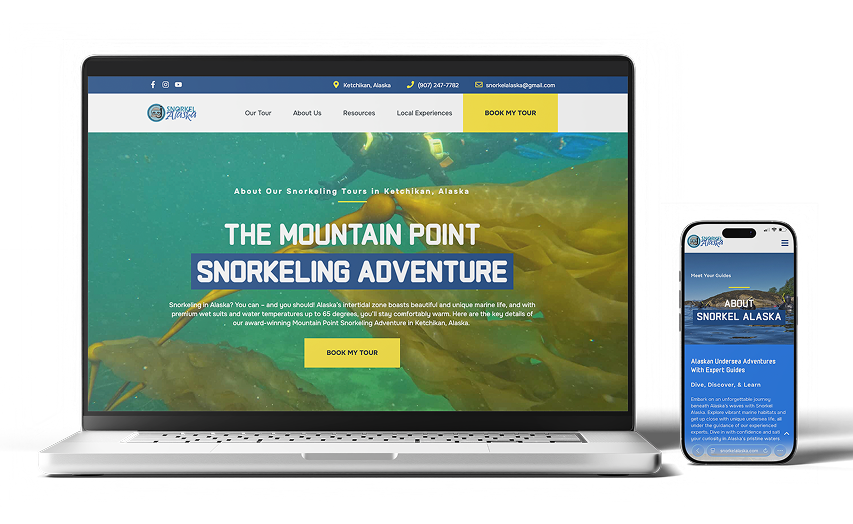
CASE STUDY
Decreased CPL
How We Helped a Local Adventure Business Increase Direct Bookings
We partnered with Snorkel Alaska to redesign their website and implement a targeted paid ads strategy, significantly increasing engagement and direct sales.
The new UX and compelling visuals boosted time on site by 112%, sales by 74%, and lowered cost-per-lead by 48%
Putting in the Work but Not Seeing Results? Let’s Change That
The owners of Beacon Media + Marketing, Adrienne Wilkerson and Ken Okonek, love working with small businesses because they believe in people over profit, and in helping to build the foundations that help stabilize growing communities. Having owned and then worked with various small businesses in a wide range of industries, they understand their profound impact on local economies and the lives they touch.
For Adrienne and Ken, marketing isn’t about chasing waves or reacting to every new trend. It’s about helping strong businesses stay visible and grounded as AI reshapes how customers discover and choose who to trust. When small businesses thrive, communities grow stronger. Local economies stabilize. Families are supported. That ripple effect is why we do what we do at Beacon; to provide steady guidance, smart strategy, and the kind of partnership that helps businesses navigate any course.
Our Specialized Small Business Marketing Services
Small Business Web Design
Launch a strategic website that builds trust and steers visitors toward action.
Small Business SEO + AIO
Small Business Social Media
Small Business PPC Ads
Set your small business ad strategy on course to drive leads and conversions.
Small Business Branding
Small Business Content Marketing
Help Your Small Business Stay Visible, Competitive, and Growing
Your website should evolve alongside your business and the way customers search. We continuously refine your content, strengthen your online presence, and improve your visibility across Google and AI-powered search platforms so more of the right customers can find—and choose—your business.
AI-Ready Content
We continuously update your website with relevant, customer-focused content that helps improve visibility in both traditional search engines and AI-powered search experiences.
Small Business SEO + GEO
Better User Experience
Clear navigation, thoughtful page organization, and intuitive user journeys help visitors quickly find what they need and take the next step.
Customer-Focused Messaging
We refine your existing content to answer the questions your customers are asking, helping build trust before they ever contact your business.
Stronger Local Visibility
From your service pages to your location information, we optimize your website to strengthen your presence where local customers are searching.
Trust & Credibility
Your website should reinforce why customers should choose you. We optimize your content to highlight your expertise, reputation, and unique value.
Climb Aboard With a Customized Marketing Plan
Are you ready to take your mental or behavioral health practice to its next stage of growth? Let’s partner up and build a strategy that gets you there now.
What Our Clients Say About Us
“Thank you, Beacon, for being the partner that we needed to growth and scale our practice. Michelle and the Team at Beacon have provided guidance and direction along with incredible results.”

Elisabeth Gulotta
NYC Therapeutic Wellness
“We are so thrilled with the content calendar, training, quality of writing, and responsiveness of your team. The results speak for themselves. We couldn’t be more happy. Thank you!”

Miranda Barker, Executive Producer
Ellie Mental Health
“The flexibility and patience with the onboarding process were exceptional. Everything has turned out so much better than I even imagined. I’m so thrilled with the growth.”

Christina Zampitella, Psy.D., FT
Center for Grief & Trauma
“The new website has streamlined intakes through the new layout and SEO plan, which has been fantastic. Intakes have increased dramatically and overall much more consistent and retention has been pretty high as a result.”

Meghan McArville, MA, LMFT
Holistic CFT
“The Beacon Media + Marketing team was the perfect choice for our small non-profit. They listened to our vision and helped craft an outstanding message that we’re proud of.”

Ali Tolman
Let Every Woman Know–Alaska
“The team at Beacon is amazing! They are able to transfer the heart and personality of our business into their marketing. They listen and respect any concerns. Our business even during the pandemic has grown thanks to Beacon Marketing! Highly recommend this company!”

Dr. Robin Ridinger
Premier Health & Holistic Medicine
“Beacon Media + Marketing has far exceeded our expectations with this campaign and in bringing our efforts in the community to light. We have received positive results and reactions from community members and more importantly, a significant increase in our fundraising efforts for these important causes.”

Michelle Engelke
Denali Express Chevron Network
“I love the website soooo much! Please make sure your team knows how incredible of a job they did! It’s wildly impressive and I’m thrilled that it’s for the CCC – ahhhh! Absolutely amazing! The design, the intuitiveness, the content, everything. I can tell how much work went into it and I couldn’t be happier!”

Janelle Anderson, Founder
Collective Care Counselling

Explore Our Insights
Take a closer look at the tools, tips, and strategies that help your practice grow with confidence.
There’s a version of mental and behavioral health marketing that makes perfect logical sense and produces mediocre results.
It goes like this: build a website, run some Google Ads targeting “therapist near me,” maintain a Psychology Today profile, and wait for motivated, ready-to-book patients to show up. That infrastructure captures demand at the moment of peak intent. And for a busy practice riding a favorable season, it can look like it’s working just fine.
But it’s only reaching one slice of the available patient population. And it’s almost certainly ignoring the larger, quieter group of people who will become patients eventually, given the right nudges at the right moments, but who aren’t captured by any of those channels because they’re not ready yet.
That’s the core problem. Most practices are marketing to the wrong patient, the one who’s already decided and is actively searching, while the much larger group of people who are somewhere earlier in the journey keep scrolling past without finding anything that speaks to them.
Not sure which patients your marketing is actually reaching? Connect with Beacon today and let’s take an honest look at who’s finding your practice and who isn’t.
Key Notes:
- Most practice marketing targets only the bottom-of-funnel patient who is ready to book right now, ignoring the larger population who will become patients eventually with the right support.
- The “wrong time” problem is just as significant as the “wrong patient” one. A summer marketing strategy that mirrors a September one is missing where patients actually are in their journey right now.
- NAMI’s 2025 public perspectives poll found that a significant portion of people who want mental health care aren’t getting it, and barriers to access, not lack of demand, are the primary reason.
- Top-of-funnel marketing that reaches patients before they’re ready to book builds the familiarity and trust that makes them choose your practice when they finally are ready.
- Matching marketing content and channel strategy to where patients actually are in their journey, not where you wish they were, is the most important shift most practices can make.
Who Is the “Wrong Patient” That Most Practices Are Marketing To?
Not wrong in the sense of being a bad patient. Wrong in the sense of being only one type of patient, the rarest and most immediately actionable one, while the larger and more buildable audience goes entirely unaddressed.
The patient most mental and behavioral health marketing is designed for is someone who has already decided they need therapy, is actively searching for a provider right now, has insurance they understand and are ready to use, and is prepared to book within days of finding the right practice.
That person exists. And they’re valuable. But they represent a fraction of the total population of people who could eventually become patients.
NAMI’s 2025 Poll of Public Perspectives on the U.S. Mental Health Care System found that a significant portion of Americans who want mental health care aren’t getting it, and the barriers are primarily informational, financial, and access-related rather than motivational. These are people who want help and aren’t finding it easily. Some of them are quietly researching practices like yours right now, at a stage of their journey where your current marketing has nothing to say to them.
The larger audience, the one most practices are ignoring, includes:
- People who are aware they’re struggling but haven’t yet connected that awareness to a need for professional support
- People who have decided they need therapy but are still in the research and evaluation phase weeks before they’re ready to book
- People who started the search and got discouraged by cost uncertainty, generic profiles, or slow responses, and quietly put it on hold
- People who tried therapy before and had a mixed experience, and need to rebuild confidence in the process before they’ll try again
Each of these groups is reachable. But not with the same content, channels, or messaging that reaches the ready-to-book patient.
What Does the “Wrong Time” Problem Look Like in Practice Marketing?
It looks like a practice running the same marketing strategy in July that it runs in October, without accounting for the fact that patient behavior is fundamentally different in each of those months.
October patients are often ready to act. They’re back in routine. The insurance window is open. The seasonal mood shift has arrived. The urgency is real and the motivation is high. Marketing that emphasizes booking, availability, and call-to-action messaging works well at this moment because the patient’s internal state matches it.
July patients are often still in motion. They’re aware of what they’re feeling but haven’t necessarily committed to acting on it yet. Summer schedules are disrupted. The urgency feels slightly lower. And the marketing content that would actually move them isn’t “book now.” It’s “here’s something that names what you’re going through” or “here’s how to know if therapy is right for you.”
Running October marketing in July doesn’t just fail to convert July patients. It misses the opportunity to build the familiarity and trust that makes them choose your practice in October.
The right time problem shows up in:
- Running conversion-focused paid ads during low-intent periods when the audience is in a research mindset rather than a booking mindset, producing higher cost-per-lead and lower conversion rates
- Publishing service-promotion content in summer when educational and awareness-building content would reach a larger and more receptive audience at the stage they’re actually in
- Focusing social media on booking CTAs during months when the same audience would be better served by content that validates their experience and builds familiarity with the practice
- Treating every month identically in terms of content strategy rather than adjusting messaging and channel emphasis to match where the patient population is in its seasonal journey
| Patient Type | Where They Are in the Journey | What They Need From Your Marketing | Channels That Reach Them |
|---|---|---|---|
| Pre-aware patient | Struggling but hasn’t connected it to a need for therapy | Content that names their experience without requiring them to self-identify as needing help | Social media, blog content, community presence, AI search |
| Considering patient | Thinking about therapy but not yet committed to acting | Validation, education, destigmatization, low-pressure information | Blog, social media, email nurture, Reddit-optimized content |
| Researching patient | Actively evaluating practices but not ready to book | Specific bios, clear specialty content, social proof, cost transparency | Website, directories, Google Business Profile, reviews |
| Ready-to-book patient | Motivated to act now; looking for the right practice to contact | Clear call to action, frictionless contact experience, fast response | Paid search, directory listings, contact page, online booking |
| Lapsed patient | Previously sought care; paused or stopped; potentially ready to return | Warm re-engagement, low-pressure outreach, reminder that help is still available | Email outreach, social media, direct referral follow-up |
How Does Getting the Patient Wrong Affect the Return on Every Marketing Dollar?
Significantly, and in ways that are hard to see because the wrong-patient problem is invisible in most analytics dashboards.
A Google Ad reaching a ready-to-book patient is efficient. A Google Ad reaching a pre-aware patient who isn’t ready to book produces an impression, maybe a click, and then nothing measurable, making it look like a failed ad rather than what it actually is: a touchpoint with someone who isn’t in the right stage for that channel yet.
The problem isn’t necessarily the channel. It’s the mismatch between what the channel delivers and what the patient at that stage actually needs.
When a practice overinvests in bottom-of-funnel channels and underinvests in top and middle-funnel presence, several things happen:
- Cost per lead rises as the practice competes with other bottom-funnel advertisers for a limited pool of ready-to-book patients, while the larger pre-ready audience goes unreached
- Brand familiarity stays low for the patients who will eventually be ready, meaning the practice has to work harder and spend more to acquire them when they do become ready-to-book
- Referral quality suffers because top-of-funnel content, social media, educational blog posts, and community presence are the primary drivers of word-of-mouth and organic referral activity
- Seasonal volatility increases because a practice that only markets to ready-to-book patients has no buffer of warmed-up prospects when seasonal demand dips
What Does Correct Patient Targeting Look Like Across the Full Journey?
It looks like a practice that shows up differently depending on where in the journey a patient is, rather than presenting the same “book an appointment” message to everyone regardless of their readiness.
For the pre-aware patient, it means publishing educational content that meets people at the symptom or experience level before they’ve connected it to a need for therapy. Blog posts, social media content, and community-visible presence that names what people are going through without immediately pivoting to a sales message.
For the considering and researching patient, it means the content and presence that builds familiarity, trust, and specialty confidence over the weeks or months they spend evaluating whether therapy is right for them and whether your practice is the right one. Clinician bios, specialty pages, reviews, and FAQ content all serve this audience specifically.
For the ready-to-book patient, it means the frictionless, fast, warm intake experience that converts motivation into an appointment before the window closes. Paid advertising, directory presence, and contact page optimization serve this stage.
And for the lapsed patient, it means the proactive, low-pressure outreach that reminds someone who had a positive experience with the practice that help is still available whenever they’re ready to return.
Getting this right requires a marketing strategy that’s designed around the patient journey rather than around the practice’s operational convenience. Our marketing strategy team helps mental and behavioral health practices build exactly this kind of journey-aware approach, matching content, channel, and messaging to the patient’s actual stage rather than the practice’s preferred one.
Why Is Summer the Right Season to Fix a Patient Targeting Mismatch?
Because summer itself is a patient targeting problem hiding in plain sight.
When a practice runs the same marketing in July that it runs in October, it’s treating July patients as if they were October patients. But they’re not. July patients are more likely to be in the pre-aware or considering stage. They have more time to browse and reflect but less urgency to act. And the marketing that would actually move them, educational content, social media presence, community visibility, is precisely the marketing that most practices deprioritize during slower months.
The result is a slow season that produces almost no pipeline for fall, not because the patients weren’t out there, but because the marketing was speaking to the wrong version of them at the wrong moment in their journey.
Fixing the timing mismatch in summer means:
- Shifting content emphasis toward awareness and education rather than conversion and booking during months when most of the available audience is in the earlier stages
- Adjusting paid advertising strategy to either reach earlier-stage patients through broader targeting or reduce bottom-funnel spend during genuinely low-intent periods
- Building the top and middle-funnel presence that creates a warm audience of familiar, trusting prospects ready to convert when fall routine and motivation returns
Our paid advertising team helps practices make these seasonal adjustments strategically, so every marketing dollar is working appropriately for the patient stage and season rather than running on a setting that made sense six months ago.
What Should a Practice Do Right Now to Make Sure It’s Reaching the Right Patients?
Start by mapping your current marketing activity against the patient journey table above and asking honestly which patient stages each piece of it is designed to reach.
If almost everything maps to the ready-to-book stage, you have a targeting concentration problem. Not a crisis, but a significant gap that’s leaving the larger, buildable audience underserved and leaving your fall pipeline thinner than it needs to be.
The fix doesn’t require abandoning what’s working at the bottom of the funnel. It requires adding the top and middle-funnel presence that most practices have been deferring because it doesn’t produce immediate bookings.
- Identify one content format that would reach pre-aware or considering patients, a blog post series, a social media content plan, or a community outreach effort, and commit to building it this summer
- Review your paid advertising targeting and ask whether the audience settings match the patient stage you’re trying to reach, or whether you’re paying to reach ready-to-book patients who would have found you anyway
- Audit your summer content calendar for whether it’s speaking to where your patients actually are in July and August, or where you wish they were
The patients your practice needs this fall are being marketed to right now, by someone. Make sure some of that marketing is yours, aimed at the right version of them, in the right places, at the right moment in their journey.
The right patient at the wrong time is still a missed opportunity. Make sure your marketing is reaching the right people at every stage, not just the ones who are already ready to book.
Reach out to Beacon today, and let’s build a patient targeting strategy that works across the full journey, not just the final step.
The decision to seek therapy feels like it should be the hard part. And for most people, it is.
But what comes after that decision is its own kind of difficult. It’s a process that’s messier, longer, and more emotionally loaded than most mental and behavioral health practices have designed their marketing to support. And understanding it, really understanding what a person goes through between “I think I need help” and “I have my first appointment scheduled,” changes everything about how a practice should be showing up online.
As the APA notes in its guidance on understanding psychotherapy, once someone decides to pursue therapy, the immediate next challenge is finding the right psychologist or therapist. That search process is where most of the journey happens. And it’s where most practices either support the patient or quietly lose them.
Want to make sure your practice is supporting patients through every stage of the post-decision journey? Reach out to Beacon and let’s look at what that journey looks like for your patients right now.
Easy Guide:
- The decision to seek therapy is the beginning, not the end. What follows is a nonlinear research and evaluation process that can take days, weeks, or months depending on the barriers a patient encounters.
- Most patients evaluate multiple practices simultaneously, comparing bios, reviews, specialties, and cost information across several providers before choosing one to contact.
- The post-decision journey has predictable dropout points where patients abandon the search, and each one maps directly to a gap in a practice’s marketing or intake experience.
- Summer is when many patients begin this journey in a low-urgency way that won’t convert to a booking until fall routines return, making now the right time to be visible and reassuring at every stage.
- The practices that support the post-decision journey most effectively don’t just attract patients. They hold their attention through a process that tests every hesitant person’s resolve.
Why Is the Post-Decision Journey So Much Harder Than the Decision Itself?
Because the decision is internal and the journey is external, and the external world is full of friction.
Inside a person’s head, the decision can feel clean and resolved. “I’m going to find a therapist.” But the moment they open a browser and start the actual process, they encounter a landscape that’s confusing, inconsistent, and often emotionally exhausting to navigate.
They find dozens of profiles on Psychology Today with varying amounts of information. They visit practice websites that look similar but feel different in ways they can’t quite articulate. They try to figure out insurance coverage and hit a wall. They read bios that don’t tell them what they actually need to know. They come close to reaching out to someone and then second-guess themselves and start the search over.
The post-decision journey is where many people quietly give up, not because they changed their minds about needing help, but because the system made finding it too hard.
That’s the gap a practice’s marketing either fills or widens. And understanding the specific stages of that journey is the first step to filling it well.
What Does the Search Phase of the Post-Decision Journey Actually Look Like?
Chaotic, multi-platform, and emotionally taxing in ways that don’t show up in any analytics dashboard.
A person who has decided to find a therapist typically begins with some version of a Google search. But that search rarely produces a clear answer. It produces a list of options, each of which requires more investigation, and the investigation itself requires emotional energy that the person may be in short supply of precisely because they need therapy.
The search phase in 2026 often involves:
- Multiple platform visits in a single session, including Google, Psychology Today, a practice website, back to Google, a directory comparison, and possibly an AI tool to help narrow the options
- Repeated returns to the same profiles over several days or weeks as the person moves closer to a decision and comes back to re-evaluate what they saw the first time
- Parallel evaluation of two to five practices simultaneously, with the comparison happening informally in the patient’s mind rather than through any structured process
- Periods of abandonment and re-engagement, where the person gets close to reaching out, pulls back due to uncertainty or anxiety, and returns days later to try again
- Emotional fatigue from the process itself, which is why practices that make evaluation easier, through clear specialty language, transparent cost information, and warm human bios, consistently outperform those that require more effort from the patient
Where Do Patients Most Commonly Drop Off After Deciding to Seek Therapy?
At predictable points that most practices have never mapped and therefore never addressed.
Understanding where patients exit the post-decision journey, and why, is the most actionable insight a practice can take from thinking about this process carefully.
The most common dropout points:
- The insurance and cost wall. A patient who can’t quickly determine whether a practice accepts their insurance or what they’d pay out of pocket frequently abandons the search entirely rather than calling to ask. This is especially common among patients who are already anxious about the financial commitment of ongoing therapy.
- The generic bio moment. A clinician bio that lists credentials and a generic set of presenting issues without conveying any real sense of personality or specialty depth gives the patient nothing to hold onto. Nothing that makes them think “this person understands what I’m going through.” And without that moment of recognition, motivation to reach out weakens.
- The unanswered email or slow response. A patient who finally works up the courage to submit a contact form and doesn’t hear back within a reasonable timeframe often interprets the silence as rejection or disinterest. Many never follow up. They start the search over, or they stop entirely.
- The overwhelming first contact form. An intake form that asks for diagnosis history, insurance information, emergency contacts, and a detailed description of presenting issues before the patient has had any human contact with the practice asks for a level of vulnerability that many patients aren’t ready to give to a stranger. A significant percentage simply close the tab.
- The “this probably won’t work for me” moment. This is the subtlest dropout point and the hardest to address. It happens when a patient reads through a website or directory profile and nothing specifically speaks to their situation. Not because the practice can’t help them, but because the practice’s content isn’t specific enough to make them feel seen.
| Post-Decision Stage | What’s Happening | Common Dropout Trigger | How a Practice Can Help |
|---|---|---|---|
| Initial search | Patient is scanning multiple options across platforms | Practice doesn’t appear in search results or directory filters | SEO optimization; complete directory profiles; specialty-specific content |
| First impression | Patient lands on website or directory profile for the first time | Generic or outdated presence fails to create a moment of recognition | Warm, specific homepage copy; recent photos; human-feeling design |
| Evaluation | Patient reads bios, reviews, and specialty pages in detail | Credential lists without personality; stale reviews; vague specialties | Human bios; specific specialty pages; consistent fresh review presence |
| Cost and logistics check | Patient tries to determine if care is accessible and affordable | No insurance information; no fee range; no telehealth clarity | Proactive FAQ page covering cost, insurance, and telehealth availability |
| Decision to contact | Patient is ready to reach out but hasn’t yet | Contact page is hard to find; form is too long; no online booking | Prominent contact CTA; short initial form; online booking option |
| Post-contact wait | Patient is waiting to hear back after reaching out | Slow or generic response; silence erodes the courage it took to reach out | Immediate warm confirmation; same-day or next-business-day response standard |
Why Does Summer Create a Specific Version of This Journey Worth Understanding?
Because the post-decision journey in summer often runs slower and quieter than it does during peak demand seasons.
Many people who decide in July that they need therapy don’t book an appointment in July. Summer schedules, vacation disruptions, and the general sense of “I’ll get to this when things settle down” push the active search into August or September. But the journey itself has already started.
They’re researching. They’re bookmarking practices. They’re reading bios and coming back to them. They’re building familiarity with names and faces and approaches that will influence which practice they contact when September finally arrives and the routine returns that makes booking feel possible.
The practices that are visible, current, and human during this quiet summer research phase are the ones that already have a relationship with these patients by the time they’re ready to act. And that head start, earned through consistent summer presence rather than a September marketing push, is one of the most durable competitive advantages available to a mental and behavioral health practice.
What Does Supporting the Post-Decision Journey Actually Look Like in Practice?
It looks like designing every patient-facing touchpoint with the post-decision traveler in mind rather than the ready-to-book patient.
Those are different people in different emotional states with different needs. The ready-to-book patient needs a frictionless contact experience. The post-decision traveler needs recognition, clarity, reassurance, and the repeated sense that this practice might actually be the right one, sustained across multiple encounters over potentially weeks.
Supporting the post-decision journey means:
- Publishing content that speaks to the experience of searching, not just the experience of being in therapy, because the post-decision traveler is still in the search and they need to feel seen at that stage specifically
- Designing bios and specialty pages to create moments of recognition for patients who are comparing multiple practices and need something to make this one feel distinctly right for their situation
- Making cost and logistics information immediately accessible so the practical questions that stop post-decision travelers in their tracks don’t become reasons to abandon the search
- Maintaining consistent, active presence across every platform a patient might return to during the multi-visit evaluation process, because the practice that looks current and attentive on every return visit is the one that builds confidence through repetition
A strong content marketing strategy is designed around exactly this kind of patient-centered thinking, building a presence that meets people wherever they are in the post-decision journey and gives them every reason to keep moving toward a booked appointment rather than abandoning the search.
What Is the Most Important Thing a Practice Can Change Right Now to Better Support This Journey?
Pick the dropout point that’s costing them the most patients and fix it before fall.
Not every practice has the same weakness. Some lose patients at the insurance and cost wall. Others lose them to generic bios. Others lose them to slow responses after first contact. The most important thing is identifying which dropout point is doing the most damage, not trying to address all of them at once and doing none of them well.
Start by asking: where in the post-decision journey do my inquiries most often go quiet? If patients are finding the practice but not reaching out, the problem is in the evaluation phase. If they’re reaching out but not converting to appointments, the problem is in the post-contact phase. If they’re not finding the practice at all, the problem is in the search phase.
Each diagnosis points to a specific set of fixes. And summer, with its quieter schedule and broader bandwidth for this kind of strategic thinking, is the right window to make them. Our strategy team helps mental and behavioral health practices map the full post-decision journey, identify the highest-impact dropout points, and build the content and systems that support patients all the way through to a booked appointment.
The patients who need your practice are out there right now, somewhere in this journey.
Make sure your practice is meeting them at every stage of it. Reach out to Beacon today and let’s build the presence that supports the full post-decision journey, not just the final step.
By the time a patient fills out your contact form, they’ve already done a lot of work.
They’ve searched, scrolled, compared, and second-guessed. They’ve read things they weren’t sure applied to them, looked at clinicians they weren’t sure they’d feel comfortable with, and wrestled with questions they weren’t even entirely sure how to ask.
The contact form submission isn’t the beginning of the patient journey. It’s the end of a long internal process that your practice either supported or made harder at every step along the way.
Understanding what questions patients are trying to answer during that process, and where they’re looking for the answers, is one of the most practically useful things a mental and behavioral health practice can apply to how it shows up online. And a slower summer season is the ideal window to make sure those answers are visible, clear, and warm in all the right places.
Not sure if your practice is answering the questions patients are actually asking? Reach out to Beacon today and let’s find out together.
Key Notes:
- Patients are asking practical questions first: cost, insurance, availability, and telehealth options, before any clinical evaluation begins.
- They’re asking whether your practice is actually right for their specific situation, not whether therapy in general might help them.
- They’re asking whether it will be safe to be vulnerable with the people who work at your practice, and that question is answered almost entirely through tone and presence rather than credentials.
- They’re asking what happens next, and unanswered uncertainty about the first session process is one of the most common reasons motivated patients don’t follow through.
- Most practices answer very few of these questions proactively, and every unanswered one is a reason for a hesitant patient to delay rather than act.
Why Do Pre-Contact Questions Matter So Much for Practice Marketing?
Because the contact form isn’t where patients decide, it’s where they confirm a decision they already made.
The actual decision, whether to reach out to this specific practice rather than continuing to look, happens earlier and quieter. It happens in the accumulation of small moments: reading a bio that felt like a real person wrote it, finding an answer to a cost question they were too embarrassed to ask by phone, seeing a review that described an experience similar to their own.
According to the APA Monitor, 80% of patients who couldn’t access mental health care cited cost as a primary barrier, and more than 60% cited shame and stigma. Both of those barriers operate as questions, “Can I afford this?” and “Will I be judged for needing this?”, that patients are actively trying to answer before they reach out. And both can be addressed proactively through a practice’s online presence.
The practices that answer the most questions clearly and warmly before a patient ever makes contact are the ones that convert the most motivated browsers into booked appointments.
What Practical Questions Are Patients Trying to Answer First?
The practical questions almost always come before the clinical ones. They’re the filters a patient runs through to determine whether pursuing this practice is even logistically possible before they invest emotional energy in evaluating whether it’s the right fit.
And they’re the questions most practices leave unanswered on their websites.
The most common practical pre-contact questions:
- “Do you accept my insurance?” This is often the very first filter, and it’s frequently the hardest to answer from a practice website. Patients who can’t find clear insurance information either call to ask, which many won’t do before they’ve established any connection, or assume the answer is no and move on.
- “How much does a session cost, and do you have a sliding scale?” Cost ambiguity is one of the most consistent reasons motivated patients don’t follow through. A practice that addresses this proactively, even with a range rather than a fixed number, removes a significant barrier before it becomes a reason to stop.
- “Do you offer telehealth, and how does that work?” For a growing segment of patients, telehealth availability isn’t a preference. It’s a prerequisite. Practices that don’t address this clearly lose these patients at the first filter.
- “How quickly can I get an appointment?” Wait time matters enormously to someone who has finally worked up the courage to seek help. If a practice’s website gives no indication of current availability, patients frequently assume the wait will be too long and look elsewhere.
- “Where are you located, and is there parking?” Simple logistical questions that create disproportionate friction when left unanswered, especially for patients whose anxiety is already heightened by the decision to seek care.
What Clinical and Fit Questions Do Patients Research Before Reaching Out?
Once the practical filters are cleared, patients move into the more personal and emotionally loaded territory of fit evaluation. This is where the question shifts from “can I access this practice?” to “is this practice actually right for me?”
And this is where the quality of a practice’s content and clinician presence does its most important work.
The most common clinical and fit pre-contact questions:
- “Do you treat what I’m dealing with?” Patients are increasingly specific in their self-identification of presenting issues, particularly younger patients who have been exposed to significant mental health literacy content through social media and online resources. A practice that lists only broad categories like “anxiety and depression” without deeper specialty content misses the patient who is specifically looking for someone with experience in ADHD in adults, postpartum anxiety, or trauma from a specific context.
- “What therapy approach do you use, and will it work for my situation?” Patients research modalities now. CBT, DBT, EMDR, somatic therapy, and others have become part of the vocabulary of mental health awareness, and patients frequently search for practices that offer a specific approach they’ve read about.
- “Are you licensed and experienced enough to help me?” Credential transparency, including license type, years of practice, and any specialized training, answers this question before a patient has to ask it explicitly.
- “Is there a clinician here who would understand my background or identity?” Questions of cultural competency, identity affirmation, and shared lived experience are increasingly central to how patients evaluate fit, particularly for those from communities that have historically experienced healthcare disparities.
| Question Category | Specific Questions Patients Ask | Where They Look for Answers | How to Answer Proactively |
|---|---|---|---|
| Practical / Logistical | Insurance, cost, telehealth, availability, location | Website, Google Business Profile, directory listings | Add a clear fees and insurance FAQ page; state telehealth availability explicitly; show current scheduling options |
| Clinical / Specialty | Therapy approach, specialty experience, credentials, treatment timeline | Website service pages, clinician bios, blog content | Write dedicated specialty pages; include modality information in bios; publish educational content on specific approaches |
| Fit / Identity | Cultural competency, shared experience, identity affirmation, language | Clinician bios, social media, Psychology Today filters | Be explicit in bios about communities served and cultural competencies; reflect this in social content consistently |
| Safety / Stigma | “Will I be judged?”; “Is this confidential?”; “Is seeking help normal?” | Website tone and copy, social media content, blog posts | Write copy that normalizes help-seeking; address confidentiality explicitly; use non-pathologizing language throughout |
| Process / Next Steps | What happens at first session; how long therapy takes; what to bring | Website FAQ, “what to expect” pages, blog content | Add a dedicated “what to expect” page; write a first-session FAQ; describe the intake process in warm, clear terms |
| Social Proof | “Do other people like me have good experiences here?” | Google reviews, Healthgrades, Psychology Today, Reddit | Build consistent review cadence; respond to all reviews; encourage specific, descriptive patient feedback |
How Are Patients Finding Answers to These Questions in 2026?
Across more channels than most practices are actively managing, and through methods that have changed significantly in the past few years.
The traditional assumption was that patients would find a practice through Google, visit the website, and call with questions. That journey still exists, but it’s increasingly just one path among many.
Today’s patients are also:
- Asking AI tools like ChatGPT directly, typing questions like “what should I look for in a trauma therapist?” or “how do I know if a therapist takes my insurance?” and receiving curated, synthesized answers that may or may not surface your practice
- Reading Reddit threads in communities like r/therapy and r/mentalhealth where real patients describe their experiences finding and evaluating practices, looking for peer-validated answers to the questions they’re not comfortable asking a practice directly
- Watching social media content from clinicians who speak openly about their approaches and specialties, using those videos as a proxy for the kind of conversation they’d eventually want to have in a session
- Comparing directory profiles side by side, on Psychology Today, Healthgrades, and similar platforms, using the filters and information available there to narrow a list before visiting any individual practice’s website
The implication is clear: a practice that only optimizes its website for patient questions is missing the channels where a significant portion of pre-contact research now happens. A comprehensive SEO strategy for a mental and behavioral health practice in 2025 accounts for all of these channels, not just traditional search.
What Is the Most Commonly Unanswered Question That Costs Practices the Most Patients?
“What happens next?”
It sounds almost too simple. But the uncertainty about what actually happens after someone submits a contact form, calls the practice, or books an appointment is one of the most consistent invisible barriers to follow-through in mental and behavioral health.
A person who has finally decided to reach out is already managing a significant amount of emotional vulnerability. The last thing they need is to finish submitting a form and have no idea what comes next, when they’ll hear back, what that communication will look like, or what the first appointment will actually involve.
Practices that answer this question proactively, through a clear confirmation process, a warm automated acknowledgment that explains next steps, and a “what to expect” section on the website or contact page, convert at meaningfully higher rates than those that leave it to the patient’s imagination.
The fix is simple. Write out exactly what happens after someone reaches out. Publish it somewhere visible. Make it warm. And then make sure the actual experience matches what you described. That alignment between expectation and reality is itself a powerful trust signal that many practices overlook entirely.
What Should a Practice Do This Summer to Make Sure It’s Answering the Right Questions?
Start by making a list of every question you’ve ever been asked by a new patient before or during their first session. Then check your website and directory profiles to see how many of those questions are answered clearly, warmly, and without requiring the patient to call or email to find out.
The gaps between the questions patients ask and the answers your practice provides are your summer to-do list.
- Add or expand a FAQ page that covers cost, insurance, telehealth, wait times, first session expectations, and confidentiality in plain, warm language
- Review every clinician bio for whether it answers the fit and identity questions that patients are researching, including specialty specificity and any cultural competencies
- Check your social media content for whether it addresses the stigma and safety questions that prevent many patients from reaching out at all
- Audit your post-contact experience to make sure the “what happens next” question is answered clearly and warmly from the moment someone submits a form through their first session
Each answered question removes a reason to delay. And the practices that remove the most reasons to delay before fall demand returns are the ones that fill their schedules fastest when September arrives. Our paid advertising team helps practices reach patients at the exact moment they’re asking these questions, with content and campaigns designed to answer them directly and drive motivated patients to take the next step.
Your patients have questions. Make sure your practice has the answers, in the right places, before they look somewhere else.
Reach out to Beacon today and let’s audit what your practice is answering and what it’s leaving to chance.
Small Business Marketing FAQs
How can Beacon help my small business grow?
What marketing strategies work best for small businesses?
If this is the first time you’ve considered outsourcing your social media marketing to an agency, it’s understandable that you might have reservations. Maybe you fear that no one will be able to capture your industry like you can or that you’re going to spend a lot of money on marketing and never see a return on your investment.
Outsourcing your social media marketing to a digital marketing agency can be a game-changer for your healthcare business. Agencies have access to the team, resources, and tools to effectively manage your social media accounts, create compelling content, and implement a successful strategy that will help you achieve your marketing goals. With their experience and knowledge of industry best practices, you can efficiently and effectively gain a strategy tailored to your business needs.
When partnering with our expert team at Beacon Media + Marketing, you save valuable time that you can direct elsewhere – whether that be sales, processes, management, or serving clients directly.
How does Beacon help me compete with larger companies?
Our team at Beacon fully understands that AI has the potential to revolutionize social media marketing and content creation. By leveraging the power of AI, we can create more personalized, effective, and engaging content that resonates with our target audience. However, we recognize that AI is still in its early stages, and it’s important for us to use it responsibly and ethically. We believe that a human touch is still essential in creating authentic, relatable, and accurate social media content.
We view AI as a resourceful tool that can help us when we’re feeling stuck creatively or need a boost in motivation. By using AI to gather new ideas and insights, we can take inspiration and make it our own —like a brainstorming session but with the added benefits of data and analysis. Ultimately, our goal is to use AI as a tool to enhance our content creation process and improve our overall strategy, while maintaining the human element that makes our content unique and engaging.
Can Beacon help me get more local customers?
The Beacon team uses a variety of social media tools to help us create, manage, and optimize our social media presence. We use Canva, an easy-to-use design tool, to create high-quality graphics and images for our social media posts. Adobe Photoshop and Premiere are also essential tools we use for more advanced design and video editing tasks. For free stock photography, we turn to Unsplash, Pixabay, and Pexels.
Buzzsumo is a tool we use to conduct content research and track social media shares in our industry. We also rely on Answer the Public to identify questions and concerns our target audience may have and generate new topics and ideas for our social media posts. Linktree is another tool we use for managing multiple links in one place, while Sparktoro provides in-depth research on our target audience’s interests, demographics, and social media behaviors. Zubtitle is an excellent tool for adding subtitles to videos, and Grammarly ensures all punctuation and grammar are accurate in our content.
For data-driven insights and automation, we use Jasper.ai and Chat GBT. These tools assist us with social media management, content creation, and innovation. To create high-quality audio and video content that engages our audience, we turn to Descript. Loomly is our go-to scheduling platform, which allows us to save time, improve collaboration, and provide valuable insights and analytics on our social media content.
How long does it take to see small business marketing results?
While we’d love to tell you that we could help your business blow up tomorrow, the reality is that results don’t happen overnight. Building a strong social media presence takes time and consistent effort. Clients often have high expectations for immediate results, but at Beacon, we believe that it’s crucial to set realistic expectations from the outset. It’s for this reason we choose to be very transparent in what results we expect you’ll achieve and how long it should take to start reaching your marketing goals.
The first thing that we like to establish with new clients is defining what success means for you. Is it increased engagement? More followers? Form fills? Webinar sign-ups? Increased web traffic? Once we’ve taken time to learn your goals, we like to emphasize that social media is an organic marketing method, meaning that it is an ongoing process that requires consistent posting and a clear strategy to take off. It’s not a quick fix and will most likely not deliver an instant ROI – it’s a long-term investment.
It’s also key to understand that brand awareness is an essential component of social marketing, and if you’re a newer company or have a poor online presence, it can take time to build a loyal following. Consistently producing high-quality content and engaging with your audience is key to building brand awareness and establishing your business as an authority in your industry.
And while it does take time to see tangible results, we also like to emphasize that social media marketing is measurable and can provide significant value to your business over time! Regularly tracking metrics and making adjustments to the strategy based on the results is essential to achieving long-term success.