Explore insights on SEO, AI, and digital marketing strategies designed to help your business grow, stay visible, and adapt in a constantly evolving online landscape.
Marketing your pediatric therapy practice with the wrong strategy can feel like you’re just not getting through to people. Or worse, you’re met with outright rejection. Here’s the thing – promoting therapy services for children requires unique strategies when marketing to adults.
For one, your target audience is parents and caregivers, and that makes things a bit tricky. But growing your pediatric therapy practice doesn’t have to be difficult. Read on for some expert tips to help in your mental health marketing for pediatric practices.
Children’s toy companies seem to have it so much easier when it comes to marketing. Their products can easily be promoted on kids’ TV shows, displayed on the lowest shelves of store aisles, or seen with their friends at school. But when it comes to pediatric therapy services, you’re out of luck marketing to children.
So, does that mean your therapy practice is relegated to dusty doctor’s office pamphlets? Absolutely not. You just need to shift your focus to a not-so-obvious (at first) target audience: Parents and caregivers.
This “indirect” target audience is nothing new in the world of marketing. Think about it. Are senior care services talking to seniors? No, they focus on their adult children. Are Valentine’s Day gift commercials for you (the recipient) or are they meant to reach your significant other?
In the same way, parents, guardians, and other caregivers should be your main focus.
2) Go Where They Are
The easiest way to connect with your target audience is to show up in related areas that don’t compete with your practice. These spaces can be in-person or online, but the key is to leverage an existing audience that is more readily available than the one you can build on your own at this stage.
Parental Blogs, Podcasts, and Forums
Caregivers and guardians are constantly looking for advice and resources to guide them in raising children. If you’re able to use guest posts and other partnerships to boost your content marketing and PR, it can bring in many new clients. Why? Because there’s already an existing audience that trusts the authority of the person or platform. Be featured in their space, and you can instantly gain credibility.
Schools and Daycare Services
When kids aren’t at home with their parents or another caregiver, they’re at school or in daycare services. So, chances are, these adults interact with the children often and may even see a difference in behavior from home life. Partnering with these facilities provides a good opportunity to get new business from referrals.
Pediatric Hospitals & Doctor Offices
Similar to schools and daycares, medical centers interact with children in a different context. But there’s one key “advantage” here: hospitals and doctors’ offices are focused on healthcare. That includes behavioral and mental health as well. If a concerned parent brings their child in for an annual checkup, they are likely to bring up issues they’ve noticed. It isn’t rare for a child’s primary care doctor to recommend therapy as a solution, and they could very well recommend your pediatric practice. That is, if they know about your services. (Hint: that was an action item).
Camps and Recreational Activities
This strategy is repeated here also. While you’re unlikely to get direct therapy referrals from these places, they are where your target audience is at. It’s a smart move to figure out a way to get in front of their eyeballs!
3) Focus on (Search) Intention
Given the nature of your practice, it’s smart to target parents who are actively looking for answers to their children’s struggles. At least at first – once you grow our practice, you can broaden your scope. The idea of search intention is usually referring to the use of paid advertising. For instance, Facebook ads are often presented on your feed without you intentionally searching for that product or service. This can sound confusing because good ad targeting will result in you seeing highly relevant ads. (Think ads for baking tools in your feed because you read cooking blogs, like social media posts for baking, or place an order for a cake recipe’s ingredients.)
But no matter how relevant or timely these ads may seem, they don’t use search intention. You never went to Facebook, typed in “large whisk” and then expected to see a paid ad for that product – even if it was something you wanted to buy once you saw it.
Advertising with search intention is different. For example, if a water pipe bursts in your home, you might immediately Google “plumbers [city] [state]” or “fix water pipe near me.” In that case, you will be shown paid search result ads from companies in your area. And generally speaking, companies are more likely to get your business when they present themselves as the solution to a problem you were already searching for. That’s the power of search intention.
Likewise, it may help to use marketing strategies that focus on this for your pediatric practice. And while it’s not direct marketing/advertising, blog posts are a great way to bring visitors to your website based on search intention. For example, an informative post for someone searching “how much does children’s therapy cost?” could bring in traffic and more leads to your practice.
4) Target Values in Your Messaging
Perhaps this tip sounds obvious to you. But many practices in the health and wellness space, end up revolving their message around “shoulds.” You should be eating this instead of your favorite comfort food. You should be doing cardio 3-5x a week instead of watching the entire season on Netflix. You should be reading a book to keep your brain sharp or you should schedule that doctor’s appointment.
Are all of these positive, healthy things? Yes, but it ends up sounding like another chore of a to-do list, or worse a judgment. That’s why the key to successful messaging is to focus on parent/caregiver values, which would naturally lead to seeking therapy for their children if needed.
Here are a couple of examples of values:
Empathy: Most people are actively trying to be good parents to their kids. Show you understand the issues they may face, too.
Nurturing: Frame therapy as something to be proactive about as well as nurturing for a child’s well-being. In other words, change the notion that therapy is a last resort or only when problems get out of control.
What core values and emotions can you connect with in your marketing?
5) Reputation, Reputation, Reputation
Lastly, this is possibly one of the most important points in growing your pediatric therapy practice. While every business needs to maintain credibility and reputation, you will have to put more emphasis on it. Why? You’re asking parents to take a risk anytime they entrust you with their child’s care.
Even if a bad review is only a disgruntled parent or an unrelated comment like an insurance complaint, it can still damage your practice’s reputation. As you grow, these things will be less of a blow compared to your overall positive feedback and credibility. However, when you’re still scaling, you must be more vigilant in managing your therapy practice’s reputation.
Scaling Your Pediatric Therapy Practice with Beacon
From monthly blog posts and running ads to marketing strategy and web design, growing your therapy practice can feel overwhelming! That’s why we’re here to step in. You can sit back and relax while Beacon Media + Marketing launches your next successful mental health marketing campaign. Our team of experts knows exactly what to do reach your business goals, and we can’t wait to see your pediatric therapy practice thrive!
With mental health gaining awareness and being destigmatized, it’s never been easier to scale a psychotherapy practice. However, if you box mental health marketing into more traditional practices or even try and copy conventional health marketing, your results will fall flat.
Some businesses have cracked the code for marketing within this unique industry, and we want you to be next. We’re ready to help you take advantage of the increasing openness and acceptance surrounding mental health. Here are 7 expert tips to market your psychotherapy practice (with real examples!).
Don’t get us wrong. We absolutely value mental health and understand how critical psychotherapy is to a person’s well-being. And while it has made tons of headway even in the last decade, many people don’t place mental health on the same level as physical health or conditions.
Mental health is often placed on the back burner when life gets in the way – if it was remembered in the first place. Our point here is that you must meet your target audience where they are in their perceptions first – then you can change minds (literally) after clients get their foot in the door.
2) Find Your Niche
One thing you already understand about mental health is that it’s never a surface-level issue. Therefore, people will get the most benefit when their unique struggles are addressed with full understanding and expertise. Translation: if a potential client can find the exact info or help needed in a first-page, generic article on Google, you need to dive deeper.
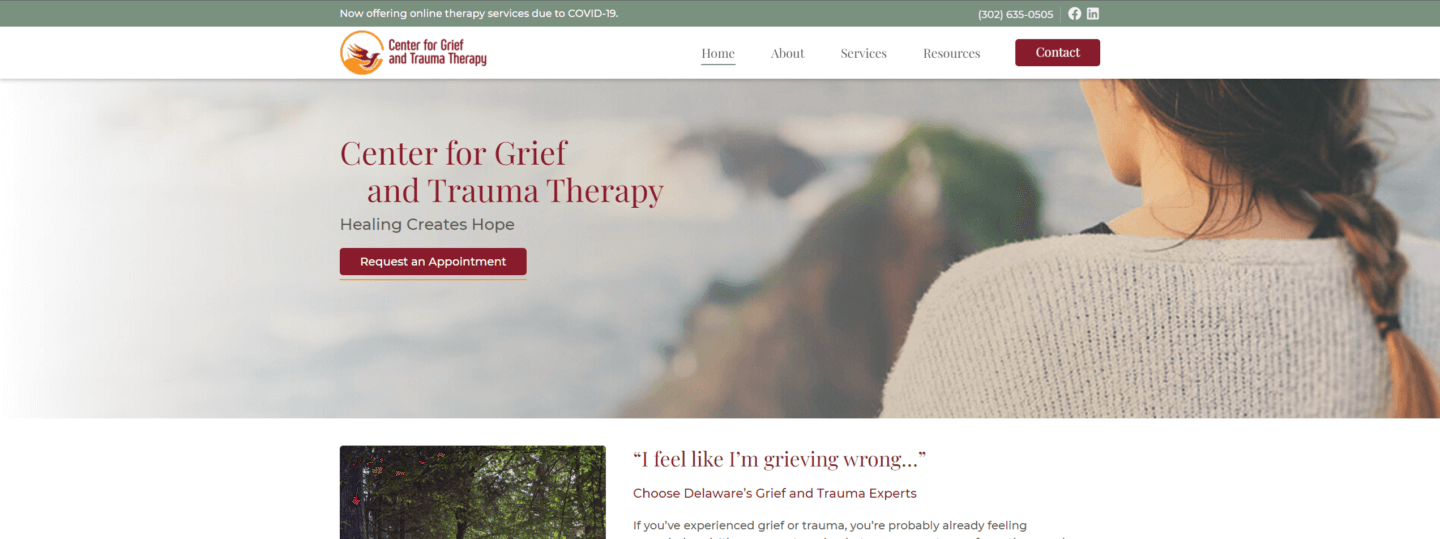
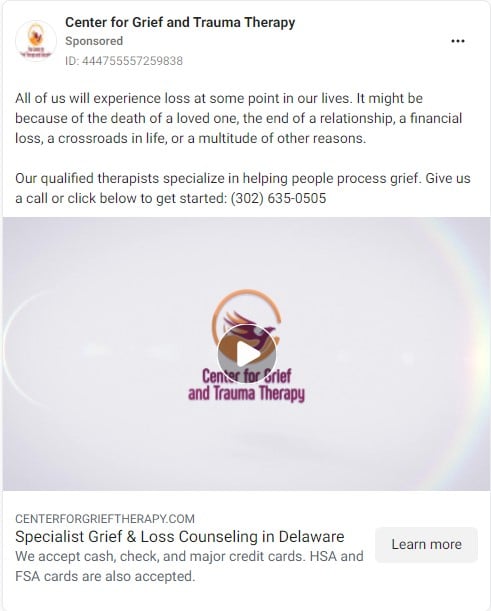
The Center for Grief and Trauma has marketed their psychotherapy practice successfully by going all-in on a specific niche. You could consider doing the same to really see marketing growth! And before you ask – no, you won’t run out of potential clients or pigeonhole yourself out of business by niching down.
However, we understand how it might feel that way at first. If this is one of your main concerns, then it might be helpful to consider a tried-and-true example: your favorite restaurant!
We’re willing to bet that your first-choice restaurant specializes in a certain cuisine. So, consider this. Does a top-tier Indian restaurant worry about missing out on the people who are looking for a $5 burrito? Does the local vegan spot stress about going out of business because of the BBQ restaurant next door? No, because they have confidence in their niche, and work on being the best at serving their ideal customers. So, where can you provide the most value in your psychotherapy practice? Chances are, you can dive deeper than “mental health.”
3) Show Your Expertise
Anyone can make claims – whether it’s in marketing or education. The Lukin Center for Psychotherapy backs up their educational resources and mental health services using scientific evidence, research, and proven practices.
They claim the tagline “Driven by science, led by compassion” as a brilliant summarization of their value. Not only is it highly ethical for psychotherapeutic and psychiatric practices to offer research-validated treatment, but it also boosts their credibility with potential clients. As with any health service, reputation is crucial.
And while you don’t want to overwhelm your leads with too much information in your marketing, you don’t have to hold back when it comes to content or other resources. The most important thing is to make it accessible and welcoming to people.
Don’t worry about your expertise going over your audience’s heads. Trust us, they can handle it. But in any case, you will appear as an authority in your space – who is expected to be more knowledgeable than the average joe!
4) Own Your Local Market
Yes, we know you’ve probably tip-toed (or even taken the plunge) into local SEO. But what we’re talking about here goes much deeper than that. If you’re located in a particularly unique area, connect with the culture of your city or town.
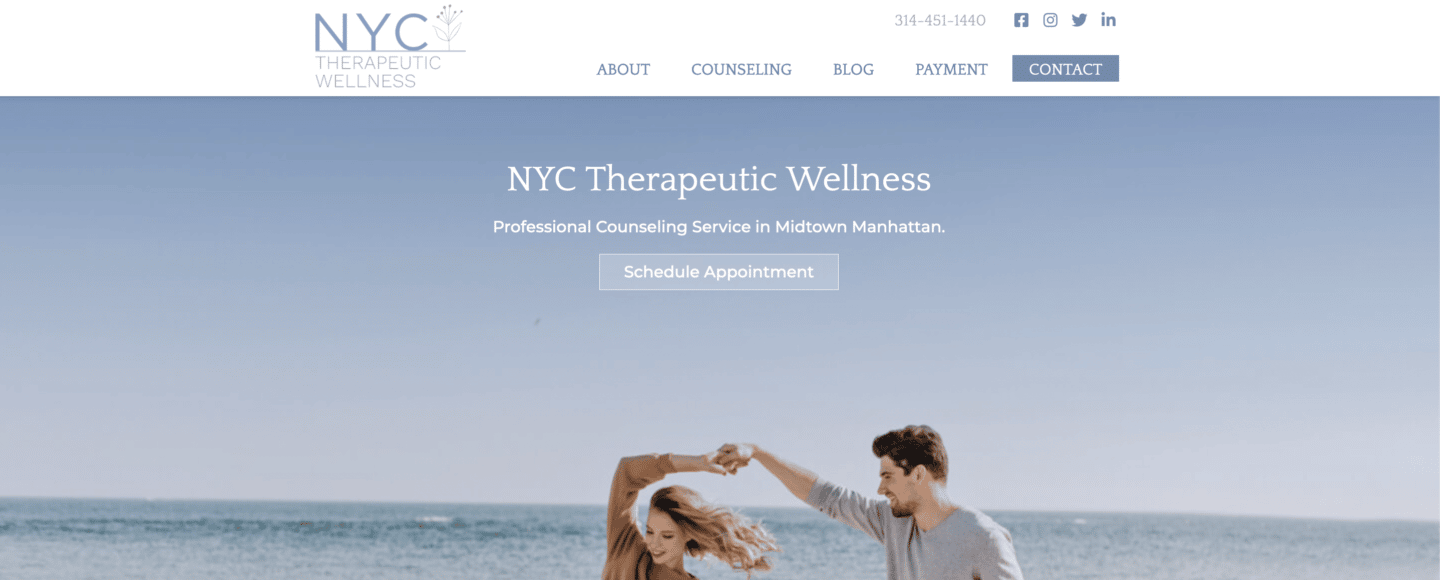
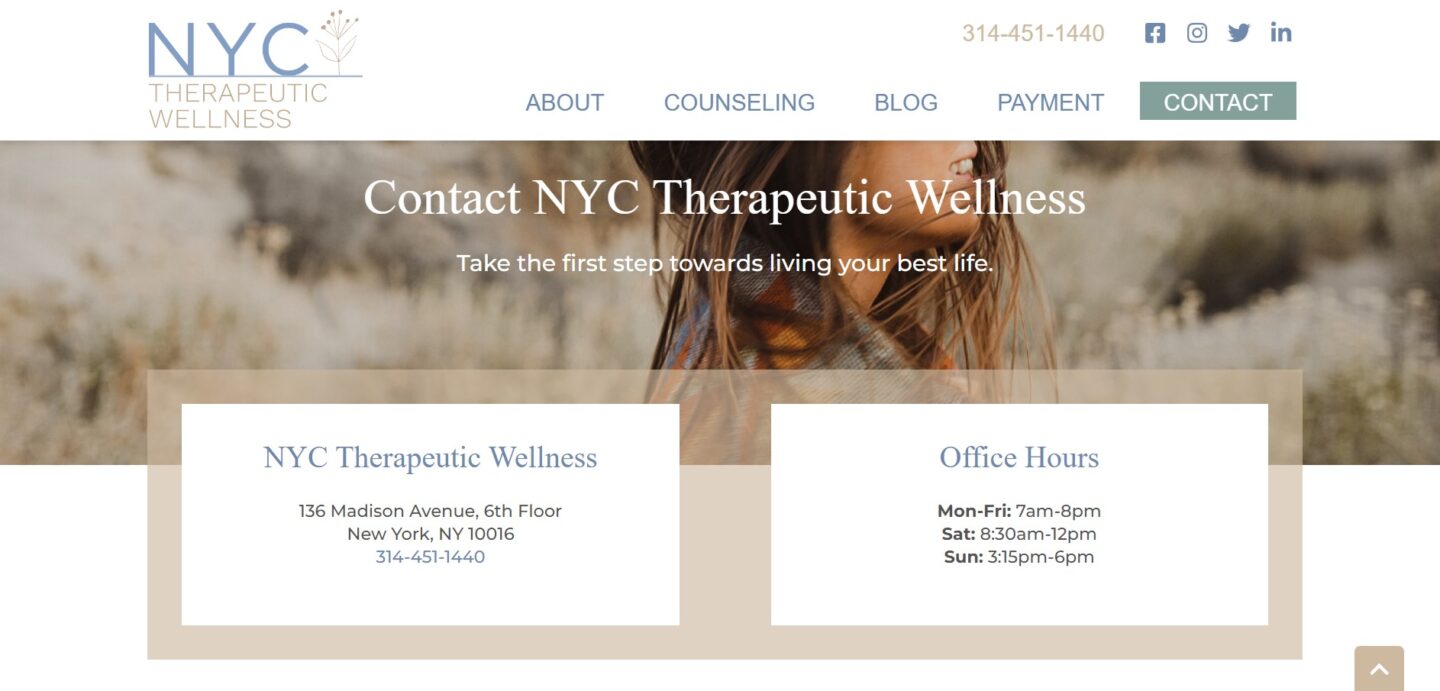
Based in Manhattan, NYC Therapeutic Wellness has capitalized and made the most of the New York City market. Even with the rise of virtual and online therapy options, many people still prefer to seek in-person counseling. If that is your primary service offering, be sure to invest in your practice’s location, interior environment, and targeted location-based advertising.
There is always an inherent trust factor when reaching your local community, so don’t throw that away as you grow and scale your psychotherapeutic practice.
5) Be Inclusive and Welcoming
Mental health doesn’t need to be so sterile. When you realize your practice is connecting with real people with lives, personalities, cultural differences, goals, unique senses of humor… you can create an incredibly safe space that validates people for being human.
This is an incredible advantage that psychotherapy practices have over traditional health, wellness, and medicine. You get to reach people on an individualized, personal basis – not just checking them in and out of isolated treatments.
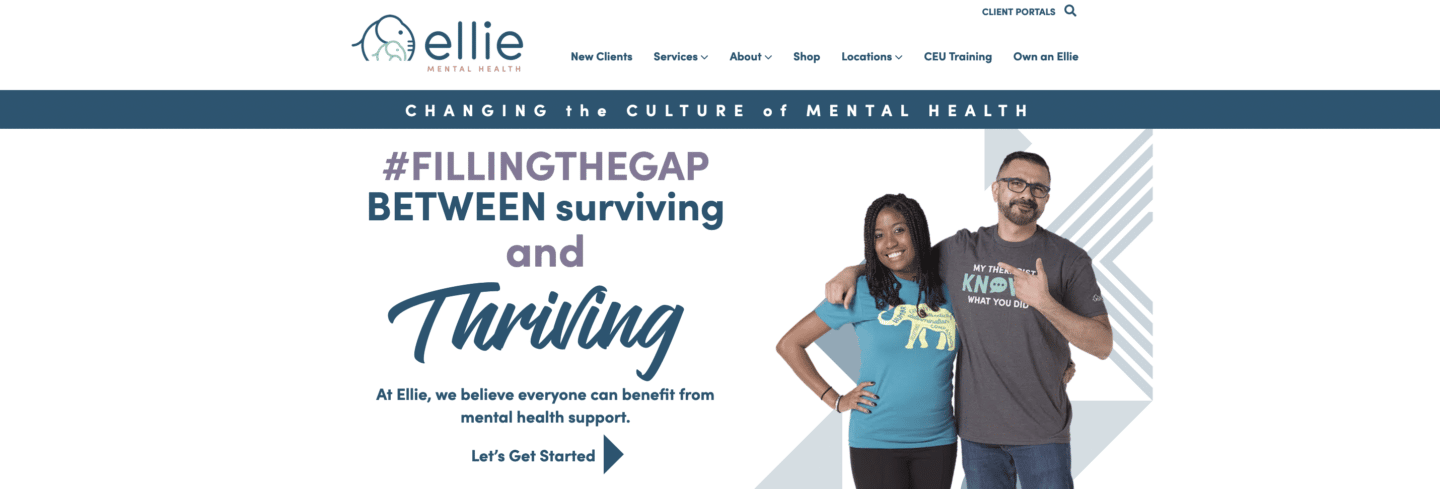
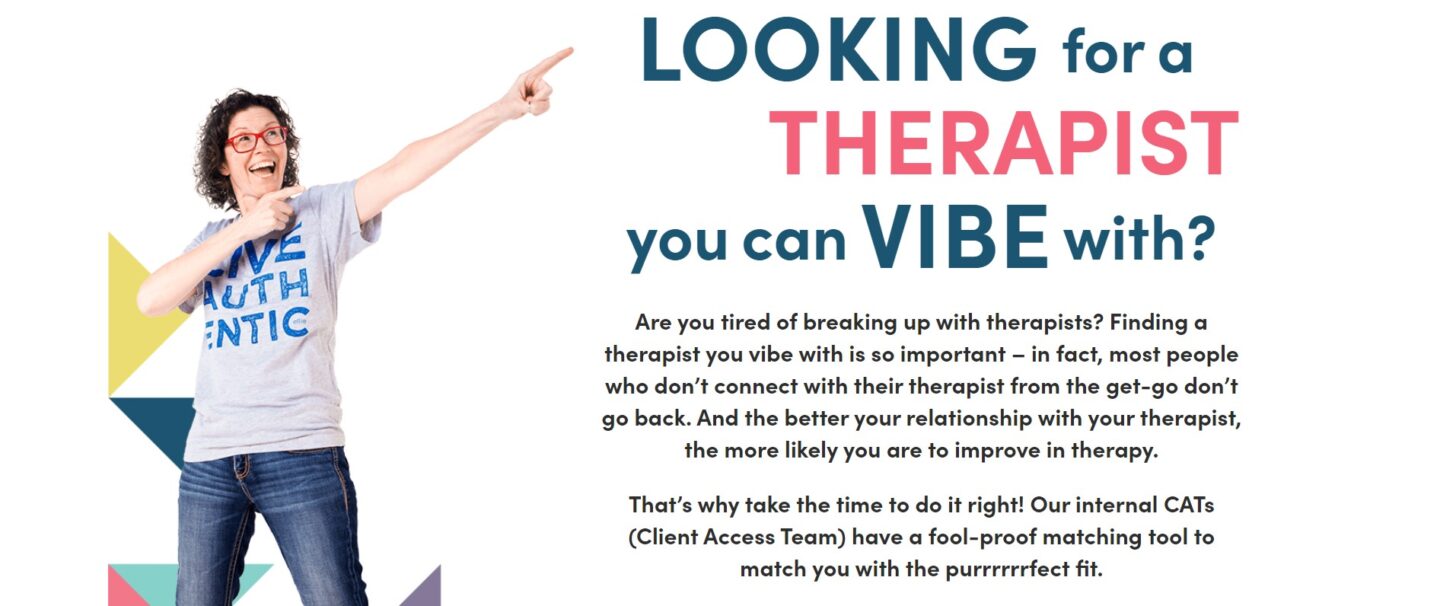
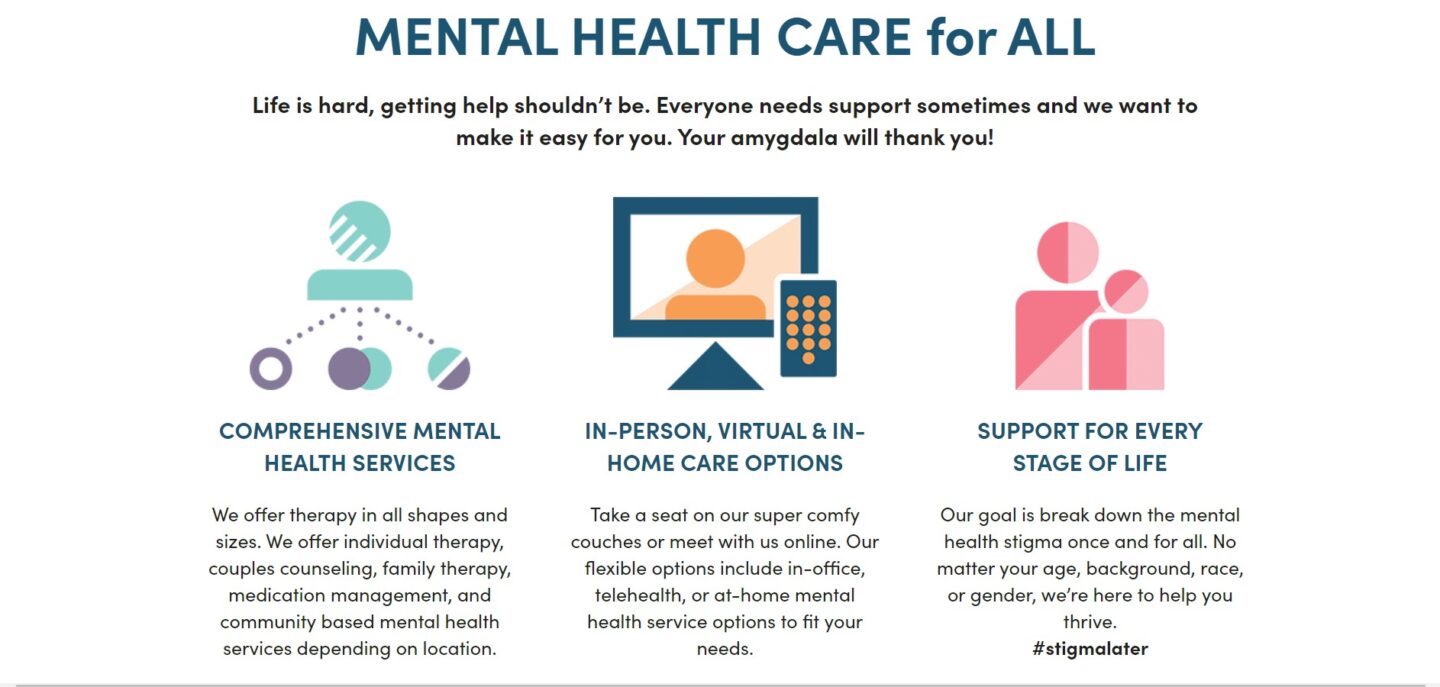
Ellie Mental Health is an amazing example of being inclusive and welcoming in their practices. The feeling is echoed throughout Ellie’s branding, messaging, and in-person locations. Just check out this statement from their website’s homepage:
“Seeing your therapist at Ellie is like stopping by a friend’s house (if your friend was a badass therapist). We have comfy couches, stylish art, and hot tea. We like to call ourselves professional secret keepers.”
How inviting does that sound?
6) Be Accessible & Convenient (Without Sacrificing Diversity)
We all love convenience and an easy choice. Drawing people to your psychotherapy practice is no different. But here’s where you need to be careful: Never choose accessibility over your ability to offer high-quality, individualized treatment.
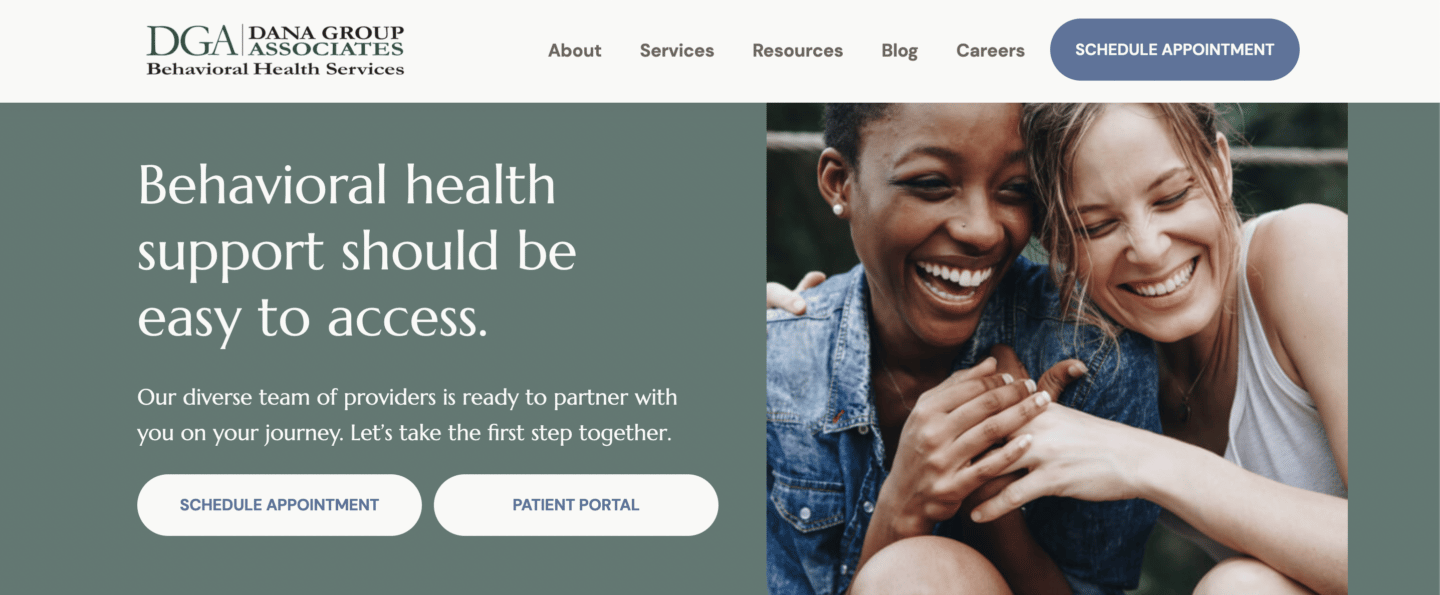
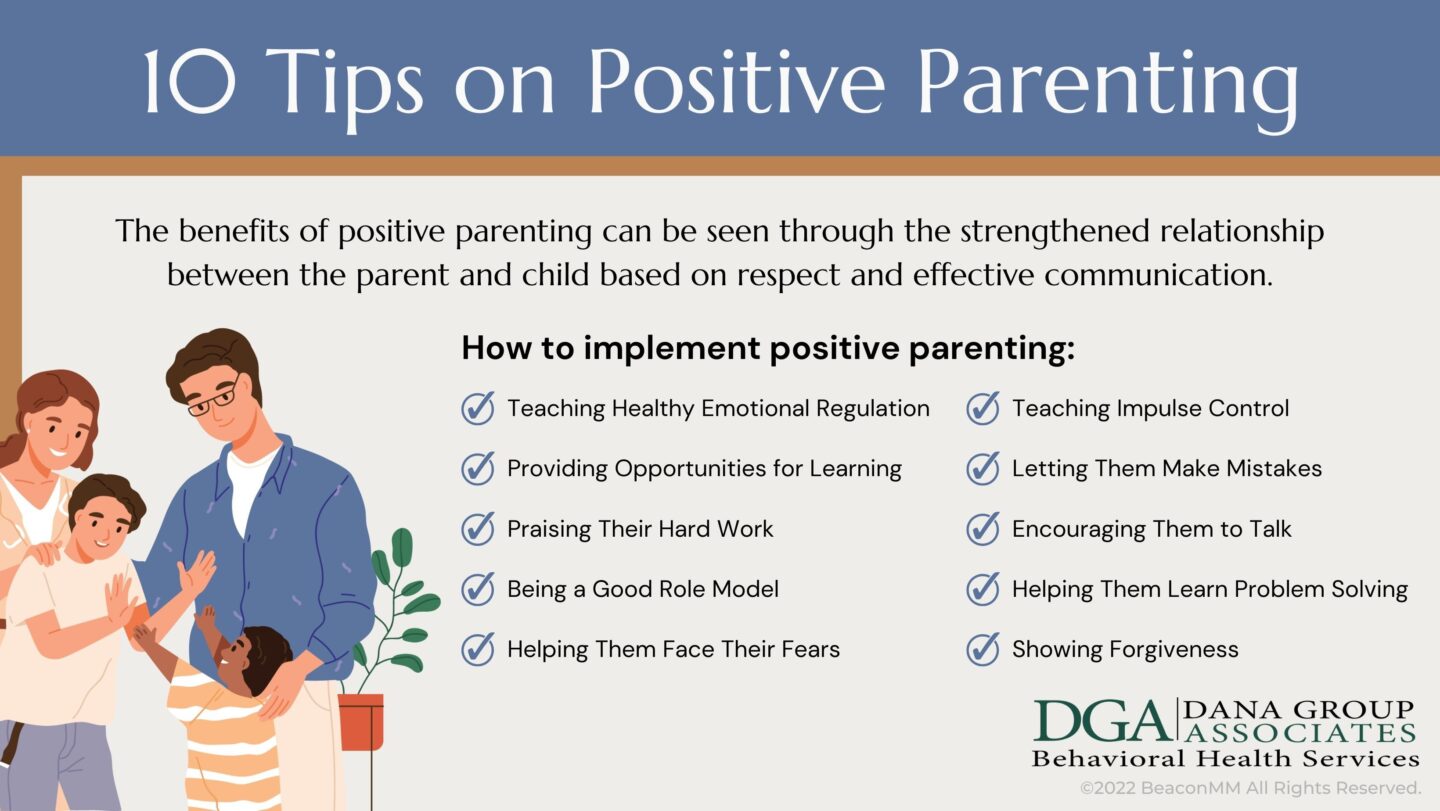
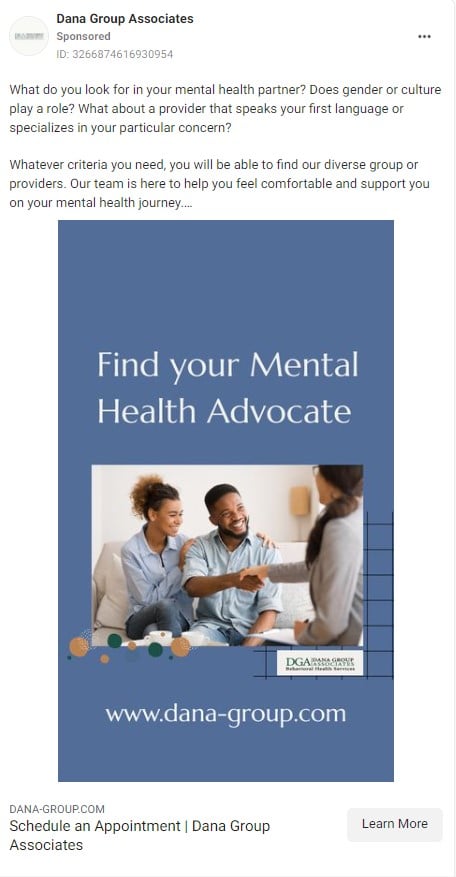
Dana Group Associates is a behavioral health organization that has therapy appointments available fast and provides medication management prescribed by in-house psychiatrists. However, despite this ease of access, Dana Group still connects clients with the right fit from a diverse team of providers. Here are just some of the behavioral health areas they focus on:
ADHD
Adjustment issues
Aging
Anxiety
Bipolar disorders
Chronic Illness
Cultural Identity
Depression
Family issues
Grief & Trauma
LGBTIQ+
Stress
7) Don’t Use a 10-foot Pole to Touch on Psychotherapy
The last tip is something we don’t think many practices realize they’re doing: approaching mental health with kid gloves.
Mental health and wellness, as well as psychotherapy, are dynamic, complex, and rarely clean or simple. However, some marketing approaches water down messaging in an attempt not to scare people away. And while this is with the best intentions, we encourage you to dive deeper and start a conversation that explores mental health honestly.
This builds a solid, empathetic relationship with your audience that lets them know they’re not alone. So, don’t be afraid to share personal stories, explore stigmas, stats, or trends (no matter how chilling), or bring awareness to real causes. Because someone out there is dealing with it – and you could be the first step for them to feel better.
Partner with Beacon to Bring New Clients to Your Psychotherapy Practice
If you’re looking for a strategic partner to grow your psychotherapy practice fast, Beacon Media + Marketing is here to help. We offer mental health marketing services to scale your business – including content marketing, paid advertising, website design, branding, and more. Whatever you need, Beacon can take you to the next level for new clients and a profitable practice!
Written by Sabrina Martinez, Content Lead, updated and revised by Sara Jokela 05/07/2025.
No, it’s not as simple as just creating a masculine-style color palette to draw people in.
It can be frustrating to find that just because something is critical, it doesn’t make it easy to market. You likely know this all too well when trying to market your health services to men.
There are many alarming statistics that reveal men seek healthcare at much lower rates than women – even in the presence of a health problem. And the impact of this is significant. From chronic health conditions to mental illness, not seeking medical care can contribute to a shorter lifespan, serious mental health outcomes (such as suicide or addiction), and a serious diagnosis that could have been mitigated with early treatment.
Internet access plays a crucial role in reaching men through digital marketing strategies, ensuring your campaigns are visible and accessible online.
While many practices may focus on marketing to their primary customer, which more often than not is women, there are many benefits of marketing your services to men (even if they make up a smaller percentage of your client base). First off, men’s health is important, and a compelling campaign geared toward men can be the very spark that compels someone to take that first step and get the care they need. Also, if a man is actively looking for a health provider, they are unlikely to choose your practice if they feel excluded by your marketing. A men’s health marketing campaign can make your practice stand out as a safe and welcome space for men seeking care for health issues they might feel embarrassed or hesitant about.
This might be surprising, but rationale alone doesn’t get people through your practice doors. You can have the most data-driven arguments or health stats, but that’s often not what brings in new patients. Instead, you’ll need to focus on emotions for successful marketing and take time to truly understand your target audience, including their pain points, their reservations, and their needs.
You might assume that since you are trying to market to men that emotions might be a less important factor. However, it’s essential you consider a key emotion in your campaigns in order to break the stigma and negative perceptions surrounding men’s health.
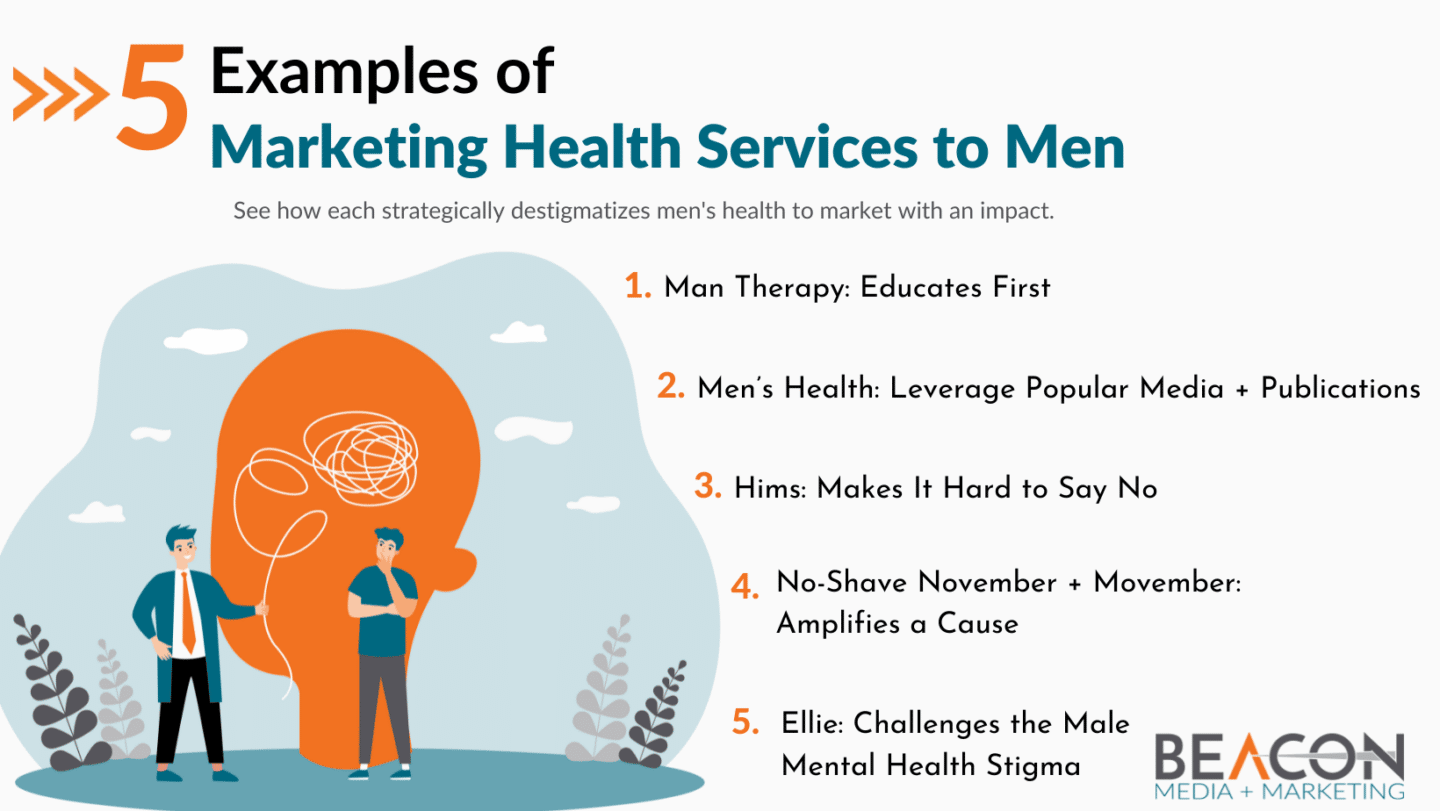
Not sure how to craft a compelling marketing campaign for men? Here are five examples of stellar men’s health services marketing strategies to model.
Men’s health is a critical yet often overlooked aspect of healthcare. Despite the importance of regular check-ups and early intervention, men are statistically less likely to seek medical help compared to women. This reluctance can lead to severe health outcomes, including chronic diseases, mental health issues, and even a shorter lifespan. Understanding the unique challenges men face in accessing healthcare is the first step in creating effective marketing campaigns that resonate with this audience. Incorporating robust network architecture and efficient data sharing through a metro area network can enhance healthcare communication, making it easier for men to access the information and services they need. By addressing these challenges head-on, we can encourage more men to take proactive steps towards their health and well-being.
At the end of the day, we’re all human. Of course, we know that’s true. On some level, everyone understands that we can all relate to each other in some way. But in this case, grouping people together isn’t the best marketing strategy. If you really want to build rapport with your audience, show you empathize with their unique struggles.
Man Therapy, a site for men’s mental health resources, does this perfectly. The tagline of their website homepage isn’t shy about who they’re targeting. It states: “It’s okay to cry, even when it’s not about sports.” From there, social proof and connection are created by featuring video testimonials from real men, and an easy-to-navigate filtering system for finding mental health resources based on topics. These filters include:
Anger
Grief
Trauma
Anxiety
Depression & Suicide
Relationships & Sex
Notice anything different about these topics as it relates to men? Trick question. There aren’t any differences – everyone (regardless of gender or sex) deals with these issues. But Man Therapy has created a space that is safe and welcoming for men, allowing education and awareness to follow. How can you generate an atmosphere like that in your men’s health marketing?
Men’s Health: Leverage Popular Media + Publications for Internet Connectivity
Key Emotion: Community
We can never stress this enough: When creating any marketing strategy, go where your target audience already is. By leveraging a popular media publication that has already created a safe, normalized space for men’s health, you reach a more receptive audience, faster.
Being featured on these sites with a guest post, review, or other collaborative effort can really help spread the word about your health services for men. You can also take a more direct route, and partner with the publication to advertise on the Men’s Health website.
If men’s activewear company, Rhone, can partner with Men’s Health for this piece, “Men Don’t Talk Enough About Mental Health”, imagine the opportunity you have as a practice that directly provides men’s health services. There’s also a bonus to creating a marketing campaign in this way – it provides outside credibility and a reputation boost against your competitors.
Hims: Make It Hard to Say No with Data Transfer Speed
Key Emotion: Ease
Changing the norm means you have a challenge: making the alternative easy.
Hims is a telehealth and medication management platform aimed at providing easy, online access to men’s healthcare. Hims also offers features like online edit diagrams, making it easy for users to manage their healthcare information and appointments from anywhere. They provide virtual medical visits with licensed experts and send your prescriptions to your door. Complete with a bold “Find My Treatment” button on the homepage, Hims services are literally a click away!
This makes it extremely convenient for someone to change their habits in a positive direction. It’s simple psychology. By increasing accessibility to men’s health services – from skincare to erectile dysfunction to anxiety and depression – it is much likelier they will be utilized.
Now, this example is not to say that you should switch your practice to telehealth options. Instead, look at the big picture. How can you provide health services in a way that makes it harder to say “no” to treatment? It takes a lot to break down the stigma surrounding men’s health – don’t add an extra barrier to that.
No-Shave November + Movember: Amplify A Cause in the Metropolitan Area
Key Emotion: Empathy + Altruism
How many times have you gained personal awareness while supporting someone else? Whether it’s a family member or friend or co-worker – when people stop to help others, they often understand more for themselves too.
No-Shave November and Movember are non-profit organizations that create challenges to spread awareness and raise support for cancer patients, men’s physical and mental health, and suicide prevention. The challenges – like no shaving for 30 days or running/walking 60 miles in a month – are great for generating attention and going viral. This, in turn, not only creates the opportunity for health education but for starting a conversation while amplifying a real cause.
In what ways can your marketing campaign help others while spreading a positive message?
Here’s a hard truth: destigmatizing men’s health and care isn’t something that’s going to be laid out for you. Ensuring the privacy of sensitive data is crucial in creating a safe and accepting environment for men seeking mental health services. Do you want to see change? Your practice needs to be a part of the solution. Fortunately, it’s not as difficult to normalize positive things as people think. Just take a look at Ellie, who’s changing the culture of mental health with clinics across the country! They’ve written a fantastic post, “Why We Need to Talk About the Male Mental Health Stigma” that we’ll pull from here.
How do they suggest destigmatizing men’s mental health?
Make getting help the norm. Mental health struggles are nothing to be ashamed of, and everyone deserves to feel better. Frame men’s health services (like therapy) in a way that allows vulnerability, comfort, and care without judgment.
Encourage sharing personal stories. Part of destigmatizing men’s health is proving that no one is alone. Highlight real issues, journeys through struggles, and how other people have gotten better – and that they can, too.
Educate and bust myths. Stigmas only continue to grow when they’re fueled by misinformation. While you should always validate feelings and emotional needs, laying out the facts has its place too. Educate men on recognizing signs, symptoms, and struggles within themselves and others, as well as evidence-based solutions for getting better.
Pass it on. Challenge today’s men to be the generation that makes prioritizing health not just the norm, but admirable. Encourage boys to express mental, emotional, and physical needs, and create a healthy expectation that those needs will (and should) be met. When men do this consistently, they will pass it on to young sons, brothers, and future fathers – ending the stigma once and for all.
Men’s Health Service Infrastructure
A well-structured men’s health service infrastructure is essential for providing high-quality care to patients. At the heart of this infrastructure is a robust computer network that enables secure and efficient communication between healthcare providers. One of the most effective ways to achieve this is through a metropolitan area network (MAN), which connects multiple local area networks (LANs) within a metropolitan area. This setup provides high-speed connectivity and internet access, ensuring that healthcare providers can share resources and collaborate seamlessly.
A metropolitan area network (MAN) can cover an entire city, enabling healthcare providers to access medical records and consult with specialists in real-time. This level of connectivity is crucial for improving patient outcomes, as it allows for timely and informed decision-making. Additionally, a MAN can support telemedicine services, providing a secure and reliable connection for patients to consult with healthcare providers remotely.
The infrastructure of a MAN includes various network devices such as routers, switches, and servers, all interconnected by fiber optic cables or telephone lines. These components work together to ensure that data flows smoothly and securely across the network. A network engineer plays a vital role in designing and maintaining this infrastructure, ensuring that it remains secure, reliable, and efficient.
By connecting multiple buildings, including office buildings, hospitals, and clinics, a MAN enhances the efficiency and effectiveness of healthcare providers. This interconnected network allows for better coordination and resource sharing, ultimately leading to improved patient care. In the context of men’s health services, a well-structured MAN can make a significant difference in the quality and accessibility of care provided.
Privacy and Data Security in Men’s Health Services
Privacy and data security are critical concerns in men’s health services, as sensitive patient information must be protected from unauthorized access. One effective way to secure data transmission between healthcare providers and patients is through a virtual private network (VPN). A VPN ensures that sensitive information is encrypted and protected, providing a secure communication channel.
A metropolitan area network (MAN) can be designed with robust security features to safeguard patient data. These features include firewalls, intrusion detection systems, and encryption protocols, all of which work together to prevent unauthorized access and data breaches. Compliance with regulations such as HIPAA is essential, as these regulations mandate the protection of patient health information.
The role of a network provider is crucial in ensuring that the MAN infrastructure is secure and compliant with regulations. This includes managing wireless technology to prevent unauthorized access and using network diagrams to visualize the infrastructure and identify potential security vulnerabilities. Regular security audits and risk assessments are necessary to maintain the integrity of the network and ensure ongoing compliance.
Healthcare providers must also be trained on data security best practices, such as using strong passwords and secure communication protocols. A data center can be used to store and manage patient data, providing a secure and reliable repository for sensitive information. By prioritizing privacy and data security, men’s health services can protect patient information and build trust with their patients, ultimately leading to better health outcomes.
Health Outcomes
The consequences of men not seeking healthcare are far-reaching. Chronic conditions such as heart disease, diabetes, and hypertension are more prevalent among men who avoid regular medical check-ups. Mental health issues, including depression and anxiety, often go untreated, leading to severe outcomes like addiction or suicide. The impact of these health issues extends beyond the individual, affecting families, workplaces, and communities. Just as data rates in network channels determine the efficiency of data transmission, the timely seeking of healthcare can significantly improve health outcomes. By highlighting these health outcomes in your marketing campaigns, you can create a sense of urgency and motivate men to prioritize their health. Remember, the goal is to make them feel understood and supported, not judged or pressured.
Evaluation and Measurement
To ensure your men’s health marketing campaigns are effective, it’s essential to evaluate and measure their impact. Start by setting clear, measurable goals, such as increasing the number of male patients or improving engagement with your content. Use tools like Google Analytics to track website traffic and social media insights to monitor engagement. Additionally, consider using network diagrams to visualize data flow and understand the role of computer networks in connecting various devices and facilitating resource sharing. Surveys and feedback forms can provide valuable insights into how your audience perceives your campaigns. Regularly review these metrics to identify what’s working and what needs improvement. By continuously evaluating and refining your strategies, you can create more impactful campaigns that resonate with your target audience.
Improvement Strategies
Improving your men’s health marketing campaigns involves a combination of creativity, empathy, and data-driven insights. Just as a robust network architecture with reliable backbone connections is essential for efficient communication in Metropolitan Area Networks (MANs), ensuring network resilience is crucial for maintaining continuous and effective marketing efforts. A well-structured marketing strategy is crucial for reaching your audience effectively. Start by conducting thorough market research to understand the specific needs and preferences of your target audience. Use this information to create personalized and relatable content that addresses their pain points. Leverage multiple channels, including social media, email marketing, and partnerships with popular media publications, to reach a broader audience. Consider incorporating telehealth options or other convenient services to make it easier for men to access healthcare. Finally, don’t be afraid to experiment with different approaches and learn from your successes and failures.
Best Practices
When it comes to marketing men’s health services, certain best practices can help you create more effective campaigns. Highlight the role of network devices in facilitating secure communication and emphasize the increased security that comes with adopting advanced network solutions, including wired connections. First, focus on building trust and rapport with your audience by showing empathy and understanding. Use clear, straightforward messaging that highlights the benefits of seeking healthcare. Leverage popular media and publications to reach a wider audience and build credibility. Make it easy for men to access your services by offering convenient options like online appointments or home delivery of prescriptions. Finally, continuously evaluate and refine your strategies based on feedback and performance metrics. By following these best practices, you can create compelling campaigns that encourage men to take charge of their health.
Start a New Men’s Health Marketing Campaign With Beacon Network Resources
The takeaway from all of this? Marketing health services to men isn’t just about presenting an opportunity for getting help. In order to be successful, you must actively change the culture and reduce the barriers that keep men’s health de-prioritized. So, will you take on the challenge of reaching a more difficult audience in your practice?
Think of it like starting a campaign in a single building and then expanding its reach over time, even if it’s not owned by a single organization. This involves establishing connections across multiple buildings, creating a cohesive network that supports efficient operations.
Do you dare to create campaigns that defy the norms in men’s health? If so, consider Beacon Media + Marketing your dedicated marketing partner in growing your practice and reaching men with compelling, barrier-free marketing. Beacon specializes in marketing for healthcare businesses, especially
We’re ready to square up to the men’s healthcare stigma right along with you and craft messaging and visuals that get the right message across, whether that’s through expertly crafted blogs, effective paid advertising, impactful social media posts, or stellar websites and branding.
Wait! Stop writing that next blog post (or at least take a long, thoughtful pause). Although mental health blogging can be a great way to boost your SEO rankings and reach people online, every skilled marketer will tell you that the key to successfully growing your business and making in impact is having a wide range of effective tools in your toolbox. And today we want to talk to you about how you can leverage your voice to provide valuable mental health education and insight and grow your practice with podcasting.
Creating a mental health podcast as a part of your overall mental health marketing plan is the perfect, casual way to reach new audiences. The team at Podcast Hosting found there are more than 2,000,000 podcasts and over 48 million episodes as of October 2022.
Moreover, nearly a quarter of Americans listen to a podcast weekly! What would engagement like that do to boost your content marketing strategy? Well, if you can read this, speak, and have a halfway decent microphone – there’s nothing stopping you from finding out.
We’ve compiled five mental health podcasts we think you can draw inspiration from. Grab a pen and paper and be sure to take notes!
Lesson: Take a fresh approach to mental health topics
If you’re in the mental health space long enough, you start to hear the same recycled topics – cognitive behavioral therapy, intrusive thoughts, breathing exercises, mindfulness, journaling…
So, why not stand out by integrating mental health content with an everyday, down-to-earth issue?
Why we like it: The Mental Health and Wealth Show takes a practical approach to an adjacent topic that influences mental health – finance. How can you calm your anxiety about future finance goals? How can you stop feelings of overwhelm and burnout from debt or a low-paying job? How do you slow emotion-fueled impulse purchases or heal financial trauma?
Melanie interviews various guests to dig deeper into these topics – encouraging discussion, but with the obvious disclaimer: the content is not to be taken as mental health or financial advice!
Takeaway: This podcast uses a unique intersection between two topics to create engaging, helpful mental health content.
Ever feel like the expert advice content you turn to can quickly become…preachy? Well, the mental health space is no different. Sometimes your audience won’t want another lecture or “pro tip.” Mental Illness Happy Hour has a surprisingly unique angle compared to other mental health podcasts: empathy.
Why we like it: This podcast isn’t here to explain mental health or provide directly educational content. Instead, each guest is someone sharing their personal story with mental illness – in a raw, honest, and therefore, more mature content form. The lessons are left up to the listener to decide for themselves. We especially like this podcast because it feels less like a discussion and more like chatting with a good friend about their struggles and recovery.
Takeaway: Not all content needs to be informative. What kind of conversation can you start by just talking?
Let’s face it – the way you think about mental health is going to be completely different from your parents’ or even your kids’ perspectives.
And that’s okay. It’s just a reminder to tailor your podcast content to your target audience.
Why we like it: While Millennial Mental Health Channel is for everyone, it will inherently attract a specific age range. This podcast is hosted by a psychiatrist and therapist duo, allowing for two different yet essential perspectives on mental health. And because Justin & Eddie are millennials themselves, it makes for relatable, authentic content.
Take some time to figure out who you best connect with. Don’t aim for an audience you won’t be able to tune into (see what we did there?)! Of course, your niche doesn’t have to be generational. Maybe you can create the greatest impact discussing mental health regarding veterans and PTSD or for high performers who struggle with burnout, stress, and anxiety.
Takeaway: Considering how large the audience on the internet is, general mental health tips won’t get very far with engagement. What’s your specific expertise? Home in on that to reach people in your space.
Sometimes the best mental health marketing strategies can still feel like another chore on a to-do list. Do you really have the time to start an entire podcast – no matter how effective it is? Cue the HealthyGamerGG “podcast.” Dr. Alok Kanojia is a Harvard-trained psychiatrist that has become especially popular for mental health content in the gaming community.
Why we like it: This podcast proves you don’t have to create a dedicated, traditional podcast to capitalize on the marketing potential it brings. The HealthyGamerGG community originates on the streaming platform Twitch and has over 1M subscribers on Youtube – encompassing lectures, chatting streams, interviews, and viewer call-ins.
However, that doesn’t stop them from repurposing the content audio in a “podcast” version with a 5-star rating on Spotify.
Takeaway: You don’t have to go all-in right away. If you have a current content marketing strategy that works, maximize it in a podcast. The best part is, if you want to create a traditional podcast later on, everything is set up — and you may have already grown a sizable audience of listeners!
Lesson: Never start from scratch. Take notes, then make it your own.
Finally, we wanted to recommend a baseline podcast you can model after! This mental health podcast is led by mental health experts that are witty, relatable, and informative. If you want to get to know your target audience in a genuine, conversational way, the Last Session of the Day is the podcast to check out.
Why we like it: This classic style captures the base of a quality mental health podcast. It features two therapists who chat through current mental health topics and issues while offering their expert perspective. Last Session of The Day follows our go-to keys for content marketing: it’s personable, valuable, and informative without selling. The shorter-length episodes also show you can make bite-sized content that is still effective!
Takeaway: If you want to get a good idea of a foundation for starting your own podcast, Last Session of The Day is a great framework.
In 2018, Entrepreneur said podcasting was “the next marketing frontier.” We have to agree with a slight twist in 2022: podcasts are the next mental health marketing frontier.
Each of our recommendations prove it with their own unique approach, and we hope you will, too! From the medium’s ability to connect with your audience deeply, as well as how easy the barrier to entry is – here’s the next content marketing strategy on your to-do list: Start a podcast!
If you’re ready to get your expertise out there and grow your practice through valuable, engaging content (whether that be a podcast, blog, social media content, email campaign, or video), Beacon Media + Marketing is your go-to digital marketing agency for mental health. We keep on top of the latest trends in mental health marketing and can’t wait to help you grow your presence and make an impact in the communities you serve.
Marketing your behavioral health business is a complicated and tricky field to navigate. You have to learn how to reach your target audience and make a connection with them. And if you’re using digital marketing, you have seconds to catch the attention of your potential clients.
If you’re not personally meeting these clients, it can be difficult to build a connection with them. And for a behavioral health clinic, gaining your clients’ trust is critical for your work’s effectiveness. The people you treat must build a solid foundation of trust with you to open up about their struggles.
The marketing you invest in can build that relationship even before your sessions start. With effective marketing tools, you can show that you’re trustworthy and make it easy as possible for someone to take the next step and schedule an appointment.
Beacon Media + Marketing has a podcast called The Beacon Way that discusses marketing tips for businesses. We talk about how important it is to build connections with your clients and how to do so in an accessible way.
Here’s a brief guide sharing five concepts of removing barriers in your digital marketing and how to increase conversions for your behavioral health clinic.
Are you interested in the work Beacon Media + Marketing has done for mental health practices? Learn how we can help you!
1. The Importance of a Niche
Many businesses make the mistake of marketing themselves as a place that can fix every problem their client has. However, in reality, that’s an unlikely expectation. Even for behavioral health clinics, many clinicians aren’t certified and trained to deal with every behavioral health issue.
Establishing your niche is an important healthy barrier to set with your potential clients. This means that you should be identifying the best clients for your services to allow you to provide the best quality care. Saying that you can work with any client– even ones that aren’t a great fit for your services– will likely lead to a poor outcome.
Onboarding and offboarding clients can be timely and costly, so ensuring that you’re marketing your services to people who will benefit from your treatments is crucial. When you can be honest about how your services can or can’t help someone, it builds a deep level of trust that will entice them to seek your services. People can sense when you’re marketing in a way that is more about gaining as many clients as possible rather than providing a great service to those in need.
Some people seek specific services such as addiction recovery and will look for behavioral health clinics with that niche. So when you market your practice as an addiction center, people will think of you first for their needs.
2. Not Using Unfamiliar Lingo
The words you use on your behavioral health website and for your marketing are crucial for building a relationship with your potential client. It would be best if you considered not using lingo that isn’t accessible to people unfamiliar with the behavioral health industry.
Breaking down complex topics to make them accessible to people is crucial. Don’t assume they can comprehend topics on your level. Similar to your sessions, you should use relatable language that your clients can process.
Paying attention to the language and thinking about things from the POV of your ideal client will help break down any barriers. If you have complex topics on your website pages, paid ads, or organic content, that can make potential clients feel intimidated and unwilling to learn more from you.
The podcast explores the idea of letting the customer choose your services. Like your sessions, you want them to work through the problem themselves and then come to the answer. They won’t seek your services if you tell someone what they’re feeling and do not give them the freedom to see if that’s the truth.
Your clients want to know that they’ve done the research and are comfortable making the right choice. Using words that make sense to them and letting them choose your services is the way to build a relationship with them and turn them into clients.
3. The Payoff of Comprehensible Visuals
Using visuals that are easy to comprehend is a great way to connect with your clients. Using online tools such as videos, infographics, or social media graphics can be a great way to catch the attention of your clients and provide valuable information.
People are drawn to visuals that are interesting and catch their attention. Many people will stay on a video for a few seconds to see if it’s something they’re interested in before scrolling past it or investing more time in it.
Videos and graphics can be a great way to catch someone’s attention and provide them with the information they’re interested in. It can also help build trust with your potential clients. When they see statistics used in infographics backed by sources, it builds a level of trust.
You can provide behavioral health education through these visuals that get people interested in the topic and possibly seeking services. However, you can also use it to be personable and show that you’re a person that can be trusted. They’ll learn more about you and feel more inclined to speak with you about their behavioral health struggles.
Many people may think that it’s obvious to provide a way of contacting your behavioral health clinic. However, some businesses overlook this small detail, which can be detrimental to your business.
Providing all forms of contact on all platforms allows people to get in touch with you quickly. Your contact information should be easy to find with no complicated forms. You can provide your email, phone number, address, and website contact forms. They should be available to access on your social media, website, and Google My Business.
A tool can also include a chatbot on your website to help direct people to book an appointment with you. You should also add plenty of website CTAs that entice someone to contact you.
5. Transparency Is Key
Being transparent is one of the most important factors for breaking through the digital barrier and connecting with your clients. Make your process and services clear from the get-go.
Be transparent about whatever services you offer, who are your providers, what modalities you provide, if you take insurance, etc. These are important questions that your clients will be asking, so if you can honestly answer them, you’ll begin to build a great relationship with them.
Don’t make clients have to dig deep into research or a call to find the answers. Having the information upfront and easy to find allows clients to make a decision more quickly and confidently.
Part of your behavioral health clinic is ensuring that people are comfortable enough to open up to you. Being transparent from the start will avoid any confusion in the long run and ensure that your clients don’t get upset for lying to them.
How Can Beacon Media + Marketing Help Your Behavioral Health Clinic?
Outsourcing your marketing can be a great investment for your behavioral health clinic. It allows you to take the time and focus on treating your patients rather than growing your client base. Our professional team can help with many marketing services, including website design and development, social media marketing, paid ads, content marketing, and more.
Beacon Media + Marketing can help you achieve your marketing goals to convert clients through our many services. We want to help your behavioral health clinic thrive and for you to focus on what you’re passionate about. Let us help you break through barriers and connect with clients in need.
Knowing the effectiveness of your marketing can sometimes be hard to tell. Although numbers that come back from reporting can be an indicator of the effectiveness of your strategy, that isn’t always a clear indication of the whole picture.
Many people use marketing tools such as Google or Facebook advertising and use the numbers that come from that as a benchmark for their marketing success. However, other valuable tools should be used for an effective marketing strategy. Companies within the healthcare industry that pair their paid marketing tools with organic content can often see the value of full marketing investment.
But how can you see if your marketing is working? Besides the number of client conversions, you may not see the long-term effects that marketing can have on sustainable growth. Here’s a guide on how to measure your healthcare marketing ROI and what to do if it’s not meeting your goals.
How to Measure Your Mental & Behavioral Health Marketing ROI
Marketing ROI (MROI) is a way of measuring the return on investment for your healthcare marketing. It’s a way to see if your spending is paying off. In the care of healthcare, it typically correlates between how much money you’re spending and how many client conversions you’re getting.
Measuring your MROI is a great way to do a few things:
Justify how much you’re spending on marketing.
Decide what to spend your money on.
Compare your marketing efficiency to competitors.
Hold yourself accountable for choosing the right marketing strategy.
To measure you’re marketing ROI, there is a straightforward formula that you can use. It looks like this:
Using this formula, you can see if your marketing investment is paying off. You want to have as high a positive number as possible. Although it is a straightforward formula, some challenges come along with measuring it correctly.
One of the challenges of calculating your MROI is that you often can see the short-term payoff. However, long-term investments can often be challenging to measure. This is where most businesses have to use the trial-and-error strategy to see which long-term marketing investments are worth it for their company. If a strategy works for one business, that doesn’t mean it will work for another.
Understand the Long-Term Investment of Marketing
Marketing takes time, so you might not see a huge ROI immediately. You can sometimes see the number of client conversions increasing but may not notice if an investment is worth it for a while.
Healthcare practices often deal with the long-term investment of their marketing. Many potential clients will take their time deciding if they’d like to seek your services. They may be considering other clinics and unsure which services they’d like to receive.
It can sometimes take months to decide that they want to see you for their healthcare. In other words, you may not see the ROI on your marketing for some time. Clients may not switch their healthcare right away, or if you provide a specific service, they may not seek your practice until they’re in a situation with that medical condition.
Marketing Strategies With Long-Term Benefits
Some marketing strategies have long-term benefits that may not be seen immediately. Some content that will stay for a long time and can be reworked as the healthcare industry learns more include blogs or videos.
Healthcare Videos
Videos are one of the most consumed media online, and many people watch healthcare videos to learn more out of curiosity or because they have that medical condition. The videos can include a wide range of topics or styles that can be a creative way to spread more awareness about healthcare. You can use the videos for various marketing tools, including social media content, YouTube videos, advertising, and more.
Healthcare Content Marketing
Blogs can be a great way to invest in long-term marketing. Blogging allows you to answer people’s questions regarding the healthcare services you provide. It can help people learn more and help your website rank higher on search engines, and spread brand awareness. You’ll also have a library of information on your website that allows people to search through it when they need more information about the healthcare condition and treatment.
One of the most important things you must do for a better ROI is identify your marketing goals. For example, one company might have a goal to generate marketing content that brings in more patients or build brand awareness. They may start providing content to draw in revenue through podcasts, vlogs, or speaking engagements. Or they may want to grow their business by hiring more providers and opening new locations.
Identifying your marketing goals can help you see what you need to do to get there. If your goal is to convert more clients, you may want to invest in Google advertising. Knowing what you want to do with your marketing can help you and your digital marketing agency find a marketing strategy to accomplish your goals.
Knowing the direction that you’d like to take your marketing will help you measure your marketing ROI. You can match your goals with the numbers you’re getting from the marketing formula and see if it reflects the direction you want to be going.
What to do If Your Marketing ROI Isn’t Where You Want it
Although you often need to take time to see an investment pay off, there are times when you can see that your marketing ROI is not what you want it to be. If that’s the case, then it’s time to adjust your marketing strategy.
1. Spend More to Make More
You often need to spend more money to make more, and if you’re unwilling to spend more on your marketing, you may hurt your ROI. For example, you might see a much higher ROI with a higher ad spend that gets you seen by more potential clients than if you stick with a low amount that gets low visibility. Your marketing company should be able to provide you with data to show you the ideal amount of marketing spending to help increase your chance of reaching your goals.
2. Identify Weak Spots
Another thing to do is consider your overall marketing strategy and identify your weak spots. For example, you’re unlikely to convert even if you have amazing ads if they lead to a clunky website or unengaging landing page. You want to ensure that you don’t have an outdated brand that doesn’t represent your business, or it will turn potential clients away.
3. Consider Missed Opportunities
You should also look for missed opportunities, such as writing blogs or trying Google ads. Your marketing can benefit greatly from marketing methods such as video content or photos.
4. Evaluate Your Marketing Agency
Something you should also consider is evaluating your marketing agency. Do you have major pain points with your current marketing agency? Do you struggle to get a response from your marketing team, have confusing invoices, or do not get information on how your marketing campaigns perform? These red flags can show that it’s time to find another healthcare marketing agency that cares about your business’s livelihood as much as you do.
How Can Beacon Media + Marketing Help You?
Outsourcing your marketing can be a great way to benefit without needing to put time and effort into it yourself. Healthcare marketing can be tricky to navigate for anyone, but our team at Beacon Media + Marketing is dedicated to staying informed on the latest marketing trends so your business can thrive. Our experts can help you with your marketing and ensure that you have high-quality marketing that leads to client conversions.
Beacon Media + Marketing can help your healthcare practice grow and meet your marketing goals. Our team can help you with multiple services such as blogging, social media, paid ads, website design and development, videos, and more. You can focus on serving the community while we find a way to connect you with your new clients.
If you can use advertising to get people to your behavioral health website, does organic website traffic still matter? Yes! While getting people to your website organically can take more time and effort to do, you’ll reap many long-term benefits.
Organic website traffic comes from unpaid methods like having an SEO-friendly website, ranking for a blog, clicking on an infographic, watching a posted video, or writing a social media post. This means that people find your website by the content you produce and use that as a way to visit your website.
Getting people to click on your website page can be difficult. You have to think about a way to show up higher in search results and make your service appear the most appealing when someone searches for behavioral health services online.
For behavioral health practices, organic content such as can be one of the best ways to reach new people and build you behavioral health marketing strategy. The following is a guide on how to increase organic website traffic for your behavioral health practice and how a marketing agency can help you increase your organic numbers.
The Benefits of Investing in Building Your Organic Web Traffic
While a paid ads strategy can be thought of as a short-term, fast method in gaining new leads, organic traffic often takes more time. The foundation of your organic web presence is your website, and an SEO strategy is one of the main ways you can increase traffic.
If your website or one of your webpages appears at the top of the search engine results page, there is a much greater likelihood it will get clicked on. Very few people take the time to look at anything that doesn’t appear on the first page of the SERP for a Google search.
Also, if you nail the right keywords in your content, you reach a very specific, targeted audience without paying an ad spend or worrying about behavioral health ad regulations. In fact, while many people do click on Google Ads when searching for a service, some people will skip ad results and go straight to the organic search results.
If you’re trying to gain new clients, a strong organic website strategy gives your great visibility and is likely to convert visitors into clients. And if you’re worried that organic traffic results will take too long to be effective, you can combine organic web tactics with paid strategies to have the best chance at reaching people.
Understanding on-page SEO can be one of the best ways to boost your website to the top of search results. On-page SEO is optimizing individual web pages to rank higher and increase organic traffic. This includes steps like:
Ensuring that you do keyword research to identify the search volume and ranking difficulty for words or phrases you want to rank for
Creating engaging content that is relevant to your target audience is searching for
Including click-worthy title tags and meta descriptions
Paying extra attention to headers as they can help you rank for keywords,
Boosting local SEO with location-specific keywords and location pages for multi-clinic practices.
2. Invest Time in Blogging
Blogging can be one of the best ways to gain organic traffic to your website. You can use blogs to answer people’s questions regarding behavioral health. If you create blogs that answer people’s questions well, they’ll be ranked higher on the search results, and people will be more likely to click on them.
Investing in long-form, SEO-friendly content can draw in website visitors and direct them to different pages if they’re interested in learning more. You can connect internal links or have CTAs that entice people to learn more about behavioral health and your clinic. You should update content as it becomes outdated or statistics change.
3. Create an Internal Linking Strategy
An internal linking strategy will help keep people on your website once you get them there. This includes what links you add to your blogs. This kind of strategy means adding links in your blogs that either lead readers to another blog, a service page, or other relevant page on your website. These are different that outbound links, which are hyperlinks to someone else’s website.
You can also implement an internal linking strategy for your website pages. This includes buttons that will allow them to schedule an appointment with you or link them to your service pages so they can see if you’re the right practice for them.
4. Have a Backlink Strategy
Similarly, having a backlinking strategy will help get people to your site from other people’s websites. When other websites use your content and link back to your pages, it allows Google to see you as a reliable source and will bump the ranking of your website to the top.
Since you can’t control if people use your website links, you can create a strategy for backlinking to your website. This can include writing press releases that announce your blog or having social media posts that link to your website. Having multiple outlets for backlinking will grow the popularity of your website and allow more people to reach your page organically.
5. Ensure Good Website Performance
One of the most important factors of having good organic traffic with a low bounce rate is creating a website that is updated and has enticing content. Your website should be responsive with short load times, as many people will leave the page if it takes too long to load. It should also have an updated design that is appealing to the eye.
Having good technical SEO will help push your website to the top of the search results. A great website is essential for gaining organic traffic and later leading to client conversions.
Do you need help creating a website that is beautiful and will convert clients? See how our website design and development service can help you!
6. Use Social Media
Social media can be an excellent tool for gaining organic traffic. Platforms such as Facebook and Instagram have built-in audiences that will be able to find your content. If you’re providing quality content such as educational videos, it will help spread your posts and gain new followers.
You should include links to your website, specific pages, or blogs on your social media posts and bios. This will help with backlinking but also allow people to access your website. You can also participate in groups or forums that raise brand awareness and allow more people searching for behavioral health treatment to find you.
7. Add to Print Materials
A traditional way to gain brand awareness and have people find your services is to add your website to print materials. This can include business cards that you hand out to people.
You can also create educational pamphlets or cards that include behavioral health information. This will help people learn more, and also, you can direct them to your website to get more information about your services and how you can help them.
8. Keep Online Listings Updated
One of the best ways to gain organic traffic is to have your behavioral health clinic listed with Google My Business. GMB works to help people find services in their area, so when someone searches “behavioral health clinic near me,” your practice will appear as an option for them.
You should ensure that your information is up to date. This includes the address, hours, website link, and contact information. It’s important to note that if you don’t have a physical location for your behavioral health practice, you won’t be able to use GMB.
9. Create Unique Infographics
Infographics are a great way to draw people to your website. They information that people may not know and will entice them to learn more about it. They can include statistics or steps for specific behavioral health treatment.
They should be beautifully designed using your brand colors and have engaging written content. You can add them to your blogs, and it’ll act as another way for people to get brief information regarding the behavioral health topic with something that draws their eye. They can also be used as social posts that draw people into reading the blogs to read more.
Infographics can also build organic traffic to your site by showing up in the images section of Google. People often recycle infographics instead of making their own. If someone finds your infographic relevant to what they’re writing about, they might use your infographic and link it back to your blog as a source – giving you a backlink which will boost SEO.
How Can Outsourcing Your Marketing Help Your Behavioral Health Practice?
Outsourcing your marketing can be a great way to have the benefits of effective marketing without needing to put in the time and effort in it yourself. Behavioral health marketing requires many moving pieces that can take away from the time you’d use to help your clients. Having experts help you with your marketing will ensure that you have high-quality marketing that leads to client conversions.
Beacon Media + Marketing can help your behavioral health practice thrive. We want you to focus on what you’re passionate about while we take care of your marketing. Our expert team can help you with multiple services such as blogging, social media, paid ads, website design and development, videos, and more. We’ll help you reach your goals while you provide exceptional services to people in your community.
Originally published by Beacon Media + Marketing. Updated and revised by Jennifer Gracey, Web Content Strategist & Writer on 07/17/23.
As a mental health practice owner, gaining more clients and expanding your practice is a given. Actively and intentionally marketing your clinic is one of the best ways to reach (and connect with) your desired target audience. However, it’s important to know — being specific in your marketing strategy is the secret sauce to finding clients in your area.
Craft a Solid Marketing Strategy
Crafting your marketing strategy to include local SEO will help you gain brand awareness and connect to those looking for mental health care in the vicinity. This of course, is in addition to what you’re likely already doing with referrals and therapist directory listings. Especially as more and more people field their search for services online.
To acquire clients effectively, incorporating SEO-optimized content by integrating keywords into your organic and paid materials is a solid strategy. However, creating a cohesive forward looking plan can prove challenging due to the multitude of marketing tools and methods that demand time and financial investment.
So, how does one implement a unified marketing strategy across multiple locations to attract clients to all your clinics? Our comprehensive guide on strategizing local SEO for a multi-location mental health practice will help you answer this question and more.
Knowing the significance of keyword optimization and incorporating SEO keywords that effectively communicate your services is just the beginning of attracting new clients online. In fact, one crucial factor you must not overlook is local SEO, a key component of your marketing strategy. By implementing local SEO, you can precisely target individuals searching for “mental health care in my area” and similar terms.
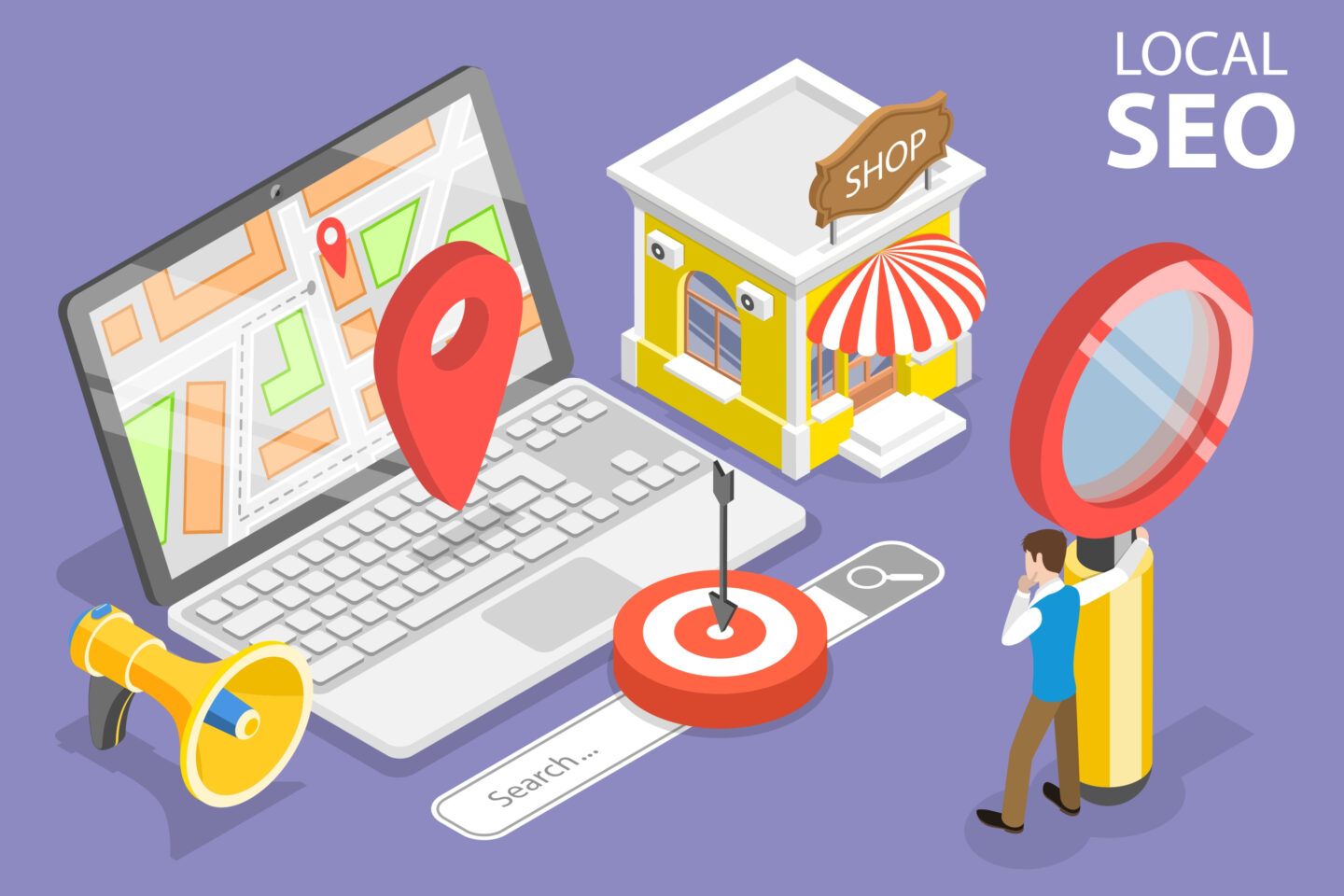
Local SEO revolves around your search intent and optimizing your website to achieve higher rankings on search engine results pages for individuals in your local vicinity in need of your services. Unlike national-level companies or online organizations that focus on broader search terms, a local SEO strategy hones in on location-specific keywords, allowing you to expand your business and attract highly qualified leads. Get ready to elevate your online presence and pave the way for success through engaging and active local SEO practices!
When you search using Google, the search engine collects relevant results by utilizing information about you, including your location. This means Google tailors the results for “near me” and searches related specifically to you (or the individual doing a search for a specific topic.)
To capture a significant search volume in your area, it is crucial for Google to understand the location of your mental health practice. You can ensure Google has this information by using keywords that indicate the services or search terms along with your location. Throughout your website, you can naturally incorporate this particular keyword or its variations, such as labeling headings as “Mental Health Clinic in San Diego.”
By incorporating local SEO into your marketing strategy, you ensure that people in the vicinity of your clinic can easily find it. This approach not only boosts brand awareness but also facilitates the conversion of a larger number of clients.
The Key Elements of a Multi-Location SEO Strategy for Mental Health Practices
Let’s look into how local SEO applies to a mental health practice with multiple locations. If your business operates practices in Los Angeles, Seattle, and Portland, how can you ensure that you rank for important keywords like “therapist near me” in all three locations? Below, we’ll explore key elements of local SEO for multi-location practices.
1. Location Website Pages
Ensure each location has its own dedicated location page. This entails including a “locations” section in the main navigation and creating individual pages for each location you serve. You can also craft distinct pages for each location, providing tailored information about those clinics. By doing so, you actively enhance user experience and facilitate seamless navigation for your visitors.
2. Unique Content
Set up each location with unique content. Avoid creating location pages that are nearly identical but with a different location as the keyword. Google can detect this duplicate content, and your SEO ranking will be negatively impacted.
3. Correct Business Listings
Make sure to accurately and comprehensively fill out all your online business listings, such as your Google Business Profile (formerly Google My Business), Yelp, Yahoo!, Bing, Facebook, etc. To rank on the coveted first page of Google, it’s vital that you actively maintain and regularly update your Google My Business profile.
4. No Virtual Locations
Avoid including virtual locations you can serve in your Google Business Profile. Your Google Business Profile links directly to Google Maps, meaning you must adhere to the guidelines by utilizing a physical business address. While you can still indicate the area of your virtual mental health practice, tools such as Google Business Profile cannot be utilized.
5. Follow SEO Best Practices
Ensure that your marketing strategy incorporates essential SEO best practices such as strategically utilizing keywords in your blog’s header, title tag, and meta description. Additionally, include a well-crafted SEO linking strategy while keeping a cautious eye on avoiding excessive keyword usage. Remember, the algorithm prioritizes blogs that skillfully respond to users’ queries rather than those that excessively stuff keywords. So, aim to create content that best addresses their questions and vaults your blog to the top of search results.
Pay attention to online reviews of your mental health practice. Consider implementing a referral reward program or asking patients to review your practice online. Peer reviews hold great value, as they provide candid experiences that can attract potential clients. Respond promptly to negative reviews and also consider reporting and removing any dishonest or malevolent reviews.
7. Have a Backlinking Strategy
A well thought-out backlinking strategy can help you acquire local, high-quality links. By incorporating backlinks, you showcase your reliance on various resources like websites, web pages, or web directories for information. Think of backlinks as references, similar to citations, that not only boost your SEO strategy but also create a more engaging online presence.
8. Long-Form Content Strategy
Implementing a long-form content marketing strategy involves leveraging locally optimized keywords to rank for key terms in blogs. By crafting insightful and informative blog posts, you can effectively utilize this powerful marketing tool to enhance brand awareness and address individuals’ mental health inquiries. Moreover, integrating your clinic locations into these posts ensures that people seeking mental health care will easily find your services. Having a comprehensive library of information readily available establishes trust with potential clients and enables them to make informed decisions.
9. Utilize Social Media
Posting on social media can help you reach local users, even if it’s not directly related to SEO. Being active online allows you to connect with a wide audience and provide valuable information, such as educational content and details about your services. It also helps you showcase a personable side of yourself, which can build trust with potential clients. So, go ahead and engage your audience by sharing content on social media platforms!
10. Consider Google Ads
If you’re facing difficulties ranking for keywords organically, why not give Google ads a try? While there are restrictions on the content of your advertisements if you’re not LegitScript certified, they still offer a fantastic opportunity to attract new clients. With Google Ads, you can propel your website to the top of search results, effectively converting potential clients into loyal customers.
How Can Beacon Media + Marketing Help?
After learning these tips, you might feel overwhelmed by the multitude of elements involved in crafting an effective marketing strategy. Managing the marketing efforts for one location alone can be challenging, let alone juggling marketing strategies for multiple locations. If you find yourself unsure of how to achieve your marketing goals independently, it may be time to consider outsourcing your marketing needs.
At Beacon Media + Marketing, we specialize in helping businesses like yours reach their marketing goals by employing a range of comprehensive services. We are dedicated to empowering your mental health practice and enabling you to focus on your real passion. Let us assist your clinics in thriving with our unbeatable marketing services.
Are you ready to see if Beacon Media + Marketing is the right fit to help you manage your multi-location clinic? Schedule a free consultation!
Originally published by Sabrina Martinez, Content Manager. Updated and revised by Sara Jokela 11/26/24
Women’s health is a particular niche of healthcare that needs special marketing strategies. Females are often the primary decision makers in their families when it comes to mental health, and women often do their due diligence in researching the best providers and treatments available for their healthcare needs.
Having a marketing campaign that really identifies with women – including their pain points, passions, and scheduling needs – can make a big impact. And being creative in your marketing for women’s health can be the main factor that sets you apart. Relying on stereotypes or overly feminine branding can hurt your marketing success in the long run – so you need a strategy that thinks outside the box and meets women where they are.
Women’s health marketing intersects with various health systems, emphasizing the importance of targeting women’s health within these systems. This includes a wide variety of health services, such as gynecology, prenatal and postnatal care, women’s mental health, autoimmune care, breast or ovarian cancer treatment, hormone therapy, and more.
This guide will go over what practice owners should know about marketing for women’s health and how these tools will convert clients.
Before getting into the nitty gritty of your marketing plan, you need to really know who your target audience is. Knowing this will help you curate your content to their likes and needs, and understand their healthcare decisions. It helps convert the clients that you’re trying to get.
Although you know that women are your general target audience, you need to consider more details about their life and why they would seek your treatments. Most women play a significant role in healthcare decision-making for themselves and their families. When coming up with ideas about your target audience, you should consider the difficulties they’re experiencing, the way they might perceive their situation, the solutions they’ve sought in the past, and their healthcare goals. Doing this helps you better target the people you’d like to become your clients and create content that speaks to the persona you assemble.
Some people think that staying broad in their marketing will attract more people. However, when you become more specific about the people you’d like as clients and integrate that into your content, it will actually convert more clients. People can feel better connected if something is tailored specifically to them, so create multiple personas that encapsulate your target audience.
Understanding the different personas of women you’d like to treat will create inclusive marketing that doesn’t stereotype or make women feel left out. For example, women seeking prenatal care can have many different journeys. Your content should be considerate of unplanned pregnancies, same-sex couples, older women getting pregnant, or single parent pregnancies. When you consider the different possibilities, it allows them to be included in the typical marketing towards married, younger moms with a planned pregnancy.
When you know whom you’d like to treat, creating content that reflects that becomes easier. It will help you convert those clients when you do ads or organic content for that specific audience.
Develop Detailed Personas for Women’s Health Marketing
Developing detailed personas for women’s health marketing is crucial to understanding the needs, preferences, and behaviors of your target audience. A persona is a semi-fictional representation of your ideal customer, based on market research and data analysis. By creating personas, you can tailor your marketing efforts to effectively reach and engage with your target audience.
To develop detailed personas for women’s health marketing, consider the following steps:
Refine personas: Continuously refine your personas as you gather more data and insights from your marketing efforts. This ensures that your marketing remains relevant and effective.
Conduct market research: Gather data on your target audience through surveys, focus groups, and online analytics. This will help you understand their needs and preferences.
Identify demographics: Determine the age, income, education level, occupation, and other demographic characteristics of your target audience. This helps in creating a clear picture of who you are targeting.
Analyze behaviors: Understand the behaviors, preferences, and pain points of your target audience, including their health concerns, values, and motivations. Women tend to engage with healthcare resources through various methods, such as phone calls for appointment scheduling and online searches for health information. This insight is crucial for crafting relevant marketing messages.
Create personas: Based on your research, create 2-3 personas that represent your ideal customers, including their demographics, behaviors, and goals. These personas will guide your marketing strategies.
Our client Brooklyn Birthing Center experienced a 94% increase in conversions with a targeted marketing plan. Read the full case study here.
2. Don’t Limit Your Creativity
When creating your brand, logo, or content, don’t be afraid to be creative. Your healthcare brand should be unique to you and your practice. Collaborating with health professionals, such as nutritionists and mental health counselors, can also enhance your brand’s credibility and service offerings. The brand should reflect what your practice does and its values.
The branding and logo are essential for attracting the right audience. Healthcare marketers play a critical role in creating unique and effective branding strategies for women’s health. If you’re targeting women, you could consider colors that reflect a safe feeling – if that’s the feeling you’re trying to capture. Or you could go with something more bold and daring. Don’t feel like you have to stick with traditionally feminine design elements just because your main audience is women – some research shows a majority of women appreciate more gender-neutral marketing.
A great example of a creative women health marketing campaign is the Any Mountain Project. Beacon Media + Marketing worked with Any Mountain to help raise awareness and earn donations toward ovarian cancer treatment. Any Mountain brought together hip hop, dance, and a team of gynecologic oncology leaders to reach women in a unique way.
One of the most important things that will help revolutionize the women’s health industry is providing valuable educational content. It’s important to learn about our bodies, and practices that provide blogs will help those in need.
Many women will do their research online to find solutions that will benefit their health and their families. Creating blogs that answer SEO keyword questions will ensure that it provides valuable information and brings you brand awareness.
Utilizing social media platforms also gives you another outlet for providing information. You can create videos that answer common questions regarding women’s health or go into specific details that bring awareness to unique health tips. The videos posted on social media platforms have a large reach and will gain the trust of clients when you should you’re educated in women’s health.
Collaborating with other healthcare professionals can enhance the quality and reach of your educational content. By partnering with various specialists, you can provide comprehensive information that attracts new clients and underscores a commitment to holistic health.
Providing education is an excellent tool for practice owners looking to reach a target audience and provide the much-needed information.
4. Highlight Your Services
A great idea to keep in mind is that you should highlight your services and clinic information. When creating posts, ads, or blogging content, you should highlight your services. Since women’s health is a broad spectrum of healthcare, telling people what you can help them with is crucial for gaining clients. Women’s health providers need to highlight their unique services to stand out in the competitive healthcare industry.
You can do specialized organic posts that highlight particular services that you provide or answer questions in blogs regarding specific women’s health topics.
It’s also helpful to provide and highlight your office information, including your hours, address, and contact information. It’s important to give people as many opportunities to schedule an appointment with you.
Consider if your target audience is women who have children that may be concerned about the time involved with getting care. If there are flexible care options, you should highlight them, so you’re more appealing to people in unique situations.
When offering unique, convenient services, you should highlight that since it will help you stand apart from your competitors. This can include specific treatments or even offering telemedicine.
5. Utilize Targeted Advertising on Social Media Platforms
Utilizing targeted advertising on social media is an effective way to reach your target audience and drive engagement for women’s health marketing. Social media platforms like Facebook, Instagram, and Twitter offer robust targeting options that allow you to reach specific demographics, interests, and behaviors. Participating in local health fairs can complement your social media advertising efforts by demonstrating your commitment to community health.
To utilize targeted advertising on social media, consider the following steps:
Choose the right platform: Select the social media platform that aligns with your target audience’s preferences and behaviors. For instance, Instagram might be ideal for younger women, while Facebook could be better for an older demographic.
Define your target audience: Use the platform’s targeting options to define your target audience based on demographics, interests, and behaviors. This ensures your ads reach the right people.
Create engaging ads: Develop ads that resonate with your target audience, including eye-catching visuals, clear messaging, and compelling calls-to-action. This will help capture their attention and drive engagement.
Set a budget: Determine your budget for targeted advertising and set a bid strategy that aligns with your goals. This helps in managing your ad spend effectively.
Monitor and optimize: Continuously monitor your ad performance and optimize your targeting, ad creative, and budget to improve results. This ensures your campaigns remain effective and cost-efficient.
6. Cultivate a Supportive Community
Cultivating a supportive community is essential for women’s health marketing, as it allows you to build trust, establish credibility, and foster loyalty with your target audience. A supportive community can be created through various channels, including social media, online forums, and in-person events.
To cultivate a supportive community, consider the following steps:
Identify your community: Determine the demographics, interests, and behaviors of your target audience and create a community that aligns with their needs. Understanding the responsibilities women have, including caring for aging parents, can help in building a relevant and engaged community.
Create engaging content: Develop content that resonates with your community, including educational resources, personal stories, and expert advice. This keeps your community informed and engaged.
Foster interaction: Encourage interaction within your community through comments, discussions, and Q&A sessions. This helps in building a sense of belonging and engagement.
Provide support: Offer support and resources to your community, including access to healthcare professionals, support groups, and online resources. This builds trust and loyalty.
Monitor and evaluate: Continuously monitor and evaluate your community’s engagement and feedback to improve your content and support. This ensures your community remains active and satisfied.
7. Enhancing the Client Experience
Providing exceptional client experiences is crucial for women’s health businesses to build trust and loyalty with their target audience. Women’s health providers can enhance the client experience by offering personalized services, innovative treatments, and empathetic care. Understanding the needs and preferences of the target audience is essential to deliver tailored services that meet their expectations.
8. Measuring Success and Growth
Measuring success and growth is essential for women’s health marketing, as it allows you to evaluate the effectiveness of your marketing efforts and make data-driven decisions. To measure success and growth, consider the following metrics:
Website traffic: Monitor website traffic to evaluate the effectiveness of your online marketing efforts. Increased traffic indicates higher interest and engagement.
Social media engagement: Monitor social media engagement, including likes, shares, and comments, to evaluate the effectiveness of your social media marketing efforts. High engagement rates suggest that your content resonates with your audience.
Lead generation: Monitor lead generation, including form submissions and phone calls, to evaluate the effectiveness of your marketing efforts. More leads indicate successful outreach and interest.
Conversion rates: Monitor conversion rates, including appointment scheduling and sales, to evaluate the effectiveness of your marketing efforts. Higher conversion rates show that your marketing is effectively driving action.
Customer satisfaction: Monitor customer satisfaction, including surveys and feedback, to evaluate the effectiveness of your customer service. Positive feedback and high satisfaction rates indicate successful service delivery
How Can Beacon Media + Marketing Help Your Women’s Health Practice?
Digital Marketing is a huge landscape that can be hard to do all by yourself. Utilizing targeted advertising on social media channels is an effective way to reach your target audience and drive engagement for women’s health marketing. You may not know where to start or how to do marketing effectively.
Beacon Media + Marketing is an agency that can help with your women’s health marketing needs. We know how difficult and time-consuming marketing can be. And as a practice owner, you much rather spend that time treating your patients.
We’re here to help you have effective marketing done by experts in the field. Our agency comprises professionals that deliver high-quality content for several marketing services. You never have to worry that one section of your marketing is better than the other. We want you to get the best content possible.
At Beacon Media + Marketing, we offer many marketing services to help your women’s health practice thrive. You can benefit from services such as website design and development, social media marketing, blogging content, paid advertising, brand and logo development, and more. If you’re ready to take your women’s health practice to the next level, we can help you convert clients and get you thriving.
Originallywritten by Sabrina Martinez, Content Manager, revised by Jennifer Gracey 6/23/23, updated and revised by Sara Jokela 11/27/24.
When marketing your mental health practice, creating a cohesive marketing strategy is a multifaceted undertaking. Given the recent global events such as the pandemic and economic downturns, many individuals face significant mental health challenges and pressures, making it crucial for brands to acknowledge the need for a mental health break in their compassionate marketing efforts.
For mental health focused brands whose primary marketing goal is get new clients or expand the practice, pay-per-click (PPC) advertising is often the quickest and most effective way to see serious growth.
Perhaps the two best known PPC advertising outlets are Google and Facebook. As one may anticipate, Google is all about paid search advertisements, while Facebook is all things paid social. In this article, we’re shining our spotlight on Facebook Ads.
Facebook Ads Gets Results
At Beacon Media + Marketing, by strategically utilizing Facebook Ads marketing, we’ve achieved remarkable results for our mental health clients. Targeting specific patient populations that matter most to the mental health practice is crucial for achieving these outcomes. Two such cases in point:
Alli, a brand new business offering a unique service in the mental health industry, received more than 40,000 impressions in the first month after launch.
The Center for Grief and Trauma had to grow its team and relocate to a larger office location after starting with us for Facebook advertising.
Take Advantage of the Free Ad Manager Tool
One of the best things about digital marketing is the numerous tools available to help businesses reach their target audience and convert clients. Using Facebook to run paid ads campaigns is one of the tools you can use to your benefit.
Healthcare Advertising Is Regulated
However, running cost-effective Facebook ads has its challenges — especially if your brand and marketing know-how falls short. Creating compelling, well-targeted ads through persuasive copywriting to reach the specific audience you have in mind takes some finesse. And Facebook doesn’t make it a walk in the park with their policies and restrictions concerning mental health advertising.
Regulations aside, taking advantage of platforms whose online ecosystems come with built-in audiences — like Facebook — is crucial for client conversion and having a winning marketing strategy.
Paid Advertising Is Best Partnered With Other Marketing Services
While using a therapist directory listing or leaning into referrals for new clients is worthwhile, paid advertising will return the best bang for your buck. To take things a step further, when strategically pairing paid advertising with other marketing services, such as organic social posts or blogging, the benefits will be tangible.
The five items below offer additional insight on running mental health Facebook ads that effectively convert clients.
1. Facebook Is the Most Valuable Social Media Ads Platform
A bold statement to be certain, Facebook is consistently proven a top platform when running advertising campaigns for mental health businesses. Because its user base reaches such a wide range of demographics, other platforms have a hard time keeping up. And, since Facebook and Instagram are integrated, we’re getting a two platform’s for one deal.
Facebook Has The Numbers
Over 2.9 billion people use Facebook worldwide, making the potential reach of your mental health practice wider than almost any other platform. If you’re strategizing how to best reach people within your locality, there’s a good chance those looking for mental health services are active Facebook users.
Using Facebook to reach new clients is a great idea because of the large potential reach. Facebook allows you to gain brand awareness through PPC as well as organic — it’s the perfect two pronged approach.
The Two Pronged Approach: Paid, Meet Organic
Imagine this scenario: It’s Friday evening. Suzzi’s relaxing on the sofa and catching up on her Facebook Feed. A video catches her eye so, she stops scrolling to watch. The new ad for your mental health clinic pops up midway through the video.
As she watches your 10 second ad, she’s reminded of a promise she made to herself awhile back, “Find a therapist and work through some unresolved childhood attachment issues.” After some hesitation, Suzzi mutters to herself, “Why not?” Then, she clicks on your ad.
Next thing she knows, she’s scrolling through the organic posts on your clinic’s Facebook Page. After stopping to read last week’s post about attachment theory, her interest in your practice peaks. She reads through a few more posts on your FB Page and decides to hop over to your Instagram Profile. Suzzi decides she likes what she sees, clicks on your link in bio and starts exploring your clinic’s website. A few more minutes pass until Suzzi decides to, “Just do it!” She clicks the book your free consultation button on your home page and books her consultation for 3pm Monday. You get to the office Monday morning and find not only Suzzi’s free consultation booking request but several more.
Suzzi’s “how I found you” story above illustrates what a potential client’s journey to your book now button could look like. And it unfolded because you decided to run Facebook Ads for your mental health services.
Understanding Facebook’s Integration
When you create an ad through Facebook Ads Manager, the default automatically places your ads on both Instagram and Facebook. Although the platforms have slightly different functions, Facebook’s integration with Instagram (IG) allows you to utilize the IG platform to connect you with even more people.
As an investment, Facebook ads are a great because of their affordability, trackability, and overall effectiveness. You can reach a geotargeted audience and retarget your ads to those people interested in mental health services. Facebook’s reporting features also let you see the effectiveness of your ads.
2. Experiment With Different Ad Types
In the world of paid advertising, there’s no such thing as one-size-budget-fits-all. Especially not when it comes to digital marketing online. This is where experimentation and A/B testing come in. One of the best things you can do to find out what works for your business is: experiment with different ad types. Experiments can include video ads, slideshow/ carousel ads, image ads, or boosted posts.
Experimenting with different ad types helps reach audiences that engage with all types of advertising. It also helps identify which kind of advertising works best for your mental health practice. You many want to try a video ad about your clinic and discuss how you can help someone. Or, you could try a carousel ad with information that inspires people to begin researching your business.
Videos are normally a great way to grab the attention of your target audience because people naturally gravitate to video. You’ve only got about 1-3 seconds to capture your audience’s attention, so you’ll need to make your video’s interesting! Photo ads are another great way to grab people’s attention. Because people are drawn to images, they’ll stop to read the description.
Experimenting with different ad types lets you pinpoint which marketing methods appeal to your audience. It also allows you to see which of your service offerings people are most interested in.
If you don’t already have one set up for your mental health business, you’ll need to create a free Facebook Business Page. On the sidebar of your Facebook profile, look for the Pages section. Clicking on the Pages section will allow you to create a Business Page. Once you get this set up properly, people can contact your clinic directly through Facebook.
Create Your Facebook Manager Account
Creating your Facebook Manager Account will allow you to create and manage your ad campaigns. From here, you can set up your budget, ad placement, schedule, and choose the audience you’d like to target. Keep in mind, you’ll need to work with a broader target audience using filters for age groups or geotargeting (location) for the healthcare industry.
To ensure that your ads and Business Page link to your website’s landing page, it’s important to confirm everything is properly connected. This will allow people to reach your website via your advertisement or Business Page. It’s helpful to keep in mind the restrictions that Facebook has on their ads, such as creating ads that target personal attributes consisting of:
Race or ethnicity
Religion
Age
Sexual orientation or practices
Gender identity
Disability
Physical or mental health (including medical conditions)
Vulnerable financial status
Voting status
Membership in a trade union
Criminal record
Name
To run health care advertisements on Facebook, you need to be certified through LegitScript. It’s a great investment for healthcare professionals interested in converting clients through Facebook Ads. Additionally, LegitScript will also help you with mental health Google ads.
4. Your Ad Landing Page Is Key for Conversions
Your Facebook Ad is one element of converting users into new patients. Ensure your ad campaign is attention grabbing, the ad copy description gives context to the ad, and directs users to where you want them to go. To grow your practice, you need supplemental content that will help engage and convert your potential clients.
The ad will link to your landing page, which should be well-designed to show the professionalism and brand of your mental health practice. The page you direct people to should have relative headings, catchy and strong CTAs, and match your ad. Being consistent across all platforms is crucial. It’s important that your landing page has content that will make audiences want to receive your services.
You should make sure that your website is up-to-date and has strong organic content to complement your Facebook Ad. Since ads can be restrictive, it’s a great idea to have engaging organic content on your social media platforms. As well as provide blogs containing information your potential clients will want to know more about.
One of the best things you can do after setting your ad up is to track it. Measuring the performance of your Facebook Ad will explain how well your it’s optimized for the target audience you are trying to connect with.
Try A/B Testing
You can do A/B tests that split your audience into different campaign variations. This will help you determine which ad performs better. And once you’ve got the numbers to support that decision, you can adjust the ad type and make other tweaks to fine tune your copy or design.
Tracking your ads is a way to analyze and optimize the ads that perform best. Consider the lifespan of the ad — and tracking its performance over time. You can tell when an ad needs to be replaced or possibly redone in order to boost attention by tracking each one.
Getting report numbers on your ads allows you to see how well the ads are converting clients. It will also help you reallocate your ad spend budget in an effective manner.
The Impact of Social Media on Mental Health
Understanding the Connection
Social media has become an essential part of our daily lives, connecting billions of people across the globe. However, its impact on mental health is a growing concern that cannot be ignored. Research has shown that excessive social media use can lead to increased symptoms of depression, anxiety, and loneliness. As a mental health social media advertising agency, it’s crucial to understand this connection to create effective advertising strategies that promote positive mental health outcomes. By understanding how social media affects mental health, we can craft messages that not only reach but also resonate with our audience, ensuring that our ads bring about a positive impact.
Implications for Advertisers
Advertisers must be acutely aware of the potential impact their ads can have on mental health. It’s essential to create ads that promote positive body image, self-esteem, and overall mental well-being. By doing so, advertisers can help mitigate the negative effects of social media on mental health. Utilizing data and stories, advertisers can craft ads that resonate deeply with their target audience, promoting a message of hope and support. This approach not only enhances the effectiveness of the ads but also ensures that the brand is seen as a positive force in the social media landscape.
Overcoming Common Challenges
Navigating Ad Regulations
Navigating ad regulations can be a significant challenge for mental health advertisers. To ensure compliance, it’s essential to understand the guidelines set by social media platforms and regulatory bodies. These regulations are in place to protect users and ensure that ads are ethical and responsible. By working with a trusted Facebook advertising agency, advertisers can ensure that their ads meet the necessary standards and reach their target audience effectively. This partnership can help businesses navigate the complex landscape of ad regulations, ensuring that their message is delivered without any compliance issues. Understanding and adhering to these regulations is crucial for the success and credibility of any mental health advertising campaign.
How Can Beacon Media + Marketing Help Your Mental Health Practice?
Beacon Media + Marketing is a digital media agency that works to evolve your mental health practice. We understand your passion for your therapy practice and for treating people with utmost care. We know effective marketing can take a significant amount of time and effort, and we want to be there to help.
Outsourcing your marketing can be an excellent choice. You’ll get the help of expert staff specializing in marketing areas that ensure high-quality content across the board. You’ll benefit from our team’s cohesive mental health marketing strategy.
At Beacon Media + Marketing, we can help bring your mental health Facebook ads to the next level. We know what works well and we work hard to ensure we’re seeing real conversions from that work. We also offer other supplementary services to the ad content, such as website design and organic content.
Written by Sabrina Martinez, updated and revised by Sara Jokela 4/3/2025.
Marketing for behavioral health services can be difficult. Creating a cohesive plan that integrates SEO optimization, blogging, social media content, and a memorable ad campaign is time-consuming and hard to do effectively.
It becomes increasingly harder to accomplish good marketing when there are restrictions on behavioral health advertising. You have to follow many rules and regulations that don’t interfere with the guidelines online.
Marketing your behavioral health practice through organic content is essential as it creates more brand awareness and has fewer restrictions than advertising. But advertising has a high ROI, which means that it’s crucial for you to utilize advertising tools such as Google Ads to reach your target audience and convert clients.
So how can you have effective behavioral health marketing? Here’s a guide on creative ways to advertise your addiction recovery center online and why organic content will help upgrade your marketing and convert clients to your behavioral health services.
Advertising is essential for reaching your target audience. However, the main advertising platforms have restrictions to cut down on scams and sometimes stop retargeting. Managing ad campaigns on platforms like Google Ads can be challenging due to these restrictions. Staying compliant with these advertising rules can be difficult.
Platforms like Facebook and Google were concerned with health services that don’t have physical locations as they wanted to stop people from getting scammed. So, you have to ensure that you provide a physical location of your services to show that you are a legitimate service provider. Advertising strategies can exploit psychological vulnerabilities, leading to addictive behaviors.
Each platform has its own specific rules for behavioral health advertising. They’ll target keywords and take down ads that don’t align with their rules, which means you have to get creative in writing your copy. Advertising can manipulate consumer emotions, promoting addictive tendencies. The following show some rules that are included on each platform regarding behavioral health advertising.
Google Ads
Google advertising has restrictive regulations for recovery-oriented services for drug addiction and alcohol addiction. This is applied globally and across all accounts that advertise addiction services. Some examples of advertising restricted under the new policy include:
Clinical treatment providers (inpatient, residential, and outpatient programs) for drug and alcohol addiction
Recovery support services (including sober living environments and mutual help organizations) for drug and alcohol addiction
Lead generators and referral agencies for drug and alcohol addiction services
Crisis hotlines for drug and alcohol addiction
Advertising through Google will help you reach a broad audience, but you must ensure that you follow all policy rules and have been LegitScript certified.
Facebook Social Media Platform
Facebook, as a social media platform, has advertising policies to help protect people from untrustworthy businesses. Their Drug and Alcohol Addiction Treatment Advertising Policy aims to protect people from scams but can be less restrictive than Google advertising. Some addiction advertising examples that can be done on Facebook include:
In-person clinical addiction treatment services or websites that provide information about treatment
Online and in-person support groups
Crisis hotlines for people in recovery and who are seeking addiction treatment information
To run ads through Meta platforms, you have to have a certification with LegitScript.
Although following the guidelines on each platform can be difficult and time-consuming, it’s worth it to invest in advertising. It can help bring brand awareness and allow more client conversions. And just like any other marketing method, online advertising can take some creative ingenuity.
The following are tips on creating behavioral health ads that will stay compliant with platform regulations and possibly increase your conversion numbers.
1. Get LegitScript Certified If Qualifiable
If you’re interested in running behavioral health advertisements on either Google or Facebook, getting LegitScript certified will be crucial. When you get certified, it verifies to Google and Facebook that you are a qualified behavioral health service and not a scam. If you get certified, it allows you to run ads that include keywords such as “drug and alcohol addiction treatment” that will bring your target audience to your website.
Certification helps ensure compliance with regulations similar to those governing pharmaceutical advertising, which is designed to prevent misleading information and protect public health.
Price can seem like a lot with a $495 upfront charge and a $955 annual charge. However, this can be an investment that will show real ROI. Advertising your services can be the major factor in how many clients you convert.
If you choose to be LegitScript certified, you must meet their qualifications for behavioral health services. Even if you are working with a marketing agency, you’ll need to be the one to do the certification as they may need additional documentation that you can only provide.
If you choose not to get LegitScript verified or don’t qualify, you’ll need to come up with clever ways to stay compliant with Google and Facebook policies.
2. Apply on Facebook
Facebook advertising requires that you fill out an additional application before you can run advertisements. Once LegitScript has approved you, you’ll need to complete the application to Facebook so they can review the certification.
Some types of ads that are eligible under their new policy include:
LegitScript-certified for in-person alcohol treatment centers
LegitScript-certified for crisis hotlines
LegitScript-certified for mutual support groups
LegitScript-certified for addiction recovery smartphone apps
Your behavioral health service will need to fall under their guidelines and show that you are a qualified resource for people searching for addiction treatment. Completing the LegitScript certification and Facebook application will ensure that your business doesn’t get flagged for being a scam.
3. Learn Restrictions on Copy
Each platform has its restrictions on what marketing messages and keywords can go into your advertisements. This means that you need to learn which words can’t be put into your behavioral health ads and develop creative copy that won’t get flagged because they’re compliant with the policies.
If you’re certified by LegitScript, you’re allowed to put keywords such as “drug and alcohol addiction treatment” into Google ads. However, if you’re not authorized, you will need to avoid using such keywords and come up with words that show you’re a treatment center but not specify what you do.
Facebook has prohibited personal attributes within ads, including:
Race or ethnicity
Religion
Age
Sexual orientation or practices
Gender identity
Disability
Physical or mental health (including medical conditions)
Vulnerable financial status
Voting status
Membership in a trade union
Criminal record
Name
In other words, you can’t use words that assume the status of your audience. You can’t say, “Are you struggling with drug or alcohol addiction?” So, learning which words you can’t have in your ads and coming up with creative copy will be crucial for staying compliant and still reaching a broad audience.
4. Direct Ads to Relevant Information
Your ads should be directing your audience to working landing pages that allow them to get the information they’re looking for and schedule an appointment with you. It’s crucial to attach the links to the keywords in your ad so people can find your website. Employing many marketing strategies can help ensure that your ads lead to effective conversions by reaching a broader audience and identifying the most successful approaches.
An ad is a tool that draws people into your behavioral health service, and your website needs to be the one that converts them. The connection of your ad to appropriate landing pages is the crucial bridge toward converting potential customers.
Your ad is the front of the wealth of information on your website. If you connect the wrong link to the keyword, it can confuse people because it’s not directing them to the information they want to learn more about. Another crucial point is ensuring that your landing pages have quick load times, are functional, well-designed, and allow clients to contact you.
Why Should You Still Do Organic Content Marketing Strategies
One of the best marketing tools that you can use for your behavioral health service is doing organic content. Since behavioral health advertising is restrictive, reaching your target audience will be best done through organic content.
Organic content can also help address the challenges and stigma associated with substance abuse by providing educational and supportive information.
Organic content is your social media engagement and blogging. Social media is a great marketing tool for behavioral health services trying to connect with their target audience. Social media isn’t restricted in the same way ads are so that you can have a wide range of content.
Some ways to use social media are talking about services you provide, educational videos regarding your behavioral health specialists, and adding personal touches about you or your staff. Providing content like that allows people to learn more about your behavioral health service while getting to know you. It creates that first bond of trust with your potential client and allows more brand awareness.
Blogging can be one of the best tools for reaching your target audience. It allows you to write detailed blogs that include information on what people search for. So when people ask a question online or search a phrase regarding your behavioral health specialty, your blogs will show up as a result that will answer their question.
Writing blogs will allow people to have a wealth of knowledge and get to know your behavioral health practice, clinic, or facility. It will also help establish credibility and show that you’re educated in the treatment they’re looking for. Organic content will be the key to reaching an audience searching for behavioral health services.
Are you interested in getting organic content services?* Learn more about Beacon Media + Marketing social media and blogging services!*
Measuring Success and ROI
Measuring success and ROI is essential for effective addiction marketing. Addiction treatment centers must track key performance indicators (KPIs) such as website traffic, social media engagement, and lead generation. Measuring the ROI of marketing efforts involves analyzing the cost of acquiring new patients versus the revenue generated. Addiction marketers must also consider the long-term benefits of marketing efforts, including increased brand awareness and reputation. By measuring success and ROI, addiction treatment centers can optimize their marketing strategies and improve their bottom line.
Ethics and Compliance in Addiction Marketing
Ethics and compliance are essential in addiction marketing. Addiction treatment centers must adhere to industry regulations and guidelines, including HIPAA and FDA regulations. Addiction marketers must also consider the ethical implications of marketing to vulnerable populations. Effective addiction marketing strategies must prioritize patient well-being and safety. By prioritizing ethics and compliance, addiction treatment centers can maintain a positive reputation and build trust with their audience.
Building Relationships and Partnerships
Building relationships and partnerships is essential in addiction marketing. Addiction treatment centers must build relationships with healthcare providers, insurance companies, and other stakeholders. Addiction marketers must also consider partnerships with advocacy groups and community organizations. Effective addiction marketing strategies must prioritize building relationships and partnerships. By building relationships and partnerships, addiction treatment centers can expand their reach and improve their reputation.
Team Up With Beacon Media + Marketing for Creative Behavioral Health Ads
Beacon Media + Marketing is a marketing agency that will help elevate your behavioral health service. Marketing can be highly time-consuming and challenging if you’re not sure what you’re doing. We’re here to create a marketing strategy to convert potential clients and bring you more brand awareness. The drug industry, for example, leverages marketing and advertising services to reach their target audience effectively.
We want to know the why being what you’re doing. At Beacon Media + Marketing, our expert team can help you find what makes your brand unique and use that to reach clients that identify with your brand.
You should consider outsourcing your marketing because it will allow you to have more time to treat your patients, and you’ll have the resources of expert marketers. We know what ads will be compliant and help convert clients.
Beacon Media + Marketing can offer marketing for behavioral health services that will upgrade your business. We offer services such as , social media content, blogging, paid advertising, and more. Your business will be taken to the next level when you choose us for your marketing services.
Originally published on April 24, 2019. Updated May 4th, 2022.
Your medical spa business needs a beautiful, visually stunning website design that reflects the work you do for your clients. With a professional MedSpa website, you can display your services, your portfolio, and the expertise of your staff.
However, an outdated or poorly designed website can do the exact opposite for your business. You might find that website visitors struggle to find your services or don’t know how to contact you. Maybe your site looks unappealing and doesn’t showcase the amazing work you do.
If it’s been a long time since you’ve last updated the website design for your medical spa, it’s likely you’re due for a new site. Most industry experts recommend you update your site at least every two to three years.
Why? The website design industry is constantly changing. New technology, design trends, and research on user experience change can alter significantly alter best practices for website design.
Additionally, it’s possible your business has changed over the last couple of years. Maybe you’ve added a new service or your medical spa brand needs to be updated. In many cases, it makes more sense to go back to the drawing board and create a new website that reflects these changes.
Here at Beacon, we take all of our medical spa clients through a 5-step process to revamp their website design. This process has been refined over many years of providing website design services. Today, you get a backstage pass into the full Beacon website design process.
If your website has gone for some time untouched, it is likely that your medical spa team has some ideas about how it could be better. The first step we take our clients through in the website design process is an information download/discovery meeting.
Gather everyone from your medical spa team who should influence website design decisions into one room.Do your research ahead of time by taking a detailed look at your website, your competitor’s website, and any other websites you like the look and feel of to guide the conversation.
Ask yourselves questions that dig deep into the goals for your website design, thinking as strategically as possible, such as:
What is the 5-year, 10-year, or even 20-year plan for your medical spa? How do you plan to grow?
How do your goals for growth fit with your goals for this website design? What is its purpose?
If your clients were to leave your website remembering one or two things, what would those be?
Thinking about other websites you have seen, what design elements or features did you like?
Do you have an official brand guide or any approved imagery that you use in the marketing of your medical spa?
You should come away from this meeting with a list of the concrete features and deliverables that will drive the success of your new website design.
Step 2: Map Out Your Website Design
With a fresh vision for your new website design and a list of concrete deliverables in hand, it is time to create an outline. At Beacon, we create two documents that provide guidance for the remainder of our website design process, a site map and a wireframe.
Your site map will outline all the pages on your website in the order in which they should go. It can be as simple as a bullet point list.
Here is the standard site map we recommend to our medical spa clients, including five top-level pages:
Home Page
About Us
Services
Service A
Service B
Service C
Blog
Contact Us
This site map will provide the foundation for your wireframe, which is the “set of images which display the functional elements of a website or page, typically used for planning a site’s structure and functionality” according to Google. Taking your site map, you will create a wireframe for each of the pages you have listed.
As complicated as it may sound, a wireframe is little more than a rough sketch of what you want each of the pages to look like. You could create a wireframe on a napkin if you wanted to.
A good wireframe will include the locations of each image, header, content paragraph, button, or form field on each of the pages in your site map. If you feel like you need practice wireframing, a great exercise to try is to wireframe one of your favorite websites, outlining all of the elements on one of the pages. Once you feel confident in your wireframing, you are ready to tackle your own website design!
There are also many free wireframing tools available online, such as MockFlow, which allow you to drag-and-drop pre-designed elements. Find the wireframing “flow” that works best for you!
Step 3: Write Your New Website Content
Remember all those content paragraph spaces you added to your wireframe? Now is the time to fill in the placeholder text with the real deal!
Use the following best practices as you write website content for your medical spa.
A. Use Medical Spa Relevant Keywords
Your new website design can be as pretty as a peach but it will be pointless if it does not rank on Google. A surefire way to ensure ranking is to search engine optimize (SEO) your website content with medical spa relevant keywords.
To optimize the content of a website page for Google, you want to include the relevant keyword for that page–say, “botox”–across the page multiple times throughout the text. This tells Google exactly what your page is about. The keyword you have chosen should be in some of the headers as well in order to rank the page for that keyword.
B. Create Interesting and “Catchy” Headers
Let’s be honest, most of us just “skim” and read the headers on most website pages and blogs. For that reason, it is very important that your headers communicate succinctly exactly what the various sections of your page is about.
In addition to headers, you want to use other formatting tools that make for easy skimming, such as short paragraphs, interesting pull quotes, relevant bullet points, and engaging imagery.
C. Write High-Quality Website Content
Google and users alike appreciate high-quality website content. When content is unique and written well, users will stay engaged and on the page, and Google will not drop your ranking because of a high page bounce rate.
Two great tactics for writing engaging content include:
Writing in the second-person, addressing users directly as “you.”
Putting yourself in the users shoes so that you write about the benefits of your services to them in the most compelling way possible.
Try your best to position your services as a value-add to the user’s life. At the end of each website page, you should include a call-to-action (CTA). This is a request for the user to take action on what they have just read, such as “call (123) 456-7890 now to schedule your appointment.”
Step 4: Develop Your Medical Spa Website
Your site map, wireframe, and written website content all come together in your final, developed website design. The first step in the development stage of any website process is selecting which website design software you would like to use.
At Beacon, we use WordPress for all of our medical spa clients. WordPress has many tiers of packages for you to choose from, so you will not need to purchase a costly agency-level package for your website design.
Our package requires the knowledge and skills of a web developer, but there are many packages that provide pre-developed themes that you can customize to your liking!
Choose the package that best fits the needs of your medical spa and your specific website design, taking into consideration your site map, wireframe, content, and the list of concrete features and specifications that you came up with in your initial meeting.
After you have chosen your package and created an account with WordPress, the software will lead you through the setup process, prompting you to pick a theme and begin customization.
Your choice in a theme should be based on the needs of your wireframe. Throughout the customization process, be sure to use your specific brand guideline and only approved, marketing imagery for your medical spa!
Create pages and upload the website content you have written. If you get stuck, check out WPBeginner, a great online resource for first time WordPress users!
Step 5: Set Your Website Design Live!
Is your new website design ready to go? Then it’s time to initiate the go-live process! It is important to run your website through a series of checks before you set it live to make sure everything is in place.
We use a go-live checklist with all of our medical spa clients. Here are some example items from our checklist:
Go page-by-page throughout the website and click on all the links to make sure they will send users where they are supposed to.
Try out your contact form if you have one, submitting a “test” entry to make sure it delivers to the appropriate email address.
Enter the URL for your website in all the popular browsers including Chrome, Firefox, and Safari to make sure it looks good.
Visit your website on mobile as well to make sure it is properly mobile optimized.
With basic WordPress packages, websites are technically already “live,” they just do not dwell at the correct location on the internet until you tell them to.
Login to your hosting account and point the domain name from your old website to your new one. At that point, your website will be fully live and functioning at the proper address!
Is Your Medical Spa Ready for a New Website Design?
A new medical spa website will help your website rank higher on Google and get more patients in the door. If you’re not sure where to get started, let our website design experts at Beacon Media + Marketing take the reins. From content to Word Press development, we’ll help you create a well-branded, aesthetically pleasing site that makes a great first impression and offers the best user-experience possible.
 Skip to content