Websites

See Our Blogs

Explore insights on SEO, AI, and digital marketing strategies designed to help your business grow, stay visible, and adapt in a constantly evolving online landscape.

Beacon_Icon_resouse

Written by Brandon Grill, updated and revised by Sara Jokela 2/19/25.

Creating or improving your therapist website is hard.

  • There are technical, design, and SEO aspects to take into account.
  • You have to format everything correctly and make it look good.
  • And you’ll likely only do it for your website, so you don’t have the benefit of experience.

Without knowing how to improve your website, you’re working in the dark.

But it’s not all bad, because there are some truly amazing therapist websites out there that you can learn from. That’s why I’ve collected thirteen of the best therapist websites on the web.

Use these great therapist website examples as inspiration and to gain insights about what a great therapist website really looks and feels like.

Then take the lessons of each and apply them to your practice website for the win.

What Makes a Great Therapist Website?

A great therapist website is more than just a digital business card; it’s a powerful tool that can help you connect with potential clients and grow your practice. At its core, a great therapist website effectively communicates your services, approach, and personality, while providing a welcoming and easy-to-navigate experience for visitors. This combination helps establish trust and credibility, making it more likely for potential clients to take the next step and schedule an appointment.

When designing your therapist website, think about what your clients need to know and how you can present that information in a clear and engaging way. Your website should reflect your professionalism and the unique qualities that set you apart as a therapist. By doing so, you create a space where potential clients feel understood and supported even before they walk through your door.

Key Features of Effective Therapist Websites

  1. Clear and Concise Content: Your website should clearly communicate your services, approach, and specialties. Avoid jargon and keep your language simple and direct.
  2. Easy Navigation: A well-organized website with clear navigation helps visitors find the information they need quickly and easily. This improves their overall experience and reduces frustration.
  3. Professional Design: A clean and modern design can help establish trust and credibility. Your website should look polished and professional, reflecting the quality of your services.
  4. Responsive Design: Ensure your website is optimized for mobile devices and tablets. This allows visitors to access your site from any device, providing a seamless experience.
  5. Secure Online Scheduling: A secure online scheduling system makes it easy for visitors to book appointments. This convenience can be a deciding factor for potential clients.
  6. Testimonials: Including testimonials from previous clients can help build trust and credibility. Positive feedback from others reassures potential clients about the quality of your services.
  7. Clear Call-to-Actions: Use clear call-to-actions, such as “Schedule an Appointment” or “Contact Us,” to guide visitors towards taking the next step. Make it easy for them to reach out and connect with you.

Benefits of Having a Professional Therapist Website

  1. Increased Visibility: A professional website can help increase your visibility online, making it easier for potential clients to find you.
  2. Established Credibility: A well-designed website helps establish your credibility and trustworthiness, which is crucial for attracting new clients.
  3. Improved Communication: Your website provides a clear and concise way to communicate your services and approach, helping potential clients understand what you offer.
  4. Increased Accessibility: A website makes it convenient for clients to schedule appointments and access information about your services at any time.
  5. Competitive Advantage: A professional website can help differentiate you from competitors, showcasing your unique strengths and approach.

12 Must-See Therapist Websites You Can Learn From

In no particular order, here are the 12 must-see websites, along with commentary on what you can learn from them about effectively showcasing counseling services.

Private Practice Therapist Website: Her Space Therapy LA

What I love about this website: Niche focus

This private practice therapist website calls out its target audience of women and mothers.

As mental health professionals, you may want to help everyone. But any longtime marketer knows that targeted messaging is best. Especially for a successful therapist website.

Additionally, all of the services are related to this audience, i.e. therapy for moms, therapy for infertility, therapy for reproductive trauma, and more.

Even the one seeming exception, “therapy for dads,” includes notes about supporting mother and baby. 

There’s no escaping it – this is clearly THE website for women and mothers, and nobody else.

Why it works: By speaking so clearly to one type of person, they connect on a deep level. Imagine being a mother and needing help yourself, then coming across this beautiful and well-targeted website.

You’d be jumping out of your seat to get onto her schedule!

Center for Grief and Trauma Therapy

What I love about this website: Empathy

This practice used a common feeling amongst those who are grieving, whether they can put the words to it or not: “I feel like I’m grieving wrong…”

Who among us hasn’t felt this way at some point? After all, most people were not taught how to grieve effectively. And it’s a message website visitors will welcome wholeheartedly.

Why it works: Calling out this feeling in the website copy shows that this practice gets them. By speaking to the reader’s experience, they start building trust right away, leading to 80 qualified leads per month.

Ellie Mental Health

What I love about this website: Branding

This website is such a vibe. So much so that it’s even part of the headline, “Find a Therapist You Can Vibe With.”

Each image looks like a real human being (no awkward photos or angles), and the backgrounds are made to be one color each.

The copy is wonderful and makes therapy seem like the obvious choice. I mean who doesn’t want to sleep better, laugh more, and stay with their partner!

Why it works: On an emotional and visual level, this website is off the charts. It’s no wonder they saw a 413% increase in traffic and currently get around $68,000 worth of free advertisement in organic search results. Choose your branding wisely. Building your own therapist website is crucial for attracting clients and establishing a strong online presence.

Therapy Near Me LV

What I love about this website: Keeping Service Front and Center

This private practice therapist website does a great job of linking to the different therapy services that they offer.

They put links to each service right underneath the hero shot, thereby helping potential clients find what they’re looking for fast.

Including a relevant picture, benefit-driven bullet points, and a button to “learn more” makes this even more enticing, and the internal linking helps with SEO.

Why it works: Often, a private practice homepage will act as sort of a catch-all or directory. If you have many services and many different types of clients, even more so. Linking to each service on the home page (and in the navigation menu) improves how easily potential clients find what they’re looking for.

Place your services front and center so people can quickly locate them (and get started on their therapy journey with you).

Tides Mental Health in Chicago

What I love about this website: Strategic CTAs

There’s a treasure trove of great marketing implementation in this single website.

I mean, you don’t get a 79% decrease in cost-per-lead by accident.

And while there are a million amazing things that stick out to me about this website, I want to call attention to the calls to action, and how you can use them on your own website.

There are at least 4 on the home page, placed right where readers are likely to click – at the top, bottom, and after the “services” and “how it works” sections. Clear calls to action are crucial for a marriage and family therapist to guide potential clients effectively.

Why it works: This website makes it easier than Bologna to get started with multiple CTAs littered throughout the site in strategic locations… (and the professional looks, visual branding, client-focused copy, FAQs, relatable images, and overall caring tone don’t hurt!)

Site for Mental Health Professionals: Center for Improving Relationships

What I love about this website: Top Banner

Adding a banner is a great way to increase your conversions.

In giving new site visitors your contact information up front, you improve the chances that they’ll reach out.

They also include their contact info at the bottom of the page, along with their Google Maps widgets for their two locations. It’s a nice touch and one that’ll make a good therapist website great.

Why it works: a banner places all of the important contact info in a place where new visitors will see it. By giving them this information very clearly, they know that you want them to reach out and how to do so.

If you’re looking to improve your conversions of potential clients, add a top banner. This is especially important for those offering family therapy, as it ensures families can easily find the support they need.

The Gritty Therapist

What I love about this website: the headline complex

The headline for this website isn’t traditional. I think of it more like a vibe than a headline.

“Connection, Empowerment, and Structure”

What person doesn’t want these?

It’s followed up by, “therapy for individuals, couples, and families,” which elaborates on the types of clients she works with.

The Gritty Therapist then adds even more detail, saying “traveling therapist providing in-home and online therapy throughout Texas.”

Lastly, there’s a very clear call-to-action button offering a free 20-minute consultation. As a private practice therapist, this website speaks to potential clients very well. Alexandria Art Therapy also offers specialized art therapy and counseling services, highlighting the unique healing potential that art offers in addressing emotional and psychological challenges.

Why it works: In being so clear about the types of clients served and what they can get out of therapy, readers are likely to think, “This seems like what I’m looking for.” Placing this front and center in the headline complex? Smart move.

Jim Dolan Therapy

What I love about this website: Client-Focus

Out of all the therapist websites we’re looking at, this one breaks the most rules.

And I love it.

I usually counsel therapists to put their “about” section lower on the home page, preferring to talk about the client’s problems and the therapist’s service before talking about themselves.

But Jim did a great job of connecting with the reader by taking this lens: “How does ‘who I am as a therapist’ help the client?”

Also, he accomplished this without overdoing it. He only used 125 words! SR Psychological Services also emphasizes the importance of addressing client needs effectively.

Why it works: Speaking to the reader about their problems and keeping the focus on them is a cheatcode for creating a strong connection. Furthermore, the headshot of this therapist complements the copy extremely well.

Don’t you feel like you know Jim after reading this section?

Sara Murdoch Therapy

What I love about this website: Thoughtful Simplicity

You’ll quickly notice that this therapist website doesn’t use a navigation menu.

As a solo practice, this website doesn’t need complex navigation. And in fact, everything you need is right on this one page.

It has a headline, scheduling link, phone call button, some website copy, and a very interesting and vulnerable “about” section. It also has images, pop-out quotes, frequent calls-to-action, and a contact form.

Why it works: In keeping things simple, website visitors have a streamlined experience with the website. They scroll down until something catches their eye, read a bit more, and click the contact button. Miss Murdoch makes it work as a private practice therapist.

Real Change Counseling

What I love about this website: “Good Enough” Marketing

I love this example because it’s not what you would expect a high-performing site to look like.

The site navigation is a few inches thick, the website copy is almost too streamlined, and there’s only one call-to-action in the main text.

But everything is accomplished, and that’s beautiful.

I spoke with the creator of this website, Phil Rozek, and he said this website fills up the therapist’s caseload with very little need for ongoing work.

Why it works: This website goes heavy on internal linking. There are links to every major page in (1) the navigation, (2) the website copy, and (3) in the footer. Every page is linked to multiple times throughout the homepage, and this helps the website rank more highly in Google Maps Packs for local searches.

Lastly, going so heavy on internal linking helps site visitors find what they’re looking for fast. This keeps them on your website for longer, an amazing signal for Google.

Audrey Schoen

What I love about this website: The Welcome Video

This private practice therapist did an amazing job on her video. She was warm, empathetic, friendly, professional, and engaging.

It’s no secret to me why she’s able to earn a high session fee, going as high as $525 per session (from her website banner).

Why it works: Adding a video to your website accomplishes at least two things.

For one, it helps improve your rankings in Google. How? By increasing the amount of time people spend on your website – a powerful signal that tells Google, “people love this therapist website, so recommend it to more people!”

For two, a video helps site visitors feel connected with you and like they know you. This understandably leads to comfort and more messages from visitors.

Trauma Recovery Center of Arizona

What I love about this website: Addressing frequently asked questions (FAQs)

At the bottom of this website, you’ll find several FAQs and their answers. 

This is a great move for therapy practices which, by nature, are dealing with sensitive information.

Why it works: By addressing each FAQ up front, therapy practices can provide all of the information a new client needs to make an informed decision. FAQs clear up any doubts or lingering concerns and are an effective selling tool.

Furthermore, FAQs are often keywords themselves, so including a few increases your ability to rank for various search terms. Add 5-8 FAQs on each of your main pages and watch your rankings improve.

Building a Successful Therapist Website

Building a successful therapist website requires careful planning and attention to detail. By following a structured approach, you can create a website that effectively attracts and engages potential clients.

Getting Started with Your Therapy Website

  1. Define Your Target Audience: Identify your ideal client and tailor your website to meet their needs. Understanding who you want to reach will guide your content and design choices.
  2. Choose a Website Platform: Select a user-friendly website platform like WordPress or Squarespace. These platforms offer customizable templates and features that make it easy to create a professional-looking site.
  3. Select a Domain Name: Choose a domain name that is easy to remember and relevant to your practice. Your domain name should reflect your brand and be easy for clients to find.
  4. Design Your Website: Create a clean and modern design that reflects your practice and personality. Use professional images, consistent branding, and a layout that is easy to navigate.
  5. Create Content: Write clear and concise content that communicates your services and approach. Focus on how you can help your clients and what makes your practice unique.
  6. Add Features: Incorporate features such as online scheduling, testimonials, and clear call-to-actions. These elements enhance the user experience and make it easier for clients to connect with you.
  7. Launch and Promote: Once your website is ready, launch it and promote it through social media and other marketing channels. Regularly update your content and engage with your audience to keep your website fresh and relevant.

By following these steps and incorporating the key features of effective therapist websites, you can create a successful therapist website that attracts new clients and helps grow your practice. Remember, your website is an extension of your practice, so invest the time and effort to make it a valuable resource for your clients.

Use These Therapist Website Examples as Inspiration

Now that you’ve seen thirteen of the best therapy websites, you have a few options.

For one, use at least one of the above tips on your website each month.

Strengthening your website is a long process and there’s always room for improvement.

Choose one of the above great therapist website examples and implement the lesson I’ve outlined for you. Commit to using each of the tips until you’re satisfied with your website (and attracting new clients).

Also, be sure to bookmark this blog post and come back to it once a month as you continue improving your therapist website.

Second, stay committed to building your marketing channels. They take time and energy but are worth the effort in the end.

Ready to learn more about how we’re creating therapy websites that draw in clients? Contact us today for a free discovery call.

About the author: This post is guest-authored by Brandon Grill, a mental health marketer based in Las Vegas, NV. Brandon helps group therapy practices create amazing websites and rank #1 in Google through thoughtful SEO efforts. In his free time, Brandon loves to spend time with his family (including his two young nephews AJ and Elias), reading, running, meditating, and being outside.

Need help crafting a compelling mental health narrative that reaches the right audience? Contact me today and let’s chat!

When I think about my time in marketing, or with business operations in general, I’ve come across a variety of standards, principles, and values that companies and their employees are expected to adhere to. Some are basic, some are inspiring, and some are even a bit bold. But in the stack of standards and all their many variances, only one thing remains true; if your actions don’t live up to your words, you really have nothing to say.

The Beacon Way is more than just a statement, and it’s more than just our standard — it’s an evolving set of values that we place ahead of our business approach, whether it’s the first time we meet with a client, or when we say goodbye to one. The Beacon Way sets us and our clients apart and places us on a path toward building a relationship, never leading to a generic business arrangement.

As our technology changes and industry standards change, we’ve found that the Beacon Way is also what guides us in adhering to the new standards being established in our industry, especially when we’re talking about Google’s latest core update, EEAT principles, and the ethical practices for using generative AI.

Learn how aligning with Google’s EEAT standards in your marketing can drive you to the top of search results. Reach out today for a free discovery call.

How Do the Beacon Way and Google EEAT Align with Broader Marketing Goals and Target Audience Engagement?

I’m proud to say that Google EEAT principles (experience, expertise, authority, trustworthiness) are actually incorporated into the Beacon Way, and this is part of what we like to consider our “holistic” or integrated marketing practice. Essentially, in our marketing approach, the Beacon Way guides us toward not only adhering to EEAT principles but also in uncovering the root cause of the problem (poor quality marketing) versus simply treating the symptoms (little to no conversions).

For example, one of our most important core values here at Beacon is that we strive to always go deep and make an impact. When we go deep with our clients, we truly understand who they are and their specific needs. We realize it’s our own expertise and experience that allows us to do this. Once we’ve built the foundation for that personal relationship, we can then structure all our clients’ messaging holistically — allowing other people to connect with them on a more personal level.

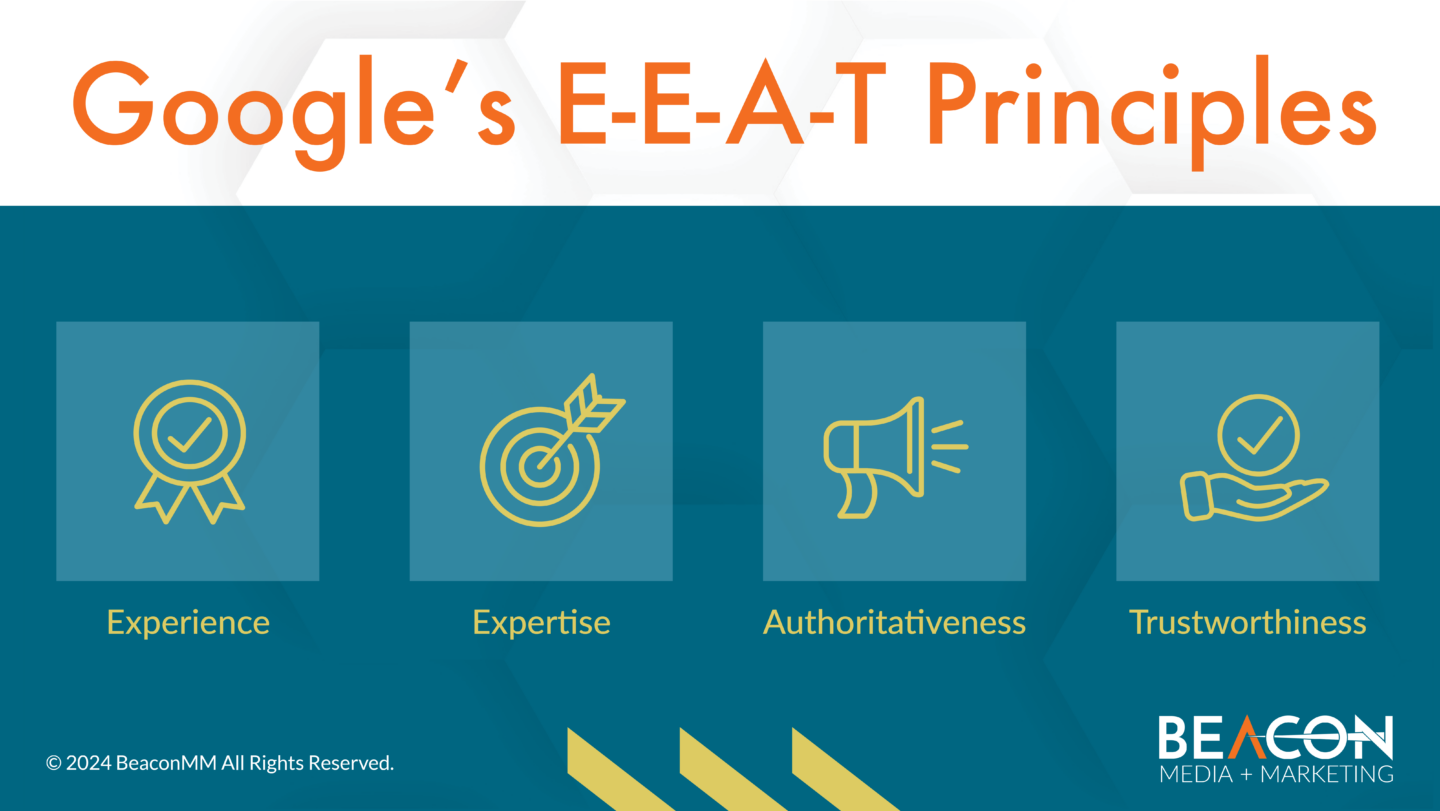
When we think of Google EEAT, for the quality raters to be appeased, we always want to demonstrate experience, expertise, authoritativeness, and trustworthiness, right? This is why these are also the pillars of the Beacon Way, and why they should be an integral part of your marketing approach.

The Problem With Content Overload

If you look at the content that’s living online today, we’re living in an era of content overload — and much of it is a regurgitation of a regurgitation. Content quality in today’s digital landscape, in one simple word, sucks. This alone is causing people to continue scrolling past content because it’s not offering any value. And frankly, what reason does a person have to land on your content and actually read it if it’s the exact same thing they can find on 100 other websites?

Answer: No reason at all.

At Beacon, both with our own content marketing and for our clients, we’re trying to cut through the noise of content overload, mindless content, duplicate content, etc. And the only way to cut through the noise is to have a very specific niche message that connects to people — one that comes from an authoritative or trustworthy source. Basically, you can’t expect a potential client to connect with a social media post, blog, or newsletter that’s been generalized or repurposed 100 times with little to no strategy, personalization, or dedication behind it.

Really, who would want to?

Information overload and baseline educational content marketing are no longer leading the way. Thus, we’ve moved into developing a more personalized niche connection. This aligns with Google EEAT principles because people are not just searching for specific answers, they’re searching to fulfill a very specific need. And we get it — people today are frustrated when they get generalized “answers” and their needs go unmet.

When it comes to audience engagement, we have to remember, we’re living in the age of intelligence. People are seeking not only authenticity but genuine intellect as well. What we’re doing with our marketing approach not only meets Google’s standards, it makes people think and it meets our clients’ needs, and this is the difference between true intelligence and a bucket of generic information.

Do Google’s Quality Rater Guidelines Ever Require a Nuanced Approach?

In a nutshell, yes. We know that Google’s search quality rater EEAT principles are tiered. For example, trustworthiness is sometimes considered to be at the top, with authority, experience, and expertise acting as its supporting tripod — or the three pillars that lead to trust. But, in certain industries, trust may be more important than authority, and vice-versa for others. It’s our job to know the difference.

For example, in the mental health field, as a potential client, trusting your therapist is likely going to be much more important than the therapist’s educational background for most people.

So the question then becomes, will I pick the therapist with a PhD that I can’t trust, or do I pick the person with lesser experience who’s giving me all the right signals of trust? Personally, I’ll always choose the person I trust.

Just for an illustration, let’s pretend a therapist who has just started a practice has 50 great reviews, their website immediately makes you feel welcome and safe, and you can even see a video of them that shows how much they actually care about people. I’m going to choose the person with a high trust factor, even if they haven’t been practicing as long over the person in business for 20 years with minimal customer service information on their website, or no personal signals of trust.

In that scenario, trust holds more weight over authority in order for a conversion to happen. But this can also depend on the niche focus. For example, if I have a family member who needs help with an advanced form of psychosis, authority and expertise are likely going to weigh more heavily over trust — because I really need to know that you know what you’re doing.

At the end of the day, trust can sometimes be established without much authority. However, a lot of authority can also establish trust. Depending on the particular industry nuance, as marketers, we simply have to know when to adjust our focus in order to promote new business growth.

How Can We Establish Authoritativeness in the Eyes of Google and Our Audience?

On authority, my philosophy has always been that it’s always better to have someone else say something good about you instead of you saying something good about yourself. If authority is citing how well you’re regarded in the market and your industry, you saying it about yourself is never going to give you as much bang for your buck as other people saying it about you.

When it comes to authority, potential clients are looking for social proof. This can be reviews, awards, nominations from well-known and respected colleagues in the industry, being cited in different articles, length of time in business, etc. In addition, content is an excellent way to build authority — but only when you’re expressing your own original thoughts. It’s an easy thing to fake, but in 2024, with Google’s recent core update, the simple fact is that it’s all about quality, not quantity.

Why We’re NOT Writing for Search Engines

Google’s latest core update is quite significant, and we anticipate potential impacts on content rankings and results, depending of course on how you create content.

What does that mean for website and content creators, marketers, the SEO community, and business owners?

Google has provided us with a 2-month window to ensure we’re all creating human content that is trustworthy, authoritative, and truly helpful for your audience. The E-E-A-T guidelines (experience, expertise, authoritativeness, and trustworthiness) are now more important than ever before. And this is what it means for us:

  • In Google’s own words, “avoid creating search engine-first content.”
  • Create a customized and personalized content plan that includes your data and relevant information to share.
  • Ensure we include bylines — and utilize writers knowledgeable about the content and who can write to a target audience, not to Google.
  • Utilize caution with the overuse of AI-generated content or AI tools.

For any business owner or content creator, when you adhere to Google’s EEAT principles, if your messaging is authentic and powerful enough, and you’re making real connections through your messaging and content, you’ll develop powerful allies — and many of them will organically come into your world.

Our job is to harness what our client already has and then amplify it for their audience, not for Google.

The Evolution of Google’s EEAT

Concerning Google’s approach, I think Google is going to continue in its current direction — but we may also see a “tightening of the reigns.” Basically, we’ll see Google looking for (or requiring) more ways to validate the authenticity of content or a specific company.

Correspondingly, we’ve already seen subtle shifts where brand identity is making a more noticeable appearance in search results, as Google has been adding brand logos and images to search results listings. And brand identity has always been very important for search, not only for clients but for Google as well.

If Google aims to remain competitive with the new surge of AI tools that also offer search capabilities, it must have access to the best information. This is where EEAT principles come in — because this will ensure that content ranked highly on Google is the best content a user can find.

Let’s face it, in the current AI landscape, when you’re searching with AI for “good information,” you have to go back and check where it originates from — otherwise, you could be generating false content, half-truths, or citing sources that simply don’t even exist.

As far as the future of Google EEAT is concerned, I believe the bottom line remains true, it’s going to be about quality over quantity. AI-generated content will continue to be penalized. And those who utilize 100% AI-generated content are ultimately operating in the opposite direction of all Google EEAT signals.

What we need now is real information. In our increasingly automated world, people have become desperate for authentic connections. This is going to include ghostwritten content, quotes from authoritative sources, real interviews, real videos, and most importantly, original human thought — because without our own element of experience, expertise, authority, and trustworthiness, what do we really have to offer?

Ready to learn more about how we’re creating content that really matters? Contact us today for a free discovery call.

In the digital age, where we’re so accustomed to information being a short click away, a well-designed website becomes a crucial gateway to generating new client growth — especially in the world of behavioral health. As such, the art of behavioral health website design goes beyond aesthetics; it involves creating a user-friendly and empathetic virtual space that fosters connection, provides valuable resources, and supports individuals on their wellness journey.

Let’s face it, it’s a reality that the majority of individuals initiate their search for a therapist through sites like Google. When exploring potential behavioral health providers, people commonly turn to a clinic’s website as their initial point of reference. Similar to other mental health websites or business platforms, the significance of having a well-designed website cannot be overstated. With this in mind, relying on listing your practice in a therapist directory is grossly insufficient for mental health marketing — especially when it comes to meeting the comprehensive needs of online visibility and user engagement.

In the following, we’ll explore the nuances of website design and highlight key elements and considerations that make behavioral health website design an art form in itself.

Need help reaching Behavioral health clients in your area? Check out our full suite of Behavioral health marketing services.

What Do Behavioral Health Clients Want?

This is a question that you must know the answer to. More importantly, you should also understand the nuanced needs of your target audience.

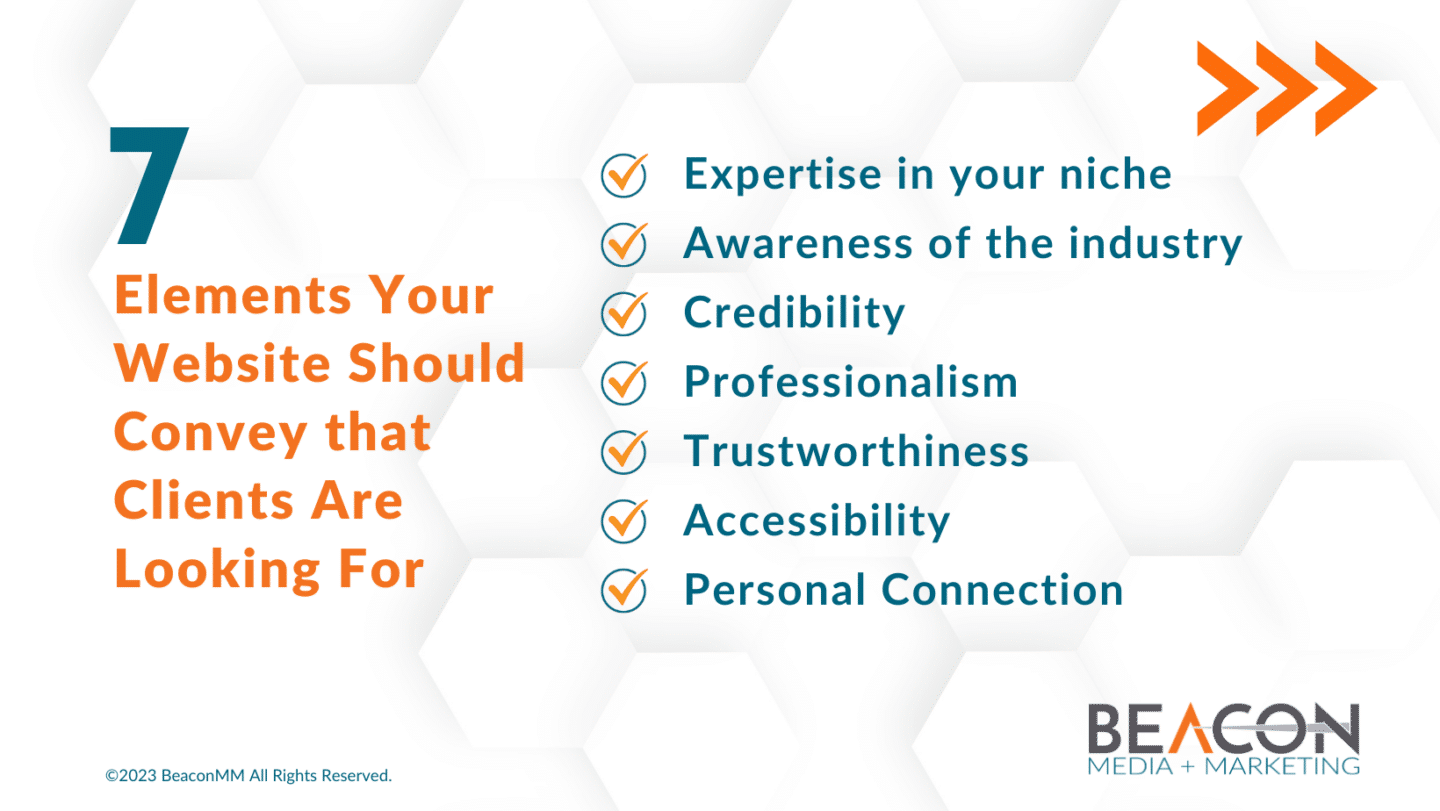
Your potential clients likely care about the following:

  • Your expertise qualifies you to address their behavioral health concerns and mental health issues effectively.
  • Your practice is characterized by mental health awareness, credibility, trustworthiness, and professionalism.
  • Your clinic is both accessible and relatable to individuals seeking support.
  • Establishing a personal connection is achievable, fostering a deeper level of engagement with your audience.

Your Behavioral Health website should:

  • Serve as the final destination for prospective clients before scheduling an appointment with you.
  • Provide a comprehensive repository of information, including details about your services, specialties, operating hours, location, testimonials, and therapist staff.

Keeping Your Behavioral Health Web Design Up To Date

At Beacon, a common inquiry we pose to our clients is, “When did you last update your behavioral health clinic’s website?”

Given the continuous evolution of web technologies, it is widely recommended to refresh your mental health website design every two to three years. If your last website redesign dates back five years or more, it is likely advisable to initiate plans for a comprehensive overhaul.

Perform a Key Features Audit

Cultivating the practice of regularly reviewing your website is an excellent habit. In addition to evaluating your site based on the items outlined in our Behavioral Health Website Design Checklist below, it’s essential to consider the following:

  • Is my website aligned with current website design trends?
  • Are there any changes in my behavioral health center that are not currently reflected on the site?
  • Is my copywriting easily readable, addressing user questions, and free of errors?
  • Should I consider hiring or parting ways with a digital marketing agency to efficiently manage this aspect of the business?

At Beacon Media + Marketing, our dedicated website design services are tailored to not only enhance the representation of your practice but also to foster significant growth for your behavioral health center. Our team is committed to creating an online presence that effectively communicates your center’s values, engages your target audience, and ultimately contributes to the expansion of your impact within the mental health community.

Engage in a Reflective Session to Define Your Behavioral Health Website Objectives

Prior to embarking on the creative journey, take a moment to reassess the goals you want your website to meet. Analyze the strengths and weaknesses of your current website design. Most importantly, define your ideal client and critically assess whether your existing website resonates with and appeals to them effectively.

What Does Your Team Think?

Believe it or not, collaborating with other mental health professionals on your team is essential when it comes to defining goals and prioritizing objectives.

For example, you can initiate the brainstorming process by engaging your behavioral health team — setting aside dedicated time to collectively review the website and aiming to gather insights from the entire team regarding what works and what doesn’t.

Conversations with team members offer a valuable advantage, as each individual brings a unique perspective to the table. For example, your front desk team may identify client scheduling issues or highlight challenges in locating new client paperwork. Therapists can contribute by pinpointing missing services, identifying broken links, or flagging outdated and irrelevant informational content.

For a comprehensive approach, you might even consider inviting a selection of patients to provide feedback on what they appreciate about your website and suggestions for improvement.

Define Your Strategies and Articulate Your Brand Message

At Beacon, as we embark on a new web design project, we guide our clients through the following inquiries:

  • What are your growth aspirations, and where do you envision your Behavioral Health clinic in 5, 10, or 20 years?
  • How does the goal for this website design align with your broader growth plan?
  • When visitors land on your site, what specific issue or challenge are they seeking to address?
  • Are there particular websites that resonate with you? If so, what aspects do you appreciate about them?
  • Do you already possess a branding package, including elements like a logo, colors, fonts, and visual assets, that we can incorporate into this design?

The objective behind addressing these questions is to develop a roadmap outlining essential features and objectives for your upcoming website design. This comprehensive roadmap serves as a valuable guide, ensuring that your new website aligns seamlessly with your vision and goals.

Are you ready to make an impact with a new behavioral health website? Reach out to Beacon Media + Marketing today and schedule a free discovery call.

Define Your Website Design Structure

Following collaborative discussions with your team and the establishment of your overarching roadmap, it’s now crucial to delve into the specifics.

To effectively steer the web design process, the creation of two fundamental documents is essential: a site map and a wireframe.

What is a site map?

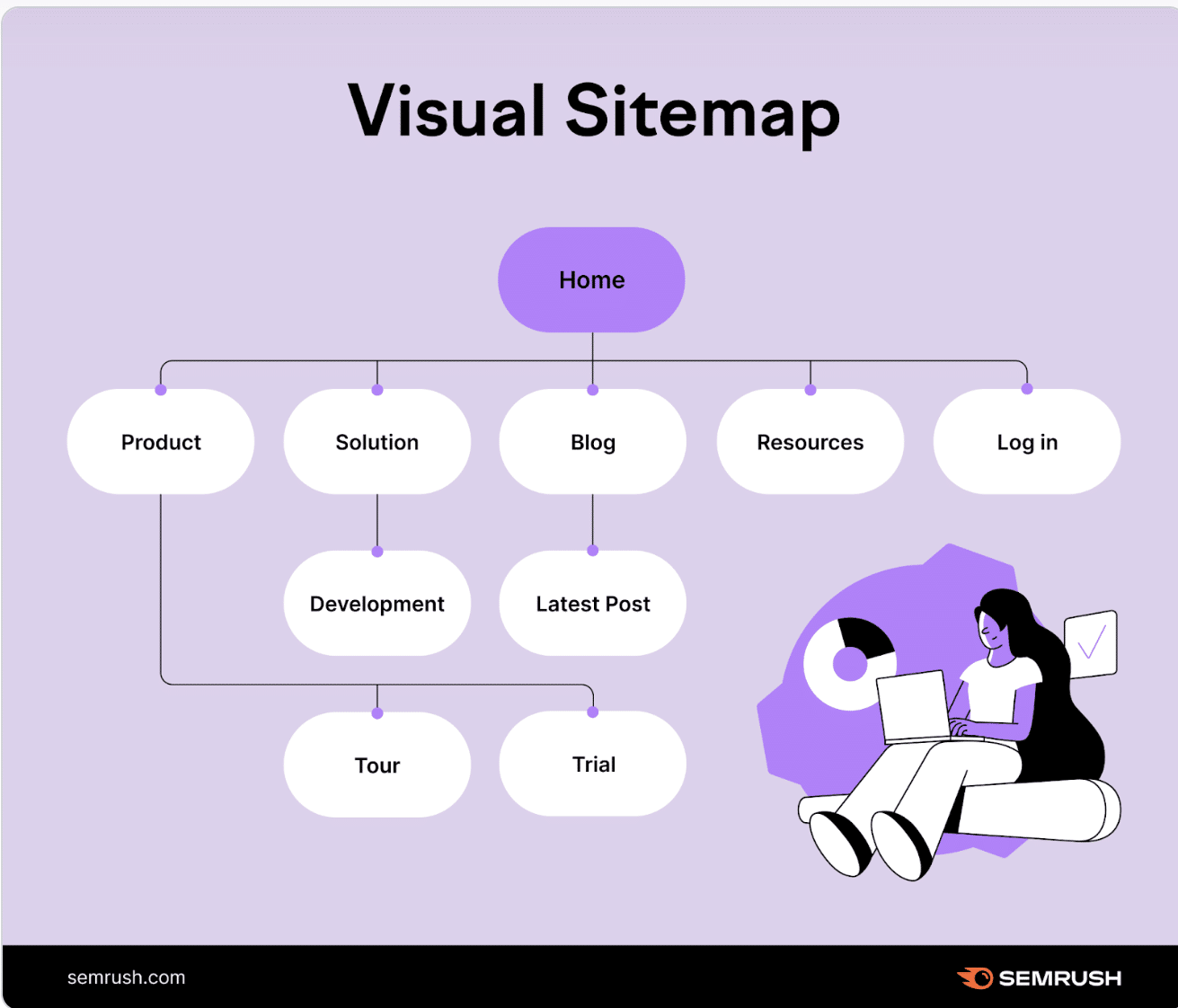
A site map is a visual representation, often presented as a flowchart or a bullet-point list, outlining the pages you intend to include on your website. Additionally, it indicates the placement of these pages within your navigation menu, providing a structured blueprint for your website’s architecture.

A site map for a standard five-page website can look like this:

  • Home Page
  • About Us
  • Services
  • Service A
  • Service B
  • Service C
  • Blog
  • Contact Us

You’ll notice that the example above encompasses a home page, an about us page, three primary service pages, a blog, and a contact page. Utilizing the information from the site map, you can then generate a wireframe to delineate the structure and content layout for each page on your website.

Image Credit: Semrush.com

What’s a wireframe?

As per Google’s definition, a wireframe constitutes a “set of images illustrating the functional elements of a website or page, commonly employed for planning the site’s structure and functionality.”

In essence, a wireframe serves as a detailed draft sketch outlining how you intend to organize your web content, defining its functionality and visual appearance.

Navigating Your Project Through the Use of a Wireframe

To effectively steer your web project, ensure your wireframe encompasses designated spaces for:

  • Headers
  • Images
  • Content boxes
  • Buttons
  • Form fields

If you are new to wireframing, a helpful approach is to practice wireframing an existing website. To facilitate this process, there are numerous online wireframing tools accessible. A few examples are Figma, Miro, and MockFlow, which provide a user-friendly experience with drag-and-drop functionality and pre-designed elements.

Craft Your Behavioral Health Content

Regardless of mental health services, you’re going to need precise, informative, and engaging content. This is the phase where you develop the content for your Behavioral Health website. In your wireframe, pinpoint all the headers and content boxes, as they serve as guides for where you intend to incorporate text on each of your web pages.

To create compelling and captivating content for your website design, consider the following processes:

Using SEO Keywords

The visibility of your new web design hinges on its ranking on Google. Consequently, an integral aspect of crafting web content is the meticulous research and optimization of SEO keywords.

For every web page, pinpoint one or two keywords that encapsulate the primary theme of that page and align with the key search terms potential clients use.

Take, for instance, our client, the Center for Grief and Trauma Therapy, which provides grief and trauma therapy services in Delaware. On their home page, we strategically targeted the keyword phrase “grief and trauma therapy.” Additionally, we incorporated the service location “Delaware” in a header to enhance their local SEO presence.

Keep in mind that one element of using keywords is including them in the title of the page and several of the headers. Ideally, your keywords will be dispersed evenly throughout the content.

Using SEO Effectively

Navigating the intricacies of SEO involves in-depth research and careful selection of optimal keywords for each page of your Behavioral Health website.

As a rule of thumb, we utilize various online tools at Beacon to identify the keywords employed by individuals in their web searches — especially when exploring specific topics relevant to our clients’ industries.

Some of these tools include:

·       Google Ads Keyword Planner

·       Google Trends

·       SEM Rush

·       Keyword Tool

·       AnswerThePublic

·       SpyFu

Effectively incorporating SEO keywords into your content has the potential to elevate your website’s visibility, allowing it to secure a prominent position on the first page of Google for relevant search terms in your specific geographical area. This increased visibility not only enhances your online presence but also significantly boosts the likelihood of attracting local users searching for services or information within the behavioral health niche.

Crafting Compelling Headlines

Online reading habits differ significantly, with most users engaging in quick skimming for essential information. As such, headlines play a pivotal role in providing an overview and guiding users to their desired destinations. Hence, getting headlines right is crucial for an optimal website user experience.

As a best practice, you’ll want to incorporate your keywords strategically to compose captivating headlines that not only capture attention but also succinctly convey your intended message.

In the context of Behavioral health websites, the primary objectives should include leveraging headers to connect with potential clients, eliminating barriers, and encouraging them to seek assistance.

Creating Engaging Content

Consider the type of website content that captivates your interest — likely, it’s easy to read, relatable, and genuinely helpful. In this phase, you aim to initiate a meaningful conversation with potential clients, providing them with a clear understanding of the services you offer.

Drawing on our experience at Beacon, we’ve gleaned valuable insights from developing successful behavioral health website designs.

Consider the following elements when creating your content:

  • Compelling content is concise and direct, getting straight to the point.
  • Engaging content employs the second person, directly addressing the reader as “you.”
  • Empathetic and heart-to-heart communication characterizes engaging content.
  • Recognizing the reader’s needs, engaging content provides effective solutions.
  • Prioritizing essential information and ensuring easy navigation defines engaging content.
  • Including a clear next step or call-to-action enhances the effectiveness of engaging content.

Highlighting Services

The primary pages on your website should offer in-depth details about your behavioral health services, emphasizing a service-oriented approach rather than an overly educational one.

For instance, visitors to your website will likely seek information on how your Behavioral health services can assist with issues like depression and anxiety. However, they are probably less interested in delving into an extensive description of the intricacies of what depression entails.

What should you incorporate in your blog?

Your behavioral health blog serves as an ideal platform to deliver valuable and educational content to your audience. On the other hand, the primary pages of your website should center on showcasing your practice, elucidating your approach to assistance, and guiding individuals on scheduling appointments.

Where should you position a call-to-action (CTA)?

Embed a call-to-action (CTA) on every page of your business website. This strategic placement assists readers in progressing towards becoming patients at your clinic. Prominently designed buttons serve as effective attention-grabbers, encouraging individuals to take the crucial step of scheduling an appointment.

Craft Your Website Design

Once you’ve assembled all the essential elements consistent with your mental health practice — your site map, wireframe, and website content — you’re well-equipped to smoothly execute your website design!

Consider the following process:

  • Commence by choosing the website software that aligns with your preferences. At Beacon, we favor WordPress, widely acknowledged as a premier content management system with widespread popularity. While we utilize an advanced version of WordPress, tailored to those familiar with coding and web development nuances, there are simplified packages tailored for beginners.
  • Select the package that best suits your requirements. Throughout this phase, your wireframe serves as a valuable reference for envisioning the final outcome and determining the features you wish to incorporate.
  • Customize your design. Once you’ve chosen and initiated your selected package, the customization journey kicks off, involving the selection of a website theme and the incorporation of your brand details. The chosen theme essentially shapes the design of your website. Take care to meticulously compare available themes with the wireframe you’ve meticulously crafted.
  • Navigate through the entire process of personalizing your chosen theme by infusing it with colors, images, and written website content.

If you encounter any challenges during this process, don’t hesitate to visit WPBeginner for comprehensive answers to your queries!

Launch Your New Behavioral Health Website!

When you’re satisfied with the visual appeal, it’s time to set your launch date.

Before hitting the final “go” button and making your site public, perform a thorough check on these crucial aspects:

  • Ensure all links are functional. Visit each page, click on every link, and test their performance.
  • Verify the proper functionality of your “Contact Us” form. Submit a test entry to ensure it works seamlessly, as overlooking inbound messages is crucial.
  • Confirm the site’s display across popular browsers (Chrome, Firefox, and Safari) to guarantee a visually pleasing experience on the internet.
  • Evaluate how it appears on mobile devices. Load your website on your smartphone and tablet (if applicable) to ensure mobile optimization and proper display.

To make your new Behavioral Health website live, log in to your hosting account and direct your domain name to its new location.

Once your new website is successfully populating at the designated address, you’re all set to go!

Enhance New Patient Growth with a Revamped Behavioral Health Website

If you’ve overlooked the maintenance of your behavioral health website, now is an opportune moment for its rejuvenation. As an increasing number of individuals turn to the internet in search of Behavioral Health services, having a professionally designed and visually appealing website is essential for making a lasting impression in the mental health field.

At Beacon Media + Marketing, we offer an impressive portfolio in the mental health industry that includes behavioral Health and mental wellness websites that not only garnered admiration from our clients but also delivered measurable results and conversions.

If your behavioral health website requires an update, at Beacon Media + Marketing we’re more than happy to assist you in achieving a fresh and captivating look for your business.

Ready to refresh your Behavioral health website design? Schedule your free consultation today!

Authors Adrienne Wilkerson and Jennifer Christensen, adapted to blog by Sara Jokela

In this series, we have been discussing best practices for websites, and what website pages you should include. This installment will discuss the blog page, the FAQ page, and the contact page.

For more information on website best practices, see The Beacon Way Episode 12, Episode 13, and Episode 14.

To Blog or Not To Blog: Is It an Effective Use of Your Time?

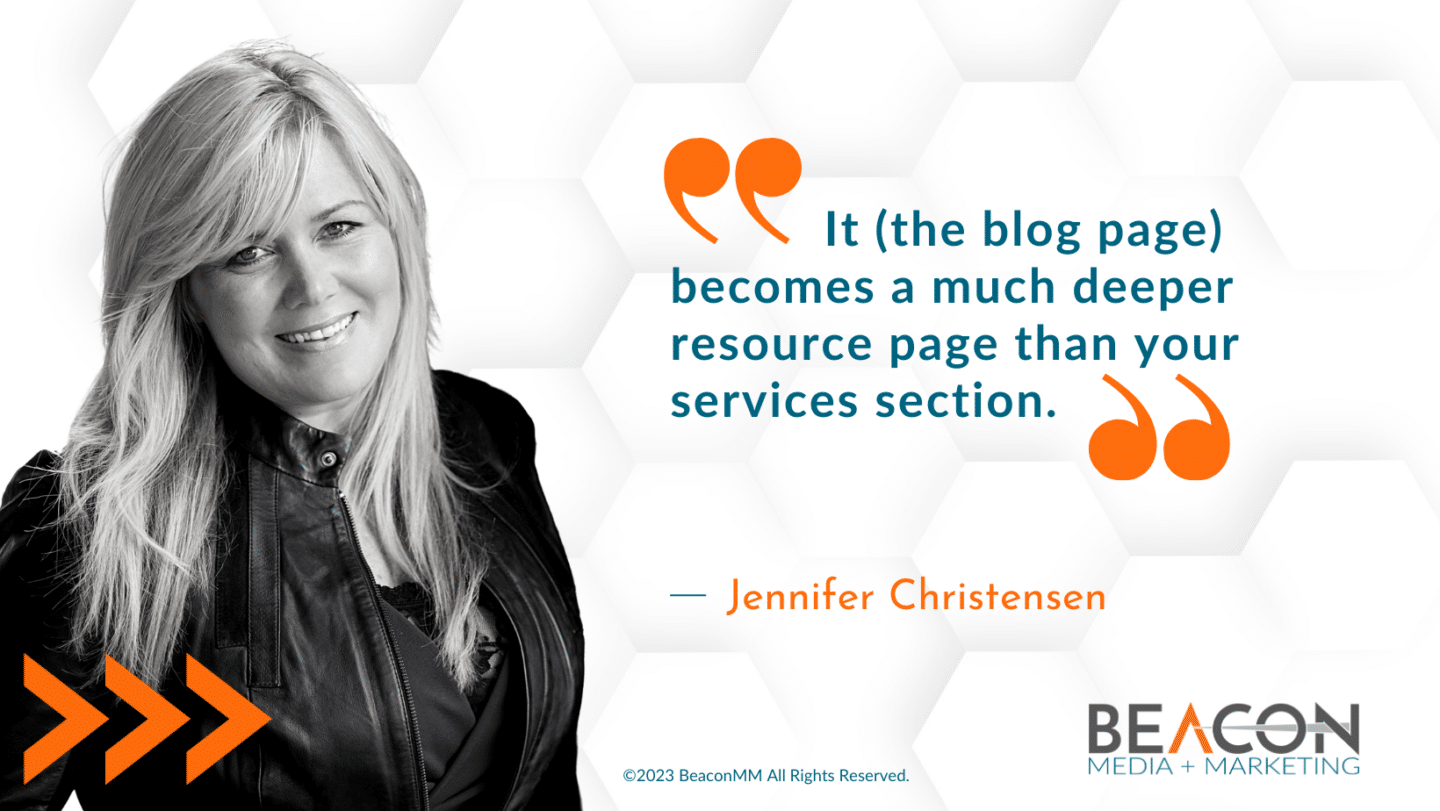
It (the blog page) becomes a much deeper resource page than your services section quote by jennifer christensen

Blogs have evolved significantly over the years and they absolutely can be effective and important to your website.

Providing dense, relevant content to your website pages along with search engine optimization helps your website rank higher with Google which is why blogs can now be seen featuring 2,000 words instead of the previous 1,000-1,200 words.

Clients and your target audience want to learn about your company and the services you offer prior to engaging you in further conversation. This is also where page titles can be a huge asset in initial engagement — as creating a blog page is a valuable tool to providing in-depth information on your website.

Blog subjects can range from how-to guides, pricing strategies, your origin story, and even a highlight of your vendors. Above all, the blog page should be a resource center for those you’re trying to reach.

At Beacon Media + Marketing, we prioritize the categorization and organization of our blog page based on the subject. We want to remove any barrier to a client or potential client finding the information they are looking for.

As mentioned above, this is also advantageous for SEO! Google loves blogs, and Google loves to favorably rank blogs that specifically address the search terms your client and potential client are using.

By providing information on a blog page, you are answering what we call “top of funnel” questions. These are questions that are at the beginning of the research phase of the buyer’s journey and lend to the credibility of your business.

For more information about the Buyer’s Journey, visit The Beacon Way Episode 6: The Customer Buying Process, and Episode 7: How Does The Beacon Way Help The Customer Through The Buying Process.

Should Your Service Pages Cover Sales Questions?

No, not in our opinion and experience. Utilizing web pages such as a blog page that is set up for providing information will be a more authentic user experience that develops the trust of potential customers.

Having a lot of articles available that are answering the questions of your target audience is a great pathway to moving them further down your sales funnel. Some potential customers will take a while to contact you — but if even a fraction of those who visit your blog book an appointment, that is still something we consider a win.

Why Make the Time Investment in Blogs?

Blogs not only provide answers to potential customers and clients, but they offer the flexibility to be adapted into social media assets as well. Blog posts are a great marketing tool to pull quotes for posting and linking back to your small business website.

Blogs also offer a low-pressure approach to your sales process that introduces people to your company and your services without the pushy hard sell of “BUY NOW”.

Just the FAQs For an Effective FAQ Page

Our best advice is to not allow the FAQ page to be an excuse for not answering client questions. Nothing can be more frustrating to website visitors who would like to use a chatbot, make a phone call, or send an email to get more information, only to be sent back repeatedly to the FAQ page.

Just like a testimonials page, FAQ pages can be very effective if used correctly. However, they can also create the impression of your business that it is cold, unapproachable, and seem as if you have no desire to answer more complex or nuanced questions.

Tips and Tricks to Effectively Build Your FAQ Page

  1. Prioritize user-friendliness:
    Users won’t stay in your FAQ section or on your website if they have to hunt for the answer they’re looking for.
  2. Optimize visual appeal and accessibility:
    The font and styling of the FAQ should draw the eye and be easy to read.
  3. Utilize video links:
    Many services can be complex, or they may be new, and a video to explain your product or service process may be the best way to answer potential questions your clients may have.
  4. Organize FAQs by category:
    Questions about billing should be separate from questions about shipping. It just makes sense!
  5. Reinforce your brand by leveraging your FAQ page:
    Your website pages need to feel consistent so that no matter which of the sections the visitor encounters, it feels authentic to your brand messaging.
  6. Use the FAQs as a starting point for further engagement:
    CTAs, chat forms, videos, and blogs are all good options to redirect to or help enhance the information that is being addressed in the FAQ.
  7. Level up by including a personal touch:
    Some answers may be just too complex or nuanced to answer in a FAQ so add a personal touch by owning that and providing an avenue for contact that will allow that question to be answered properly and thoroughly.
  8. Understand and strategize FAQs as a customer service tool:
    Here at Beacon, we are all for using technology to enhance your client and potential customer experience. We advise that when using a FAQ list, do your best to ensure that it is a benefit and not a deterrent.

Contact Us! How to Leverage the Contact Page as an Effective Marketing Tool

We’ve seen it time and time again, the contact page looks empty and neglected. Your contact page is one of your most important pages and should contain more than just your phone number. In fact, there is a huge opportunity to leverage this page to help meet your marketing goals.

What Should You Consider When Writing Your Contact Page?

Contact pages will have less content than other pages on your website, but they also offer a tremendous opportunity to add relevant information — and incorporate search engine optimization (SEO).

When you are strategizing your contact page, some things to consider adding are the various ways to contact you, the most effective way to contact you, and whether you are going to send them to a form.

Many businesses have several forms of communication but some are more easily accessible than others. For instance, if you are sending them to a contact us form and your typical turnaround is 24-48 hours, that should be specified at the time they are sent to the form. Communicating return contact expectations build trust.

Site visitors often may want a quicker way to contact you without a wait time, so there should be several options available and detailed information on how that contact will be handled.

Extending the Investment in Building Trust Past Your Service Page and into the Contact Us Page

All of these considerations should focus on keeping the trust that you have built up until this point. Your contact details are just as important to search engines as your home landing page, blog, services page, and product page.

Each of those pages was strategically built to bring in leads but if those leads aren’t converting because the contact experience isn’t meeting expectations, you’ve lost trust.

The Contact Us Page: A Most Important Portfolio Page

Moving beyond research into conversion is all in the details for many reasons across your site. Visitors want to options so we recommend that you give as many options for contacting you as possible and explain how those options can be used best.

The contact us page is a critical web page — and a continuation of the customer experience. Customer feedback can be vital when reviewing and setting up your page.

Many customers use the contact us page to get a hold of you when something goes wrong and you certainly don’t want to leave them hanging when they need you.

Maintaining the client relationship is just as vital as gaining a new client relationship. Happy clients tend to send referrals and they won’t send a referral if they have difficulty contacting you.

Chatbots: Potential Annoyance or Asset?

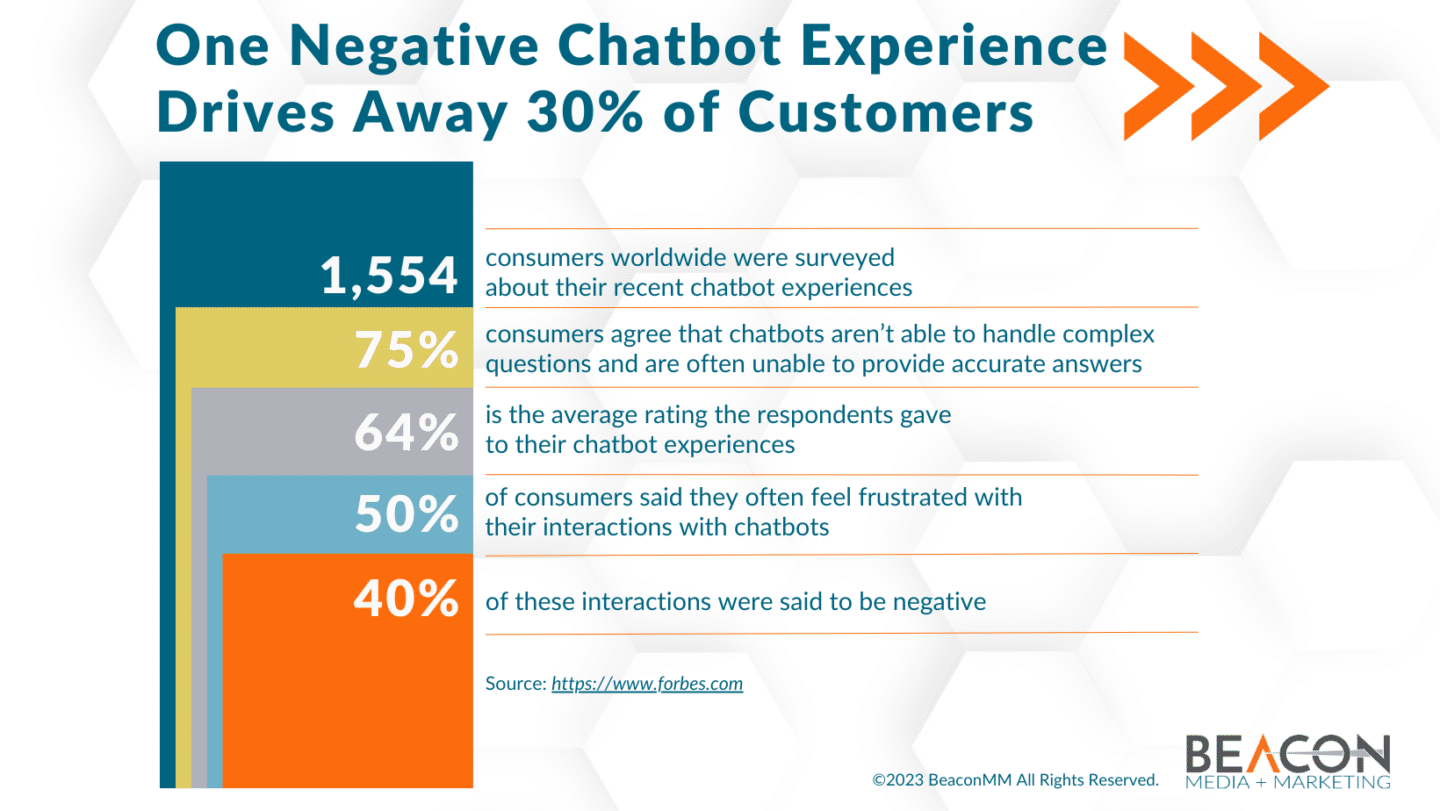
one negative chatbot experience drives away 30% of customers infographic

Chatbots can be both a potential annoyance and an asset. We’ve all had the experience of a chatbot that isn’t working properly and that is incredibly frustrating.

In the era we are living in, AI chatbots pop up automatically on most sites your visit. When the chatbot is aggressive and it’s not easy to navigate away from it, that can be highly annoying for the user.

Ultimately, it is another option for a form of communication and people like options. We have seen that the more we call out the chatbot for what it is, the better customer responds to it and we like to communicate the expectation of when to expect the return reach out.

Best Practices for Chatbots

  1. Make sure to communicate clearly whether or not a human is attached to the chatbot:
    Customers who expect to be connected to a customer service agent but are funneled to a form instead are likely to lose trust in your business.
  2. Clearly communicate all the details of the return reach out:
    Removing barriers to contact are important when strategizing how your customers can contact you. Clearly communicating when you are and are not available builds trust in your business.
  3. Allow the user to be able to close the chatbot and return to it if they want to:
    Chatbots that obstruct the user, particularly on mobile, from navigating your site to retrieve the information they are looking for will be more likely to bounce off your site.

Transparency Matters in the Digital Customer-Facing Landscape

No matter your industry, being transparent in your customer-facing digital landscape is crucial to building the trust with clients that we so often talk about.

The answer could be that you won’t be able to answer them for a week because you are out of the office, and that is ok as long as you clearly communicate that upfront to the customer.

Don’t shy away from being honest and transparent with your digital marketing efforts. It will really serve you well in the long run.

The Beacon Way is a Podcast and blog series with the mission to help others understand and navigate the digital marketing world. Listen to The Beacon Way on our website or wherever podcasts can be found.

Build a Website That Cultivates Connections With Clients

Digital marketing is an ever-moving entity but does contain some constants. For example, cultivating connections with clients over a digital marketing platform is more relevant than ever in our digital age.

For more information, check out Episode 12 and Episode 13 of The Beacon Way, where we discuss how a website is the cornerstone of digital marketing campaigns and how building a home and about page that people want to read will benefit your business.

Transparency in Price Listing on Your Website: A Recommended Do or a DON’T?

Prices on your web pages are a controversial subject among business owners and digital marketers. The Beacon Way highlights transparency as one of our values — so we believe this is a marketing strategy that should be considered.

Potential customers are looking for information when they visit your website; it’s part of the customer journey.

We believe that an effective digital marketing strategy should include allowing your website to prescreen visitors to funnel in your target audience and we’ll discuss that more in depth a little later in the blog.

Dig Deep: Sharing Guidelines for Service Pages

Standard logic in website design for service and product pages is, “This is what we offer and this is what we do ~ Click this widget and you’re in!” This is only the surface of what your website should offer, but have you considered going deeper?

Potential customers have already used digital channels and are visiting your site. They’re spending time on the Home page and the About page — getting to know you. We want to emphasize that you cannot overshare information on your service pages.

Digital marketing using Google Analytics and search engine optimization allows your pages to rank well and we recommend focusing those marketing efforts into content marketing on your service pages.

Your target audience has found you! Now it’s time to answer their questions about the services you provide. Establishing your authority on a subject is not just a marketing strategy — it’s a way to earn the trust of your reader and increase conversions.

Style Matters: Visual Appeal in a Virtual World

Content marketing strategy is an important component of your service and product pages. Certain industries need to consider more education for their services that they know won’t convert as easily as others.

Botox, for example, has done a great job in marketing itself. They have used multiple channels to educate the consumer on who they are and what their product does. This type of service won’t need as much education as a lesser-known service.

By focusing your digital marketing efforts on developing a content-rich service page, you’ll create an environment where your higher-end, lesser-known services will convert more easily by providing your visitor with a really good education.

Social proof, visuals, links, and blogs are a great way to keep the conversation going. Potential customers want to have plenty of research under their belt and see the experience of others who have used your services. The bottom line: They need reassurance before making a big purchase from you.

How to Communicate What You Know: Developing a Content Marketing Strategy

When considering your content marketing strategy, how will you get the information out there for new and current prospective customers?

You already know the knowledge base your clients are coming to you with, consider what other services may they be interested in and searching for on social media channels or anywhere online.

The Beacon Way recommends that a service page should contain about 2000 words to be successful in the search engine optimization arena.

Check out how Beacon Media + Marketing has designed our Service Pages here https://www.beaconmm.com/marketing-services/

That’s a lot of content! So, part of your digital marketing strategy should be how you will visually arrange that to keep the attention of the reader and keep them on your page.

Linking blogs and other information keeps your reader on your page — which pleases the search engines ranking algorithms and serves to educate your website visitor.

They may want to read more information from those blogs that originate from your site or they will hit your Call-To-Action button. Either way, it’s a win for you!

Digital Marketing Channels: Be Prepared to Shift Strategies

Digital marketing strategies change in the digital marketing channels and you need to be prepared to make shifts as they make these changes.

In the past, Google ads used to consider it acceptable to send the user to your general services page when pay-per-click advertising was used. That is not the case any longer, now it’s important for Google ads to have the specific information match up to the specific service on your page.

Circling back to the Botox example, PPC campaigns for an application of facial Botox, as opposed to other application places, should lead website traffic to facial Botox.

So social media advertising has become a lot more specific and picky about how it is applied as opposed to the traditional search engine marketing methods that were used in years past.

Breaking out your services can seem a little repetitive but potential customers want to learn about Botox and they are sent to the homepage, which can be very annoying. A digital marketing strategy should always consider the User’s experience.

UX and Multiple Service Pages: Why it Matters

In Episode 12 of The Beacon Way, we discussed the Homepage of your website and why that matters— it’s a digital introduction to your business. The service page act as a digital marketer (and sales agent) for those who are interested in learning more about what you do.

Using a digital marketing strategy with multiple service pages serves to break up the content and allow the user to spend more time on your site — and increase the odds of them continuing to explore what you offer.

If your site is full of pop-ups or doesn’t direct them to the subject the ad promised, the bounce rate skyrockets. Google Analytics has figured this out and they will de-rank your digital advertising and charge you more to run those ads.

In addition to a skyrocketing bounce rate and ad spend, it’s counterintuitive to what the digital marketing strategy was created for.

Other sources of social media marketing campaigns, like Facebook, may not apply these changes but instead will be initiated by the user because they want to be redirected to the subject they’re looking for, so the bounce rate will still be high in this circumstance as well.

Listing Your Pricing Online: Why The Beacon Way Encourages It

adrienne wilkerson quote

As we stated previously, this controversial subject has been a point of contention among digital marketers for a very long time. Here at Beacon, we decided the risk is worth it.

Understandably, the reasoning against this online marketing strategy is valid. It can feel like you’re giving away your secret sauce and all your competitors are going to go on the offensive to drive pricing down.

The truth is that everyone is searching for that information. In fact, one of our best-performing blogs is https://www.beaconmm.com/2020/04/30/how-much-does-cost-hire-agency/.

This blog gets so much website traffic because current and prospective customers are searching for a range of costs that they can expect for the services they want to contract.

This not only helps them plan, but it also serves a few other purposes as well.

  1. It can pre-qualify or disqualify leads, saving Sales time and unproductive appointments.
  2. It helps keep sticker shock at bay by outlining expense expectations for your future clients.

Potential customers will know if their budget supports more investigation into hiring us as their digital marketing partner.

At the time of the sales call, they come in prepared for the costs expected from the list of services you offer — which helps them decide on services that are the most important to them.

Staying Competitive: Offer a Range instead of Hard and Fast Numbers

Digital marketing techniques employed in your strategy are unique to you and what you want to present to the world. It’s ok to not reveal all the ingredients in your secret sauce!

Beacon Media + Marketing has a variety of packages we offer for our digital marketing services. Not all websites we design cost the same and therefore our pricing has to be different for each project.

Our web design services start at $3500 and can range to $50,000 depending on the client’s needs.

We offer a range based on the work that needs to be done and the client’s approach to services. No matter where the price point starts, be transparent and explain the why behind the pricing.

Check out our ever-evolving Web Design page here for inspiration and reach out to our top-notch sales team to discuss our web packages!

Highlight Your Values in Your Marketing Strategy

Your services may range higher than a competitor, and that’s ok! Consider what makes you different and why you charge more, using that to your advantage. We talk so much about how transparency breeds trust and this area is no different.

Wendy’s Burger King, and McDonald’s would generally be considered apples-to-apples competitors until Wendy’s decided to highlight the value that they have for serving menu items it deems as fresher than the competition.

Wendy’s digital marketing tactics were to come right out and say this is who we are, why we do what we do, and why are prices are different from our competitors.

Make your case and stand behind it, let your digital marketing work to grab the attention of those target customers.

The Price Matters

Check out Episode 10: Brand Messaging Part 3

In Episode 10, we talked about the pricing triangle: speed, price, and quality. One will always suffer, so make that part of your why.

Perhaps your business charges more for services because you have an expert in that field and your client will be receiving higher-quality services from that provider. This will either matter to the client or it won’t. But in either case, it will help vet the client before they come into your sales funnel.

If price matters over quality for that client and they pass you by, consider that a gift. It more than likely would have led to a difficult client relationship in regard to price.

Talking Money Shouldn’t Be a Taboo

One of the best examples we’ve seen of this is a digital marketing agency that said their minimum buy-in was $5000 a month.

They wrote a great blog story on their values, how they treat their staff, how long the staff retention is, how long client retention is, and how all of those things go together.

Yes, $5000 a month can be a bit much for some to start with, but the results will speak for themselves and the transparency of this agency that was laid before potential clients was evidence of that.

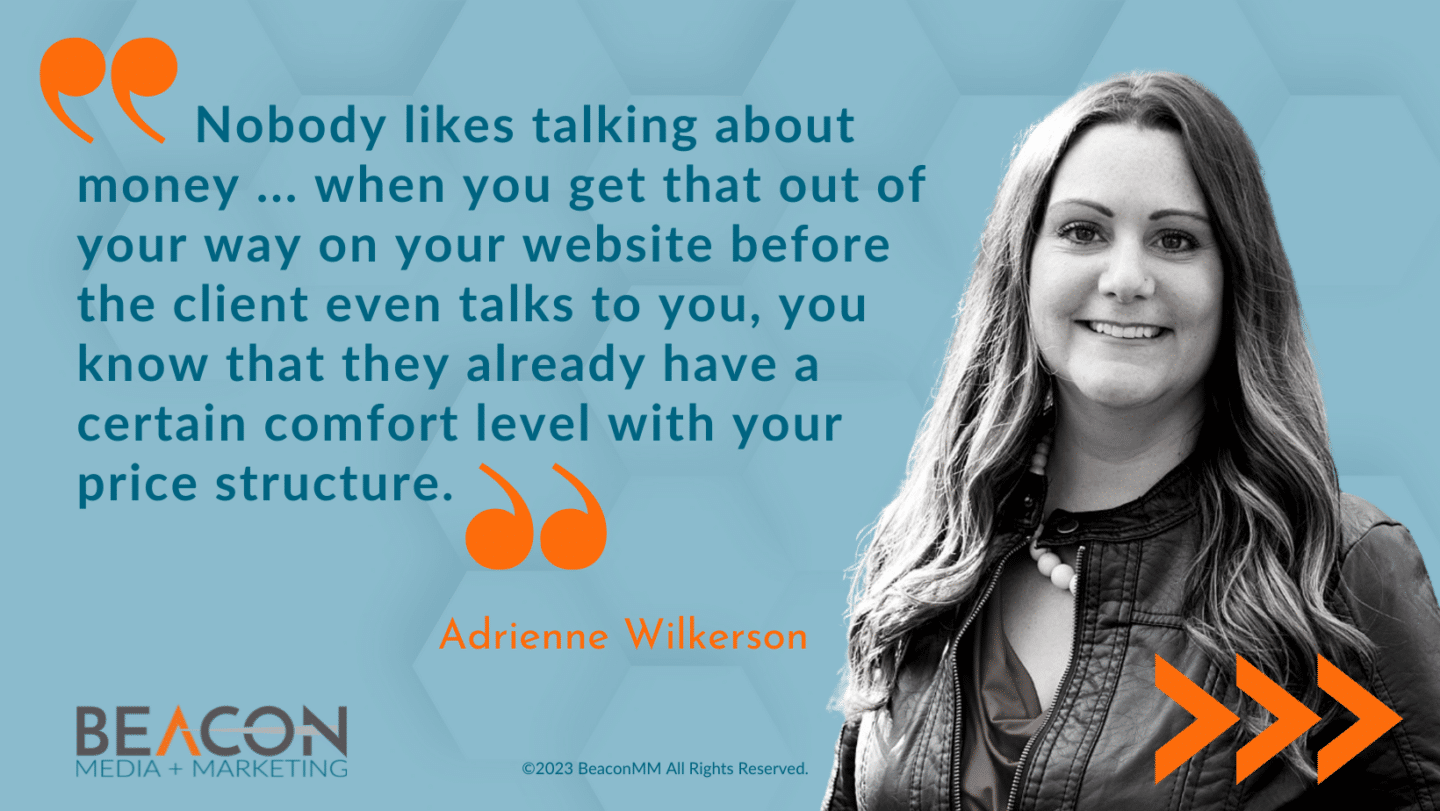
Oftentimes, pricing conversations are the most awkward part of the sales process. No one really likes to talk about money, so taking that guesswork out of the sales conversation provides a certain comfort level with both parties and removes a huge barrier to conversion.

You can assume that nine times out of ten, they’ve already been to your website, looked at your prices, and decided they are comfortable continuing the conversation with you.

The fewer barriers you have to overcome in the sales process, the better the experience will be for all involved.

Use a Measure of Caution: Don’t Bait and Switch

The fastest way to lose a client with internet marketing is to claim one thing on your website and tell them something different when you meet with them. People want to buy from others they know, like, and trust.

Using the bait-and-switch method is not only counterproductive but unethical as well. It may serve to get some quick business in the door — but it is not a good way to create long-term business relationships.

We’ve done it both ways at Beacon. We’ve published our prices and removed them — so we truly understand the risk in what we’re advising you to do with your pricing.

Overall, we believe that the risk is worth it because we’ve seen it pay off for business owners time and time again.

Not only will you gain a different position in the market, but you’ll also see more traffic, and people will trust you more because you’re willing to be transparent.

Don’t be afraid to tell your story and go deeper into the “why” behind your pricing structure. Believe it or not, you’re not just competing on price.

The Parable of the Dryer Ball

Have you ever looked for something silly and thought, “Oh! I’ll just pop on Amazon real quick and pick this item up.” One day as Adrienne was shopping for some plastic dryer balls, she got sucked in by the word “organic” and the story of a company selling dryer balls made of wool.

The story went on about how wool was sourced from a specific organic farm in New Zealand that detailed how they cared for the sheep and she was hooked!

Price didn’t matter at that point because of the investment and connection she felt with the farm that was being supported by this company — and the beautiful lives of the sheep they took the wool from.

When people connect to your story and align themselves with the values you communicate in that story, suddenly the investment isn’t as shocking or jarring as it could have been for them because they believe in who you are and what you’re doing.

Go Deep and Leverage the Power of Your Story

Whether you’re in digital marketing, traditional marketing, or another industry, your story has power.

Human connection in digital channels can be one of your greatest assets. Our digital society has opened a world of connectivity for your story and your business — much greater than in direct mail or offline marketing.

Ask probing questions, be transparent, live your values in your business and you’ll authentically connect to those who share those same values. We guarantee it’s worth the risk.

Join us for more episodes of The Beacon Way as we continue to talk about how to leverage your website to Grow, Scale, and Thrive!

Homepage Necessities for Success

what is the average time spent on a website infographic

Communications have changed so much over the years, in more recent history, newspapers and magazines were the option for printed marketing and advertising. Advertisers wanted their business name to be on the front page or above the fold because passers-by could see it at a glance without purchasing a paper. The same is true for any media site.

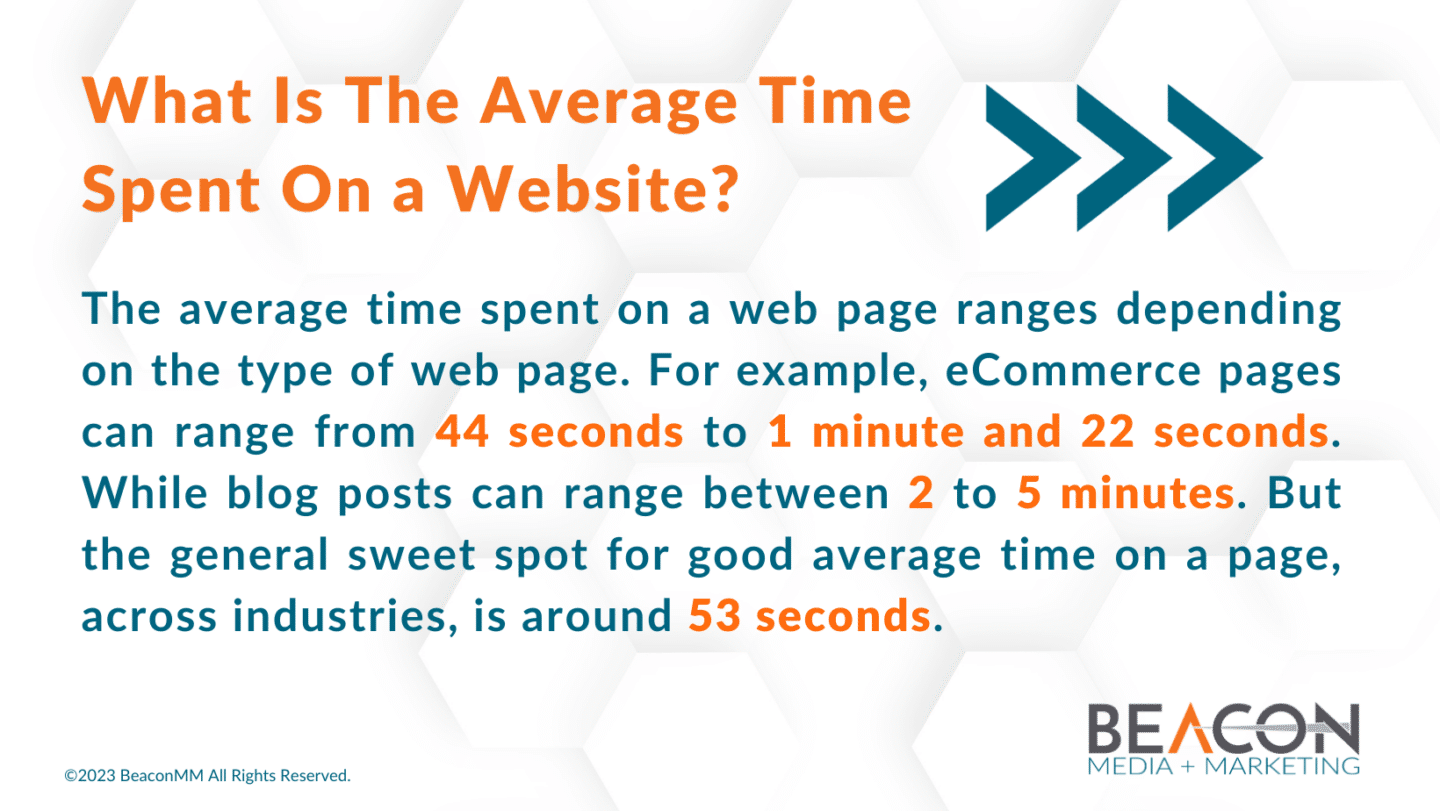
According to websitebuilderexpert.com, the average time spent on a web page across multiple industries is 53 seconds. Your website’s homepage has less than one minute to grab the attention of the viewer. This is why the impression on your web page above the fold is so vital.

Your Homepage is Prime Real Estate

Considering the above statistic, misunderstanding the value of your homepage is a mistake you can’t afford to make. Your goal should be for users to become engaged with you and there is a limited amount of time to make that happen before they navigate to other sites.

Statistically, about 50% of traffic will be directed to your home page from a search engine. The Beacon Way suggests three things you should focus on for a successful web page visit.

3 Tried and True Tips for Homepage Success!

  1. Clear and Effective Communication of Your Unique Selling Position

Your welcome page is your main page. As such, this needs to say what you do and what services you offer. Beyond that, what makes you good at what you do, or what makes you unique at it?

Pretty pictures, sleek designs, and even your logo might draw in site visitors, but adding specific website content that tells your story is a fabulous opportunity to keep them from bouncing off your page. The story should be succinct, clear, and quickly communicated.

Additionally, pulling out what is unique to you can take some thought and it’s a worthy investment. Consider enlisting the help of friends, family, and trusted clients when crafting your home page story.

  1. Establish Credibility

Secondly, The Beacon Way advises that you establish credibility. In prior episodes, we have talked a lot about how your target audience wants to know, like, and trust you. Social proof is the gateway to that trust relationship that means so much to your business.

Social proof is the content that grabs the attention of visitors when they are asking, “Do they really do what they say they do?”. Case studies, testimonials, videos, and even reviews help establish trust just by the visit to your webpage.

  1. Remove Barriers

Third, we at Beacon advise that you remove any barriers, tell people what you do, and what they can expect from you when they engage you for services. Don’t make the experience complicated for your visitors.

As we talked about in Episode 12 of The Beacon Way, what your website’s homepage communicates to your audience is their first impression of you. If it’s difficult to navigate, you’ve most likely lost them and if they proceed then they must really want to buy from you.

The more you guide a potential client on your homepage, the happier they will be because they won’t have to think about where to click next, you’ve already done that for them.

For example, Apple is a prime company that thinks intuitively when it comes to the navigation of its web pages. This is because they’ve thought through where site visitors want to go and what they want to do on their site.

Again, The Beacon Way recommends that you think through a site visitor’s experience and remove as many barriers as possible from not only your main homepage but from your service pages — and from any landing page on your website.

Providing a clear navigation bar, an arrow, a CTA (Call To Action), or another pathway that shows examples of where to go next from the home screen may seem like a basic concept. But it’s extremely effective.

SEO Content: It’s Not Just About a Blog Post

Below the fold of your homepage can be a little more challenging. This is where the consideration of UX (user experience) continues. Your site visitors will vary in demographic and personality — but it is possible to appeal to these varied differences.

Visual stop points are also important for your homepage. These stopping points provide an opportunity for the next steps and CTAs but also, continue to grab and hold the attention of your visitors.

At Beacon, we use a lot of visual blocks when we are adding content. Visual blocks allow for those all-important visual stopping points that fulfill the SEO requirements of Google for your page to rank well, regardless of how many visitors scroll down to that point on your page.

Icons, videos, and infographics are all great items to display on your homepage because of their visual appeal with the added bonus of breaking up the SEO content — leading to a more pleasing user experience.

CTA | The Call-To-Action Advantage

One consistent and effective technique we believe every website should have are clear calls to action. A CTA is a prompt for your visitors to take immediate action. The CTA should be concise and appealing, spurring a connection. Whatever the next step is that you want them to take intuitively to connect with you.

CTA’s can come into play on your website in a variety of ways, such as providing links to the blog page of a website containing full articles, connecting via phone, form, or even a download. Different personalities will be prompted to use different CTAs so having many may seem repetitive. However, the goal of your website is to connect the visitors to your sales funnel, and without clear CTAs, they are more likely to bounce off than connect.

Consider CTAs like your website’s sales assistant, always available to make the process easy for your visitors and ready to capture their information so you can continue to grow your relationship with them.

You Don’t Know What You Don’t Know! CTAs Are Here to Help

Visual pathways help establish credibility with your visitors and they are more likely to contact you if they know, like, and trust you. We love the statement, “You don’t know what you don’t know.”

Don’t assume that your visitors know the information that you have to present to them or that they know how to contact you when they’re ready to learn more. Your default web page has done its job effectively when they want to reach out to you for the service you offer, make it easy on them, help them by facilitating giving them the answers to questions they came to ask, and helping them contact you.

You want to be that person who is meeting their needs so they don’t bounce to another site that will.

The About Page | Web-Based Relationship Building

jennifer christensen quote

The About page is a good example of a page that can be confusing to many people. How personal should you get, should your staff be featured, and how to effectively tell your story in a captivating and more in-depth way, are all questions we address with The Beacon Way.

The About page will vary from industry to industry. No matter your industry, the About page is your relationship-building page.

Often, this is the second stop by your website visitors, because they want to know who they’re doing business with. In this day and age where electronic introductions happen all day long, the About page is your virtual handshake. It’s another opportunity to show your visitor what type of relationship you will have outside of the services you provide.

Your About page opens the conversation to who you are and how you’ll conduct yourself with potential clients. Whether consciously or subconsciously, we make a lot of decisions based on if we feel comfortable with someone or not. That decision drives whether we’ll let them in or walk away.

In many industries, comfortability and trust are all you have to open the door for services, like therapy, for example. Your site visitor may have had a friend or current client refer them to you and if you don’t strike them as someone they can let in, they will find someone else who does.

Transactional About pages will go through the history of the company and staff and stop there. The Beacon Way encourages you to be ultra-transparent with the people who are interacting with you on your website.

For Beacon, we chose to share our backstory and even talk on our other pages about why we’ve chosen certain industries to niche into. Being transparent is more than a buzzword to us, it’s one of our values and we strive to live it authentically.

The mental health industry is also one of our favorite niche markets and we are very proud to work within it. We love to communicate why this industry matters to us on top of who we are as a company in an endeavor to create a more transparent relationship with our clients.

This goes back to your brand, who you are, and what you want to represent to the world. For more information on brand messaging, check out episodes 8 -11 of The Beacon Way podcast on Brand Messaging.

Your Story Has Value and Makes Connections

One of the joys of The Beacon Way is to encourage our clients to share information on who they are with their target market. In our sales meetings, they share with us who they are and they tell us their story, it connects us to them and provides tremendous insight into how we can best serve them.

Hearing our clients tell us about how proud they are and of their accomplishments, helps us craft, not only a solid marketing strategy but share who they are as a brand and what they want to represent to the world.

Leadership, Staff, and Transparency: It’s All Connected

The Beacon Way also encourages clients to showcase the founders and owners as well as their staff. By keeping your staff shrouded or in the dark, it can unconsciously communicate that you aren’t comfortable with them.

We recommend that you showcase your staff, within reason, through pictures and testimonials on your website pages to support your company culture. Positive experiences by your staff with you as an owner really go a long way to client trust. Remember, as we keep quoting BNI’s Ivan Misner, your clients want to know, like, and trust you.

The more you put out there, the more you’re going to attract the right people.

Introducing your staff to your visitors on your About page can help ease anxiety and nervousness that some may have when approaching your industry. Dentistry, for example, is an industry that causes a lot of anxiety for people. If they can connect on a personal level with some members of the staff, the anxiety starts to fade and they are more likely to connect with you.

In addition, the virtual introduction to your staff serves to connect visitors with a familiar face. Thus, they’ve connected with their story, and recognize who to look for when they come into the office, which begins instant trust. And trust can be the trigger to picking you over another business just by creating an avenue of connection through transparency.


Communicate Confidence: Advantages to Staff on Your Web Pages

Do you believe in your staff and do you want to inspire confidence in them with your clients? We, at Beacon, believe that by introducing them on your site, you will do just that. This personalizes them on a whole new level. Visitors will not only learn who they are but you can use it as a pathway to their client journey.

The new Beacon Media + Marketing site not only shows who are staff are, but it also helps our clients know who will be helping them along the way. From the Sales team to Account Management, even all the way to Accounting — if there is a possible client touchpoint within Beacon, we want you to know who you are interacting with.

Breaking barriers to conflict can be a benefit as well. We cannot deny that collections and billing disputes are a part of every industry. And believe it or not, humanizing your bookkeeper can go a long way in both client relations and getting paid on time.

No matter what your decision is on your About page, your website has to communicate clearly who you are and what you do. Trust starts on your homepage! Reach out to Beacon Media + Marketing today to learn more.

The following four podcasts in our series will center around building your brand through website pages and strategy. Your marketing goals should cultivate connections with your clients and remove barriers. Website strategy should be a foundational piece of your business and an extensive consideration for building your brand messaging.

Creating a Powerful Marketing Hub through Website Development

Marketing happens through many channels but no matter where it happens, if your visitors aren’t being funneled back to a website that is effective, you’ve already lost money.

It is essential to build a website that represents your brand’s personality and begins to help you develop authority with your target audience who wants to know, like, and trust you. It’s most common in this time we live in, that people are using search engines as their starting place to begin researching their needs and begin planning on who and what they need. Removing barriers to connection and creating an easy user experience should be at the top of the list of your marketing goals.

Statistics show that 93% of people are heading to Google or Bing to determine first what they need and where to find it, showing that data-driven decisions are more prevalent now than ever before.

Check out our blog on Episode 4 to find more information on how The Beacon Way helps companies navigate the landscape of this digital world.

Representation of Your Brand Image Through Visuals

Consumers who dive into research and identification of their needs online have decided that they could be your target audience because the information you presented online built interest and trust. Once they decide to then visit your website, that site acts as your digital salesperson ahead of you. It is important to have a solid visual experience and a clear call to action to increase leads.

The look and feel of your brand image online is just as critical as the technical side of your website. The experience that visitors to your website have will influence how they experience your brand. If your website is cold and unfeeling, the perception of your brand will also be cold and unfeeling. If your website is warm and inviting, your brand will be perceived in the same light.

The visual elements you choose, such as colors, fonts, and imagery you use, just to name a few, play a crucial role in user experience and should also be on top of your list when considering branding strategy.

One of the first things we suggest you start analyzing is, “How will new leads experience your brand’s personality on the first visit to your website?” Have you taken the time to determine who your brand is and what you want to portray to your target audience?

To read more about branding strategy, check out our blog series on Brand Messaging, Episode 8, Episode 9, Episode 10, and Episode 11.

Unlocking the Power of Content: Creating Content Tailored for Your Target Audience

When building your website strategy, another priority should be a content strategy. Content strategy is the development and publication of content that your users want to know. What service do you market and can your users find solid information on your website that answers their questions?

A great example of tailoring content is dental veneers. A dentist may create an ad from keyword research showing that people are searching for dental veneers and add those keywords for dental veneers to his website to drive more traffic. Website visitors are going to click that site expecting to learn more about dental veneers.

The content strategy could be: Let’s grab that search attention to drive traffic. But, without any content to back up the ad, the bounce rate skyrockets. You may have increased your views but the trust of that visitor is not gained and they have no reason to stay on your site or convert.

Google Analytics for SEO: Web Crawlers at the Ready

Your website may be on point technically, but if your content is lacking in depth based on Google’s analytics of it, your score will be in danger of being lowered.

Google uses web crawlers to analyze hundreds of billions of web pages looking for a multitude of points. Google wants to see that your content is relevant to what your customers are searching for, and does it have authority and usefulness.

If the search engines see that your pages aren’t relevant, your SEO will decline and they may actually penalize you. If you’re doing ads like the dentist is with the veneers but the page the ad sends the client to is about general dentistry, Google Analytics will decide that isn’t relevant and your ranking will drop. They will continue to take your money and allow the ads, but the SEO effect of that ad will significantly decrease and the price for that ad will significantly increase.

Understanding Your Target Audience: Answer Their Key Questions.

Where good website strategy comes into play, is determining your target audience and then brainstorming their specific questions based on their needs. Buyer personas can help with this tremendously. Utilizing buyer personas helps you narrow down the exact needs of the demographic you are desiring to serve and can help to bring clarity to what they are searching for and why, out of your service.

Your target audience will have specific questions and concerns and there will be specific keywords that they will search for, you want your content pages to be there to answer those questions and concerns for them.

We, at Beacon, want to assure you that even though this seems extremely overwhelming, there are many tools out there to assist you in the discovery of those buyer personas and a good marketing partner can help you reach them, turning them into measurable conversions!

Shifting Focus from Content to Conversion

Once your website strategy has you on the path to clear and relevant content, you can shift your efforts to ensure your website is effectively functioning as your digital salesperson.

If your website is set up properly, meaning your website has all the keyword research, search engine optimization, and critical pages for good ranking it will begin driving more traffic your way.

If this is the case, conversions should come easily. Industries like mental health, dentistry, med spa, and others have clients converting online all the time. The website has done its job, the barriers to booking are removed, and new clients can easily set an appointment at their convenience without ever making a phone call.

What Exactly is a Conversion?

Conversions mean different things to different industries and sometimes even vary depending on your goals. The success of conversion is based on defined goals that you have for your business and what your visitors accomplish on your website.

Considering the mental health space, for these clients, conversion is considered for someone who has potentially gone all the way through the online process to book an appointment. Perhaps the time isn’t booked yet but they have given you their information, shared with you their availability, what service they are looking for from your business, or possibly become a phone call, booking an appointment time.

This is a prime example of a target audience who was just interested but now decided that they are interested in becoming a client of your business. This is the cleanest example of conversion.

Functional medicine, as another example, has a little more depth to create a successful conversion. Ads can send hundreds of interested visitors to them but what the functional medicine space can offer them may not be what they are looking for.

Conversions, again, vary depending on the industry and defined goals. In this particular case, it may be necessary to determine what new leads actually qualify as conversions. It has been necessary for us in the past, to change that definition in order to measure the data accurately to measure the success of the campaign.

For one of our functional medicine clients, we changed the definition of conversion for them and then created a funnel on their website that took people searching for services through a step-by-step process to determine if this business was a good fit for them.

This website strategy was well received by the business because they are no longer being inundated with unqualified leads and they have been able to save so much time and develop good relationships with the ones who are good potential clients. The volume of conversion came down, however, those that remain have a higher rate of conversion by becoming actual closing clients.

Start Creating Success by Defining It for Your Business

At Beacon Media + Marketing, we call conversions leads, and from those conversions about half are good potential clients. You decide what you will call a conversion for your business, we advise that you be thoughtful and strategic about that decision. Only you will know what works best for your business and inflated data isn’t helpful to your success.

The bottom line here is that our websites can do a lot of the pre-qualification for us saving our businesses time, money, and staff power to focus on the things that will make your business a success.

Evolution of the Website and the Need for Strategy

Websites are a fun thing and they really have evolved since they became a thing. In the early 2000s, websites were still very awkward and clunky. Internet sites were secondary to brick and mortar, which still signified you were a legitimate established business.

In the beginning, when websites were first being utilized, no one really thought past the first page because that simply was not the consumer’s first stop. As the consumer landscape changed and evolved, the website changed and evolved with it. Website pages became prettier brochures, then some content started showing up and became useful to the audience.

Web pages for services started becoming part of the digital landscape as well, then introductions to founders and staff. Owners began to say, “Hey, our staff are getting the same questions over and over again, let’s put the answers to those up on our website so people can get their questions answered first before calling.”

The website evolution has been an interesting trend to watch, even as recent as 2019, if there wasn’t a website, we would assume they were closed. From the inception of the internet, websites have shifted and changed with society and their access to information has increased dramatically.

Gone are the days when the preference was for a brick-and-mortar storefront now the preference is website-based sales and information, we see more and more need for solid website strategy and content. You simply can no longer slap together a few pictures with your phone number and think you have a great website.

Every industry has exceptions, for instance, a small “Mom and Pop” store that may just be utilizing a Facebook page. This type of small business isn’t looking to grow or scale and they don’t have an audience who needs answers to questions before they come in to buy. They may use the online presence just to communicate hours and specials or product highlights which works very well for them.

About You | Reviews and Social Proof: Genius or Crazy?

We recommend always adding two controversial items to your website, reviews and social proof. Why do these two items cause so many issues for businesses?

Reviews are maybe the most controversial item to add to your website strategy, however, customers want to know who and what they will be encountering when they decide to do business with you.

The About Us Page is one of the first pages that customers will visit when they are looking at your website. They want to know, like, and trust you which is where reviews and social proof come into play.

The web is full of scams and scammy businesses looking to sell you anything to separate you from your money. This is the reason that the About page, Reviews, and social proof are critical pages on your website.

Reviews can be tricky, which we know, but they can be such an asset to you. In recent years we have seen the rise of negative reviews as scams, as well, as attempts to get free stuff in exchange for removing reviews. It is truly unfortunate, in fact, Amazon has begun suing fake review sites on Facebook.

A negative comment in a review is not as important as how you respond to it. Consumers want to know that you did your best to rectify the situation and your response to a negative review is an opportunity to build trust with your audience through your site. Perspective on reviews, and making a plan, should play a role when considering your website strategy. Don’t shy away from them but instead be prepared to handle a negative review and always respond to all the reviews you receive. Having Google reviews also help with SEO ranking for your website.

Service Pages and Blogs: Reaching Website Visitors With What They Are Looking For

Blog content should be another page your website strategy should consider as well. Blogs can be time-consuming to maintain which you may or may not have the capacity for. Hiring a writer to get your message out is another powerful tool to leverage on your website.

A skilled content writer will help you develop a blogging strategy and research keywords for the blogs to rank for. Keywords are the words people search for when they are looking for information on a subject and your blog can rank higher or lower in those searches depending on how keywords are used. Keyword research is worth the time it takes to find a way to connect to unique visitors that are looking for the services and expertise you offer.

In the next three blogs, we will continue to talk about the pages that your website should contain and how to best utilize them. Stay tuned for more in-depth information through this series of The Beacon Way Podcasts in Episodes 13 “Build a Home & About Page People Want to Read”, Episode 14 “Your Service or Product Pages: Should You Put Your Prices on Your Site?”, Episode 15 “Don’t Forget About Your Support Pages!”

You won’t want to miss this valuable information!

In today’s digital age, a user-friendly website is essential for any business or organization, and the healthcare industry is no exception. With more patients relying on the internet to find healthcare providers and make appointments, it’s crucial for healthcare organizations to invest in effective user experience (UX) design for their websites.

A well-designed healthcare UX website can improve conversions, increase patient engagement, and ultimately lead to better patient outcomes. And as a matter of fact, studies have shown that quality UX can increase a website’s conversion rate by over 200 percent.

Design can make or break a website. And the last thing you want to do is give your potential healthcare clients a poor first impression. Here, we will explore the importance of UX design in healthcare websites and provide practical tips on how to create a user-friendly website that can improve conversions.

Are you ready to improve conversion with high-quality UX design? Reach out to Beacon Media + Marketing today and learn how we can help!

Understanding the Role of UX Design in Healthcare Websites

UX design refers to the process of creating websites and applications that are easy to use, visually appealing, and provide a positive experience for users. In the healthcare industry, UX design plays a critical role in ensuring that patients can easily access the information and services they need on a website.

A user-friendly website can significantly impact a healthcare organization’s conversions – which are the actions taken by users that align with the organization’s goals. For example, conversions you may be looking for can include:

  • Making an appointment
  • Submitting a contact form
  • Signing up for a newsletter
  • Downloading patient resources
  • Becoming a return patient

If you’ve ever navigated to a website and found it to be slow or clunky, chances are you didn’t stay on the site long. But when a website is user-friendly and provides a positive experience, it increases the likelihood that visitors will take the desired actions, ultimately leading to improved conversions. This is why any new website design should include great UX.

7 Tips for Improving Conversions with User-Friendly Healthcare Websites

Healthcare UX design incorporates a lot of moving parts. It goes beyond just designing a website that looks stunning and deep dives into the functionality of the site and how the layout can lead website visitors down an easy path to make an appointment with you. Even though a website may have great colors and eye-grabbing content, if it’s slow or difficult to navigate, users are likely going to take their business elsewhere. This is why UX design needs to be cohesive in all elements that it incorporates.

Here are a few fundamentals that you can follow that will increase the likelihood of improving user experience and conversions.

1. Simplify the Navigation

The navigation of a healthcare website should be simple and intuitive, allowing users to easily find the information or services they need. Using clear and descriptive labels for navigation buttons and keeping the number of menu items to a minimum will help your clients to better navigate your site. Additionally, consider using a search function to allow users to quickly find specific information.

2. Optimize for Mobile Devices

With the increasing use of mobile devices to access the internet, it’s essential to ensure that your healthcare website is responsive and mobile-friendly. Mobile optimization is crucial for providing a seamless experience for users who access your website on their smartphones or tablets. Make sure that buttons and links are easy to tap on mobile screens and that the website loads quickly on mobile devices.

3. Use Clear Calls to Action (CTAs)

Calls to action (CTAs) are buttons or links that prompt users to take a specific action, such as making an appointment or downloading a brochure. For this to work you need to use clear and prominent CTAs with descriptive text to guide users toward the desired actions. In addition, place CTAs strategically throughout your website, including on the homepage, services pages, and contact pages.

4. Provide Relevant and Engaging Content

The content on your healthcare website should be informative, engaging, and relevant to your target audience. You’ll want to use clear and concise language, avoid jargon, and organize the content in a logical and easy-to-read manner. Incorporate visuals, such as images and videos, to make the content more engaging and accessible.

5. Implement Trust Signals

Trust signals are elements on a website that build trust and credibility with users. In the healthcare industry, trust is crucial, as patients want to feel confident in the quality of care they will receive. This is why you should always include trust signals for your patients. These items may include:

  • Patient testimonials
  • Certifications
  • Awards
  • Affiliations
  • Education
  • Provider bios

Trust is the foundation of any relationship – including business relationships as well as those between patients and providers. And by highlighting your trust signals up front, you’ll be showing prospective patients what they can expect – and that they can trust you.

6. Prioritize Security and Privacy

Healthcare websites deal with sensitive patient information, so it’s essential to prioritize security and privacy. This is why it’s important that you implement SSL encryption to ensure that patient data is transmitted securely and to clearly communicate your website’s privacy policy. You can also display security badges and certifications to assure users that their information is safe.

7. Conduct User Testing

User testing involves gathering feedback from actual users to identify any issues or areas for improvement on your website. As such, you should conduct usability testing with real patients or potential users to understand how they interact with your website design and identify any pain points or areas for improvement.

In addition, check out a few statistics that show just how important high-quality UX can be when developing a website:

  • A study by the Journal of Medical Internet Research found that improving the usability of a healthcare website can lead to a 90% increase in user satisfaction. Higher user satisfaction translates into increased engagement, trust, and ultimately higher conversion rates.
  • Research often cited from the American Medical Association (AMA) showed that 60% of patients reported that they would choose one healthcare provider over another based on a strong online presence and the quality of their website. This highlights the importance of UX design in creating a positive impression and influencing patients’ decision-making process.
  • According to Lambourn Digital, 90 percent of users are less likely to return to a healthcare website that provides a poor user experience. Word-of-mouth recommendations from satisfied patients can also significantly impact the conversion rates of a healthcare website, as negative reviews and referrals can hinder traffic and leads.
  • According to a study by the Health Industry Distributors Association (HIDA), 82% of patients use healthcare websites to research providers, schedule appointments, and access healthcare information. A user-friendly website that provides easy access to relevant information and services can lead to higher conversions and patient loyalty.
  • The Journal of Medical Internet Research published a study that found that 80% of patients trust online reviews as much as personal recommendations. By incorporating features, such as patient testimonials and reviews, healthcare websites can build trust and credibility, leading to improved conversion rates.

These statistics highlight the significant impact that UX design can have on healthcare website conversion rates. By prioritizing accessibility, usability, and visual design, healthcare organizations can create a user-friendly website that enhances patient experience, builds trust, and ultimately leads to improved conversions and patient satisfaction.

The Value of Having a User-Friendly Healthcare Website

6 Values Of Having A User-Friendly Healthcare Website Infographic

The value of great UX can’t be overstated. And this is because having a user-friendly healthcare website can provide numerous benefits for both your organization and patients. Check out a few top key values of having a user-friendly healthcare website:

Improved Patient Experience

A potential patient typically looks for a site that speaks to who they are. Great UX at the outset sets the stage for an ideal interaction with a healthcare website. As such, great UX is also less about how a healthcare company can promote itself and more about how it can connect with the needs of healthcare consumers. This can lead to increased patient satisfaction, engagement, and loyalty, as patients are more likely to return to your website if it is easy to use and meets their needs.

Enhanced Brand Reputation

A well-designed website reflects positively on the reputation of your healthcare organization. A user-friendly website that provides accurate information, showcases your expertise, and offers a seamless experience can build trust and credibility – leading to an enhanced brand reputation.

A great UX design will adhere to your established brand and ensure both visuals and functionality is consistent – helping to establish your brand and keep potential patients engaged.

Competitive Advantage

In today’s digital age, having a user-friendly website is essential to stay competitive in the healthcare industry. Patients have become increasingly tech-savvy and expect a seamless online experience. A website that offers excellent user experience can give a healthcare organization a competitive edge, attracting more patients and retaining existing ones. For example, many healthcare providers are now offering telemedicine, and having this integrated into your site with great UX can be a huge selling point for your clinic.

Increased Patient Engagement

A website with great UX can encourage patients to actively engage with the healthcare organization. For example, designs might include features such as:

  • Patient portals
  • Appointment scheduling
  • Online bill payment
  • Access to educational resources
  • Testimonials and client reviews

Engaged patients are more likely to adhere to treatment plans, follow up on appointments, and have a better overall experience with the healthcare organization.

Cost-Effective Communication

A user-friendly website can serve as an effective communication channel between the healthcare organization and its patients. With the right attention to UX, you can create a streamlined path for website visitors to make an appointment and provide you with essential information. This can reduce the need for phone calls, paperwork, and other administrative tasks, leading to cost savings and increased operational efficiency.

Better Accessibility

A website that is designed with accessibility in mind ensures that patients with disabilities or other special needs can access the information and services they need. This promotes inclusivity and demonstrates a commitment to serving all patients, regardless of their abilities.

At the end of the day, having a user-friendly healthcare website brings multiple values – including improved conversions. This is why investing in UX design for your healthcare website can result in tangible benefits for both you and your patients.

Explore Healthcare UX Design With Beacon Media + Marketing

At Beacon Media + Marketing, we employ a team of dedicated creative professionals that are all well aware of the power of UX design and how it can improve your website. With our experience in marketing for healthcare-based clients, we know how to implement designs that speak to your patients – and bring in new clients.

By partnering with Beacon, you’ll become part of a team that understands the value of the service that you provide for your community. And with our great UX design team at your side, you’ll be able to sit back and let us do the marketing legwork – while you concentrate on yours.

Are you ready to see the power of high-quality UX design? Contact Beacon Media + Marketing today and get a free consultation!

Originally written by Jeremiah Blanchard, Beacon Content Lead. Updated and revised by Sara Jokela 12/23/24.

When you think of any well-known or popular brands on the market, you likely have a related image in your mind along with how you view that brand’s reputation. For instance, if you think of Nike, Gucci, or even Starbucks, you can probably envision their logo and your perception of the brand itself – also known as brand recognition.

While brand recognition and marketing are critical for any brand to become recognized and successful, so is personal branding. Establishing a clear brand identity is essential because your individual presence can also have a huge impact on your business and your client volume – and be helpful if you ever want to expand your practice.

As a therapist in the mental health space, it’s just as important for you to create a platform for yourself as it is for your practice. And as you’re likely the face of your practice, knowing how to showcase yourself in the best light is going to be integral to your overall success.

But how do you develop personal branding from a multi-faceted marketing approach? And what are consumers really looking for that will set you apart from other clinics?

Could you use help with personal branding for your therapy practice? Contact Beacon Media + Marketing today for a free consultation

What is Personal Branding?

Definition of Personal Branding

Personal branding refers to the process of creating and establishing a unique identity for an individual, in this case, a therapist, to differentiate themselves from others in their profession. It involves developing a consistent image, message, and values that reflect their expertise, personality, and approach to therapy. A strong personal brand helps therapists establish trust, credibility, and recognition with their target audience, ultimately leading to increased visibility, opportunities, and success.

Importance of Personal Branding for Therapists

In today’s competitive market, personal branding is crucial for therapists to stand out and attract clients. A well-crafted personal brand helps therapists:

  • Establish a unique value proposition and differentiate themselves from others
  • Build trust and credibility with potential clients
  • Increase visibility and recognition in their field
  • Attract their ideal clients and grow their practice
  • Develop a consistent message and image that reflects their expertise and approach
  • Enhance client engagement and increase sales by building a strong personal brand that resonates with your target audience

By investing in personal branding, therapists can take control of their professional image, build a loyal client base, and achieve their business goals.

Benefits of Personal Branding for Therapists

Personal branding is essential for therapists to establish themselves as experts in their field, build trust with potential clients, and differentiate themselves from competitors. By developing a strong personal brand, therapists can:

  • Increase Online Visibility and Credibility: A well-crafted personal brand enhances your presence on digital platforms, making it easier for potential clients to find and trust you.
  • Attract More Clients and Grow Your Practice: A unique and authentic brand helps you stand out, drawing in clients who resonate with your approach and values.
  • Establish Yourself as a Thought Leader: Sharing your insights and expertise through your brand positions you as a leader in your niche, attracting opportunities for speaking engagements, collaborations, and more.
  • Build a Loyal Community: A strong personal brand fosters a sense of connection and loyalty among your clients, turning them into advocates who refer others to your practice.
  • Increase Earning Potential and Career Opportunities: As your brand grows, so do your opportunities for higher earnings and career advancements, whether through expanding your practice or exploring new ventures.

What Exactly Are Consumers Looking For?

With such an emphasis being placed on policing misinformation in the modern digital era, many customers and consumers are keenly aware that the likelihood of being misled is fairly high – even in the health and wellness space. And this is why many consumers are seeking out profiles, credentials, bios, and other content that is going to tell them your story – or at least content that will let them know that you’re who you say you are.

For example, you don’t have to be a medical doctor to have a website claiming that you are. Though this would be a great example of fraudulent business practice, the fact remains that because the Internet is so vast and full of misinformation, you’ll want to ensure that your potential clients can trust you – and that you’re the real deal.

In addition, consumers are also actively seeking out content on social media, podcasts, blog posts, and client reviews about therapists. This is because your face and your story are important for building the foundation of trust – the first building blocks of any relationship.

Understanding Your Target Audience

Identifying Your Ideal Client

To create an effective personal brand, it’s essential to understand who your ideal client is. This involves identifying their demographics, needs, preferences, and pain points. By gaining insights into your target audience, you can tailor your branding, marketing, and services to meet their expectations and build a loyal client base. By treating your personal branding efforts as a structured project, you can ensure that each phase of development is carefully planned and executed.

To identify your ideal client, consider the following factors:

  • Demographics: age, location, occupation, education level, etc.
  • Needs: what are their specific needs and challenges related to therapy?
  • Preferences: what type of therapy approach do they prefer? What are their values and beliefs?
  • Pain points: what are their biggest challenges and concerns related to therapy?

By understanding your ideal client, you can create a personal brand that resonates with them, addresses their needs, and establishes you as a trusted and expert therapist in your field.

Understanding Their Needs and Pain Points

To create an effective personal brand, therapists need to understand the needs and pain points of their ideal clients. This involves:

  • Conducting Market Research: Identify your target audience and their specific concerns by analyzing market trends and data. This helps you tailor your services to meet their needs.
  • Analyzing Online Reviews and Feedback: Pay attention to what clients are saying about you and other therapists. This provides valuable insights into what clients are looking for and how you can improve your offerings.
  • Identifying Unique Challenges: Understand the unique challenges and pain points your target audience faces. This allows you to address these issues directly in your branding and marketing efforts.
  • Understanding the Client’s Journey: Map out the typical journey your clients take, from discovering your services to achieving their goals. This helps you create a brand that supports them at every stage.

Creating a Client Avatar

A client avatar is a detailed profile of your ideal client, including their demographics, goals, challenges, and behaviors. By creating a client avatar, therapists can:

  • Develop a Deeper Understanding: Gain a comprehensive understanding of your target audience and their specific needs, allowing you to tailor your services and marketing efforts effectively.
  • Create Targeted Marketing Campaigns: Use the insights from your client avatar to develop marketing campaigns that resonate with your ideal clients, increasing engagement and conversion rates.
  • Develop Services and Programs: Design services and programs that address the specific needs and challenges of your clients, ensuring they feel seen and understood.
  • Build a Loyal Community: When clients feel that you truly understand them, they are more likely to become loyal followers and advocates for your practice.

What Does a Personal Brand Identity Strategy Entail?

When it comes to personal branding, half of this is all about focused messaging. And the clearer and more authentic your message is to your target audience, the better the response will be.

Collaborating with experienced partners can provide valuable insights and resources to enhance your personal brand strategy.

Achieving measurable results is crucial, as it demonstrates the effectiveness of your branding strategy and enhances the value of your brand.

Let’s face it. Most of us know a phony when we see (or hear) one. And your potential clients are the same. It’s easy to spot a fake, and it’s just as easy to spot fake or inauthentic messaging. This is why working with a marketing company can be a huge asset for honing your message and delivering it to the world in the most honest way.

But in order to have a message, you also need a platform. And this is where you can leverage your website and social profiles to help deliver your message.

A few ways you can highlight your personal brand are:

  • A bio on your website
  • Podcasts
  • Videos
  • Blogs (written by you or professionally ghostwritten)
  • E-books and guides
  • Social media posts

All in all, a personal brand message contains a few essential elements that all work together. And these include delivering a focused message, being genuine, being consistent, seeking to create a positive impact, and leaving potential clients intrigued about you and your practice.

Once you incorporate these elements into your strategy, you’ll be setting yourself apart from the competition by highlighting all of the amazing things that you’ve done in your career – and making potential clients curious about you and what you can offer.

Developing Your Brand Identity

A strong brand identity is essential for therapists to establish themselves as experts in their field and build trust with potential clients. This involves:

  • Developing a Unique Logo and Visual Brand: Your logo and visual elements should reflect your values and personality, creating a memorable and professional image.
  • Creating a Consistent Tone and Voice: Your communication style should resonate with your target audience, whether through written content, videos, or social media posts.
  • Developing a Brand Message: Clearly communicate your unique value proposition, highlighting what sets you apart from other therapists and how you can help your clients.
  • Establishing a Strong Online Presence: Utilize social media and a professional website to showcase your expertise, share valuable content, and engage with your audience.

Crafting Your Brand Message

A clear and compelling brand message is essential for therapists to communicate their unique value proposition and attract potential clients. This involves:

  • Identifying Unique Strengths and Expertise: Highlight what makes you unique, whether it’s your approach to therapy, your experience, or your specialized skills.
  • Developing a Clear and Concise Message: Your brand message should be easy to understand and resonate with your target audience, clearly conveying how you can help them.
  • Creating a Consistent Brand Voice and Tone: Your communication should reflect your personality and values, creating a sense of authenticity and trust.
  • Using Storytelling and Emotional Connections: Share your story and connect with your audience on an emotional level, building rapport and trust with potential clients.

By following these steps, therapists can create a powerful personal brand that attracts clients, builds trust, and sets them apart in the competitive mental health space.

Enhancing Your Online Presence

We can’t stress the importance of your online presence enough for businesses. After all, it’s largely through social media and review sites that clients may hear about you, and what your practice can offer. This is why you need to not only be engaging, you need to build a legacy and leave a positive impression no matter where your digital footprints lead.

Additionally, as the old saying goes, the best PR is often by word of mouth. And as you may already know, word travels fast on the Internet.

So how can you enhance your online presence? Consider the following methods for better engagement with your potential clients:

  • Create monthly or bi-monthly blog posts centered around subjects that your target audience cares about
  • Actively post on social media and respond to messages and comments
  • Create a podcast and speak about topics that your audience wants to learn more about
  • Link to review sites and respond to all reviews – even the negative ones
  • Guest post on industry-related blogs or colleague websites
  • Speak at conferences in your local community and nationally
  • Create informative videos and host them on your website
  • Engage with companies locally by participating in community events and collaborating on local projects to build a strong local presence

The key is to get yourself out there as much as possible. And while going viral isn’t the exact goal, if it happens, this will only enhance your brand recognition, both personally and professionally.

Creating a Positive Impact

As a therapist in the health and wellness space, companies and people naturally expect you to be positive so that you can help them with their problems and guide them toward better health. But before anyone is going to walk through your door, you have to create trust and establish authority. And this can be done in a variety of ways.

When looking to create your personal brand, delivering a positive impact on your community should be a main priority. And whether this is creating uplifting or helpful content on mental health issues, retweeting industry-related wins or any other method is up to you. But above all, being consistent and keeping positivity as a part of your overall message is going to be the key to attracting more clients and standing apart from your competitors.

The world is already full of negativity. But if you can be a light in the darkness, chances are that more people will take notice and naturally gravitate toward you – where they feel safe and welcome.

Create Your Personal Brand With Beacon Media + Marketing

Personal branding for therapists can be a time-consuming process. And as a therapist, it’s likely that you have current clients who need your undivided attention. This is where we come in. Because we know just how much work is involved in any personal branding endeavor and we have all the tools to show the world who you are and allow your therapy practice to thrive.

Here at Beacon Media + Marketing, we’re ready to help you craft your message and engage with your target audience by using a multi-faceted marketing approach. With our team of social media experts, paid ads experts, content writers, and marketing professionals well-versed in brand reputation management, you can rest easy and let us do all of the work to get your personal brand highlighted and set up for success.

Are you ready to get started with personal branding for your therapy practice? Reach out to Beacon Media + Marketing today for a free consultation

We all know that Google loves rolling out new updates. And anyone in the marketing space loves digging into these new updates and nerding out on how to best apply the principles – right after we’re done freaking out. This is why last month we brought you several reasons why Google E-A-T matters, and how you can apply the principles of E-A-T in your marketing strategy.

Well, in typical Google update fashion, the acronym itself has been updated to include an added E – Experience. And though trust remains the most important component of E-E-A-T, experience is one element that all content should reflect.

Google E-E-A-T now stands for Experience, Expertise, Authoritativeness, and Trustworthiness. And you can look at this acronym as tiered, beginning with Experience as the first threshold and finally ending at Trustworthiness – the final and most valued element of E-E-A-T according to Google. But what value does “Experience” bring to your marketing campaign, and how can it help with your 2023 SEO strategy?

Are you applying the principles of E-E-A-T in your 2023 SEO strategy? Reach out to Beacon Media + Marketing today to schedule a free consultation.

Why Does E-E-A-T Matter for SEO?

The acronym E-E-A-T comes from Google’s Search Quality Rating Guidelines but is only one factor that Google references in order to evaluate the overall quality of web content and rank it accordingly. However, as you might imagine, the quality of your content is going to play a huge role in how Google ranks a particular page in organic search results.

According to Google, when determining the overall quality of a web page, the most important factors used include:

  • The overall purpose and value of the page
  • E-E-A-T
  • Content quality (including the amount of content)
  • Detailed information about the content creator (or the website itself)
  • The content creator’s reputation (or the reputation of the website)

It’s important to remember that different types of content will require different levels or applications of E-E-A-T. And each of these factors has its own ranking profile. For example, if you have high expertise, you could also have low authority along with a mediocre ranking in experience or trust – or any similar variation. As such, it becomes critical to hone and balance your E-E-A-T, and fully understand the evaluation of each element.

How Important is “Experience” for Your 2023 SEO Strategy?

All in all, Experience is the lowest threshold that a website needs to cross to meet the first standard of E-E-A-T. This is not to say that it’s the least important factor as experience does weigh heavily on the effectiveness and value of a piece of content. However, in contrast to expertise and authority, experience is considered a lower tier by Google evaluators.

The main thing to understand is that experience adds significant value. And it is quite easy to tell when a content creator has little to no experience when crafting a blog post, article, or any other piece of content because some information may not be factual or even relevant to a reader.

For example, you may know a lot about wilderness survival, but have you ever been in a real survival situation? Do you know how to navigate the wilderness, or how to build a fire? This is where proof of experience can be a huge asset such as a video of you making a fire in the woods using primitive tools, or images including the step-by-step process.

When Google (and readers) can see that you have experience, this enhances your E-E-A-T, and can work to boost your SEO rankings – another great reason why adding proof of experience, or listing verified credentials is critical to your overall SEO strategy.

What is YMYL and Why is It Important for SEO?

YMYL – Your Money or Your Life, is another clever acronym that Google uses to categorize web pages that may impact elements such as your health, finance, safety, or happiness. And sites that have content falling into these categories are held to the highest standards of E-E-A-T when being reviewed by a Google search evaluator.

Due to the subject matter, if statements are misleading or inaccurate, this can not only affect the person reading the content, it can diminish the trust that a user has in Google to guide them when searching for information. Because at the end of the day, when you’re speaking to clients or consumers in any piece of content, you need to ensure that you’re not being misleading.

Additionally, according to a statement from Google, “We have very high page quality rating standards for YMYL pages because low-quality YMYL pages could negatively impact a person’s happiness, health, financial stability, or safety.”

A few types of common YMYL websites may include information related to:

  • Investments or retirement planning
  • Healthcare, mental health, or pharmacies
  • Ecommerce content
  • Content that discusses dangerous activities
  • Law or government agencies
  • Content that discusses age, race, nationality, disabilities, or gender

All of this makes E-E-A-T extremely important for SEO – starting with experience. And businesses that create content falling into the YMYL category need to make sure that the content is created by those with verifiable experience, sound reputations, and verified credentials.

How to Enhance Google E-E-A-T for Your SEO Strategy

Google updates essentially all serve the same purpose – to improve user experience and enhance trust in Google services. And E-E-A-T is simply another way for Google to build trust and give its consumers what they want.

At the end of the day, E-E-A-T is used to determine a website or content creator’s credibility. And it’s this preliminary evaluation process that allows Google to determine whether a website offers valuable content to its readers – or not.

When working to enhance your E-E-A-T, consider the following practices for SEO:

  • Build relevant backlinks (if you’re operating a healthcare business, you probably don’t want backlinks from a furniture website)
  • Frequently update your content for accuracy and relevance · Make it easy for clients to leave reviews and testimonials (authority and trust)
  • Bring in verifiable experts to create content
  • Acquire mentions from trusted and verifiable sources
  • List your credentials and those of your colleagues, or link out to a bio page

By working to enhance the trust and authority of your website, you’ll be making Google happy. And by sending Google all the right signals, you’ll be building trust, showing your experience and expertise, and establishing authority – all the ingredients that make for a great website and a higher SEO ranking.

Enhance Your E-E-A-T with the Content Marketing Professionals at Beacon Media + Marketing

You’ve probably worked really hard to gain the experience you need to start your business and create content that your readers love to read. And experience in the field is the first step in becoming an expert and developing authority and trust – all key components of E-E-A-T. And here at Beacon Media + Marketing, we know how to build your content the right way – without taking any shortcuts.

By highlighting your direct experience and expertise we can build your authority and trust. And this allows our marketing team to enhance your content and make sure that it meets Google and consumer standards.

With our talented team of creatives and marketing professionals, here at Beacon Media + Marketing, we have the tools to showcase your experience and deliver your content to your audience keeping best industry practices in mind.

Are you ready to showcase your experience and enhance E-E-A-T in your 2023 SEO strategy? Reach out to Beacon Media + Marketing today to schedule a free consultation.

We all expect a little bit of trust in the places that we choose to do business with. After all, trust is the foundation for authentic and positive relationship building. And the same holds true when people search for information.

Basically, in the same way that you’d likely be disappointed if you went to a hot dog stand only to find out that they only had chicken sandwiches, people are also getting frustrated when they search for specific terms and can’t find the answers they’re looking for. This is where Google E-A-T comes in. Because in the digital era, people want to know real facts and be confident that the content they read is trustworthy.

Without trust, it’s nearly impossible to grow your client base or your business. And as the world’s most prominent search engine with more than 8.5 billion searches per day, Google understands that users expect reliability when they use their service. So, if you’re serious about growing your business in 2023, understanding Google E-A-T is a great place to start.

Could your SEO strategy be better for navigating Google updates? Reach out to Beacon Media + Marketing today and schedule a free consultation.

What Is Google E-A-T?

The days of keyword stuffing have been over for a while. Even though some businesses still employ these shady practices, Google continues to penalize them in many ways. But today, especially with the proliferation of misinformation, the need for a greater level of authenticity and trustworthiness is more important than ever.

E-A-T, stands for Expertise, Authoritativeness, and Trustworthiness. First mentioned in 2014, E-A-T is part of a relatively recent update to Google’s algorithm that has become an integral part of Google’s search quality evaluator guidelines. At its most basic level, E-A-T gives Google a clearer picture in determining whether a specific piece of content is valuable to readers.

In the evaluation of search quality, E-A-T prompts quality evaluators to determine:

  • A content creator’s specific expertise
  • The overall authoritativeness of the content creator, the content, and the website where the content lives
  • The overall trustworthiness of the creator, the content, and the website where the content lives

By determining these three factors of E-A-T, they will help to indicate if a piece of content is high-quality, valuable, and helpful for users and readers.

How Can Google E-A-T Impact the Ranking of Content?

If you think about it, would you rather get your information for marketing trends in 2023 from a site with authority such as Forbes, or from a private blog belonging to an unnamed person with no listed credentials? Basically, if you don’t even know who wrote the article, the value is going to be pretty low. And as a business that produces content, this makes it critical for you to have a healthy element of expertise, authoritativeness, and trustworthiness that both Google and your readers can place their confidence in.

Google understands that people want their service to be reliable. Otherwise, users will likely begin using another search engine. And obviously, this is the last thing that Google wants to happen. As such, without strong, authoritative content, the possibility of having your content ranked lower – or not even ranking at all – becomes much higher.

How Can You Improve Your E-A-T?

As mentioned, Google – and readers – want to know that what they’re reading comes from a reliable and trustworthy source. And this is where the power of creativity can be leveraged to improve your overall E-A-T.

Additionally, people love to see both a face and a name when they’re looking for answers. Instead of writing dry content without mentioning the author at all, implementing new practices that can highlight your E-A-T should be prioritized. And here are a few ways to do so:

  • Interview real company experts and list their credentials within the content
  • Offer content written, or ghost-written, by the CEO, CMO, or a director of operations
  • Link out to the content creator’s LinkedIn profile
  • Link to a bio of the content creator, or display an image of the creator along with his or her credentials at the bottom of the piece

Essentially, when creating content for your specific audience and looking to improve your E-A-T, you really need to begin with the foundational elements of marketing and ask a few simple questions:

  • What do your clients care about?
  • What questions are they asking?
  • What information do your target clients want from you – before they reach out?

Your authority comes from understanding the answers to these questions, and your transparency – from actually showcasing and proving what you do. And this is done by giving examples in your content of how your company operates, identifying your process, showing how you get results for your clients, and highlighting specific case studies. Basically, don’t tell your audience what you can do, show them – and be able to back it up with proof.

In addition, your reputation and connections also play a major role. As such, other companies you’re aligning with and your community connections are also equally important to showcase. And this goes back to the basic principle of it being far more effective to have other people talking about you versus you talking about yourself.

How Can a Marketing Company Help to Elevate your E-A-T

A well-planned marketing strategy should play a key role when attempting to improve or enhance your overall expertise. But when attempting to increase your expertise, authoritativeness, and trustworthiness, you really need to dig in and understand a marketing company’s process before you decide to work with them.

Here are a few key questions to consider before working with a marketing company:

  • Are they deeply researching the content that will be placed on your site?
  • Are they interviewing the founders of the company and asking relevant questions?
  • Are they outsourcing their content to AI?
  • Are they outsourcing content production to experts in a specific field, or are they relying on content mills?

In considering these questions, you want to be sure that your voice is being highlighted, and that you’re not just producing content for content’s sake.

In addition, you also want to be fully aware of the process a marketing company employs when they develop content for you and ensure that they’re not taking industry shortcuts. And this is because Google will eventually penalize you for engaging in shady content practices, and your trustworthiness will correspondingly diminish as a result.

A marketing company can also enhance your brand awareness through the best utilization of imagery and web design. And at the end of the day, UX is a visual expression of a company on a website. For example, as over 80 percent of communication is non-verbal, the same holds true online. Essentially, it’s not all about the written words within the content, it’s how you present those words that make the greatest impact.

How can healthcare organizations get help with SEO for their websites?

Healthcare organizations seeking assistance with SEO for their websites have various avenues to explore. By following these strategies, healthcare entities can enhance their online presence and improve their ranking on search engine results pages (SERPs):

1. Seek professionals with expertise in healthcare SEO: Collaborate with experienced SEO specialists who possess in-depth knowledge of the healthcare industry. Look for professionals who understand the unique challenges and requirements of optimizing healthcare websites.

2. Optimize content with E-A-T in mind: E-A-T (Expertise, Authoritativeness, and Trustworthiness) is an essential aspect in healthcare SEO. Ensure that your website content is created or curated by individuals or organizations with credible medical expertise or accreditation. Present author credentials prominently to showcase their qualifications.

3. Focus on accurate and high-quality content: Developing valuable content is crucial for healthcare SEO. Craft informative and reliable articles, blog posts, and resources that address relevant medical topics and provide meaningful insights. Invest in creating engaging, well-written, and professionally styled content that resonates with your target audience.

4. Regularly update content for accuracy and relevance: To maintain E-A-T and sustain website rankings, regularly review and update your healthcare content. Ensure that information remains accurate, and reflect the latest medical advancements, guidelines, and research. Regular updates not only improve user experience but also signal to search engines that your website offers fresh and reliable information.

5. Consider linking to authoritative sources: Establishing credibility through relevant outbound links is essential. Include links to reputable and authoritative medical websites, healthcare organizations, academic journals, and trusted sources. This practice helps support your claims, enhances user experience, and signals to search engines that your website relies on trustworthy sources.

6. Avoid linking to low-quality websites: Prevent damaging your website’s reputation by avoiding associations with poor-quality or untrustworthy websites. Conduct due diligence in evaluating potential links, ensuring they come from reliable and credible sources. These proactive measures help maintain the credibility and authority of your healthcare website.

7. Collaborate with an SEO agency specializing in healthcare: Consider partnering with a reputable SEO agency that specializes in healthcare. They can offer customized strategies, technical expertise, and ongoing support to optimize your website for improved visibility, organic traffic, and higher rankings on SERPs.

By implementing these SEO strategies and seeking professional guidance, healthcare organizations can enhance their online presence, reach a wider audience, and effectively connect with patients and stakeholders.

Why is meeting Google’s guidelines important for maintaining a high-quality score and rankings?

Meeting Google’s guidelines is crucial for maintaining a high-quality score and rankings due to the significant impact it has on user experience and the potential consequences of misinformation. Google sets exceptionally high standards, particularly for healthcare websites, emphasizing the importance of expertise, authority, and trustworthiness (E-A-T). This is because information related to health and medical fields can directly impact a person’s happiness, health, financial stability, or safety.

Google’s Page Quality rating standards for Your Money or Your Life (YMYL) pages, including health sites, are particularly stringent. Low-quality YMYL pages have the potential to create negative outcomes for users, which is why Google places a strong emphasis on ensuring the content on these pages is of the highest quality. While manual ratings may not have a direct impact on rankings, algorithm updates are frequently based on these guidelines.

Non-compliance with Google’s guidelines can result in a low-quality score for a website, potentially leading to a decline in rankings. This, in turn, can significantly impact visibility in search results, reducing organic traffic and potential user engagement. Therefore, aligning with Google’s guidelines and producing content that demonstrates expertise, authority, and trustworthiness is essential for maintaining a high-quality score and achieving favorable rankings on the search engine.

What negative factors can impact a healthcare website’s reputation and rankings?

Negative factors that can impact a healthcare website’s reputation and rankings are as follows:

1. Poor-quality and unreliable content: Healthcare websites must ensure that their content is accurate, reliable, and up to date. Inaccurate information or low-quality content can decrease trust and credibility, leading to a negative impact on reputation and rankings.

2. Lack of expertise and accreditation: It is crucial for healthcare websites to have content developed by experts with appropriate medical expertise or accreditation. Websites should clearly display the credentials of authors or organizations to establish trust and authority.

3. Failure to adhere to E-A-T guidelines: Healthcare websites need to comply with Google’s Expertise, Authoritativeness, and Trustworthiness (E-A-T) guidelines. Failing to meet these standards can result in a negative impact on reputation and rankings.

4. Misleading or unclear information: Websites should provide clear and accurate information about the healthcare topics they cover. Misleading or unclear information can lead to a loss of credibility and trust, affecting the website’s reputation and rankings.

5. Negative online reputation: Having a negative online reputation, including negative sentiment or links from low-quality websites, can harm a healthcare website’s rankings. It is crucial for websites to actively manage their online reputation and cultivate positive recommendations and citations from reputable sources.

6. Poor user experience: User experience plays a significant role in website rankings. If a healthcare website has usability issues, slow loading times, or a lack of mobile optimization, it can negatively impact user satisfaction, leading to decreased rankings and reputation.

In summary, healthcare websites must focus on providing high-quality, accurate, and trustworthy content from recognized experts, adhere to E-A-T guidelines, cultivate a positive online reputation, and prioritize a seamless user experience to avoid negative impacts on their reputation and rankings.

How does a positive online reputation impact the quality rating of a healthcare website?

A positive online reputation plays a significant role in determining the quality rating of a healthcare website. According to Google, when assessing the reputation of a website, it is crucial to consider expert opinions and recommendations from reputable sources. This includes links or citations from professional societies and leading healthcare websites, as they serve as strong evidence of a positive reputation.

Google instructs evaluators to explore various sources online to gauge a website’s reputation. This includes looking for reviews, news articles, and credible information available on the internet. If a healthcare website has a positive online reputation, it is likely to be considered high-quality by Google’s evaluators.

On the other hand, a negative online reputation can have adverse effects on the quality rating of a healthcare website. If there is negative sentiment surrounding the website’s brand or business, Google may view it as a low-quality site. Additionally, if the website has numerous inbound links from low-quality sites categorized as “bad neighborhoods” (such as those related to pornography or gambling), its reputation will almost certainly suffer.

In summary, a positive online reputation greatly impacts the quality rating of a healthcare website. Expert opinions, recommendations, and credibility from reputable sources play a crucial role in establishing a positive reputation. On the contrary, a negative online reputation or association with low-quality sites can significantly lower the website’s overall rating.

How can healthcare organizations determine the amount of content needed on their website?

Determining the appropriate amount of healthcare content for a website is crucial for healthcare organizations. To do so, it is important to follow the guidelines set out in the Search Quality Evaluator Guidelines (SQEG). According to these guidelines, the E-A-T (Expertise, Authoritativeness, and Trustworthiness) of a page is a key factor in determining its quality. Hence, healthcare organizations should focus on satisfying Google E-A-T requirements in their content.

To start, it is recommended to carefully consider the purpose of each page before creating the content. This strategic approach to content creation is an essential part of an effective content strategy. It requires a dedicated team of marketing strategists and content creators who possess the necessary expertise and knowledge in the healthcare field.

While there is no precise answer to how much healthcare content is needed on a website, following technical SEO best practices can provide some guidance. Google emphasizes the significance of providing high-quality information that is factually accurate, clearly written, and comprehensive for health websites.

In summary, healthcare organizations must prioritize the E-A-T of their content to ensure its quality. By taking into account the purpose of each page, following technical SEO recommendations, and providing accurate, well-written, and comprehensive information, healthcare organizations can determine and deliver an appropriate amount of content on their websites.

Work With the Content Marketing Experts at Beacon Media + Marketing

At Beacon Media + Marketing, we’ve placed ourselves beyond the conventional practices and paths that often lead to industry shortcuts. And with our talented team of creative professionals, we can enhance your E-A-T and showcase the expertise and authority that your clients are looking for.

Are you ready to grow, thrive, get ranked higher, and show the world your expertise in 2023? Reach out to Beacon Media + Marketing and talk with an expert today.

How much does a new website cost? Should you consider making your website or hiring a freelancer? What value does a marketing agency bring when creating your website?

In this blog, we’ll dig into why a website matters and what factors to look for when hiring someone for website design. We’ll also cover what factors affect the cost of a website and how to choose the right website design and development team for your upcoming web project.

Also– you’ll get a quick overview of Beacon’s website process, custom features that can add to the time/cost for a new website, and a behind-the-scenes look at how we create websites – from content to development – at Beacon Media + Marketing.

Are you interested in what website development projects we’ve done? Learn more about what website projects Beacon Media + Marketing has done!

Why Does Your Website Matter?

It’s really hard to encapsulate the value of a good website. Although many people know it’s important to have one for their business in this digital age, they may not understand the true value of an excellent website.

The physical location of your website is critical for showing customers your brand, but your website will typically be the first thing your potential clients come across. In other words, your website is your first impression.

When people come across a bad website that doesn’t accurately represent the business or has poor functionality, many get discouraged from working with the company. So, ensuring that you have a functioning website that has a good user experience is critical. If your potential customers can’t find the information they’re looking for or the load times are too long, they will likely leave your site.

You’ll see higher conversions when you have a website that accurately represents your brand, allows people to learn more about your products or services, and encourages people to reach out to buy from your business.

Your website is the foundation of your business. All digital marketing efforts, such as blogs, paid ads, or social media posts, will direct people to your website. So, having a sturdy foundation means you’re more likely to convert customers and show that you’re worth the investment.

What Elements do You Need for Your Website Project?

Building your website requires knowing many factors you will need for your website. And having these elements can decrease the time your website project takes and help convert clients. When creating your website, you need to have these elements planned so your designer can implement them:

  • Brand: Showcase your business’s unique offerings.
  • Logo: Reflect what you do and who you are.
  • Budget: Know how much you can spend on building your website.
  • Content: Choose who will write the content (you or a content writer).
  • Pages: Pick out what pages you’d like (services, contact, about, etc.).
  • Design: Decide what it should look like (compare this to your competitors).
  • Existing Website: Tell your designer if you’re integrating your existing website.

Knowing these elements will help you have a clearer vision of what you’d like and make it easier for you to relay that information to your website designer or developer. These are typical factors you’ll need to consider when working on a website project. So, being prepared beforehand can make the process a lot smoother.

What Can Affect the Price of Your Website?

You’ve probably heard varying degrees of how much it costs to create a website. There’s a chance you may have heard of some cheap ways to create your website or how expensive it can actually be.

So, why is that? Well, when creating your website, you have a lot of freedom. There are several factors that you need to consider when creating your website. And those elements can often drive up the price.

Depending on your business type, your visions and goals for the website will be unique. So, talking with your website developer at a marketing agency can be valuable for understanding what works well for user experience and converting clients. And this coincides with the factors that can affect the price of your website, including:

  • Size: Decide how big your website needs to be (this is a big factor in the final price).
  • Content: Have someone create good SEO content, so your website ranks well.
  • Experience: Know the level of experience your design team has, as it can raise the price.
  • Software: Choose what software you’ll build your website with (WordPress is often the best choice for functionality, freedom of customization, and versatility).
  • Functionality: Decide functionality tools, including e-commerce, password-protected pages, portfolios, software integrations, custom forms, blog migration, additional pages, how many services you have, etc.

Depending on the factors you decide to have on your website, the price can vary drastically.

Are you interested in how we can help your business? Contact Beacon Media + Marketing today to see how we can help your business thrive!

How Much Does a Website Cost?

So, what is the cost of a website design? As you can see, it’s hard to pin down exactly how much it can cost for a website design.

According to WebFX, the average cost to build a website with an agency or freelancer costs anywhere from $12,000 to $10,000. Although this seems like a high cost compared to a few hundred dollars it could take with a website builder, you won’t see the same results. With experts creating your website, you’ll significantly increase customer conversions.

Besides the factors that go into building a website, another thing to consider is whether you want to rent or create your website. This is a massive consideration for what you’re looking for in a website.

Renting means using a content management system (CMS) such as Wix or Squarespace, where you don’t really own your website. Rather you have an account for a website with them. If you choose an open-source CMS, such as WordPress, you have full control of your website and can have the freedom to code custom functionalities to meet your needs.

The analogy we like to use at Beacon Media + Marketing for building a website versus renting is that it’s like renting a condo versus having a custom-built home. It will be cheaper if you want to rent the condo, but you’re stuck to the provided layout. However, choosing an open-source CMS allows you to customize your website like you do when building your custom home.

If you want to rent a website, this is a cheaper way to have a website. However, building an open-source CMS website is the best way to go if you’re ready to set up to the next level.

What Are Factors to Consider When Hiring Someone to do Your Website?

You’ve decided that you want to build a website– great! Now you have to determine who is going to do that.

One of the best ways to approach this is to see what elements we talked about previously you’re missing (content, design, logo, etc.). This can help you determine your needs. If you need someone to design your website or write the content, then you’ll have to consider these factors when hiring someone to build your website.

Although you can go to a website developer, this may not be the best way to invest your money. Going with a marketing agency is one of the best ways to build your website.

Choosing an agency to do your website allows you to have an all-in-one experience. So, if you need people to write your content, design the website pages, and consider how it affects client conversions, then you can get that with a marketing agency like Beacon Media + Marketing.

Some main factors to consider when hiring someone to do your website includes if the agency has:

These allow your project to be worked on by multiple people who understand your end goal and can cover every important aspect of your website. Choosing an agency also means having cohesive branding across all marketing efforts that combine to convert clients. In other words, you’ll see a better ROI.

How Does Beacon Media + Marketing do Websites?

So, how do we do websites? The first thing we’ll do is talk to you and see what you need for your website. This can include content, design, hosting, etc.

Then we can get a quote for how much it will cost depending on what you’d like on your website. On average, we provide 10-to-15-page websites for $15,000. But you can call us and get a better idea of what it’ll cost for your website.

To create your website, we will have a few stages. The first includes sitting down with you to understand your website’s mission and details. Then we’ll ask for some assets that include a questionnaire, your logo, and any photos you can provide us through a Dropbox link, so it’s easy. We’ll write the content for your pages, have our UX designer give their insight, and have our team develop your website. Depending on your project size, your website project can be anywhere from eight to 12 weeks.

Start Your Website Project

So, are you ready to see what a good website can do for your business? Beacon Media + Marketing has a lot of experience in website development and design. We know what converts clients, what looks best, and are passionate about sharing your business with the world. Don’t wait any longer to get started.

Let’s start on this new journey together! Schedule your free consultation today!