Get On Course for Behavioral Health Growth
Connect Your Services With the People Who Need Them Most
We build ethical, data-driven marketing strategies that increase visibility, strengthen trust, and help the right individuals find your services when they need support most.
Driving Sustainable Growth for Behavioral Health Leaders
Reach on IG in 3 months for Horizon Services
Struggling to Fill Programs While Demand Keeps Growing?
Our work in the behavioral health sector is deeply personal. It began with our founder and CEO, Adrienne Wilkerson, who was raised in the world of mental and behavioral health. Her father, Dr. Brian Green, a therapist for over three decades, founded his practice, Cornerstone Medical & Counseling Clinic, back in 1995.
We see our role as a partnership in your mission to transform lives. Whether you are a group practice, a multi-location organization, or doing med management, our team is dedicated to supporting your growth so you can make a greater impact on the communities you serve.
Expert Marketing Solutions for Behavioral Health Providers + Clinics
- Private Practice Behavioral Health
- Behavioral Health Group Practices
- Multi-Location Behavioral Health Clinics
- Outpatient Behavioral Health Practices
- National Behavioral Health Franchises
- Addiction + Rehab Centers
CASE STUDY
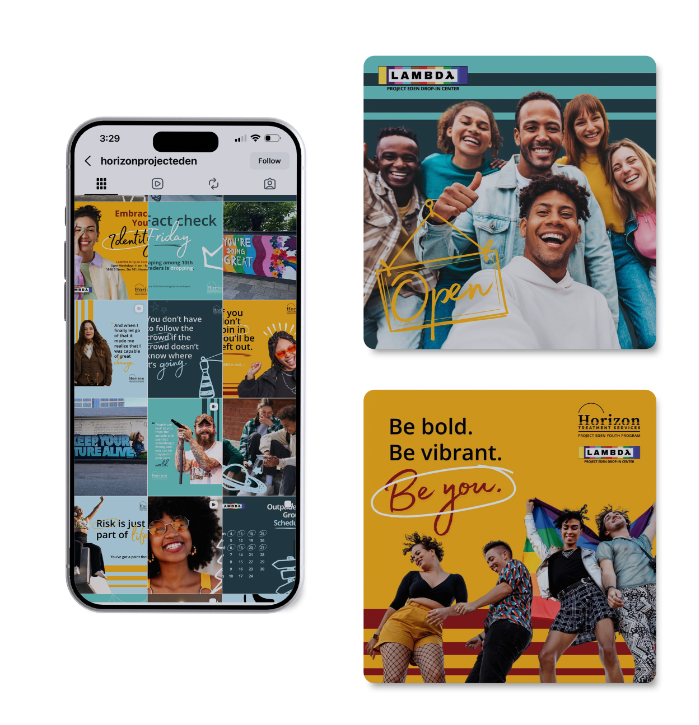
How We Helped a Community-Based Recovery Program Drive 1M+ Engagements
We helped Horizon Services launch a branded Instagram strategy for Project Eden, creating custom youth-focused content.
This initiative drove over 1.35 million impressions, reached 1.04 million users, and generated 1.8 k profile visits in 90 days, boosting awareness and engagement with at-risk youth.
Is Your Website Keeping Up With How People Search Today?
Your website should evolve alongside the way people search, browse, and make decisions. We help behavioral health organizations modernize marketing strategies and existing websites with clearer messaging, stronger user experiences, and SEO + GEO strategies designed for today’s search landscape.
Modern User Experience
Today’s visitors expect fast answers, intuitive navigation, and a seamless experience. We optimize your website around how people actually browse and make decisions online.
Clearer Brand Messaging
People should understand who you are and how you help within seconds. We refine messaging that builds trust, reduces confusion, and encourages meaningful action.
Conversion-Focused User Journeys
Every page should have a purpose. We simplify navigation and create intuitive pathways that guide visitors from discovery to inquiry with less friction.
Built for AI Discovery
Search is changing. We structure your content to support both traditional SEO and emerging AI-powered search experiences to help your organization stay visible across evolving platforms.
Mobile-First Performance
Most visitors will experience your website on a mobile device. We optimize layouts, speed, and usability to create a consistent experience wherever people find you.
Continuous Website Optimization
Your website shouldn’t remain static after launch. We continuously refine content, user experience, and performance based on evolving search behavior, AI trends, and real user data.

“It’s a joy to work with such an amazing team that is so dedicated to our clients’ success!”
Adrienne Wilkerson, CEO
Beacon Media + Marketing

Our Specialized Behavioral Health Services
Behavioral Health Web Design
Behavioral Health SEO + AIO
Behavioral Health Social Media
Behavioral Health PPC Ads
Behavioral Health Branding
Behavioral Health Content Marketing
It’s all about connecting with and helping people.
Blogs allow you an outlet to do just that.

Explore Our Insights
Take a closer look at the tools, tips, and strategies that help your practice grow with confidence.
Ask a practice owner to name their referral sources, and you’ll get a real answer. The hospital discharge planner. Two pediatricians. The EAP contract. The church counseling program down the road. They can tell you which ones send steady volume, which ones dried up last spring, and which relationship needs a lunch. If one of them disappeared tomorrow, they’d feel it inside a month and be working the problem that week.
Now ask the same owner where their patients find them online.
The answer is almost always Google, said with a shrug, the way you’d name the weather.
How Did Google Become the Only Room?
Nobody decided this. There was never a meeting where a practice owner looked at the options and concluded that one company’s algorithm should sit between them and every prospective patient in their county. It happened the way most concentration happens, which is quietly, because the thing was working and it was the only thing anybody could measure.
Google was generous for about fifteen years. It gave us clean numbers, a dashboard that updated overnight, and a story we could tell the board. Everything else in the discovery landscape was harder to see, so it got treated like it wasn’t there. Marketing budgets follow measurement, and measurement followed Google.
Nobody decided this. It happened while everyone was busy running a practice.
So the practice ended up with a single point of failure at the very top of the funnel, and the owner who would never accept that from a referral relationship accepted it from a search engine without ever knowing they’d made the trade.
I want to be careful here, because this is not an argument that Google stopped working. Google works. It’s still the biggest room in the building. The point is narrower and, I think, more uncomfortable: it stopped being the only room, and most practices have not adjusted their behavior to match.
Where Are Patients Actually Finding Providers Right Now?
Start with the one nobody expects. According to Statcounter data compiled by Backlinko, Bing now accounts for roughly one in ten U.S. searches across all devices, and close to one in five on desktop.
Desktop. Sit with that for a second, because in behavioral health it matters more than it does almost anywhere else.
Think about who’s on a desktop in the middle of a Tuesday. Somebody at work. On a Windows machine, in Edge, defaulted to Bing, using their lunch break to look up whether their insurance covers therapy, because the work computer is the one their spouse won’t pick up and scroll through that evening. That’s not a rounding error in your traffic. That’s a person doing the most private search of their year on the only device where it feels safe, and if you’ve never once checked how your practice appears on Bing, you have no idea whether you were there for them.
Then keep going, because Bing is only the first surprise.
There’s the insurance plan’s provider directory, which for a huge number of patients is the actual first stop, ahead of any search engine, because coverage is the gate everything else has to pass through. There’s Psychology Today, Healthgrades, and the specialty directories, where people compare profiles side by side using filters before they visit a single practice website. There’s the map listing. There’s a Facebook group for parents of teenagers where somebody asked for a recommendation last week and four people answered. There’s a Reddit thread from 2023 that still ranks.
And now there’s the newest one. rater8’s 2026 Patient Choice Report, a survey of nearly a thousand U.S. adults, found that among patients who searched for a provider in the past year, AI tools were cited as an influence slightly more often than Google search itself, and slightly more often than a recommendation from another doctor.
Every one of those is a room where a decision about your practice gets made, and most of them have never appeared in a marketing conversation at your practice.
What Does This Concentration Actually Cost You?
Here’s what makes this so hard to catch. The failure is completely silent.
When a referral partner stops sending patients, you notice. The volume drops, somebody says something, you pick up the phone. When you’re invisible on a channel you were never on, nothing happens at all. There’s no drop, because there was never a number. There’s no complaint, because the person who couldn’t find you doesn’t know you exist and has no way to tell you.
You don’t get a notification telling you that you were invisible.
This is also why the dashboard can’t save you. Analytics is a rearview mirror pointed at the roads you already drove. It reports faithfully on the channels you’re in and says absolutely nothing about the ones you’re not. A practice can look at a report showing 80% of traffic from Google and read it as proof that Google is where the patients are, when it’s equally consistent with Google being the only place they ever bothered to show up.
Your analytics can only report on the rooms you’re already standing in.
And the one question that’s supposed to close this gap mostly doesn’t. “How did you hear about us?” gets you whatever comes easily to mind. It gets you the last thing, not the first thing, and certainly not the six things in between. A patient who heard your name in a Facebook group in March, checked your reviews in April, found you again through their insurance directory in June, and finally called in July is going to say “I think I found you online.” That answer is true and nearly useless.
What Would You Do If This Were a Referral Problem?
You’d already know, which is the whole point of framing it this way.
You’d start by finding out where the volume actually comes from instead of assuming. You’d look at the sources you’d never worked and ask whether there was a relationship worth building. You’d stop treating the largest partner as permanent. You’d diversify, not because the big one is bad, but because depending on one of anything is a decision you should make on purpose rather than drift into.
That’s it. That’s the entire strategic move, and there’s nothing clever about it. The reason it hasn’t happened isn’t that owners lack sophistication. It’s that this work is unglamorous, it’s spread across a dozen platforms nobody owns, it produces no dopamine, and there’s no dashboard that makes it feel like progress. So it stays undone in practices that are otherwise run beautifully.
Why This Matters More in Behavioral Health Than Anywhere Else
Now the part that actually keeps me up.
The person looking for you is not running a channel strategy. They’re not optimizing their search. They finally decided, after weeks or months of talking themselves out of it, that they’re going to do something about this. And in that moment they’re going to look in whatever room they happen to be standing in. The work laptop. The insurance portal, because money is the thing they’re most afraid of. The group chat with the one friend who’ll get it. Whatever their kid’s pediatrician wrote on a sticky note.
The person looking for you isn’t running a channel strategy. They’re scared, and they’re looking in whatever room they happen to be standing in.
We say “meet them where they’re at” constantly in this field, and we mostly mean it emotionally. Meet them in their fear, in their ambivalence, in their shame. That’s right, and it’s not enough anymore. Meeting people where they are is also a logistics problem now. It means being present in the physical and digital places they’ll actually be standing in when the window of courage opens, because that window does not stay open long, and it does not reopen on your schedule.
A practice that’s only findable in one room is asking every prospective patient to walk to it. Most of them are barely able to make the first step as it is.
So here’s what I’d ask you to sit with this week. If your practice’s presence on Google went away on a Thursday morning, how would you find out? And how long would it take?
I’d love to hear your answer, especially if it’s the uncomfortable one.
Single-platform dependency is the marketing equivalent of keeping all your money in one bank account with no backup.
Everything is fine until it isn’t. An algorithm shifts. A platform changes its ad policy. A competitor outbids you on every keyword you’ve been relying on. Google rolls out a core update and your page-one rankings disappear overnight. Any one of these things can happen, and for practices that have built their entire patient acquisition strategy around a single channel, any one of them is enough to crater inquiry volume for weeks or months.
The mental and behavioral health practices that navigate the digital marketing landscape most consistently are the ones that have distributed their visibility intentionally across multiple platforms and channels. Not randomly. Not everywhere at once. But strategically, with a clear understanding of which channels serve which stages of the patient journey and why.
Building that kind of strategy isn’t complicated. But it does require letting go of the idea that one platform is enough.
Wondering how diversified your current marketing actually is? Let’s find out together and build a strategy that holds up through whatever comes next.
The Rundown
- Single-platform dependency is a structural vulnerability, not just a missed opportunity. Any platform can change, and practices built entirely around one of them are one update away from a visibility crisis.
- A diversified strategy doesn’t mean being active everywhere. It means being intentionally present across the specific platforms where your ideal patients are at each stage of their journey.
- The healthcare marketing and communications market is rapidly moving toward omnichannel strategies, with the global market projected to reach $24.55 billion in 2025 as organizations recognize that multi-platform presence drives more resilient patient acquisition.
- Platform diversity should be built in layers: owned assets first, then earned visibility, then paid channels, so the strategy holds up even when any single layer underperforms.
- Consistency across platforms matters as much as presence. A practice that shows up on six platforms with inconsistent messaging is less effective than one that shows up on three platforms with a coherent, patient-centered voice.
Why Is Single-Platform Dependency Such a Significant Risk for Mental and Behavioral Health Practices?
Because the platforms practices depend on most are the ones that change most frequently.
Google’s algorithm updates dozens of times per year. Meta changes its ad targeting capabilities in response to privacy regulations. Psychology Today adjusts its search algorithm and suddenly profiles that were appearing on page one are buried. Any of these shifts can meaningfully affect a practice’s patient inquiry volume, and they happen with little to no warning.
The healthcare marketing landscape is evolving rapidly in response to exactly this dynamic. Industry analysis projects the global healthcare marketing and communications market to reach $24.55 billion in 2025, with omnichannel strategies cited as the primary driver of resilient patient acquisition. The shift isn’t just about reaching more patients. It’s about building a marketing presence that doesn’t crumble when any one channel has a bad month.
For a mental and behavioral health practice, the consequences of a visibility disruption aren’t just financial. They affect care access. When a practice’s inquiry volume drops because an algorithm changed, the patients who would have found that practice find someone else instead, or don’t find anyone and give up. That’s not a marketing problem in isolation. It’s a patient care problem that starts with a marketing vulnerability.
What Does a Well-Diversified Marketing Strategy Actually Look Like?
It looks like a practice that has built its visibility in three distinct layers, and understands why each layer matters.
The first layer is owned assets. These are the things your practice controls completely: your website, your blog content, your email list. No algorithm can take these away from you. A well-optimized website with strong content is an asset that compounds over time and belongs entirely to the practice. This is the foundation everything else builds on.
The second layer is earned visibility. Reviews, directory listings, mentions in community platforms, social proof across third-party sites, referral relationships. These are things your practice earns through consistent quality and presence rather than paying for directly. They’re also significantly more trusted by patients than anything you pay to put in front of them.
The third layer is paid channels. Google Ads, Meta Ads, Microsoft Advertising, directory premium placements. These generate immediate visibility and can be scaled up or down quickly. But they’re also the most volatile layer, the one most affected by external changes, and the one that stops producing results the moment you stop funding it.
A diversified strategy doesn’t lean entirely on any one layer. It treats all three as complementary, with owned assets providing stability, earned visibility providing trust, and paid channels providing reach.
Which Platforms Should Be Part of a Diversified Mental Health Marketing Strategy?
The answer depends on which patients you’re trying to reach and at what stage of their journey. But for most mental and behavioral health practices, the core platform mix should include at least one channel from each of the following categories.
Search visibility:
- Google, through both organic SEO and paid advertising, remains the highest-volume search channel and the one most patients still use as their primary starting point
- Bing / Microsoft, for the meaningful share of patients using Microsoft devices, older demographics, and corporate computers, and as the engine powering Microsoft Copilot AI recommendations
- AI search tools like ChatGPT, Perplexity, and Google’s AI Overviews, which are increasingly surfacing provider recommendations and favor practices with strong multi-platform authority
Directory and local visibility:
- Psychology Today and specialty directories for decision-stage patients actively filtering by specialty and insurance
- Google Business Profile and Apple Maps for local search and voice search visibility across iOS and Android devices
- Healthgrades and Zocdoc for the patients who start their search on healthcare-specific platforms rather than general search engines
Social and community visibility:
- Instagram and TikTok for awareness-stage patients discovering practices through content before they actively search
- Facebook for older demographics and community-based visibility, including local group presence and targeted advertising
- LinkedIn for B2B referral relationships with EAPs, corporate HR departments, and healthcare professionals who make referrals
| Strategy Layer | Examples | What It Provides | Vulnerability If It’s the Only Layer |
|---|---|---|---|
| Owned assets | Website, blog, email list | Stability; permanent visibility that compounds over time | Slow to build; needs consistent investment to maintain |
| Earned visibility | Reviews, directories, referrals, community mentions | Trust; the highest-credibility form of visibility available | Can’t be purchased or accelerated quickly when volume drops |
| Paid channels | Google Ads, Meta Ads, Microsoft Ads, directory premiums | Immediate reach; scalable on demand | Stops working the moment you stop paying; subject to platform changes |
| Social platforms | Instagram, TikTok, Facebook, LinkedIn | Awareness; pre-trust building with patients not yet searching | Algorithm-dependent; organic reach can be suppressed without warning |
| AI and emerging channels | ChatGPT, Perplexity, Copilot, Google AI Overviews | Future-facing; growing share of patient discovery | Not yet predictable; dependent on the quality of multi-platform presence |
How Do You Maintain Consistent Messaging Across Multiple Platforms Without It Becoming a Full-Time Job?
By building a core message architecture first, and then adapting it to each platform rather than creating something entirely new for each one.
The biggest reason practices resist multi-platform marketing is the perceived workload. And it’s true that showing up on six platforms poorly is worse than showing up on two platforms well. But maintaining a consistent presence across multiple channels doesn’t require producing original content from scratch for every platform every week.
It requires having a clear answer to three questions: who are we, who do we help, and why does that matter to them? Once those answers are clear, the content across every platform is a different expression of the same core truth rather than a completely independent creative exercise.
A blog post becomes a series of social captions. A clinician bio becomes a short video introduction. A FAQ page becomes an Instagram story series. The core content is created once, and the adaptation for each platform takes a fraction of the original effort. Systemizing this process is what separates practices that maintain a strong multi-platform presence without burning out from those that try, fail to sustain it, and retreat back to single-platform dependency.
At Beacon, we help mental and behavioral health practices build exactly this kind of efficient multi-platform content system, so consistent visibility doesn’t require a full-time marketing hire.
What’s the Biggest Mistake Practices Make When Trying to Diversify Their Marketing?
Trying to be everywhere at once without a strategy for any of it.
Platform diversity without intentionality is just noise. A practice that creates a TikTok account, posts twice, and abandons it isn’t building multi-platform visibility. It’s creating a digital footprint that signals inactivity to any patient who finds that dormant profile. A practice that claims a Bing Places listing but never updates it isn’t helping its Bing visibility. It’s potentially hurting it with outdated information that contradicts what appears elsewhere.
The right approach is sequential, not simultaneous:
- Start by auditing what already exists. Most practices have more digital presence than they realize, and a significant portion of it is outdated, inconsistent, or actively working against them.
- Fix and optimize before expanding. A clean, current, consistent presence on four platforms is more effective than a scattered presence on ten.
- Add one new channel at a time, with a clear plan for what that channel is meant to achieve and how success will be measured before moving to the next one.
- Prioritize by patient stage. A practice that needs more top-of-funnel awareness should invest in social media before adding another paid search channel. A practice that has strong awareness but weak conversion should focus on directories and website optimization before expanding reach.
How Do You Know When Your Strategy Is Diversified Enough?
When losing any single platform for a month wouldn’t cause a crisis.
That’s the practical test. If Google went down tomorrow, would your practice still have meaningful visibility through directories, social media, direct traffic to your website, and referral pipelines? If Meta changed its ad targeting overnight, would you still have organic channels generating warm leads? If Psychology Today restructured its search algorithm, would you still be findable through other directory platforms and search engines?
The answer for most practices right now is no. And that’s not a criticism. It’s a starting point. Building toward yes is a process, and it starts with an honest audit of where the practice is currently visible and where it’s entirely absent.
The practices that weather platform disruptions without a dip in patient volume aren’t lucky. They’re built differently. And building differently is a strategic choice that’s entirely available to any practice willing to approach its marketing with the same intentionality it applies to its clinical work. Our strategy team helps mental and behavioral health practices build that kind of resilient, multi-platform marketing foundation from the ground up.
A strategy built on one platform is a strategy with one point of failure. Start the conversation with Beacon today, and let’s build something more durable than that.
Google isn’t going anywhere. Let’s just get that out of the way upfront.
But if your entire digital marketing strategy begins and ends with Google, you’re building visibility on a single foundation in a patient landscape that has quietly grown at least five more floors. Today’s prospective mental and behavioral health patients aren’t just searching on Google. They’re asking Bing. They’re scrolling TikTok. They’re reading Psychology Today profiles, Healthgrades listings, and Reddit threads. They’re typing questions into AI chatbots and trusting what comes back.
The practices that are winning new patients consistently in 2026 aren’t the ones with the best Google strategy. They’re the ones that show up across the full spectrum of platforms where patients are actually doing their research. And most behavioral health practices are nowhere to be found on at least half of those platforms.
So the question worth asking right now isn’t “how do I rank better on Google?” It’s “where else should I be?”
Not sure where your practice is visible and where it’s invisible? Talk to our team at Beacon today and let’s map your full digital footprint.
The Rundown:
- Bing and other search engines are capturing a meaningful and growing share of health-related searches, particularly among older demographics and Microsoft device users.
- Provider directories like Psychology Today, Healthgrades, and Zocdoc are often the first stop for patients specifically looking for a mental health provider, not just any search engine.
- Social media platforms, especially TikTok and Instagram, are functioning as discovery channels where patients encounter practices before they’re actively searching.
- AI search tools like ChatGPT and Perplexity are increasingly surfacing provider recommendations, and the practices with the strongest multi-platform presence are the ones getting named.
- Maps and local business listings beyond Google Maps, including Apple Maps and Bing Places, are influencing patient discovery in ways most practices have never optimized for.
Why Is Google No Longer Enough for Mental and Behavioral Health Visibility?
Because patient behavior has fragmented across platforms faster than most marketing strategies have adapted.
It wasn’t a dramatic overnight shift. It was a slow accumulation of small changes: TikTok becoming a place where people learn about mental health, AI chatbots becoming a place where people ask for provider recommendations, Bing quietly capturing a growing share of searches from Microsoft device users and older demographics, directories becoming the default starting point for patients who already know they want a therapist and just need to find the right one.
A peer-reviewed study on social media and patient decision-making found that 96.2% of patients now have personal social media accounts, and platforms like Instagram and X have become meaningful tools for researching healthcare providers. That statistic alone is enough to make the case that Google-only visibility is leaving a significant audience unaddressed.
The patients searching for a therapist today are not a monolithic group. They’re different ages, with different platform habits, different levels of mental health literacy, and different comfort levels with different types of content. Meeting all of them where they are requires showing up across more than one channel. And the practices that do are quietly building a compounding visibility advantage over those that don’t.
Should Behavioral Health Practices Be Investing in Bing?
Yes, and it’s one of the most consistently overlooked opportunities in mental and behavioral health marketing.
Here’s the reality: Bing processes billions of searches per month and has a disproportionately strong user base among older adults, Microsoft device users, and corporate computer users, all of whom represent a significant segment of mental and behavioral health patients. And because most practices and most of their competitors have focused almost exclusively on Google, the competitive landscape on Bing is dramatically less crowded.
That means lower cost-per-click in paid advertising, less competition for organic rankings, and a more accessible path to page-one visibility for searches that would require significant effort on Google.
What Bing investment looks like in practice:
- Claiming and optimizing a Bing Places for Business profile, which is Bing’s equivalent of Google Business Profile and directly influences how the practice appears in Bing local search results
- Running Microsoft Advertising campaigns alongside or instead of Google Ads for certain high-intent keywords, often at a meaningfully lower cost per conversion
- Ensuring the practice website is indexed and performing well on Bing through Bing Webmaster Tools, which is free and provides actionable insights separate from Google Search Console
And here’s the kicker: Bing powers a significant portion of AI-generated responses through Microsoft Copilot. Optimizing for Bing isn’t just about Bing searches anymore. It’s about influencing the AI-generated recommendations that Copilot users are receiving when they ask for a therapist recommendation.
What Role Do Provider Directories Play Beyond Google?
A massive one, and most practices have barely scratched the surface of managing them effectively.
Provider directories like Psychology Today, Healthgrades, Zocdoc, and TherapyDen aren’t supplementary to Google. For a specific and important segment of patients, they’re the primary discovery tool. These are the patients who already know they want a therapist and are specifically filtering by specialty, insurance, location, and availability. They’re not in an exploratory phase. They’re in a decision-making phase. And they’re using directories to make that decision.
The challenge is that most practices set up their directory profiles once and never revisit them. Which means:
- Photos are outdated or missing entirely, sending an immediate signal that the profile hasn’t been tended to
- Specialty language is generic and doesn’t match the specific search terms a patient might use to filter for the presenting issue they’re dealing with
- Insurance and fee information is incomplete, causing patients to move on to a profile that answers those questions without requiring a phone call
- The bio reads like a credentialing form rather than an introduction, giving a searching patient nothing to connect with emotionally before they decide to reach out
Directories also increasingly feed AI search results. When a patient asks ChatGPT or Perplexity to recommend a therapist, those systems pull from the same data sources that power directories and search engines. A well-maintained directory presence isn’t just good for the directory. It’s good for AI visibility too.
| Platform | Patient Type It Reaches | Investment Required | Why Most Practices Ignore It |
|---|---|---|---|
| Bing / Microsoft | Older adults; Microsoft device users; corporate employees | Low–Medium; Bing Places free; Microsoft Ads affordable | Google dominance creates tunnel vision |
| Psychology Today / Healthgrades | Decision-stage patients filtering by specialty and insurance | Low; profile setup with consistent maintenance | Set-and-forget mentality; profiles go stale |
| Apple Maps / Bing Places | iPhone users and voice search users asking Siri for recommendations | Low; free to claim and optimize | Most practices only think about Google Maps |
| TikTok / Instagram | Younger patients in awareness and consideration stages | Medium; requires consistent content creation | Perceived as entertainment rather than discovery |
| AI tools (ChatGPT, Perplexity, Copilot) | Tech-forward patients of all ages seeking curated recommendations | Indirect; built through strong multi-platform presence | Most practices don’t know they’re influenceable |
| Reddit / Community Forums | Patients in research phase seeking peer validation | Low direct; influenced by brand presence and content quality | Feels uncontrollable and therefore ignored |
Is Social Media a Discovery Channel or Just a Branding Tool for Mental Health Practices?
Both, but most practices are only getting the second one.
TikTok and Instagram have evolved into genuine search and discovery platforms, particularly for younger adults navigating mental health decisions for the first time. A significant and growing number of people are finding mental health content, encountering practice names, and forming impressions of providers through social media before they ever open a browser and type something into a search bar.
That means social media isn’t just about engagement or follower counts. It’s about appearing in the place where a patient’s first awareness of a practice can form. And a practice with no social presence, or a dormant one last updated eight months ago, is invisible to that entire segment of the patient population.
The discovery function of social media is built through:
- Consistent content that uses the language patients actually search for on social platforms, including condition-specific terms, experience descriptions, and the kinds of questions people type into TikTok’s search bar
- Clinician-led content that builds personal familiarity with the people behind the practice, since social discovery is fundamentally about people encountering people, not brands encountering browsers
- Hashtag and keyword strategy tailored to social search behavior, which is different from traditional SEO and requires understanding how each platform’s algorithm surfaces content to new audiences
How Do AI Search Tools Factor Into Post-Google Visibility?
More significantly than most practices realize, and the window to get ahead of the curve is still open.
When a patient asks ChatGPT “who is a good therapist for PTSD in Austin?” they’re not getting a list of search results. They’re getting a synthesized recommendation based on the information those AI systems have been trained on and can access. And the practices that appear in those recommendations aren’t necessarily the ones with the highest Google rankings. They’re the ones with the most consistent, authoritative, and cross-platform presence.
AI visibility is built through:
- A website with clear, specific, well-structured specialty content that gives AI systems something authoritative to cite when a patient asks a relevant question
- Consistent presence across directories, social media, and local listings, since AI tools learn from what appears across multiple reputable sources rather than from a single platform
- Educational content published regularly that positions the practice as a knowledgeable resource on the topics its ideal patients are researching
The practices investing in AI visibility now are building an advantage that will compound as AI search adoption continues to grow. And the investment required isn’t separate from everything else discussed in this post. It’s the cumulative result of doing all of it well. Our SEO + GEO team helps mental and behavioral health practices build the kind of multi-platform presence that feeds both traditional search and the AI-powered channels that are increasingly shaping how patients find care.
How Should a Practice Prioritize Where to Invest First?
Start with what’s free and broken, then build toward what’s strategic and new.
Most practices have unclaimed or neglected platforms that are costing them visibility right now without any additional investment required to fix them. Apple Maps. Bing Places. Outdated directory profiles. Inconsistent business information across platforms. These are the low-hanging fruit, and they represent genuine lost visibility that can be recovered with a few focused hours of attention.
Once the basics are covered, the strategic investments follow in order of audience size and patient intent: directories for decision-stage patients, social media for awareness-stage patients, and paid advertising on undercompetitive platforms like Bing for ready-to-book patients who aren’t finding the practice on Google.
The goal isn’t to be everywhere at once. It’s to be in every place where your ideal patient is likely to encounter your practice on their journey from “I think I need help” to “I have an appointment.” That journey is happening across more platforms than it ever has before, and the practices that show up consistently across it are the ones that fill their schedules first. Our marketing strategy team helps practices map that full journey and build a prioritized investment plan that reaches patients at every stage, not just the ones already searching on Google.
Google is the start of the conversation, not the whole conversation. If your practice isn’t showing up beyond it, you’re leaving patients on the table every single day.
Reach out to Beacon today, and let’s build a visibility strategy that meets patients wherever they’re searching.
Behavioral Health Marketing FAQs
How can Beacon help a behavioral health organization grow?
Behavioral health organizations face unique growth challenges, from increasing competition and shifting referral patterns to rising patient expectations and limited internal resources. Many organizations know they provide exceptional care but struggle to consistently reach the people who need their services.
Beacon helps bridge that gap by improving visibility, strengthening trust, and creating marketing systems designed to support long-term growth. Whether the goal is increasing referrals, filling programs, expanding service lines, or attracting more qualified inquiries, we focus on building a strategy that aligns with your organization’s mission and growth objectives.
What makes Beacon’s behavioral health marketing different from other agencies?
Many marketing agencies understand marketing. Far fewer understand behavioral health. Our team has spent years working alongside mental health practices, addiction treatment centers, psychiatric providers, and behavioral health organizations, giving us a deep understanding of the challenges, regulations, and nuances that impact this industry.
We also take a different approach to strategy. Rather than relying on assumptions or one-size-fits-all solutions, we use our Beacon Approach—testing, learning, and refining strategy based on real-world data. The result is marketing that feels more intentional, adaptable, and aligned with actual organizational goals.
How do you market services like addiction treatment or outpatient programs?
Marketing behavioral health services requires a thoughtful balance of visibility, education, and trust-building. Individuals seeking care are often navigating difficult circumstances, while family members and referral partners may be conducting extensive research before making a decision.
Our approach focuses on creating clear messaging, educational content, optimized websites, search visibility, and targeted campaigns that help people understand their options and feel confident taking the next step. The goal is to meet potential clients where they are and provide helpful information when they need it most.
What marketing channels work best for behavioral health organizations?
The most effective marketing channels often depend on your services, audience, and growth goals, but strong behavioral health marketing typically includes a combination of SEO, content marketing, website optimization, local search, paid advertising, and social media.
Rather than relying on a single tactic, we focus on creating a connected strategy where channels work together. This helps improve visibility, build trust, support referrals, and create multiple pathways for prospective clients to find and engage with your organization.
How long does it take to see results from behavioral health marketing?
Marketing is rarely an overnight solution, especially in a relationship-driven industry like behavioral health. Some initiatives, such as paid advertising, can generate visibility and inquiries relatively quickly, while SEO, content marketing, and authority-building strategies typically take several months to gain traction.
The most successful organizations view marketing as a long-term investment rather than a short-term campaign. By consistently building visibility, trust, and audience engagement over time, marketing becomes a stronger and more reliable driver of sustainable growth.