Orthodontics

Chart The Waters

Explore insights on SEO, AI, and digital marketing strategies designed to help your business grow, stay visible, and adapt in a constantly evolving online landscape.
Beacon_Icon_resouse

It’s time for people to come back to the dentist after lockdown, which means now is a great time to be marketing your dental practice. This is a great opportunity to start gaining market share, as well as welcoming back your own regular patients. If you want to make the most of this period, you’re going to need a killer marketing strategy that makes use of all the tools available to you. Keep reading for our top four dental marketing tips.

Prefer to talk it through in person? Give us a call.

1. Dental marketing starts with a website

No matter what your dental marketing plan entails, sooner or later patients will be looking at your website. A few years ago, an amateur could put together a website and it didn’t matter that much what it looked like. Nowadays, however, so many people have well-designed sites that anything less can reflect badly on your dental practice. It’s easy to see why. If you’re looking for a dentist to take care of your teeth, you want someone who gives a sense of competence and professionalism in every aspect of their business. A well-designed website, with a clear list of services and costs, is a necessity if you want potential patients to feel as though they can trust you to take care of their oral health.

Your website can also show the human side to your dental practice. Many people are wary of visiting a dentist, and humanizing the process can alleviate some of their fears. Short biographies of your staff members, lots of pictures of the practice, and testimonies from current patients are all dental marketing essentials. They can all help to make the dentist seem much less daunting.

A great website will be the anchor for your entire dental marketing strategy.  All of your social media presence, advertisements, and physical marketing will point people to your website. It should be easy for visitors to find your location, your contact details, and your services and costs. This allows them to decide that you’re the dental practice they want to visit and make the necessary appointments.

Read more: Managing online reviews in dental marketing

2. Community building in dental marketing

Social media is the next most important dental marketing tool. It has such a huge reach that not using it is a significant lost opportunity. Social media allows you to produce ads which can be targeted to specific audiences. This targeting can be incredibly specific due to the amount of data people willingly give and the inferences that these companies are able to draw from users’ activity. We’ve written before about how Facebook advertising yields results (you can read that here).

Here, we want to focus on the organic side of social media. When we talk about “organic” on social media, we’re referring to the posts you make on your own profile, rather than paid ads. These posts are visible to people who follow your page, as well people tagged in the comments. This kind of post may not have the same kind of reach as an ad, but it has a different relationship with the people who see it, because it feels more genuine – it’s a modern form of word-of-mouth advertising. It’s easy to present the culture of your dental practice, perhaps with slightly less “polished” visuals, but they let people interact with your practice on a personal level, which builds a community. Dental marketing in this way builds a form a form of brand loyalty, where patients feel that they actually know you.

We’ll develop a step-by-step guide for you. Contact us now.

3. Dental marketing with Google My Business

Google My Business is a tool that we are recommending to our clients more and more as we see really impressive results. You’ve probably come across it before. When you search for a restaurant or store, you’ll see a box on the right-hand side of your Google Search results page. It can include images, a link to the website, and interactive phone links for mobile users.

We recommend it for the same reason we recommend a professional website: it’s becoming standard, which means not having one can make your dental practice seem less reputable.  If all the big-name businesses have Google My Business then not having one makes you seem like a small, slightly unofficial business, and no-one wants to visit an unofficial dentist.

The good news is that it’s is really easy to set up. In fact, we’ve written a detailed guide on setting up your listing here – it’s as simple as finding your listing on Google and claiming it. You’ll want to do this as soon as you can, because the process is so simple that anyone can claim a listing. At this stage, there’s actually nothing that can stop someone else from claiming yours, which isn’t ideal.

Case studies: Grow your practice with these bold strategies

4. Online reviews in dental marketing

Google My Business allows us to slide neatly into our next tip, online reviews. Reviews are integrated into your listing, so anyone who searches for your dental practice can see what others think of you. This is really important. If your practice is well-rated, this will obviously inspire confidence in prospective patients. On the other hand, dentistry is a field where people are already nervous, and the perceived potential for harm is large. In practice, this means that your reviews are going to have a much more significant impact than other types of businesses, such as stores or coffee shops.

The best way to make sure you get good reviews is to give good service, but there are other tricks to maximize your score. You may have heard of a concept called “volunteer bias.” This is what happens when people are voluntarily able to review products. Those who had an average experience don’t put in the time to review, so the aggregate score represents only those who had either a bad experience or a very good experience. As a result, negative reviews can have a disproportionate effect. You can get around this by actively asking people to review your business. This is a fine line to tread, because being too pushy can lead to people be put off and giving a worse review, however, when it’s done well, it can fill in some of that space between the very good and the bad, which improves your score. It also increases the numbers of reviews, so any single bad review is much less noticeable.

Another good strategy for reducing the impact of bad reviews is to reply to them. A well-reasoned, polite response can often turn a bad review into a positive – read this post to learn more.

Worried about your reviews? We can help!

Bonus tip: Using video in dental marketing

Okay, okay, we promised four tips – but here’s one extra. We’ve been writing a lot about video lately. It’s dramatically increased in popularity with the increased performance of mobile devices, and it’s a great way to connect with customers online. For example, it’s an excellent way to cram a lot of information into a format that takes little effort to absorb, and it’s easy to maintain attention.

Not only is video great for information transfer, but it’s also really great for building rapport as it allows you to present a human face to potential patients. As we mentioned before, this is especially important for dental practices as it helps remove some of the apprehension that people may feel. It also gives you a great opportunity to let people see your practice and to talk about offers.

We hope you’ve found this list of our top tips helpful, if you’re interested in learning more about the digital marketing strategies we use, check out our other blog posts on marketing for orthodontics.

Need a marketing partner? We’d love to help.

The world is very different right now than it was six months ago. The events of this year have caused a lot of change in the way people live and do business. Businesses that rely on face-to-face interaction, such as dental practices, have been hit particularly hard. Even now, as the market is starting to open up again, there will be lasting changes. It makes sense, then, that your dental marketing strategy changes accordingly.

Need personalized advice? Schedule a free consultation.

Social strategy is now king in dental marketing

One of the most important lessons learned from the lockdown period is that dental practices who interact with their customers on a real, human level do best. That means social media should be at the core of your dental marketing strategy, because it allows direct contact for reviews, criticism, and complements. This lets your patients feel like they’re really talking to a person and that their comments and concerns are being heard.

Posting on social media falls into two categories: ads and organics.

Ads are exactly what you think: images or short videos that grab attention and hopefully draw people to your social profile or website. Social media advertising is incredibly powerful. Platforms such as Facebook collect lots of data about their users which allows them to build detailed profiles about those people’s personalities, likes, and dislikes. Also, you are able to target your ads, rather than just scattering them out and hoping that potential leads see them, as you might with traditional media such as newspaper or radio ads.

Because of all the data social media companies collect, you can be really specific about the people you want to target. This type of advertising is called “targeted advertising” and it is almost the sole source of revenue for Facebook, Google, and other large tech companies that offer free services.

Organic posts are posted directly to your account feed, and while there is no cost attached to these, people won’t see them unless they visit your account or follow you. The advantage of organic posting is that it has a way more personal feel. People who see these posts are more likely to feel like they are seeing something personal.

This is where our next point comes in.

Read more: Step-by-step orthodontics marketing plan

Dental marketing needs constant communication

Because so many people have been exposed to reduced, and often uncomfortably low, levels of social interaction over the last few months, it is more important than ever to show a friendly, welcoming face in your dental marketing plan. Social media provides an amazing way to do this by allowing you to communicate directly with potential new patients. However, just posting once or twice won’t be enough to maintain this image.

The more you communicate with your followers, and the friends they share your posts with, the more this impression of personability comes through. If you’re able to post daily, both existing and potential patients will feel as if they’ve got to know you. Not only does this give them cause to trust you when they are looking to return to the dentist, but also keeps you in the back of their minds, so that they think of you when they do decide it’s time for their next appointment. This is key to your dental marketing success.

Applying the methods you use for your organic posts to your ads is another great way to give the impression of interacting with a real person. When people see a clean-cut, professional ad, with all the perfect imagery and color, it may feel just a little distant and corporate. To someone who hasn’t seen their family for four months, or who hasn’t left their apartment in a week, a simple video of your staff warmly expressing how much they’re looking forward to welcoming patients back to your practice can go a long way.

Case studies: Grow your practice with a bold plan

Video is perfect for dental marketing right now

Speaking of video… video is one of the best tools in your dental marketing toolbox when it comes to making things personal. Someone who really understands the power of this strategy is Gary Vaynerchuk. He has mastered the use of his smartphone camera to give the impression that he is talking directly to the viewer, almost like a personal video call. This works especially well on social media because of how scalable it is. He can have a “1-to-1” conversation with millions of people at once. (We’ve discussed Gary and how he creates such successful content before – if you want to learn more about video production, check out this blog). This style may not suit you or your dental marketing plan, but using video of your staff, and even customers if they are happy to help, gives a sense of honesty when you make claims about how great your business is. A short text post saying that you’re offering a discount for new clients is nowhere near as impactful as a short video of a patient who had a great experience.

The sense of personal service that you can give with visual media is complemented by the brain’s ability to digest imagery better than text, and to remember it for longer. In fact, this article from 2012 found that users are more than 27 times as likely to click on a video ad than a standard banner ad! From presenting information faster than text, to allowing people to take in non-verbal communication, there’s a reason why the most popular social media platforms are those that include a large amount of video, including Facebook, YouTube, and Instagram.

Read more: Managing online reviews in dental marketing

Dental marketing needs reassurance first

As people start heading back to the dentist after lockdown, many may be concerned about the continuing risk of infection. Your marketing is an excellent way to reassure your existing and potential new patients that you are exercising the highest standards of safety and infection control. This is something that won’t disappear just because the lockdown ends either. It’s highly likely that the impact of this period will be felt for at least the next year and that people’s awareness of infectious disease will remain at a heightened level for a long time.

Again, video will prove an important tool in showing how seriously you’re taking the safety of your dental patients. Showing the preparations you’ve made and precautions you’ve taken, while also reassuring people that they can still expect a warm, personal service behind the mask, will make sure that people feel confident to pay you a visit.

Need some help? Ask our dental marketing experts today.

So you’ve made the decision to grow as an orthodontics practice. Great! Now what?

You know that digital marketing is the first step to reaching prospective patients. Your website needs freshening up, you need to run Facebook Ads, and you need to boost your Google ranking. It can be intimidating and time consuming when you’re first starting out. How do you get all of these pieces working together to your advantage?

We’re glad you asked. After over 20 years in the marketing industry, we’ve developed the ultimate step-by-step guide to digital marketing for orthodontists that will send new patients flocking to your doors. Find out what we consider to be our “secret sauce” below.

Want to talk strategy? Schedule a free consultation.

Quick overview of orthodontics marketing

If you want to register more patients for your orthodontics practice, you have to think like your prospective patients! It is well-known in the digital marketing industry that people go through four stages as they are being convinced to buy: Attract, Engage, Convert, and Close.

We’ve added one more: Prepare. Orthodontics marketing doesn’t work unless you’re organized, with a crystal clear strategy in mind. Make sure your digital ducks are all in a row before you launch into the buying cycle, and you should see results in a matter of months!

1. Prepare your orthodontics marketing strategy

The foundation of an effective digital orthodontics marketing plan is strong branding and an optimized website. Without these elements, your strategy will struggle to get off the ground. Here is what we mean when we talk about branding and website design:

  • Branding and graphic design: Your brand, including the logo, colors, and fonts of your orthodontics practice, is one of your greatest assets. It visually communicates to prospective patients who you are and what you do. Without a strong and consistent brand, your orthodontics marketing strategy won’t be effective. Prospective patients will be confused, and less likely to remain loyal, if they see different visuals representing your practice in different places online. Make sure you have an authoritative style guide, outlining which logo, colors, and fonts you can use, to keep you on-brand throughout your digital marketing.
  • Website design and content: Your website is the first impression you give, and the primary source of the content Google will read to rank your position online. Therefore, it’s vital that your orthodontics marketing strategy includes a clean, seamlessly designed website with a good structure and keyword-optimized content. This means writing each service page focused on including a specific service-related keyword (such as “Invisalign”) so that Google knows what you’re talking about. This is called “Search Engine Optimization” or “SEO.” Clean up your website if you can and rewrite your services if you need to before you begin marketing online.

Ready to get started? Let’s talk orthodontics marketing.

2. Use orthodontics marketing to attract patients

Your orthodontics marketing strategy begins with the “Attract” phase. Here, you should identify prospective patients as people in your area who are starting to become unhappy with their appearance, people who are beginning to notice issues caused by the alignment of their teeth or jaws, or parents who are wondering if their children might need orthodontic work. As a result of this heightened awareness, many of these people are asking questions online, typing them into their browsers or asking friends over social media. All of these people in your region can be targeted and attracted to your business using the following digital marketing tools:

  • Social media marketing: You’ve probably already created a Facebook page for your business and tried to run some Facebook Ads. This is undoubtedly the place to be if you want to reach as many people as possible – in fact, Facebook has 214 million users in the United States alone. That’s almost 66% of the population! Platforms like Facebook and Instagram allow you to target these people based on location, their demographics, the groups they follow, their interests, and more, showing your advertisements in their news feeds. This is gold when it comes to your orthodontics marketing strategy. Post consistently with your target marketing in mind, answering questions they may have as they engage with you online. Always, always include a call to action in your posts and advertisements, either by linking back to your website or providing a phone number people can call to schedule an appointment.
  • Google Ads: Never underestimate the power of Google Ads. One of the first things any modern, prospective patient is going to do as they are looking for an orthodontist is research online. Did you know you can put your practice in the number one spot on the Google results page with Google Ads? They show up at the top of the page in the “ad” section whenever a prospective patient searches using the keywords you choose to target through your ad account – for example, you could target “Invisalign.” Be sure to use a catchy title and point the ad toward a relevant, keyword-optimized service page on your website for best results.
  • Blog marketing: A great way to target the *exact* questions prospective patients are searching online is to write a blog answering their question! This is an essential part of every orthodontics marketing strategy. Google Autocomplete is a great way to do this. Simply type in a word like “Invisalign,” see what pops up, and write a blog answering the question. Easy! If you blog regularly (we recommend one to two times per week if you are able), you’ll notice your web traffic increase substantially! The most important thing is to be consistent.

Looking to outsource your orthodontics marketing? Call us.

3. Orthodontics marketing that engages

Once you have attracted potential customers, your next goal should be to have them stick around. Keep your followers coming back with higher levels of content that answer more of their questions about orthodontics, establish your credibility, and begin to develop a virtual relationship. Use the following orthodontics marketing tools to engage prospective patients:

  • Video marketing: Now that your followers know that they can find quality content from you on social media, they will be on the lookout for more. Video is one of the most easily consumable forms of content and a very effective way to get your message across. Create short, 30-60 second video productions that talk about the benefits of becoming a patient at your orthodontics practice or that answer common questions to keep people engaged.
  • Social media quizzes: Social media quizzes are also becoming increasingly popular online. Create an engaging quiz such as, “What does your smile say about your personality?” Be as serious or as silly as you like – it all helps develop your brand personality. Remember that this stage of your orthodontics marketing strategy is all about engagement! Include a call to action at the end to encourage people to call or visit your website.

Need help developing your messaging? We’re the experts.

4. Convert using lead generation

After your orthodontics marketing strategy has attracted and engaged prospective patients, you can ask them for something in return. At this point, your followers are interested and will be willing to give you something, such as their email address or their availability for an appointment. Convert these people to leads by requesting their contact information using the following tools:

  • Landing pages: Landing pages are generally the pages on your website that a customer lands on after they have clicked on an advertisement or a call-to-action, however, many landing pages are built with one goal in mind: conversion. These landing pages offer something valuable in return for prospective patients’ contact information. It could be an eBook, free consultation, or whatever you choose (see below)! When creating a landing page, be sure to write a catchy headline, use relevant images, and write concise, relevant content to the topic at hand, always driving the visitor closer to the call to action of submitting their contact info.
  • eBooks: eBooks are a fun way to repurpose the blogs written in the “Attract” stage of your orthodontics marketing strategy! Compiling and indexing relevant blogs into an eBook gives you a valuable piece of content to deliver to prospective patients in exchange for their contact information. For example, after you have answered a comprehensive set of questions about braces, you can create an eBook entitled, “What You Need to Know Before You Get Braces.”
  • Other: There are many ways to capture contact information that are not limited to landing pages. For example, you should have a contact form setup on your website and strongly consider installing a chatbot if your orthodontics practice has the time to manage it. Chatbots can request that visitors enter their email address and/or phone number before they chat. You could also offer free subscription to email updates whenever you publish a new blog or a free subscription to an e-newsletter if you have time to regularly email prospective patients as well.

Struggling to convert leads? Let’s assess your strategy.

5. Final stage of your orthodontics marketing plan

The “Close” stage is the final stage where a prospective patient makes the decision to register with your orthodontics practice. Now that you’ve reached the end of your orthodontics marketing strategy, make it as easy as possible for them to give you their business using a simple sales tactic:

  • Free Consultations: Free consultations require no commitment and allow prospective patients to take a no-strings-attached peek into your practice. By making the first step, however, they are taking action that will give them a favorable predisposition to you over your competitors. Offer a free consultation form on your landing page or website to take prospective patients through the final stage of the buying cycle.

After you have completed the “Close” stage, you’ve done it! You have successfully taken a prospective orthodontics patient through the buying cycle using an effective orthodontics marketing plan. Now all that’s left is to stay consistent with all of these tools and techniques to keep them coming!

If all of these stages and tools sound too overwhelming, please know that they can easily be built up over time. That said, it is imperative that you complete them regularly and in a reasonable timeframe if you want this orthodontics marketing strategy to be effective. Please know that we have done this for many practices over the years and we would be happy to talk strategy with you.

Ready to get started? Schedule a free consultation today.

Your friendly (or not so friendly) competing orthodontics practice recently launched a video commercial on social media and everybody’s talking about it.

You’ve been watching as, week after week, they share more video and get more likes, comments, reactions…and business.

You know that the use of video media is skyrocketing and marketers are recommending increased video production to keep up, but you don’t know how to make that happen.

Is this you?

If so, we’re glad you’re here, because this blog was written for you.

Our goal today is to give you some practical tips for ramping up video production at your orthodontics practice.

We’ll talk about a tool called content repurposing, how to make video a part of your practice culture, and we’ll even give you some video formats you can use right now!

Enjoy!

1. Use Content Repurposing for Massive Video Production

Okay, so what is content repurposing and how will it help you ramp up video production at your orthodontics practice?

Content repurposing is a method of starting with one piece of video content and editing it to create many videos to use throughout your marketing.

Content repurposing is a method of starting with one piece of video content and editing it to create many videos to use throughout your marketing.

It is a very effective way to increase your video production without the added expense.

For example, say you filmed a commercial for your orthodontics practice.

Maybe your commercial focused on a couple of different aspects of your orthodontics practice, such as the advanced technology you use and your family-friendly atmosphere.

You can take the fundamental pieces of that video–the audio, A-roll (primary footage), and B-roll (secondary footage)–and take them apart to make several shorter videos with different focuses, for instance, one video each on technology and atmosphere.

Content repurposing makes your video production stretch as far as it can!

Learn From the Best at Video Production and Content Repurposing

Someone who excels at video production and content repurposing is Gary Vee.

If you’ve never heard of him before, he’s a famous entrepreneur and marketing professional who has practically built some of his businesses using content repurposing.

What Gary Vee does is he has his staff film him as often as they can and then he turns around and multiplies those videos by 10.

It’s called the “Gary Vee Content Model” and it takes one long video and repurposes it into 30 different content formats including videos, gifs, podcasts, blogs, social media posts, and more.

Take a look at his content model on SlideShare.

The example Gary Vee gives in his SlideShare is of a keynote he repurposed to generate over 35 million views.

For a video production that cost him very little (he was probably paid to speak), Gary Vee created thousands of dollars in marketing value through content repurposing.

Content Repurposing Saves Your Orthodontics Practice Money

By this point, you have probably picked up on a theme.

Ramping up video production at your orthodontics practice doesn’t have to be a costly ordeal.

Content repurposing is one of the scrappiest ways to produce lots of video and it is great for small orthodontics practices or for those who have small marketing budgets.

In fact, all the ideas we are sharing today carry this theme.

Let’s talk about other ways to increase your video production without spending a dime!

2. Make Video Production Part of Your Orthodontics Practice Culture

Have you ever considered the video talent you have working at your orthodontics practice?

Your staff could be the #1 source of video content for your marketing! Especially those who have customer service skills and experience.

And no, they don’t need fancy videography equipment to make it happen.

The iPhone is becoming more and more advanced. At this point, many photographers and videographers consider iPhone photos and videos passable for marketing material. In fact, iPhone video often comes across as more authentic because it is more casual.

Encourage your staff to start filming and see what happens.

Just Pick Up the Camera at Your Orthodontics Practice

Another example of someone who excels at video production is Allen Gannet.

Like Gary Vee, Allen is an entrepreneur and marketing professional, albeit not as famous. He is, however, a reasonably popular LinkedIn influencer, in part because of his skill with iPhone video.

Through a fun video series called #AllenAsks, Allen just picks up his iPhone video camera and asks famous business people questions that everybody would like to ask them.

It’s just about the easiest thing a person could do, but it’s wildly successful, and it’s something you could do at your orthodontics practice (although you should probably choose different people to interview).

Allen regularly gets thousands to tens of thousands of views on his videos. Imagine getting that much attention with a 30-second video recorded by one of your orthodontics staff on a Tuesday afternoon!

You may not get the level of viewership Allen receives right away, but he is an excellent example of what’s possible with iPhone video.

Make Video Production As Easy As Possible for Your Staff

Now you’re probably thinking to yourself, “There’s no way I can get my orthodontics team to do this…”

It can be challenging to get buy-in from your staff, especially for something as talent-driven as video production.

One of the ways you can tackle this is by writing scripts for your team in advance and by providing them with everything they need for their first filming, including equipment and instructions.

This makes video production as easy as possible for them and empowers them to be the best they can be on the camera.

If they have a good experience the first time they try, chances are they’ll want to do it again!

Show Your Orthodontics Staff What You Want Them to Do

To make sure your orthodontics team is producing the style of video you’re looking for, you may want to set the tone by filming yourself first.

Showing is always more powerful than telling! Not only will this show your staff what you want, it will also show them that you are not afraid of video and they shouldn’t be either.

3. Try Some New Video Production Formats

Okay, we’ve talked about how content repurposing stretches your video content, we’ve shared just how easy video production can be with the advent of the iPhone, and we’ve discussed ways to make video part of your orthodontics practice culture.

One thing we haven’t covered yet is what kinds of videos you could actually be producing!

Take a look at some of these ideas and see what might click for you and your orthodontics team.

Try Every Video Production Format You Can Think Of

Something our team (Beacon!) has been doing is creating video for just about every kind of marketing we use.

That means video for our website, our blogs, our social media, and more. And we’ve been getting everyone on our staff involved!

Here’s an example of a recent video our Social Media Specialist Luke Pahlau filmed as an introduction for one of our social media blogs (on iPhone no less).

We encourage you to think broadly about how you could be using video at your orthodontics practice.

The blog we filmed this video for currently ranks #1 on Google for the search “social media for med spas” and it regularly brings us new web traffic and leads.

Video production works!

Pull Patients Aside at Your Orthodontics Practice and Film

Remember Allen Gannet from before?

He found great success by simply pulling people aside and asking them one question only.

You can imitate this video format at your orthodontics practice!

Instead of business professionals, plan to interview your orthodontics patients (with their permission of course), your vendors, your staff, people from non-profits you support in your local community, or simply everyday people from around town.

Come up with a relevant, open-ended question to ask them that you think other people would be interested in hearing the answer to, such as, “Why do you love living in our city?”

You have a great opportunity to position your orthodontics clinic as one that provides value to the people you serve beyond orthodontics!

In the case of your staff, you may ask an educational question about your services that you think people are asking, like, “What alternatives are there to traditional wire-and-bracket braces?”

Work with the Video Content You Already Have

After reading this headline, you might be thinking, “But I don’t have any video content. That’s why I’m reading this blog!”

You may have more to work with than you realize.

Whenever you instruct a patient on how to care for their orthodontic appliance, that’s something you could be filming for others to benefit from.

If your orthodontics practice participates in local, community events, turn the video camera on! This is something you could be filming too.

Finally, if you are already writing blogs for your patients, you could film your staff repeating the information shared in the blog.

Look for the value you are already providing to the people you serve and find ways to create video content from it.

That video content can then be broken down and repurposed!

At Beacon, we have lots of awesome conversations with our clients and other people in the local business and non-profit community.

We recently turned those conversations into a video series on YouTube called “LIVE Conversations.”

https://youtu.be/YI7BnYYWrjg

Besides being just fun these videos have seriously improved our YouTube presence!

Just Turn on the Video Camera

Ultimately, our best advice for increased video production is to just turn on the camera!

What the best video producers excel at is finding ordinary moments that other people could benefit from.

An easy start to a video like this is, “Hey guys, I was just talking with so-and-so and I feel like this is something you could benefit from too.”

Wouldn’t that hook you into listening, at least for the first couple seconds?

We hope this blog has helped you think broader about video production for your orthodontics practice.

We also hope it has inspired some “right now” practical ideas!

Video production does not have to be as big and scary as some marketers make it out to be.

You can ramp up video production at your orthodontics practice no matter your budget, skills, and technology.

If you are interested in working with a marketing agency to brainstorm some ideas and get you started with some high-quality video production, we would love to talk.

You can schedule a free consultation with us now based on your availability.

We look forward to hearing from you!

Happy filming!

“The biggest mistake I see, is that people tend to give up…SEO (blogging) is a lifestyle, it’s a practice, it’s not a transaction…You just gotta keep going, you’re building your castle, you’re building your moat, it’s going to take time.”

Sarah Bird, CEO of Moz

Should you be blogging for your orthodontics practice? Absolutely.

Is it as easy as publishing a short article from time-to-time? Not exactly.

You should only be blogging for your orthodontics practice if you are willing to apply best practices and take your time doing so.

Otherwise, you are wasting valuable resources, writing to no benefit.

Blogging done right over a period of time has taken many of our clients to new heights, ourselves included! A large number of our leads come directly from our blogs as we climb higher and higher in ranking on Google for our topics. But getting to this place requires a little bit of technical knowledge and a whole lot of patience.

Find out why you should be blogging for your orthodontics practice and learn the key tactics that will get you closer to that coveted #1 spot on Google!

Why Blog for My Orthodontics Practice?

Why should you blog? Well, let’s take a look at some of the results.

Case Study: Beacon

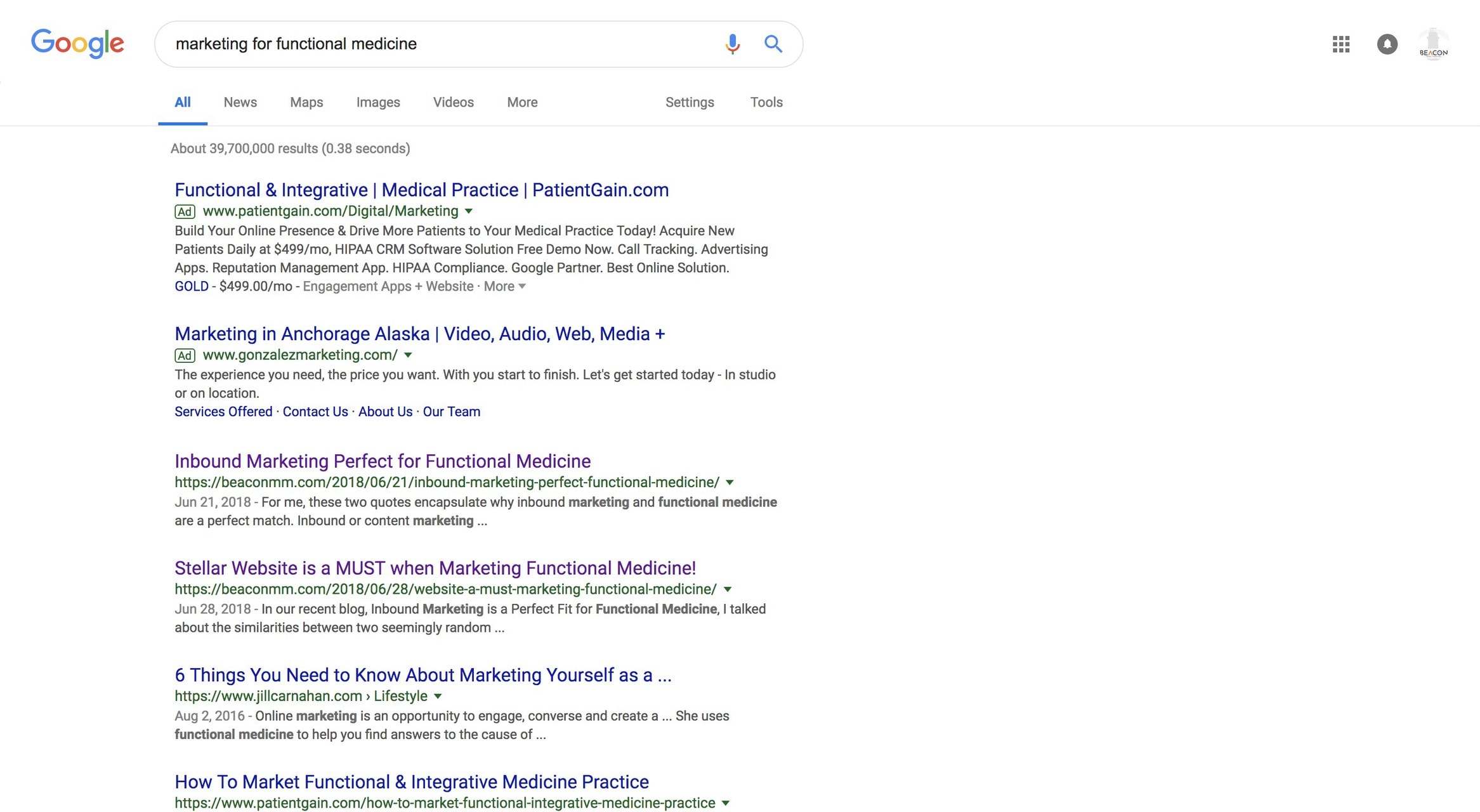
In 2018, we (Beacon) decided that we wanted to bring in more clients in the functional medicine industry. We started blogging on various marketing topics for the industry, social media, web design, etc. Months later, we had the #1 and #2 spots on Google for the search, “marketing for functional medicine” (beneath the paid ads):

Should I Blog for My Orthodontics Practice?


Many of our sales leads come from our blogs. We can see this on our various tracking software–I cannot tell you the number of times that we have seen potential clients come through our webchat directly from the blog, “How Much Does It Cost to Hire an Agency?” Many of our blogs have become key parts of our sales funnel.

Case Study: Mandanas Dental

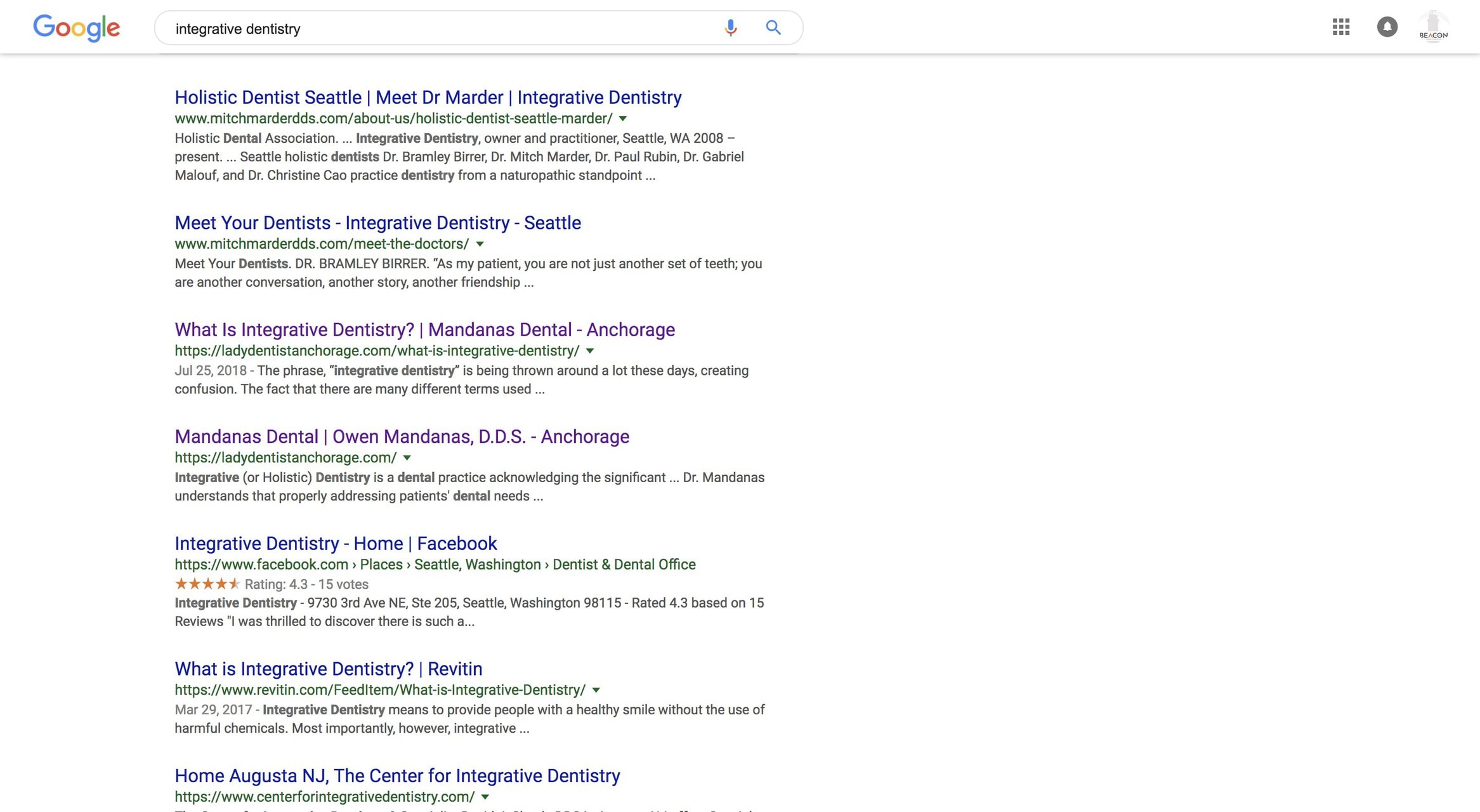
Dr. Owen Manadanas has been a client of ours for many years. In 2017, she decided that she wanted to focus her marketing on integrative dentistry. We immediately implemented the change in our blogging strategy. Within months, she was on the 1st page of Google for her home page and one of her top blogs for the search “integrative dentistry:”

Should I Blog for My Orthodontics Practice?


We are constantly recommending blogging strategies like these to our clients. Not only do they deliver results such as clicks and website traffic, but they convert into real, new patient registrations, coming right through your door!

How to Make Blogging for Orthodontics Work

At this point you are probably wondering, what magical strategy is achieving these results?

It may not be magic, but it is certainly very strategic.

The Inbound Strategy

Digital marketing (blogging, SEO, social media) frequently goes by another name, “inbound marketing.” The key principle of inbound is this…

Go where people are, provide value that is relevant to them, and they will come to you.

For just a few minutes, think critically about where people spend most of their time–It’s not reading the newspaper, it’s not listening to the radio, it’s not watching TV (streaming services such as Netflix are becoming significantly more popular)… They’re spending their time scrolling through social media and browsing the internet. Every moment. Of every day. In the coffee line, on little breaks at work, in the evening at home–We have become a culture that consumes digital media.

So what does that have to do with blogging for orthodontics?

It means that if we want to get new patient registrations, we need to be putting our information where they spend their time. By “information” I do not mean advertisements, but “value that is relevant to them,” namely, answers.

The Power of Answers

Now that we have taken a look at where people spend their time, it is time to think about what they do with it.

As an orthodontics practice, you exist to meet the needs of your patients, such as teeth straightening or jaw alignment. What does a potential patient do just as soon as they discover that they have one of these needs? More often than not, they go to the internet.

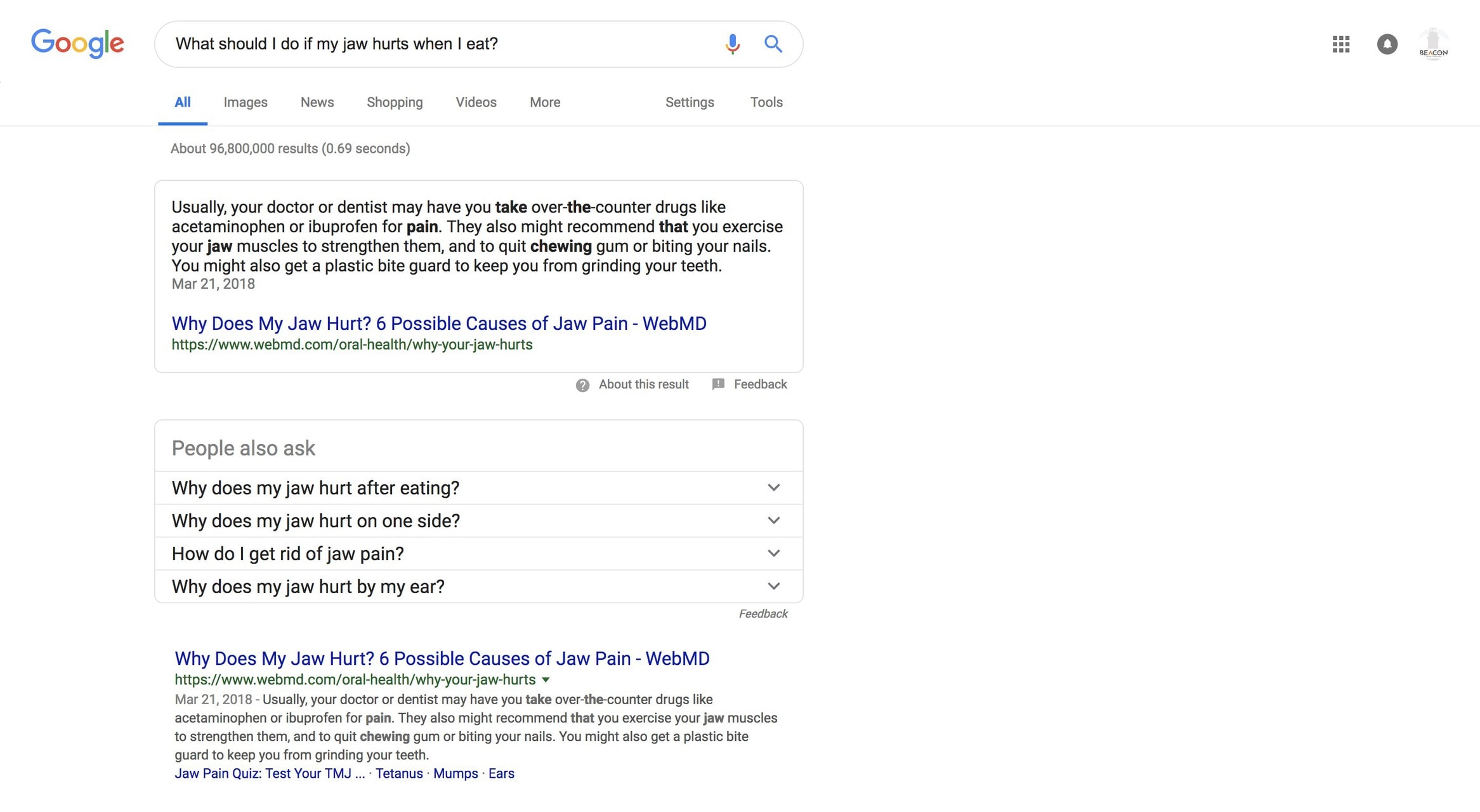
Maybe they have discovered that they have jaw pain. The search may go something like this:

Should I Blog for My Orthodontics Practice?


As you can see, WebMD has done a great job at answering this question for the potential patient. They or one of the other top-ranking blogs on this page will likely get the click.

Key Tactics for Orthodontics Blogging

By answering questions, you are one step closer to ranking your orthodontics blogs on the 1st page of Google. Here is just about everything else that you need to do:

Topic

It is harder to rank for general topics than specific ones, because more people are competing for the topic overall. For example, it would be extremely difficult to get on the 1st page of Google for “orthodontics” (~67M competitors), however, you may have a shot at “orthodontics for teens” (~2-3M competitors). At Beacon, we qualify our topics by the industries we are targeting. For example, instead of writing an article about “blogging,” we wrote an article about “blogging for orthodontics.” Choose a topic that is specific enough to stand a chance at achieving rank on the search engine.

Headlines

Once you have chosen a topic, it is time to come up with a title for your blog. At Beacon, we use a tool called Answer the Public to find common questions asked by internet searchers in our topic area. The tool is simple, all you must do is enter your topic, and it will show you the kinds of questions people are asking. Honestly, the best way to rank is to simply use the question as your title, but you can get a little creative if that title is already taken for the search. Just be sure to check your headline against a tool like CoSchedule’s Headline Analyzer or our blog on headlines that get attention.

In addition to the main headline, you should be able to set headlines throughout your blog using what are called “H tags”–H1, H2, H3, etc. Be sure to put your topic keyword–“orthodontics for teens”–in H tags throughout your article to achieve ranking.

Content

A lot of people think that it is engaging and persuasive content that ranks blogs and gets people to read them. That is only half true. Content that is free of common spelling errors and grammatical mistakes is important, but arguably more important is the keyword optimization of your blog. This means that your keyword, make it “orthodontics for teens,” is spaced naturally throughout the article. Keyword optimizing your blog will tell the search engine what your blog is about so that it achieves rank. Write with authority and authenticity to show readers that you know what you’re talking about.

Note: Although it is important to answer questions thoroughly, the goal of ranking blogs is to get potential patients in the door! After you have answered their question, put a gentle “call-to-action” at the end of your blog telling them about your services and requesting that they schedule an appointment with a link.

Metadata

“Metadata” may sound like a big and scary word, but it is really rather simple. Setting the metadata for your post is adding the title, description, and keywords in a format that Google can grab and populate on their page. At Beacon, we use WordPress for our blogs, which allows us to add intuitive plugins such as SEOPress with form fields to set our metadata. This is a very important part of the keyword optimization of your blog, so do not forget it! You should also remember to set a featured image for your blog, as this is what will show up whenever you share it to social media.

Schedule

How often should you be blogging to achieve rank? Good question. At Beacon, we recommend 1-2 times per week. That said, a lot of our clients find this too time-consuming or cost prohibitive and opt for a strategy of 1-2 times per month instead. Depending on the strategy that you choose and how competitive your market is, each blog should be between 400-600 words or between 1,600-2,000 words. With a minimum strategy, you can typically see results within 6-9 months.

The Waterfall Method of Blogging for Orthodontics

Another important tactic that we have yet to address is called “backlinking.” This is the practice of acquiring links to your blogs from other websites, thereby boosting their rank in Google. You can think of a backlink like a referral–the more credible the website referring your business to Google, the more likely they are to help you rank higher on the search engine.

Backlinks can be difficult to come by, and the traditional method of prospecting for backlinks is becoming less and less advised as we learn more about best practices for search engine optimization (SEO).

Something that you can do to create a strong link structure, however, is apply the waterfall method.

The waterfall method involves writing one, primary overview blog about your services, then writing blogs about your services individually, then going back and linking the sections of the first blog to blogs about those topics. If that was a bit confusing, we understand. Here is an example/potential waterfall that we are currently working on for Beacon:

  • Digital Marketing for Orthodontics
    • Branding for Orthodontics
      • Logos for ” “
      • Taglines for ” “
    • Web Design for Orthodontics
    • Social Media for Orthodontics
      • Video Marketing for ” “
      • Lead Quizzes for ” “
    • Google Advertising for Orthodontics
    • Blogging for Orthodontics – THIS BLOG!

As you can see, one blog cascades into a subset of blogs that cascades into another subset of blogs, much like a waterfall.

If you use the waterfall method in your blogging, you are showing Google how all of your information relates! Google loves this, and will reward you richly with a strong rank.

This blog is essentially our handbook for blogging, both for our clients and for us! We hope that it helps you understand why blogging is important–even for orthodontics practices–and how you can make it all happen. If you are interested in hiring Beacon for our blogging services, we would be happy to chat with you! You can reach out to us via our Contact Form or even schedule a free consultation with our VP of Marketing Jennifer Christensen directly using our scheduler. We look forward to helping you achieve your goals for blog marketing!

“The best place to hide a dead body is on the second page of Google.” – Anonymous

A lot of the practice managers we meet have a gut instinct that they need to be advertising on Google, but few know exactly what Google advertising is, how it works, and whether or not it can truly help them grow their practice. They’ve heard the terms–Google AdWords, PPC, even search engine optimization–but they don’t know what it all means. We’re here to shed some light on these subjects and to tell you that yes, Google advertising can help you grow your orthodontics practice, but there are some important factors that you need to know. You’ll learn about the Google advertising algorithm, how much Google advertising costs, and much, much more! Enjoy!

Bonus: We threw in some of our agency best practices at the end. Check it out!

What is Google Advertising?

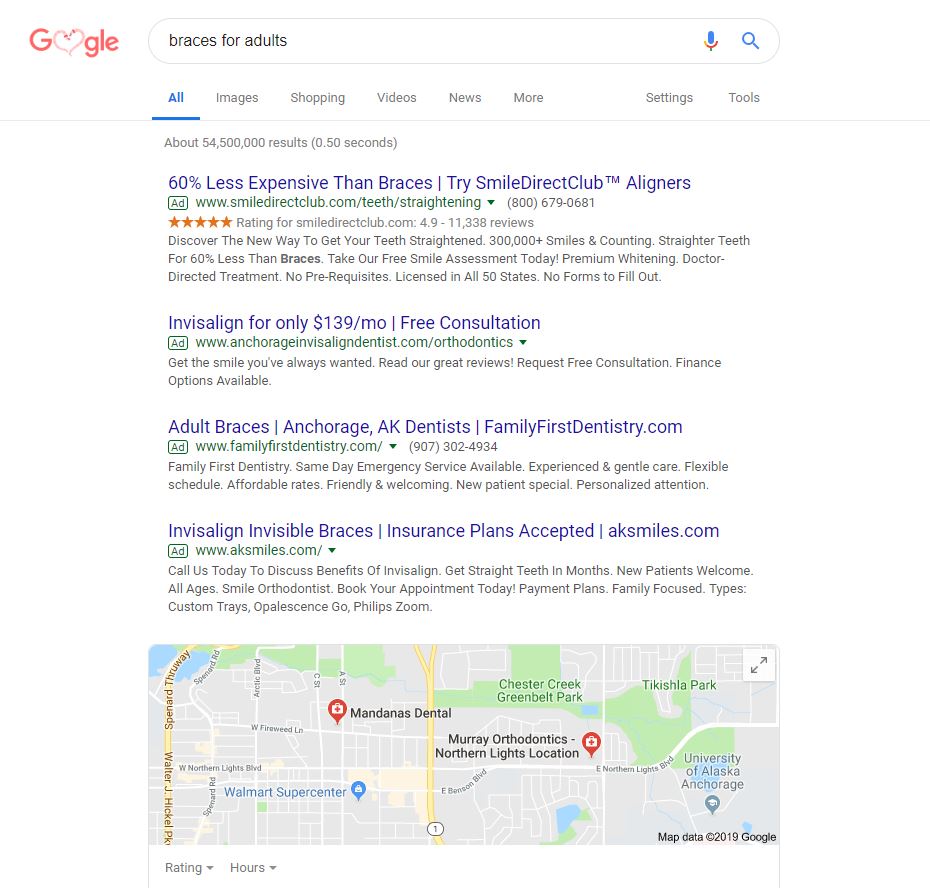
Have you ever performed a search on Google and wondered why the top several results have a little green box that says “Ad” next to them? Or have you ever visited a website only to have their advertisements follow you to the next site you visit? If so, you have encountered Google advertising.

When you perform a search on Google, you are taken to something we marketers call a SERP (search engine results page). This is simply the page on which Google displays all of the results of your query. The SERP will be formatted differently depending on your search, but in general, Google Ads are the results displayed at the top of the page:


How Can Google Advertising Grow My Orthodontics Practice?


Google Ads are called “paid” results because the advertiser must pay whenever an internet user clicks on them. That is why in the marketing world we call Google advertising “pay-per-click” or “PPC” advertising. The results below this area of the SERP are called “organic” results because they are chosen by Google strictly according to their relevance to the search, as in, there is no additional paid incentive.

It can be tough for an orthodontics practice to show up in the top of the organic results. That is why Google Ads are so appealing to many practices. At Beacon, we recommend a strategy that incorporates both Google Ads and techniques to rank organically.

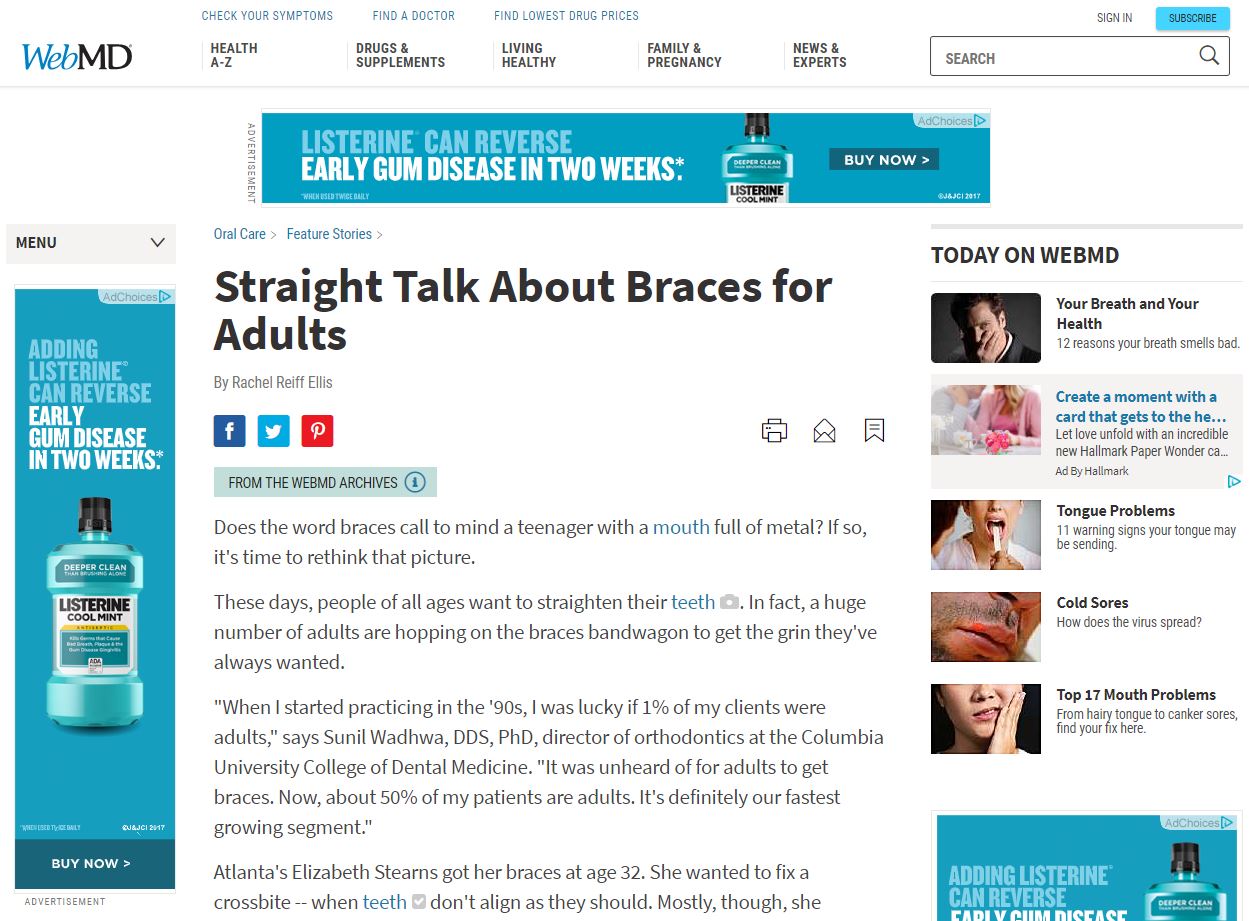
Google Ads are created using Google AdWords, and they are typically comprised of three components, a headline, URL, and description. The advertisements that you see on the websites you visit are a little bit different, however. These are called Display Ads, and they can come in sixteen different formats combining logos, graphics, headlines, and descriptions. Here are some examples of Display Ads being run by Listerine on WebMD:


How Can Google Advertising Grow My Orthodontics Practice?


As you can see, Display Ads look very different from the ads shown in the SERP, and allow for a lot more visual, creative freedom. When you see Display Ads that seem to “follow” you from other sites you have been visiting, this is because the advertisers are trying to reach you through something called “remarketing.” Remarketing is a kind of advertising enabled by Display Ads that allows advertisers to show ads to you if you have already visited their website, enticing you to come back. It is very effective!

How Does Google Advertising Work?

Both the Google Ads that are displayed in the SERP and the Display Ads that are shown on websites are created using Google Adwords. To create a Google AdWords account for your orthodontics practice, follow their sign-up guide.

Registering for an account is one thing, but creating advertisements is another. Getting those advertisements to show up when other orthodontics practices are competing for the same advertising space proves to be an even greater challenge! Let’s talk about the Google advertising algorithm and how it works, then we’ll dive into how you can use Google advertising to grow your orthodontics practice.

The Google Advertising Algorithm

A lot happens in the split second it takes to perform a search on Google.

Whenever someone performs a search, Google takes a look at all of the AdWords accounts it has on record, checking for advertisers who are trying to rank for relevant keywords. For example,  an advertiser who wants to rank for searches like, “Can I get braces as an adult?” might be trying to rank for the keyword, “adult braces.” Advertisers tell Google that they want their ads to rank for certain keywords by bidding a monetary value on them. This makes every Google search an auction of sorts for advertisers.

How does Google choose who wins? The algorithm looks at two factors:

  • The maximum bid you have set for your keyword
  • The quality score of your advertisement

Your maximum bid is how much you are telling Google you are willing to pay if an interested party clicks on your ad. It can also be called your cost-per-click (CPC) bid. The quality score is comprised of additional factors:

  • Past performance of the ad, ad group, and your account
  • The relevance of your selected keyword, ad, and landing page

Ad groups are the groups of keywords that you are trying to rank your ad for. Landing pages are the page you send interested parties who click on the URL in your ad to. All of this comes together in one simple equation that selects winners:

CPC Bid x Quality Score = Ad Rank

Display Ads work very similarly to Google Ads with only a few key differences. In the case of Display Ads, CPC bids are set on an ad group level, not for individual keywords. In addition, you can bid based on impressions–the number of times your ad was delivered–instead of clicks if you like. These are called CPM bids.

Why does Google rank ads based on relevance? The more relevant results they return to their users, the more their search engine is used and loved, the more money they make! It is in Google’s best interest to connect you with the right customers.

How Much Google Advertising Costs

As the name pay-per-click implies, your orthodontics practice will be charged every time an interested party clicks on your ad. This rate is determined on a case-by-case basis according to the following equation:

Next Highest Ad Rank / Quality Score + $0.01 = CPC*

Take a look at this equation for a second. Notice anything interesting? The higher your quality score is, the less you will have to pay per click. Google rewards advertisers for relevance. How cool is that?

Advertisers are rewarded for the relevance of their ads in how much they are required to pay! The more relevant the ad, the higher your quality score will be, and the lower your cost-per-click will be.

*The cost-per-click will never go above your maximum set CPC.

Can Google Advertising Grow My Orthodontics Practice?

There is not a simple “yes” or “no” answer to this question. As we have seen, Google advertising can make your practice show up first in search results, but this is dependent on a lot of factors such as bid, relevance, and especially the number of other orthodontics practices you are competing against.

Certain industries and certain locations are more competitive than others. At our location in Anchorage, the legal industry sees cost-per-click of up to $50! For credit card processing clients, we are looking at between $25-$53 CPC. Here is a breakdown of the top three keywords in orthodontics for Alaska:

Keyword Average Monthly Searches Competition Page Bid (Low Range) Page Bid (High Range)
orthodontist 320 Low $6.68 $19.90
braces 170 Low $3.86 $11.31
invisalign 380 Medium $6.00 $15.35

Source: Google Adwords Keyword Planner (at the date of this blog post)

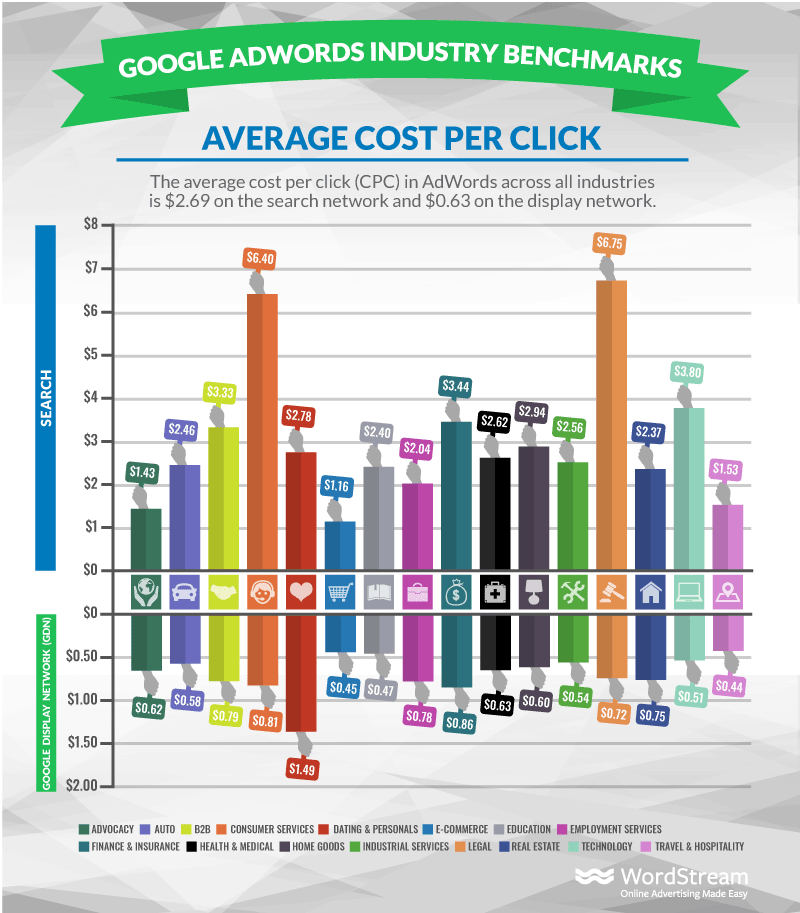
On the low end, those are reasonable bids. According to industry benchmarks, the average cost-per-click for the health and medical industry (the closest to orthodontics recorded) is closer to $2.62:

How Can Google Advertising Grow My Orthodontics Practice?

Source: WordStream (at the date of this blog post)

That said, relevancy in advertising can do a great deal for bringing down cost-per-click prices. At Beacon, we typically run Google Ads that have CPC below industry benchmarks.

Over the years, we have developed best practices for our own Google AdWords team to grow their accounts. Here are a few key pointers that we recommend to new clients:

  • Do not attempt to run Google Ads on a budget less than $300 per service advertised. This amounts to 1-3 ad groups and minimum cost-per-click budget on each keyword.
  • Choose a niche that differentiates your orthodontics practice from everyone else. For example, we run Google Ads for a holistic dentist–These keywords are easier to target than general dentistry.
  • Write strong ads, but also optimize your landing pages for the keywords you are using in your ads. Doing so will boost your quality score.

In summary, if you do your research on the competitiveness of relevant keywords in your area, find a niche, spend the right amount, and create high quality score ads, you can grow your orthodontics practice using Google advertising. As we mentioned earlier, however, we typically recommend a strategy that incorporates more marketing channels than simply Google AdWords. For one client, we were able to deliver over 180 leads in one month (that’s over five leads a day) using an integrated Facebook and Google AdWords strategy.

If all of this is a little overwhelming, we completely understand–the pay-per-click advertising industry uses a lot of terms and technology! We have spent many years sorting through the ins and outs of Google Ads and Display Ads as an agency. Our team has earned the Google Partner certificate and we would love to help you grow your orthodontics practice using Google advertising. Please reach out to our VP of Marketing Jennifer Christensen to schedule a free consultation if you are interested.

“Nobody (not even us!) can sit in front of a blank computer screen three times a week and pull something out of our hat each time like it’s no big deal. Publishing regular content is a challenge for anyone who does not have a plan. So that is exactly what we do–we come up with a plan to guide us on the days that creative genius does not come naturally.” – #TeamBeacon

A lot of practice managers know that social media is important, but they simply haven’t been able to get a strategy moving forward. If this is you, we feel your pain.

That’s why we put together this quick guide outlining our approach to consistent social media publishing, for orthodontics!

First, we’re going to do a quick refresh on the top 3 platforms we recommend at Beacon. Then we’ll go straight into our key to success: the Editorial Calendar. We’ll also touch on paid social media advertising for a bit! Enjoy the ride!

The King of Social Media: Facebook

There is no question about the popularity of Facebook and its potential for reaching a significantly large audience of prospective orthodontics patients, but just in case, here are some statistics to ease your mind.

Almost 75% of online American adults use Facebook.1At the end of 2018, Facebook had 2.32 billion monthly active users.2 That’s almost one-third of the global population!

What makes Facebook such a great tool for reaching these people is its targeting abilities. When you publish paid content to Facebook (see: Boosting Posts and Advertising), you are not simply showing your content to the world at large–you have the ability to tell Facebook who you would like to show your advertisements to based on important demographics such as location, title, income, interests, and more.

Posting Schedule

In order to grow and maintain a following on Facebook, we recommended that you post to your orthodontics page 3-5 times per week. The content of these posts should follow an Editorial Calendar to publish consistently, which we will talk about in a moment.

For a brief summary of the information shared in this blog, watch Social Media Manager Sarah Testen discuss social media marketing on Beacon’s Digital U!


Instagram for Orthodontics

Instagram is an important platform for reaching a millennial audience as well as the teenage population (prime time for braces!). The platform’s most active users are between 18 and 29 years old,3 with 72% of teens saying that they use Instagram.4

A good rule of thumb for posting Instagram content is that “everything that goes on Instagram can be shared on Facebook, but not everything that is shared on Facebook should go on Instagram.” This is because the content that performs well on Instagram includes warm and engaging images, and not all Facebook posts are that way.

Instagram is a visually-oriented platform that works best when you are sharing high-quality images taken in good perspective. If you have a natural photographer on staff at your orthodontics practice, you will want to enlist his or her help for this platform.

Instagram also thrives on “everyday” images, photos that provide a sneak peak into the visual life of the person, business, or practice being followed. Arm the photo-savvy members of your orthodontics team with the ability to share pictures of pretty views out the practice windows, indoor plants, positive interactions with patients (if they are willing to have their photo shared), and more! This will bring life and a following to your page.

Posting Schedule

Plan to share a couple posts types from the Editorial Calendar that include engaging images each week in addition to the photos your team photographers take!

If you are just getting started on Instagram, we recently wrote a blog with 14 tips to optimize an Instagram for Business profile. Check it out for a deeper look at some of these concepts!

Tips for Social Media Marketing on Linkedin

LinkedIn is coming back as a great way to do business-to-business marketing. Although your orthodontics practice is likely not targeting other businesses, LinkedIn can be valuable for vendor relationships as well as for reaching prospective new hires.

Among social media platforms, LinkedIn is a powerhouse for business-to-business traffic. The platform makes up more than 50% of all social traffic to business-to-business websites and blogs.5 Although there are only 154 million LinkedIn users from the U.S., this is a select group of people, comprised primarily of senior-level staff and decision-makers.6 In addition, there are currently 40 million students and recent college graduates on LinkedIn as more and more realize that it is an effective platform for networking to find jobs.7

Content that performs well on LinkedIn includes business and industry news as well as personal coaching/life advice, which makes sense considering the demographics.

Posting Schedule

If your orthodontics practice is looking to forge new vendor relationships, strengthen old ones, or if you are currently hiring, we recommend posting 3-5 times per week.

How to Create an Editorial Calendar for Your Orthodontics Practice and Publish Consistently

At this point you are probably thinking, “This information is great and all, really it is, but how do I make it happen?”

Yours is a common pain point among our clients–they understand the importance of publishing consistently to their social media accounts, but they have not been able to get the task off the ground.

As a social media agency, our job is to publish social media content on a consistent basis, and we understand the struggle. Nobody (not even us!) can sit in front of a blank computer screen three times a week and pull something out of our hat each time like it’s no big deal. Publishing regular content is a challenge for anyone who does not have a plan. So that is exactly what we do–we come up with a plan to guide us on the days that creative genius does not come naturally. We call this plan our “Editorial Calendar.”

Here is a page from an Editorial Calendar we recently produced for one of our clients (name and logo blurred for anonymity):


Get Your Orthodontics Social Media Strategy Off the Ground!


At the start of service for each of our social media clients, we sit down as a team and brainstorm 3-5 categories of content or “post types” that we could publish on a consistent basis. These categories are informed by our knowledge of the goals of our clients as well as market research. If you haven’t already come up with goals or done market research with your orthodontics team, this is a good starting place.

Once the heavy lifting of goal setting and market research has been done, you are ready to create your editorial calendar. Here are a few ideas for post types we have used in the past:

  • Educational (see example above) – Use this post type to tackle the incorrect perceptions of your followers that are holding them back from doing business with you, or for things they simply do not know. Educational posts establish authority, so we often recommend them to groups who want to be thought leaders in a particular topic space.
  • Blog or Article Shares – If your orthodontics practice has a blog, sharing those posts on social media will drive more traffic to your website. You can also share articles by other thought leaders in your industry if they share your perspective on orthodontics. Doing so reinforces a position of educational authority for your practice.
  • Human Interest – We have experienced wild success with our clients sharing human interest posts on social media. These are posts that focus on a particular person and their story, such as a staff member or a patient (with permission). As an example of this post type and the kind of following it receives, visit the Humans of New York Facebook page.
  • Behind-the-Scenes – Behind-the-scenes posts promote the transparency and authenticity of your practice. If you are able to show your orthodontics staff working directly with patients (with permission), great! If not, photos from staff get-togethers and fun moments around the practice are just as effective if not more so.
  • Before and After – Orthodontics practices especially can benefit from before and after posts. Show the value of your services by posting quality before and after pictures of your patients on social media (again, with permission)!
  • Lifestyle – Tying your services to the lifestyle of prospective patients will do wonders for your practice. Show smiling, happy people with the demographics of your target audience and talk about the direct benefit to them of getting orthodontic work done with you.
  • Videos – If you have the capacity to produce promotional videos for your practice, social media is exactly where you need to be sharing them!
  • Events – A lot of practices are involved in their local community, either sponsoring events or volunteering in some capacity. In the advent of an upcoming event, share the information to your social media accounts and invite others to participate!
  • Promotions – Practices who run promotions should be sharing them to their social media account. It’s a no-brainer for getting more participation!
  • Contests – Contests are a great way to foster social media engagement among your audience! We have discovered that photo sharing contests work best, where the followers are asked to share their favorite photo from a particular category for a chance to win your services, such as “your favorite picture of mom” for Mother’s Day.
  • Quizzes – Quizzes are a very engaging form of content on social media as well. You have probably seen this post type before, any time you have found out “what kind of cookie you are” or “which character from the office you would be.” Use tools like Lead Quizzes to create questionnaires that resonate with your audience.
  • Campaigns – Social media campaigns allow your practice to push an important message that challenges perceptions and expresses the heart of your business services. Brainstorming a campaign is a slightly more challenging task than simply developing an editorial calendar, but if you feel like you need one, go for it!

With an Editorial Calendar in place, it should be easy for your orthodontics team to stay on top of publishing for your practice!

Something that we do and we also recommend for our clients is to schedule posts in advance. Facebook Business Manager allows you to draft posts, schedule them in advance, and even post-date them! Our team writes posts at least a week ahead of when they are scheduled to go live to avoid any kind of “getting stuck” on content ideas.

Boosting Posts and Advertising on Social Media

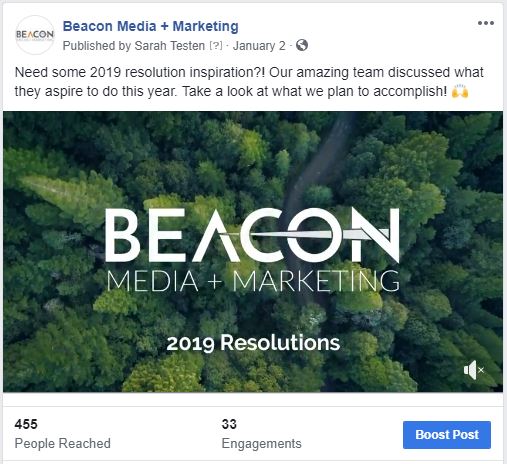
If you have been publishing for your orthodontics practice on Facebook for any amount of time, you have probably seen the blue “Boost Post” button on the bottom of your posts:


Boosting your posts extends your reach beyond the people following your Facebook page and allows you to target audiences according to the demographics we discussed earlier.

After you click the blue button, you will be prompted to create an audience, set a budget, and decide how long you would like your posts to run. We recommend that our clients spend a minimum of $300-$500 each month, distributed across 2-3 advertisements, in order to gain worthwhile traction with Facebook advertising. That said, it is VERY IMPORTANT that you get your targeting right or your ads will flop.

While boosting posts can be done through Business Manager, running traditional Facebook advertising is accomplished through Ads Manager. In Ads Manager, you can dive deeper into targeting and the A/B testing of your ads as well as the analytics. Ads Manager is too in-depth to get into in this article, but here is a brief summary of how to make Facebook ads that bring in results.

We hope this quick guide helps your orthodontics team get a social media strategy up and out! If you get stuck at any point in this process and would like to work with us, our VP of Marketing Jennifer Christensen is always up for a free consultation. You can also reach out to our President directly at [email protected]!

“Your website is prospective patients’ first impression of your practice.” – #TeamBeacon

Is it time to redesign the website for your orthodontics practice? Digital marketing experts recommend that every business, practice, and organization–regardless of industry–redesign their website every 2-3 years. New products or services, staff, and even changes to website best practices can all mean your site is ready for an update!

Updating your practice website can feel like a daunting task. But we are here for you.

After over 20 years in the marketing industry, we have developed a proven process for our website services that we believe is the greatest thing since sliced bread! It is the very process that we walk every one of our clients through. We hope this process grants you and your team smooth sailing as you tackle one of your biggest projects yet.

1. Meet with Your Orthodontics Team

The first step in redesigning your orthodontics website is to determine why you are doing what you are doing, what your goals are, and what a successful website design looks like to you. Gather all of the key people on your team into one room and ask yourselves these questions. Take some time to look at competitors’ websites, orthodontics websites from across the country, as well as any websites that you generally like the look and feel of, identifying concrete specifications for your own redesign. You may be surprised by the concept you begin to develop through collaboration! Here are just some of the questions that we ask our clients at the beginning of their website services with us:

  • What are you trying to achieve as a practice? What sectors of your practice are you trying to grow?
  • What are the primary and secondary purposes of your website? What do you expect it to accomplish?
  • What information do you want your patients to find quickly on your website? Do you have any primary categories of products or services to highlight prominently?
  • Of the website designs that you like the look and feel of, what features do you like?
  • What type of imagery do you prefer to use? Is there any imagery that you like to stay away from? Do you have any official branding guidelines to adhere to?

We also discuss general marketing information (such as target patients and differentiators) with our clients in order to be as strategic as possible with their website design. Be sure to talk about these important facets of your marketing strategy with your team! Information like who your target patients are and how you stand out in the market can completely change how you choose to position your orthodontics practice online.

2. Map Out A Plan for Your Website Design

Once you have laid the foundation of a strong vision for your new website design, it is time to put your creativity to work! Using the information you gathered during the meeting with your team, you are going to create a sitemap demonstrating all of the pages you want on your site. A sitemap is simply a flowchart, and it can be as simple as a bulleted list. Here is a standard sitemap for a basic, “five-page” website:

  • Home Page
  • About Us
  • Services
    • Service A
    • Service B
    • Service C
  • Blog
  • Contact Us

Now that your sitemap is in place, you are going to create a wireframe for each of these pages, containing all of the design and content elements your team requested.

What is a wireframe, you may ask?

“(A wireframe is) an image or set of images which displays the functional elements of a website or page, typically used for planning a site’s structure and functionality.” – Google

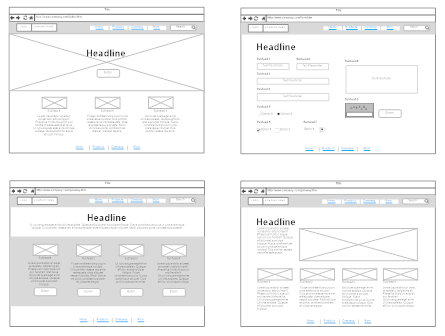
It may sound complicated, but a wireframe is nothing more than a drawing or sketch of what you want your web pages to look like, using only boxes and lines. At this point, you do not want to get too detailed–you will have the opportunity to do that in the development step! Simply outline where you want your images, headers, written content, and buttons on each page. Here is an example wireframe, for your reference:

Source: SmartDraw

If you would like to practice wireframing a good website design, start by looking at some of your favorite websites and trying to imitate their structure with your own wireframe. There are a lot of easy wireframing tools available online. One of them is MockFlow, which offers drag-and-drop wireframing and a free package for basic users.

While you are wireframing your new website design, you will want to be thinking about the written content your team wants on your website and how to execute those concepts on each page. Now is a good time to start writing this content as your vision begins to form, but it is okay to put placeholder content such as “lorem ipsum” in your wireframe for now.

3. Write the Content as an Orthodontics Team

With wireframe in hand, you are now ready to fill in your placeholder text with real, written content that speaks to the soul of your orthodontics practice! There are several important concepts to keep in mind as you go about this process:

#1 Keywords – If one of your goals is for your website to rank on the first page of Google, pay attention to the keywords and phrases prospective patients are using to search for orthodontics services! You will want to incorporate these keywords throughout your text. This is called search engine optimization (SEO). We use the Google AdWords Keyword Planner at Beacon to do our keyword research. It is best practice to focus on one or two keywords per page and place them naturally 5-10 times throughout 400-600 word content, but do not go overboard! Keyword stuffing makes content unreadable–although your website will rank high at first, it will quickly lower in ranking as the Google algorithm learns that everyone who visits your site leaves because they cannot read your content.

#2 “Catchy” Headers – The rate at which people are moving through websites is getting faster and faster as more of the general population become tech savvy. Be sure to use headlines that catch attention at reasonable intervals throughout your content to keep prospective patients engaged. Place relevant keywords in your headers as well to boost your search engine ranks.

#3 Quality & Quantity – Although it is best practice to write 400+ words for each page of your website, do not merely write content for content’s sake. You might put prospective patients to sleep! Keep your content engaging and write in second person, directly addressing “you,” the reader and speaking to the heart of what they want in an orthodontist. Split your content up into paragraphs and use tools like headers, bullet points, and other formatting to keep your content visually interesting and palatable.

Finally, always, always, always include a call-to-action (CTA) at the end of your content! A CTA indicates to the reader what they can do next to act on what they have just read. It should be hyperlinked. For example, a common CTA for an orthodontics practice is “Schedule a Free Consultation,” linked to a contact form.

4. Implement Your Website Design

Once you and your orthodontics team are satisfied with your sitemap, wireframe and content, it is time to design your new website! This may not sound like an “easy step” at first glance, but there are actually many useful tools for people who are just getting started with website design. We use a hefty version of WordPress at Beacon that requires custom coding, but the company also offers a variety of packages available for beginners that allow you to do some customizing of your website without touching the code.

Source: WordPress

Your first task once you have established an account with WordPress is to begin the guided setup process and pick a website theme that fits your wireframe! You will then be able to customize your website design within the parameters of a basic package using the options available. Use the colors and fonts of your orthodontics practice, add the images you like, and upload your written content. WPBeginner is a great resource for any questions you may have throughout this process.

5. Set Your Website Design Live!

If you are finished with your website design and you are happy with how it turned out, you are almost ready to press “go!” First, there are a few things you will want to check to make sure everything is in order.

We have created a pre-live checklist for our staff to go through before the launch of every one of our client websites. Here are just a few of the things on that list:

  • Ensure all links across the website, including all buttons, icons, and linked images, are working properly.
  • Check the contact form to make sure it is sending to the correct email address.
  • Look at the website in all major browsers as well as on mobile to ensure it looks good on all platforms.

Most basic WordPress websites are already “live” from the get-go, however, now is the time to take the domain name from your old website and point it to your new one! Your domain name is the address at which your website is located, for example, our website is located at www.beaconmm.com/. Log in to the account you were given when you first purchased your domain and use the tools provided to point it to your new website. You should be able to see your new website at your domain name within a matter of minutes.

Congratulations! You did it! If you have followed all of these steps, you should have a fully-functioning, up-to-date website that is ready for prospective patients.

We are happy to share our proven process with you, however, if you get stuck on any part of this, please let us know! Our team would love to come on board with your website project and help you see it through to completion. If you are interested, please reach out to our VP of Marketing Jennifer Christensen to schedule a free consultation.

Happy marketing!

“Your brand is what people say about you when you’re not in the room.” – Jeff Bezos

It’s time to brand your orthodontics practice. Where do you start? From discovering your unique reputation and identity to selecting the icons, fonts, and colors for your logo, we created this guide to walk you step-by-step through a proper branding process. Enjoy!

What Is a Brand?

Your brand is your visual identity. It communicates the essence of who you are and what you do in the form of a logo, colors, and fonts. When your patients look at these aspects of your brand, they should emotionally connect with what they know about you. A brand should run parallel to an orthodontics practice’s reputation. Done right, it informs that reputation. Done wrong, it detracts. Proper branding bears the following responsibilities:

  • If you have a good reputation, your job is to capture it.
  • If you don’t know what your reputation is, your job is to discover it.
  • If you have a bad reputation, your job is to pivot it.

How do you do all of this using only the tools of form, font, and color?

We’re glad you asked!

The Discovery Process

At Beacon, we guide all of our orthodontics clients through a series of discovery questions to either capture, discover, or pivot their brand. Begin the branding process by gathering all of the key people into one room, sitting down, and giving due-diligence to self-discovery. You may be amazed by what comes together!

You need serious buy-in from your team if you are going to change your reputation. Do not attempt to pivot your brand until everything is in place. Rebranding is not for the faint of heart!

Here are just a few of the questions that we ask our clients:

  • Describe your practice in two sentences or less. What is your “elevator pitch?”
  • A brand is a promise. What is the promise of your brand?
  • What is the current perception of your practice? What is the desired perception?
  • How do you want to position yourself in the marketplace? Are you the “value” company? The expensive boutique? The innovator? The “tried and true?” The academics? The quick-fix? The thought leaders?
  • What is your big-picture mission?

A big portion of our brand discovery meeting focuses on competition, differentiators, and target patients too! Don’t forget to talk about these aspects of your practice and market with your team.

Naming Yourself

Now that you have all of the data about your brand gathered, it is time to give your orthodontics practice a name and a tagline! Names can come as easy as pie or prove to be a real challenge depending on the day and the flow of ideas. Here are a few ways to get the creative juices flowing:

  • Take a look at what your competitors and orthodontics practices out-of-state are naming themselves. Don’t copy but use these names as a starting place for your own, unique thoughts.
  • Consider using the name(s) of your primary orthodontist(s), especially if they are family names that have a good reputation in your community.
  • Decide if you want to use your location (city, region, state) in your name.
  • Think about any nouns or adjectives that struck a chord with who you are when you had your discovery meeting.

It might sound funny, but one of the best ways to find words that resonate with your brand is to use a thesaurus! Perform searches on some of the top words that came out in your discovery meeting and see where they take you!

The Tagline

A tagline is an opportunity to communicate more about who you are than you get with a name and a logo alone. If during the naming process your team had trouble homing-in on just one idea, that’s great! Find a way to incorporate one of your “secondary” concepts in a tagline.

Not every brand needs a tagline, but it can be helpful to go through the process of creating a tagline to discover what the core of your brand’s messaging is going to be. For example, at Beacon we recently redesigned our website using the tagline, “Award-Winning Marketing, Data Driven Results.” This core message is a starting place for everything else we say or show about who we are on the new site, and it carries over into all of our marketing channels, whether that be Facebook or Google advertising, blogging, video marketing, etc.

Picking Icons, Colors, and Fonts

Selecting the icons, colors, and fonts that represent the reputation you have discovered may sound like an insurmountable task to some. “How do spoken words and visual concepts connect?” You may ask. The psychology surrounding colors and forms and how they are mentally and emotionally perceived by us is an interesting topic, but a little too deep for us to get into in this article. Suffice it to say that a lot can be communicated by what you decide to present visually with your brand, making the choice of a practice’s icons, colors, and fonts one of the most important parts of the branding process. Fortunately, there are a lot of easy-to-grasp tools available to help us overcome this challenge.

Iconography

The icon part of your logo is the form that visually represents something about who you are. It could be related to your location, your name, your values, or even something you want your patients to feel when they participate in your services. For example, when we designed a logo for Juneau Youth Services, we chose mountains and an eagle to visually tie-in the facts that their location is Juneau and that JYS youth and families feel freedom when they get the treatment they need.

An icon is an extremely valuable part of a logo because of its versatility. Icons can become art for promotional products, watermarks on branded documents, and even a standalone logo for practices that have achieved brand recognition.

To come up with ideas for your practice’s icon, reflect back on your discovery meeting. Take a look at your name and the tagline you have developed and see if anything comes to mind. We also recommend browsing the iconography of other orthodontics practices on Pinterest, which is a great tool for creating boards of ideas. To search for specific icons that you are considering, we recommend using The Noun Project, which contains over a million curated icons created by artists globally.

The Color Wheel

The colors you choose will elicit emotions in your patients more than any other part of your brand. Make sure you pick colors that communicate what you want! We recently wrote an article on the emotions associated with different colors on the color wheel. Here are just a few of the color-emotion associations we discussed:

  • Red – Depending on what shade it comes in, red can communicate temptation, warning to stop and pay attention, danger, celebration, love, or femininity.
  • Orange – Often associated with food, oranges are appetite stimulating. They can communicate softer versions of red emotions, including light and life.
  • Yellow – Yellow means light and warmth and catches attention too. It can reveal joy, optimism, comfort, and in its gold form, wealth, luxury, and rank.
  • Brown – Earth and wholesomeness are two concepts we associate with brown. Brown is a popular color in outdoorsy, organic, and all-natural circles.
  • Blue – Blue is often used in the health and wellness industry, reminding us of tranquility, mystery, depth, and strength.
  • Green – The color green comes in the most diverse forms of any other color in the world, so it has a wide range of associations from new beginnings to relaxation.
  • Purple – Purple can act either like a red or a blue! On the red side of the spectrum, it is energetic and intense. On the blue side, it is calmer and loftier.

A great tool for selecting the color palette of your brand is Adobe’s online color wheel. Using the color wheel, you can experiment with various colors and the tool will adjust all the colors in the palette so that they go well with the colors you have chosen. Try it out with your team and see what you think!

Typography

Typography is often an afterthought for practices working on their brand. This is unfortunate because, finding the perfect font to fit with your icon, colors, and feel is the finishing touch on a strong logo! Using just “any old font” can make a logo feel disjointed, especially if the font does not fit with the feel and messaging that you are going for.

Visit Google Fonts to take a look at what is available for free online! This tool is especially neat because it allows you to type the text that you want to see in each font, right in your browser.

Matching font and form is often a matter of the gut. As you are scrolling through fonts, think about what each font is making you feel. Now think about why you feel that way.

Maybe you think of one font as “editorial” because you have seen it on a popular news site. Maybe another is “creepy” to you because you have seen it on the cover of a horror film. Your patients probably feel the same way about these fonts, as certain industries gravitate toward certain font feels.

Pick a handful of fonts that elicit the right feels for you, and present them to your team. Depending on what they affirm or deny about your font/emotion choices, you have a font for your logo!

Brand Management

Once icon, font, and colors have come together, you have done it! You have branded your orthodontics practice. The next step is to protect the beautiful brand you have created!

Brand management can be as complex as a corporate policy or a simple as a style guide that tells your team what your icon, font, and colors are and the versions of the logo they have available to them to use. We produce a style guide for each of the clients that we work with. This step is important and not something to skip if you want your brand to work for you.

We hope this guide helps you on your journey to rebranding your practice! If you have any questions about any one of these steps, please feel free to email our Creative Director Adrienne Wilkerson. Adrienne has been branding practices and clinics in the health and wellness industry for over 20 years. She can be reached at [email protected]. If you are interested in hiring Beacon to work with you through the branding process, please reach out to our VP of Marketing Jennifer Christensen. You can schedule a free consultation with Jenn directly!