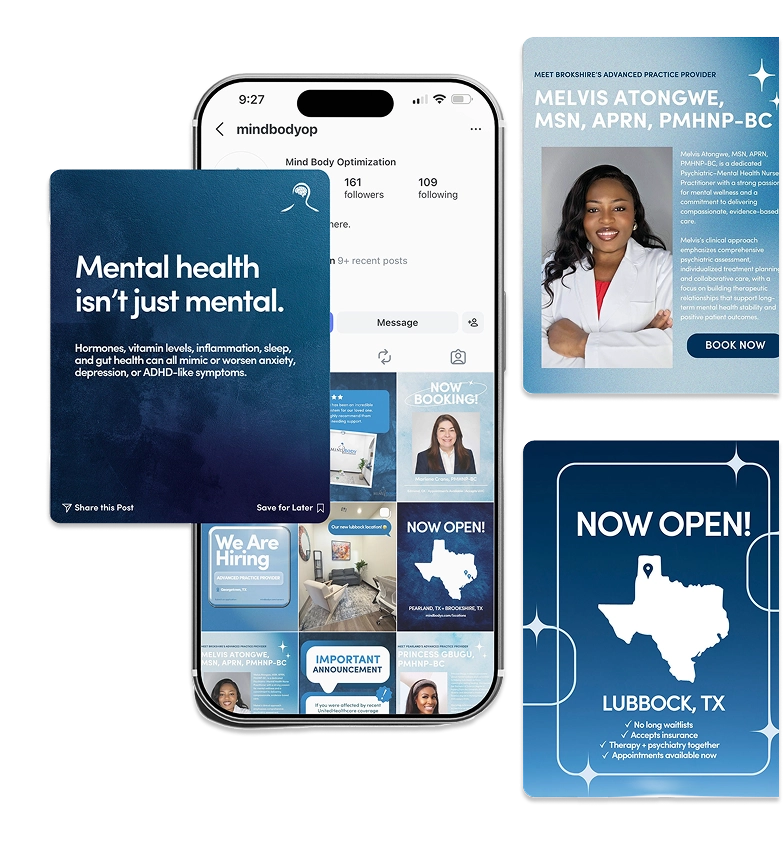
Posting Consistently but Not Seeing Engagement?
Establish a strong online presence that showcases your expertise and builds trust with our social media and reputation management strategies, made for mental + behavioral health providers.
Driving Sustainable Growth
Years of Experience
Award
Why Choose Beacon For Social Media?
Full-Funnel Social Strategy
Purpose-Driven Content + Creative
Collaborative + Efficient Workflow
Engagement + Reputation Management
Climb Aboard With a Customized Marketing Plan
Are you ready to take your mental or behavioral health practice to its next stage of growth? Let’s partner up and build a strategy that gets you there now.
Are Your Social Posts Just Not Connecting?
Seamless Review Process
Many of our clients opt to be hands-on with their marketing and review social media posts before publishing. We utilize user- friendly software that makes it easy to review and schedule all posts.
Social Media Strategy
Whether you’re focused on increasing your following, driving traffic, or generating leads for your practice, we'll develop a strategy that will draw in the most engagement for your mental + behavioral health brand.
Reputation Management
Your online reputation can influence a decision long before someone reaches out. We help you monitor reviews, strengthen credibility, and create a more positive digital presence that builds trust with prospective clients and customers.
What Our Clients Say About Us
“Thank you, Beacon, for being the partner that we needed to growth and scale our practice. Michelle and the Team at Beacon have provided guidance and direction along with incredible results.”

Elisabeth Gulotta
NYC Therapeutic Wellness
“We are so thrilled with the content calendar, training, quality of writing, and responsiveness of your team. The results speak for themselves. We couldn’t be more happy. Thank you!”

Miranda Barker, Executive Producer
Ellie Mental Health
“The flexibility and patience with the onboarding process were exceptional. Everything has turned out so much better than I even imagined. I’m so thrilled with the growth.”

Christina Zampitella, Psy.D., FT
Center for Grief & Trauma
“The new website has streamlined intakes through the new layout and SEO plan, which has been fantastic. Intakes have increased dramatically and overall much more consistent and retention has been pretty high as a result.”

Meghan McArville, MA, LMFT
Holistic CFT
“The Beacon Media + Marketing team was the perfect choice for our small non-profit. They listened to our vision and helped craft an outstanding message that we’re proud of.”

Ali Tolman
Let Every Woman Know–Alaska
“The team at Beacon is amazing! They are able to transfer the heart and personality of our business into their marketing. They listen and respect any concerns. Our business even during the pandemic has grown thanks to Beacon Marketing! Highly recommend this company!”

Dr. Robin Ridinger
Premier Health & Holistic Medicine
“Beacon Media + Marketing has far exceeded our expectations with this campaign and in bringing our efforts in the community to light. We have received positive results and reactions from community members and more importantly, a significant increase in our fundraising efforts for these important causes.”

Michelle Engelke
Denali Express Chevron Network
“I love the website soooo much! Please make sure your team knows how incredible of a job they did! It’s wildly impressive and I’m thrilled that it’s for the CCC – ahhhh! Absolutely amazing! The design, the intuitiveness, the content, everything. I can tell how much work went into it and I couldn’t be happier!”

Janelle Anderson, Founder
Collective Care Counselling

Explore Our Insights
Take a closer look at the tools, tips, and strategies that help your practice grow with confidence.
Your contact page is the last thing standing between a motivated patient and a booked appointment. It is, in theory, the simplest page on your website. And in practice, it’s the one that loses more patients than any other.
Not dramatically. Not with an obvious error message or a broken form. Quietly. One person at a time, clicking away because something about the page didn’t feel right, the form asked for too much, the next step wasn’t clear, the page felt cold when they were hoping for warm. Most practices never know it’s happening because there’s no notification when someone closes a tab instead of clicking submit.
NAMI’s research on access to mental health care consistently shows that only about half of adults with a mental illness receive treatment in any given year. The barriers cited are cost, stigma, and access friction. The contact page is one of the few places a practice has direct control over that third category. And most are squandering it.
Here’s what actually makes a mental health contact page convert, and what gets in the way.
Is your contact page working as hard as the rest of your marketing? Let’s take a look at it together and find out what it’s costing you.
What’s Really Going On
- A contact page that converts isn’t just functional; it’s emotional. It meets a patient at the most vulnerable point in their decision-making process and makes the next step feel safe rather than bureaucratic.
- Form length is the single biggest friction point on most mental health contact pages, and reducing it is the fastest, cheapest conversion improvement available to most practices.
- The copy matters as much as the design. What a contact page says, and how it says it, directly influences whether a hesitant person completes the form or quietly talks themselves out of it.
- What happens after submission is part of the conversion. A warm, specific confirmation experience keeps the patient moving forward. A cold auto-reply often undoes everything the page did right.
- Mobile optimization is non-negotiable. A significant share of mental health contact form submissions happen on a phone, often late at night, often in a moment of private vulnerability. If the form is hard to use on a small screen, it’s losing patients you’ll never know about.
Why Is the Contact Page the Highest-Stakes Page on a Mental Health Website?
Because it’s where the emotional work of the entire patient journey meets the practical reality of the practice’s intake process. And those two things are rarely designed to work together.
By the time a patient reaches the contact page, they’ve already done something genuinely hard. That effort includes:
- Acknowledging they might need support, often after months of sitting with the idea
- Researching multiple practices and evaluating which one felt like the right fit
- Reading bios, checking reviews, and building enough trust to consider reaching out
- Working up the courage to take a step that still feels uncertain and vulnerable
The contact page is the payoff for all of that effort, and also the moment when the anxiety that drove the search peaks. This is not the moment to present a form that looks like a health insurance application. It’s the moment to make the next step feel so simple, warm, and obvious that completing it feels like the path of least resistance.
Most contact pages are designed around the information the practice needs. A high-converting contact page is designed around the emotional state the patient is in.
How Much Does Form Length Actually Affect Conversion?
More than any other single variable on the page. And the direction is straightforward: shorter converts better.
Every field in a contact form is a decision point. Each one asks the patient to provide something before they’ve established any trust with the practice, before they’ve spoken to a human, before they know whether this practice will even have availability or accept their insurance. In a clinical context, those questions might feel routine. To a nervous first-time patient filling out a form at 10 pm, each field is friction.
What to Ask at Initial Contact
Keep the initial form to the bare minimum needed for a first conversation:
- First name (last name optional)
- Preferred contact method — phone or email
- A brief, optional note about what they’re looking for
What to Defer Until After First Contact
Everything else can wait until after the first human connection has been made:
- Date of birth and full legal name
- Insurance information and policy details
- Detailed symptom history or presenting diagnosis
- Emergency contact and referral source
Many practices include those fields because the EHR system makes them feel necessary, or because someone decided it would be convenient to have everything in one place. What those fields actually do is filter out the patients who were motivated but not desperate enough to push through the friction. And in mental health, those are often exactly the patients a practice most wants to reach.
Why Does the Copy on a Contact Page Matter as Much as the Design?
Because a patient in a vulnerable emotional state is reading every word, and those words are either reinforcing their decision to reach out or quietly building a case for closing the tab.
Most contact page copy falls into one of two failure modes:
Failure Mode 1: Clinical Distance
Language that sounds professional and precise but cold. Forms that say “submit inquiry” instead of “let’s talk.” Pages that lead with hours and fees instead of a sentence that acknowledges what it takes to make this kind of contact. The patient arrived hoping to feel seen. This version of the page makes them feel processed.
Failure Mode 2: Generic Warmth
Phrases so overused they’ve lost all meaning. “We’re here for you.” “Your journey starts here.” Language that technically checks the warmth box but says nothing specific enough to make a patient feel actually seen. It reads as a template, because it is one.
Contact page copy that converts avoids both failure modes by doing a few specific things well:
- Acknowledging the moment. Something as simple as “reaching out is the hardest part, and we’re glad you did” at the top of the page costs nothing to write and does significant work for the patient who needed to read it.
- Telling the patient exactly what happens next. Not vaguely (“we’ll be in touch”) but specifically (“you’ll hear from us within one business day by phone or email”).
- Keeping tone consistent with the rest of the website, so the patient who arrived with a formed impression of the practice finds that same warmth confirmed rather than contradicted by a form that sounds like it was written by a different person.
What Happens After Submission and Why Does It Determine Whether the Patient Actually Books?
The post-submission experience, the confirmation message and what follows it, is where a significant percentage of motivated patients either move forward or quietly disengage. And most practices have never given it more than a few minutes of attention.
The Confirmation Message
An auto-reply that says “thank you for contacting us, someone will be in touch” is not a warm confirmation. It’s an acknowledgment that the message was received, which is logistically useful and emotionally worthless to a patient who just did something scary. A confirmation that acknowledges the courage it took to reach out, tells the patient exactly what to expect next, and sounds like a real human being wrote it does something fundamentally different. It validates the action, reduces the anxiety of the unknown, and keeps the emotional forward momentum alive.
Response Time
A patient who submits a form in the evening and hears back the next morning has had their courage confirmed. One who waits two business days has had time to reconsider, find another practice, or retreat back into the reasoning that maybe now isn’t the right time after all. The window of readiness is real and it closes. Practices that respond within one business day consistently convert at higher rates than those that don’t, not because they’re better at therapy, but because they don’t let the moment pass.
What Specific Elements Should Every Mental Health Contact Page Include?
The ones that remove uncertainty, reduce friction, and make the patient feel like reaching out was the right decision before they’ve heard back from anyone.
A converting mental health contact page should include:
- A warm opening acknowledgment written in a human voice that validates the patient’s decision to reach out before they’ve read a single form field
- A clear statement of what happens next, including the specific response timeframe and how the practice will follow up (phone, email, or both)
- A visible alternative contact method, typically a phone number displayed prominently on the page, not buried in the footer, for patients who aren’t ready to complete a form
- A short, low-friction form with only the fields necessary to initiate a first conversation
- Mobile optimization, with fields large enough to tap on a small screen and a submit button that doesn’t require scrolling to reach
- Clear telehealth availability information, since patients researching remote care who can’t find that answer will often assume it isn’t available and look elsewhere
How Beacon Approaches Contact Page Conversion
At Beacon, we build contact pages engineered around this exact emotional reality. Our website design process accounts for the patient’s state of mind at every stage of the conversion experience, from the first word on the page to the confirmation message that appears after submission. We track performance data before and after for every client we work with, and the practices that come to us with low conversion rates despite strong traffic almost always have a contact page problem. The fix is almost always faster and more impactful than they expect. Our website design team builds these pages with conversion as the primary design brief, not aesthetics, not technical compliance. Conversion.
What Is the Fastest Way to Know If Your Contact Page Has a Conversion Problem?
Compare your contact page traffic to your contact form submission rate.
In Google Analytics, you can see exactly how many people are landing on your contact page and how many are completing a form submission. If a high percentage of visitors are reaching the page and not submitting, the page has a friction problem. If very few visitors are reaching the page at all, the problem is upstream in the navigation or the calls to action that are supposed to direct people there. Both are fixable, but they require different solutions.
The single fastest free improvement available to most practices right now is to read the contact page out loud as a nervous first-time patient and flag every moment that creates friction:
- Too many fields before any trust has been established
- Vague language about what happens after submitting
- No acknowledgment of how hard it is to take this step
- A confirmation message that sounds like an automated receipt
- A submit button that’s hard to find on mobile
- No visible phone number for patients who aren’t ready to use the form
Any one of those is a patient lost.
The contact page is not the glamorous part of digital marketing. Nobody puts it in a case study lead or talks about it at conferences. But it is the page that determines whether everything else you’ve invested in, the SEO, the content, the social media, the paid ads, actually pays off in the form of a patient who made it all the way through and decided to stay. That’s worth getting right. And if you’re not sure whether yours is, our strategy team helps mental and behavioral health practices audit and rebuild the conversion experience so no motivated patient gets lost at the final step.
Your best marketing doesn’t matter if your contact page loses the patient at the last moment. Reach out to Beacon today, and let’s make sure the page that matters most is doing its job.
It’s one of the first questions any practice asks when getting serious about social media, and it’s also one of the most misleading ones to answer with a simple number.
How often you post matters. But it matters a lot less than what you post, how consistent you are, and whether the content you’re putting out is actually doing anything useful for the patients you’re trying to reach. A practice that posts three times a day with content that nobody cares about is generating noise. A practice that posts twice a week with genuinely useful, human content is building something.
That said, posting frequency does affect algorithmic reach, audience growth, and the kind of sustained visibility that eventually translates into patient inquiries. So here’s the honest, practical answer to the frequency question, along with the context that actually makes it useful.
Not sure your posting strategy is working as hard as it should be? Let’s take a look together and build a social calendar that’s actually sustainable.
The Answers You Actually Need
- Consistency beats volume every time. Three posts per week, every week, for six months will outperform seven posts one week and nothing for the next three weeks.
- The APA’s guidance for psychologists on social media is clear: even five to ten minutes of daily engagement can help maintain visibility. Most algorithms favor active accounts over high-volume ones.
- Platform matters enormously. The right frequency for TikTok is different from Instagram, which is different from LinkedIn and Facebook, and treating them identically is one of the most common social media mistakes practices make.
- Quality decay happens faster than most practices realize. Posting too frequently with low-quality content actually hurts reach over time because algorithms learn from engagement rates, not just post counts.
- The minimum viable frequency for most practices is two to three times per week on primary platforms, combined with daily micro-engagement, responding to comments, engaging with relevant content, and maintaining account activity.
Why Is “How Often Should I Post?” the Wrong First Question?
Because it assumes that frequency is the primary driver of social media performance, and it isn’t.
The right first question is: “What am I trying to achieve with social media, and what content would genuinely serve the patients I’m trying to reach?” Once that’s answered, the frequency question becomes much easier, because the answer is simply “often enough to maintain consistent visibility without sacrificing the quality that makes the content worth posting in the first place.”
A practice that posts daily with content that doesn’t resonate, doesn’t serve a clear audience, or doesn’t reflect the actual warmth and expertise of the clinical team will see its engagement rates decline over time as the algorithm learns that the content isn’t worth surfacing. That declining engagement reach is worse than a lower posting frequency with higher-quality content.
The APA’s guidance for psychologists on digital and social media puts it directly: focus on providing value to your audience rather than growing follower numbers quickly, and recognize that even five to ten minutes of daily engagement can maintain visibility. That’s a frequency framework built around quality and consistency rather than volume, which is exactly the right model for a mental and behavioral health practice.
What Is the Minimum Posting Frequency That Actually Maintains Meaningful Visibility?
Two to three posts per week on your primary platform, combined with daily micro-engagement, is the minimum that most social media algorithms will reward with sustained organic reach.
Below that threshold, most platforms will deprioritize an account in their distribution. Not because the content is bad, but because the algorithm interprets infrequent posting as a signal that the account isn’t actively serving its audience, which reduces its willingness to show that content to people who don’t already follow the account.
The micro-engagement piece is often overlooked but genuinely important. Responding to comments, engaging with relevant content from other accounts, and showing up in the platform’s native behaviors for five to ten minutes a day signals activity to the algorithm without requiring the creation of new content. It’s the social media equivalent of keeping the lights on between posts.
What minimum viable activity looks like in practice:
- Two to three feed posts per week on Instagram or Facebook, with a mix of educational content, clinician-led posts, and practice culture content
- Three to five Stories per week on Instagram, which can be lower-effort than feed posts, repurposed from existing content, or simple behind-the-scenes moments that keep the account feeling active between feed posts
- One to two TikTok videos per week if TikTok is a primary platform, since TikTok’s algorithm is more forgiving of lower frequency than Instagram as long as the content earns strong completion rates
- Two to three LinkedIn posts per week if professional referral development is a priority, which can include thought leadership articles, clinician expertise posts, and repurposed content from other platforms
- Daily engagement activity of five to ten minutes across whichever platforms the practice maintains, responding to comments and engaging with relevant accounts
What Happens to Reach and Visibility When a Practice Posts Too Infrequently?
It erodes. Gradually at first, and then more steeply as the algorithm updates its understanding of the account’s activity level.
Social media platforms use posting consistency as one of several signals to determine how widely to distribute content. An account that posts twice a day for a month and then goes quiet for three weeks doesn’t get credit for its prior activity when it returns. Each period of inactivity resets some portion of the algorithmic momentum the account had built, meaning the first few posts after a gap will reach fewer people than the posts before the gap did.
For mental and behavioral health practices, this pattern of burst-and-gap is one of the most common and most costly social media mistakes. It usually happens because content creation is treated as a task that gets done when there’s time, rather than a consistent practice that happens on a defined schedule. The fix isn’t complicated: a documented content calendar with scheduled posting times removes the daily decision about whether to post and reduces the likelihood that a busy week silently kills the account’s momentum.
The compounding cost of infrequent posting:
- Algorithmic reach declines with each extended gap, meaning content that would have reached 500 people in an active period might reach 150 after a hiatus
- Profile visits from new audiences drop because the algorithm stops recommending the account to users who don’t follow it yet
- Follower engagement atrophies as existing followers adapt to the absence and begin engaging with other accounts that show up more consistently
- The credibility signal of recency disappears, meaning a patient who visits the profile and sees the last post was three weeks ago gets a subtle but meaningful signal about the practice’s attentiveness
| Platform | Minimum Effective Frequency | Optimal Frequency | Best Posting Windows |
|---|---|---|---|
| Instagram (Feed) | 3× per week | 4–5× per week | Weekday mornings (7–9am) and early evenings (5–7pm) |
| Instagram (Stories) | 3× per week | Daily or near-daily | Morning and early evening; less algorithm-dependent than feed |
| TikTok | 2× per week | 3–5× per week | Evenings (7–9pm); weekends perform well for mental health content |
| 3× per week | 4–5× per week | Midweek mornings; Wednesday and Thursday tend to outperform | |
| 2× per week | 3–4× per week | Tuesday through Thursday, 7–9am or 12pm | |
| YouTube | 1× per week | 1–2× per week | Consistency matters more than timing; Friday and Saturday afternoons perform well |
Can a Practice Post Too Frequently and Hurt Its Reach?
Yes, and this is less intuitive than the under-posting problem but equally real.
Posting too frequently, particularly with content that isn’t earning strong engagement, teaches the algorithm that the account’s content isn’t worth surfacing widely. Every post with a low engagement rate is a data point the algorithm uses to calibrate how enthusiastically it distributes the next one. A practice that posts seven times a week with mediocre content will eventually see its per-post reach drop below what a practice posting three times a week with excellent content regularly achieves.
Over-posting also has a human cost: audience fatigue. Followers who see too much content from any single account, particularly when that content doesn’t consistently deliver value, begin to mentally filter it out or actively unfollow. In mental and behavioral health, where the relationship between a practice and its social audience is built on trust and genuine helpfulness, annoying people into unfollowing is an especially counterproductive outcome.
The question to ask before posting any piece of content isn’t “is it time to post?” It’s “does this piece of content serve someone who might be considering our practice?” If the answer is yes, post it. If the answer is “not really, but we haven’t posted in a few days,” don’t.
How Should Practices Think About Posting Frequency During Slower Periods Like Summer?
As a minimum-maintenance discipline rather than an area to cut back, and for exactly the same reasons that summer marketing investment matters across every other channel.
The patients who are quietly researching practices in August, who are in the awareness or consideration stage but not yet ready to book, are still on social media. They’re still encountering content. And the practice that maintained a consistent presence through a slow month is the one they’ll recognize in September when their routine returns and they’re finally ready to act.
Maintaining posting frequency during a slow season doesn’t require producing new high-effort content every week. It does require:
- Batching content in advance during periods when there’s bandwidth, so the schedule doesn’t go dark when clinical demands pick back up
- Repurposing existing content into new formats, turning a blog post into a carousel, a FAQ into a series of short videos, or an older piece of educational content into a refreshed version for a new platform
- Leveraging scheduling tools to queue content days or weeks in advance, removing the daily decision about whether to post and ensuring consistency even through busy periods
- Keeping daily micro-engagement active even when new content production is lighter, since the algorithm activity signal from engagement doesn’t require creating anything new
Our social media team helps mental and behavioral health practices build the kind of sustainable, calendar-driven social strategy that maintains consistent visibility across every season without requiring someone to reinvent the content plan every week.
What Is the Most Practical Way to Build a Sustainable Posting Cadence?
Start with the minimum viable frequency, execute it consistently for 60 days, and then evaluate whether to increase based on results rather than anxiety.
The most common mistake practices make when trying to build a social media habit is committing to a frequency they can’t sustain. They decide to post daily, maintain it for two weeks, burn out on content creation, and then go dark for a month. That cycle is worse for long-term visibility than a modest consistent cadence would have been from the beginning.
The minimum viable approach:
- Choose one primary platform and commit to two to three posts per week on it for 60 days before adding a second
- Build a 30-day content bank before launching, so the first month isn’t spent scrambling for ideas at posting time
- Designate one person as the account manager who owns the calendar, the scheduling, and the daily engagement, even if multiple team members contribute content
- Review analytics monthly to understand which content types and posting times are producing the best engagement and reach for the specific audience the practice is building
Sustainable consistency over twelve months builds more patient acquisition value than any single viral moment or posting frequency sprint. And the practices that internalize that truth early are the ones whose social media presence is still producing results a year from now. Our strategy team helps mental and behavioral health practices build the content systems and calendars that make that kind of consistency achievable without requiring heroic effort every week.
The right posting frequency is the one you can sustain with quality. Connect with Beacon today and let’s build a social media calendar that’s realistic, strategic, and actually produces the patient visibility your practice deserves.
The social media landscape for mental and behavioral health practices looks meaningfully different than it did even two years ago. And the gap between what an effective social presence looks like today versus what most practices are actually doing has never been wider.
Platforms have evolved. Patient behavior has shifted. TikTok and Instagram have become legitimate search and discovery tools. Short-form video has outpaced static graphics as the highest-trust content format for healthcare. AI systems are synthesizing social content into provider recommendations. And the bar for what “showing up” on social media actually means has risen considerably.
A social presence that would have been considered strong in 2022, a well-branded Instagram page with consistent graphics and a few engagement posts per week, now reads as maintenance rather than growth. The practices that are using social media most effectively in 2026 are doing something different in kind, not just degree. And understanding what that looks like is the starting point for building or rebuilding a social presence that actually works.
Wondering if your social presence is keeping pace with where patients are looking? Get a fresh perspective from Beacon and let’s look at what’s working and what’s ready for an upgrade.
What’s Changed and What Matters Now
- Social media is now a search engine, not just a broadcast channel. Patients are actively using TikTok, Instagram, and even LinkedIn search to find mental health providers and resources before they ever open a browser.
- Video is the dominant trust-building format in 2026, and practices without any video presence are effectively invisible to the fastest-growing segment of therapy-seeking patients.
- NAMI recognizes that social platforms have genuine therapeutic potential, providing mental health interventions and peer-to-peer support that build the kind of community trust practices can leverage through their own presence.
- Platform-specific strategy matters more than ever. A practice that posts the same content to every platform is leaving most of that content’s potential untapped, since each platform rewards different formats, tones, and posting behaviors.
- Effective social presence in 2026 is multi-layered: it builds pre-trust with patients who aren’t searching yet, supports discovery for patients who are, and contributes to the AI search visibility that’s becoming a meaningful patient acquisition channel.
How Has the Definition of an Effective Social Presence Changed for Mental Health Practices?
Significantly, and faster than most practices have adapted to.
Two or three years ago, an effective social presence for a mental health practice meant consistent branding, regular posting, and a mix of educational and engagement content. The goal was primarily visibility and awareness, with a secondary benefit of humanizing the practice for patients who were already considering it.
In 2026, the expectations are higher on every dimension. Social media is now a search channel, a discovery tool, a trust-building mechanism, and increasingly a factor in AI-generated provider recommendations. NAMI’s policy research on social media and mental health documents that platforms have genuine potential to provide mental health interventions and build peer-to-peer support communities that improve youth and young adult mental health outcomes. For practices, that finding has a direct implication: the patients you’re trying to reach are already on social media engaging with mental health content. The question is whether your practice is part of that ecosystem or invisible within it.
The practices navigating this shift most effectively have moved from thinking about social media as a broadcasting channel to thinking about it as a patient relationship channel that begins well before a patient ever contacts the practice.
Why Is Video Now the Non-Negotiable Element of an Effective Social Presence?
Because it’s the format that builds the fastest and deepest pre-trust with the patients most likely to book, and because every major social platform has reorganized its algorithm to prioritize it.
Short-form video on TikTok and Instagram Reels, longer educational video on YouTube, and even simple talking-head videos on LinkedIn all share a common quality that static graphics and text posts cannot replicate: they let a prospective patient see and hear a real person before the first contact. In behavioral health, where the therapeutic relationship is the product, that pre-contact familiarity with a clinician’s voice, manner, and personality is enormously valuable.
A peer-reviewed guide on healthcare department social media published in MedEdPublish identified video content as among the most effective formats for healthcare organizations building a meaningful social presence, citing both its algorithmic advantages and its superior capacity for conveying expertise and building genuine audience connection compared to text or image-based content.
The video formats most effective for mental and behavioral health practices in 2026:
- Short educational explainers (60 to 90 seconds) that address a specific mental health concept, therapeutic approach, or common misconception in plain, accessible language
- Clinician introductions where team members speak briefly in their own voice about their specialty, their approach, and what draws them to the work, giving patients a sense of the person before the first session
- “Day in the life” content that pulls back the curtain on the practice environment in an authentic and warm way, reducing the fear of the unknown that prevents many patients from reaching out
- Destigmatization content that addresses the experience of needing mental health support directly and compassionately, reaching the large pre-aware audience that social platforms deliver better than any search channel can
What Does Platform-Specific Strategy Actually Mean and Why Does It Matter?
It means that what works on TikTok doesn’t work on LinkedIn, what works on Instagram doesn’t work on Facebook, and a practice that posts identical content to every platform is leaving most of that content’s potential untapped.
Each platform has a distinct audience, a distinct algorithmic preference, and a distinct content culture. Patients use them differently, search them differently, and form different kinds of relationships with the content they encounter there. Effective social presence in 2026 means understanding those differences and calibrating content accordingly.
A practical platform breakdown for mental and behavioral health practices:
- TikTok: the highest-reach platform for younger adults actively searching mental health topics through video. Short, educational, personality-forward content performs best. The search function makes keyword-rich captions as important as the video itself.
- Instagram: strong for both discovery and trust-building. Reels for reach and discovery; static posts and carousels for deeper educational content that followers engage with repeatedly. Stories for daily presence and behind-the-scenes warmth.
- Facebook: strongest for adults 35 and older and for community-based visibility. Local group engagement, event promotion, and community content outperform broadcast-style posting for this audience.
- LinkedIn: the platform for referral partner relationships, EAP connections, and professional credibility. Thought leadership content and clinician expertise posts build the B2B trust that generates referral pipelines from other healthcare providers.
- YouTube: the long-form video home base. Educational content that’s too long for TikTok or Reels lives here and compounds over time through YouTube search, making it one of the most durable social investments a practice can make.
| Platform | Primary Audience | Best Content Format | Primary Function for Mental Health Practices |
|---|---|---|---|
| TikTok | 18–34; increasingly 35–44 | Short educational video (30–90 sec); search-optimized captions | Discovery and awareness for patients not yet searching Google |
| 18–44; broad reach | Reels for reach; carousels for depth; Stories for daily presence | Discovery, trust-building, and community engagement | |
| 35–65; community-connected | Community content; event promotion; local group engagement | Local visibility; community trust; older demographic reach | |
| Professionals; referral partners; EAPs | Thought leadership articles; clinician expertise posts | Referral pipeline development; professional credibility | |
| YouTube | All ages; search-intent users | Long-form educational video (3–10 min) | Durable SEO asset; deep authority-building; AI content citation |
| Primarily women 25–54 | Educational graphics; resource guides; mental health tips | Evergreen discovery for specific demographics; search-adjacent visibility |
How Does an Effective Social Presence in 2026 Contribute to AI Search Visibility?
More directly than most practices realize, and through mechanisms that are worth understanding even if you’re not yet thinking about AI search optimization explicitly.
AI tools like ChatGPT, Perplexity, and Google’s AI Overviews are increasingly being used by patients to find provider recommendations. These systems synthesize information from multiple sources, including social media content, to generate those recommendations. A practice with a consistent, authoritative, keyword-rich social media presence across multiple platforms is more likely to be surfaced in those AI-generated results than one whose digital presence is limited to a website and a dormant Instagram page.
The specific social media behaviors that most directly support AI visibility:
- Using specific, searchable language in post captions and video descriptions that matches the terms patients use when searching for care, since AI systems learn from this language when synthesizing recommendations
- Publishing consistently across multiple platforms, since cross-platform presence signals authority to AI systems in the same way that multi-platform consistency signals credibility to human patients
- Creating content that gets shared, saved, and referenced by others, since these signals of third-party validation are among the strongest authority indicators AI systems use when evaluating which sources to recommend
- Maintaining accurate and consistent practice information in every platform’s bio and business profile, since AI systems cross-reference this data when building their understanding of what a practice offers and who it serves
Our social media marketing team helps mental and behavioral health practices build the kind of strategic, platform-specific, AI-aware social presence that serves all of these functions simultaneously rather than optimizing for any single one in isolation.
What Are the Most Common Social Media Mistakes Mental Health Practices Are Still Making in 2026?
The same ones they were making in 2023, which is part of the problem.
The digital landscape has shifted significantly, but most practices haven’t updated their approach to match. The gap between what’s working now and what most practices are doing has widened rather than narrowed, creating a meaningful competitive opportunity for the practices willing to evolve.
The most common and costly mistakes:
- Treating all platforms identically. Posting the same content everywhere simultaneously is the social media equivalent of using the same script for every patient regardless of their presenting issue. It’s efficient and almost entirely ineffective.
- Prioritizing aesthetic over authenticity. Highly polished, perfectly branded content that feels corporate is actively less trustworthy to most mental health patients than genuine, slightly imperfect content from a real clinician. The production bar has lowered; the authenticity bar has risen.
- Measuring the wrong things. Follower count and post likes are the metrics that feel good and tell you the least about whether social media is actually driving patient acquisition. Profile visits, link clicks, and traceable inquiry sources are the metrics that matter.
- Posting without a strategy. An account that posts sporadically when someone remembers to, about whatever seems relevant that week, is not a social media strategy. It’s noise. A documented content calendar with clear themes, formats, and platforms is the minimum infrastructure for social media to produce consistent results.
- Ignoring video entirely. In 2026, a mental health practice with no video presence is a practice that a significant and growing segment of its ideal patient population will never encounter in a meaningful way.
What Does a Realistic Effective Social Presence Look Like for a Practice Without a Dedicated Marketing Team?
More achievable than most practice owners assume, provided the effort is focused on the right things rather than spread thin across every available platform.
A realistic, effective social presence for a smaller practice in 2026 doesn’t require a social media manager, a content studio, or daily posting. It requires a clear strategy, a manageable cadence, and a commitment to quality over quantity that most practices can sustain even alongside a full clinical schedule.
A sustainable social presence framework for a practice with limited resources:
- Choose two to three platforms where your ideal patients actually spend time and where your content style is a genuine fit, rather than maintaining a mediocre presence on six
- Commit to one video piece per week, even if it’s a 60-second phone-recorded clip from a clinician answering a common patient question. Consistency trumps production value every time.
- Batch content creation by setting aside two hours per month to record, write, and schedule several weeks of content at once, reducing the daily decision-making that leads to erratic posting
- Repurpose across platforms, turning a blog post into a caption series, a video into multiple clips, and a FAQ page into a month of educational posts, so the investment in any single piece of content works across multiple channels
The practices that build effective social presences without large marketing teams are the ones that have been ruthlessly focused about which platforms they serve, which content they create, and how they measure whether it’s working. Our video production team helps practices develop the kind of high-impact, low-overhead video content that makes social media work efficiently even without a dedicated in-house team.
An effective social presence in 2026 isn’t about being everywhere. It’s about showing up in the right places with the right content for the right patients.
Let Beacon help you build it so your social media is doing real work in your patient acquisition strategy, not just occupying space in your marketing plan.
Real People. Real Perspective.
Every idea comes from someone with a point of view. Meet the team behind the work.
Social Media Marketing FAQ
What is social media marketing used for and why is it effective?
Social media helps organizations build brand awareness and educate patients. By sharing informative content, they can position themselves as trusted industry leaders while empowering patients to make informed health decisions.
Why should I outsource my social media marketing to a digital marketing agency?
One of the biggest challenges businesses face with social media is consistency. Between running your business, serving customers, and managing day-to-day operations, creating content often falls to the bottom of the priority list. Even when content is being published, it can be difficult to know whether it’s actually contributing to business goals.
Outsourcing social media marketing gives you access to strategy, creative expertise, and a dedicated team focused on maintaining a consistent presence. Instead of guessing what to post or scrambling to keep up with trends, you gain a structured approach designed to support visibility, engagement, and long-term growth.
What’s the impact of AI on social media marketing and content creation?
AI has dramatically changed how content is created, distributed, and discovered online. It can help businesses brainstorm ideas, improve efficiency, and produce content more quickly than ever before. However, AI alone isn’t a strategy, and audiences are becoming increasingly skilled at recognizing generic, low-quality content.
The businesses seeing the best results are using AI as a tool, not a replacement for human expertise. Strong social media marketing still requires creativity, audience understanding, strategic thinking, and authentic brand storytelling. The goal isn’t simply creating more content; it’s creating content that people actually want to engage with.
What social media marketing tools does Beacon use?
Our team utilizes a combination of social media management, scheduling, analytics, design, reporting, and AI-powered tools to support content creation and performance tracking. The specific platforms and tools we use often vary depending on the client’s goals, industry, and marketing strategy.
What matters most isn’t the tool itself. It’s how the data and insights are used. Technology helps us streamline workflows and uncover opportunities, but strategy, creativity, and audience understanding remain at the center of every social media campaign we manage.
How long does it take to see results from social media marketing?
Social media is a long-term growth channel, not typically an overnight lead generator. While some businesses may see increases in engagement, reach, and audience growth within the first few months, building trust and meaningful momentum often takes time.
The timeline depends on factors such as your industry, audience, competition, content consistency, and overall marketing strategy. The businesses that see the strongest results are usually those that view social media as an ongoing investment in visibility, credibility, and relationship-building rather than a quick-win tactic.