Jennifer Christensen

Chart The Waters

Explore insights on SEO, AI, and digital marketing strategies designed to help your business grow, stay visible, and adapt in a constantly evolving online landscape.
Beacon_Icon_resouse

Co-authored by Jennifer Christensen and Sara Jokela

In the age of performance marketing, it’s easy to believe that a solid ad budget alone will deliver results. But as digital behavior in the healthcare industry becomes more sophisticated, so too must our marketing strategies. A compelling case study from Jennifer Christensen and Sara Jokela demonstrates that without consistent organic content, even well-funded paid ad campaigns can falter.

This blog explores how a behavioral health provider saw dramatic performance declines when they paused their organic social strategy—and why smart marketers now treat organic content as the fuel that powers their entire funnel.

Introduction to Behavioral Health Marketing

Behavioral health marketing is the strategic promotion of mental health services aimed at connecting with individuals seeking care. In today’s digital age, it’s not enough to rely solely on traditional methods; a robust digital presence is essential. This involves creating and maintaining an engaging online presence through websites, social media platforms, and online directories. Effective behavioral health marketing strategies can significantly enhance the visibility of mental health professionals and organizations, helping them reach a broader audience and attract new clients.

Strategic promotion in behavioral health marketing is about more than just advertising services; it’s about building trust and credibility. By sharing valuable content, such as self-care tips, personal stories, and encouraging messages, mental health professionals can establish a connection with prospective clients. This approach not only helps in attracting more clients but also in providing them with the necessary resources and support they need. In essence, behavioral health marketing is about creating a supportive digital environment where individuals feel comfortable seeking help and accessing mental health services.

The Importance of Digital Presence

In the realm of mental health services, having a strong digital presence is indispensable. For mental health professionals and organizations, a well-designed website, active social media accounts, and listings in online directories are crucial components of this presence. These elements not only increase visibility but also enhance credibility, making it easier for potential patients to find and trust the services offered.

Search engine optimization (SEO) plays a pivotal role in this process. By optimizing content for search engines, mental health services can appear at the top of search results, ensuring that those in need can easily find them. This is particularly important in raising awareness about mental health issues and reducing the stigma associated with seeking treatment. A strong digital presence allows mental health providers to share valuable information, educate the public, and encourage individuals to seek the help they need.

Moreover, a robust digital presence helps mental health providers build their brand and establish themselves as thought leaders in the industry. By consistently sharing insightful content and engaging with their audience, they can attract new patients and foster a community of support. In today’s digital world, the importance of a strong online presence cannot be overstated—it is a key factor in reaching more clients and providing effective mental health care services.

The Case Study: When Organic Content Was Removed

Client Overview: A leading behavioral health center partnered with a digital marketing team to drive visibility, credibility, and lead generation. Their strategy included:

  • Paid ads on Google and Meta (Facebook/Instagram)
  • Organic content and reputation management across Facebook, Instagram, and LinkedIn

The Results—With Organic Content in Place:

  • 63% increase in LinkedIn post likes
  • Steady engagement growth across all platforms
  • Google Cost Per Lead (CPL): $39.50
  • Meta Cost Per Click (CPC): $1.03

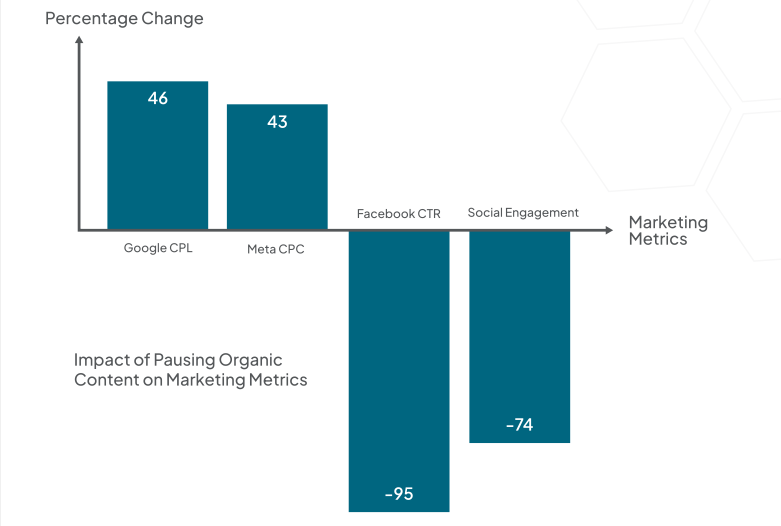
However, when organic efforts were paused, the impact was immediate and painful:

The Drop-Off:

  • 74% decrease in social engagement
  • 43% increase in cost per click
  • 46% increase in cost per lead
  • 95% drop in Facebook click-through rate (CTR)

Engaging with existing patients through organic content is crucial for maintaining a strong online reputation and encouraging positive reviews.

graph

Why Organic Content Amplifies Paid Performance in Social Media Marketing

When organic content is present, it creates the foundation of trust, familiarity, and brand authority. These are the same attributes that help paid campaigns convert.

Organic content can also serve as a valuable source of mental health resources, providing essential information and support to those in need.

According to HubSpot and Buffer, integrating both strategies leads to:

  • Higher click-through and conversion rates
  • Lower customer acquisition costs
  • More brand loyalty and advocacy

Organic Fuels Paid—Here’s How:

  • Brand Warmth: Users who’ve seen your brand organically through mental health marketing are more likely to click and convert.
  • Content Reinforcement: Paid ads that echo consistent brand messaging from organic posts perform better.
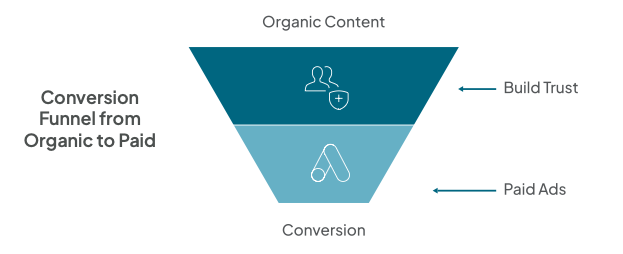
  • Full-Funnel Flow: Organic drives awareness; paid drives conversions. You need both for a complete journey.

The Funnel Visual: Why TOFU Matters


Marketing funnel

Organic Content → Builds Trust Paid Ads → Drives Action Together → Conversion

Without TOFU (top-of-funnel) content like blog posts, reels, testimonials, and thought leadership in mental health treatment, the middle and bottom of the funnel collapse. Paid ads become isolated, expensive, and ineffective.

Best Practices: How to Balance Paid and Organic in Digital Marketing Strategies

To achieve long-term growth and campaign efficiency as a mental health provider:

1. Don’t Pause Organic Content

Even during budget cuts, maintaining an organic presence in the mental health industry is crucial. It’s not just “free” content—it’s your credibility engine.

2. Boost High-Performing Organic Posts on Social Media Platformsn

Identify which content resonates, such as positive reviews, and repurpose it in your paid strategy.

3. Monitor Hybrid Metrics

Use unified dashboards (like Sprout Social or HubSpot) to analyze how organic impressions influence paid conversions. Use unified dashboards like Sprout Social or HubSpot, along with Google Analytics, to analyze how organic impressions influence paid conversions.

4. Layer Storytelling into Ads through Content Creation

Translate top-performing organic narratives into paid creative for seamless brand consistency that resonates with mental health clients.

Key Takeaway

As the data clearly shows: organic content is not optional. Organic content is not optional, especially when addressing mental health challenges. It’s a critical performance layer that makes your paid spend more efficient. According to the case study metrics on page 2, turning off organic content led to:

  • A 74% drop in engagement
  • A 46% increase in cost per lead
  • A 95% drop in Facebook CTR

No matter your industry, this is a warning sign: treat organic as your growth engine—not an afterthought.

Conclusion: Strong Tops, Strong Bottoms

To avoid collapsing your marketing funnel and promote mental wellness, don’t just spend more—spend smarter. Integrate a storytelling-first approach through organic content and amplify it with targeted paid media. The synergy between the two is where scalable ROI lives.

Ready to stop wasting ad dollars and start building a full-funnel engine?

Contact Beacon Media + Marketing today and let’s start building trust that sticks and sells.

The landscape of digital marketing changes quickly in today’s fast-paced business world. Achieving marketing success requires a strategic approach and expertise that may not be readily available within your organization.

That’s where fractional CMO marketing teams come in. Client marketing managers offer high-level marketing leadership, and strategic insights, managing their marketing teams to drive results.

Contact us for your free growth plan consultation and discover how a fractional CMO marketing team can help take your business to the next level.

What is a fractional CMO Marketing Team?

Fractional CMO marketing teams offer a cost-effective solution for those in search of expert-level marketing expertise. A fractional CMO acts as an executive-level marketing officer providing strategic leadership.

Our teams at Beacon Media + Marketing are comprised of seasoned marketing professionals who contribute expertise in your niche, delivering the same strategic guidance and proficiency as a full-time Chief Marketing Officer (CMO) but at a reduced cost.

The fractional CMO marketing teams at Beacon are comprised of dedicated digital marketing professionals who know your business needs and what marketing works.

Our teams will drive your marketing forward with a strategy personalized to you and your needs. Your client marketing manager will collaborate with your paid ads specialist, social media marketer, web team, and designer to bring your marketing goals to life.

The services fractional CMOs provide are diverse, from developing holistic marketing strategies to managing campaigns and teams. Their accumulated knowledge and experience empower businesses to act wisely and execute successful marketing initiatives. Fractional CMO services encompass a range of strategic marketing leadership and guidance.

By harnessing the expertise of a fractional CMO team, businesses can effectively and efficiently reach their marketing goals.

5 Benefits of a Beacon Media + Marketing Fractional CMO Marketing Team

Partnering with a fractional CMO marketing team offers numerous advantages that drive business growth and success. Let’s explore the key benefits of leveraging this type of marketing expertise:

  1. High-Level Marketing Expertise: Fractional CMO teams are seasoned marketing professionals who understand your niche. They have extensive experience in developing and executing successful marketing strategies. They bring a wealth of knowledge and expertise across various marketing disciplines, ensuring that businesses have access to the highest level of marketing guidance and support. These teams consist of experienced marketing professionals with a proven track record in managing growth and leading companies through various stages.
  2. Fresh Perspective and New Ideas: Our Fractional CMO teams, led by the Client Marketing Manager, come from outside your company, bringing a fresh perspective and new ideas to the table. They will challenge conventional thinking, identify untapped opportunities, and help your business evolve its marketing strategies to stay ahead of the competition by advising you on what works and what is good for your business.
  3. Flexibility and Scalability: Fractional CMO teams offer flexibility and scalability that traditional full-time CMOs cannot provide. Our team of professionals will build and execute personalized plans for you and your business based on your needs. They also have a host of professionals in their networks to support additional services your marketing plan requires. Additionally, they provide focused marketing strategy leadership, ensuring that your campaigns are aligned with growth objectives and driving sales and profitability.
  4. Valuable Insights and Analytics: Our Fractional CMO teams leverage several data sources and analytics such as Databox, SEM Rush, and Google Analytics. These data sources collect the data so the Client Marketing Manager can then assess market trends, customer behavior, and campaign performance. They provide your business with valuable insights and recommendations based on hard data, enabling informed decision-making and optimizing your marketing efforts.
  5. Cost-Effectiveness: Fractional CMO teams offer a smart solution for companies seeking top-tier marketing know-how without the overhead of a full-time CMO and complete marketing team. This approach allows businesses to tap into high-level marketing strategy at a more affordable investment.

Teaming up with a fractional CMO marketing team opens the door to a wealth of expertise, creativity, flexibility, data-driven insights, and cost-effectiveness. It’s the perfect fit for small to mid-sized businesses with an eye on heightened marketing performance and sustainable growth.

What Services Does a Fractional CMO Marketing Team Provide? Key Skills That Make Them Effective

Our fractional CMO marketing teams offer a comprehensive range of services to help businesses achieve their marketing objectives. These services typically encompass:

  • Strategic Planning: Our client marketing manager works hand-in-hand with your discovery call information to craft a comprehensive marketing strategy that seamlessly aligns with your overarching business goals.
  • We dive deep into market research, analyze your target audience’s behavior, and pinpoint growth opportunities to create plans that are primed for your business’s success.
  • Campaign Management: Our fractional CMO teams are experts at managing marketing campaigns across a variety of channels, including social media, email marketing, content creation, and paid advertising.
  • Data Analysis and Insights: Fractional CMO teams utilize data analytics tools to monitor campaign performance, track key performance indicators (KPIs), and gain valuable insights into customer behavior. This data-driven approach empowers us to make informed decisions and optimize our marketing efforts for better outcomes.
  • Creative Development: Our fractional CMO marketing teams are skilled in the art of collaboration, working with you to craft captivating marketing materials, from website content to social media posts, email newsletters, and promotional materials.

They ensure that every creative piece speaks to your specific audience and effectively conveys your brand’s message.

The power of fractional CMO marketing teams is in the blend of their diverse skill sets and industry experience that one person simply can’t possess in the vast landscape of digital marketing. These teams include seasoned marketing professionals with expertise in:

  • Strategic Thinking: The Client Marketing Managers are adept at strategic thinking, crafting long-term marketing plans that dovetail with overarching business goals. Their wealth of experience and knowledge empowers businesses to make well-informed decisions, propelling them toward sustainable growth.
  • Digital Marketing Prowess: Imagine having an entire Digital Marketing staff at your disposal. Our Fractional CMO Marketing teams are at the forefront of digital marketing, equipped with the latest trends and technologies. They craft online strategies that resonate with your audience, driving engagement and growth for your business.

Beacon Media + Marketing is at the forefront of adaptation of AI technologies while not relying on them for content or design. Beacon has a robust AI policy that allows for AI to assist in productivity, while not replacing the human touch in content and design.

  • Data Analysis and Interpretation: Our fractional CMOs possess robust analytical skills and the ability to interpret data for actionable insights. We prioritize data-driven decision-making to ensure the optimization of your marketing campaigns is not based on preference, but on what is working or change what is not.

·       Adaptability and Flexibility: Our teams are adaptable and flexible, able to quickly adjust our strategies and tactics based on market changes and evolving business needs. We know the digital marketing landscape moves quickly and we are always seeking innovative solutions to drive business growth.

By joining forces with a fractional CMO marketing team, businesses can tap into the knowledge and capabilities of seasoned marketing professionals without the need for a full-time commitment. These teams offer a cost-effective and scalable solution that propels businesses toward their marketing objectives and sustainable growth. Fractional CMOs manage the marketing function within organizations to ensure alignment with business objectives.

When to consider a fractional CMO or Marketing Team

When your internal marketing expertise or resources are limited, a fractional CMO Marketing Team can provide the strategic direction you need. They bring a wealth of knowledge and specialized skills to help your business overcome challenges and achieve your marketing objectives. Becoming a fractional CMO requires significant experience in marketing leadership, strategic thinking, and the ability to adapt to various business environments.

For companies looking to increase their marketing capabilities, hiring a fractional CMO Marketing Team is a game changer. These experts have a proven track record of developing and executing successful marketing strategies that drive results. They know how to make every marketing dollar count, ensuring that you get the most out of your investment and see real business growth. Hiring a fractional CMO offers benefits such as quick impact with low risk, making it ideal for organizations at a critical growth phase or in need of executive-level guidance.

Our professionals are more than just marketing experts; they are collaborative partners who provide strategic guidance and support. Their insights and expertise empower businesses to make informed decisions, develop effective marketing campaigns, and confidently navigate the ever-changing marketing landscape. By carefully assessing your needs and objectives, you can unlock the potential of fractional CMOs and marketing teams, propelling your business to new heights of success.

Let’s talk about how a fractional CMO or marketing team can help revolutionize your business. Contact us today to schedule a free consultation. We’ll work with you to elevate your marketing strategies and help you achieve the remarkable.

How do you measure the success of your Fractional CMO Marketing Team?

The shift to a fractional CMO marketing team wasn’t just a business decision. It was a strategic move to get the specialized expertise, flexibility, and results into the hands of our clients in the time frame that the market requires. Fractional CMOs typically work either in-person or virtually, providing flexibility to businesses. With the growth of AI, gone are the days when website development can take years. Beacon’s shift from traditional Account Management to fractional CMO marketing teams has allowed us to get the specialized knowledge we need and stay ahead of industry trends.

At Beacon, we are all about the data. We needed a marketing partner structure that would deliver measurable results and contribute directly to your bottom line. The team’s ability to analyze data, track ROI, and optimize campaigns has been a key driver in our decision to reset our internal structure to drive your marketing results with greater focus and clarity.

Beacon wants to provide a more integrated approach to marketing and business strategy. Marketing isn’t just a function, but a key driver of our client’s overall success.

What is the difference between Account Management and a Fractional CMO Marketing Team?

Account Management and Fractional CMO Marketing Teams play different but equally important roles in marketing and business growth. It’s important to understand these differences to determine the best fit for your organization’s needs.

Account Managers are often immersed in the tactical, day-to-day aspects of marketing: executing campaigns, managing projects, and communicating with clients. While these functions are crucial, they may not always align with the big-picture, long-term strategic growth of your business. Account Managers may not be suited for every marketing discipline and may not be able to strategically address individual client needs.

Fractional CMO Marketing Teams bring a strategy into their marketing approach. They possess high-level expertise and experience across a wide range of marketing disciplines, enabling them to develop comprehensive marketing strategies that align with business objectives. Their focus is on long-term growth, revenue generation, and competitive advantage. They act as your personalized marketing team, providing strategic guidance, data-driven decision-making, and thought leadership. A fractional CMO acts as a marketing executive, providing part-time or project-based leadership to drive strategic initiatives.

Fractional CMO Marketing Teams are the strategic partners that provide the guidance, expertise, and leadership necessary for sustained growth and success. Recognizing this distinction empowers businesses to make choices that align with their unique needs and aspirations.

How do Fractional CMO Marketing Teams drive growth and enhance your marketing efforts?

Fractional CMO marketing teams drive business growth and enhance marketing efforts by providing strategic guidance, executing effective campaigns, and leveraging data-driven insights. They offer marketing leadership that fortifies brands, enhances marketing effectiveness, and drives results without the commitment to a full-time, in-house marketing leader.

They identify and focus on high-value marketing activities that align with their client’s overall business goals. By developing and implementing tailored marketing strategies, fractional CMO Marketing Teams ensure businesses reach their target audience and achieve measurable results.

Another advantage of a fractional CMO marketing team is their capacity to offer objective and impartial counsel. As partners looking in, they bring a fresh viewpoint, making recommendations solely in the best interest of the business. This objectivity often paves the way for more effective and efficient marketing strategies.

To learn more about Beacon’s mental health marketing services, check us out here.

Beacon’s Strategic Decision to shift to Fractional CMO Marketing Teams

Beacon’s journey to embracing fractional CMO marketing teams is a testament to our unwavering commitment to growth, innovation, and strategic marketing practices. Our decision was driven by several key factors that aligned perfectly with the benefits offered by this unique model.

First, we recognized the need to offer specialized expertise in digital marketing and growth hacking. Fractional CMOs provide leadership to the existing marketing team, ensuring that executive-level guidance and improved systems are in place. In today’s fast-paced digital world, these skills are critical to driving growth and staying ahead of the competition.

Additionally, Beacon was in search of an internal structure for their clients that offered marketing solutions that could adapt to the ever-changing market conditions. The fractional CMO marketing team model allowed for flexibility and speed, ensuring that marketing efforts could be strategically adjusted as needed. A growth focused marketing strategy is essential in maximizing efficiency and achieving business success.

This provided optimal resources, combined with cost-effectiveness, allowing Beacon to serve our clients better while responding quickly to market changes, capitalizing on new opportunities, and optimizing marketing investments. Fractional CMOs work closely with the in house marketing team to achieve marketing goals through their experience and industry knowledge.

Unlike a marketing agency that handles specific tasks or campaigns on a project basis, a fractional CMO becomes an integral part of the team, providing personalized, high-level strategic guidance. Beacon Media + Marketing is committed to providing measurable results and ROI for all of our clients.

Want us to help bring your vision to life? Schedule your free consultation to learn more about our digital marketing services.

When I think about my time in marketing, or with business operations in general, I’ve come across a variety of standards, principles, and values that companies and their employees are expected to adhere to. Some are basic, some are inspiring, and some are even a bit bold. But in the stack of standards and all their many variances, only one thing remains true; if your actions don’t live up to your words, you really have nothing to say.

The Beacon Way is more than just a statement, and it’s more than just our standard — it’s an evolving set of values that we place ahead of our business approach, whether it’s the first time we meet with a client, or when we say goodbye to one. The Beacon Way sets us and our clients apart and places us on a path toward building a relationship, never leading to a generic business arrangement.

As our technology changes and industry standards change, we’ve found that the Beacon Way is also what guides us in adhering to the new standards being established in our industry, especially when we’re talking about Google’s latest core update, EEAT principles, and the ethical practices for using generative AI.

Learn how aligning with Google’s EEAT standards in your marketing can drive you to the top of search results. Reach out today for a free discovery call.

How Do the Beacon Way and Google EEAT Align with Broader Marketing Goals and Target Audience Engagement?

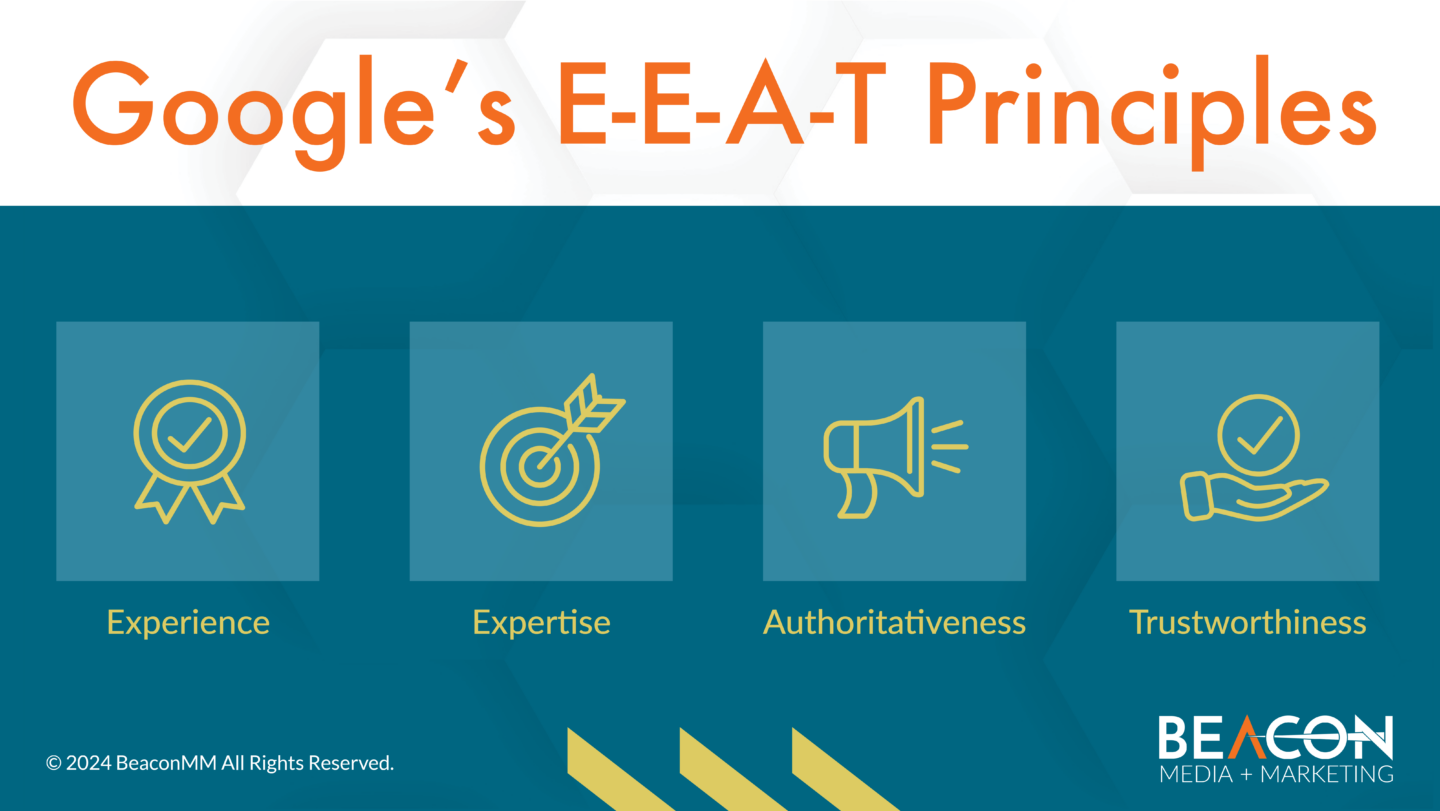
I’m proud to say that Google EEAT principles (experience, expertise, authority, trustworthiness) are actually incorporated into the Beacon Way, and this is part of what we like to consider our “holistic” or integrated marketing practice. Essentially, in our marketing approach, the Beacon Way guides us toward not only adhering to EEAT principles but also in uncovering the root cause of the problem (poor quality marketing) versus simply treating the symptoms (little to no conversions).

For example, one of our most important core values here at Beacon is that we strive to always go deep and make an impact. When we go deep with our clients, we truly understand who they are and their specific needs. We realize it’s our own expertise and experience that allows us to do this. Once we’ve built the foundation for that personal relationship, we can then structure all our clients’ messaging holistically — allowing other people to connect with them on a more personal level.

When we think of Google EEAT, for the quality raters to be appeased, we always want to demonstrate experience, expertise, authoritativeness, and trustworthiness, right? This is why these are also the pillars of the Beacon Way, and why they should be an integral part of your marketing approach.

The Problem With Content Overload

If you look at the content that’s living online today, we’re living in an era of content overload — and much of it is a regurgitation of a regurgitation. Content quality in today’s digital landscape, in one simple word, sucks. This alone is causing people to continue scrolling past content because it’s not offering any value. And frankly, what reason does a person have to land on your content and actually read it if it’s the exact same thing they can find on 100 other websites?

Answer: No reason at all.

At Beacon, both with our own content marketing and for our clients, we’re trying to cut through the noise of content overload, mindless content, duplicate content, etc. And the only way to cut through the noise is to have a very specific niche message that connects to people — one that comes from an authoritative or trustworthy source. Basically, you can’t expect a potential client to connect with a social media post, blog, or newsletter that’s been generalized or repurposed 100 times with little to no strategy, personalization, or dedication behind it.

Really, who would want to?

Information overload and baseline educational content marketing are no longer leading the way. Thus, we’ve moved into developing a more personalized niche connection. This aligns with Google EEAT principles because people are not just searching for specific answers, they’re searching to fulfill a very specific need. And we get it — people today are frustrated when they get generalized “answers” and their needs go unmet.

When it comes to audience engagement, we have to remember, we’re living in the age of intelligence. People are seeking not only authenticity but genuine intellect as well. What we’re doing with our marketing approach not only meets Google’s standards, it makes people think and it meets our clients’ needs, and this is the difference between true intelligence and a bucket of generic information.

Do Google’s Quality Rater Guidelines Ever Require a Nuanced Approach?

In a nutshell, yes. We know that Google’s search quality rater EEAT principles are tiered. For example, trustworthiness is sometimes considered to be at the top, with authority, experience, and expertise acting as its supporting tripod — or the three pillars that lead to trust. But, in certain industries, trust may be more important than authority, and vice-versa for others. It’s our job to know the difference.

For example, in the mental health field, as a potential client, trusting your therapist is likely going to be much more important than the therapist’s educational background for most people.

So the question then becomes, will I pick the therapist with a PhD that I can’t trust, or do I pick the person with lesser experience who’s giving me all the right signals of trust? Personally, I’ll always choose the person I trust.

Just for an illustration, let’s pretend a therapist who has just started a practice has 50 great reviews, their website immediately makes you feel welcome and safe, and you can even see a video of them that shows how much they actually care about people. I’m going to choose the person with a high trust factor, even if they haven’t been practicing as long over the person in business for 20 years with minimal customer service information on their website, or no personal signals of trust.

In that scenario, trust holds more weight over authority in order for a conversion to happen. But this can also depend on the niche focus. For example, if I have a family member who needs help with an advanced form of psychosis, authority and expertise are likely going to weigh more heavily over trust — because I really need to know that you know what you’re doing.

At the end of the day, trust can sometimes be established without much authority. However, a lot of authority can also establish trust. Depending on the particular industry nuance, as marketers, we simply have to know when to adjust our focus in order to promote new business growth.

How Can We Establish Authoritativeness in the Eyes of Google and Our Audience?

On authority, my philosophy has always been that it’s always better to have someone else say something good about you instead of you saying something good about yourself. If authority is citing how well you’re regarded in the market and your industry, you saying it about yourself is never going to give you as much bang for your buck as other people saying it about you.

When it comes to authority, potential clients are looking for social proof. This can be reviews, awards, nominations from well-known and respected colleagues in the industry, being cited in different articles, length of time in business, etc. In addition, content is an excellent way to build authority — but only when you’re expressing your own original thoughts. It’s an easy thing to fake, but in 2024, with Google’s recent core update, the simple fact is that it’s all about quality, not quantity.

Why We’re NOT Writing for Search Engines

Google’s latest core update is quite significant, and we anticipate potential impacts on content rankings and results, depending of course on how you create content.

What does that mean for website and content creators, marketers, the SEO community, and business owners?

Google has provided us with a 2-month window to ensure we’re all creating human content that is trustworthy, authoritative, and truly helpful for your audience. The E-E-A-T guidelines (experience, expertise, authoritativeness, and trustworthiness) are now more important than ever before. And this is what it means for us:

  • In Google’s own words, “avoid creating search engine-first content.”
  • Create a customized and personalized content plan that includes your data and relevant information to share.
  • Ensure we include bylines — and utilize writers knowledgeable about the content and who can write to a target audience, not to Google.
  • Utilize caution with the overuse of AI-generated content or AI tools.

For any business owner or content creator, when you adhere to Google’s EEAT principles, if your messaging is authentic and powerful enough, and you’re making real connections through your messaging and content, you’ll develop powerful allies — and many of them will organically come into your world.

Our job is to harness what our client already has and then amplify it for their audience, not for Google.

The Evolution of Google’s EEAT

Concerning Google’s approach, I think Google is going to continue in its current direction — but we may also see a “tightening of the reigns.” Basically, we’ll see Google looking for (or requiring) more ways to validate the authenticity of content or a specific company.

Correspondingly, we’ve already seen subtle shifts where brand identity is making a more noticeable appearance in search results, as Google has been adding brand logos and images to search results listings. And brand identity has always been very important for search, not only for clients but for Google as well.

If Google aims to remain competitive with the new surge of AI tools that also offer search capabilities, it must have access to the best information. This is where EEAT principles come in — because this will ensure that content ranked highly on Google is the best content a user can find.

Let’s face it, in the current AI landscape, when you’re searching with AI for “good information,” you have to go back and check where it originates from — otherwise, you could be generating false content, half-truths, or citing sources that simply don’t even exist.

As far as the future of Google EEAT is concerned, I believe the bottom line remains true, it’s going to be about quality over quantity. AI-generated content will continue to be penalized. And those who utilize 100% AI-generated content are ultimately operating in the opposite direction of all Google EEAT signals.

What we need now is real information. In our increasingly automated world, people have become desperate for authentic connections. This is going to include ghostwritten content, quotes from authoritative sources, real interviews, real videos, and most importantly, original human thought — because without our own element of experience, expertise, authority, and trustworthiness, what do we really have to offer?

Ready to learn more about how we’re creating content that really matters? Contact us today for a free discovery call.

By Jennifer Christensen CMO

“Gratitude can transform common days into thanksgivings, turn routine jobs into joy, and change ordinary opportunities into blessings” ~ William Arthur Ward

We hear a lot about gratitude these days. But what exactly is the power of gratitude? How can practicing gratitude not only transform your entire perspective on life but also the direction of your business?

Gratitude presents us with a pathway to embrace the entirety of our lives, encompassing all that shapes our existence. It goes beyond mere contentment with the aspects of our lives that are currently favorable; it embodies a readiness to broaden our awareness and embrace all qualities— the good and the bad. This expansion allows us to recognize and appreciate more of the constant stream of goodness that we continuously receive.

In the ever-evolving landscape of recruitment, success is not dependent on compelling job descriptions. Besides, companies are continuously seeking innovative approaches to attract top talent. While strategies often focus on competitive salaries, attractive perks, and impressive company cultures, one often underestimated yet powerful tool remains: gratitude.

Remember, gratitude is but a small particle in an atmosphere of love. It has the power to transform your life. And the act of practicing thankfulness not only enhances your life, it contributes to a positive workplace culture — and can significantly elevate your recruitment strategy.

Are you curious about how you can improve recruitment by highlighting gratitude? Contact Beacon Media + Marketing today to find out how today!

Here’s How Embracing Gratitude Can Enhance Your Recruitment Strategy

Gratitude as a foundational aspect of corporate culture is a transformative force that extends beyond internal operations and the interview process. And when integrated into the recruitment process, it becomes a compelling magnet for potential candidates.

  • Cultivating a Positive Employer Brand: Expressing gratitude and showcasing appreciation for current employees sends a powerful message to prospective candidates. In addition, a workplace where gratitude is evident becomes an attractive destination for job seekers. Positive reviews and testimonials from current employees regarding their experiences with gratitude within the company can significantly impact the employer brand.
  • Authentic Connection Building: Gratitude fosters genuine connections between potential hires and the company. When candidates feel appreciated during the recruitment process, it creates a sense of belonging and establishes an emotional connection. This connection can lead to a higher acceptance rate of job offers and increased loyalty among employees.
  • Enhanced Candidate Experience: The recruitment process can be stressful and daunting for candidates. Incorporating gratitude into every interaction—be it through personalized thank-you notes, acknowledging their time and effort, or providing constructive feedback—enhances the overall candidate experience. Basically, it leaves a lasting impression, regardless of the outcome, and reinforces a positive perception of your company.
  • Boosting Employee Referrals: Grateful employees are more likely to become brand advocates and refer top talent to their workplaces. When individuals feel appreciated and valued, they naturally want to share their positive experiences. This can lead to a steady influx of high-quality referrals, streamlining the recruitment process and ensuring a higher caliber of candidates!
  • Differentiation in a Competitive Market: In a competitive job market where multiple companies vie for the same talent pool, gratitude becomes a distinguishing factor. Highlighting your company’s culture of appreciation sets it apart — making it more appealing to prospective candidates who seek not just a job but an inclusive and appreciative work environment.
  • Continuous Improvement and Growth: Practicing gratitude is not a one-time action but an ongoing commitment. It’s truly a lifestyle all its own. Additionally, regularly soliciting feedback from both successful hires and past applicants who chose another path offers invaluable insights. And this feedback loop fuels continuous improvement in recruitment strategies — leading to growth and refinement in attracting top talent.

Incorporating gratitude into your recruitment strategy isn’t just a trend; it’s a fundamental shift toward a more genuine and effective approach. Embracing a culture of appreciation not only attracts the right talent but also fosters a work environment conducive to productivity, innovation, and employee satisfaction.

How Exactly Does Gratitude Enhance Work Culture?

Gratitude is not only the “high-octane fuel” of relationships, it’s the “ultimate performance-enhancing substance at work” according to renowned Psychology Professor and Gratitude Researcher Robert Emmons.

From sending personalized thank-you emails to implementing employee recognition programs, there are numerous ways to infuse gratitude into your recruitment efforts. But by making thankfulness an integral part of your company’s ethos, you’ll be setting your company culture on a path toward success and paving the way for sustainable growth and success in the competitive world of talent acquisition.

Remember, the power of gratitude isn’t just in what it offers your employees today but in how it shapes the future of your organization, one appreciative interaction at a time.

Consider the following ways that gratitude is a force to be reckoned with in the workplace:

  • Positive Atmosphere: Expressing gratitude fosters a positive and appreciative atmosphere within the workplace. When employees feel acknowledged and valued for their contributions, it creates a sense of belonging and positivity.
  • Increased Motivation and Engagement: Gratefulness acknowledges effort and achievements, motivating employees to continue their good work. It boosts morale and encourages higher levels of engagement as employees feel their efforts are recognized and appreciated.
  • Improved Relationships: Gratitude encourages stronger relationships among team members and between employees and management. It cultivates a culture of respect and appreciation, leading to better collaboration and teamwork.
  • Enhanced Mental Well-being: Gratefulness is linked to improved mental health. Encouraging gratitude practices in the workplace can reduce stress levels and increase overall well-being among employees, leading to a more productive workforce.
  • Higher Retention Rates: A culture of gratitude increases employee satisfaction and loyalty. Employees are more likely to stay with a company where they feel appreciated, leading to reduced turnover rates.
  • Increased Innovation and Creativity: When employees feel valued, they are more likely to contribute innovative ideas and solutions. Gratitude fosters an environment where individuals feel comfortable sharing and exploring new concepts.
  • Better Customer Relations: Employees who feel appreciated are more likely to extend that same appreciation to customers. Gratitude in the workplace can positively impact customer service and relationships, enhancing the overall reputation of the company.
  • Cultural Impact: A workplace culture centered around gratitude sets a powerful example for incoming employees. It becomes a foundational aspect of the company’s identity, aiding hiring managers in attracting like-minded individuals who value appreciation and recognition.

Are ready to improve recruitment by highlighting gratitude? Contact Beacon Media + Marketing today for a free discovery call today!

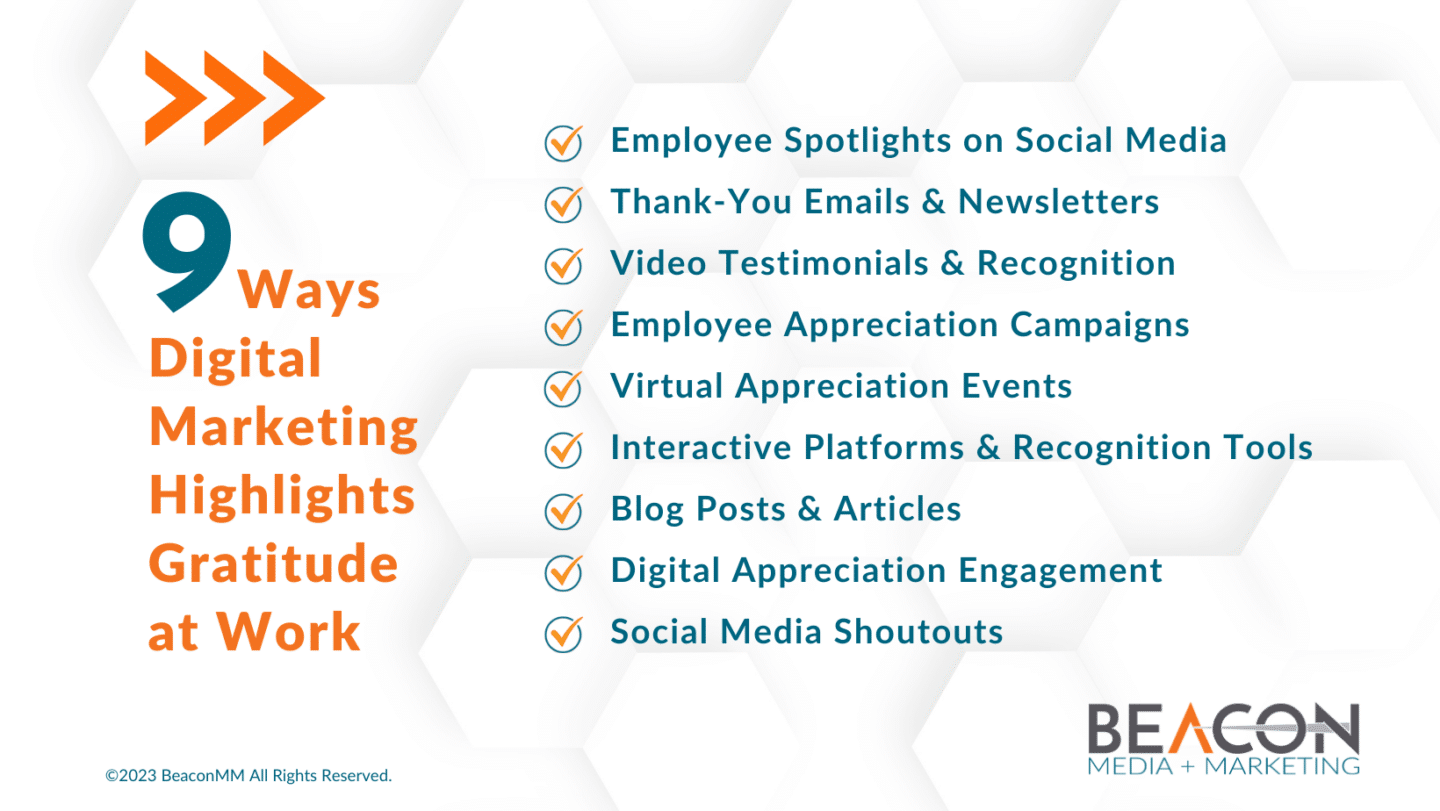
9 Ways Digital Marketing Highlights Gratitude at the Workplace

It should go without saying that it’s been a tough few years since the pandemic changed the entire dynamic of work culture in 2020 — especially in the healthcare industry. We were forced to change quickly, and this caused anxiety, stress, and several challenges that nobody saw coming. But this also gave us even more of a reason to be grateful.

Showcasing gratitude in digital marketing is a beautiful thing. Honestly, it’s what makes marketing shine. And in turn, it has the potential to generate a “virtuous cycle” that not only enhances your employees’ attitudes at work but your overall recruitment efforts as well.

At the end of the day, showcasing gratitude in the workplace through digital marketing involves leveraging a few common online platforms and strategies to express appreciation. Here are some effective ways to do so:

  1. Employee Spotlights on Social Media: Highlight team members’ achievements, milestones, or contributions through dedicated posts on social media platforms. Use engaging content formats like employee interviews, success stories, or behind-the-scenes glimpses to showcase their efforts and express gratitude publicly.
  2. Thank-You Emails or Newsletters: Send personalized thank-you emails or newsletters to employees, acknowledging their hard work, dedication, and specific contributions. Include messages from leadership, success stories, or quotes from team members to make it more impactful.
  3. Video Testimonials and Recognition: Create videos featuring testimonials from leaders or colleagues expressing gratitude towards individuals or teams. Share these videos on the company website, social media channels, or internal communication platforms to show appreciation and inspire others.
  4. Employee Appreciation Campaigns: Launch digital campaigns during special occasions like Employee Appreciation Day or work anniversaries. Utilize hashtags, interactive polls, or user-generated content contests to engage employees and celebrate their value within the organization.
  5. Virtual Appreciation Events: Organize virtual events such as webinars, live Q&A sessions, or virtual town halls where leadership can express gratitude, share success stories, and recognize outstanding performances. Stream these events live on platforms like YouTube or LinkedIn.
  6. Interactive Platforms and Recognition Tools: Implement digital recognition platforms or tools within the company’s intranet or employee portal. Encourage peer-to-peer recognition by allowing employees to send digital badges, stickers, or personalized messages to colleagues.
  7. Blog Posts or Articles: Create blog posts or articles that highlight the positive impact of employees’ efforts on the company’s success. Share stories of collaboration, innovation, or dedication, showcasing how individual contributions drive the organization forward.
  8. Engage Employees in Digital Appreciation: Encourage employees to participate in digital gratitude initiatives by sharing their appreciation for peers or team accomplishments on social media platforms, using specific hashtags or dedicated channels.
  9. Personalized Social Media Shoutouts: Use the company’s social media channels to publicly recognize employees’ achievements or exceptional performances. Share photos, quotes, or anecdotes that highlight their contributions.

What’s Beacon Doing to Show Gratitude at Work?

As a hybrid company, with employees working remotely and in the office on occasion, our work cadence is dynamic — but it’s so much fun. One thing that we’ve learned as we’ve grown: our employees are an intrinsic part of our brand. And this should be true for any company operating in any vertical.

Basically, it’s all connected. The people you work alongside affect your mood, your work performance, and ultimately, the product or service you provide. But when you highlight your employees and build them up, you’re ultimately fortifying the foundation of your entire business.

Consider a few things we do on a daily and weekly basis when it comes to fostering a vibrant, positive, work culture:

  • Wellness Wednesdays: Every other Wednesday, we get together on Zoom and talk about what’s going on in our lives, whether work-related or personal. We each highlight a bud (something promising), a rose (something that has blossomed), and a thorn (whatever might be bothering us) present in our lives and open the floor to discussion in a positive, accepting, environment.
  • Teambuilding: We come together every other Wednesday and forget about work for an hour. We play games, learn about one another, tell stories, show our appreciation on work anniversaries and birthdays, and really get to know who our team is on an intimate level.
  • Slack: If you take a peek into our Slack channels, you’ll see a team brimming with activity and good vibes. Our communication channels might be business-related, but they’re definitely not lacking a true personal touch and appreciation for each one of our team members. We regularly give thanks and shoutouts to team members who are crushing their jobs — even if it’s just a quick thank you.
  • What’s On Your Wall Wednesday: Our newest addition, each week we’re highlighting one of our clients and how they are elevating themselves in their niche. Not only is this a great way to show appreciation for our clients, but it’s a bit of free marketing for them as well!

Employees don’t only impact your brand — they are your brand. Correspondingly, acts of celebration also become part of your brand. And once you begin to highlight this, you’ll see your recruitment strategy and hiring process reach an entirely new level.

Elevate Your Brand Through Highlighting Gratitude with Beacon Media + Marketing

“A grateful mind is a great mind which eventually attracts to itself great things” ~ Plato

At Beacon, we know that the recruiting process can be tough. Let’s face it, it’s just hard to find qualified candidates who you know—for sure—will fit your company. And it doesn’t matter if you’re advertising on niche job boards, running an employee referral program, or regularly changing the verbiage on your job postings; when it comes to effective recruitment strategies, highlighting the achievements of your existing employees can be your greatest asset.

You have to remember that recruitment goals should extend well beyond an ad or job posting. And recruiting strategies without an element of thankfulness, showcasing what it’s like to work for your team, is going to be relatively lackluster. Essentially, you’re going to be missing a key ingredient in your recruiting strategy. And you’ll be leaving prospective employees wondering if the juice is really worth the squeeze.

If you want to attract great employees and talented candidates, attract them by how you operate. In every action, in every meeting, and while working on every task, it’s through gratitude that we all become successful.

Are you ready to improve company culture and recruitment by highlighting gratitude? Contact Beacon Media + Marketing today and speak with an expert today!

By Jennifer Christensen CMO

We’ve all had that nightmare healthcare experience of waiting for hours to be seen, and then waiting even longer before your doctor shows up. Then, 15 minutes later, you’re being shuffled right out the door. It should go without saying that this is simply unacceptable — but it only illustrates a problem that has pervaded the healthcare industry for decades: a lack of effective communication.

In today’s interconnected healthcare landscape, patients are now realizing that they have the power to choose which healthcare provider they prefer to wait on — and which one they prefer to pay. For a provider, capitalizing on this simply entails leveraging personable and effective communication skills. Fortunately, this is also where digital marketing comes in.

The thing about digital marketing that’s so exciting is not the advanced tech that we get to use every day. Though the latest technological advances are brilliant and make our jobs easier, it’s how these tools transform communication and offer our clients a stronger bridge to building patient relationships in a genuine, transparent way that makes digital marketing such a great investment for healthcare professionals.

Communication is key in any relationship. So, how has digital marketing transformed healthcare communication? Well, without it, we’d still be passing out flyers and hoping someone heard our latest radio blast.

Are you ready to provide your patients with an enhanced healthcare experience and transform patient communication? Connect with Beacon Media + Marketing today for a free discovery call!

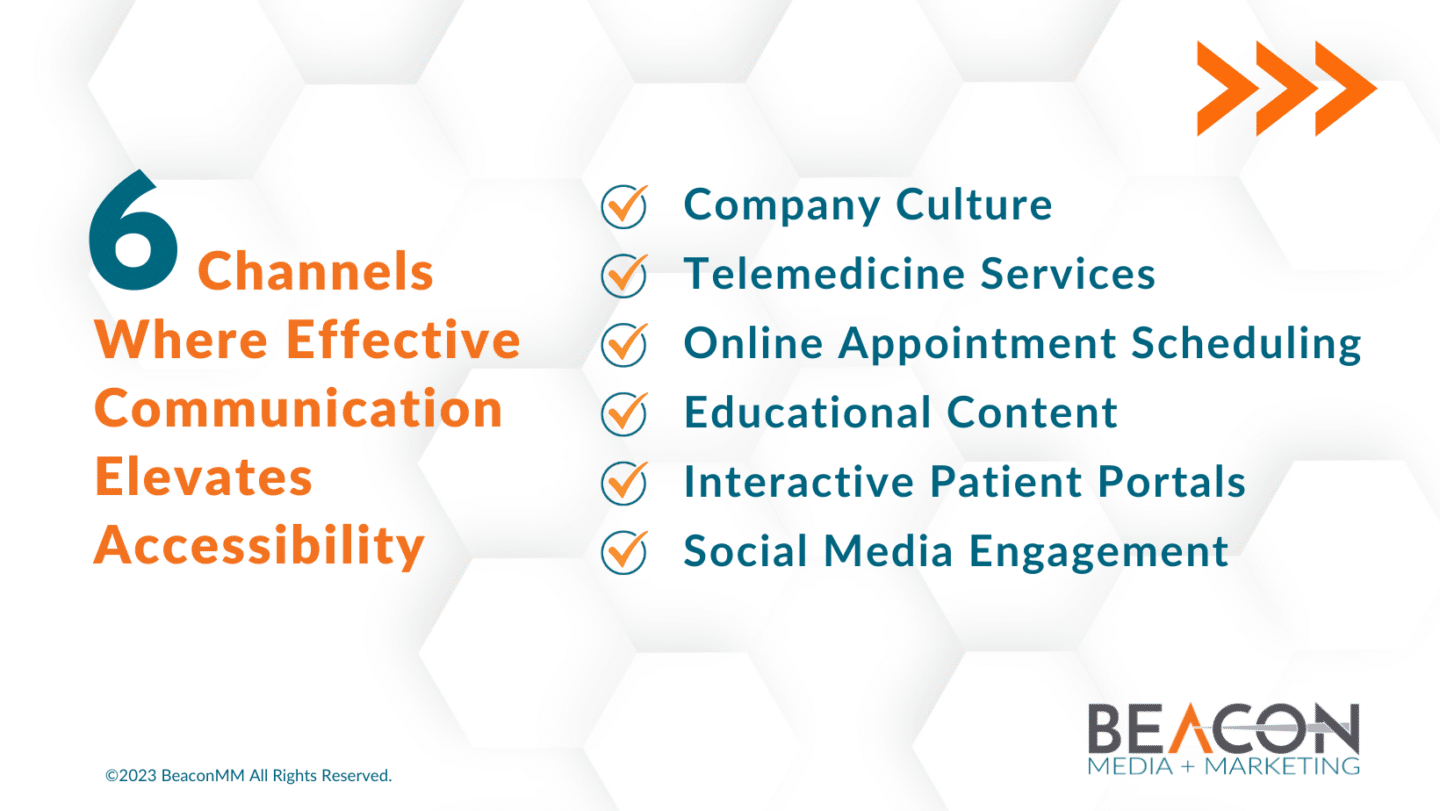
Effective Communication Creates Accessibility

Just like any consumer, patients want results. Today, we live in a world where instant access to whatever we need is almost considered a given. And that’s exactly what your patients want from you — accessibility.

Through digital marketing, your patients can get exactly what they’re looking for without having to “hurry up and wait.” Just consider what real-time accessibility and information through digital marketing can offer your patients:

  • Company Culture: Patients can research you and your clinic, decide if you’re a good fit, and take a peek into what an experience at your location is really like. By leveraging digital marketing, in turn, you can leverage your company culture, reviews, and testimonials, and showcase a patient experience that will draw in more patients.
  • Telemedicine Services: Patients can access virtual appointments and consultations, receiving immediate medical guidance or advice without physical presence, reducing patient anxiety, promoting convenience, patient safety, and timely healthcare delivery.
  • Online Appointment Scheduling: Enables patients to book appointments at their convenience, reducing wait times and providing flexibility in managing their healthcare appointments.
  • Educational Content: Sharing informative content online allows patients to access resources that empower them with knowledge about health education, conditions, treatments, and preventive care, fostering informed decision-making and active engagement in their health.
  • Interactive Patient Portals: Offer patients secure access to their medical records, test results, and treatment plans, promoting transparency, and allowing them to actively participate in their care journey.
  • Social Media Engagement: Utilizing social platforms facilitates direct communication, feedback sharing, and community building, creating a space for patients to ask questions, share experiences, and engage with healthcare providers and peers.

Traditional healthcare communication relied heavily on one-way interactions, often leaving patients powerless. By giving the provider all of the power, this narrowed the potential pool of patients significantly. And while patients remained worried about their health, “care professionals” reaped all of the benefits.

While these methods once served their purpose, they lacked the personalization and real-time engagement that could truly make a difference in patient care. But the advent of digital marketing has ushered in a new era of healthcare communication, one characterized by two-way dialogues, data-driven insights, and a patient-centered approach; one where patients feel more like partners on their care journey.

Fostering Patient-Centric Interactions

Digital marketing enables health professionals to move beyond generic communication and tailor their messages to the specific needs and preferences of individual patients. Through targeted messaging, healthcare organizations can provide relevant and timely information about preventive care, disease management, and treatment options. This personalized approach empowers patients to take an active role in their health decisions, leading to improved adherence to treatment plans and overall better outcomes.

Embracing Real-Time Engagement

Digital marketing tools provide healthcare providers with the ability to engage with patients in real-time, facilitating seamless communication and building stronger relationships. Through secure online portals, patients can access their medical records, schedule appointments, ask questions, and receive updates from their healthcare providers. This real-time engagement fosters trust and transparency, ensuring that patients have access to the information they need, whenever they need it.

Leveraging Data-Driven Insights

Digital marketing platforms also generate a wealth of valuable data about patient preferences, behaviors, and online interactions. For example, healthcare teams can analyze this data to gain deeper insights into their patient population, enabling them to tailor their communication strategies and personalize their outreach efforts. This data-driven approach ensures that healthcare organizations are reaching the right audience with the right message — at the right time.

Harnessing the Power of Digital Tools

The digital marketing landscape offers a wide range of tools and marketing strategies that healthcare providers can leverage to enhance their communication with patients. Here are a few examples:

  • Email Marketing: Personalized email campaigns can provide patients with timely updates, educational resources, and reminders about appointments or preventive care recommendations.
  • Social Media: Healthcare organizations can use social media platforms to engage with patients, share informative content, create targeted ads through social feeds, and build a strong online community where engagement drives results.
  • Patient Portals: Secure online portals offer patients convenient access to their medical records, appointment scheduling, and secure communication with their healthcare providers.
  • Content Marketing: Creating informative and engaging content, such as blog posts, videos, and infographics, can educate patients about health conditions, treatment options, and lifestyle changes.
  • CRM Software: Keeping up with your patient’s health communication is perhaps one of the most important tasks you can engage in. With digital Customer Relationship Management (CRM) tools, you’ll have a robust toolkit that empowers you and your patient to keep in touch.

Remember, effective physician-patient communication is not just about sending out messages; it’s about understanding the impact of those messages on patient behavior and outcomes. As such, healthcare providers can use various metrics to measure the effectiveness of their digital marketing efforts, such as website traffic, email open rates, social media engagement, and patient satisfaction surveys.

Are you ready to improve your messaging and bring in more patients? Reach out to Beacon Media + Marketing today to learn how we can take your practice to the next level.

Patient-Physician Communication: Diversifying Your Messaging

We want to be clear. Digital marketing is a great asset, but you can rely too much on digital marketing. And it’s best not to get caught on this slippery slope. The key is to leverage digital marketing — but never forget your entire outreach plan.

Here, you have to remember that you’re likely not just serving only one demographic. But if you set up your strategy without taking into consideration the diversity of your community, you’ll end up catering to only one patient pool. For example, targeting your ads and content to a specific audience is one way to go. But if you want to edge out your competition, considering language barriers, cultures, and gender, you need to be able to target everyone without offending a specific group. And digital marketing can make this possible through a multi-layered campaign and targeted messaging.

Lastly, when it comes to campaigns and messaging, the data you collect will be extremely critical to your success. After analyzing, you’ll be able to determine if you need to set up channels to deliver messaging or commercials in Spanish, or if you should target women expecting birth, or those suffering from cancer, cognitive decline, or other ailments.

The Future of Effective Health Communication

When we think of the future of digital marketing and healthcare, we’re really excited about a return to the core values in marketing — and focusing on what patients truly care about. And this speaks to our philosophy of prioritizing people over profit, or what we like to call “profit with a purpose.”

We can see this now in how social media engagement is evolving. People aren’t just sending out friend requests at random anymore. The fact is, your prospective patients are looking for providers with lifestyles, hobbies, and interests that they can connect with on a personal level. The best part is, when you showcase these qualities, who you are becomes part of your brand — and everyone will see it as a genuine expression of your practice.

In addition, the future of digital marketing is increasingly heading toward fully utilizing high-functioning technology, such as advanced AI tools that bring SEO and web content together in a robust way. And as consumers engage with video 80 percent more than written content, short-form video is also an expected direction that will become much more personal and targeted as digital marketing tools evolve.

At the end of the day, while you’re going to ultimately rely on a nurturing doctor-patient relationship, interpersonal skills and patient understanding are going to bring it all together. Just keep in mind that other healthcare professionals are likely going after the same pool of potential patients, but with the ability to leverage digital marketing at your side, you’ll be set up for the future of this shifting dynamic.

Take Your Healthcare Business to the Next Level With Beacon Media + Marketing

Whether you practice general internal medicine, you’re partnered with a group of primary care physicians, or even if you’re part of the World Health Organization, any healthcare system needs marketing. And this is what we do best.

At Beacon, we know firsthand the impact that digital marketing can make — not only on your business but on patient communication and their overall health outcomes. When you can find the synergy between enhancing your marketing efforts and improving the lives of your patients, this is exactly where you want to be — and we can help get you there.

At Beacon Media + Marketing, we know that your patients matter most to you. So, naturally, you want to provide them with the most comfortable and seamless healthcare experience possible. And with digital marketing, you can achieve this result.

Our team is well-versed in communication and messaging in the healthcare space, from mental health clinics to functional medicine practices. Whether designing the perfect paid ads or creating the best UX-driven website experience for your clients, we’ll deliver it on a personal level that connects with your specific clients.

Are you ready to improve your patients’ lives as well as to bring more prospective patients to your door? Reach out to Beacon Media + Marketing today to learn how we can take your practice to the next level.

Why Your Psychology Today Profile Matters

Written by Jennifer Christensen, updated by Sara Jokela 7/09/24

Creating an engaging Psychology Today profile is more than just filling out information; it’s about crafting a personal connection with potential clients from the first click. In this guide, we’ll dive into the nuances of a standout profile that not only looks professional but also resonates emotionally with those seeking therapy.

Top Takeaways:

  1. First Impressions Count: Learn how to make your profile photo speak volumes about your professionalism and warmth.
  2. Video Introductions: Break down barriers before they even arise with a personal greeting.
  3. Crafting Your Narrative: How to write a personal statement that attracts the right clients.

Did you know clients are more likely to choose a therapist whose profile picture exudes warmth and confidence?

  • Posture: Whether standing or sitting, ensure you face the camera directly. This positioning invites openness and trust.
  • Facial Expression: A genuine smile that shows your teeth conveys confidence and approachability.
  • Attire: Choose colors that reflect your professional style. Bright colors can make you appear more approachable, while neutral tones with a pop of color maintain professionalism with personality.
  • Background and Lighting: A simple, unobtrusive background and proper lighting are crucial. The light should always be behind the camera, illuminating your face without harsh shadows.
  • Cropping: A professional headshot typically cropped from the middle of the torso to just above the top of your head ensures a focused and professional appearance.

Engage with a Personal Video for Psychological Well Being

Imagine breaking down the initial consultation barriers before even meeting your client. Psychology Today allows a 19-second video, which is a perfect opportunity to:

  • Greet potential clients warmly.
  • Express gratitude for their visit.
  • Briefly introduce your specialties and therapeutic approach, including mental health.
  • Identify the client types you work best with, enhancing relatability and focusing on psychological well being.
  • End with a clear call to action, inviting them to reach out.

(Intro Video Example)

“Hi and thank you so much for stopping by my profile, my name is Omar Ruiz. I’m a marriage and family therapist and I specialize in couples’ therapy. I help couples repair trust, resolve communication issues, and rebuild intimacy. If your relationship needs help, please submit a request here on Psychology Today or visit my website to book a consultation call. I hope to hear from you soon.”

 Credit: https://www.youtube.com/watch?v=KoJElu_QR3A Online Private Practice, Omar Ruiz

Writing a Compelling Personal Statement for Life Satisfaction

Your personal statement is your chance to speak directly to your potential client’s heart.

  • Evoke Emotions: Start with addressing the emotional pains and needs of your ideal client. This connection is often what pulls them deeper into your profile by highlighting the importance of psychological health.
  • Give Value: Clearly articulate what sets you apart from other therapists without resorting to jargon about qualifications and methodologies. Emphasize how your approach can enhance life satisfaction and overall well-being.
  • Call to Action: Conclude with a direct invitation to contact you, making the next steps easy and clear, and showing how you can help them achieve a balanced and fulfilling life.

Specialties: Stand Out with Your Expertise in Psychological Aspects

Psychology Today lists 84 specialties. Selecting and prominently displaying a few where you have deep expertise can significantly impact the relevance of your profile to potential clients.

Understanding the biological factors that link psychological health to physical health can enhance your profile. Highlighting the increased risk of psychological problems and the lifetime prevalence of mental health disorders can also attract clients seeking specialized care. Emphasizing the importance of managing stress and maintaining a positive outlook can resonate with clients looking for holistic approaches.

Additionally, considering marketing efforts in choosing your specialties can help target your ideal client base. Addressing both physical and mental health, and the interconnectedness of psychological aspects, is crucial for comprehensive care. Promoting overall well-being and referencing the World Health Organization’s definition of mental health can further establish your expertise.

  • Primary Specialties: Choose specialties that align closely with your most successful therapeutic outcomes.
    • Bipolar disorder
    • Major depression
  • Secondary Specialties: Consider including areas that complement your primary specialties, such as related disorders or client demographics.
    • Substance abuse

A Profile That Works for You

Your Psychology Today profile is a dynamic tool in attracting the right clients. By strategically choosing images, crafting personal videos, and writing a resonant personal statement, you set the stage for a thriving practice. Remember, the goal is to make potential clients feel they’ve found the right therapist before they even meet you.

Ready to enhance your professional presence? Start refining your Psychology Today profile today and watch as your practice grows—not just in numbers, but in successful therapeutic relationships.

It wasn’t that long ago when the mere mention of artificial intelligence brought to mind images of a computer-controlled world with humans enslaved by the very machines they built. Though this dystopian world is often the backdrop in many science-fiction stories, the fact is, AI is here – and we have control over it.

It’s also been said that the use of AI will be a world-changing phenomenon – perhaps more impactful than the Internet itself. But as AI has only begun to surface, many companies have yet to explore this new technology. However, as with all new technological developments, some will be slow to catch on and embrace it. And the future will likely show that those who chose to understand and adopt AI technology were the ones able to keep up with the rapid pace of constantly changing consumer trends.

In the modern business world, modern marketing professionals understand connecting with the consumer is crucial to developing relationships and maintaining brand recognition. And with the ability to develop better data-driven and consistent targeting methods, a brand can gain greater real-time insights into customers’ preferences and behavior patterns than that of their competitors who aren’t leveraging AI.

The bottom line is, artificial intelligence is allowing brands and marketing companies to exceed customer expectations in many ways. In the following guide, we’ll explore this transformation and how digital marketing AI is taking the industry to levels that have never before been seen.

Are you ready to learn how AI can transform your digital marketing efforts? Reach out to Beacon Media + Marketing today to learn more.

What is Digital Marketing Using AI? The online world is constantly changing. From how we use social platforms to trending topics and the latest tech in voice search, to the simple power of modest hashtags, it’s just getting harder for humans to predict and keep up with these trends – #sorrynotsorry.

Data gathering and processing by AI tools have effectively begun to automate behavioral targeting – taking away the element of error and bias that are synonymous with humans. But this doesn’t make humans completely obsolete. What you have to offer your company is still very valuable, AI simply enhances the value that each member of your team brings to the table.

Using advanced algorithms, AI data gathering and processing analyze the consumer experience as they view and interact with content. Reactions and responses through natural language processing are cataloged and analyzed in a fraction of the time it would normally take a dedicated team of data analysts to complete. This data becomes the basis for strategic marketing, and marketers are able to immediately use the data that AI collects. And in the digital marketing world, this is a total game changer.

How Does AI Work?

Without getting deep into how advanced computer algorithms work, in a nutshell, AI utilizes scientific models that can be trusted and makes use of all software activities that collect customer data – both online and off. This forms a blueprint of a customer’s most likely action or behavior and prompts the customer to perform a desired action, thus giving marketers and brands an automated advantage over their competitors.

Additionally, there are also a few core elements that make AI technology possible and these include:

  • Data Analytics
  • Enterprise AI platform solutions
  • Machine learning technology

Data Analytics

When we think of data, most humans think of a spreadsheet with a bunch of tiny numbers that all represent value. However, in the digital marketing landscape with its vast ocean of big data, that little spreadsheet contains only a drop of usable knowledge. And in the past, marketers have had to weed through this data for months to make sense of it. With AI, what once would have taken months now takes minutes.

Enterprise AI Platform Solutions

AI platform solutions are essentially integrated technology sets that facilitate the development, design, operation, and deployment of AI applications. These often incorporate customizable solutions designed to address use cases, help brands solve challenges, develop marketing strategies, or meet goals at scale. And at the end of the day, platform solutions often lead to your ability to provide the best customer experience possible.

A few examples of AI platform solutions include:

  • Microsoft Azure AI Platform
  • Google Cloud AI Platform
  • IBM Watson
  • Infosys Nia
  • Dialogflow
  • BigML

Machine Learning

A huge part of AI, machine learning (ML) helps a computer learn without direct input or instruction and instead relies on mathematical data models. Basically, this process enables a computer to keep learning, processing data, and improving on its own. The machine learning process itself allows a computer to learn from data and previous experiences in order to identify patterns and make predictions – and this is used largely by brands and marketers to understand and predict consumer behavior.

What are the Best AI Tools for Digital Marketing in 2023?

As mentioned, AI in digital marketing is all about data. More to the point, it’s about understanding the data that you collect and how it relates to your target audience. And the faster and more precisely you can do this, the further ahead of your competition you’ll be.

The digital marketing world is already full of moving parts. From personal branding to predictive analysis and customer relationship management, many believe that throwing AI into the mix will only slow the whole machine down. However, AI is doing exactly the opposite. And depending on your needs, there are many tools already available that are changing the game in big ways.

AI can be used for a variety of tasks that marketing companies must perform on a daily basis. From content writing to social media marketing and conversion management to predicting future behavior, chances are there is an AI tool perfect for enhancing your team’s performance. And a few of these tools include the following:

  • Jasper AI – content creation and copywriting
  • Surfer SEO – content writing and SEO
  • Fullstory – tracking digital experiences
  • Zapier – task automation
  • Influencity – influencer marketing
  • Brand24 – media marketing
  • Headlime – landing page creation
  • Userbot.ai – conversion management

Whether you need to optimize your content or track every move of a consumer’s cursor as they browse content for your digital marketing campaigns, AI tools can work to enhance your team’s skills, save time, and improve your overall productivity. And this will only enhance the value that you bring to your clients and customers.

Understanding the Impact of AI on Digital Marketing Strategies

According to an article in Forbes, AI contributed to “a whopping $2 trillion to global GDP” in 2018 alone. But, “by 2030, it could be as much as $15.7 trillion.”

Many believe that AI going to allow more room for creativity and innovation, freeing up hours of time for marketers to drill down on data and implement solutions much faster than ever before. And the technology itself has the ability to level the playing field for those who jump on board and begin utilizing this technology, translating into greater profitability and the ability to expand your efforts.

AI digital marketing will streamline marketing campaigns across the board, reducing the element of human error and bias. And with the element of predictive marketing, brands will have a new weapon in determining the best marketing strategy to use in any given situation or for meeting any challenge.

Having insight into how consumers behave is by far one of the biggest game changers that AI brings to the table. And this data-driven process, once fueled by savvy intuition or creative solutions, will help brands make data-driven decisions regarding:

  • How much a customer will likely spend
  • When a customer is most likely to make a purchase
  • How a customer will choose to make a purchase
  • What previous buying behavior dictates new marketing strategies

With AI, not only will your brand be able to gain new insights into consumer behavior, you’ll also see improved customer engagement, better use of marketing budgets, increased ROI, improved use of data, greater lead generation, enhanced overall productivity, and greater customer satisfaction.

Transform Your Digital Marketing Strategy with Beacon Media + Marketing

Here at Beacon Media + Marketing, embracing innovation and making a deep impact are two of our most fundamental core values. And we understand that implementing and using AI to enhance our own content marketing processes is critical to staying on the front line of the digital marketing world.

With our team of talented marketers, writers, ad specialists, and web designers, we have all the tools in place to make scale your digital marketing efforts and bring the best experience to your clients and customers. And with Beacon by your side, you’ll have the technological and creative advantage that you’ll need to grow and thrive.

Want to learn more about how AI can transform your digital marketing efforts? Contact Beacon Media + Marketing today to learn more.

If you’ve been operating a successful healthcare clinic for any extended period of time, chances are you’ve had your share of successes and failures.

Perhaps it took several years to get your clinic noticed. Maybe it took years for your clinic to show up in local search engine results. Or maybe you struggled to find the right colleagues to bring you closer to opening multiple locations while providing the best care possible. No matter what your challenges were, as a healthcare provider, the fact that you have a multi-location healthcare clinic is success, and it speaks volumes about your commitment to the community and to providing care.

So, how do you scale your multi-location clinic? What tools do you need to succeed without expending or locating additional resources? The answers are actually quite simple. And in this short guide, you’ll find many tools that you can leverage to scale your clinic and bring your healthcare services to more of those in need.

Are you looking to scale your multi-location healthcare practice? Reach out to Beacon Media + Marketing for a free consultation today.

Should You Scale Your Multi-Location Healthcare Clinic, or Grow It?

It’s the obvious question that so many business leaders ask and get asked – what’s the difference? The answer is typically subjective depending on whom you talk to. However, scaling a business is all about the long game – setting the stage to support growth.

In the world of healthcare marketing, when you grow your clinic, you’re likely focused on new patient acquisition and revenue. And this is because your intention in a growth model is to grow one location and increase or at least improve the result of gaining more patients and revenue quickly. But this also causes you to spend more time, energy, and resources to do so. In a growth model, your goals and resources are intimately tied together.

When you scale your clinic, you’re ultimately looking to increase your results – gaining more patients and revenue, and practitioners – without expending additional resources or the process itself being hindered. The idea here is to remove the limitations you face when growing your practice, and instead, strategically plan and implement the right processes and technology that can facilitate growth.

What Tools Do You Need to Scale Your Multi-Location Clinic?

The good news is that you likely have the primary tools in place to scale your clinic. But you may be lacking the manpower to increase both the number of prospective patients you’ll be able to treat and the space for treating them.

In a healthcare setting, having the right amount of personnel for multiple locations, the right amount of space, and the tech to expand is going to be the key to scaling your practice. And this comes in the form of adding additional personnel and space – or entering into a partnership. Once this is acquired, it becomes a game of strategy.

But what about tools?

As a multi-location clinic, you already have a workforce. But in order to scale your clinic you have to put the right pieces in place to facilitate new growth. This is where strategic planning and digital marketing tools can bring you the greatest benefits while expending the least amount of time, energy, money, and additional resources.

Scaling Your Healthcare Clinic With SWOT Analysis

As mentioned, scaling requires strategy. Understanding your market is a large part of this strategy along with bringing in new patients and understanding where exactly you stand in relation to your competitors.

One way you can understand your own company more is by undergoing a process known as SWOT analysis – a study that an organization will complete to identify its internal Strengths and Weaknesses along with its external Opportunities, and Threats (SWOT).

At the end of the day, SWOT analysis can lead you to a greater depth of understanding, self-awareness, and honesty that allows you to make calculated decisions for the good of your entire company. And it’s at this level of truth that you can make the deepest impact when you begin scaling your clinic.

Elements of SWOT Analysis

For multi-location practices, SWOT analysis can be utilized to identify niche areas where you have the most competitive advantage. In addition, it can also be used to plot a path toward scaling and growth that optimizes your strengths as a clinic and can alert you to threats near your locations.

The process itself requires collaboration within your team regarding how to best utilize experiential data. This often includes revenue and profitability projections. However, as the name suggests, SWOT analysis closely examines the following four areas of business:

  • Your internal strengths – services you offer, reviews and testimonials, patient loyalty, and customer relationship management
  • Your internal weaknesses – weak marketing practices, failing PR campaigns, excessive debt, inadequate staffing, and lack of facilities or technology
  • Your external opportunities – available technology, tax incentives, new market projections on ad spend, new facilities at a cheaper rate, or better locations for your clinic
  • Your external threats – nearby competition, lack of demand, lack of patients, lack of modern facilities or technology

Once you’ve determined your specific strengths, opportunities, weaknesses, and threats, you can come up with prioritized objectives and solutions to position your clinic in a much better place to scale and grow effectively.

Improving Search Results With Digital Marketing

It should go without saying that any business with a website, no matter the industry, is looking to rank as highly as possible on a search engine results page. And with the number of online searches being performed each day, your chances of showing up at the top of search results are slim – especially with competition.

While many companies buy into link-building companies in hopes of gaining high-quality links, the fact is that there are numerous moving parts when it comes to being ranked highly by search engines like Google. And there are many companies out there that charge thousands of dollars for link building with no promise of return.

By partnering with a digital marketing company, you’ll be able to have an entire team analyze search data, improve your website SEO, and enhance your web content so that Google is able to find you. And this in itself will help to put your clinic in a much better position when you’re looking to scale.

Scale Your Clinic With Digital Marketing

The power of digital marketing in today’s healthcare space cannot be overstated. Today, it’s as simple as this – either you’re utilizing tools with the greatest ROI, or you’re not. And digital marketing offers the best tools at the lowest cost.

From marketing consultants who provide a complete marketing strategy to utilizing tools such as CRM software, WordPress, and social media management, digital marketing covers all of the bases. This is how partnering with a digital marketing agency for your clinic can make a significant impact on your ability to scale.

For example, perhaps you’re looking to open two more clinics by the end of the year, or you’re looking to improve your social media strategy and really home in on your target audience. A digital marketing company can analyze your local markets, provide guidance with SWOT analysis, enhance your brand strategy, and improve your chances of scaling by developing brand awareness and visibility in your target areas.

A few advantages of utilizing digital marketing include:

Traditional marketing is limited. But with a digital marketing company by your side, creating a national or even an international marketing campaign can be an attainable goal. And if you’re looking to scale for growth, or just to leverage your clinic at the local level, having all the right tools in place is going to make all the difference in the world.

Scale Your Multi-Location Healthcare Clinic With Beacon Media + Marketing

At Beacon Media + Marketing, we understand the business of healthcare. And we know that scaling your clinic is part of the long game. This is why we bring all of the tools and expertise to the table to give you an edge over your competitors.

From creative copywriting over multiple streams of content, content strategy, blogging, social media marketing, Google ads, and website design to brand reputation management and market analysis, we know how to set you up for success and allow you to scale, attract new clients, and thrive.

With Beacon Media + Marketing, our goal is to allow you more time and freedom to do the work that you’re passionate about – helping those in need in a multi-location setting – while our dedicated team of creatives handles all of your marketing needs.

Are you ready to see how digital marketing can help scale your multi-location healthcare clinic? Contact Beacon Media + Marketing and get your free growth plan today.

We all expect a little bit of trust in the places that we choose to do business with. After all, trust is the foundation for authentic and positive relationship building. And the same holds true when people search for information.

Basically, in the same way that you’d likely be disappointed if you went to a hot dog stand only to find out that they only had chicken sandwiches, people are also getting frustrated when they search for specific terms and can’t find the answers they’re looking for. This is where Google E-A-T comes in. Because in the digital era, people want to know real facts and be confident that the content they read is trustworthy.

Without trust, it’s nearly impossible to grow your client base or your business. And as the world’s most prominent search engine with more than 8.5 billion searches per day, Google understands that users expect reliability when they use their service. So, if you’re serious about growing your business in 2023, understanding Google E-A-T is a great place to start.

Could your SEO strategy be better for navigating Google updates? Reach out to Beacon Media + Marketing today and schedule a free consultation.

What Is Google E-A-T?

The days of keyword stuffing have been over for a while. Even though some businesses still employ these shady practices, Google continues to penalize them in many ways. But today, especially with the proliferation of misinformation, the need for a greater level of authenticity and trustworthiness is more important than ever.

E-A-T, stands for Expertise, Authoritativeness, and Trustworthiness. First mentioned in 2014, E-A-T is part of a relatively recent update to Google’s algorithm that has become an integral part of Google’s search quality evaluator guidelines. At its most basic level, E-A-T gives Google a clearer picture in determining whether a specific piece of content is valuable to readers.

In the evaluation of search quality, E-A-T prompts quality evaluators to determine:

  • A content creator’s specific expertise
  • The overall authoritativeness of the content creator, the content, and the website where the content lives
  • The overall trustworthiness of the creator, the content, and the website where the content lives

By determining these three factors of E-A-T, they will help to indicate if a piece of content is high-quality, valuable, and helpful for users and readers.

How Can Google E-A-T Impact the Ranking of Content?

If you think about it, would you rather get your information for marketing trends in 2023 from a site with authority such as Forbes, or from a private blog belonging to an unnamed person with no listed credentials? Basically, if you don’t even know who wrote the article, the value is going to be pretty low. And as a business that produces content, this makes it critical for you to have a healthy element of expertise, authoritativeness, and trustworthiness that both Google and your readers can place their confidence in.

Google understands that people want their service to be reliable. Otherwise, users will likely begin using another search engine. And obviously, this is the last thing that Google wants to happen. As such, without strong, authoritative content, the possibility of having your content ranked lower – or not even ranking at all – becomes much higher.

How Can You Improve Your E-A-T?

As mentioned, Google – and readers – want to know that what they’re reading comes from a reliable and trustworthy source. And this is where the power of creativity can be leveraged to improve your overall E-A-T.

Additionally, people love to see both a face and a name when they’re looking for answers. Instead of writing dry content without mentioning the author at all, implementing new practices that can highlight your E-A-T should be prioritized. And here are a few ways to do so:

  • Interview real company experts and list their credentials within the content
  • Offer content written, or ghost-written, by the CEO, CMO, or a director of operations
  • Link out to the content creator’s LinkedIn profile
  • Link to a bio of the content creator, or display an image of the creator along with his or her credentials at the bottom of the piece

Essentially, when creating content for your specific audience and looking to improve your E-A-T, you really need to begin with the foundational elements of marketing and ask a few simple questions:

  • What do your clients care about?
  • What questions are they asking?
  • What information do your target clients want from you – before they reach out?

Your authority comes from understanding the answers to these questions, and your transparency – from actually showcasing and proving what you do. And this is done by giving examples in your content of how your company operates, identifying your process, showing how you get results for your clients, and highlighting specific case studies. Basically, don’t tell your audience what you can do, show them – and be able to back it up with proof.

In addition, your reputation and connections also play a major role. As such, other companies you’re aligning with and your community connections are also equally important to showcase. And this goes back to the basic principle of it being far more effective to have other people talking about you versus you talking about yourself.

How Can a Marketing Company Help to Elevate your E-A-T

A well-planned marketing strategy should play a key role when attempting to improve or enhance your overall expertise. But when attempting to increase your expertise, authoritativeness, and trustworthiness, you really need to dig in and understand a marketing company’s process before you decide to work with them.

Here are a few key questions to consider before working with a marketing company:

  • Are they deeply researching the content that will be placed on your site?
  • Are they interviewing the founders of the company and asking relevant questions?
  • Are they outsourcing their content to AI?
  • Are they outsourcing content production to experts in a specific field, or are they relying on content mills?

In considering these questions, you want to be sure that your voice is being highlighted, and that you’re not just producing content for content’s sake.

In addition, you also want to be fully aware of the process a marketing company employs when they develop content for you and ensure that they’re not taking industry shortcuts. And this is because Google will eventually penalize you for engaging in shady content practices, and your trustworthiness will correspondingly diminish as a result.

A marketing company can also enhance your brand awareness through the best utilization of imagery and web design. And at the end of the day, UX is a visual expression of a company on a website. For example, as over 80 percent of communication is non-verbal, the same holds true online. Essentially, it’s not all about the written words within the content, it’s how you present those words that make the greatest impact.

How can healthcare organizations get help with SEO for their websites?

Healthcare organizations seeking assistance with SEO for their websites have various avenues to explore. By following these strategies, healthcare entities can enhance their online presence and improve their ranking on search engine results pages (SERPs):

1. Seek professionals with expertise in healthcare SEO: Collaborate with experienced SEO specialists who possess in-depth knowledge of the healthcare industry. Look for professionals who understand the unique challenges and requirements of optimizing healthcare websites.

2. Optimize content with E-A-T in mind: E-A-T (Expertise, Authoritativeness, and Trustworthiness) is an essential aspect in healthcare SEO. Ensure that your website content is created or curated by individuals or organizations with credible medical expertise or accreditation. Present author credentials prominently to showcase their qualifications.

3. Focus on accurate and high-quality content: Developing valuable content is crucial for healthcare SEO. Craft informative and reliable articles, blog posts, and resources that address relevant medical topics and provide meaningful insights. Invest in creating engaging, well-written, and professionally styled content that resonates with your target audience.

4. Regularly update content for accuracy and relevance: To maintain E-A-T and sustain website rankings, regularly review and update your healthcare content. Ensure that information remains accurate, and reflect the latest medical advancements, guidelines, and research. Regular updates not only improve user experience but also signal to search engines that your website offers fresh and reliable information.

5. Consider linking to authoritative sources: Establishing credibility through relevant outbound links is essential. Include links to reputable and authoritative medical websites, healthcare organizations, academic journals, and trusted sources. This practice helps support your claims, enhances user experience, and signals to search engines that your website relies on trustworthy sources.

6. Avoid linking to low-quality websites: Prevent damaging your website’s reputation by avoiding associations with poor-quality or untrustworthy websites. Conduct due diligence in evaluating potential links, ensuring they come from reliable and credible sources. These proactive measures help maintain the credibility and authority of your healthcare website.

7. Collaborate with an SEO agency specializing in healthcare: Consider partnering with a reputable SEO agency that specializes in healthcare. They can offer customized strategies, technical expertise, and ongoing support to optimize your website for improved visibility, organic traffic, and higher rankings on SERPs.

By implementing these SEO strategies and seeking professional guidance, healthcare organizations can enhance their online presence, reach a wider audience, and effectively connect with patients and stakeholders.

Why is meeting Google’s guidelines important for maintaining a high-quality score and rankings?

Meeting Google’s guidelines is crucial for maintaining a high-quality score and rankings due to the significant impact it has on user experience and the potential consequences of misinformation. Google sets exceptionally high standards, particularly for healthcare websites, emphasizing the importance of expertise, authority, and trustworthiness (E-A-T). This is because information related to health and medical fields can directly impact a person’s happiness, health, financial stability, or safety.

Google’s Page Quality rating standards for Your Money or Your Life (YMYL) pages, including health sites, are particularly stringent. Low-quality YMYL pages have the potential to create negative outcomes for users, which is why Google places a strong emphasis on ensuring the content on these pages is of the highest quality. While manual ratings may not have a direct impact on rankings, algorithm updates are frequently based on these guidelines.

Non-compliance with Google’s guidelines can result in a low-quality score for a website, potentially leading to a decline in rankings. This, in turn, can significantly impact visibility in search results, reducing organic traffic and potential user engagement. Therefore, aligning with Google’s guidelines and producing content that demonstrates expertise, authority, and trustworthiness is essential for maintaining a high-quality score and achieving favorable rankings on the search engine.

What negative factors can impact a healthcare website’s reputation and rankings?

Negative factors that can impact a healthcare website’s reputation and rankings are as follows:

1. Poor-quality and unreliable content: Healthcare websites must ensure that their content is accurate, reliable, and up to date. Inaccurate information or low-quality content can decrease trust and credibility, leading to a negative impact on reputation and rankings.

2. Lack of expertise and accreditation: It is crucial for healthcare websites to have content developed by experts with appropriate medical expertise or accreditation. Websites should clearly display the credentials of authors or organizations to establish trust and authority.

3. Failure to adhere to E-A-T guidelines: Healthcare websites need to comply with Google’s Expertise, Authoritativeness, and Trustworthiness (E-A-T) guidelines. Failing to meet these standards can result in a negative impact on reputation and rankings.

4. Misleading or unclear information: Websites should provide clear and accurate information about the healthcare topics they cover. Misleading or unclear information can lead to a loss of credibility and trust, affecting the website’s reputation and rankings.

5. Negative online reputation: Having a negative online reputation, including negative sentiment or links from low-quality websites, can harm a healthcare website’s rankings. It is crucial for websites to actively manage their online reputation and cultivate positive recommendations and citations from reputable sources.

6. Poor user experience: User experience plays a significant role in website rankings. If a healthcare website has usability issues, slow loading times, or a lack of mobile optimization, it can negatively impact user satisfaction, leading to decreased rankings and reputation.

In summary, healthcare websites must focus on providing high-quality, accurate, and trustworthy content from recognized experts, adhere to E-A-T guidelines, cultivate a positive online reputation, and prioritize a seamless user experience to avoid negative impacts on their reputation and rankings.

How does a positive online reputation impact the quality rating of a healthcare website?

A positive online reputation plays a significant role in determining the quality rating of a healthcare website. According to Google, when assessing the reputation of a website, it is crucial to consider expert opinions and recommendations from reputable sources. This includes links or citations from professional societies and leading healthcare websites, as they serve as strong evidence of a positive reputation.

Google instructs evaluators to explore various sources online to gauge a website’s reputation. This includes looking for reviews, news articles, and credible information available on the internet. If a healthcare website has a positive online reputation, it is likely to be considered high-quality by Google’s evaluators.

On the other hand, a negative online reputation can have adverse effects on the quality rating of a healthcare website. If there is negative sentiment surrounding the website’s brand or business, Google may view it as a low-quality site. Additionally, if the website has numerous inbound links from low-quality sites categorized as “bad neighborhoods” (such as those related to pornography or gambling), its reputation will almost certainly suffer.

In summary, a positive online reputation greatly impacts the quality rating of a healthcare website. Expert opinions, recommendations, and credibility from reputable sources play a crucial role in establishing a positive reputation. On the contrary, a negative online reputation or association with low-quality sites can significantly lower the website’s overall rating.

How can healthcare organizations determine the amount of content needed on their website?

Determining the appropriate amount of healthcare content for a website is crucial for healthcare organizations. To do so, it is important to follow the guidelines set out in the Search Quality Evaluator Guidelines (SQEG). According to these guidelines, the E-A-T (Expertise, Authoritativeness, and Trustworthiness) of a page is a key factor in determining its quality. Hence, healthcare organizations should focus on satisfying Google E-A-T requirements in their content.

To start, it is recommended to carefully consider the purpose of each page before creating the content. This strategic approach to content creation is an essential part of an effective content strategy. It requires a dedicated team of marketing strategists and content creators who possess the necessary expertise and knowledge in the healthcare field.

While there is no precise answer to how much healthcare content is needed on a website, following technical SEO best practices can provide some guidance. Google emphasizes the significance of providing high-quality information that is factually accurate, clearly written, and comprehensive for health websites.

In summary, healthcare organizations must prioritize the E-A-T of their content to ensure its quality. By taking into account the purpose of each page, following technical SEO recommendations, and providing accurate, well-written, and comprehensive information, healthcare organizations can determine and deliver an appropriate amount of content on their websites.

Work With the Content Marketing Experts at Beacon Media + Marketing

At Beacon Media + Marketing, we’ve placed ourselves beyond the conventional practices and paths that often lead to industry shortcuts. And with our talented team of creative professionals, we can enhance your E-A-T and showcase the expertise and authority that your clients are looking for.

Are you ready to grow, thrive, get ranked higher, and show the world your expertise in 2023? Reach out to Beacon Media + Marketing and talk with an expert today.

Creating a work-life balance isn’t a new thing. And it could honestly go without saying that many people are desperately trying to find this balance – and they have been for a while.

Just like the great resignation that we saw occur during 2020 when the pandemic caused many people to rethink their lives – and their jobs – mental health practitioners today are looking for a company that speaks to their core values, and for a place to work where they’re going to feel comfortable and valued. Essentially, today’s job candidates in the mental health space are on the hunt for much more than a “job.”

With so many people looking for more than a paycheck, creative and forward-thinking marketing is critical today for meeting the recruitment challenges in mental health. And while it’s safe to say that incentives such as profit sharing, health benefits, and a modest 401K are nice to place on the table, job candidates are looking for a deeper connection to what they do and with the companies they choose to work for.

Through a combination of creative marketing and truly understanding the desires and needs of your target candidates, you can fill your empty positions with quality job candidates who will likely enjoy their work and what your company can offer. And studies have proven that if your company culture meets their needs, they even might stick around for a while.

Could Your Mental Health Practice Benefit from Recruitment Marketing? Reach out to Beacon Media + Marketing today and schedule a free consultation.

Unique Recruitment Challenges for Mental Health Providers

Recruitment in the mental health space has become much more challenging today than it ever has been. And this is primarily because the number of available positions is disproportionately higher than the number of qualified candidates. Essentially, there just aren’t enough therapists to go around – and this can make recruitment especially difficult.

Between a large number of in-house positions without remote or telehealth options and the high burnout rate among many therapists, retention of qualified therapists has also become a big challenge in the mental health space. But this is where the role of marketing can be a game-changer when it comes to mental health recruitment.

Quality messaging and focusing your marketing efforts where they can be the most effective is just the beginning of your marketing journey when attempting to boost candidate engagement. However, just the bare tip of this iceberg won’t get the job done entirely.

How important is Company Culture Messaging in Recruitment?

In the same way that sales practices have transformed over the last decade with the influx of digital marketing, everyone wants to research online before they decide if they’re going to do business with you or not. And the same transition has crossed over into recruiting. People want to research a prospective employer or company thoroughly before they decide if they want to work for you or not.

Consider the questions that today’s job candidates are asking about your company before they make their decision:

  • How do they treat their staff?
  • Is this a place where I’m going to be cared about?
  • Will I be just another number?
  • What is it really like to work there?

If you want your recruitment efforts to be successful, all of this need-to-know information needs to be put out in online marketing. While the website is the core of this marketing strategy, and a website should contain plentiful information about your team, values, and culture, you also have to be able to showcase these same elements on social channels and show prospective employees who you really are in a genuine framework.

At the end of the day, you can claim to have the greatest company culture in the world, but if it’s not genuine and you can’t showcase it, people will pick up on it and likely look elsewhere for employment.

Additionally, mental health companies that are showcasing their culture online are actually attracting 80 percent more applicants than those who do not. And these companies actually have a 50 percent higher retention rate as well. So, they’re not just attracting more people, they’re keeping people longer than their direct competitors who forego highlighting their company culture online.

Making Your Company Culture Shine

Company culture is a primary attractor that job candidates are looking for as we head into 2023. And in order to highlight your company culture, you have to talk about your internal culture online through all of the same channels that you’re using to attract clients – blogging, video, social media, ads, and the like. Basically, your internal culture needs to become part of your messaging to the world. And by doing so, you’re going to have a better chance of attracting the right people who want what your culture offers.

In order to highlight your company culture, you need to clearly understand what your ideal job candidates are looking for beyond the obvious – like having a day off on occasion and a boss that doesn’t take advantage of those who passionately go above and beyond in their work. And a few examples of an attractive company culture might include:

  • Flexibility – hybrid/remote options, 4-day workweeks, PTO
  • Human qualities – respect and understanding
  • Accountability – including both staff and leadership
  • Empathy – understanding what a therapist does and working to provide the best environment for both clients and employees.

Many businesses have attempted to commoditize mental health, and this can make the process of providing care feel mechanical for both the practitioner and the patient. Essentially, where there is a lack of understanding between the investors and the people actually providing the service, there will be a company culture that repels rather than attracts applicants.

Trends in Mental Health Recruitment

Today, job applicants are wearing their detective hats. They’re looking under every rock for the finest details about your company and what you could offer them. And with all of the information and insider reviews proliferating online such as on sites like Indeed and Glassdoor, you have to paint a truly genuine and inviting picture of your company if you hope for anyone to apply.

Basically, you can spend millions of dollars on ads for recruitment, but if you don’t showcase your culture and show that you’re different – that you can provide a good experience for a potential employee – it’s going to be a very expensive endeavor and not as effective.

De-Siloing HR from marketing

Most businesses see HR and marketing as completely separate fields. But people are not siloed anymore. And for a recruitment campaign to be successful, the full force of marketing needs to be utilized to develop a complete strategy for recruitment instead of having HR only utilize marketing for bits and pieces of your hiring efforts.

Quality marketing highlights your culture, speaks about what makes your company different, and actually develops the strategy around the target candidates you’re looking to hire. This process will also target what job candidates actually care about and what they’re looking for. And if successful, you’re likely going to see 80 percent more applicants, and 50 percent better retention.

It may seem simple, but by using the same strategic skills that you use to bring on new clients as you would get new employees, you’ll find that more qualified applicants will be curious to see what you really have to offer.

Scale Your Recruitment Program with Beacon Media + Marketing

Building a recruitment strategy that gets you the people you’re looking for isn’t an impossible dream. And just like you’re looking for the best applicants, there are many qualified candidates in the mental health space that are looking for you – as long as you can offer and highlight a culture that offers a better quality of life.

With our team of creatives, social media experts, and marketing professionals, here at Beacon Media + Marketing, we will go to work for you and scale your recruitment efforts and get you the results you’re looking for.

Are you ready to scale your recruitment program with strategic marketing? Reach out to Beacon Media + Marketing today and schedule a free consultation.

Originally published on July 5, 2018. Updated on April 15, 2020.

We’ve all heard, at some point in our lives, someone tell us: “Words can’t hurt you!” Oh, but they absolutely can, my friend. Words can implode relationships, ruin careers, and even destroy a business.

There have been far too many stories online about the person who tweeted an insensitive joke and suddenly lost their whole career after a massive public outcry, or a business owner who responded to a negative Yelp review with angry curses and insults and soon found themselves without any customers.

Words DO matter, and in an online world you never know who is watching and reading. Just as words can break you down, they can also build you up and help you soar – okay, we’re getting a little too excited here.

Want to skip to the part where we help you? Schedule a free consultation today.

How to deal with bad online reviews

We know that many consumers read online reviews when they’re making a decision on what and where to buy. It can be easy for you, the business owner, to feel like you must do everything you can think of to keep customers from ever seeing negative reviews of your business, but don’t let that fear bring you down! Negative reviews may be scary or disheartening, but they don’t have to be the Mark of Death. I’ll tell you why in a minute.

Truthfully, if someone is looking up your business online and they see no negative reviews whatsoever, their first thought is likely going to be, “Ooooh I get it, they’re just deleting all the negative ones.” Modern consumers are smart and cynical, and they’ll absolutely judge you like a gang of junior high mean girls.

If they see a negative review and see that you’ve responded with name-calling, cursing, customer shaming, or outright out-of-control rage, it gets even worse. They will instantly want no part of whatever you’re selling. They’ll gladly take their business elsewhere to someone who has shown their ability to remain professional.

The truth is it’s possible to use bad reviews to your advantage.

How? We’re so glad you asked.

Read more: The evolution of marketing.

Make your online reviews work for you

1: Pay attention to social media.

Social media can be both good and bad. Don’t just focus on comments let on Yelp, Google and Facebook. Think of it like high school – if you only pay attention to the rumors they write on your locker, you’re going to miss out on all the great rumors they’re starting about you in the lunch room at that table where the cool kids sit.

If you’re not sure where else to look, we highly recommend using tools like Google Alert to find out when your business is being talked about online. This will send you emails when a news site, a blog, or any public page mentions your product and service. You can gain so much valuable information by keeping an eye on all of the online spaces where your business might be a topic of discussion. It might even give you new ideas!

2: Remember that it isn’t personal.

We’ll say it louder for the people in the back: THIS IS NOT PERSONAL. PEOPLE LIKE YOU. YOU ARE GREAT. YOU ARE A FIRECRACKER AND NO ONE CAN DOUSE YOUR MAJESTIC FLAMING – okay, sorry, we’re getting too excited again. Ahem. Seriously, people are going to talk about businesses, about products, about the service they received, the thing they ordered, and so on.

Yes, sometimes what they say will be negative. Sometimes it’ll be angry, or disappointed, or insulting. Yes, those words can hurt like a knife in the heart. A knife covered in lemon juice. That is also on fire. We feel you. We’ve all been there, we all understand that flaming lemon-knife in the heart. But please, whatever you do, don’t react in anger. Don’t let emotion write your words, because you can’t take them back.

Read more: Why it’s important for CEOs to connect on social.

3: Respond promptly, personally, and calmly.

When you’re calm, remember that many times customers can and do have a very legitimate complaint. Take your time to read the comment and think about what’s been said before you reply. Have a cup of tea. Put on some sitar music. There, feel better? Also, always keep in mind that Facebook will track business response times and display that as a badge on your page, so try to respond within an hour if you are able. This is your chance to do two things:

First, respond personally and start by acknowledging the person and their complaint (instead of a copy-and-paste canned response, which is like a neon sign saying “THIS BUSINESS REALLY DOESN’T CARE AND JUST WANTS YOU TO GO AWAY”). This will show your customers, and potential customers, that you listen and pay attention to their needs. Don’t build a fort out of sofa cushions and pretend you didn’t read it.

Second, make sure your response is calm and clear. Showing everyone online that you’re cool, professional, and respectful under tough circumstances can drive customer confidence through the roof. Your words on a public page are showing the customers who you are as a business owner, which builds trust. Figure out what the issue is and decide what you, or an appropriate employee, can do to resolve it. Let the customer know this, and give them an estimate of how long it will take to resolve it or to hear back from you.

IMPORTANT DISCLAIMER: In some cases, it is okay to hide or delete a complaint, such as when the complainer is using vulgarities or the complaint is not based on a product or service but is instead an attack against you or your business. On Facebook, it is easy to remove complaints. On Yelp, there are certain rules for which complaints you can remove and which you cannot. If you’re not sure, contact the platform to ask for help.

4: Show the customer that you care.

If the complaint arose because of a mistake, acknowledge it. Sometimes, mistakes just happen – and by honestly addressing the issue, you will raise people’s respect for you. Do not fall into the trap of arguing in public, because it will do nothing but reflect badly on you. If it turns out that the customer was wrong, that can be addressed in private messages. In public, show the world your most professional, concerned, and responsible face. It’s not always easy, but it will benefit you in the long run. Also, we strongly recommend against using free products to try to make the customer go away, because this habit absolutely will be abused.

Read more: Rise of the idealistic marketer.

5: Get the conversation away from the public eye.

Once you’ve publicly acknowledged the customer, offer to private message them, or talk about the resolution via email or by phone. In today’s world, the longer you try to converse in a public forum the more time there will be for trolls and troublemakers to jump in and try to start conflict. Let the customer know you heard their concern, publicly acknowledge that you are aware and working on a resolution, and then get it out of the public eye ASAP.

6: Follow through.

Responding and acknowledging is great, but that alone won’t solve the initial customer issue. It’s like staring intently at a pile of laundry on a chair, hoping it will become clean (oh man, it would be great if that actually worked!). You need to follow up with the customer to be sure that their issue was resolved satisfactorily. This assures the customer that your concern is sincere and that you value their business, and it also gives you an opportunity to get feedback that can help you develop your products or services in the future.

Of course, we can’t make everybody happy all of the time, but you and your business will only benefit if you take the time to make your customers feel heard, valued, and important. The more professionally you handle issues like negative reviews, the more you can demonstrate your caring, the more likely a customer is to return to you in the future, and recommend you to friends and associates. Word of mouth is still the best advertising you can ever hope to have, and a little effort on your part to protect your relationships with customers is priceless.

Want to turn your online reviews around? Schedule a free consultation today.

Originally published on November 10, 2014. Updated on April 13, 2020.

As someone who works in marketing and advertising, you might be surprised that I wasn’t a huge fan of mission statements until recently. I generally thought of mission statements as aspirational words that we use to describe how we want people to perceive us, which don’t really translate into real actions. Integrity, honor and fair play sound great, but what does that really mean as far as the company policies and practices?

How did I become a believer in the importance of the mission statement?

It’s an interesting story. A few years ago, we recently hired an amazing business consultant (more about that later), who assisted us in improving our processes and company culture. She helped us in so many ways and we are beyond grateful that we took the time to work on our business from the inside out. Our original vision and plans concerning Beacon Media + Marketing are now more aligned than ever with our daily actions.

Need help developing your mission statement? Contact us for a free consultation.

What makes a good mission statement

It was our business consultant that clearly showed me the importance of a clear mission statement. Not one that was general, with big sparkling words, but one that really gets to the heart of the matter. Why are we in business? What matters to us and why?

The mission statement itself is just the beginning. It’s the foundation on which your business is built with action. It took a lot of thought and soul searching, and what we found both delighted and surprised us. It was the story we’ve been trying to tell since we merged and formed Beacon Media + Marketing, but now it’s clear and intentional for all to see and hold us accountable to our principals.

In his book Essentialism: The Disciplined Pursuit of Less, researcher Greg McKeown talks about the importance of clarity of purpose. A mission statement isn’t an airy statement filled with buzzwords and nice-but-vague intentions. It doesn’t matter what other people think of it. What matters is that it sets a clear and achievable goal that you can take micro-steps toward achieving every day.

Here are some examples:

  • American Express: Our mission is helping others accomplish theirs.
  • Tesla: To accelerate the world’s transition to sustainable energy.
  • Patagonia: We’re in business to save our home planet.
  • TED: Spread ideas.

See what we mean? Each one is very simple and very clear in its intention.

Read more: What is corporate branding?

Why mission statements matter

Mission statements aren’t just about sounding great to prospective clients. They’re about defining your company culture and allowing your team to work to the best of their ability. Say, for example, that you’re not able to attend a meeting yourself. The mission statement will provide a set of values that allow a team member to attend the meeting on your behalf, make decisions on your behalf and ultimately help the business move forward.

Here are three examples of how mission statements can help:

  1. Your Team: When you hire and train staff to represent your company, they are looking for evidence of who you are as a company. If you want them to represent your mission and values well, they have to know the foundation of where you stand.
  2. Your Clients: Famed business expert, Steven Covey, says it best. “People are hungry for authentic leadership that is mission-focused, leadership that draws on their lives’ meaning and purpose to prosper,” he says. Frankly, do you want to do business with a company that really doesn’t care about anything besides making a profit?
  3. Yourself: When days get rough as an entrepreneur, and they do sometimes, it’s easy to forget why you are working this hard. Does it really matter? A mission statement that is truly birthed from an authentic place of your vision and purpose for your business can bring you back to the why you are doing this and inspire you all over again!

Business has its ups and downs and plans constantly change and evolve to suit supply and demand. Getting the mission statement right will help your company stay on the right trajectory as it continues to grow.

Read more: Why is corporate branding important?

Real mission statement example

Marketing is a highly-competitive industry, because everyone is great at promoting their own brands. So how do you know which one to choose? It comes down to values. Are you and the agency a good fit for each other?

An easy way to figure this out is to look at each agency’s mission statement, because this will show if they “walk the talk,” so to speak. It will give you an insight into the agency’s values. One of the things we pride ourselves on at Beacon Media + Marketing, for example, is our transparency. Here is our mission statement:

Mission

To be a beacon of light in the often-murky waters of the marketing world. To operate with transparency, forward thinking, excellence and to always be competitive in our value and services.

Company Overview

We are Inbound Marketing and Social Media Experts currently serving Alaska and Arizona. We offer services in the areas of marketing, PR, social media management, event planning, graphic design, website development, brand development and management. We also offer niche publishing and publicist services.

Description

Beacon Media + Marketing puts people and relationships first. Our founder, Adrienne Wilkerson, started our company because she saw a need for quality design and unparalleled customer service. She wanted to create a design team that focused on the goals of the client and needs of the audience, a strategic partnership between client and designer. Thus, Beacon Publishing + Design, LLC, was born.

In 2012, things changed for the better. Jennifer Christensen, from Amazing Grace Media, met Adrienne through mutual clients and they discovered just how dynamic they could be as a team. Amazing Grace Media became a division of Beacon and new opportunities began opening up for both companies. Through this partnership, Beacon is now a full service advertising and PR company with a fantastic suite of services to offer.

Our mission statement reflects who we are, where we’ve come from, and where we’re going next.

Jennifer Christensen, Vice President of Marketing.

Let’s talk about your mission statement. Contact us today for a free consultation.