Marketing

See Our Blogs

Explore insights on SEO, AI, and digital marketing strategies designed to help your business grow, stay visible, and adapt in a constantly evolving online landscape.

Beacon_Icon_resouse

What Is the Customer-Buying Process?

The customer buying process is the thought process that potential customers go through in today’s marketing world. While this process is constantly changing and evolving, we have identified five solid points that customers go through before making a purchase.

What Is the First Step of the Customer-Buying Process?

Customers first need to figure out that they need something. How they come to identify this need can be very simple or it can be very complex. Maybe they are triggered by a problem that they feel can be solved by a product or service, or there has been a shifting dynamic in their lives, or this need arises from suggestive marketing they are exposed to. The length of the process will be determined by either the simplicity or the complexity of the issue they are facing.

Customers, at times, are in denial that they have a need and may stay in the identification process for quite a while. Personal or sensitive needs, such as mental health or nutrition counseling, can cause a long pause in this process until they can come to terms with the depth of the need. So really, the process can be lengthy or it can be as quick, such as an impulse purchase.

How Can Businesses Initiate the Customer-Buying Process?

The customer buying process is more of a journey than a destination. As a company, you can decide if your marketing is going to be part of identifying the problem, instigating the identification process, and providing research that moves them into the purchasing phase.

Overall, the goal is to be part of that journey. With effective marketing that has a clear target audience and needs in mind, businesses can help individuals move from the identification phase to the research phase — which is a really effective way to gain trust and a loyal customer.

What Is the Research Phase of the Customer-Buying Process?

The research phase is often the longest phase a customer goes through when considering a potential purchase, especially if it’s a very high-priced item or a very complex issue.

Customers often begin the research phase by reading blogs, reviews, articles, and other resources to help them gain information on the issue or need they are facing. Customers are looking to see which companies are out there that offer the services they are looking for and who stands out to them and intrigues them to investigate further.

One of the most important parts of this process is the transparency of your company and the ability that your website has to remove any barriers between you and your potential customer. If you have your barriers set up or torn down correctly, you’re able to help people self-vet themselves, which means they can determine if they are ready to move forward to the next step of the process with your business.

It saves a lot of time for everyone when customers have the information they need to quickly decide whether to either engage with or move past you and get to a company that is offering specifically what they are looking for. By providing new leads with detailed information on your website that would be the same type of answers to questions that you’d give on the phone, you can streamline the process and gain a huge advantage over your competitors.

Researching is the most thrilling step for us, as it is the cornerstone of The Beacon Way. When your site offers top-notch research, comparison options, and credibility within your industry, it shows customers that they can trust you. Additionally, removing barriers by providing helpful information through blogs or other resources keeps those connections and boosts your reputation with potential customers.

While potential customers are in the research phase, they are not only educating themselves, they are creating a connection with you. The cultivation of that connection is critical to helping them stay with you once they move out of research and into the next phase, evaluation. You’re already higher on their list once they enter the evaluation phase because you have met them where they were and provided helpful information for them.

What Are Some Ways To Cultivate Connection in the Research Phase?

Potential customers will have a suite of questions that they want answers to, and if you’re meeting them there every time, that’s a huge win. For instance, you may have a blog post, an article, or a post on social media that identifies and answers your question. By being the one to first address their need, you’ve just placed yourself in a strategic position to be at the top of their evaluation matrix.

A massive hack for small businesses is to gain momentum on the advertising money spent by large corporations by being the one in the market that provides answers, highlighting to your potential customer that you are a local expert with personal service. This adds tremendous value to the online marketplace. Small businesses can have a super small marketing budget but kill it in the research phase by being the one who provides the information the potential customer is looking for.

Statistics show that 93% of consumers will immediately go to Google and look up the item they are interested in, and if your content for that item is on point, they will be more likely to choose you over the big company. This may take a little more time and be considered a little bit of a slow burn, but once you spend the time and invest in getting the content out there, it will continue to win for you over and over again. It is an investment on the front end that pays big dividends in the long run.

What Tricky Spaces Do Businesses Need To Consider When Moving Through These Phases With Potential Customers?

Yes, absolutely. The tone is incredibly important when it comes to how potential customers interact with your brand. One tactic we’ve mentioned to help move an individual through the first cycles of the buying process is to identify possible problems. However, if your presentation of these issues is negative, rather than forge new connections, you may actually turn away potential clients.

However, if done well, this strategy can also turn out brilliantly. For example, Steve Jobs, the previous owner of Apple, is a great model of someone who took this type of marketing to a whole new level. He’s been quoted as saying, “They don’t know that they need it until we tell them they need it.” A couple of other examples would be Nike and Adidas, who often feature the key messaging “Here is the next new shoe,” or “You need this shoe to be popular and to run faster.”

Again, this can be risky, but if done well can have a huge impact on your company. To learn more check out Episode 4 of the Beacon Way Podcast.

How Do Reviews Contribute to the Customer-Buying Process?

Reviews are massively important for any business. In this digital age, online reviews are more common – and just as powerful – as word-of-mouth reviews, so it is a very good use of your time to learn to gather online reviews. Google, Google My Business, and Facebook are a few places where we suggest spending time encouraging client reviews.

Let’s consider negative reviews for a moment because they really can inspire concern in a business owner — but they are nothing to fear. Negative reviews are an opportunity for you to respond to the unhappy party, but the response isn’t necessarily for that person. Rather, the response will have a lot of effect on the subsequent customers who will come afterward and read that response.

As business owners, we can’t expect to never have a negative review. By reframing your mindset toward negative reviews, you can provide potential customers with a sense of safety based on your response to the situation. We actually find that without negative reviews, you might run the risk of creating a “too good to be true” impression of your company.

Negative reviews are important in many aspects, and we suggest that you develop a response strategy based on professionalism by always maintaining a polite and empathetic tone. If you respond in this way, you have the opportunity to turn the situation around and the possibility of turning your biggest naysayer into your biggest fan.

Are There Some Other Strategies to Complement Reviews?

Yes! Publishing case studies on your website is a great opportunity for you to directly lay out problems that you have helped your customers solve. Case studies provide you with a framework to show the statistics behind your work as you explain the problems your clients faced and how you addressed and successfully solved them. Case studies can carry a heavier weight than a review if it addresses a complex problem.

The Customer Is Ready to Move From the Research Phase. What Comes Next?

The last two phases of the customer buying process are making the purchase and remorse. These are the most critical of the phases because they have taken the leap of faith to trust you and then the psychological human effect of remorse sets in, where they begin to wonder if they made the right choice and if the purchase was worth it. As businesses, we have to be very intentional at this point to continue to communicate and show trust in how we operate. The customer needs to know that you will not deviate from the process that you have already established with them to this point.

Once the customer has decided to purchase from you, you want to make sure that the process of making that purchase is very clear and that it ties back to a positive user experience. If the customer has identified that you’re the one they want to work with but then finds that it’s not easy to purchase from you, they will move on to the next person on the list.

Remorse is the next part of the process. One of the ways to successfully combat remorse is over-communication. We don’t assume in this phase that everything will be perfect, but what we have found is that when we really spend time and money to make sure that the actual purchase process was incredibly easy and clear, and then the immediate onboarding is systematized, all of this has made the following phases so much better for our clients.

Overall, the biggest takeaway from these points is to evaluate what you want to prioritize for your marketing efforts, formulate a plan to be the expert in your field and be able to readily offer that information to your potential clients. Develop a strategy to effectively remove barriers to the buying process, and have the plan to combat remorse and negative reviews. All of these items, if executed well, will help you to cultivate that important connection with your potential customers —helping move them from potential to actualize.

The process doesn’t end here, however. The second part of this series, Episode 7 of The Beacon Way podcast digs into how The Beacon Way interacts with customers at each one of these phases and we invite you back to learn more about effectively moving them through each one.

Where Can Business Owners Get More In-Depth Information on the Customer-Buying Process?

Check out episode 6 of The Beacon Way podcast or our blog, Understanding the Buying Process for Effective Marketing!

Written by Jeremiah Blanchard, Content Lead, updated and revised by Sara Jokela May 7, 2025.

Working in the mental health space is rewarding in so many ways. As a provider, you have the ability to help people work through challenges, change lives, and truly make a difference in the community. And as a mental health marketing agency, we have the privilege of working alongside providers like you and helping your business to grow and thrive – all so you can attract more clients and help even more people along the way. It’s good work – and the rewards are even further reaching than we can imagine.

In recent years, providers and mental health organizations have worked tirelessly to increase mental health awareness and start important conversations on the matter. More and more people are beginning to understand that mental health is not something to be swept under the rug – that it’s a real issue affecting real people across the globe. As a result, Mental Health Awareness Month gets bigger each year, and we’ve seen exciting support for mental health awareness across the board. Mental Health Awareness Week is a pivotal time to engage in discussions and initiatives surrounding mental health, emphasizing the importance of fostering ongoing conversations and support within organizations throughout the year.

With the right marketing campaign, you can bring even more awareness to mental health issues. And what better time to roll out a brand-new campaign than Mental Health Awareness Month? Consider incorporating creative ideas for mental health to make your campaign more impactful and engaging.

Are you looking for a great marketing campaign to help further mental health awareness? Reach out to Beacon Media + Marketing today and find out how we can help.

Introduction to Campaigns

Mental health awareness campaigns are an essential tool for promoting mental well-being and reducing the stigma surrounding mental health issues. These campaigns can take many forms, from social media initiatives to community events, and are designed to raise awareness, provide support, and encourage individuals to prioritize their mental health. By leveraging the power of mental health campaigns, organizations and individuals can make a positive impact on the lives of those affected by mental health challenges. Effective mental health campaigns can help to promote mental health awareness, provide mental health resources, and support mental health initiatives. Whether it’s through a local mental health organization or a global movement, these campaigns play a crucial role in fostering a culture of understanding and compassion. By encouraging open conversations and providing valuable resources, mental health campaigns can help individuals navigate their own mental health journey and seek the support they need.

Why Is Mental Health Awareness so Important Today?

Anyone working in healthcare knows that mental health has emerged as a critical topic of discussion in recent years, and for good reason. Our mental well-being plays a crucial role in our overall health and quality of life. However, mental health is often overlooked or stigmatized, leading to negative consequences for individuals and society as a whole.

Mental health encompasses our emotional, psychological, and social well-being. It affects how we think, feel, and act, and it influences how we handle stress, make decisions, and interact with others. Basically, good mental health is vital for our overall functioning and being able to perform many of our daily activities. It also enables us to cope with challenges, form meaningful relationships, achieve our goals, and experience a sense of well-being and fulfillment.

The ongoing living crisis has further intensified mental health challenges, as financial strain and instability contribute to rising anxiety levels among individuals.

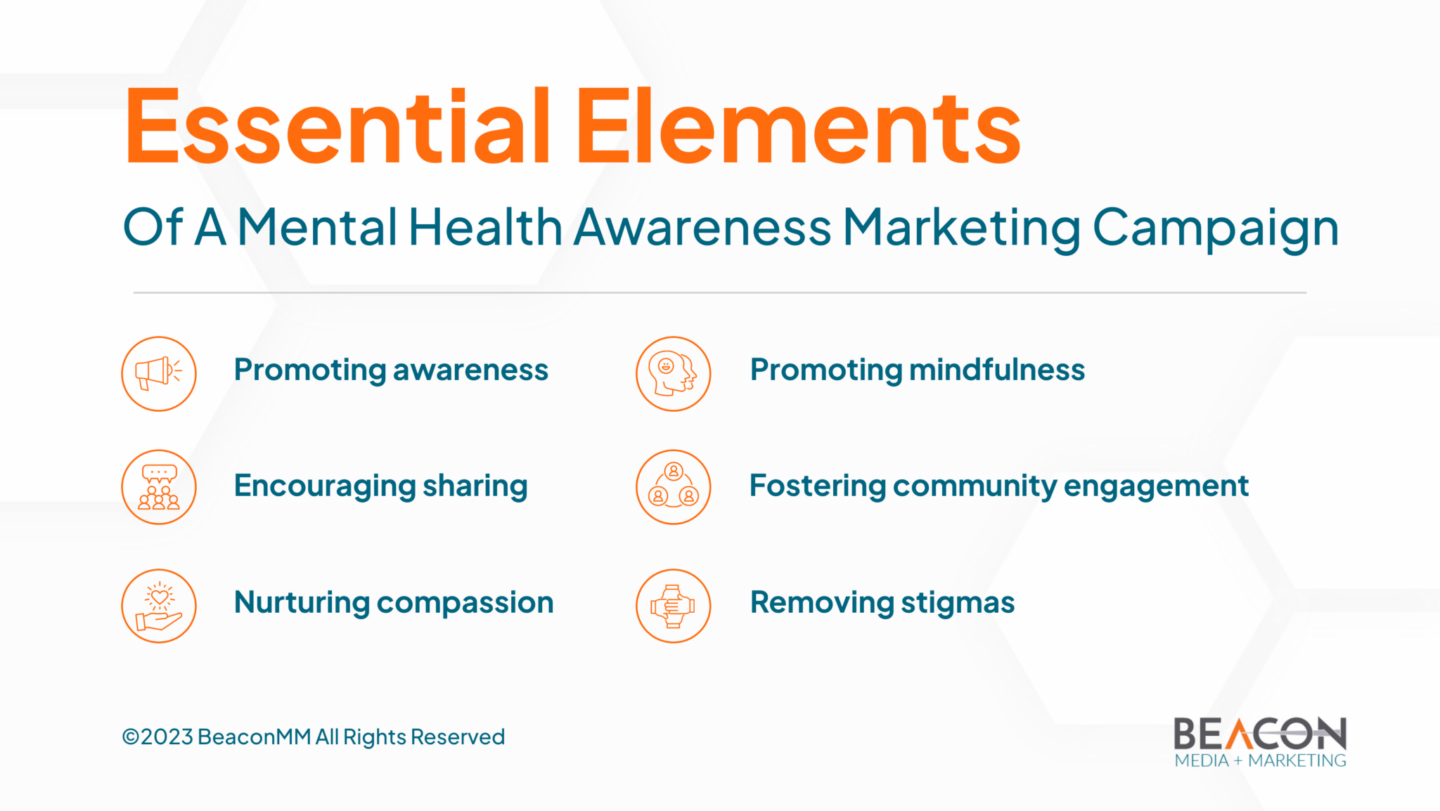
Essential Elements Of A Mental Health Awareness Marketing Campaign Infographic

The ongoing mental health crisis, particularly among young people, underscores the importance of addressing these issues. Many young individuals feel burdened by their mental health challenges, which are often exacerbated by societal pressures and toxic beauty ideals perpetuated by social media. Raising awareness and fostering open conversations about mental health can help alleviate this weight and promote a healthier society.

With so much emphasis on mental health, we believe that the awareness of these issues deserves special attention. And with a little creativity, innovation, and the power of modern technology, we can bring many aspects of mental health into focus.

Here, we’ll outline 10 marketing campaign ideas for promoting mental health.

Understanding Mental Health Awareness

Mental health awareness is crucial for promoting mental well-being and reducing the stigma surrounding mental health issues. It involves understanding the importance of mental health, recognizing the signs and symptoms of mental health challenges, and knowing how to access mental health resources and support. Mental health awareness can be promoted through various channels, including social media, community events, and educational programs. By raising awareness and promoting education, individuals and organizations can help to create a supportive environment that encourages individuals to prioritize their mental health and seek support when needed. Mental Health Awareness Month is a great opportunity to raise awareness and promote mental health initiatives. During this time, various activities and campaigns can be organized to highlight the importance of mental health and provide valuable information and resources to the community. By fostering a culture of awareness and support, we can help individuals feel more comfortable discussing their mental health concerns and seeking the help they need.

1. “Mental Health Matters” Photo Contest

Nothing captures time quite like the right image. Images have the power to evoke an emotional connection and can encourage a response – especially when the image is of something near and dear to one’s heart. Featuring real stories through a photo contest can make encouraging people to share their mental health journey a great mental health campaign.

Participants can submit a photo that represents their mental health story along with a caption, and the entries can be showcased on social media platforms or in a virtual gallery. This mental health campaign not only promotes mental health awareness and encourages individuals to share their stories in a creative and visual way, but it can also attract more followers to your social channels – and possibly be used as leverage for lead generation.

The techniques and activities that you can engage in to foster greater mental health are something that everyone should be made aware of. And this is where you can create a social media challenge where individuals share their mindful moments on social channels using a designated hashtag.

This type of campaign can include photos, videos, or stories of people engaging in activities that promote mental well-being, such as meditation, yoga, or spending time in nature. Not only will you be promoting self-care and mindfulness while raising awareness about mental health, but you’ll also attract more viewers to your channels which can lead to greater brand awareness and potentially higher conversion rates.

2. Community Engagement Ideas

Community engagement is a cornerstone of promoting mental health awareness and fostering support for mental health initiatives. By actively involving your community, you can create a supportive environment that encourages open conversations about mental health. Here are some ideas to get you started:

  1. Host a Mental Health Fair: Organize a mental health fair in collaboration with local mental health organizations. This event can provide valuable resources, support services, and information to the community, helping to raise awareness and offer direct assistance to those in need.

  2. Community Events: Plan community events such as walks, runs, or festivals dedicated to mental health awareness. These events can bring people together, promote physical activity, and create a sense of unity while highlighting the importance of mental health.

  3. Partner with Local Schools: Work with local schools to provide mental health education and resources to students and teachers. This can include workshops, seminars, and distributing informational materials to help young people understand and manage their mental health.

  4. Support Groups: Establish support groups for individuals struggling with mental health issues. These groups can offer a safe space for sharing experiences, receiving support, and building a sense of community among participants.

  5. One on One Support: Emphasize the importance of one on one support in community mental health initiatives. Personalized assistance can be crucial for addressing anxiety and depression, especially among young people. This approach allows for open discussions about mental health challenges and provides tailored support to those in need.

  6. Volunteer Opportunities: Create volunteer opportunities for community members to get involved in mental health initiatives. Volunteering can be a fulfilling way for individuals to contribute to promoting mental health and making a positive impact in their community.

3. “Stress-Free Work Day” Campaign for Mental Health Awareness Month

Nobody likes stress. In fact, undue stress is a huge factor that can deteriorate anyone’s mental health and mental wellbeing. And a stress-free day is something that just about everyone can get behind.

If possible, you can organize and partner with local businesses or corporations to designate a “Stress-Free Work Day” during Mental Health Awareness Week. Here, we can encourage companies to implement mental health initiatives such as flexible work hours, mindfulness breaks, or team-building activities.

This campaign promotes mental health in the workplace and raises awareness about the importance of creating a supportive work environment. In addition, this is also an action that can spark a conversation, and illustrate the type of work culture that your clinic stands behind – and it could be a great recruitment strategy that you can highlight in the future if you’re ever looking to expand your mental health franchise.

4. “Speak Your Mind” Podcast Series

Podcasts are pretty popular these days and are a great way to talk to your local community and bring up issues that people want to know about – especially when it comes to mental health.

Consider launching a podcast series featuring real-life stories of individuals who have struggled with mental health challenges and overcame them. This series can address the ongoing mental health crisis by inviting mental health professionals, advocates, and individuals with lived experiences to share their insights, tips, and stories of resilience. The aim here is to destigmatize mental health, provide support, and spread awareness through an engaging medium. And it can be used as a tool for boosting local engagement and brand awareness.

5. “Art for the Heart” Virtual Art Exhibit

What better way to engage with your local community than by rallying the community together for a great cause? Here, you can partner with local artists and other creatives to host a virtual art exhibit that showcases artwork related to mental health. This virtual art exhibit can serve as an effective mental health campaign to raise awareness and promote dialogue about mental health.

To enhance accessibility, you can provide various online resources related to the virtual art exhibit, ensuring that everyone can participate and benefit from the campaign.

The best part is, anything is possible. For example, you can include paintings, sculptures, photographs, and other visual arts that convey emotions, struggles, and triumphs related to mental health. This campaign combines the power of art and storytelling to raise awareness and promote dialogue about mental health – another great tool for establishing yourself in the community and potentially creating new leads.

A healthy environment naturally promotes healthy living. And there’s nothing like promoting environmental awareness alongside mental health.

Organizing a community clean-up event where volunteers come together to clean up a local park, beach, or neighborhood is a great way to give a little love back to Mother Earth. And you can promote the event as a way to practice self-care through community service and emphasize the connection between a clean environment and mental well-being.

This sort of campaign promotes physical activity, community engagement, mental health awareness, and shows your company’s core values – another great local engagement and potential recruitment tool.

Myths and hearsay about mental health are both common problems associated with the stigmatization of mental health. And debunking these myths is a great way to nurture awareness of the truth surrounding this sensitive issue.

Creating a series of engaging and shareable social media graphics that debunk common myths and misconceptions about mental health is a great way to build engagement on your website or social channels. You can share facts, statistics, and stories that challenge stigmas and raise awareness about the realities of mental health.

Additionally, you can encourage followers to share the graphics on their own social media accounts to spread accurate information and promote mental health awareness – and sharing a link to your channels will also help generate interest in your practice.

8. “Healing Words” Poetry Contest

Words are powerful healing tools – when used the right way. We all know that words can hurt, but it’s important to realize that heartfelt expressions hold a great power all their own.

Hosting a poetry contest during Mental Health Awareness Week where participants can submit original poems that reflect their experiences with mental health can be an intimate and transformative experience for many of your patients and followers. For example, you can create categories such as “Hope,” “Resilience,” “Self-Care,” or “Empowerment,” and invite a panel of judges to select winners. Additionally, consider incorporating yoga classes as part of the campaign to further promote physical wellness and mental health among participants.

In addition, you can publish the winning poems on social media or in a local publication to raise awareness and celebrate the healing power of words – and offer a prize (or discount for a visit) as a bonus!

9. “Mental Health Check-In” Webinar Series

Knowledge also nurtures healing. And webinars are a great way to engage with younger professionals or Gen Z-ers, prioritizing mental wellbeing alongside academic achievements. For example, you can organize a series of webinars featuring mental health experts who discuss various topics related to mental health, such as stress management, coping strategies, and self-care techniques. This can be an effective mental health campaign to provide valuable information and resources to the community.

You may also consider offering the webinars for free and promoting them through social media and local partnerships. This campaign will help to provide valuable information and resources to the community and promotes mental health awareness – and help potential clients take notice of who you are.

We all love kindness! And this is perhaps the most valuable ingredient in helping to create positive mental health. You can encourage individuals to share acts of kindness and positivity on social media using the hashtag #ShareYourSunshine – or link directly to your website. This can include sharing uplifting messages, engaging in random acts of kindness, or expressing gratitude towards others – any act of kindness will do.

Not only will you be able to promote positivity, connection, and mental health awareness by encouraging individuals to spread kindness and positivity, you’ll be showing your followers and visitors who you are, and why you do the type of work you do.

As a digital marketing company operating in the mental health space, at Beacon Media + Marketing we know the importance of spreading awareness about mental health. And with our team of talented creatives, we have the passion, ability, and know-how to build a solid mental health awareness campaign tailored to meet your clinic’s specific needs.

Mental health awareness is something that should be promoted every month – and every day. And by partnering with Beacon, we’ll use all of our resources to help you lead the way in spreading awareness so more people in your community can get the help that they so desperately need.

Are you ready to develop a great marketing campaign to help further mental health awareness? and let’s talk about options!

9. Social Media Campaigns

Social media is a powerful tool for raising awareness about mental health issues and promoting mental health initiatives. With the right strategy, you can reach a wide audience and inspire meaningful conversations. Here are some ideas for impactful social media campaigns:

  1. Mental Health Awareness Month: Launch a dedicated social media campaign during Mental Health Awareness Month. Share informative posts, engaging graphics, and personal stories to highlight the importance of mental health and encourage your followers to get involved.

  2. Share Personal Stories: Personal stories have a unique way of connecting with people. Share real stories of individuals who have faced mental health challenges and found ways to overcome them. These narratives can inspire and educate others, fostering a sense of community and support.

  3. Mental Health Tips: Regularly share practical mental health tips and resources on your social media platforms. These can include stress management techniques, self-care practices, and information about local mental health resources. Providing valuable content can help support your audience’s mental well-being.

  4. Influencer Partnerships: Collaborate with social media influencers who are passionate about mental health. Their reach and influence can help amplify your message and attract a broader audience. Influencers can share their own experiences, promote your initiatives, and encourage their followers to engage with your content.

  5. Hashtag Campaigns: Create and promote hashtag campaigns such as #MentalHealthMatters or #BreakTheStigma. Encourage your followers to use these hashtags when sharing their own mental health stories or participating in your initiatives. Hashtag campaigns can increase visibility and create a sense of community around your cause.

10. Partnering with Influencers and Brands

Partnering with influencers and brands can significantly amplify your efforts to raise mental health awareness and promote mental health initiatives. By leveraging their reach and credibility, you can engage a wider audience and create a more significant impact. Here are some ideas for effective partnerships:

  1. Influencer Partnerships: Collaborate with social media influencers who have a genuine interest in mental health. These influencers can share their personal experiences, promote your campaigns, and encourage their followers to engage with your content. Their endorsement can lend credibility and attract a larger audience to your initiatives. Invite mental health professionals to join these collaborations to provide expert insights and enhance the credibility of your message.

  2. Brand Partnerships: Partner with brands that align with your mission to promote mental health awareness. These collaborations can include co-branded campaigns, joint events, or providing mental health resources to the brand’s employees. Brand partnerships can help you reach new audiences and create a unified message about the importance of mental health.

  3. Mental Health Ambassadors: Appoint mental health ambassadors who are passionate about raising awareness and supporting mental health initiatives. These ambassadors can be influential figures in the community, celebrities, or individuals with lived experiences. They can help spread your message, provide support, and connect with individuals struggling with mental health issues.

  4. Collaborative Events: Host collaborative events with influencers and brands to raise awareness and promote mental health initiatives. These events can include panel discussions, workshops, or fundraising activities. Collaborative events can attract a diverse audience and create opportunities for meaningful engagement.

  5. Content Partnerships: Partner with influencers and brands to create compelling content, such as videos, blog posts, or social media campaigns. This content can highlight mental health issues, share personal stories, and provide valuable resources. Content partnerships can help you reach a broader audience and create a lasting impact.

Reaching Different Audiences

Reaching different audiences is critical for the success of mental health campaigns. Different demographics, such as younger audiences, may require unique approaches to engage and educate them about mental health topics. For example, social media platforms can be an effective way to reach younger audiences, while community events and workshops may be more effective for older adults. Additionally, mental health campaigns can be tailored to address specific mental health concerns, such as anxiety or depression, and can provide coping strategies and resources for individuals affected by these conditions. By understanding the needs and preferences of different audiences, mental health campaigns can be designed to maximize their impact and promote mental health awareness. For instance, creating engaging content that resonates with younger audiences on platforms like Instagram or TikTok can help spread awareness and encourage positive mental health practices. On the other hand, organizing informative seminars and support groups can be more effective for older adults who may prefer face-to-face interactions. By diversifying the approach and utilizing various channels, mental health campaigns can effectively reach and support a broader audience, ultimately fostering a more inclusive and understanding community.

Evaluating Campaign Success

Evaluating the success of your mental health campaigns is crucial to understanding their impact and identifying areas for improvement. By tracking key metrics and gathering feedback, you can refine your strategies and ensure your efforts are making a difference. Here are some metrics to consider:

  1. Engagement Metrics: Track engagement metrics such as likes, shares, comments, and views on your social media posts and content. High engagement indicates that your message is resonating with your audience and encouraging them to take action.

  2. Website Traffic: Monitor website traffic to measure the effectiveness of your campaigns in driving visitors to your mental health resources and support services. An increase in website traffic can indicate that your campaigns are successfully raising awareness and attracting interest.

  3. Social Media Analytics: Use social media analytics tools to track the performance of your campaigns on various platforms. Analyze metrics such as reach, impressions, and follower growth to gauge the overall impact of your social media efforts. Additionally, tracking the effectiveness of online resources can provide insights into how well these tools are supporting your mental health initiatives.

  4. Survey Feedback: Collect feedback from campaign participants through surveys or questionnaires. Ask about their experiences, what they found valuable, and any suggestions for improvement. This feedback can provide valuable insights into the effectiveness of your campaigns and help you make data-driven decisions.

  5. Partnership Evaluation: Evaluate the effectiveness of your partnerships with influencers and brands. Assess the reach and engagement generated through these collaborations and determine if they helped achieve your campaign goals. Strong partnerships can enhance your efforts and create lasting relationships for future initiatives.

By carefully evaluating your mental health campaigns, you can ensure that your efforts are making a meaningful impact and continuously improve your strategies to better serve your community.

If you’re ready to boost your mental health company’s reach and engagement, we’re here to help. Contact us today for a free growth plan.

No matter the industry you’re operating in, whether in healthcare, finance, tech, or tourism, without the right marketing strategy your chances of meeting goals and being successful are going to be slim. But before you can define your marketing strategy and put all the moving parts into working order, you have to set realistic marketing goals. Sounds simple, right? The process, on the other hand, needs to be specific.

Setting marketing goals opens the field fairly wide – and can include a lot of different business actions. This is precisely why you need to define specific target goals and drill down to the core of each in order to define a process for meeting each goal.

The truth is, marketing goals vary widely. Perhaps you want to improve brand awareness or launch a new service. Or maybe your primary goal is to get more leads and conversions. Regardless of what your focus is, your marketing goal should have a specific strategy customized to help you succeed. And this is what we’re here to talk about today.

Are you ready to define your marketing goals and implement a process to meet them? Reach out to Beacon Media + Marketing today and ask us how we can help.

How To Create Marketing Goals for Improving Brand Awareness

One of the most important aspects of a successful business is the element of brand awareness. If nobody knows who you are, they’re not going to remember you or choose your products or services. But with the right brand awareness strategy, consumers will remember you – and you’re likely going to be very hard to forget.

Setting marketing goals for improving brand awareness also requires careful planning and consideration of your brand’s current status and desired outcomes. And this process requires a few steps to help you set effective marketing goals.

1. Assess Current Brand Awareness

Start by evaluating your brand’s current level of awareness among your target audience. This can be done in a variety of ways, such as through market research, surveys, or social media analysis. Understanding your current brand awareness will provide you with a data-driven baseline for setting realistic goals.

2. Define Specific Objectives

Without objectives, you cannot set processes in place. This is why you need to clearly define what you want to achieve with your brand awareness efforts. For example, you may want to increase your brand recognition by a certain percentage, boost your social media followers, or generate a certain number of website visits.

During the planning process, a great way to improve the chances that you’ll actually achieve these objectives is to be very specific with how you set your goals.  And this can be achieved through the SMART goal-setting process. Make sure your objectives are specific, measurable, achievable, relevant, and time-bound (SMART).

3. Know Your Target Audience

In order to sell anything to anyone, you have to know a little bit about them. As such, this all comes down to knowing your target audience and their preferences, behaviors, and needs. This approach will help you tailor your marketing efforts to reach and resonate with your prospective consumers effectively. Even better – knowing your audience will also allow you to set relevant goals that align with their expectations.

4. Consider Branding Metrics

It’s always important to identify key branding metrics that align with your objectives. These could include:

  • Web traffic
  • Social media engagement
  • Brand mentions
  • Share of voice
  • Customer sentiment (testimonials & reviews)

At the end of the day, you need to choose metrics that are meaningful and can be tracked accurately to measure progress.

5. Set Realistic and Achievable Goals

Goals are different from objectives. Objectives are the deliverables that make goals happen, while goals are the larger vision – and the end game. Above all, we have to operate within the realm of possibility. And though lofty goals can be fun to think about, you can potentially reach too far and expend too much time and resources chasing a goal that is otherwise unrealistic.

As such, consider your brand’s current resources, budget, and market conditions when setting your goals. And always avoid setting unrealistic or overly ambitious goals that may be difficult to achieve – making sure your goals are aligned with your overall marketing and business objectives.

6. Create an Action Plan

A plan is nothing without action. This is true in any part of life – and definitely a fact in marketing. This is why you need to develop a comprehensive marketing plan that outlines the strategies and tactics you will use to achieve your brand awareness goals. This may include:

  • social media campaigns
  • paid advertising
  • content marketing
  • website optimization
  • influencer partnerships
  • public relations
  • search engine optimization

The list above can also be combined with other marketing initiatives. And once you have this plan, it’s time to assign responsibilities, set timelines, and establish a budget for each tactic.

7. Monitor and Adjust

You can’t cook a successful meal without keeping an eye on the stove. And just like when you’re in the kitchen, you have to regularly monitor your progress toward your brand awareness goals and make adjustments as needed. This is where you can use analytics and data to measure your marketing efforts’ success and identify improvement areas. But above all, be flexible and adaptable, and make changes to your strategies and tactics as necessary to optimize your results.

Remember that improving brand awareness is a long-term effort requiring consistency, creativity, and strategic planning. By setting clear marketing goals and implementing a well-thought-out plan, you can enhance your brand’s visibility, reach, and recognition among your target audience.

Marketing Goals for Generating Leads and Conversions

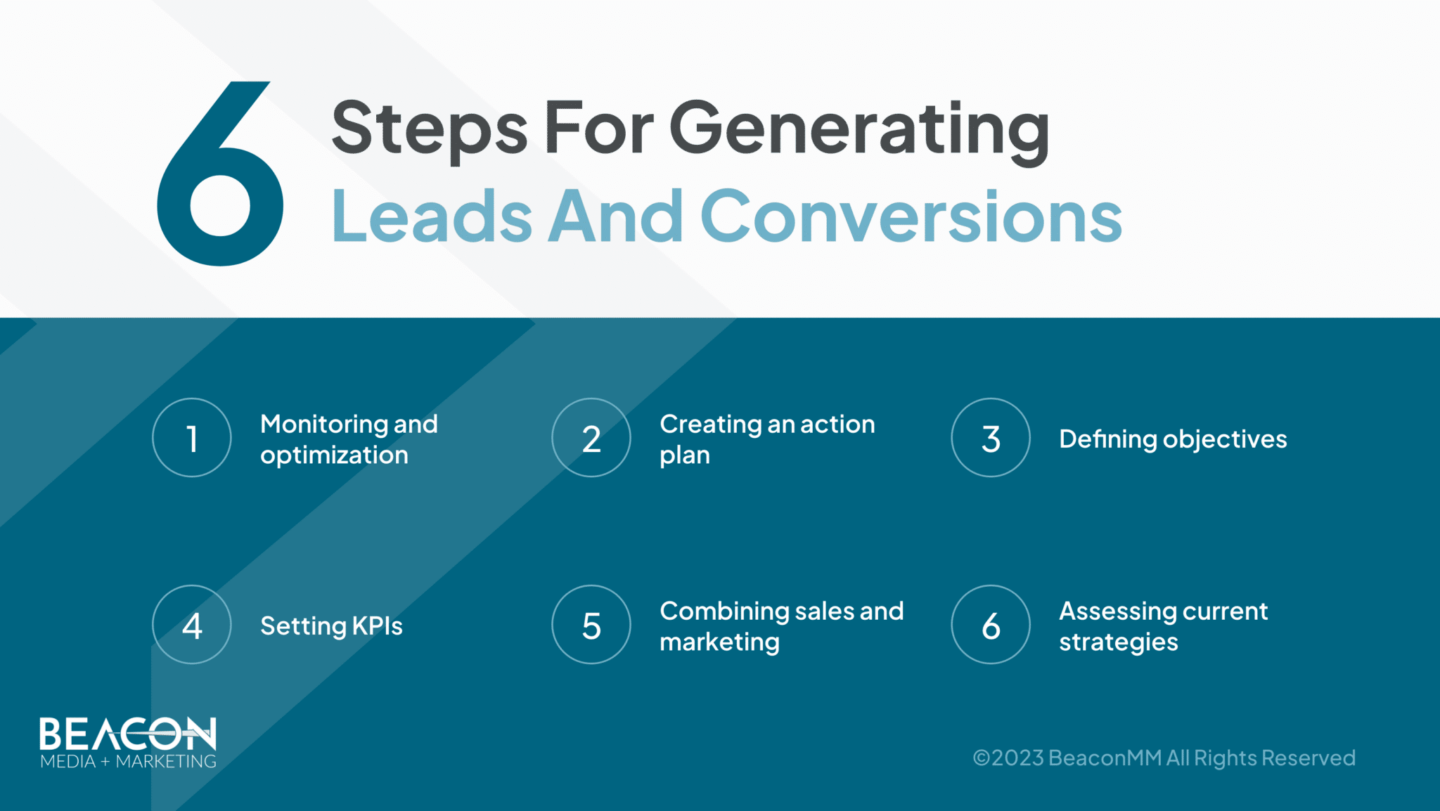
6 Steps For Generating Leads And Conversions Infographic

Just like with improving brand awareness, setting marketing goals for gaining more leads and conversions requires a strategic approach. After all, it’s your ability to convert a consumer and keep them happy that ultimately translates into getting more organic, quality leads. In general, an approach you can follow for generating leads and conversions includes:

  • Defining objectives
  • Setting KPIs
  • Assessing current strategies
  • Creating an action plan
  • Monitoring and optimization
  • Combining sales and marketing

Define Your Lead Generation and Conversion Objectives

Just like with any personal branding effort, you need to clearly define what you want to achieve with your lead generation and conversion efforts. For example, you may want to increase your leads by a certain percentage, improve your conversion rate, or generate a certain number of sales.

Get down to business with the details, and this is where your plan of action will begin to emerge.

Set Key Performance Indicators (KPIs)

Identify key performance indicators (KPIs) that align with your lead generation and conversion objectives. These could include metrics such as:

  • Website traffic
  • Click-through rates
  • Form submissions
  • Email sign-ups
  • Bounce rates
  • Sales revenue.

You’ll also want to choose KPIs that are relevant, measurable, and align with your overall marketing and business objectives.

Assess Your Current Lead Generation and Conversion Strategies

It’s always an asset to know what’s been working – and to understand what hasn’t worked at all.  For this reason, you should evaluate your current lead generation and conversion strategies to identify strengths, weaknesses, and areas for improvement.

Consider your existing marketing channels, tactics, and campaigns, and assess their effectiveness in generating leads and driving conversions. At the end of the day, this analysis will help you identify opportunities for optimization.

Create a Lead Generation and Conversion Action Plan

Develop a comprehensive marketing plan that outlines the strategies and tactics you will use to generate more leads and drive conversions. This may include content marketing, email marketing, search engine optimization (SEO), paid advertising, landing page optimization, and other marketing initiatives. Above all, ensure that you assign responsibilities, set timelines, and establish a budget for each tactic.

Monitor and Optimize

Trust the data! Once you have the right systems in place, the data will speak for itself.

Regularly monitor your lead generation and conversion efforts using trusted analytics and marketing data. Then, measure the success of your marketing campaigns against your defined KPIs, and make adjustments as needed to optimize your results. This will enable you to continuously test and refine your strategies and tactics to improve lead generation and conversion outcomes.

Align Sales and Marketing Efforts

Miscommunications in marketing can cause chaos. This is why you have to ensure that your sales and marketing teams are aligned and working collaboratively toward a common goal of generating leads and driving conversions. Establish clear communication channels, share insights and feedback, and collaborate on strategies to optimize lead generation and conversion efforts.

By setting clear marketing goals, understanding your target audience, implementing effective strategies, and continuously monitoring and optimizing your efforts, you can improve your lead generation and conversion outcomes and drive business growth.

How to Measure Marketing Goals for Success

Measuring marketing goals involves several steps that can vary depending on the specific goals and objectives of your marketing campaign. In general, here are some general steps to help you measure marketing goals.

Implement Tracking and Analytics

Set up tracking mechanisms, such as Google Analytics, social media analytics tools, or CRM systems, to collect data on your KPIs. This will allow you to measure the performance of your marketing efforts and track progress toward your goals. Make sure to set up tracking properly and consistently to ensure accurate measurement. A few great choices for tracking and data collection include:

  • Google Analytics – a widely used and popular web analytics tool that provides comprehensive tracking and analytics features for websites and mobile apps. It offers a wide range of data insights and reporting options to measure website traffic, user behavior, conversions, and more.
  • SEMrush – an all-in-one digital marketing toolkit that offers a wide range of tools and features for SEO (Search Engine Optimization), PPC (Pay-Per-Click) advertising, content marketing, social media management, and competitive research. It is a popular software suite used by digital marketers, SEO professionals, content creators, and businesses of all sizes to optimize their online presence and improve their digital marketing efforts.
  • Facebook Analytics – a specialized analytics tool for tracking and analyzing marketing efforts on Facebook and Instagram. It provides detailed data on ad performance, user engagement, and audience demographics, specifically tailored for businesses leveraging social media marketing.

Monitor and Analyze Data

Regularly review and analyze the data collected from your tracking mechanisms to assess the performance of your marketing efforts. Look for trends, patterns, and insights that can help you evaluate the effectiveness of your marketing strategies and tactics. This may involve analyzing data on website traffic, conversion rates, engagement metrics, or other relevant data points.

Compare with Benchmarks

Compare your performance against established benchmarks, such as industry standards, historical data, or competitor data, to assess how well you are doing relative to your goals. Benchmarks provide context and help you understand whether you are on track or need to adjust your marketing strategies.

Adjust and Optimize

Based on your analysis of data and performance against benchmarks, make adjustments to your marketing strategies and tactics as needed. This may involve refining your messaging, changing your targeting, or reallocating resources to optimize your marketing efforts and improve performance toward your goals.

Define Your Marketing Goals With Beacon Media + Marketing

Here at Beacon Media + Marketing, goal setting is at the core of all work we do. We understand that without strategic marketing goals, marketing simply isn’t possible. And we believe in a methodical approach supported by data to meet each and every goal we strive toward.

At Beacon, we have a proven track record for getting our clients the results they desire to boost brand awareness and sales. With our team of marketing professionals, SEO experts, web designers, and content strategists, we can develop your goals and provide the path for reaching your objectives – all while allowing you to sit back and focus on building your business. Are you looking to meet your marketing goals and grow your business? Contact Beacon Media + Marketing today and schedule a free consultation.

What is the Beacon Way and why is it impacting the digital marketing industry?

The Beacon Way is Cultivating Conversations and Connections with Your Ideal Client infographic

The Beacon Way is something that we have been formulating, testing, and using for our clients over the past several years. We’ve been able to put together a methodology around the most successful pieces that any business needs to have as part of its marketing plan.

The Beacon Way focuses on your digital footprint and its human connection in a digital world of disconnection.

Can you explain why human connection is important in a digital format?

More People are Finding Services and Products Online Than Ever Before infographic

93% of people begin online experiences with a search engine and 81% of people perform some type of online search before making a large purchase. Even though they start online and are getting the information they’re looking for from a digital platform, they don’t want to be sold and they don’t want to be just a number, they want to be a customer, a fan of your company, and possibly an unpaid brand ambassador for your services based on the experience they have once they decide to make that initial contact.

Bringing humanity back into the digital equation humanizes what has become largely dehumanized. We have found that the more we bring that human-to-human connection back into digital marketing, it transforms the whole buying process.

To put it simply, The Beacon Way cultivates conversations and connections with your ideal clients. It brings digital marketing back to the human level, which directly affects your bottom line, your brand, and your ability to recruit people to work for you.

How do you formulate a marketing plan based on The Beacon Way?

A good in-person networker knows that to connect on a human level, you have to watch how you use speech and body language to invite conversation. Closed body language, like directly facing one person instead of a more open stance, does not invite others into your sphere for connection and conversation. A simple side step to open your shoulders to the room shows people that you are open to them coming toward you, inviting them into the conversation. This applies to your digital presence as well, a website that is not easily navigated and appears cold, does not as easily invite the potential client to continue to explore the conversation.

Taking a step back with fresh eyes to analyze your online presence is the first step to solid plan formulation. 90% of how potential clients will perceive you is in the “tone and body language” of your online presence, how is your conversation and your communication? Do the words you use make them feel comfortable? Is your color scheme welcoming? Is the general theme of the website welcoming or is it cold and off-putting? Are you communicating clearly with your potential clients that they have found whom they are looking for or are they having to hunt and struggle to discover that you are the solution they are looking for?

For example, when a potential client is looking for your contact information, is it easily accessible on your website or is it hidden? If information is not easily accessible, it will cost you in your conversions. 93% of potential clients are going to check out your online profile first. If your online profile does not reflect the correct tone, the correct body language, and use the words that you would express in person, that can cause you to miss out on a huge percentage of potential new clients. You risk turning this first impression from a welcoming invitation to explore more of who you are into a transactional experience, people don’t want to be sold, they want to connect.

The core of The Beacon Way is being open and attentive to the tone and body language of your digital presence and translating human-to-human interaction skills into that digital presence to engage and convert potential clients into customers and fans.

How can The Beacon Way enhance the UX experience?

90% of users will perceive you through your online tone and virtual body language infographic

The UX experience, or user experience, is what the potential client will encounter when they click on your website. This is why exploring tone, body language, and words is so very important. That first impression needs to remove as many barriers as possible to ensure that they stay on your site and browse for more information.

When a potential client lands on your home page or your services page from a Google post, what do you optimally want them to experience? Statistics show that if a website doesn’t load within 1-2 seconds, the user will click off of it, with the majority of people not staying past 3 seconds. Focusing on the back-end technical foundation of your website is a critical step to ensuring a solid UX experience. Many tools are available, either through paid or free subscriptions, to analyze this functionality.

Having a website that does not load quickly is a frustrating experience, it communicates to the potential client that their time is not valuable to you and that you don’t want to talk to them. It may seem extreme, but not when you consider the subconscious message the user receives that creates the click-off after a max of 3 seconds.

The second most important thing to consider is the content on that page of your website, does it communicate clearly the relevant information that your potential client is looking to learn? We know that intrinsically, in networking or in building a relationship with someone, we have to cultivate a curiosity from them so that they want to learn more but also, it’s being curious about them and learning about them first. We have to give them information relevant to what they are searching for, establish ourselves as the expert without being salesy, and create a lasting positive first impression.

All of these items do take time to review and make right, but once you have them right and understand the process of what your potential clients are looking for, you can start seeing great increases and better conversions.

How can I look at my website through The Beacon Way?

Again, start by taking a look at the foundational technical items on the back end of your website. Does it load fast enough, is it accessible quickly? Are you prepared for the moment that you initially meet your potential client and are you putting a positive first impression forward to them each and every time?

Next, look to see if you are ranking well. Your presence will be solid if your website loads quickly, you don’t have off-putting spam on your website, and your domain is updated. Clearly stating what you do, thinking clear over creative, and not getting distracted by adding all the bells and whistles to your page, will help you stand out from your competitors. Ultimately, the goal should be, “This is who I am and why I’m different from my competitors. I do what I do really well and I can actually help you.”

Communication of whom you actually help is a very important part of your digital presence. If a potential client comes to your site, they need to clearly understand that you can provide a solution to what they are searching for. Potential Clients don’t want to read between the lines and wonder if your service is the right one for them, they want to know they’ve chosen well and feel comfortable when choosing you.

What about design? Doesn’t that matter?

Absolutely, however, it doesn’t matter over content and UX. You can have an outrageously designed site, but the client has no idea who you are, what you do, or how to get in contact with you. It is not about how flashy your website or online presence is, you have to cultivate connections with your ideal clients and be super obvious about whom you help and how they can contact you because those are two very large barriers to client conversions.

The Beacon Way of marketing is cultivating connection that leads the potential client from the initial connection to an actual converting client by having a good UX experience that ties back to the human connection in digital marketing.

If you were to prioritize changes using The Beacon Way, what would they be?

Start thinking about your website objectively, are you making that human-to-human connection with your digital marketing? What about your tone and how fast does your website load? Are you taking the time to make sure your website body language is working? How easy is it to find the information you want to provide for your UX? Are you communicating that you want potential clients on your website to explore and receive information or are you trying to instantly funnel them into a sales situation?

Make sure the words you are using are welcoming and communicating clearly while using a good tone. Words matter less if you have already lost your viewer in the first few categories.

How can we get more in-depth information on removing barriers from potential clients?

Check out episode 5 of The Beacon Way podcast or our blog, Removing Barriers in Marketing!

Following the onset of COVID-19, marketers nationwide began scratching their heads. This is because, between March and August of 2020, reporting showed that one in five consumers hopped to a different brand, and seven in ten consumers began exploring new shopping channels. However, the data collected ultimately led marketers to rethink their tech and data strategy as related to precision marketing – initiating a new wave of data-driven marketing.

The fact is, even though these reports showed us that data models need to change alongside consumer trends, many companies have continued to rely on outdated data modeling – even three years after the pandemic. In a world where trends set standards, you have to be prepared to adapt quickly.

While some marketers rely on mass marketing strategies in place of trusting or improving data modeling, this tactic will only lead to stagnant sales and snailish growth. As such, the value of data, analytics, and reporting cannot be overstated in an environment where marketing meets constant consumer change.

Ready to Learn more about how data-driven marketing can improve your overall marketing strategy? Reach out to Beacon Media + Marketing today to learn more.

Why Is Data-Driven Marketing so Valuable?

In today’s digital age, data is more important than ever before. It is the fuel that powers and guides most businesses, and it is an essential tool for marketing teams looking to reach their target audience and achieve their goals.

The ability to collect and analyze data has become a key competitive advantage for businesses of all sizes, and it can be used to inform your marketing strategies and drive better business outcomes.

At the end of the day, data-driven marketing is simply a strategy that relies on the analysis of data and the use of insights to inform marketing decisions. And with the growing volume of data being generated every day, businesses have access to a wealth of information that can be used to better understand their customers and improve their marketing efforts.

The Value of Data

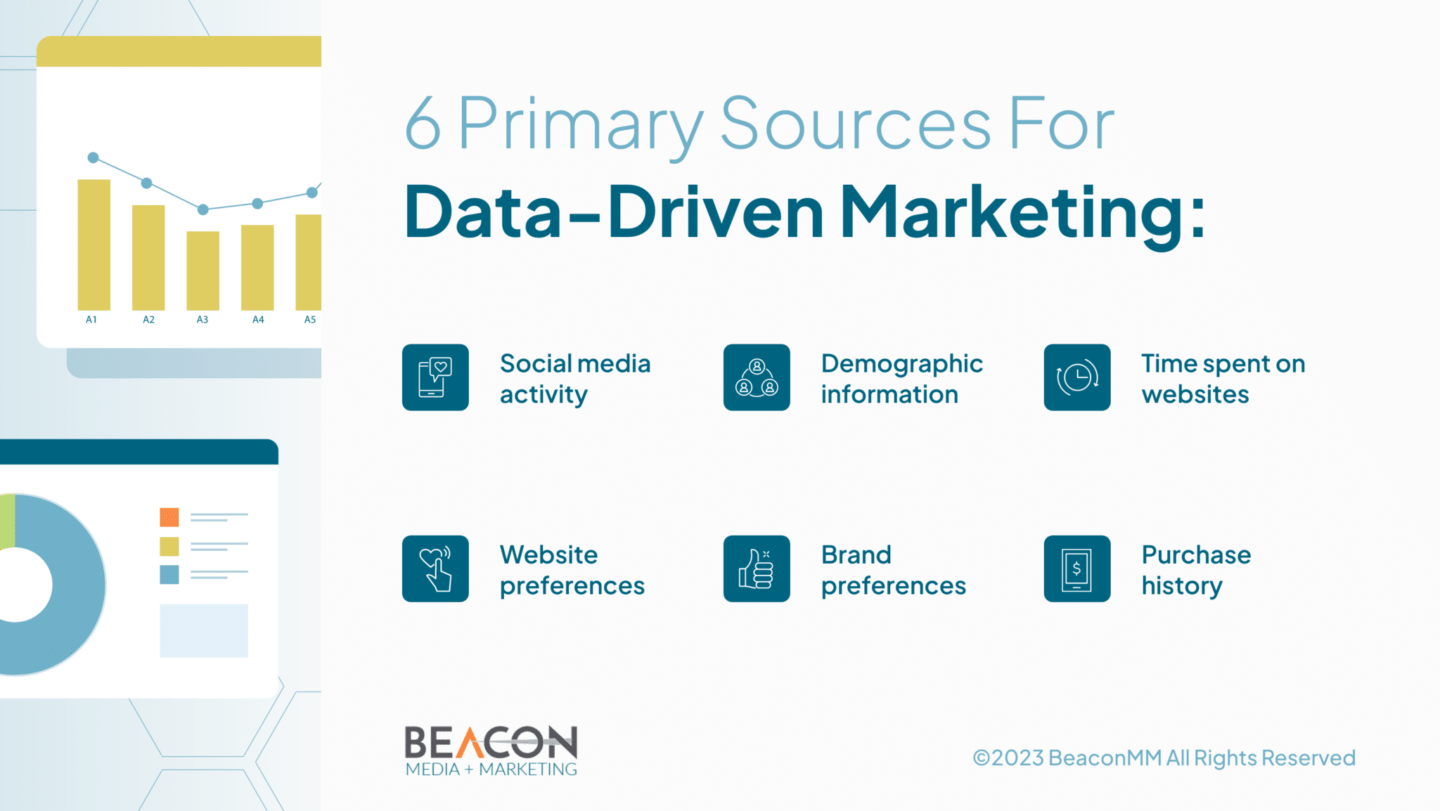
6 Primary Sources of Data-Driven Marketing infographic

Data is the foundation of data-driven marketing – hence the name. The more data a business can acquire, the better it can understand its customers – including their needs and preferences. And by measuring the right data, businesses can make informed and calculated decisions that lead to increased customer engagement, loyalty, and revenue.

One of the primary sources of data for data-driven marketing is consumer data. This often includes:

  • Demographic information
  • Purchase history
  • Website preferences
  • Brand preferences
  • Time spent on websites
  • Social media activity

By analyzing this data, you can create detailed customer profiles that help you to understand who your customers are, how and when they shop, where they shop, and most importantly, what they want.

Another great source is marketing data. And this includes a range of data collected from marketing campaigns including:

  • Email open rates
  • Click-through rates
  • Bounce rates
  • Conversion rates

By drilling down into this data, businesses can easily identify which marketing campaigns are most effective and make changes to improve future campaigns.

Value of Analytics

Analytics refers to the process of analyzing data to uncover insights that can inform your marketing decisions. And analytics allows businesses to identify key patterns, trends, and correlations in data that may not be immediately apparent. All in all, analytics is where the magic happens – illustrating how you can leverage data to scale any campaign.

One of the most common types of analytics used in data-driven marketing is predictive analytics. This process uses statistical algorithms and machine learning to identify patterns in data that can be used to predict future outcomes. For example, businesses can use predictive analytics to identify which customers are most likely to make a purchase in the future. And as AI marketing tools continue to evolve, this will only become more accurate.

Another type of analytics is descriptive analytics. Here, the focus is on summarizing and visualizing data to provide insights into what has happened in the past. And this can be useful for identifying trends and patterns in customer behavior that can inform marketing decisions.

Value of Reporting

Reporting is the process of presenting data and insights in a way that is easy to understand and act upon. In the most fundamental sense, reporting allows you to digest and communicate the results of your analytics efforts to stakeholders – and make data-driven decisions based on those results.

One of the most important aspects of reporting is data visualization. And this process allows businesses to present data in a way that is easy to understand and interpret. It can include graphs, charts, and other visual aids that help stakeholders quickly understand the insights presented. For example, a quality data-driven report may include the following information:

  • Impressions The number of times an ad or piece of content was displayed.
  • Clicks: The number of times someone clicked on an ad or a piece of content.
  • Click-through rate (CTR): The percentage of people who clicked on an ad or a piece of content after seeing it.
  • Conversion Rate: The percentage of people who completed a desired action, such as making a purchase or filling out a form, after clicking on an ad or a piece of content.
  • Cost Per Click (CPC): The amount of money spent on each click.
  • Cost Per Acquisition (CPA): The amount of money spent on each conversion.
  • Return On Investment (ROI): The amount of revenue generated from a marketing campaign compared to the amount of money spent on the campaign.
  • Engagement Rate: The percentage of people who interacted with a piece of content, such as liking or commenting on a social media post.
  • Reach: The number of unique people who saw a piece of content.
  • Bounce Rate: The percentage of people who visited a website but left after viewing only one page.
  • Average Session Duration: The average length of time that people spend on a website.
  • Revenue: The total amount of money generated from a marketing campaign.
  • Customer Lifetime Value (CLV): The predicted amount of money that a customer will spend on a company’s products or services over their lifetime.
  • Customer Acquisition Cost (CAC): The amount of money spent to acquire a new customer.
  • Net Promoter Score (NPS): A customer satisfaction metric that measures the likelihood of customers recommending a company’s products or services to others.

Another important aspect of reporting is the ability to customize reports for different stakeholders. Different stakeholders may have different needs and interests, so it’s critical to create reports that are tailored to their specific needs.

How to Execute Data-Driven Marketing Strategies

All in all, data-driven marketing is a powerful strategy that can help businesses better understand their customers and improve their marketing efforts. By leveraging the value of data, analytics, and reporting, businesses can make informed decisions that lead to increased customer engagement, loyalty, and revenue.

Identify Your Target Audience

One of the most significant advantages of using data in marketing is the ability to identify your target audience. Data analytics tools can provide insights into customer demographics, behaviors, and preferences, allowing businesses to develop targeted marketing campaigns that resonate with their ideal customers.

By analyzing data on customer behavior and preferences, businesses can tailor their marketing efforts to reach their target audience more effectively. They can identify which channels their customers prefer, which types of content they respond to, and which products or services they are most interested in.

Measure the Effectiveness of Your Marketing Campaigns

Data can also be used to measure the effectiveness of marketing campaigns. By analyzing data on key performance indicators (KPIs), such as website traffic, click-through rates, conversion rates, and sales, businesses can determine which marketing channels and tactics are working and which ones need to be improved.

Data can also provide insights into customer engagement and retention rates, allowing businesses to develop strategies to retain customers and increase customer lifetime value.

Optimize Your Marketing Strategies

Data can help businesses optimize their marketing strategies by providing insights into customer behavior and preferences. By analyzing data on customer interactions with marketing channels and content, businesses can identify areas for improvement and make adjustments to their marketing strategies.

For example, if a business discovers that its customers are more likely to respond to social media ads than email campaigns, it can reallocate its marketing budget accordingly. Similarly, if a business finds that its customers are more likely to purchase a particular product or service during a specific time of the year, it can adjust its marketing strategy to ensure its advertising efforts are having the biggest impact.

Improve Your Customer Experience

Data can also be used to improve the customer experience. By analyzing data on customer interactions with products, services, and marketing channels, businesses can identify areas for improvement and make changes to improve the customer experience.

In addition, data has long been an essential tool for businesses looking to develop effective marketing strategies and drive better business outcomes. By leveraging data, businesses can identify their target audience, measure the effectiveness of their marketing campaigns, optimize their marketing strategies, and improve the customer experience.

In today’s data-driven world, businesses that do not embrace data are likely to fall behind their competitors. But by leveraging data, businesses can gain a competitive advantage, improve their marketing strategies, and drive better business outcomes.

How to Measure and Optimize Marketing Campaigns Using Data Analytics and Reporting

Again, we cannot overstate the importance of data-driven marketing. In fact, it’s part of the basics of marketing in today’s world. But before you can leverage any data that you collect, or modify it to help you reach target goals, you have to employ a process. The good news is, the process is fairly simple.

Define your campaign goals

Before you start your campaign, you need to define your goals and what you want to achieve. Is it to increase website traffic, generate leads, or boost sales? Defining your goals helps you determine the metrics you need to track.

Choose the right metrics

Once you have defined your goals, you need to choose the right metrics to track. For example, if your goal is to increase website traffic, you may want to track the number of page views, unique visitors, bounce rate, etc. If your goal is to generate leads, you may want to track the number of form submissions, conversion rate, cost per lead, etc.

Set up tracking

Once you have defined your goals and metrics, you need to set up tracking. You can use tools like Google Analytics, Mixpanel, or Kissmetrics to track your campaigns. But you have to be sure to set up tracking correctly to ensure accurate data.

Analyze your data

Once you have collected data, it’s time to analyze it. Use data visualization tools to make sense of your data. Look for trends and patterns and identify areas where you can optimize your campaigns.

Optimize your campaigns

Based on your analysis, make adjustments to your campaigns to optimize them. For example, if you find that a particular ad is not performing well, you can change the targeting, ad copy, or creative to improve its performance.

Report on your results

Finally, report on your results to stakeholders. Use data visualization tools to create reports that are easy to understand. Then, share your insights and recommendations for future campaigns.

By following these steps, you can use data analytics and reporting to measure and optimize your marketing campaigns. And don’t forget to regularly monitor your campaigns to ensure you are on track to achieving your goals.

Improve Data-Driven Marketing With Beacon Media + Marketing

As you can see, the power of data in today’s marketing landscape cannot be overlooked. Without data, you’re basically flying blind, using your gut, and hoping for the best when looking to make your customers happy. And though intuition is a valuable tool in itself, combining this with the power of data-driven marketing will only enhance your chances of success.

At Beacon, we know how to present data effectively. And knowing how to evaluate a digital marketing agency is a great place to start the process of finding an agency that knows how to read data and implement these findings for optimizing marketing performance across all channels.

Our team thrives on data collection – and we use this knowledge to enhance the performance of all marketing campaigns. In an environment where big data is pushing a technological revolution, we’re on the front lines, using it as leverage.

Are you interested in applying data-driven to your overall marketing strategy? Contact Beacon Media + Marketing today to find out more.

When running a clinic, you’re likely focusing on getting your patients the care they need. But what about keeping them on as a client? Are your efforts being focused here as well? If not, you’re risking losing them to your competitors if your marketing strategy doesn’t include measures for patient retention.

Healthcare marketing strategies are often too narrowly focused on bringing in new patients and expanding locally. But placing all your energy into these areas neglects your current clientele. And this is where customer relationship management can play a huge role.

Strong marketing strategies need to consider all of your target audiences, and this needs to include efforts to keep your current patients engaged and happy so that they don’t feel the need to shop elsewhere for their healthcare needs.

In the following guide, we’ll look at how you can keep your current patients engaged so you can count on them to count on you.

Could you use help with patient retention at your healthcare clinic? Reach out to Beacon Media + Marketing today to learn what actions you can take.

What is Patient Retention?

In a nutshell, patient retention is all about making sure that your patients continue returning to your clinic instead of taking their business elsewhere. And though you can expect to lose patients from time to time because they’ve moved away, lost or switched insurance providers, or they’re not actively involved with keeping up with their own health needs, these conditions are not in your control.

The good news is that through an effective retention strategy, your clinic can keep more patients than you’ll lose. And this can be done through a variety of methods. One of the best methods to consider is implementing a personalized marketing interaction strategy. This way, you can work to predict what your patients will need and engage with them accordingly before they take their business to a clinic down the street.

What is the Value of Investing in Patient Retention?

Studies have indicated that 67 percent of consumers are likely to sever ties with a business due to poor customer experiences. Essentially, if your patients don’t like their experience, or if they don’t feel valued, they’re likely to find another clinic.

What’s even more startling about this statistical data is that the average healthcare brand has an approximate growth rate of 45 percent, but also a churn rate of 48 percent. At the end of the day, this illustrates that the majority of healthcare brands lose more patients than they gain. But this can be mitigated by enhancing your patient retention strategy.

The problem is, most healthcare brands don’t have a solid grasp on how to improve patient retention, nor do they understand the long-term value that retention strategies can bring.

Consider these points:

  • The average lifetime value of a patient is between 12,000 and 15,000 dollars
  • Over 80 percent of patients report not feeling valued by their providers
  • Physicians lose nearly 50 percent of their patient base over a five-year period
  • A healthcare brand can increase profits between 25 and 95 percent by increasing patient retention by as little as 5 percent
  • Healthcare brands can see a 2 percent increase in value for every 1 percent change in annual retention over a five-year period

The key takeaways here are that most healthcare brands could stand to improve all areas of their customer service. And by improving patient retention, you could make big gains in profit over the course of time and become a much more reputable brand in the process.

Why Do Patients Leave a Healthcare Clinic?

The way patients view healthcare has changed significantly just in the last decade. And if you think about the high cost of healthcare as it is, with costs rising each year, patients are more likely to research and shop around for the best deal they can get. Because let’s face it, life is expensive. And we’re all trying to save a buck or two.

Beyond this, consumers in every space have become accustomed to fast service – getting what they want when they want it. And this has a great deal to do with advances in technology in nearly all consumer spaces. Basically, patients have come to expect a higher quality of care, greater convenience, easier access, and greater customer service from a healthcare provider than ever before in history.

So, why do so many patients leave your clinic never to return? Many reasons exist for this, but there are a few that land at the top.

Excessive Wait Time

On average, waiting 20 minutes to see your provider is considered “quick” in the healthcare industry. However, wait times longer than 20 minutes increase the likelihood of more patients walking out of your clinic.

Additionally. In an MGMA survey, nearly 20 percent of patients have changed healthcare providers due to excessive wait times. And clinics with longer than average wait times are actually rated much lower in brand reviews.

Patients Don’t Feel Valued

Just like in any department store, restaurant, or any other place of business, if a customer isn’t feeling that they’re being prioritized, they will take their business elsewhere.

Your simplest interaction with a patient – whether it’s introducing yourself or making small talk – may be the one thing that keeps a patient in your care. This being said, your bedside manner plays a major role in a patient’s decision to stay at your clinic or head to your nearest competitor.

Patients need to feel valued, listened to, and respected just like any other consumer. But you can improve bedside manner by spending extra time to answer their questions, being thorough and informative, and explaining your reasoning behind diagnosis and treatment.

Lack of Communication Between Visits

The days of calling to confirm the next appointment are over. In today’s interconnected world, it’s too easy to stay in touch with consumers. And consumers are aware of this. Because of this changing landscape, if you want to make a patient feel valued, you need to send out much more than an appointment reminder.

The great news is that by maintaining an active presence in your patient’s life when they’re not in the office you can keep them engaged and increase the likelihood of keeping them as a patient.

For example, you can give your healthcare marketing strategy a boost by encouraging your patients to follow you on social media, sending out a newsletter, or sending “check-in” emails that let a patient know that you’re thinking about them. And you can even automate all of these tasks to ensure that none of your patients are slipping through the cracks or feeling undervalued.

Marketing Strategies for Patient Retention

The benefits for patient retention don’t just stop at profit. In fact, patients can also reap major benefits from staying at your clinic. And this is a total win-win scenario.

For example, with consistent visits to your clinic, you can develop a better analysis of a patient’s health history and offer improved care and treatment options. And building these lasting relationships can also foster trust and make a patient more likely to adhere to your recommendations and care – creating greater wellness for them in the long run. But what are the best strategies for this?

First, you need to analyze your current retention strategy and figure out the areas that need improvement. And working with a marketing company can be a great asset in isolating and correcting these problems. A few questions to ask are:

  • What is your current retention rate?
  • How is your retention rate affecting your bottom line?
  • Where can you improve the most to encourage patients to return?

Once you have the numbers, it’s time to implement strategies to ensure patient engagement and retention.

Alaska Women's Health social media post

Social Media

Social media today isn’t just for kids wanting to talk to friends about what shoes to wear. It’s a powerful tool that all healthcare brands should be leveraging.

With a sound social media strategy, you can stay engaged with patients by making daily posts, speaking about important issues, addressing health concerns, and staying in step with the pulse of your community. And the more engaged you are on social media, the more your patients will remain engaged with you.

Email and Content Marketing

As mentioned, sending a “thank you” note in the mail is not the only step you need to be taking. And today, with AI tools and Customer Relationship Management (CRM) software that can predict your customer’s behavior, you can create personalized content that suits your target patient groups by age, illness or any other demographic you choose.

Personalized emails are also a great way to stop in and say hello. And these should be a part of your retention marketing campaign.

Dr. Z Phoenix Rising podcast graphic

Podcasts and Videos

Listen Now

The more your community knows you personally, the greater brand awareness you’ll be able to build. And hosting podcasts or making informative videos can show your community or current and prospective patients that you’re involved in the community and that you actively care about health concerns that affect all walks of life.

You can even add links to your podcast or videos in your email programs and deliver them to patients that have already been onboarded. And with sending these helpful and informative reminders, you’re likely going to keep more patients by showing them that they are valued.

Enhance Your Patient Retention Marketing Efforts With Beacon Media + Marketing

Here at Beacon Media + Marketing, we fully understand how losing a patient can be frustrating. We know what it’s like to lose clients. But we also know the power of digital marketing when it comes to patient/client retention.

With our team of marketing professionals, we can take your brand vision and enhance your marketing efforts to build your patient base and help keep your clients coming through your doors instead of your competition. Through a combination of expert web design, social media strategy, content marketing, paid ads, and email marketing, here at Beacon, we have the tools to help you grow and keep your patients coming back time after time.

Are you ready to improve patient retention at your healthcare clinic? Contact Beacon Media + Marketing today to enhance your patient retention efforts.

Written by Jeremiah Blanchard, Content Lead, revised by Sara Jokela 2/20/25.

Of all the powerful tools that digital marketers can leverage in the healthcare marketing space, even alongside the most complex and developed marketing strategies, referral marketing is still one of the most effective methods for clinics to gain new patients.

Not only does referral marketing act as a strategy built from the testimonials of real patients, if done correctly, it can also be used to empower previous patients to share their knowledge and help get others real information that they can base their healthcare decisions on.

Healthcare decisions are never taken lightly. Often, these are well-researched and well-planned before a patient ever sets foot in your clinic. But with referral healthcare marketing, you can offer prospective patients the information they need to choose your clinic over your competitors, ultimately benefiting the entire health system.

All of this may raise a few questions. Why are referrals so effective? How do they work? Can you ask for or solicit referrals? And how can you implement an ethical and effective referral marketing program that will assist you in patient acquisition?

In this guide, we’ll walk through the process of referral healthcare marketing and show you how it’s done.

Are you curious about how you can improve referrals for your healthcare clinic? to find out how to leverage patient referrals.

What Exactly are Referrals in Mental & Behavioral Health Marketing?

In the world of marketing, there’s often a bit of confusion regarding leads and referrals. And while both of these can potentially help you bring in new patients, leads are much more challenging to pursue. However, referrals come from a trusted source – usually through friends and family.

Referrals are also likely to become repeat clients because they have first-hand information about an experience at your clinic from someone they know and trust. And this is the foundation of referral healthcare marketing – enticing or encouraging your patients to refer your services to people they know.

An effective referral management process is crucial for ensuring that referrals are handled efficiently and that patients receive timely care.

The bottom line is, referrals work to enhance your credibility and make it easier for prospective customers to place their trust in you. Referrals also show others that you’re doing something right, that you provided great service, and that you are definitely worth mentioning – a perfect foundation for building strong brand awareness.

Definition and Explanation of Referral Marketing

Referral marketing is a form of word-of-mouth marketing that leverages people’s trust to drive purchasing power. It is a marketing strategy that encourages satisfied customers to refer new customers to a business in exchange for incentives, such as discounts, rewards, or exclusive offers. This approach taps into the natural human tendency to share positive experiences with friends and family, making it a powerful tool for businesses to acquire new customers, increase brand loyalty, and drive revenue growth. By creating a structured referral program, businesses can systematically harness the goodwill of their existing customers to expand their reach and influence.

Importance of Referral Marketing in Healthcare

Referral marketing holds particular significance in the healthcare industry, where patient referrals can profoundly impact the quality of care and patient outcomes. A well-structured healthcare referral system is essential for ensuring that patients receive the specialized care they need. Primary care physicians often rely on this system to refer patients to specialists or other healthcare providers, ensuring a seamless continuum of care. By leveraging referral marketing, healthcare providers can improve patient access to necessary services, streamline the referral process, and ultimately enhance the overall quality of care. This not only benefits patients but also strengthens the healthcare system as a whole.

Benefits of Referral Mental & Behavioral Health Marketing

One great initial benefit of healthcare referral marketing is that you’re using your existing patient base to bring in new patients. However, you can’t just expect this to happen. You have to take an active role in building trust and rapport with your patients so that they will trust you enough to talk about your clinic to their friends and family.

At the most basic level, a few primary benefits of implementing a referral marketing program for your healthcare clinic, compared to other marketing strategies, are:

  • Improved new patient acquisition
  • Enhanced community presence
  • Enhanced customer loyalty
  • Enhanced brand awareness
  • Improved ability to retain your current patient base
  • Higher lifetime value with repeat patients

As you provide your patients with great service – the type of service that they can’t wait to share with their family and friends – the likelihood increases that they’ll recommend you to their peers. But you also have to take steps to identify and engage with your patients each and every time.

For example, do you know who your patients really are, what they do for a living, or what they do in their spare time? Do you know that their aunt Hazel has been complaining about lower back pain, or that their brother just won a major business award? These are the things that you need to know – but you can only know these things by getting to know your patients intimately. And you do this by being inquisitive and taking an honest interest in your patients.

In addition, the more you open up to your patients about your own life and take an interest in theirs, the more they’re going to trust you and this only increases the chances that they’ll talk about you with their peers – maybe even aunt Hazel, too.

Increased Customer Acquisition at a Reduced Cost

One of the standout advantages of referral marketing is its cost-effectiveness in acquiring new customers. Traditional marketing strategies can be expensive, with customer acquisition costs having risen by 222% over the last eight years. Referral marketing offers a more economical alternative. By incentivizing existing customers to refer new ones, businesses can significantly reduce their customer acquisition costs while still achieving substantial growth. This approach not only lowers expenses but also increases the return on investment (ROI), making it an attractive option for businesses looking to expand their customer base efficiently.

Creation of Loyal Customers Through Successful Referrals

Successful referrals are a gateway to creating loyal customers. Referred customers tend to have a higher level of trust and satisfaction from the outset, as they come with a personal recommendation. This trust translates into loyalty, with referred customers often becoming repeat clients who advocate for the business. Studies have shown that referred customers have a two-fold higher lifetime value compared to those acquired through traditional marketing methods. By leveraging referral marketing, businesses can cultivate a loyal customer base that not only drives revenue growth but also enhances the overall brand reputation.

Improved Brand Loyalty and Reputation

Referral marketing is a powerful tool for improving brand loyalty and reputation. When satisfied customers share their positive experiences, it builds trust and credibility for the brand. According to studies, 83% of customers are willing to refer a business after a successful purchase, and 78% of these referrals result in viable customer leads. In the healthcare industry, this translates to improved patient satisfaction, better quality of care, and increased patient loyalty. By leveraging referral marketing, healthcare providers can build a loyal patient base that drives revenue growth, enhances brand reputation, and attracts new patients, ultimately leading to a more robust and trusted healthcare practice.

Digital Marketing Strategies for Referral Mental & Behavioral Health Marketing

Recent studies have shown that nearly 75 percent of consumers agree that referrals have influenced their purchases and decisions. And it’s also been found that referrals have driven three to five times more positive results than paid ad channels or content marketing.

This is the power of word-of-mouth marketing. But when you combine referrals with digital marketing, you’ll not only improve your patient base, but you can also gain more recognition in your community. This is because referral marketing builds social proof. And we humans rely on others’ opinions much more than we may realize.

Implementing a referral management system can streamline the process and ensure that all referrals are tracked and managed efficiently.

The key to enhancing your referral marketing combines several factors. But it all starts with your rapport with your patients.

Know How (and When) To Ask for Patient Referrals

It would be great if referral programs just happened organically. And often they do without your knowledge. But you probably don’t want to play this type of random game, and instead, ask for referrals.

It’s also important to note that while it is ethical for you to ask for referrals, asking for patient reviews is looked upon as an unethical practice in the healthcare space and needs to be avoided. But knowing when to ask your patients for a referral is an art in itself.

A few ways you can ask for referrals include:

  • Right after a patient gives you praise or positive feedback, this is a great time to encourage them to refer you to their family or friends
  • If you notice a patient has left a great review or has posted about their positive experience on social media, this is a great time to encourage them to refer your clinic to their peers
  • Take advantage of thank you pages, snail mail, or follow-up emails and encourage a referral after you’ve cared for a patient
  • If you notice a patient is already a repeat customer, go ahead and encourage them to refer you to others they know

The key is to ask your patients to recommend your services when you know they’ve been satisfied and are happy – and when they have your brand on their minds.

Meet and Exceed Patient Expectations

As mentioned, it’s one thing to care for your patients, but it can be a total game changer when you take an active interest in your patients’ lives. For example, many years ago, it was common for a small town to only have one doctor. And these doctors were part of the community. Thus, they knew many intimate details about their patients’ lives. This built trust and the same principle is true today.

To really stand out from your competitors, you have to build trust and keep your brand at the top of your customer’s minds. And this can be done in a few ways, including:

  • Send them a discount for their next visit
  • Send them a birthday card
  • Ask for a follow-up visit free of charge
  • Offer a “reward” for any referral that they send your way

Though these may seem like small actions, they can all bring big results in the way of referrals.

Strategic Referral Incentives for Primary Care Physicians

Referral incentives are what get people talking. And this is where digital marketing can be of great assistance. And this is because no matter what incentives you offer, your delivery and messaging are key to getting noticed.

For example, you could offer rewards such as discounts on a visit, a free diagnosis, or even cash rewards for a referral. And you can advertise these incentives through newsletters, social media posts, or in email marketing campaigns. And digital marketing can enhance these deliverables and ensure that you’re using the right kind of language that highlights your values and your business.

Leverage Your Social Media Presence

It should go without saying that just about everyone is on social media these days. In fact, research suggests that over 80 percent of Americans have at least one social media profile. This, combined with the fact that nearly 60 percent of people learn about brands through social networks means that you already have a powerful tool to help drive referrals.

Digital marketing professionals can enhance your social media strategy and set you up for success for when you’re ready to roll out your referral marketing posts. And the simple fact is this – your social posts reach hundreds of people each day. And with great reviews highlighted appropriately, you can showcase referral incentives and potentially get a huge response.

Additionally, you may pique someone’s interest who isn’t even a patient of yours and they may share the post with others – enhancing awareness of your brand in the community.

Make it Easy

Nobody likes a rigorous or complicated process no matter what it facilitates. And this applies to referrals as well. The key is to make it as effortless as possible for your patients to refer their peers to you.

For example, if you have a website, build a referral link on your “thank you” or “about” page. If they pay for your services online – perhaps before or after a telehealth visit – make sure that they can share your brand in just a few clicks. Or if you have a blog, ensure you have a space set up to mention referrals – like a banner, a pop-up, or something similar.

Additionally, you can also send a quick, friendly reminder directly as a text message with your referral incentive. In fact, you can even automate this process using referral software that can easily integrate with any CRM or email program that you may use.

Enhance Your Referral Marketing Program With Beacon Media + Marketing

Referrals should be an integral part of your overall marketing strategy. After all, your patients are the foundation of your business. And if they have great things to say about you, we think that everyone should know about it.

Here at Beacon Media + Marketing, we understand the power of referrals. And we understand the methods you can use to enhance your referral marketing strategy. With our team of talented marketing professionals, we can take your referral healthcare marketing to the next level while you sit back and watch new patients walk through your doors.

Are you to drive more referrals for your healthcare clinic? to find out how you can enhance your patient referrals.

Have you ever wondered why the pace of technological advancement seems to speed up every couple of years? In 1965, Gordon E. Moore – a co-founder of Intel – made an observation that would come to be known as Moore’s Law. Moore’s Law states that “the number of transistors on a microchip will double about every two years,” essentially offering a hypothesis for why we can expect the speed and capability of our computers to increase exponentially.

The only problem with Moore’s Law is that it is now being outpaced by our technology. And with new advancements in AI, it is thought that Moore’s Law will be rendered obsolete by 2025. In addition, it’s also been projected that the rate at which Big Data is growing across all industries will require artificial intelligence just to keep track of it.

Artificial intelligence is just beginning to be leveraged by businesses for a variety of tasks – and marketing is one space where AI can be a huge asset. But what does the implementation of AI mean for healthcare marketing? Will AI change marketing in the healthcare space? How can AI help your healthcare business scale and grow?

The truth is, AI will likely change how consumers shop and purchase services in the healthcare space. And in this guide, we’ll explore how AI can create amazing opportunities for healthcare brands.

Would you like to learn more about the future of AI in healthcare marketing? Reach out to Beacon Media + Marketing today to find out more.

Trends in AI Mental & Behavioral Health Marketing

The digital marketing space is one of the most rapidly evolving industries today. And with the increasing presence of AI, the technological advancements that marketers are able to leverage are mind-blowing.

Younger generations are steeped in tech. They’re learning new and complex technology from a very young age. And with younger generations becoming fluent in emerging tech much faster than ever before, it’s imperative for marketing companies to realize this and use AI to their advantage.

When it comes to healthcare marketing, much of the same trends that can be seen in other major industries are just as evident.

Focusing on Personalizing the User Experience

Market trends are always changing. But with AI and its ability to predict consumer behavior, professionals in healthcare marketing are finding new ways to make their clients stand out.

By using AI-collected data, marketers can deliver targeted ads, content, and other deliverables all while tailoring a user’s journey to their individual preferences. And this can also include utilizing personalized messaging in a variety of channels based on AI data collection.

Immersive Content Experiences

With the rise of new platforms such as augmented reality and virtual reality, healthcare marketers are beginning to think about how to create engaging content that leverages these emerging platforms.

A couple of examples of this may include a virtual tour of a healthcare clinic or constructing digital telehealth experiences. And content experiences of this level may even be used to attract younger consumers who are more accustomed to shopping and browsing in the virtual world.

Chatbots

As mentioned, targeted messaging is critical for getting consumers to notice a brand. And healthcare marketers can utilize chatbots to offer consumers the ability to get their questions answered in real-time. However, with new advancements in AI, chatbots are getting a complete makeover.

Though chatbots usually have scripted messages, AI-enhanced chatbots have real, human voices and can converse with users – learning from each interaction.

Automation

Healthcare marketers need to have access to multiple campaigns across several channels. This can take hours of work on its own. But through the help of AI, marketers are able to analyze data and understand how effective each campaign is in a fraction of the time.

In addition, AI is able to generate personalized recommendations of products and services and generate content (and personalize it) based on collected data. And AI can even send these deliverables over to your target audience whenever you choose.

How is AI Helping the Healthcare Industry?

Not only is AI giving healthcare marketers a huge competitive advantage, it’s reshaping the healthcare space in significant and beneficial ways. And while many people may still view AI with a wary eye – nervously awaiting the day when the machines “take over”– right now, AI is helping humanity far more than harming it.

But where can we see AI’s footprint in the healthcare space? And how is it really helping?

A few areas where we can see AI at work are:

  • Data and records management
  • Improving patient care
  • Pharmaceutical product creation
  • Virtual assistants

Data Management

Storing data, along with collecting and analyzing it takes time – lots of time. But AI is changing the game and making data management faster. This equates to providing more proficient health services and correspondingly adds to an arsenal that a healthcare marketer can leverage when looking to get clients more patients.

A great example of data management with AI is the DeepMind Health Project launched by Google to crawl medical records to help boost efficiency.

Patient Care

The fact is, human-based operations are synonymous with errors and processes that contain flaws – even in the healthcare space. The more AI is able to organize treatment plans and enable physicians to make diagnoses and decisions based on sound data, the more efficient a healthcare brand will become. And with greater brand presence, marketers can utilize this when highlighting and scaling a marketing program.

Pharmaceutical Product Creation

It’s no secret that pharmaceutical development often takes decades and billions of dollars. But with AI and machine learning, drugs can be developed in a fraction of the time that they used to take.

For example, many people were alarmed at how quickly a COVID-19 vaccine was developed and tested. But many people fail to realize that this was made possible through AI and its ability to test millions of molecular structures in months instead of years. And this same technology has also been used to redesign medicines to treat the Ebola virus.

Virtual Assistants

If you’ve ever been to a healthcare clinic or hospital, you’ve probably waited several hours to be seen. And this has always been a major pain point for consumers. One of the biggest challenges that a healthcare provider will face is improving the interaction between patients and caregivers.

AI technology can streamline the traditionally slow processes between patients and caregivers, and help physicians and nurses to avoid unnecessary visits. With AI virtual assistants, caregivers can monitor their patient’s conditions and treatment.

How Can AI Help With Patient Acquisition?

Of all the things that a healthcare provider needs – aside from office space, qualified practitioners, supplies, and equipment – the one thing they need the most is patients. And patient acquisition has traditionally been a clumsy process, but not anymore.

In the past, the patient acquisition process was performed (and plagued) with a great deal of guesswork. With AI and the power of predictive analysis, healthcare marketers can now use advanced algorithms to predict consumer intent and utilize other tracking methods that have the uncanny ability to predict how consumers will behave – and even divide them into groups.

By using AI predictive analysis, grouping prospective customers give a marketer the ability to develop and modify programs tailored specifically for a target group. And it should go without saying that knowing your customer is one thing, but knowing your customer’s next move is an entirely new level of power that can lead to much higher conversion rates.

Not only can AI predictive analysis drill down to recommend the right product or service for the right person, but it can also help you target those who will be most interested. The bottom line – acquiring new patients through the use of AI places you at the highest level of competition.

What are the Predictions for AI Marketing in Healthcare Beyond 2023?

We’ve already mentioned that the pace of technological advancement is exponential. But with AI, marketers who embrace this new technology and understand it while it’s still in its infancy will be much better positioned to get their healthcare clients exactly what they want – and at a much faster pace.

Though the future of marketing will likely include a higher level of data security and online privacy that may present a challenge to marketing professionals operating in any space, the future is sure to see a surge of AI marketing which will also likely usher in a new era of SEO tactics. And with AI as the new kid on the block, this technology will likely be better able to keep up with the pace of changing consumer trends far more efficiently than with any traditional methods.

In addition, with AI-driven data and tools, healthcare businesses will become much more competitive. Patients will know all about a healthcare provider without ever having to walk through the door. And this will also require some of the best marketing talents to keep clients on par with their competitors. This will also result in healthcare companies needing to attract the best talent to keep up with larger patient numbers.

The key takeaway here is this: Embracing AI now, learning its advantages, understanding its capabilities, and implementing the technology today will only serve to enhance marketing efforts and put you in the lead – way ahead of healthcare businesses that choose to stay on the sidelines.

Enhance Your Mental & Behavioral Health Marketing Efforts with AI and Beacon Media + Marketing

Here at Beacon Media + Marketing, we welcome innovation with open arms. We understand that AI may be a great unknown for some. But we also know that it will be those who leverage this technology at the outset who will be poised to change their clients’ lives for the better – and the lives of all of their patients.

Our team is composed of talented professionals who look for exciting new opportunities to embrace new technology and allow it to enhance their own natural skills and productivity. And with an innovative team at your side, you’ll have the technological edge that you’ll need to grow and thrive in an extremely competitive market – all enhanced by AI.

Does AI sound like it could be a game changer for your healthcare marketing efforts? Reach out to Beacon Media + Marketing today to learn how we can help.

Written by Jeremiah Blanchard, Content Lead, updated and revised by Sara Jokela 3/18/25.

If you’ve ever been on the receiving end of a sales pitch then you already what we’re about to say – it’s not a warm and fuzzy feeling.

The fact is, knowing that you’re actively being sold something can often bring along a cheap, grimy feeling. It’s nearly anxiety-inducing. You can sense the other person buttering you up in hopes of you letting your guard down so they can get their hands right into your wallet. They’re looking to intrigue, entice, and make you think that you just have to have what they’re offering. But the problem is that this alone is a huge reason why many people have reservations about working with a digital marketing agency.

Everyone in the modern business world should understand that nobody wants to be sold to. And this is because as humans we operate primarily from the foundation of trust. We build our close personal relationships off of trust and loyalty, and these same principles apply when we enter into business relationships.

Working with a digital marketing agency is a huge partnership to enter into. But how can you know you’re entering into a good partnership? What questions should you ask of yourself and of the marketing agency you’re vetting? Are there any red flags to look out for? And how do you know which company is the right fit for you?

In this guide, we’ve compiled a list of the questions you should ask when looking to be more competitive and take your business to the next level.

Are you curious about how digital marketing can take your business to the next level? Contact Beacon Media + Marketing today and ask about the process.

Understanding Digital Marketing

Definition of Digital Marketing

Digital marketing is a form of marketing that leverages digital channels to promote products or services. It involves using each digital marketing channel, such as desktop computers, mobile phones, and other digital media and platforms, to reach and engage with target audiences. In today’s fast-paced digital world, digital marketing has become a crucial component of modern marketing strategies. It allows businesses to connect with customers and prospects in a more personalized and efficient way, making it an indispensable tool for achieving business growth and success.

Benefits of Digital Marketing

Advantages of Digital Marketing

Digital marketing is a powerful tool in any marketing arsenal. Here are some of the key advantages:

  • Increased Reach and Visibility: Digital marketing allows businesses to reach a wider audience and increase their online presence. By utilizing various digital channels, businesses can connect with potential customers across the globe, breaking geographical barriers.
  • Cost-Effectiveness: Compared to traditional marketing methods, digital marketing is often more cost-effective. It enables businesses to achieve a higher return on investment (ROI) by targeting specific audiences and optimizing marketing efforts based on real-time data.
  • Measurable Results: One of the standout benefits of digital marketing is the ability to track and measure results. Businesses can monitor the performance of their marketing campaigns, analyze data, and make informed decisions to improve their strategies.
  • Personalization: Digital marketing enables businesses to personalize their marketing efforts. By tailoring messages and offers to individual customers and prospects, businesses can create more meaningful and engaging experiences that resonate with their audience.
  • Flexibility: The digital landscape is constantly evolving, and digital marketing allows businesses to quickly adapt to changes in the market. Whether it’s adjusting a campaign or exploring new digital channels, businesses can stay agile and responsive to market trends.

Types of Digital Marketing Channels

Overview of Digital Marketing Channels

There are several types of digital marketing channels that businesses can use to reach and engage with their target audiences. Each channel offers unique opportunities to connect with customers and drive business results. Here are some of the most effective digital marketing channels:

  • Search Engine Optimization (SEO): SEO is the process of optimizing a website to rank higher in search engine results pages (SERPs) and increase organic traffic. By improving the visibility of a website on search engines, businesses can attract more visitors and potential customers.
  • Search Engine Marketing (SEM): SEM involves using paid advertising to increase visibility and drive traffic to a website. This includes pay-per-click (PPC) ads that appear on search engine results pages, helping businesses reach their target audience quickly.
  • Social Media Marketing: Social media marketing leverages social media platforms to promote products or services and engage with target audiences. By creating and sharing content on platforms like Facebook, Instagram, and Twitter, businesses can build brand awareness and foster customer relationships.
  • Content Marketing: Content marketing focuses on creating and distributing valuable, relevant, and consistent content to attract and retain a clearly defined audience. This can include blog posts, videos, infographics, and more, all aimed at providing value to the audience and driving engagement.
  • Email Marketing: Email marketing is the process of sending targeted and personalized messages to customers and prospects via email. It is a powerful tool for nurturing leads, building customer loyalty, and driving conversions.

These digital marketing channels can be used individually or in combination to create a comprehensive digital marketing strategy that drives business results. By understanding and leveraging these channels, businesses can effectively reach their target audience and achieve their marketing goals.

What Types of Reservations Do Business Have When Choosing a Marketing Company?

Marketing is a huge partnership. And it could easily be argued that it’s one of the biggest and most important business relationships you can enter into. As such, you should take things slow, find out everything you can about your chosen marketing company up front.

When it comes to reservations about working with a marketing company, the biggest obstacle that occurs is an overall lack of trust. This is common because trust is foundational and it takes time to build. As such, you should be skeptical, and you have every right to look at a digital marketing company with wary eyes, to ask questions and get answers.

A few additional reasons why a business owner may have reservations about working with a marketing company include:

  • You don’t know much about the digital marketing process
  • You don’t know what questions to ask
  • You have a hard time letting go and allowing someone else to take your business to the next level

Additionally, understanding the scope and impact of digital marketing efforts can be daunting for those unfamiliar with the field.

This short list is only the tip of the spear. The fact is you might have a plethora of reservations of working with a digital marketing company.

A Poor Previous Experience

You may have worked with an agency before but saw no results. In fact, you may even think that you got burned, or even that you were robbed. This is a common reaction when you pay for something and you aren’t given the results (or deliverables) you’d been assured you’d get. You may even think that all digital marketing agencies are the same, and you may be worried that you’d be making another mistake.

We’re here to tell you, not all digital marketing agencies are the same. And this is why it’s crucial that you enter the process slowly and well-informed.

No Understanding of the Process

People who’ve never worked with an agency before may have no idea what to expect – or they might have misconceptions. This includes understanding the intricacies of digital marketing campaigns and how they contribute to overall marketing success. And this can be a huge reservation when embarking on a business partnership. When you don’t understand how something works, it’s easy to doubt whether it works at all.

It’s important to remember just as you’re the expert in your industry and you know your business best, a digital marketing agency has the highest expertise in how to build your online presence and make the biggest impact with your target audience.

With the right digital marketing company, you’ll be guided through the process every step of the way. You’ll never be left in the dark, and you should always be encouraged to ask questions.

Difficulties Letting Go

Businesses are children to their owners. And rightfully so. You’re the one who’s envisioned, nurtured, and built your business from the ground up. It’s natural to be scared that someone else will misrepresent your brand if you give them creative control in certain areas.

However, remember that your marketing agency is your partner. By entrusting your marketing with the experts, you’ll have the time and capacity to focus on the most important aspects of your business – while experiencing all the benefits and growth that come with a solid marketing plan.

And just because you work with a marketing agency doesn’t mean you need to completely give up the reins. You can still give suggestions, share your vision, and ask plenty of questions. And a great marketing company will communicate well and ensure you’re never surprised. From quarterly reports to regular meetings, your marketing company should keep you in the loop.

No Clue About Budget

If you’ve never worked with an agency before, you may not fully understand the cost of services or deliverables – especially if you’ve been doing everything yourself when it comes to marketing. But you have every right to know exactly where your money is going and why the costs are set.

Understanding industry standards is the beginning of understanding how digital marketing operates, what it can offer, and why the pricing is set the way it is. And a competent and trustworthy digital marketing agency will inform you of this and ensure you fully understand what you can expect to pay before moving forward on any project.

Limited Knowledge About Tools, Language, or Social Media Marketing

The more you feel that you don’t know something, the more uncomfortable you’re going to get. And this is why one of the biggest reservations of working with a digital marketing agency regards the tools and specific language we use.

Let’s face it, when you get a lot of acronyms thrown at you all at once, it can be overwhelming and perhaps even a bit intimidating. Because not many people outside of the digital marketing space know what SEO, PPC, CMS, SEM, or even KPI means. In addition, you may have never heard of WordPress, SEO Surfer, Ahrefs, or SEM Rush – and these are all essential tools that are used in the digital marketing world.

The good news is you don’t need to know everything there is about marketing to see results. While it could be helpful to brush up on some of the basics, your marketing company should be willing to take the time to explain its strategies, share its results, and discuss its reasoning.

Struggling to Connect in the Sales Process

Here at Beacon, we believe there is a marketing partner for everyone. We’ll be the first to admit that we’re not the right partner for everyone and that it’s vital for both parties involved to make sure the match is just right. Maybe you’ve found a marketing agency that looks great on paper, has amazing case studies, and all the rest, but you can’t seem to meet eye to eye.

What worked for another company might not be what you need. Maybe you need a marketing agency that’s more responsive and willing to explain their process to you. Or maybe you need a company that can completely take the reins and get results with as little involvement from you as possible. And remember that relationships matter when it comes to partnerships. Ultimately, you need a partner you can trust and enjoy working with.

13 Red Flags to Look Out for When Choosing a Marketing Agency

Wouldn’t it be nice if ALL of life came along with red flags placed in the right places just so you could avoid danger? Well, fortunately, they do exist. You just have to know where to look. And one of the great things about a poorly run marketing agency is that they’re pretty easy to spot if you know what to look for.

A few reds (and yellow) flags to keep an eye out for include:

  • No SSL certification on their website
  • No photos of the team
  • No Glassdoor reviews
  • No Google reviews
  • Yellow flag: No work on the website that is similar to your industry – indicating they may have to learn your industry
  • Yellow flag: If the forms you fill out have low UX this could indicate poor management
  • The website lacks proper grammar, includes template/cookie-cutter examples, is not customized
  • No case studies (need to see some evidence of an agencies work)
  • Companies that claim to specialize in everything
  • Lack of contract or terms
  • Very long contract/ locking you in (Anything more than 1 year is suspect)
  • Promising instant results (if you get instant results no need for a contract)
  • High-pressure sales tactics – a good agency won’t need to push you into their services

Though these red flags may be evident up front, there still exists a small caveat – you won’t know if an agency doesn’t deliver until you’re in the relationship. And this may be evident right up front as well. But entering into the relationship is the only way you’ll know if the partnership is going to work.

Assessing a Digital Marketing Agency’s Capabilities

When evaluating a digital marketing agency, it’s essential to assess their capabilities to ensure they can meet your business needs. Here are some key factors to consider:

Digital Marketing Services

A reputable digital marketing agency should offer a range of services that align with your business goals. These may include:

  • Search Engine Optimization (SEO): Improving your website’s visibility on search engines to attract more organic traffic.
  • Social Media Marketing: Engaging with your target audience on social media platforms like Facebook, Instagram, and Twitter to build brand awareness and foster customer relationships.
  • Content Marketing: Creating and distributing valuable content that attracts and retains a clearly defined audience, such as blog posts, videos, and infographics.
  • Email Marketing: Sending targeted and personalized messages to your email list to nurture leads, build customer loyalty, and drive conversions.
  • Digital Marketing Campaigns: Developing and executing comprehensive marketing campaigns to drive traffic, generate leads, and increase conversions.

By offering a diverse range of services, a digital marketing agency can create a tailored marketing strategy that meets your specific business needs and helps you achieve your goals.

Technology and Tools

A digital marketing agency should have access to the latest technology and tools to help them deliver effective digital marketing strategies. These may include:

  • Marketing Automation Software: Streamlining and optimizing marketing processes to save time and improve efficiency.
  • Analytics Tools: Tracking website traffic, engagement, and conversion rates to measure the success of marketing efforts and make data-driven decisions.
  • Social Media Management Tools: Scheduling and publishing content across multiple social media platforms to maintain a consistent online presence.
  • SEO Tools: Optimizing website content to improve search engine rankings and attract more organic traffic.
  • Content Creation Tools: Producing high-quality content that resonates with your target audience and drives engagement.

By leveraging these advanced tools, a digital marketing agency can implement effective digital marketing strategies that deliver measurable results and drive business growth.

Questions to Ask a Digital Marketing Agency Before Hiring Them

The best part about hiring a digital marketing agency is that you’re in control. You have the power to turn over every rock before you ever sign a contract or shake a hand. And you should leave no stone unturned when it comes to handing over any element of control of your business to a partner. Understanding the role of a digital marketer and their expertise can help you make an informed decision. Digital marketers are crucial in creating effective strategies, utilizing automation, and adapting to new trends like AI and the metaverse.

What’s Your Project Management System?

If you ask this question and a marketing agency doesn’t have a project management system, this is a big problem. In today’s world, there’s just no way you can handle digital projects with a whiteboard and a handful of post-it notes.

The type of project management system an agency uses is critical to understanding how they operate as a business. So, it’s best to do your homework in this area.

What is Your Communication Cadence?

How often an agency communicates with each other internally and with you as a client is extremely important. Without an agreed-upon communication cadence, you’re going to be left in the dark when you want answers. And this is never a good way to operate in a business partnership.

In today’s business world, you simply have to have a robust communication system and a regular communication cadence if you hope to meet goals and be successful.

How is Reporting Delivered?

More importantly, ask how you’ll get your reporting – and what is to be included. Here at Beacon, we give customized reporting where our clients can access critical marketing data at any time from a convenient dashboard. And this is beneficial in so many ways.

The bottom line is, this is your data. And you’re going to use it to help make decisions. If you’re unable to decipher your reporting, or if you’re given access to reporting seldomly, then you may want to revisit your marketing partnership and set greater expectations.

Why Are Deliverables and Services Priced According to the Digital Marketing Strategy?

Ask about pricing and why. You have every right to know why you’re spending thousands of dollars on marketing. And if an agency can’t give you specific details on why prices are set accordingly, they need to at least give a qualifier on pricing before you consider moving forward with them.

Who’s Doing the Work, and What is Their Experience in Content Marketing?

Wouldn’t you like to know if the person handling your content marketing is at least competent at their job? You should, and you have every right to. Let’s face it, the last thing you’re going to want is for a team with little to no experience handling your account.

Ask about references, education, past work, and reputation. And if you’re not happy with the answers, you can move on.

Why Have Past Clients Left? Was It Due to Search Engine Optimization Issues?

Past clients hold troves of information for anyone looking to vet a digital marketing agency. And this is why checking out Glassdoor and Google reviews is critical to understanding how an agency operates.

In addition, a trustworthy agency will be open and honest about why clients have left in the past no matter the reason. And you could also ask follow-up questions to get even more clarity such as:

  • Was there an internal fix that was required?
  • Who are your most successful clients and why?
  • Who is not a good fit for you?

Is There a Guarantee?

We all love guarantees. And though not all agencies give a guarantee, some do. And if they do, this needs to be specific.

Chances are if a digital marketing agency is offering a guarantee, they’re likely operating at a very high level and are confident in their abilities to deliver.

Can I Interview My Account Manager Ahead of Time?

This question may be one of the most important. After all, your account manager will be your point of contact during your entire partnership. And wouldn’t you want to know the person handling your account a little bit better before agreeing to work with them?

In this case, ask to interview your account manager to see if you’re a good fit for one another.

How Involved Can I Be in the Process?

You may be accustomed to doing everything on your own. And this may make it hard to let go completely and allow someone else to take control of your brand. But many agencies will happily accept your input, whereas other agencies prefer to have full control.

Be clear and upfront with how involved you’re wanting to be in the process and choose an agency that can accommodate you.

What is the Onboarding Process and When Can I Expect Results?

Onboarding processes vary among agencies. The timing of deliverables will vary as well. But you should have a full picture going in on how quickly you’ll be able to get your program channels up and running, as well as a prospective timeline on when you can expect to see results from the partnership.

Making an Informed Decision

When evaluating a digital marketing agency, it’s crucial to make an informed decision based on their capabilities, services, and technology. Here are some factors to consider:

Evaluating Proposals and Pricing

When evaluating proposals from digital marketing agencies, consider the following factors:

  • Services Offered: Do they align with your business goals and objectives? Ensure the agency offers a comprehensive range of services that meet your needs.
  • Pricing: Is it competitive and transparent? Make sure you understand the cost structure and what you’re paying for.
  • Technology and Tools: Do they have access to the latest technology and tools to deliver effective digital marketing strategies? Advanced tools can significantly impact the success of your marketing efforts.
  • Case Studies and Testimonials: Do they have a proven track record of delivering successful digital marketing campaigns? Look for evidence of past successes and client satisfaction.
  • Communication: Are they responsive and communicative throughout the proposal process? Effective communication is key to a successful partnership.

By carefully evaluating these factors, you can make an informed decision and choose a digital marketing agency that meets your business needs and helps you achieve your goals.

Don’t Be Afraid To Ask Any Question

It’s often said that there’s no such thing as a stupid question except for the questions that you don’t ask. And you have every right to enter into any partnership knowing exactly where you stand. Once again, it comes down to understanding that not all agencies are a good fit for a client, and not all clients are a good fit for some agencies.

Here at Beacon, transparency is one of our core values. Our best clients give total control, and we get to work.

Other clients have very specific directions on what they want, and these clients are great to work with as well. It’s only when clients can’t relinquish control and everything tends to be micromanaged by the client that problems tend to arise.

At the end of the day, be honest about what you don’t know. Ask as many questions as possible. And pay attention to your experience with an agency right from the beginning.

How quickly did they get back to you? Was it an easy process? Is their website UX-friendly? Does the tone of the website match or connect to how their business operates? Is their team operating locally or based outside of the U.S.?

Base how an agency operates on your first impression – both digitally and personally. If you can’t navigate the website, the company may be hard to navigate as well. And if you had a bad experience over the phone or on a Zoom call, chances are your experience going forward may not be in your best interests.

What’s it Like Partnering With Beacon Media + Marketing?

At Beacon Media + Marketing, we’re not afraid to tell you if we feel we’re not a good match. Though we would love to work with every client who contacts us, we know that we simply can’t make everyone happy. And we’re well aware that some clients would do better with another agency that can cater directly to their needs.

In the digital marketing space, we understand that some clients have fears of the unknown. Some potential clients have been burnt in the past and come into a partnership in full guard. Our job is to vet you just like you’re going to vet us.

Here at Beacon, you can trust that our team of creative professionals will work diligently to get you the results that you’re looking for.

Are you ready to leverage digital marketing and make your business more competitive? Reach out to Beacon Media + Marketing today to learn how we can help.

It wasn’t that long ago when the mere mention of artificial intelligence brought to mind images of a computer-controlled world with humans enslaved by the very machines they built. Though this dystopian world is often the backdrop in many science-fiction stories, the fact is, AI is here – and we have control over it.

It’s also been said that the use of AI will be a world-changing phenomenon – perhaps more impactful than the Internet itself. But as AI has only begun to surface, many companies have yet to explore this new technology. However, as with all new technological developments, some will be slow to catch on and embrace it. And the future will likely show that those who chose to understand and adopt AI technology were the ones able to keep up with the rapid pace of constantly changing consumer trends.

In the modern business world, modern marketing professionals understand connecting with the consumer is crucial to developing relationships and maintaining brand recognition. And with the ability to develop better data-driven and consistent targeting methods, a brand can gain greater real-time insights into customers’ preferences and behavior patterns than that of their competitors who aren’t leveraging AI.

The bottom line is, artificial intelligence is allowing brands and marketing companies to exceed customer expectations in many ways. In the following guide, we’ll explore this transformation and how digital marketing AI is taking the industry to levels that have never before been seen.

Are you ready to learn how AI can transform your digital marketing efforts? Reach out to Beacon Media + Marketing today to learn more.

What is Digital Marketing Using AI? The online world is constantly changing. From how we use social platforms to trending topics and the latest tech in voice search, to the simple power of modest hashtags, it’s just getting harder for humans to predict and keep up with these trends – #sorrynotsorry.

Data gathering and processing by AI tools have effectively begun to automate behavioral targeting – taking away the element of error and bias that are synonymous with humans. But this doesn’t make humans completely obsolete. What you have to offer your company is still very valuable, AI simply enhances the value that each member of your team brings to the table.

Using advanced algorithms, AI data gathering and processing analyze the consumer experience as they view and interact with content. Reactions and responses through natural language processing are cataloged and analyzed in a fraction of the time it would normally take a dedicated team of data analysts to complete. This data becomes the basis for strategic marketing, and marketers are able to immediately use the data that AI collects. And in the digital marketing world, this is a total game changer.

How Does AI Work?

Without getting deep into how advanced computer algorithms work, in a nutshell, AI utilizes scientific models that can be trusted and makes use of all software activities that collect customer data – both online and off. This forms a blueprint of a customer’s most likely action or behavior and prompts the customer to perform a desired action, thus giving marketers and brands an automated advantage over their competitors.

Additionally, there are also a few core elements that make AI technology possible and these include:

  • Data Analytics
  • Enterprise AI platform solutions
  • Machine learning technology

Data Analytics

When we think of data, most humans think of a spreadsheet with a bunch of tiny numbers that all represent value. However, in the digital marketing landscape with its vast ocean of big data, that little spreadsheet contains only a drop of usable knowledge. And in the past, marketers have had to weed through this data for months to make sense of it. With AI, what once would have taken months now takes minutes.

Enterprise AI Platform Solutions

AI platform solutions are essentially integrated technology sets that facilitate the development, design, operation, and deployment of AI applications. These often incorporate customizable solutions designed to address use cases, help brands solve challenges, develop marketing strategies, or meet goals at scale. And at the end of the day, platform solutions often lead to your ability to provide the best customer experience possible.

A few examples of AI platform solutions include:

  • Microsoft Azure AI Platform
  • Google Cloud AI Platform
  • IBM Watson
  • Infosys Nia
  • Dialogflow
  • BigML

Machine Learning

A huge part of AI, machine learning (ML) helps a computer learn without direct input or instruction and instead relies on mathematical data models. Basically, this process enables a computer to keep learning, processing data, and improving on its own. The machine learning process itself allows a computer to learn from data and previous experiences in order to identify patterns and make predictions – and this is used largely by brands and marketers to understand and predict consumer behavior.

What are the Best AI Tools for Digital Marketing in 2023?

As mentioned, AI in digital marketing is all about data. More to the point, it’s about understanding the data that you collect and how it relates to your target audience. And the faster and more precisely you can do this, the further ahead of your competition you’ll be.

The digital marketing world is already full of moving parts. From personal branding to predictive analysis and customer relationship management, many believe that throwing AI into the mix will only slow the whole machine down. However, AI is doing exactly the opposite. And depending on your needs, there are many tools already available that are changing the game in big ways.

AI can be used for a variety of tasks that marketing companies must perform on a daily basis. From content writing to social media marketing and conversion management to predicting future behavior, chances are there is an AI tool perfect for enhancing your team’s performance. And a few of these tools include the following:

  • Jasper AI – content creation and copywriting
  • Surfer SEO – content writing and SEO
  • Fullstory – tracking digital experiences
  • Zapier – task automation
  • Influencity – influencer marketing
  • Brand24 – media marketing
  • Headlime – landing page creation
  • Userbot.ai – conversion management

Whether you need to optimize your content or track every move of a consumer’s cursor as they browse content for your digital marketing campaigns, AI tools can work to enhance your team’s skills, save time, and improve your overall productivity. And this will only enhance the value that you bring to your clients and customers.

Understanding the Impact of AI on Digital Marketing Strategies

According to an article in Forbes, AI contributed to “a whopping $2 trillion to global GDP” in 2018 alone. But, “by 2030, it could be as much as $15.7 trillion.”

Many believe that AI going to allow more room for creativity and innovation, freeing up hours of time for marketers to drill down on data and implement solutions much faster than ever before. And the technology itself has the ability to level the playing field for those who jump on board and begin utilizing this technology, translating into greater profitability and the ability to expand your efforts.

AI digital marketing will streamline marketing campaigns across the board, reducing the element of human error and bias. And with the element of predictive marketing, brands will have a new weapon in determining the best marketing strategy to use in any given situation or for meeting any challenge.

Having insight into how consumers behave is by far one of the biggest game changers that AI brings to the table. And this data-driven process, once fueled by savvy intuition or creative solutions, will help brands make data-driven decisions regarding:

  • How much a customer will likely spend
  • When a customer is most likely to make a purchase
  • How a customer will choose to make a purchase
  • What previous buying behavior dictates new marketing strategies

With AI, not only will your brand be able to gain new insights into consumer behavior, you’ll also see improved customer engagement, better use of marketing budgets, increased ROI, improved use of data, greater lead generation, enhanced overall productivity, and greater customer satisfaction.

Transform Your Digital Marketing Strategy with Beacon Media + Marketing

Here at Beacon Media + Marketing, embracing innovation and making a deep impact are two of our most fundamental core values. And we understand that implementing and using AI to enhance our own content marketing processes is critical to staying on the front line of the digital marketing world.

With our team of talented marketers, writers, ad specialists, and web designers, we have all the tools in place to make scale your digital marketing efforts and bring the best experience to your clients and customers. And with Beacon by your side, you’ll have the technological and creative advantage that you’ll need to grow and thrive.

Want to learn more about how AI can transform your digital marketing efforts? Contact Beacon Media + Marketing today to learn more.

If you’ve been operating a successful healthcare clinic for any extended period of time, chances are you’ve had your share of successes and failures.

Perhaps it took several years to get your clinic noticed. Maybe it took years for your clinic to show up in local search engine results. Or maybe you struggled to find the right colleagues to bring you closer to opening multiple locations while providing the best care possible. No matter what your challenges were, as a healthcare provider, the fact that you have a multi-location healthcare clinic is success, and it speaks volumes about your commitment to the community and to providing care.

So, how do you scale your multi-location clinic? What tools do you need to succeed without expending or locating additional resources? The answers are actually quite simple. And in this short guide, you’ll find many tools that you can leverage to scale your clinic and bring your healthcare services to more of those in need.

Are you looking to scale your multi-location healthcare practice? Reach out to Beacon Media + Marketing for a free consultation today.

Should You Scale Your Multi-Location Healthcare Clinic, or Grow It?

It’s the obvious question that so many business leaders ask and get asked – what’s the difference? The answer is typically subjective depending on whom you talk to. However, scaling a business is all about the long game – setting the stage to support growth.

In the world of healthcare marketing, when you grow your clinic, you’re likely focused on new patient acquisition and revenue. And this is because your intention in a growth model is to grow one location and increase or at least improve the result of gaining more patients and revenue quickly. But this also causes you to spend more time, energy, and resources to do so. In a growth model, your goals and resources are intimately tied together.

When you scale your clinic, you’re ultimately looking to increase your results – gaining more patients and revenue, and practitioners – without expending additional resources or the process itself being hindered. The idea here is to remove the limitations you face when growing your practice, and instead, strategically plan and implement the right processes and technology that can facilitate growth.

What Tools Do You Need to Scale Your Multi-Location Clinic?

The good news is that you likely have the primary tools in place to scale your clinic. But you may be lacking the manpower to increase both the number of prospective patients you’ll be able to treat and the space for treating them.

In a healthcare setting, having the right amount of personnel for multiple locations, the right amount of space, and the tech to expand is going to be the key to scaling your practice. And this comes in the form of adding additional personnel and space – or entering into a partnership. Once this is acquired, it becomes a game of strategy.

But what about tools?

As a multi-location clinic, you already have a workforce. But in order to scale your clinic you have to put the right pieces in place to facilitate new growth. This is where strategic planning and digital marketing tools can bring you the greatest benefits while expending the least amount of time, energy, money, and additional resources.

Scaling Your Healthcare Clinic With SWOT Analysis

As mentioned, scaling requires strategy. Understanding your market is a large part of this strategy along with bringing in new patients and understanding where exactly you stand in relation to your competitors.

One way you can understand your own company more is by undergoing a process known as SWOT analysis – a study that an organization will complete to identify its internal Strengths and Weaknesses along with its external Opportunities, and Threats (SWOT).

At the end of the day, SWOT analysis can lead you to a greater depth of understanding, self-awareness, and honesty that allows you to make calculated decisions for the good of your entire company. And it’s at this level of truth that you can make the deepest impact when you begin scaling your clinic.

Elements of SWOT Analysis

For multi-location practices, SWOT analysis can be utilized to identify niche areas where you have the most competitive advantage. In addition, it can also be used to plot a path toward scaling and growth that optimizes your strengths as a clinic and can alert you to threats near your locations.

The process itself requires collaboration within your team regarding how to best utilize experiential data. This often includes revenue and profitability projections. However, as the name suggests, SWOT analysis closely examines the following four areas of business:

  • Your internal strengths – services you offer, reviews and testimonials, patient loyalty, and customer relationship management
  • Your internal weaknesses – weak marketing practices, failing PR campaigns, excessive debt, inadequate staffing, and lack of facilities or technology
  • Your external opportunities – available technology, tax incentives, new market projections on ad spend, new facilities at a cheaper rate, or better locations for your clinic
  • Your external threats – nearby competition, lack of demand, lack of patients, lack of modern facilities or technology

Once you’ve determined your specific strengths, opportunities, weaknesses, and threats, you can come up with prioritized objectives and solutions to position your clinic in a much better place to scale and grow effectively.

Improving Search Results With Digital Marketing

It should go without saying that any business with a website, no matter the industry, is looking to rank as highly as possible on a search engine results page. And with the number of online searches being performed each day, your chances of showing up at the top of search results are slim – especially with competition.

While many companies buy into link-building companies in hopes of gaining high-quality links, the fact is that there are numerous moving parts when it comes to being ranked highly by search engines like Google. And there are many companies out there that charge thousands of dollars for link building with no promise of return.

By partnering with a digital marketing company, you’ll be able to have an entire team analyze search data, improve your website SEO, and enhance your web content so that Google is able to find you. And this in itself will help to put your clinic in a much better position when you’re looking to scale.

Scale Your Clinic With Digital Marketing

The power of digital marketing in today’s healthcare space cannot be overstated. Today, it’s as simple as this – either you’re utilizing tools with the greatest ROI, or you’re not. And digital marketing offers the best tools at the lowest cost.

From marketing consultants who provide a complete marketing strategy to utilizing tools such as CRM software, WordPress, and social media management, digital marketing covers all of the bases. This is how partnering with a digital marketing agency for your clinic can make a significant impact on your ability to scale.

For example, perhaps you’re looking to open two more clinics by the end of the year, or you’re looking to improve your social media strategy and really home in on your target audience. A digital marketing company can analyze your local markets, provide guidance with SWOT analysis, enhance your brand strategy, and improve your chances of scaling by developing brand awareness and visibility in your target areas.

A few advantages of utilizing digital marketing include:

Traditional marketing is limited. But with a digital marketing company by your side, creating a national or even an international marketing campaign can be an attainable goal. And if you’re looking to scale for growth, or just to leverage your clinic at the local level, having all the right tools in place is going to make all the difference in the world.

Scale Your Multi-Location Healthcare Clinic With Beacon Media + Marketing

At Beacon Media + Marketing, we understand the business of healthcare. And we know that scaling your clinic is part of the long game. This is why we bring all of the tools and expertise to the table to give you an edge over your competitors.

From creative copywriting over multiple streams of content, content strategy, blogging, social media marketing, Google ads, and website design to brand reputation management and market analysis, we know how to set you up for success and allow you to scale, attract new clients, and thrive.

With Beacon Media + Marketing, our goal is to allow you more time and freedom to do the work that you’re passionate about – helping those in need in a multi-location setting – while our dedicated team of creatives handles all of your marketing needs.

Are you ready to see how digital marketing can help scale your multi-location healthcare clinic? Contact Beacon Media + Marketing and get your free growth plan today.

Originally written by Jeremiah Blanchard, Beacon Content Lead. Updated and revised by Sara Jokela 12/23/24.

When you think of any well-known or popular brands on the market, you likely have a related image in your mind along with how you view that brand’s reputation. For instance, if you think of Nike, Gucci, or even Starbucks, you can probably envision their logo and your perception of the brand itself – also known as brand recognition.

While brand recognition and marketing are critical for any brand to become recognized and successful, so is personal branding. Establishing a clear brand identity is essential because your individual presence can also have a huge impact on your business and your client volume – and be helpful if you ever want to expand your practice.

As a therapist in the mental health space, it’s just as important for you to create a platform for yourself as it is for your practice. And as you’re likely the face of your practice, knowing how to showcase yourself in the best light is going to be integral to your overall success.

But how do you develop personal branding from a multi-faceted marketing approach? And what are consumers really looking for that will set you apart from other clinics?

Could you use help with personal branding for your therapy practice? Contact Beacon Media + Marketing today for a free consultation

What is Personal Branding?

Definition of Personal Branding

Personal branding refers to the process of creating and establishing a unique identity for an individual, in this case, a therapist, to differentiate themselves from others in their profession. It involves developing a consistent image, message, and values that reflect their expertise, personality, and approach to therapy. A strong personal brand helps therapists establish trust, credibility, and recognition with their target audience, ultimately leading to increased visibility, opportunities, and success.

Importance of Personal Branding for Therapists

In today’s competitive market, personal branding is crucial for therapists to stand out and attract clients. A well-crafted personal brand helps therapists:

  • Establish a unique value proposition and differentiate themselves from others
  • Build trust and credibility with potential clients
  • Increase visibility and recognition in their field
  • Attract their ideal clients and grow their practice
  • Develop a consistent message and image that reflects their expertise and approach
  • Enhance client engagement and increase sales by building a strong personal brand that resonates with your target audience

By investing in personal branding, therapists can take control of their professional image, build a loyal client base, and achieve their business goals.

Benefits of Personal Branding for Therapists

Personal branding is essential for therapists to establish themselves as experts in their field, build trust with potential clients, and differentiate themselves from competitors. By developing a strong personal brand, therapists can:

  • Increase Online Visibility and Credibility: A well-crafted personal brand enhances your presence on digital platforms, making it easier for potential clients to find and trust you.
  • Attract More Clients and Grow Your Practice: A unique and authentic brand helps you stand out, drawing in clients who resonate with your approach and values.
  • Establish Yourself as a Thought Leader: Sharing your insights and expertise through your brand positions you as a leader in your niche, attracting opportunities for speaking engagements, collaborations, and more.
  • Build a Loyal Community: A strong personal brand fosters a sense of connection and loyalty among your clients, turning them into advocates who refer others to your practice.
  • Increase Earning Potential and Career Opportunities: As your brand grows, so do your opportunities for higher earnings and career advancements, whether through expanding your practice or exploring new ventures.

What Exactly Are Consumers Looking For?

With such an emphasis being placed on policing misinformation in the modern digital era, many customers and consumers are keenly aware that the likelihood of being misled is fairly high – even in the health and wellness space. And this is why many consumers are seeking out profiles, credentials, bios, and other content that is going to tell them your story – or at least content that will let them know that you’re who you say you are.

For example, you don’t have to be a medical doctor to have a website claiming that you are. Though this would be a great example of fraudulent business practice, the fact remains that because the Internet is so vast and full of misinformation, you’ll want to ensure that your potential clients can trust you – and that you’re the real deal.

In addition, consumers are also actively seeking out content on social media, podcasts, blog posts, and client reviews about therapists. This is because your face and your story are important for building the foundation of trust – the first building blocks of any relationship.

Understanding Your Target Audience

Identifying Your Ideal Client

To create an effective personal brand, it’s essential to understand who your ideal client is. This involves identifying their demographics, needs, preferences, and pain points. By gaining insights into your target audience, you can tailor your branding, marketing, and services to meet their expectations and build a loyal client base. By treating your personal branding efforts as a structured project, you can ensure that each phase of development is carefully planned and executed.

To identify your ideal client, consider the following factors:

  • Demographics: age, location, occupation, education level, etc.
  • Needs: what are their specific needs and challenges related to therapy?
  • Preferences: what type of therapy approach do they prefer? What are their values and beliefs?
  • Pain points: what are their biggest challenges and concerns related to therapy?

By understanding your ideal client, you can create a personal brand that resonates with them, addresses their needs, and establishes you as a trusted and expert therapist in your field.

Understanding Their Needs and Pain Points

To create an effective personal brand, therapists need to understand the needs and pain points of their ideal clients. This involves:

  • Conducting Market Research: Identify your target audience and their specific concerns by analyzing market trends and data. This helps you tailor your services to meet their needs.
  • Analyzing Online Reviews and Feedback: Pay attention to what clients are saying about you and other therapists. This provides valuable insights into what clients are looking for and how you can improve your offerings.
  • Identifying Unique Challenges: Understand the unique challenges and pain points your target audience faces. This allows you to address these issues directly in your branding and marketing efforts.
  • Understanding the Client’s Journey: Map out the typical journey your clients take, from discovering your services to achieving their goals. This helps you create a brand that supports them at every stage.

Creating a Client Avatar

A client avatar is a detailed profile of your ideal client, including their demographics, goals, challenges, and behaviors. By creating a client avatar, therapists can:

  • Develop a Deeper Understanding: Gain a comprehensive understanding of your target audience and their specific needs, allowing you to tailor your services and marketing efforts effectively.
  • Create Targeted Marketing Campaigns: Use the insights from your client avatar to develop marketing campaigns that resonate with your ideal clients, increasing engagement and conversion rates.
  • Develop Services and Programs: Design services and programs that address the specific needs and challenges of your clients, ensuring they feel seen and understood.
  • Build a Loyal Community: When clients feel that you truly understand them, they are more likely to become loyal followers and advocates for your practice.

What Does a Personal Brand Identity Strategy Entail?

When it comes to personal branding, half of this is all about focused messaging. And the clearer and more authentic your message is to your target audience, the better the response will be.

Collaborating with experienced partners can provide valuable insights and resources to enhance your personal brand strategy.

Achieving measurable results is crucial, as it demonstrates the effectiveness of your branding strategy and enhances the value of your brand.

Let’s face it. Most of us know a phony when we see (or hear) one. And your potential clients are the same. It’s easy to spot a fake, and it’s just as easy to spot fake or inauthentic messaging. This is why working with a marketing company can be a huge asset for honing your message and delivering it to the world in the most honest way.

But in order to have a message, you also need a platform. And this is where you can leverage your website and social profiles to help deliver your message.

A few ways you can highlight your personal brand are:

  • A bio on your website
  • Podcasts
  • Videos
  • Blogs (written by you or professionally ghostwritten)
  • E-books and guides
  • Social media posts

All in all, a personal brand message contains a few essential elements that all work together. And these include delivering a focused message, being genuine, being consistent, seeking to create a positive impact, and leaving potential clients intrigued about you and your practice.

Once you incorporate these elements into your strategy, you’ll be setting yourself apart from the competition by highlighting all of the amazing things that you’ve done in your career – and making potential clients curious about you and what you can offer.

Developing Your Brand Identity

A strong brand identity is essential for therapists to establish themselves as experts in their field and build trust with potential clients. This involves:

  • Developing a Unique Logo and Visual Brand: Your logo and visual elements should reflect your values and personality, creating a memorable and professional image.
  • Creating a Consistent Tone and Voice: Your communication style should resonate with your target audience, whether through written content, videos, or social media posts.
  • Developing a Brand Message: Clearly communicate your unique value proposition, highlighting what sets you apart from other therapists and how you can help your clients.
  • Establishing a Strong Online Presence: Utilize social media and a professional website to showcase your expertise, share valuable content, and engage with your audience.

Crafting Your Brand Message

A clear and compelling brand message is essential for therapists to communicate their unique value proposition and attract potential clients. This involves:

  • Identifying Unique Strengths and Expertise: Highlight what makes you unique, whether it’s your approach to therapy, your experience, or your specialized skills.
  • Developing a Clear and Concise Message: Your brand message should be easy to understand and resonate with your target audience, clearly conveying how you can help them.
  • Creating a Consistent Brand Voice and Tone: Your communication should reflect your personality and values, creating a sense of authenticity and trust.
  • Using Storytelling and Emotional Connections: Share your story and connect with your audience on an emotional level, building rapport and trust with potential clients.

By following these steps, therapists can create a powerful personal brand that attracts clients, builds trust, and sets them apart in the competitive mental health space.

Enhancing Your Online Presence

We can’t stress the importance of your online presence enough for businesses. After all, it’s largely through social media and review sites that clients may hear about you, and what your practice can offer. This is why you need to not only be engaging, you need to build a legacy and leave a positive impression no matter where your digital footprints lead.

Additionally, as the old saying goes, the best PR is often by word of mouth. And as you may already know, word travels fast on the Internet.

So how can you enhance your online presence? Consider the following methods for better engagement with your potential clients:

  • Create monthly or bi-monthly blog posts centered around subjects that your target audience cares about
  • Actively post on social media and respond to messages and comments
  • Create a podcast and speak about topics that your audience wants to learn more about
  • Link to review sites and respond to all reviews – even the negative ones
  • Guest post on industry-related blogs or colleague websites
  • Speak at conferences in your local community and nationally
  • Create informative videos and host them on your website
  • Engage with companies locally by participating in community events and collaborating on local projects to build a strong local presence

The key is to get yourself out there as much as possible. And while going viral isn’t the exact goal, if it happens, this will only enhance your brand recognition, both personally and professionally.

Creating a Positive Impact

As a therapist in the health and wellness space, companies and people naturally expect you to be positive so that you can help them with their problems and guide them toward better health. But before anyone is going to walk through your door, you have to create trust and establish authority. And this can be done in a variety of ways.

When looking to create your personal brand, delivering a positive impact on your community should be a main priority. And whether this is creating uplifting or helpful content on mental health issues, retweeting industry-related wins or any other method is up to you. But above all, being consistent and keeping positivity as a part of your overall message is going to be the key to attracting more clients and standing apart from your competitors.

The world is already full of negativity. But if you can be a light in the darkness, chances are that more people will take notice and naturally gravitate toward you – where they feel safe and welcome.

Create Your Personal Brand With Beacon Media + Marketing

Personal branding for therapists can be a time-consuming process. And as a therapist, it’s likely that you have current clients who need your undivided attention. This is where we come in. Because we know just how much work is involved in any personal branding endeavor and we have all the tools to show the world who you are and allow your therapy practice to thrive.

Here at Beacon Media + Marketing, we’re ready to help you craft your message and engage with your target audience by using a multi-faceted marketing approach. With our team of social media experts, paid ads experts, content writers, and marketing professionals well-versed in brand reputation management, you can rest easy and let us do all of the work to get your personal brand highlighted and set up for success.

Are you ready to get started with personal branding for your therapy practice? Reach out to Beacon Media + Marketing today for a free consultation