blogging

See Our Blogs

Explore insights on SEO, AI, and digital marketing strategies designed to help your business grow, stay visible, and adapt in a constantly evolving online landscape.

Beacon_Icon_resouse

By Jennifer Christensen CMO

We’ve all had that nightmare healthcare experience of waiting for hours to be seen, and then waiting even longer before your doctor shows up. Then, 15 minutes later, you’re being shuffled right out the door. It should go without saying that this is simply unacceptable โ€” but it only illustrates a problem that has pervaded the healthcare industry for decades: a lack of effective communication.

In today’s interconnected healthcare landscape, patients are now realizing that they have the power to choose which healthcare provider they prefer to wait on โ€” and which one they prefer to pay. For a provider, capitalizing on this simply entails leveraging personable and effective communication skills. Fortunately, this is also where digital marketing comes in.

The thing about digital marketing that’s so exciting is not the advanced tech that we get to use every day. Though the latest technological advances are brilliant and make our jobs easier, it’s how these tools transform communication and offer our clients a stronger bridge to building patient relationships in a genuine, transparent way that makes digital marketing such a great investment for healthcare professionals.

Communication is key in any relationship. So, how has digital marketing transformed healthcare communication? Well, without it, we’d still be passing out flyers and hoping someone heard our latest radio blast.

Are you ready to provide your patients with an enhanced healthcare experience and transform patient communication? Connect with Beacon Media + Marketing today for a free discovery call!

Effective Communication Creates Accessibility
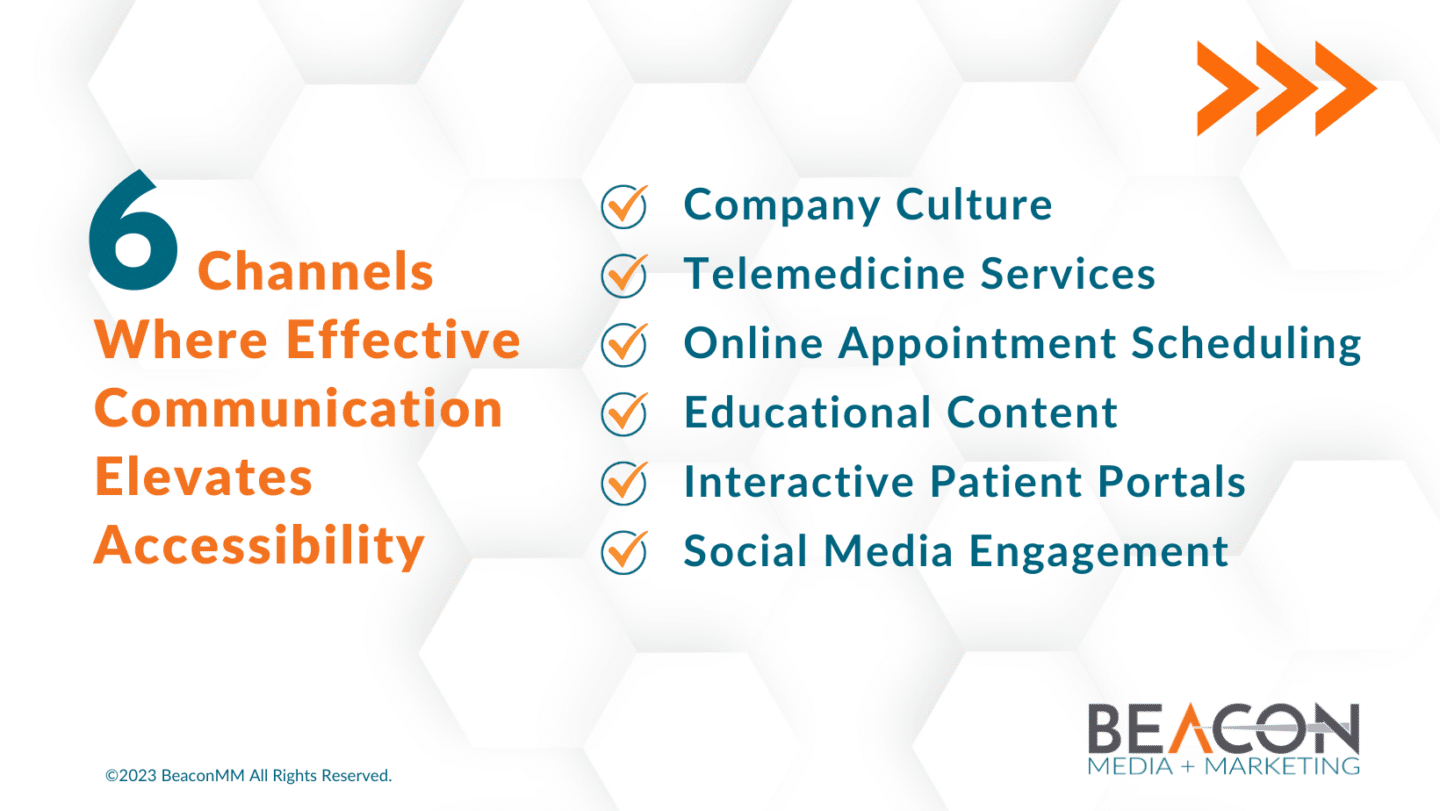
Just like any consumer, patients want results. Today, we live in a world where instant access to whatever we need is almost considered a given. And that’s exactly what your patients want from you โ€” accessibility.

Through digital marketing, your patients can get exactly what they’re looking for without having to “hurry up and wait.” Just consider what real-time accessibility and information through digital marketing can offer your patients:

  • Company Culture: Patients can research you and your clinic, decide if you’re a good fit, and take a peek into what an experience at your location is really like. By leveraging digital marketing, in turn, you can leverage your company culture, reviews, and testimonials, and showcase a patient experience that will draw in more patients.
  • Telemedicine Services: Patients can access virtual appointments and consultations, receiving immediate medical guidance or advice without physical presence, reducing patient anxiety, promoting convenience, patient safety, and timely healthcare delivery.
  • Online Appointment Scheduling: Enables patients to book appointments at their convenience, reducing wait times and providing flexibility in managing their healthcare appointments.
  • Educational Content: Sharing informative content online allows patients to access resources that empower them with knowledge about health education, conditions, treatments, and preventive care, fostering informed decision-making and active engagement in their health.
  • Interactive Patient Portals: Offer patients secure access to their medical records, test results, and treatment plans, promoting transparency, and allowing them to actively participate in their care journey.
  • Social Media Engagement: Utilizing social platforms facilitates direct communication, feedback sharing, and community building, creating a space for patients to ask questions, share experiences, and engage with healthcare providers and peers.

Traditional healthcare communication relied heavily on one-way interactions, often leaving patients powerless. By giving the provider all of the power, this narrowed the potential pool of patients significantly. And while patients remained worried about their health, “care professionals” reaped all of the benefits.

While these methods once served their purpose, they lacked the personalization and real-time engagement that could truly make a difference in patient care. But the advent of digital marketing has ushered in a new era of healthcare communication, one characterized by two-way dialogues, data-driven insights, and a patient-centered approach; one where patients feel more like partners on their care journey.

Fostering Patient-Centric Interactions

Digital marketing enables health professionals to move beyond generic communication and tailor their messages to the specific needs and preferences of individual patients. Through targeted messaging, healthcare organizations can provide relevant and timely information about preventive care, disease management, and treatment options. This personalized approach empowers patients to take an active role in their health decisions, leading to improved adherence to treatment plans and overall better outcomes.

Embracing Real-Time Engagement

Digital marketing tools provide healthcare providers with the ability to engage with patients in real-time, facilitating seamless communication and building stronger relationships. Through secure online portals, patients can access their medical records, schedule appointments, ask questions, and receive updates from their healthcare providers. This real-time engagement fosters trust and transparency, ensuring that patients have access to the information they need, whenever they need it.

Leveraging Data-Driven Insights

Digital marketing platforms also generate a wealth of valuable data about patient preferences, behaviors, and online interactions. For example, healthcare teams can analyze this data to gain deeper insights into their patient population, enabling them to tailor their communication strategies and personalize their outreach efforts. This data-driven approach ensures that healthcare organizations are reaching the right audience with the right message โ€” at the right time.

Harnessing the Power of Digital Tools

The digital marketing landscape offers a wide range of tools and marketing strategies that healthcare providers can leverage to enhance their communication with patients. Here are a few examples:

  • Email Marketing: Personalized email campaigns can provide patients with timely updates, educational resources, and reminders about appointments or preventive care recommendations.
  • Social Media: Healthcare organizations can use social media platforms to engage with patients, share informative content, create targeted ads through social feeds, and build a strong online community where engagement drives results.
  • Patient Portals: Secure online portals offer patients convenient access to their medical records, appointment scheduling, and secure communication with their healthcare providers.
  • Content Marketing: Creating informative and engaging content, such as blog posts, videos, and infographics, can educate patients about health conditions, treatment options, and lifestyle changes.
  • CRM Software: Keeping up with your patient’s health communication is perhaps one of the most important tasks you can engage in. With digital Customer Relationship Management (CRM) tools, you’ll have a robust toolkit that empowers you and your patient to keep in touch.

Remember, effective physician-patient communication is not just about sending out messages; it’s about understanding the impact of those messages on patient behavior and outcomes. As such, healthcare providers can use various metrics to measure the effectiveness of their digital marketing efforts, such as website traffic, email open rates, social media engagement, and patient satisfaction surveys.

Are you ready to improve your messaging and bring in more patients? Reach out to Beacon Media + Marketing today to learn how we can take your practice to the next level.

Patient-Physician Communication: Diversifying Your Messaging

We want to be clear. Digital marketing is a great asset, but you can rely too much on digital marketing. And it’s best not to get caught on this slippery slope. The key is to leverage digital marketing โ€” but never forget your entire outreach plan.

Here, you have to remember that you’re likely not just serving only one demographic. But if you set up your strategy without taking into consideration the diversity of your community, you’ll end up catering to only one patient pool. For example, targeting your ads and content to a specific audience is one way to go. But if you want to edge out your competition, considering language barriers, cultures, and gender, you need to be able to target everyone without offending a specific group. And digital marketing can make this possible through a multi-layered campaign and targeted messaging.

Lastly, when it comes to campaigns and messaging, the data you collect will be extremely critical to your success. After analyzing, you’ll be able to determine if you need to set up channels to deliver messaging or commercials in Spanish, or if you should target women expecting birth, or those suffering from cancer, cognitive decline, or other ailments.

The Future of Effective Health Communication

When we think of the future of digital marketing and healthcare, we’re really excited about a return to the core values in marketing โ€” and focusing on what patients truly care about. And this speaks to our philosophy of prioritizing people over profit, or what we like to call “profit with a purpose.”

We can see this now in how social media engagement is evolving. People aren’t just sending out friend requests at random anymore. The fact is, your prospective patients are looking for providers with lifestyles, hobbies, and interests that they can connect with on a personal level. The best part is, when you showcase these qualities, who you are becomes part of your brand โ€” and everyone will see it as a genuine expression of your practice.

In addition, the future of digital marketing is increasingly heading toward fully utilizing high-functioning technology, such as advanced AI tools that bring SEO and web content together in a robust way. And as consumers engage with video 80 percent more than written content, short-form video is also an expected direction that will become much more personal and targeted as digital marketing tools evolve.

At the end of the day, while you’re going to ultimately rely on a nurturing doctor-patient relationship, interpersonal skills and patient understanding are going to bring it all together. Just keep in mind that other healthcare professionals are likely going after the same pool of potential patients, but with the ability to leverage digital marketing at your side, you’ll be set up for the future of this shifting dynamic.

Take Your Healthcare Business to the Next Level With Beacon Media + Marketing

Whether you practice general internal medicine, you’re partnered with a group of primary care physicians, or even if you’re part of the World Health Organization, any healthcare system needs marketing. And this is what we do best.

At Beacon, we know firsthand the impact that digital marketing can make โ€” not only on your business but on patient communication and their overall health outcomes. When you can find the synergy between enhancing your marketing efforts and improving the lives of your patients, this is exactly where you want to be โ€” and we can help get you there.

At Beacon Media + Marketing, we know that your patients matter most to you. So, naturally, you want to provide them with the most comfortable and seamless healthcare experience possible. And with digital marketing, you can achieve this result.

Our team is well-versed in communication and messaging in the healthcare space, from mental health clinics to functional medicine practices. Whether designing the perfect paid ads or creating the best UX-driven website experience for your clients, weโ€™ll deliver it on a personal level that connects with your specific clients.

Are you ready to improve your patientsโ€™ lives as well as to bring more prospective patients to your door? Reach out to Beacon Media + Marketing today to learn how we can take your practice to the next level.
There is so much more to blogging than just trying to get a piece of content up on your website. Businesses tend to get wrapped up in meetings and are constantly on the go, which makes it difficult to really take the time to sit down, research the topic, and actually put in the effort to writing a successful blog for your website. While you may think that hurrying to get a blog post up will help your business, you are only hurting it and hereโ€™s why. 

Curating a successful blog post takes time, and there are a lot of major details you may be missing out on that we want to make sure you are honing in on โ€“ which is why Beacon Media + Marketing is here to shift your focus and get the website traffic and SEO rankings your business should be receiving. In this blog, we are going to give you a breakdown of the top five principles every blog could use. 

We can help you develop the perfect content strategy. Schedule a free consultation! 

1. Structure and Format  

The number one principle every blog should use is ensuring the content you write is well structured and you have a plan. Blog posts arenโ€™t meant to just live and sit on your website. Instead, we want your audience to engage with the blog, read it, digest it, and have an experience. In order to do this, you must make sure your content has structure to it โ€“ meaning donโ€™t scatter and jot down your thoughts just anywhere throughout the blog. Keeping your thoughts clear and organized will not only help the flow of content, but it will also help keep your brain focused.  

Once you have your thoughts in line and you know exactly how you want your blog to sound, you can then begin shaping the content, making it engaging and compelling for your audience or users to read. Nailing the tone you want to use and understanding your messaging can really help achieve these goals. Do you want your blogs to be more on the professional side, focusing on statistics and reaching a more serious audience? Or do you want your blogs to have a friendly and fun, yet informative, tone? It all depends on the type of business you run or work for. 

2. Relevant Subheadings 

The next big item on the list of things you want to make sure you are including throughout your blog is relevant subheadings. You may be wondering why you would need subheadings โ€“ isn’t the point of a blog to just get information out? Wrong. Subheadings are extremely important and hereโ€™s why. 

When you write a blog without subheadings, what do you see? A lengthy page with just a bunch of words on it. The reason behind subheadings is that they break up the page. When the user only sees a bunch of text with the same font throughout what they are attempting to read, it may be difficult to concentrate, or you may lose your place easily. When you incorporate subheadings, this gives the reader a chance to easily digest and navigate through the content they are reading, which will in turn result in better engagement and user experience. 

Aside from breaking up the content throughout the page, they also allow readers to know what each section covers before reading it. This makes content โ€œscannableโ€ โ€“ so readers are able to scan through the content, while focusing on a part of the blog that has the information theyโ€™re looking for. Not to mention, all types of headings are a huge component for SEO ranking and keyword placement.

3. Calls to Action

This is an absolute MUST for any blog! Calls to action, often known as CTAโ€™s, encourage the user  to make a second click. A call-to-action is extremely powerful and can come in many different forms. You can have a CTA button towards the end of the blog, throughout the blog, at the very beginning of a blog, or wherever you see it fitting best. 

The first step in deciding what call-to-action you want is figuring out what action it is you want your visitors or users to take. Do you want them to contact you? Do you want them to sign up for your mailing list? Monthly newsletters? Do you want them to purchase a specific product? 

Understanding what your users are actively engaging with the most will help you determine what action you want them to take. Always think about the page path for your user and the overall goal. What is it that you want to obtain or achieve? 

4. Internal Linking 

Internal linking is  because it gives you the chance to link to another piece of content to your website. For example, letโ€™s say you are writing a blog about health and wellness, and you are addressing a mental health topic. What you can do is highlight the word โ€œmental healthโ€ and insert a link that will take the user to a service page that has  more information on mental health. 

We recommend using at least three to five internal links on not only blogs but throughout the rest of your website as well. When the user sees something that is hyperlinked, chances are they will click on it and want to browse and engage more with the rest of your content, while also boosting your SEO. 

5. Meta Descriptions 

Meta descriptions are an important key feature that many people overlook. Most times, the platform you are using to create a website or write blog posts, service pages, or subpages, there is a section on the backend of your website where you can write a meta description or enter in a keyword that best reflects the topic you are addressing. Meta descriptions are important because they are the snippet Google displays on the search engine results page. 

Meta descriptions have a big impact on your SEO and SERP rankings . Every time you create a new page or post in the backend of your website, you want to make sure you are inputting into the meta description section. When you do this, you are giving your website a chance to populate all over search engines, making your website or page rank higher than others. To improve click-through-rate, make sure your meta description is easily readable for all audiences, clear, and compelling. 

A well-written meta description that gives readers a clear idea of what the page is about draws in more website visitors. If you do not write a meta description yourself, Google pulls an excerpt from your blog/web page, and it may not give searchers the best idea on what the blog is about.

Tackle Blogging from A Different Perspective 

All in all, blogging can be a very crucial aspect in generating more website traffic, creating better user experiences, and bringing more business straight to your doorstep. At Beacon Media + Marketing we offer a blogging distribution package personalized just for you! 

If you are looking for more than just a couple of blogs posted every month and want to go the extra mile in really boosting your SEO, we have just the solution you need. We will first optimize and produce high-quality blogs for your website and then we will work to repurpose this content and distribute it to other platforms. 

Our content distribution package includes a video that is then published on our Beacon Media News YouTube Channel, a press release that will be reached by tons, and a spotlight feature on our Beacon Media News website. Give your content a purpose and invest in repurposing blog content that can be sought out by many other news outlets and sources to improve visibility. 

Are you ready to take your blogging to the next level? Click here to get started! 

When 2010 rolled around, it felt like every other person had a blog. CEOs? Check. Amateur chefs? Check. Avid travellers? Check. Moms? Check. Businesses? Hmm. Not so much.ย But why not? After all, people come to your website to see what products and services you offer, and what kind of company you are, right?

The first question we hear you asking is whether blogs are even still relevant in 2020? It’s a fair question. After all, there’s only so much time in the day, so why would you invest your time in writing a business blog? The answer is simple: traffic.

A blog offers you the opportunity to potentially get a lot more eyes on your website, educating potential clients, and generating leads. Unless people are already acquainted with your business, they won’t Google you specifically. They’ll Google similar products and services. It makes sense, then, to dominate those keywords online and ensure your business ranks right at the very top of the list. By creating a business blog, you dramatically improve your chances of ranking… and who knows, it may convert new visitors into customers.

Creating a blog can be quite daunting, as there is a lot to learn – especially around search engine optimization (SEO). This refers to the techniques used to get your posts ranking at the top of Google’s results page, and can feel like opening a can of worms. If you don’t have time to figure it all out yourself, remember you can always outsource. But if you’re ready to learn all there is to know, then keep on reading!

Want help with your website? Call our helpful team today.

What is a business blog?

We all know that having a website is important. It’s your own little piece of digital real estate, and one of few things on the internet you’ll ever fully control. Blogs are essentially signposts that increase virtual foot traffic into your business to that you can make sales. While Google is known to change its algorithms, affecting your rankings, blogs are not nearly as volatile as social media results that can spike or plummet overnight.

Blogs have come a long way since the weblogs, or diary updates, that first started in the mid-90s. Nowadays, a “blog” simply refers to the section of your website that gets updated on a regular basis. It’s designed to keep your website fresh and relevant, and keep the Google algorithm happy, so it keeps ranking your articles as high as possible. This means it works very differently to regular webpages, which generally focus on sales.

Content marketers believe in the creation of blogs as a marketing strategy because they have seen the results. On average, companies that have a blog section on their website produce 67% more leads monthly compared to companies that don’t. Alongside the additional leads, blogs also increase brand loyalty by bringing in new readers and interacting with them in a meaningful way… which can boost revenue.

Let’s talk about SEO

The best way to grow traffic to your website is by creating the kinds of content people are actively looking for in search engines like Google. Once they click through to your website and see that you know what you’re talking about, it will be much easier to convert them into a paying customer. The best way to do this is to take a look your website analytics, so you can see the kinds of pages people are most interested in reading about.

However, creating a lead generating content strategy is not as simple as writing something that you think your audience might like and throwing it up on the internet. These days, it’s important to have an SEO strategy in place that will allow you to build up content and keywords on your website that are relevant to your audience and to your product or service. This means that you should be thinking about what your consumer might be looking for and using the available SEO tools to see whether they actually are. This way, you’re letting the customers come to you on their own than paying for their clicks.

How do I write a blog?

There are many types of blogs that you can create for your business. Truthfully, you can turn almost anything into a blog post, as long as it’s something your target audience will find valuable. This can include handy how-to guides, news items relevant to your industry or business, think pieces, infographics, listicles, cheat sheets, interviews, guest blogs, commentary on current news items, key terms explained, and much more.

Whichever type of content you decide to write, make sure you start your blog strategy with a clear goal in mind and a realistic path to reach that goal. Know who you want to reach, what they’re looking for, where they hang out online, and most importantly, what action you want them to take when they click through to your website.

An essential part of a successful blog strategy is keyword research. To put this simply, you need to pick the best combination of words that describe your business and DOMINATE. The researching phase is critical, so you might want to consider engaging a SEO professional to ensure you’re on the right track. This will help you work as efficiently and effectively as possible, by finding words that are well-trafficked but not too competitive.

Once you’re confident about your selection, create a content calendar so that you know how your target keywords are going to work together in real-time. This way, you and your team will know what’s coming up, so you can plan ahead to create high-quality content whilst building up authority in those essential keywords.

Should I start a blog in 2020?

Yes! A thousand times yes. Blogs are a powerful tool to drive traffic to your website, and a well-executed content strategy has proven to be one of the most efficient ways to grow your business by boosting your online traffic. With every blog post, you are adding relevant keywords to your website. This, in turn, signals to Google that you have a highly-relevant business within your industry, so the algorithm sends more traffic your way.

A business blog allows you to provide your target audience with value that they cannot get from a sales or landing page. Modern consumers research the brands that they’re planning to purchase from, which means education and transparency are more important than ever. Consumers want companies to be helpful and provide them with value before they are willing to invest. Having a blog allows you to provide that information, to educate your customer about your service or product, to capture their attention, to build trust, and to create a positive connection. If the end-goal is to drive the sales of your business, this is a fantastic way to get started!

Need a little help getting started? Outsource to the professionals!ย 

Originally published on December 1, 2015. Updated on June 29, 2020.

The term “landing pages” is one you will hear fairly often in discussions about websites and marketing techniques. Thereโ€™s a very good reason for that: landing pages can be one of the most valuable assets in your digital toolkit. So what exactly are they? And why do you need them?

Landing pages are web pages that visitors land on when they follow an offer and click through to your website. Designed to convert visitors to your website into leads for sales, landing pages will gather information about potential customers using a simple form.

There are two key ways that landing pages will help you.

  • Landing pages can gather information like email addresses as well as lead demographics, interests, and concerns. With this information your sales team can build strong relationships with leads and keep their focus on the most qualified contacts.
  • They can lead to higher conversion rates, which means more customers for you and more profit potential for your business. Landing pages are your digital representative twenty-four hours a day, seven days a week, helping your work as efficiently as possible.

Want to talk landing pages? Schedule a free consultation.

What are landing pages used for?

Landing pages
For more great landing page examples, check out this blog from Hubspot.


A perfect landing page is not a sales pitch asking for information that the visitor doesnโ€™t want to give up. A well-designed landing page will convert at least 20% of its visitors into leads by guiding them and warming them up. Here are eight jobs landing pages can accomplish for you.

  1. Landing pages are an opportunity to persuade visitors that what youโ€™re offering them has value equal to, or greater than, the information youโ€™re asking from them.
  2. Landing pages offer grounded, real benefits. Not abstract features. When you have a problem, you need the solution and the features donโ€™t really matter as much.
  3. Landing pages help your visitors feel like theyโ€™re understood. It can show them that you know about their problem, you understand their frustration, and you can help them. Understanding leads to empathy. Empathy leads to connections.
  4. Landing pages will give your lead something of value in exchange for personal information. But it wonโ€™t take a lot of their time. They can get a solution or learn something new and move on with their busy schedule.
  5. Landing pages provide social proof of your value. Your leads will feel safer knowing that other people have done what theyโ€™re thinking of doing and benefitted from it.
  6. Landing pages will trigger one of the six psychological principles that influence people โ€“ scarcity. Scarcity will encourage them to act sooner rather than later.
  7. Landing pages point out a gap in the visitorโ€™s knowledge and then provide a way to fill it. Curiosity can be piqued and your visitors will develop a need to know more.
  8. Landing pages make your leads feel important. By showing them that what you offer is important information or a valuable solution you are telling them that by association they are important and valuable as well.

Read more: How to create a high-converting landing page.

How to design landing pages

Landing pages come in every different shape, size, and structure imaginable. There are no rules when it comes to design, but the best landing pages have a few important elements in common:

  • Strong keywords to ensure the page is as searchable as possible.
  • A simple layout that ensures visitors can find what they need in seconds.
  • Educational and persuasive content that answers questions they may have.
  • An engaging design with helpful headings and images that looks sharp.
  • Clear calls to action that make it easy for visitors to take next steps.

If you’re new to the idea of landing pages, there are a couple of ways you can proceed.

If you plan to build the landing pages yourself, we strongly recommend A/B testing to see what design elements are most persuasive. Play around with the layout, color, and images. Try a couple of variations in the headings and text to see what resonates best with your readers. Be prepared to make a few adjustments here and there to ensure your pages are working as effectively as possible.

It’s important to remember that one size doesn’t always fit all. Running a variety of different offers, targeted to a variety of different demographics, will broaden your reach exponentially. Studies have shown that having more than thirty landing pages on your website will generate 7x the number of leads than websites with less than ten. Different people like different things, and keeping this in mind will ensure you target all the different elements people will find persuasive. The results can be huge.

You may also want to consider bringing a marketing agency on board. Marketing agencies design custom landing pages all day, every day, and they’ll have a pretty good idea of the types of things that work best in your industry. Outsourcing the design and development of your landing pages also means they can run things like A/B testing for you and make all the necessary adjustments, which means you can invest your time and energy into other parts of your business.

Read more: 5 website design trends you need to watch.

Why landing pages are important

As we said right at the start of this blog post, a landing page is essentially your digital marketing representative. It can help you convert leads every day of the year, even while you’re doing other things. Done right, they’ll become a key component of your digital sales funnel.

Within seconds of viewing a landing page, a visitor should have enough information to decide if they want to accept your offer and continue through the buyerโ€™s journey with you. This split-second decision can mean more leads and conversions or it can mean more bounced visitors to your site.

If you donโ€™t have enough landing pages, then youโ€™re missing out on a plethora of opportunities to gather valuable information on potential leads. So what are you waiting for?

Ready to get started? Schedule a free consultation.

Content marketing is a powerful marketing tool for a few reasons.

For one thing, it’s an effective way to add combinations of keywords to your website to boost your SEO, building awareness. For another, it’s a great way answer questions and educate people about why your products and services are the best option for their needs, generating leads. Content lets your brand personality shine, which ensures people have a positive experience while interacting with your business.

Content marketing comes in lots of different forms, but for the purposes of this post, we’re going to talk about nailing the humble blog. Blogging may sound a bit silly at first – after all, how is an article tucked away on your website going to boost your business? Truthfully, it’s an essential component of an inbound marketing strategy, and when it’s done well, it will work hard for you for a long time to come.

If you’re new to writing, it can be a bit intimidating. The truth is that you can follow a really simple formula. It’s a bit like a recipe – if you know what ingredients you need, you can just mix them together and know that you’re creating something that will work. Here’s a five-step method that we use for all our own blog posts.

Looking to outsource this? Schedule a free consultation.

Step 1: Know your goal

Every piece of content should serve a specific purpose, so the most important thing is to figure out exactly what you’re trying to achieve by writing the blog post. This will make sure you stay on track. For example:

  • Are you trying to build awareness of your brand and attract a new audience?
  • Do you want to win people over to your viewpoint or opinion?
  • Are you promoting your product or service?
  • Are you educating people or raising awareness?
  • Are you reporting on a new and important piece of news that is relevant to your industry?
  • Are you answering questions and looking to increase your reputation as an expert?

Having a clear goal will also help you choose a topic that addresses a specific issue. This is really important for SEO purposes, but also readability, because it will stop you from rambling and losing people’s interest.

Read more: Seth Godin is still right, content marketing is the only marketing

Step 2: Define your audience

Once you know what you’re trying to achieve, think carefully about the target audience. This will impact the way you present your information, because you’ll need to identify the tone and style of content most likely to resonate with them. Think about things like location, age, income level, education level, and pain points.

Read more: What are buyer personas and how can they convert leads?

Step 3: Research

There are three key components to researching a new blog post: competition, keywords and facts.

Research your competition

What are your competitors doing? Scope them out before you start to write your piece, so you can see what’s already being done and look for gaps in the market that your content can fill. Regurgitating content everyone else is doing is essentially a waste of time, because it will be really hard to make your content stand out in order to build your brand and start driving traffic to your website. Instead, look around and see if you can find a niche, and use this as the basis of your content marketing strategy. If people are looking for information on that topic, and you’re the only one providing helpful information, you’ll start capturing attention for all the right reasons.

Research your keywords

Once you’ve identified your goal, defined your audience and found your niche, it’s time to research the most popular search terms on that subject. This will make sure people can find it when they’re looking for answers on this subject through search engines such as Google. There are lots of tools available to help with this. Google Keyword Planner and Google Trends are the obvious ones, but we also recommend SEM Rush and KeywordTool.io. They’re also a good way to identify any topics that are trending in your industry.

Read more: Pump up your SEO efforts in 2020 with these simple tricks

Research your facts

Check, and double-check, every piece of information your share on your blog. One of the biggest challenges of content marketing is the abundance of false information available online, and it will be really embarrassing if you’re ever called out for accidentally relying on a “fact” that isn’t actually true. Do your homework and trace facts back to their source. You can even link to them in your blog post, so people can check for themselves. Always make sure you’re sharing high-quality information. A little bit of research at this stage will go a long way to building your brand’s credibility and establishing its authority as a thought-leader in your field.

Step 4: Write your post

Now that you’ve assembled your ingredients, it’s time to follow the recipe.

Google’s reputation depends on its ability to fine high-quality content that quickly answers search queries. As such, there are a few simple things you can do to improve the chance the algorithm will find and rank your post.

  • Use the goal you identified in Step 1 to make sure your content stays on track. Convenience is important in attracting and sustaining the interest of modern consumers, because they have a wealth of information available at their fingertips. They want answers quickly, so it’s best to get straight to the point.
  • Use the keywords you identified in Step 3 to provide structure. You should aim to find 3-5 related keywords to incorporate into your blog post, to maximize its chance of showing up in search results. The most popular search result should form the title of your blog, while the next few will form the subheadings, and then you’ll color in the gaps in between. See what we mean about following a recipe?
  • Keep sentences simple. You’re not trying to write an award-winning novel, you’re trying to help the good folks of the internet, so make sure your writing is clear. When it comes to structure, you might find bullet points to be a helpful aid (like what we’re doing here) to help break things into bite-sized chunks.
  • Aim to write about 1,200-1,300 words on your topic. Search engine algorithms are programmed to favor longer posts, because these are more likely to answer search queries in sufficient detail.
  • Always run a spell-check to make sure your copy is sparkling clean.

Read more: Starting a blog (an expert guide to content marketing)

Step 5: Build your funnel

Great, you’ve written your blog post! You’ve picked a topic that meets your goal, optimized content for your target audience, found a niche in the market and packed it with searchable keywords, and created well-written copy. You’ve done all the hard parts, but it’s not time to put your feet up just yet. You need to incorporate that blog post into your sales funnel to ensure you maximize its value over time. Put that baby to work!

  • Share the post on your social media channels, and promote it through Facebook Ads and Digital Ads. This will build awareness of your brand. It will also educate clients about why they need you.
  • Link back to your post in future blog posts, to help educate customers about certain topics and explain why you can help solve their problems. This is really persuasive in the consideration phase.
  • Always incorporate a strong call-to-action that makes it clear exactly what next steps are required to proceed to the conversion phase of the path to purchase. For example, ask readers to schedule a free consultation, or direct them to a dedicated landing page that invites them to proceed.
  • Finally, keep blogging. Consistency is an essential part of every content marketing strategy, because each blog will build upon the good work of the last one, to create a comprehensive long-term strategy.

Blogging isn’t a “build it and they will come” scenario. Yes, a stream of fresh content will help your website rank higher in search; yes, keyword-optimized posts are likely to boost your spot on Google’s results page.

However, it’s capable of doing a lot more to help you. Integrating your content marketing strategy into your sales funnel will ensure you get the maximum impact for the time you invest in creating each post. This will go a long way toward building awareness, generating leads, and ultimately converting sales to grow your business.

Ready to get started? Schedule a free consultation.

Originally published on June 19, 2018. Updated on May 25, 2020.

Shopping has changed a lot since smartphones were invented. Remember the good old days? All you had to do was see a TV commercial or hear a recommendation from a friend and know you were about to get a great deal. Today’s customers need a little more persuasion.

According to Think With Google statistics from January 2018, 53% of shoppers say they always do research before they buy to ensure they’re making the best choice possible. What’s more, nearly 2/3 of shoppers say online video has given them ideas that inspired their purchase.

It makes sense, right? Smartphones put all the answers right at their fingertips. They don’t have to blindly trust that a product is good; they can read the reviews, compare prices, and find out what the brand’s competitors are doing. Consumers are much more empowered.

There’s no way to ignore the numbers. The whole buying process has evolved, and if you want to stay profitable, you need to be changing right along with your tech-savvy consumers. They’re looking for educational material, reviews, and testimonials.

To stay on top, you need to provide them with that information.

Too hard basket? Try outsourcing!ย Schedule a free consultation.

Evolution of the SEO blog

Blogs have long been a powerful tool that businesses use to educate the public, in order to capture their attention, solve their problems, and gently guide them along the path to purchase. They’ve gone up and down in popularity over the years, but we say the humble blog is here to stay.

In the early days of blogging, all you had to do was write 400-odd words about your products and you’d be set. Various combinations of keywords would naturally boost your SEO, and it was an almost effortless way to start driving traffic to your website. Then other businesses caught on to the trend, and the floodgates burst open. Today, SEO is a fiercely competitive game.

Marketing strategies change all the time as technology and consumption habits evolve. The industry has moved away from traditional outbound marketing methods to new inbound marketing methods. The idea is not to force your brand messaging down the throats of the unsuspecting public, but to make yourself easy to find when they’re looking for your products and services.

Blogs are a critical part of this strategy, because the first thing anyone with a problem wants to do is find answers. Educate your prospective customers. Tell them tips and tricks, publish how-to guides, answer frequently asked questions. Try to help; don’t try to sell. Remember, today’s customer is tech-savvy, which means if they can’t find the answers on your digital assets, they’ll look elsewhere.

Give them a good experience, however, and they might stick around to learn more. They’ll browse a related blog article, or click through to your “about” page, or check out your products or services. If you strike the right note, they may even reach out and ask more questions.

Blogging has evolved a lot over the years, but it’s still an essential marketing tool.

Read more: Pump up your SEO efforts in 2020 with these simple tricks

What does modern blogging require?

Blogging is more than just blogging now, and it has been for a while. Consumers still can’t seem to get enough content and us content marketers are hard pressed to provide enough. Customers are demanding not just written blogs, but a variety of types of content.

Remember the statistic we shared about video? Two-thirds of online customers told Google that video has inspired them to purchase. A modern blogging strategy should include:

  • Videos: Short-format content, ranging from 30 seconds to about three minutes, can be a great way to convey information quickly and help your prospective customer.
  • Infographics: Significant amounts of content presented in a visual, easy-to-digest format.
  • Podcasts: Free audio files, usually offering informative content, delivered in subscription form that can be downloaded and listened to on the move.
  • eBooks: Longer format educational information, including how-to guides, can go a long way to boosting your credibility by presenting you as a thought-leader.

Read more: What is StoryBrand marketing and how can it help my business?

How does blogging actually help?

Another Think With Google article, published in June 2018, notes that modern consumer paths are becoming increasingly complicated. The average computer user will use 3.4 touchpoints before committing to a purchase, whereas a smartphone user will have an average of 2.9 touchpoints.

This means they interact with a variety of sources while researching their purchase before making a decision. The first touchpoint for the average smartphone user looks like this:

  • Web search: 22%
  • Store/manufacturer website: 18%
  • Price comparison website: 12%
  • Conversation with friends: 13%
  • POS/in-store visit: 7%
  • (A whole bunch of little ones fit here, including social media)
  • Video streaming website: 4%.

As you can see, web search and business websites are the two key sources of potential consumers – right off the bat. This means your SEO strategy needs to be on point, and your website needs to be in tip-top shape, if you want to catch people’s attention for the right reasons.

Blogs form a key part of this strategy, because they naturally contain more keywords than webpages, so they typically rank higher in search. A consistent stream of new posts also keeps your website fresh and up-to-date, which appeals to modern consumers.

Remember, this is just the first touchpoint in the process. For smartphone users, there are still another 1.9 touchpoints to come, and you want to be sure they find you.

Read more:ย Seth Godin is still right, content marketing is the only marketing left

Where do your clients consume content?

Most people start their research on Google, but many are also exposed to brands for the first time on Facebook and other social media channels. According to statistics from Facebook, published in 2018, there are 2.45 billion monthly users. About 247 million of these are based in the United States and Canada. More than half of these admit to checking the platform “more than a couple of times a day.”

Blogs make great fodder for search and social. Your Google Ads can drive traffic to blog posts; your Facebook and LinkedIn ads can share information for people to read, comment about, and (hopefully) share with their friends. They key is to be consistent, and keep ’em coming.

One of the foundational parts of running a 21st-century business is interacting with your customers. It’s as vital today as having a working business phone. In order to do that successfully, and capitalize on it, you need to figure out where they’re spending time online. You can make assumptions about this based on a couple of things – for example, where do you interact with most customers now? How old are your customers? Where are they based? Are you targeting consumers or businesses?

HubSpot is a leading American software developer, specializing in marketing and sales products. It compiles a report every year telling marketers what demographics are using different social media platforms, which is incredibly helpful when it comes to targeting the right people:

  • Facebook:ย The most popular age range of users is 18-29, at 81%. About 75% of users are based in urban areas, and 90% access the site via mobile devices. College graduates make up about 77% of adult users, and the median income is between $30K-$49K. Helpful, right?
  • Instagram:ย About 42% of Instagram’s users are college graduates. It’s a smaller number because it appeals to a younger audience, with 72% of users aged 13-17. However, it’s very powerful, because 60% of users say they discover new products on the platform.
  • LinkedIn:ย LinkedIn is a primarily business-to-business platform, and it has about 165 million users in the United States. The average age of users is higher: 36% are aged 18-29, while 34% are aged 30-49. As you might expect, many of these are college graduates.
  • YouTube:ย About 81% of American internet users aged 18-25 watch YouTube videos. It’s no surprise, then, that about 15% of all YouTube traffic comes from the United States. About 62% of YouTube users are male, who spend an average of 44% more time on the site than women.

See what we mean? Each platform attracts a different audience. You obviously already know who your target customer is, so you need to keep this in mind when you’re trying to reach them. The tone and style of your blogs will need to adjust to appeal to different demographics; so does the platform on which you share them. This really is about working smarter, not harder, in sharing your message.

Read more:ย Google judges your website based on mobile friendliness

It’s now called content marketing

Blogging emerged as a way to answer a need for content, boost SEO rankings and keep websites fresh. After all, it’s much easier to type out a quick blog post than re-think your website every week. As Google’s algorithm has changed, we’ve learnt to incorporate searchable keywords; as Facebook’s algorithm has changed, we’ve learnt to improve visuals and include video when we can.

However, blogging is no longer a standalone digital marketing strategy. Rather, it’s a critical part of a digital ecosystem. Modern marketing strategies might incorporate blogging as follows:

  • Problem: A business wants to increase brand awareness and generate leads
  • Solution Part 1: You create an editorial calendar – including how-to guides, frequently asked questions or hot topics in your industry – aiming for 2 x new blog posts every month for six months. You incorporate strategic keywords, which naturally boost your SEO.
  • Solution Part 2: Blogs are shared on Google Ads, either as a search ad (which appears at the top of the Google results page for a search of like keywords) or a display ad (which appears on Google’s many other internet properties). This drives traffic to your website.
  • Solution Part 3:ย Blogs are shared on social media, either as organic posts (which are designed to encourage community engagement) or Facebook Ads (which are designed to boost awareness). They’re tailored for your target audience. This drives traffic to your website.
  • Solution Part 4: Every blog post includes a strong call-to-action with a clear next step. It might be signing up for an e-newsletter, scheduling a free consultation, asking for a free assessment, etc. It prompts the customer to engage once they’re on the page.
  • Solution Part 5:ย Congratulations! You’ve just generated a new lead.

Remember, the whole point is to make it as easy as possible for people to find you when they need you. When content marketing, social media marketing and digital advertising work together to create an effective digital marketing strategy – well, it’s a beautiful thing to behold.

As you can see, blogging is as important in 2020 as it was in 2015. The way we do it has changed, and the digital infrastructure that supports it has changed, but the essence is unchanged. You’re here to serve your customers. Modern customers are demanding information, so you need to adapt your strategy and ensure that need is met. That’s the key to generating leads. When all the pieces come together, content marketing is a powerful tool for organizations and business alike.

Inspired to create a killer content marketing strategy?ย Schedule a free consultation.

Originally published by Beacon Media + Marketing. Updated and revised by Jennifer Gracey, Web Content Strategist & Writer on 07/14/23.

Making a significant post-COVID comeback, the tourism industry is roaring back to life with exciting opportunities in tow for travel agency and hospitality-based businesses, brands, destinations, and cultural and heritage experiences in the city.

In fact, CEO and President of U.S Travel Association, Geoff Freeman is on record saying, โ€œRobust domestic leisure travel demand has been the driving force in the overall [travel] industryโ€™s post-pandemic comeback… the surge we experienced in [2022] is starting to moderate, we expect [the trends in] this top customer segment to remain resilient in coming quarters.โ€

If you’ve not yet prepared your tourism marketing strategy, now is the best time to begin. Especially if you’re aiming to get and stay ahead of the competition by capturing your portion of the market share. Whether your primary clientele caters to domestic leisure, domestic business, or international inbound travelers, incorporating some (or all) of these 5 focus areas into your overall tourism marketing strategy will help your marketing campaigns gain traction, attract, and produce results.

Want help with your tourism marketing strategy or just want to talk business?  We’re here for that! Schedule a free consultation.

1. Marketing for Hospitality  

If you’re marketing your business in the hospitality sector, showing your potential customers what a great experience they can have is as important as telling them. Whether you run a restaurant, or a boutique accommodation experience, showing your customers and guests where they’ll be staying and eating allows them to not only feel confident they’ll enjoy the experience. But, it also allows them to more accurately visualize themselves having the same experience. 

Visual Storytelling: What’s your story?

Taking time to review where you’re currently with your story-craft and overall tourism marketing strategy will be tremendously helpful in determining what direction to take things next. Set aside some time to do an in-depth internal audit of your company’s visual imagery. You’ll want to look at your:

  • Website
  • Blog Posts & Articles
  • Social Media Profiles (FaceBook Page, Instagram, Twitter, Linkedin, Pinterest, TikTok, etc)
  • Google Business Profile
  • Crowd Sourcing & Review Sites (Yelp, Foursquare, etc)
  • Listings on Booking & Reservations Sites (Booking.com, Expedia, Airbnb, etc)
  • Anywhere else your hospitality company appears online

There are some significant questions you’ll want to ask during your visual imagery audit. They should cover things like:

  1. Does everything I’m seeing across our customer-facing visuals look like my brand and the picture I want to paint for my visitors and future guests?
  2. Do our visuals match the experience guests and customers expect to have when they come?
  3. Do the colors, shapes, fonts, artwork, photographs, and videos tell a cohesive story that not only makes sense as a whole but, compels an emotional response from our customers?
  4. Does the imagery invoke a positive or negative emotional response? Why? How?
  5. Has the approach we’ve taken with our visual imagery so far been strategic and consistent in telling our brand story across the board or a hodge-podge mash-up?
  6. In order to level up our first impression to potential guests, is it time to rebrand or get more serious and focused in our approach to visual storytelling?
  7. Will it be a better investment of my time and skill sets to do a rebrand ourselves or hire branding and marketing professionals to really help elevate my brand? 

How do you use Google Business Profile?

If you’re not yet taking full advantage of Google Business Profile, you’re really missing out. Previously known as Google My Business (the name changed in 2021 in Google’s attempt to simplify the user experience) Google Business Profile is a powerful tool every business should take advantage of โ€” particularly for companies, as it’s FREE. When utilized regularly, a well-set-up Google Business Profile can really help drive organic traffic to your company’s website.

Your Google Business Profile will contain the name and address of your company, operating hours, website URL, and a detailed description of your company and types of service offerings. It also allows you to post updates on special promotions or events, your customers and guests to post reviews, and more. If you’d like to learn more about Google Business Profile and what it can do for your marketing strategy, click on the linked article below for a more detailed overview.

Read more: Google My Business is the perfect tool for a tourism marketing strategy tourism marketing

Want to get started with Google Business Profile and not sure where to begin? Or need help getting the most out of this tool? Get in touch โ€” as Google Certified Partners, we’re here to help!

2. Marketing Tourism Destinations 

Is your company a destination or experience-centric business? There many tools available for you to use in order to gain attention from visitors. Among the ones you’ll want to seriously look into and take utmost advantage of is: search engine optimization (SEO). SEO refers specifically to the strategic use of specific and related keywords that users type into their Google ‘search’ bar when researching a specific topic. When properly integrated into your tourism marketing strategy โ€” having a well laid out SEO strategy exponentially increases the likelihood your webpages, blog posts, and other content appear higher in the SERP (search engine results page) on Google as well as other sites your company may appear on or have a profile set up with.

We’ll summarize a few of the techniques we use here, but if you want to learn more, this post we wrote on blogging for Arctic tourism is an illustration of how blogging can help get the word out about your destination and inspire people to come visit. 

SEO for Your Website 

A foundational premise of good SEO is: write engaging, informative, and relatable content people want to read. This is Google’s benchmark for providing quality content to people and continuing to build their reputation for being a good search engine. Really search engine optimization is your way of helping Google, and them helping you in return. Here are some more basics:

Read more: Top tourism marketing strategies for 2020 and beyond.

With the travel industry and tourism on the upswing, it’s safe to assume people are looking for your specific destination. Because of this, it’s important your website is the one they see at the top of their SERP on Google. By optimizing your content to rank for certain keywords (as mentioned already in the paragraph above) you increase your chances of getting eyes on your website. To help your site list higher on the results page than your competition here’s two of our top must-do SEO optimization tips:

  1. Use the name of your destination in headers and in your body text.
  2. Use the name of your destination in the alt-text of any images.

When auditing your existing website (or building a new one), it’s vital to remember: Your website is the online equivalent of your physical premises. And, it’s critical the way your website looks and feels to users should represent your company as accurately and relevantly as possible.

Information Maintenance: Keeping Your Website Accurate

Ensuring your website stays up-to-date and easily accessible by providing information people want to find in the places they expect to find it is critical when talking about tourism marketing strategies and how to give your potential guests a positive first impression.

Initially, people may use your site as a tourist information resource. And this is where providing them with accurate, high-value, and actionable information encourages them to take the next step by visiting you in real life. To learn more about the process we use at Beacon for building websites for our tourism and hospitality clients, click the link just below:  

Read more: 10 tips to improve your website’s ranking on Google

Content Marketing: Key to Capturing Your Audience’s Attention

In a nutshell, content marketing is: Marketing intended to garner an audience’s interest in products or services. It does not involve direct selling and nor does it typically involve paid ads. Content marketing does, however, make use of both written and visual content to show what your business offers, build support, and reinforce your SEO strategy. In fact, the purpose of content marketing is often categorized in the following ways: educate, entertain, inspire, and convince. This is where blogs and social media really help to build out a brand’s content marketing strategy. The most obvious forms of content marketing are:

  • text (such as blog posts)
  • video
  • imagery
  • customer reviews 

Blogs

If you’ve not already developed a robust blogging strategy for your company, you’re truly missing out. Why? Well, they’re truly a perfect match for your tourism marketing SEO strategy! Blogs are an excellent convergence point for the integration of features Google loves. Blogs can also be used to implement a few sneaky tricks in order to get extra engagement. 

The Inbound Marketing Approach

At Beacon, when writing blogs for our clients, we make use of a philosophy called inbound marketing. Inbound marketing is best understood with a bit of help from a cat. For example:

What happens if you stand up suddenly and begin chasing a cat? Typically skittish animals, the cat will be surprised at your unexpected and sudden movement then scamper off as fast as it can.

What about if you stand perfectly still while holding out something our cat really wants (like a piece of freshly cooked grilled fish?) If it’s like many cats we know, it’ll come right up to you and quite happily take the fish from your hand.

In this illustration, think of your clients and customers as the cat. Inbound marketing tells us to, “Provide clients and potential guests with content they find useful and interesting.” That way, when they’re in need of your particular services, they’ll remember you and trust your business.

In the context of tourism, this could mean: writing insightful, value-added blogs highlighting the locations you run tours in, the specific activities you organize, the equipment that you rent out, etc. 

The Waterfall Method

We also make use of the waterfall method. This is a strategy that makes Google’s algorithm rate your blog posts more highly. Google really likes it when external websites provide links to your pages. These external website links are the digital equivalent of the more traditional word-of-mouth customer referral.

The reward is: Because someone likes your content enough to refer and promote it to others, Google notices and ranks your page higher thus moving you up in the SERP.

The caveat is: External links just because someone liked your content aren’t easy to come by. To help things along, we use our own blogs to provide those links by creating a waterfall structure of interlinked content! By writing an overarching “summary” blog designed to provide a high-level overview of a specific subject or group of interrelated topics, and then writing more detailed blogs on each facet of that subject, we link all the blogs together. Thus encouraging Google to trust that the content in each post is useful. 

Read more: What’s in a headline? How to write to get attention

Videos

Video marketing is something we’ve discussed lots lately and for good reason: Video is the closest we come to genuine human interaction, without physically being together in person. This is why video is so exceptionally powerful right and why it’s only going to continue growing in relevance and importance as a powerful communication and connection tool. 

A Powerful Visual Content Marketing Tool

We’ve written before about stats that show why you should be using video. (Those are available here.) The important takeaway is: video can and should be used everywhere. This includes in blogs to provide a quick synopsis or to further illustrate/highlight a key feature. They can run in your ads, on your website as a personal introduction, or welcome to the company โ€” a message from or interview with the founder is always great. In short, videos should appear anywhere and everywhere you post content about your company.

Video is Memorable

People love video because it’s easy to consume and makes it easier for people to recollect the information presented. To briefly tie this back to something we mentioned before, “Give the consumer what they want and they’ll come back time and time again.”

The tourism marketing and hospitality industries are particularly well-suited to video. You’re offering experiences that people already crave, which look visually appealing, and that inspire people. Make the most of it!

Read more: How to start a dynamic video marketing campaign

3. Marketing Heritage and Cultural Tourism  

When marketing heritage or culture, the most important and foundational thing you can do is: identify your target audience. When doing this, keep in mind, different aspects of heritage or cultural traditions may appeal to different demographics. You’ll have the most success in this as you work to tailor your marketing plans and strategies to appeal to the interests of each of those specific demographics. 

Content Marketing and Immersive Experiences

When we discussed content marketing in point two above, we pointed out its ability to immerse people in the experience. This immersive experience aspect is even more valuable when talking about marketing something as story-based as culture and heritage.

Harness the Power of Story-telling Mediums

The use of high-quality, engaging written and video content really allows you to showcase the story of your site or attraction. By giving them a taste of what it looks, sounds, and feels like to be there and feel the age or the atmosphere of a cultural site is an incredibly effective way of drawing them and giving them a small taste of the reality. 

Direct Advertising: How to Draw Attention

In order to draw even further attention to your company and more specifically, the cultural and heritage sites you run โ€” making successful use of direct advertising is important. With paid Google and Facebook ads, it’s possible to make use of all the content marketing mediums: text, imagery, and video. By strategically weaving them all into your marketing strategy, you’ll really show off the best of your company and everything you’re offering customers. The outcome of this brings us back to our cat illustration from point two: You’ll have far more hungry cats coming up to you looking for that tasty, appealing morsel of their own volition than you’ll get chasing them around.

If you want to learn more about social media advertising or Google advertising, these two articles are great places to start.

Want to talk strategy or ask us some questions about the waterfall strategy we used in this blog post? Schedule a free consultation and let’s chat!

Originally published on April 10, 2017. Updated on May 4, 2020.

Does word-of-mouth networking even work anymore? Or has it been replaced with digital or social media networks? We hear this question a lot. We believe they are both integral to any businessโ€™s marketing plan and should be strategically planned and implemented.

Networking is an important part of business. It will help you stay on top of the latest trends in your industry, find new business opportunities, meet prospective partners and clients and build awareness of your own brand. At the end of the day, people do business with people and connections matter.

Benefits of social media networking

Social media is a fantastic method of networking, in fact, we are big fans! The stats are impressive regarding the power of social media to influence consumers through people networking digitally. For instance:

There are a few best practices that we have found to be helpful for business professionals who want to use social media networking as part of their marketing plan.

  • Focus your time and energy on two social media networks. In Alaska, we have found that Facebook and LinkedIn are a great combo for business-to-business networking (B2B), while Facebook and Pinterest is a good option for business-to-consumer (B2C) industries
  • Be consistent with your interaction. Here are 10 tips to optimize your social media.
  • Offer helpful information that your target audience will find useful in their daily lives. We’re here to add value to their lives by helping them find the products or services they need, so donโ€™t sell your products or services directly. This is important – you can read more about whether marketing is the new sales.

There is no denying the power of networking through social media to a wide range of age groups, but itโ€™s most effective when coupled with word-of-mouth networking. Word-of-mouth is the original and best form of marketing. We can come up with effective digital strategies until we’re blue in the face, but if your product or service is good, people will talk about it. It’s the most effective marketing tool you’ll ever hope to have.

Benefits of word-of-mouth networking

Some refer to this style of networking as “old fashioned” or “traditional” networking. It’s been around since the first product was put up for sale and it’s still incredibly persuasive in purchase decisions. In fact:

  • 3.3 billion brand mentions in 2.4 brand-related conversations happen offline in America ever day
  • 54% of Americans say that their purchase decisions are driven by word-of-mouth
  • 59% of Americans believe offline or word-of-mouth to be highly credible

Word-of-mouth networking gives people a chance to build deeper relationships and increase trust. This increased trust often leads to more qualified referrals, longer professional relationships, and more profitable transactions.

As part of a targeted marketing plan, we recommend business professionals be part of at least three face-to-face networking groups. The best combination is to join two soft touch groups and one referral, focused group.

For example, if you live in Anchorage, AK, you could try:

A referral based organization like BNI is what is called a hard contact referral network because the whole organizationโ€™s focus is increasing the business for each member through referrals and word-of-mouth networking. This is also a good option to consider if you’re looking to drive brand awareness quickly.

Secrets to effective networking

No matter your target audience, it’s important to get the most of our networking and leverage the power of both social media and word-of-mouth. Used together, they allow business professionals to be highly effective at not only getting their message out to their target markets but also to build profitable client relationships.

The key, either way, is to follow up. Take your connection to the next level and get to know your new contact as a real person rather than an opportunity to boost your business. If you’ve met online, follow up with an email linking an interesting article or asking for an opinion. If you’ve met in person, follow up with an invitation to coffee or another industry event. No-one wants to stay connected with a robot.

Networking is a two-way street. It’s not just about what they can do for you, but what you can do for them as well. Connect thoughtfully. Ask people about themselves. Talk about their projects. Offer considered thoughts. Give advice if they ask. Successful networking requires give-and-take, but who knows who you’ll meet?

Need help developing your brand? Schedule a free consultation today.

Originally published on July 20, 2015. Updated on March 4, 2020.

Back in the 1960s, marketing was relatively straightforward. Let’s be real, you’re probably picturing the orange tones and box pleats of the advertising world featured in the TV show Mad Men,ย complete with boardroom discussions, concept presentations and an expensive media buy.

The industry was turned on its head with the emergence of the Internet in the 1990s. The past 20 years have seen drastic changes, with advancements in technology and the development of social media.ย Let’s quickly compare traditional marketing and digital marketing.

From bricks and mortar to online

THEN: Most businesses only had physical locations. This meant it was much more difficult for new customers to find businesses they had never heard of, that is, unless they saw an advertisement somewhere. They couldnโ€™t look up anyone for reviews. And what were you supposed to do when you needed to contact a business? Remember their phone number? Or use a PHONEBOOK? Word of mouth was king and reputation was everything when it came to owning a local market.

NOW: Many modern businesses no longer require physical locations, operating completely online. Many have both. Some have physical locations only. As time passes, it’s becoming increasingly difficult to do business the old-fashioned way, because having on online presence means missing out on a huge potential expansion of customers. Customers want convenience and trust. By that, we mean they want to be able to find you easily when they need you, and they want to be able to look you up in advance to make sure you offer exactly what they’re looking for and that you’re reputable.

Having an online presence is critical in 2020. Schedule a free consultation today to talk about your website needs.

From monologue to dialogue

THEN: Marketing was a one-way street, informed by gut-feel and educated guesses. Companies would give snippets of information to potential customers, trying to persuade them to buy or use their products or services. To a large extent, customers were unaware that other options existed. If someone bought a car from Ford, for example, they were likely to continue buying from Ford because that’s what they had used in the past and they knew it to be trustworthy and reliable.

NOW: Engagement is crucial to success in a digital world. Customers feel like they can trust a company that engages with their customers, because that reminds them that they’re dealing with real people. It’s a two-way street, because businesses can utilize the feedback given via the Internet to come up with new ideas and solve problems. Furthermore, positive reviews go a long way to encouraging other potential customers to take the plunge. These are marketing gold.

Read more: 10 tips for optimizing your social media presence.ย 

From outbound to inbound

THEN: Traditional marketing focused on the idea of taking your business to your customers. Huge amounts of money and time were invested in buying advertising space on billboards, newspapers and magazines, as well as commercial slots on television and radio. Sales people would cold-call people and go door-knocking to find new business. Essentially, information was forced upon the public, casting a very wide net in the hope of getting a few bites from the right buyers.

NOW: Digital marketing focuses on the idea that customers will find you when they want you. As such, the idea is to make yourself as easy to find as possible. This means an active digital presence, quality content on your website and social media channels and a strong focus on search engine optimization (SEO). Rather than shouting, “buy this!” you can think of it as saying “enjoy this information we’ve provided.” Your content needs to be educational, helpful or funny to build trust with potential customers. A stellar website is key to helping your company reach its potential.

Ready to get started? We are a digital marketing agency based in Anchorage, AK, and Reno, NV. We work with clients all over the United States. Schedule a free consultation!

Next-level digital marketing

Every successful digital marketing strategy requires three basics: a website, a social media presence, and quality content. You can spend as much or as little as you like when it comes to establishing your digital presence and getting started. The most important thing is simply that your business exists online so that potential customers can find you easily.

Here’s how to take your digital marketing strategy to the next level:

Website

Your website sets the foundation for your entire strategy. Good design can lead to stronger connections, more sales leads and a better conversion rate. If you’re transferring to digital from a traditional marketing strategy, it might help to think of it as an online brochure that showcases your products and services and gives customers an idea of what your business is about.

Here are the most important things to keep in mind:

  • Lead generation: Didn’t think you could get a measurable ROI from a website? Yes, you can.
  • Automation: Your website will act as a virtual sales rep, qualifying leads while you sleep.
  • User experience: Guide your prospects on a journey that leads to doing business with you.
  • SEO optimization: Gain more customers because they can find you online when they need you.
  • Mobile optimization: Most web visitors use mobile devices. Use that to your advantage.
  • Multimedia optimization: Videos and graphics create human interactions with customers.
  • Professional appearance: Bring in the right customers by creating the right first impression.

Sign me up! Click to learn more about our website and development service.

Social Media

Social media is the best way to connect with the people who want to do business with you. The key is to prioritize genuine customer engagement. There are lots of different theories about how to do this best, but we think it’s simple: remember you’re talking to HUMANS. Lots of companies fall into the “sell, sell, sell” trap, but the truth is that prospective customers are real people with real problems.

Here are some things to consider in developing your strategy:

  • Team brainstorming: Good ideas can come from anywhere, so utilize your full team.
  • Campaign objective: Define a clear and measurable goal for every campaign to stay consistent.
  • Campaign budget: Run your ads at the budget that will receive optimal ROI and save.
  • Target audience: Delivering your message to the right people will make sure they take action.
  • Editorial calendar: Know what’s coming up next in your social media content and promotions.
  • A/B testing: Test your ads and audiences to learn what works and optimize messaging.
  • Creative media: Show people interesting content that encourages them to engage.
  • Reporting: Daily monitoring and regular reporting is critical to success.

Not sure where to start? Learn more about our social media marketing service.

Quality Content

Imagine a world where you’re at the top of every Google search. Sounds good, right? It all comes down to content marketing. Quality content generally comes into two forms: articles and videos. The idea is to create content that is wonderful to consume while being full of keywords that will help you rank on search engines, working hard to flood your business with qualified leads.

Here are the basic concepts you’ll need to get started:

  • Editorial calendar: Make sure you cover your bases and stay inspired for the future.
  • Best practices: Trends and algorithms change, so stay up-to-date with the latest advice.
  • Headlines: Get clicks with headlines that have been approved by a title optimization algorithm.
  • Subject matter experts: Interviews with experts will position you as a thought-leader.
  • Research: Make sure you share good information that is accurate and interesting.
  • SEO: Use keywords, metadata and backlinks to make sure your content ranks in search.
  • Multimedia: Good images and videos go a long way to increasing engagement and trust.
  • Calls to action: Your content needs to create results, so include a strong call to action.

We get it, this is a lot to take in.ย Learn more about content marketing and video marketing.

To go ahead and get started, book your free consultation today!

Originally published on August 3, 2013. Updated on May 31, 2019.

So you want to be a connected CEO? You want to take the plunge?

Great! But where do you actually start?

Corporate social media 101

  1. Make sure your company has a social media policy that both the PR and HR can agree and live with. Then stick to it. This may seem obvious, but depending on your industry, there can be some tricky areas to navigate when communicating via social media.
  2. Decide which social media platforms you want to โ€œownโ€ as the companyโ€™s CEO. There is a lot out there and itโ€™s easy to get burned out. We recommend picking three to focus on and master. We also recommend checking with your PR/Marketing department to find which ones they believe to be the most effective for your company and industry.
  3. Be consistent! It would be better to not do social media or only use one social media outlet than to be sporadic. Set up yourself on a schedule for posting and/or blogging. Some social media platforms like Twitter take a lot more time and should have multiple posts a day to be effective, others like a blog could have one post a week.
  4. Establish and maintain a voice. Social media is just that, social. It is all about conversations. Be yourself and communicate the way you would naturally do with a friend or colleague. People want to connect with the real you, they are looking to feel connected to you and therefore the company you lead.
  5. Finally, we highly recommend having a least one person who can be a second pair of eyes to double check content, basic typos, or other things we might miss composing material. After we take the time to actually post, the last thing we want are typos in our material. Twitter is a little more difficult since it is probably the most casual and spontaneous of the social media outlets. But even so, if youโ€™re responding to a PR issue or posting a response to a national or international crisis for instance, it is better to take the time and get the post proofed prior to sending it out.

Have questions?ย Schedule a free consultation today.

We spend a significant portion of our prospect meetings going over what exactly the Inbound Marketing plans should include. It’s usually a rather lengthy discussion dependingย on the particular client’s needs. Though there is a list that we recommend for most clients (a foundation if you will), it is important to customize each package to the client and their goals. A lot of the conversation seems to circle around how each of the different pieces of the plan willย help that particular business.

Comprehensive Inbound Marketing Package

The way we see it, there are about 10 pieces in a full program. Not every agency will include all of these elements, but for clients willing to invest in the whole Inbound Marketing experience this is the way to go!

  1. Ongoing Strategy & Analysis.ย An effective strategy is built on an understanding of the client’s goals and their target audience’s persona. We invest a lot of time in understanding whatย exactlyย motivatesย those you are trying to reach and how we want them to respond. Making sure we consistently hit that moving target requires ongoing analysis of the data from our efforts. We continuously adapt our strategy according to the data to ensure your ROI is as high as possible. Part of what makes this possible is your account manager.They are your advocate within our company, and they keep an eye on the analytics. Your account manager makes sure your Inbound Marketing strategy is running smoothly and handles any challenges that may come up.
  2. Social Media Publishing & Monitoring. We create custom content, publish it and monitor the responses coming into your social media channel. In the creation of content, we will incorporate royalty-free photographs, custom videos, etc. We act as our first responders, so you don’t have to worry about the response time. In most circumstances, we will respond within an hour. The most effective social media channel for your business will depend in part on where your company is in the US and where your target market is currently interacting. For a robust strategy, we recommend 2-3 channels. For example Facebook, Instagram, and Pinterest or Facebook, Twitter, and SnapChat. For some clients, we focus on just one.
  3. Blogging. Quality, relevant content keeps your website current and increases your leads by two-thirds (according to a recent HubSpot survey). The best way to keep your website updated is to blog regularly. For smaller blogging packages we post twice a month, but ideally, we postย once or twice a week. Our dynamite content creators write custom blogs based on questions your target audience is asking. By answering these questions, your website rankings increase as do your leads and conversions.
  4. Content Creation. Putting out quality content is critical to a successful Inbound Marketing strategy. Content varies from webinars, YouTube videos, to whitepapers, infographics, and more. Our content creation process typically involves idea creation and research, copywriting (if needed), artwork/photography/videography, SEO optimization, web design and coding (if necessary), and publishing.
  5. Landing Pages. When people are looking for a particular service or product, they often do not want to dig through your entire website and will bounce off your site before “converting” to a lead. The solution to this is to provide a “landing page” that focuses in on a specific service, offer, product, or piece of information that is of particular interest to the end user. When an interested party clicks on a PPC (Pay Per Click) ad of Google, a Facebook ad or a sponsored or promoted post it will take them to a landing page on your site. The user must then provide some basic contact information to access or receive what they are looking for. It is a “win-win” for both parties. The end users get the information they need, and our clients receive contact information for future marketing.
  6. Pay Per Click (PPC). Is also called cost per click,ย is most often referring to Google AdWords, but Facebook has increased their ad system. In both cases, we leverage Google or Facebook’s targeting systems toย ensure the ad shows up to the right target market. Our clients only pay when someone clicks or in some way interacts with the ad. We employ PPC to direct traffic to our client’s websites and their landing pages.
  7. Google SEO and Web Maintenance. Search Engine Optimization (SEO) can be a confusing term to grasp and this is in part because it is another moving target. Google is constantly changing their search algorithm, that thing that determines which website ranks where in attempts to improve the user experience. Blackhat marketers are always trying to figure out ways to fool the system. So there is never a clear target for long. We make marked efforts to stay on top of the newest Google requirements to ensure your website is organically ranking in a way Google approves of. This, in turn, keeps your site on good terms with Google, so it doesn’t get blacklisted. We spend time each month updating keywords, manually managing link-building, etc. Additionally, we maintain content on your website as needed for staff changes, new services, and more.
  8. Email Marketing. It is not enough to just collect lead information; you must have a system to follow up with those leads. Email marketing through newsletters sent out at regular intervals is a powerful way to foster and develop leads into converting to regular customers.
  9. Video Content.ย Facebook now has more videos being uploaded every day than even YouTube. Videos are becoming the most widely viewed content on the internet. On social media, 15-30 second videos are the most effective. We work with clients to create the strategy, record and post the videos on various social media channels.
  10. Campaigns & Special Projects. Finally, campaigns can span multiple marketing methods and greater periods of time. They are a concerted and coordinated effort to push out a specific message or to tell a story. The size of the campaign will vary depending on the budget, the goals, and the impact required. We bring the full weight of our diverse creative team to bear for our clients to put together effective, innovative strategies that achieve their goals.

We love sitting down and brainstorming with our clients to come up with the best plans with the most value. If you are interested in what Inbound Marketing can do for your business, please click on the link at the bottom of the page for a free consultation or drop me a line at [email protected]. I look forward to hearing from you!

This blog was originally published in November 2015, but was updated for content and accuracy.ย 

“67% of the buyers journey is now done digitally.” -Sirus Decisions

The value of Inbound Marketing is unequivocal, and there is no denying the preponderance of evidence the data shows us (channeling my inner Law & Order here). When done correctly, inbound marketing is far and away the ROI champion in the marketing arena.

There are several reasons no one can even come close to competing for the ROI crown. One big reason is that consistently doing inbound marketing creates company assets that grow even without any additional investments. Each and every piece of published content ย (i.e. blog, landing page, white paper, video, etc.) continues to build value even over time.

Blogs deliver compounding returns over time
Graph courtesy of Tomasz Tunguz at Redpoint

One great example is this blog by Tomasz Tunguz on “The Compounding Returns of Content Marketing”. His data shows a steady and consistent growth rate of 8% per month from core readers and 10%
per month from spikes (when a post becomes intriguing to a larger group). That is 18% per month with no additional investment of resources over a 12 month period!

In another example from HubSpot, we can see that over 90% of the leads fromย their blogs come from old posts and 56% of the leads they generate come from marketing they are no longer actively participating in.

But let’s get down to the stats you really came to this blog for.

  1. Last year, 67% of surveyed B2B companies said Inbound Marketing was a top three or very high priority in their marketing strategy.
  2. 67% of B2B marketers see a 10% or more increase in sales opportunities throughout the sales funnel when lead nurturing is used. (DemandGen)
  3. 32% of surveyed brands have decided to reallocate marketing budget from outbound to Inbound Marketing.
  4. Of the surveyed marketers, 23% of their overall marketing budgets was earmarked for outbound marketing and 34% for Inbound Marketing practices. (Gannett Local)
  5. Businesses who focus primarily Inbound Marketing save more than $14 per each new customer. (State of Inbound Marketing)
  6. When compared to paid search, mid-sized businesses save on average 31% on Inbound Marketing costs. (Eloqua)
  7. B2B buyers seek out to the following top 3 sources while researching a purchase decision: Whitepapers (78%), Case Studies (73%), and Webinars (67%). (DemandGen)
  8. Inbound leads cost 61% lessย on average than outbound leads. (HubSpot)
  9. B2B companies that blog at least 1 or 2 times per month generate 70% more leads than the companies who donโ€™t blog. (HubSpot)
  10. After five months of consistent inbound marketing, the average cost per lead drops 80%. (Eloqua)
  11. Inbound Marketing yields 3 times more leads per dollar than traditional methods. (Kapost)
  12. Nurtured leads will most often make 47% larger purchases than non-nurtured leads. (The Annuitas Group)
  13. Companies that excel at lead nurturing generate 50% more sales ready leads at 33% lower cost. (Forrester Research)

If any of these stats catches your eye and you would like to know how if Inbound Marketing could work for your company, I would love to chat with you. You can even see some of the results we have gotten for our current clients on our portfolio page. You can reach me at 907-563-6008 or via email. I look forward to hearing from you.

This blog was originally published in August 2016 and has been updated and republished.