content marketing

See Our Blogs

Explore insights on SEO, AI, and digital marketing strategies designed to help your business grow, stay visible, and adapt in a constantly evolving online landscape.

Beacon_Icon_resouse

A prospective patient finds your practice online, calls the listed number and reaches a disconnected line. Another sees an old address and assumes the location is too far away, while someone else checks a directory that lists services you no longer offer. 

These may seem like small errors, but they can create enough uncertainty to stop someone from reaching out. Behavioral health organizations often focus their digital marketing attention on their websites, yet patients may also encounter business profiles, maps, provider directories, insurance websites and social accounts while searching for care. 

When those sources are accurate and aligned, patients can find what they need without questioning whether the information is current. When details conflict, the burden falls on the patient to determine which version is correct. 

Talk with Beacon Media + Marketing today about strengthening your behavioral health practiceโ€™s digital presence. 

The Fast Facts

  • Prospective patients mayย encounterย several online listings before visiting aย practiceโ€™sย website.ย 
  • Incorrect phone numbers, addresses,ย hoursย and service information can interrupt the path to care.ย 
  • Complete business profiles can support local search visibility.ย 
  • Listings should answerย common questionsย about services, locations,ย insuranceย and telehealth.ย 
  • Practices need a clear process for updating information when operational details change.ย 

Why Do Online Listings Matter? 

Prospective patients rarely follow one simple path from search to appointment. Someone may begin with Google Maps, compare providers through a directory, check an insurance website and review social profiles before reaching the practiceโ€™s main website. 

Each platform answers practical questions that influence the decision. An address helps the patient determine whether care is accessible, service information indicates whether the practice treats their concern and insurance details may decide whether they continue researching. 

Although listings are sometimes treated as administrative tools, they play an important role in both marketing and patient access. A practice may have a thoughtful website and a strong clinical reputation, but patients can still miss both when an inaccurate profile sends them in the wrong direction first. 

Which Listing Errors Create the Most Problems? 

The most damaging listing errors usually affect contact information, location, availability or whether the practice is a good fit. 

Incorrect Phone Numbers and Addresses 

Phone calls remain an important conversion point for many behavioral health practices. A disconnected number, incorrect extension or voicemail that does not identify the organization can make the practice seem unavailable. 

Outdated addresses create similar problems by sending patients to the wrong office, generating inaccurate directions or making a convenient location appear farther away. Multi-location organizations face additional challenges because each office may have different services, providers, hours and contact information. 

Most patients will not compare several platforms to determine which details are correct, especially when they are already overwhelmed by the process of seeking care. 

Inaccurate Hours and Availability 

Office hours may change because of staffing, holidays or adjustments to intake availability. When those changes are not reflected online, patients may call when no one is available or arrive at a closed location. 

Listings should also be clear about whether the practice is accepting new patients. A profile that suggests immediate availability when the practice has a long waiting list can create frustration and reduce trust. 

Outdated Services and Insurance Information 

Behavioral health practices evolve as they add clinicians, expand telehealth, introduce new programs or stop offering certain services. Profiles that reflect an old service mix may attract inquiries the practice cannot serve while missing patients who would be a good fit. 

Insurance information creates similar confusion. A listing that names plans the practice no longer accepts can lead to disappointment later in the intake process, while missing information may cause an eligible patient to move on too soon. 

Because coverage may vary by provider, location and service, listings should provide helpful guidance without making overly broad promises. 

Former Providers Still Listed 

A clinician who has left the practice may remain attached to an old profile, while a new provider may be absent from the directories patients use to compare care options. 

This can lead to misdirected inquiries and inaccurate expectations about availability. Provider listings should be reviewed during both onboarding and offboarding so patients receive a current picture of the organization. 

How Can Inaccurate Information Affect Search Visibility? 

Accurate listings improve the patient experience, but they also help search platforms understand the practice. 

Complete information about the organizationโ€™s name, location, category, services and website gives search engines a clearer picture of when the practice may be relevant to a local search. Details such as profile categories, location information and service descriptions should therefore receive the same attention as other search engine optimization efforts. 

Consistency also matters because patients may encounter several versions of the organization during their research. One directory may use the legal business name, another may show an old brand name and a third may link to an outdated website. Even when those differences do not directly affect rankings, they make the search experience harder to navigate. 

Business profiles may also be changed through public suggestions or information gathered from other online sources. Without routine monitoring, practices may not realize that incorrect details have been published or that old information has resurfaced. 

Where Should Practices Review Their Information? 

Most behavioral health organizations should begin with the platforms that influence local discovery, provider comparison and insurance research. 

Google Business Profile 

Google Business Profiles affect what patients see in Search and Maps, making them an important starting point for location-based practices. 

Each eligible location should be claimed and verified. Practices should review the business name, categories, phone number, address, hours, website link, appointment link, services, photos and description. 

Multi-location organizations should avoid using the same generic information for every office when clinicians, services or contact details differ. 

Apple Maps and Bing Places 

Patients donโ€™t all use the same search engine, device or map application. Apple Maps and Bing Places may introduce the practice to people who never interact with its Google profile. 

These listings should use the same approved name, contact details and website information as the practiceโ€™s location pages. They should also be reviewed after moves, rebrands, phone changes and other major updates. 

Provider and Insurance Directories 

Directories such as Psychology Today, Healthgrades and specialty platforms often appear prominently when someone searches for a therapist, psychiatrist or treatment program. Patients may use these profiles to compare specialties, credentials, treatment approaches and insurance plans. 

Insurance directories can also be valuable referral sources, but they frequently contain outdated provider and location information. Practices should periodically review their clinicians, locations and services within the directories of the plans they accept. 

Updating these platforms may require coordination among marketing, credentialing and administrative teams, so ownership should be clearly defined. 

Social Media and Community Websites 

Social profiles often include phone numbers, addresses, website links and service descriptions. An old Instagram link or incorrect Facebook location can create just as much friction as an outdated directory entry. 

Hospitals, referral partners, professional associations and community resource guides may also publish information about the practice. Regular searches for the organizationโ€™s name, phone number, address and clinicians can uncover older references that need correction. 

What Should Behavioral Health Listings Include? 

A useful listing should give prospective patients enough information to determine whether the practice may meet their needs. 
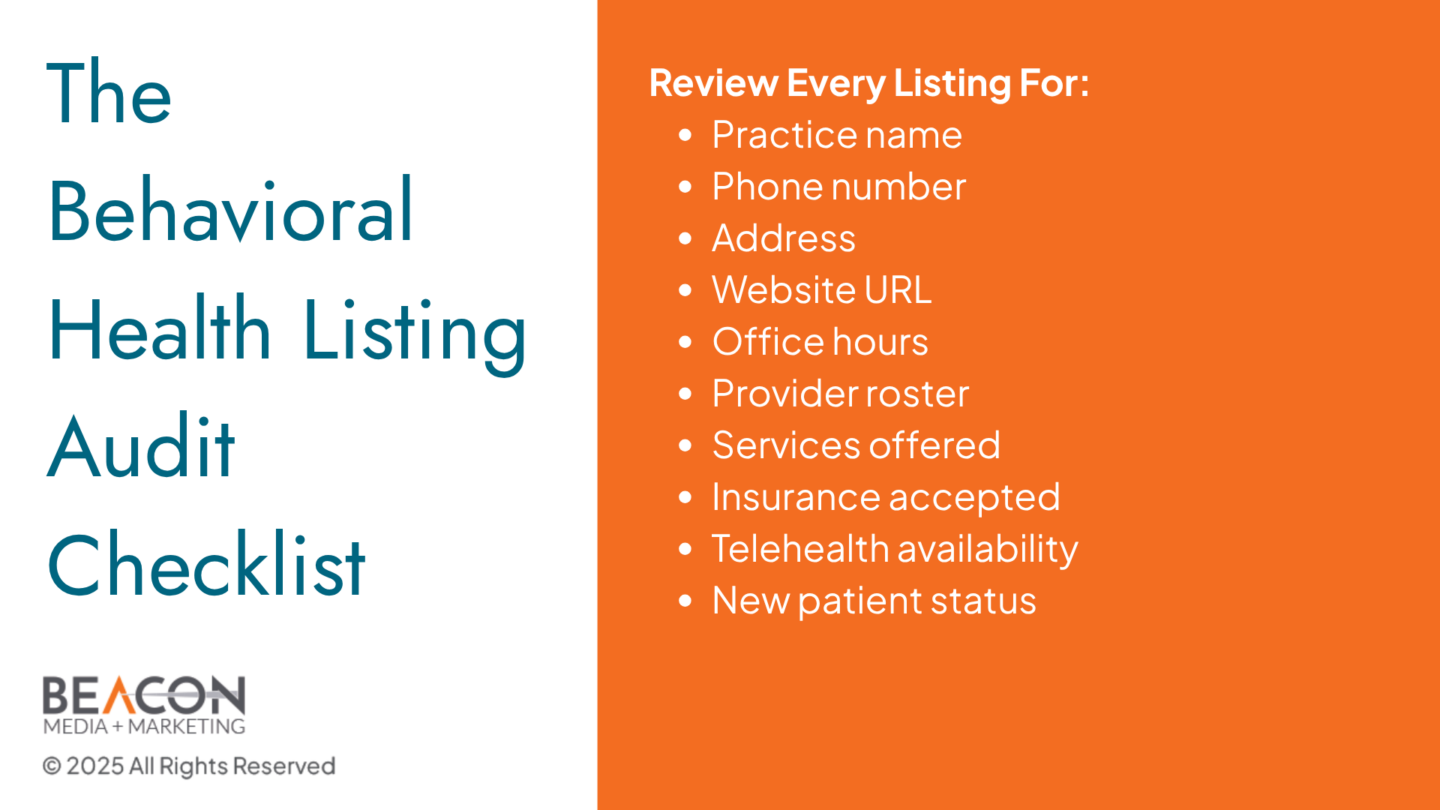
Profiles should accurately reflect: 

  • Practice nameย 
  • Address or service areaย 
  • Main phone numberย 
  • Office and intake hoursย 
  • Website and appointment linksย 
  • Services and levels of careย 
  • Conditions treatedย 
  • Age groups and populations servedย 
  • Telehealth availabilityย 
  • Current providersย 
  • Insurance informationย 
  • Accessibility detailsย 
  • New-patient availabilityย 

The amount of space will vary by platform, but the central details should remain consistent. Shorter profiles can link to a location or service page with more complete information. 

Descriptions should also use language that patients understand. Internal program names and clinical terminology may be familiar to staff but confusing to someone seeking care for the first time. 

How Can Marketing Teams Keep Listings Current? 

Creating profiles is usually easier than maintaining them. An effective process connects marketing with the teams that know when providers, locations, hours, services and insurance participation are changing. 

Create a Central Source of Truth 

Maintain one approved document or system containing the current information for every location. This may include official names, addresses, phone numbers, hours, URLs, descriptions, services and insurance details. 

The source should identify who owns each field and when it was last verified. Without a central reference, teams may update one platform using information that has already changed elsewhere. 

Assign Clear Ownership 

Listing management often becomes inconsistent when responsibility is spread across several departments. Assign one person or team to oversee account access, routine reviews and requested changes for each major platform. 

Backup access should also be maintained so profiles arenโ€™t tied to one former employee or an account no one else can enter. 

Connect Updates to Operational Changes 

Listing updates should be included whenever the practice: 

  • Opens or closes a locationย 
  • Changes phone systems or hoursย 
  • Adds or removes a providerย 
  • Launches or ends a serviceย 
  • Changes insurance participationย 
  • Expands or reduces telehealthย 
  • Rebrands or changes its website domainย 

Adding these steps to existing onboarding, offboarding and operational checklists is more reliable than expecting the marketing team to discover changes later. 

Review Priority Listings Regularly 

Even when no major changes have occurred, priority profiles should be checked on a recurring schedule. Quarterly reviews may be enough for a smaller organization, while multi-location practices may need more frequent monitoring. 

Complete the review from the patientโ€™s perspective by searching the practiceโ€™s name, opening website links, checking directions and calling listed phone numbers. A simple inventory can also track profile URLs, account owners, access status, review dates and pending corrections. 

Are Your Listings Making It Easier to Find Care? 

Prospective patients already face emotional, financial and logistical barriers when deciding whether to seek behavioral health care. Conflicting phone numbers, old addresses and unclear service information only make that process more difficult. 

Accurate listings give people a clearer path from initial research to direct contact. They help patients understand where the practice is located, what services it offers and how to reach the right team, while giving search platforms more complete information about the organization. 

A strong website remains essential, but it cannot correct every outdated profile elsewhere online. Behavioral health practices need a connected digital presence that carries the same reliable information across the channels patients use. 

Contact our team at Beacon Media + Marketing today to strengthen your practiceโ€™s digital footprint. 

Social media engagement is dropping while views are rising because people are still paying attention, theyโ€™re just not interacting the way they used to. Content is being watched, read, and evaluated, but much of that happens quietly now.

If youโ€™ve looked at your analytics recently, youโ€™ve probably noticed the disconnect. Posts are reaching people. Videos are getting views. Impressions might even be trending up. But the visible signals: likes, comments, shares, donโ€™t match that growth.

It can feel confusing at first. Engagement used to be the clearest indicator that something was working. When those numbers drop, itโ€™s easy to assume your content is missing the mark or that your audience is losing interest.

In most cases, thatโ€™s not whatโ€™s happening. Whatโ€™s changed is how people behave online. Theyโ€™re moving faster, filtering harder, and interacting more selectively. Theyโ€™re still taking in your content and forming opinions about your brand, but theyโ€™re doing it without announcing it.

This shift is easy to misread if youโ€™re only looking at surface-level metrics.

And it matters, because if youโ€™re trying to solve a โ€œlow engagement problemโ€ without understanding the behavior behind it, you can end up adjusting the wrong things, like posting more, changing formats, or chasing trends, that donโ€™t actually move people closer to a decision.

So before you try to fix engagement, it helps to understand whatโ€™s actually going on.

If your content is getting views but not turning into clients, it may be time to rethink how itโ€™s structured. Reach out to Beacon Media + Marketing today.

What You Should Know Right Now

  • Views are increasing because people are still consuming content, just more passively
  • Likes, comments, and shares now take more intention
  • Many potential clients are watching without interacting before they ever reach out
  • Engagement metrics donโ€™t tell the full story anymore
  • Content needs to prioritize clarity and trust from the start

Engagement Didnโ€™t Go Awayโ€”It Became Harder to See

For a long time, engagement metrics were the easiest way to measure success.

Likes, comments, and shares gave immediate feedback. You could look at a post and quickly decide whether it worked. But thatโ€™s not as reliable anymore.

Today, a large portion of your audience is:

  • Watching your video content
  • Reading your social posts
  • Clicking through to your website
  • Forming opinions about your brand

…all without interacting.

This creates a gap between whatโ€™s happening and whatโ€™s visible in your analytics. And itโ€™s one of the biggest reasons many creators and brands think their content strategy isnโ€™t workingโ€”when in reality, the behavior has just shifted.

And this isnโ€™t just something individual brands are noticing. Recent data shows that engagement rates are declining across major platforms like Instagram and LinkedInโ€”even as content consumption continues to increase.

Why Social Media Engagement Is Dropping

1. Content Saturation Is Higher Than Ever

Thereโ€™s a constant stream of content across every platform.

Every day, users are exposed to:

  • Organic posts
  • Ads
  • Short-form video
  • Carousel posts
  • Stories
  • Sponsored content

The volume alone makes it harder for any single post to stand out, but even quality content can get lost.

This is one of the biggest challenges in modern digital marketing: Youโ€™re not just competing with other brandsโ€”youโ€™re competing with everything in the feed.

2. Algorithms Favor Attention, Not Interaction

Social media platforms have shifted how they rank content.

Instead of focusing on:

  • Likes
  • Comments
  • Shares

They now prioritize:

  • Watch time
  • Retention
  • Engagement velocity (how quickly people interact, especially in the first hour)

This is why video content, especially short-form video like Instagram Reels and YouTube Shorts, continues to dominate.

Platforms want to keep users on the app longer. So they push content that holds attentionโ€”not necessarily content that gets the most engagement.

3. Organic Reach Has Declined

In recent years, platforms like Facebook, Instagram, and LinkedIn have reduced the visibility of organic business content.

Why?

Because:

  • Platforms prioritize paid promotion
  • They favor personal connections and entertainment-driven content
  • And they want to keep users engaged inside the platform

The result:

  • Fewer people see your posts organically
  • Engagement rates drop
  • Brands rely more on ad spend to maintain visibility

4. Users Scroll Faster and Interact Less

The way people scroll has changed.

Most users:

  • Scan quickly
  • Decide within seconds
  • Move on without engaging

Even if they find something helpful, they donโ€™t always stop to like or comment. That doesnโ€™t mean they didnโ€™t notice it. It just means theyโ€™re filtering faster.

This is where a lot of content loses people before it even has a chance to work.

As our social media lead here at Beacon Media + Marketing, Ashley Witucki, shared:

โ€œStop optimizing for what you want to say and start optimizing for what earns attention in the first two seconds. If the hook doesnโ€™t stop the scroll, nothing else matters.

Most brands lose people before they ever deliver value. When you focus on creating immediate relevance or curiosity upfront, youโ€™ll see a noticeable difference in how people engage.โ€

When decisions are happening this quickly, the opening matters more than anything else. If someone doesnโ€™t have a reason to pause right away, theyโ€™re already on to the next post.

5. Digital Fatigue and Stress Are Real Factors

People are dealing with constant inputโ€”notifications, news, content, messages.

That creates fatigue. And when people feel overwhelmed, they tend to:

  • Consume passively
  • Avoid unnecessary interaction
  • Limit how much they engage publicly

Stress isnโ€™t just affecting mental healthโ€”itโ€™s shaping how people behave online.

6. People Are Moving Toward Private Interaction

Another shift that impacts social media engagement is that people are interacting more in:

  • DMs
  • Group chats
  • Niche communities

And less in public comments.

So while your comment section might look quiet, conversations could still be happening elsewhere. Theyโ€™re just harder to track.

7. Audiences Recognize Marketing Instantly

Users are more aware than ever when something feels like marketing.

If content feels:

  • Generic
  • Overly polished
  • Or clearly promotional

Users scroll past it. This is why content quality and authenticity matter more than ever.

People engage with content that:

  • Feels relevant
  • Feels human
  • Provides value quickly

What This Means for Your Social Media Strategy

If engagement is dropping, the answer isnโ€™t just to post more or chase trends.

Itโ€™s to adjust your approach.

Focus on Valuable Content That Holds Attention

Content that performs well today:

  • Teaches something
  • Answers a real question
  • Or creates a moment of recognition

This is often called zero-click contentโ€”content that provides value without requiring users to leave the platform.

Prioritize Video Content

Platforms continue to favor:

  • Short-form video
  • Platform-native formats
  • Content that keeps users engaged

If youโ€™re not investing in video yet, itโ€™s becoming harder to compete.

Use Clear Calls to Action

Even small adjustments can improve engagement. Try things like:

  • Asking a direct question
  • Inviting a response
  • Encouraging saves or shares

Clear CTAs help guide behavior instead of hoping for it.

Build a Community, Not Just an Audience

Follower count matters less than connection does.

Focus on:

  • Responding to comments
  • Engaging authentically
  • Participating in niche communities

Smaller, engaged groups often drive more meaningful results than large, passive audiences.

Diversify Your Marketing Channels

Relying on one platform is risky. Algorithms change. Reach shifts. Engagement fluctuates.

Strong strategies include:

  • Multiple social platforms (Instagram, LinkedIn, TikTok, YouTube)
  • Email marketing
  • Website content
  • SEO and organic traffic

Putting everything in one basket limits your growth.

Track the Right Metrics

Instead of focusing only on likes and comments, look at:

  • Views
  • Watch time
  • Saves
  • Website traffic
  • Leads generated

These give a better picture of whether your content is actually working.

The Bigger Shift in Audience Behavior

The way people move from seeing your content to becoming a client has changed.

Itโ€™s less visible.

A more realistic path today looks like:

  • They see your content
  • They recognize your brand
  • They revisit your profile
  • They check your website
  • They reach out later

No comment. No like. No obvious signal. But the decision still happens.

The Biggest Mistake Businesses Are Making

Many businesses see low engagement and assume:

โ€œWe need to post more.โ€
โ€œWe need to fix our posting times.โ€
โ€œWe need to chase trends.โ€

Sometimes, thatโ€™s not the issue.

The bigger problem is focusing too heavily on outdated engagement benchmarks instead of understanding how audience behavior has changed.

More posts donโ€™t fix a misaligned strategy. Better content does.

Engagement Is Down. Attention Isnโ€™t.

Think about how you use social media.

You probably scroll, read, watch, and move onโ€”without liking or commenting on most of what you see.

Your audience is doing the same thing.

That doesnโ€™t mean theyโ€™re not paying attention. It just means you have to meet them where they are now.

Want content that works even when people donโ€™t interact? Letโ€™s talk. Reach out to Beacon Media + Marketing today.

Nobody at your last marketing meeting wanted to say this out loud. So I will.

The way most businesses have been measuring whether their marketing works… isn’t working anymore. And if you’re well into 2026 and expecting the same attribution clarity and ROI timelines you had 2-3 years ago, you’re navigating with an outdated map. The territory has changed.

That’s not a criticism. It’s just where we are, where the industry is. And the sooner we can have an honest conversation about it, the better decisions you’ll make with your budget.

What Is the Dark Funnel, Exactly?

The dark funnel refers to all the marketing touchpoints that influenced someone’s decision to contact you โ€” that you can’t see or directly attribute in your analytics.

Here’s how it actually plays out. Someone reads your blog post at 11pm on a Thursday. Doesn’t click anything. Three weeks later, they listen to your podcast on the drive home. A month after that, a colleague mentions your name in a LinkedIn comment. They Google you. They read your About page. They sit with it. And then, finally, they fill out your contact form.

What does your analytics platform report as the source of that conversion? Probably “organic search.” Maybe “direct traffic.” It almost never tells you about the blog, the podcast, or the LinkedIn mention โ€” even though all of it was doing real work.

That’s the dark funnel. It’s not a failure of your marketing. It’s a failure of attribution.

And here’s the part that makes it even more complex: the dark funnel has grown significantly wider. AI-powered search. Voice assistants. Social algorithms that surface content without generating outbound clicks. Zero-click search results where Google answers the question before anyone visits your site. People are discovering, evaluating, and forming opinions about your brand through channels you can’t easily measure โ€” and it’s only accelerating.

The buyer’s journey hasn’t just gotten longer. It’s gotten less linear. People aren’t clicking one ad and converting. They’re doing research. They’re building trust over time. They’re watching how you show up before they ever raise their hand.

The Microwave vs. the Slow Cooker

For years, pay-per-click advertising was the microwave of marketing. Set the timer, press start, results. Traffic. Leads. Conversions. Fast, measurable, satisfying. You could tie almost every dollar to an outcome.

That era isn’t gone. PPC still has its place โ€” for a new service launch, a short-term campaign, a specific census gap. It’s the microwave. You need one.

But you can’t build a sustainable, recognizable brand by paying for every single eyeball. And you can’t feed a family exclusively on microwave meals.

What’s taken center stage is fundamentally different. Content-driven, organic, relationship-first marketing. The slow cooker. You set it up, you trust the process, and what comes out is richer, more complex, and a lot more durable than anything that came out of the microwave.

The slow cooker doesn’t flash instant results. But what it produces โ€” trust, authority, consistent inbound โ€” compounds. And compounding is where the real growth is built.

What Good Agencies Are Actually Doing About It

Let me be honest with you: we’re all adapting. Rapidly. And any agency that tells you otherwise is either not paying attention or not being straight with you.

The old model was built on dashboards that made attribution look cleaner than it actually was. Point to click-through rates. Call it working. The problem is that a click-through rate has almost nothing to do with whether someone decided to trust your behavioral health practice with the most vulnerable moment of their life.

What a good marketing partner should be tracking now:

  • Content engagement depth โ€” not just page views, but whether people are actually reading. Are they spending 40 seconds or 4 minutes on your services page? That distinction matters.
  • Brand search volume over time โ€” are more people searching your name specifically? That’s the dark funnel showing up in measurable form.
  • Share of voice in your market โ€” are you being mentioned, cited, recommended? Are you showing up in more places than last quarter?
  • Qualified lead quality, not just lead quantity โ€” a content strategy attracts clients who already understand your value, which shortens the sales cycle and improves fit.
  • Multi-touch attribution modeling โ€” imperfect, but better than last-click attribution lying to you about what’s actually driving decisions.

None of these tools is perfect. Attribution is genuinely hard right now, and anybody who tells you they’ve cracked the code is probably trying to sell you something. What I can tell you is that the practices that committed to this longer-game approach 12 to 18 months ago are seeing real returns now โ€” lower cost per acquisition, stronger referral networks, and a brand presence that holds up even when ad costs spike.

The Timeline Conversation Nobody Is Having

If you launch a content strategy today, you should not expect to see significant ROI in 30 or 60 days. Here’s what a realistic content and organic strategy actually looks like:

Months 1-3: Foundation. Content is being built. Technical SEO is being cleaned up or established. Your brand voice is being refined. Nothing looks exciting on the dashboard yet. This is the prep work โ€” the painting a room phase โ€” and skipping it is exactly why so many strategies fail.

Months 3-6: Early signals. Search rankings start to move. Organic traffic begins ticking upward. Content pieces accumulate. Brand mentions may start appearing in places you didn’t expect.

Months 6-12: Momentum. The compound effect starts to show. Organic leads increase. Referrals mention they found you through your content. Your name starts coming up in conversations you weren’t part of.

Month 12 and beyond: This is where the real ROI conversation begins.

I know that timeline makes people uncomfortable. I get it. We’re running businesses. We want to see results. But here’s what I know after more than two decades in this industry: the tortoise always beats the hare. Not because the hare isn’t faster. But because consistency beats speed over a long enough horizon.

The businesses that demanded microwave results from a slow-cooker strategy? Many of them are starting over. Again. Because the shortcut didn’t hold.

This Matters Differently for Behavioral Health

For those of you leading counseling practices, treatment centers, or behavioral health clinics โ€” this isn’t just a marketing conversation. It’s a trust conversation.

Your clients don’t convert on impulse. They’re often in the most vulnerable moments of their lives. They’re researching carefully. Reading your blog at 2am when they can’t sleep. Listening to your podcast on a drive they took to clear their head before calling someone. Building trust with you over weeks or months before they ever submit a form.

For behavioral health practices, the dark funnel isn’t a problem. It’s a description of how your audience actually works. Your marketing needs to match that journey โ€” which means being present consistently, creating content that meets people where they are, and building a brand they recognize before they need you. So when they do need you, you’re already there.

This is exactly why the practices we work with at Beacon are shifting their success metrics alongside their strategies. We’re not just reporting on what we can see. We’re building frameworks to make the invisible visible โ€” or at least more visible than it was.

The Longer Game Always Wins

Here’s what this is really about. It’s not KPIs or attribution models or slow cookers and microwaves.

It’s about building something that lasts. A practice that grows because it’s genuinely known, genuinely trusted, and genuinely serving its community. Marketing that reflects who you actually are โ€” not just what you can afford to put in front of people this month.

That requires a different kind of partnership with your agency. One built on honest timelines, realistic expectations, and a shared commitment to the long game. It’s not always the most comfortable conversation. But it’s the right one.

Where are you in this shift? Is your team still expecting 30-day returns from a 12-month strategy โ€” and how are you navigating that conversation?

Faster than most people think.

When someone lands on your website, theyโ€™re not settling in to read an article. Theyโ€™re scanning a screen, often on mobile, sometimes with multiple tabs open, deciding in a moment whether your page is worth their time.

That first impression carries more weight than anything that comes after it.

If itโ€™s not immediately clear:

  • What your service is
  • Who itโ€™s for
  • And what to do next

You lose them.

Not because theyโ€™re not interested. Because they didnโ€™t find the right message fast enough.

And in a market where every brand is competing for the same audienceโ€™s attention, that first moment matters more than ever.

Ready to turn more website visits into actual patient bookings? Connect with Beacon Media + Marketing today.

A Few Things to Know Up Front

  • Most users decide within seconds whether to stay on a website
  • People often browse with multiple tabs open, comparing options quickly
  • Attention is limited, especially on mobile screens
  • Strong messaging matters more than longer explanations
  • The first impression often determines whether someone reads further or leaves

The First Impression Is Doing More Work Than You Think

Research from Nielsen Norman Group suggests that users often leave a webpage within 10โ€“20 seconds unless they quickly find something that feels relevant or useful.

That window is short, and it puts pressure on your site to communicate clearly right away.

They donโ€™t need to read the full page. They donโ€™t need to analyze every detail.

They look at:

  • Your headline
  • Your layout
  • Your visual structure
  • Your tone

And they decide if itโ€™s worth continuing.

This is happening while theyโ€™re:

  • Scrolling through other social media platforms
  • Checking multiple providers
  • Or comparing services in real time

Your website isnโ€™t being viewed in isolation. Itโ€™s being evaluated against everything else on their screen.

People Are Comparing You Faster Than Before

Itโ€™s common for users to have multiple tabs open, several providers pulled up, and a short window of time to make a decision.

They might click your website, then another, then anotherโ€”looking for clarity.

Not the best design.
Not the longest explanation.

Just the clearest answer.

If your page doesnโ€™t provide that quickly, they move on.

And they donโ€™t need much time to decide. Research shows people spend less than a minute on most pages, often much less if something doesnโ€™t immediately resonate.

Patients Donโ€™t Read Websites Like Articles

Most websites are written as if someone will read them start to finish.

In reality, people skim. They move through a page looking for familiar words, recognizable problems, and anything that confirms theyโ€™re in the right place.

They might glance at a headline, scroll past a section, pause on something that stands out, and then jump somewhere else entirely.

Theyโ€™re not trying to absorb everything. Theyโ€™re trying to decide whether itโ€™s worth staying.

What Patients Are Actually Looking For

When someone lands on your site, theyโ€™re usually trying to answer a few simple questions:

  • Do you help with what Iโ€™m dealing with?
  • Does this feel relevant to me?
  • What do I do next?

If those answers arenโ€™t clear within the first few seconds, itโ€™s easy to lose their interest.

This is where a lot of websites miss the mark.

They explain too much before they clarify anything.

Why Websites Lose Attention So Quickly

1. The Message Isnโ€™t Clear

If your headline doesnโ€™t immediately communicate what you do, users have to figure it out themselves.

Most wonโ€™t.

Clear messaging makes it easier for the right people to stay.

2. The Page Feels Heavy

Too much text, too many sections, or too many competing elements can overwhelm the viewer. Instead of reading more, users pull back.

This is especially true on mobile, where space is limited, and attention is already split.

3. Thereโ€™s No Clear Direction

Even if someone is interested, they need to know what to do next.

If itโ€™s not obvious how to:

  • Book
  • Contact
  • Or learn more

They hesitate.

And hesitation often leads to drop-off.

4. It Doesnโ€™t Connect Right Away

Users are looking for something that resonates.

And this is where emotional connection plays a bigger role than most websites account for.

Research shows that emotional connection drives engagement and influences decision-making. When people feel like something applies to themโ€”when they can see themselves in the messageโ€”theyโ€™re more likely to stay, explore, and take action.

That connection often comes from:

  • Specific language
  • Relatable scenarios
  • Or a clear understanding of what someone is going through

Without that, itโ€™s harder to hold attention.

The Influence of Social Media on Website Expectations

The way people use social media platforms has changed how they interact with websites.

Theyโ€™re used to:

  • Fast content
  • Quick answers
  • Short-form video
  • Immediate clarity

That behavior carries over. When someone clicks from a social post, ad, or video to your website, they expect the same experience. If your site feels slow or unclear by comparison, it creates friction.

Attention Is Limitedโ€”and Competing Everywhere

Every brand is trying to grab attention, deliver value, and turn interest into actionโ€”and theyโ€™re all competing for the same moment.

That means your website isnโ€™t just up against other practices. Itโ€™s up against social media, video, ads, articles, and everything else on the screen.

In that environment, capturing attention quickly isnโ€™t optional. Itโ€™s what determines whether someone stays or moves on.

What This Means for Your Website Strategy

If attention is limited, your website has to meet people where they are.

Make Your Headline Clear Immediately

Your headline should answer:

  • What you do
  • Who you help
  • And why it matters

Without forcing someone to think about it.

This is your hook. If it doesnโ€™t land, the rest of the page doesnโ€™t get a chance.

Simplify Your Page Structure

A clear structure helps users move through your site without effort.

That means:

  • Strong section headers
  • Short blocks of text
  • Logical flow

Users should be able to scan your page and still understand it.

Prioritize What Shows Up First

The top of your page does most of the work.

This is where you:

  • Capture attention
  • Establish relevance
  • And guide the next step

If this section is unclear, most users wonโ€™t scroll further.

Use Visuals That Support the Message

Visuals play a bigger role than most people realize.

Theyโ€™re often processed before the words are. A clean layout, intentional spacing, and the right imagery can make a page feel easier to understand right away.

In some cases, a simple visual, like a before-and-after image or a short video, can communicate more quickly than a paragraph ever could.

The goal isnโ€™t to add more. Itโ€™s to make whatโ€™s there easier to take in.

Make the Next Step Obvious

Every page should make it easy to take action.

That could be:

  • Booking a consultation
  • Filling out a form
  • Or calling your office

If users have to search for what to do next, you risk losing them.

How We Approach This at Beacon Media + Marketing

At Beacon, this is something we actively analyze across every website we work on. Most practices assume the issue is traffic. But more often, itโ€™s what happens after someone lands on the page.

We look at:

  • How quickly the message is understood
  • Whether the page structure supports scanning
  • And how clearly the next step is presented

The biggest improvements donโ€™t usually come from adding more content.

They come from:

  • Simplifying messaging
  • Improving structure
  • And aligning the page with how users actually behave

Measuring Attention (Beyond Just Traffic)

Itโ€™s easy to focus on traffic numbers. But traffic alone doesnโ€™t tell you much.

To understand attention, you need to look at:

  • Time on page
  • Scroll depth
  • Bounce rate
  • Conversion behavior

These metrics help you see whether users are:

  • Staying
  • Engaging
  • Or leaving quickly

And they give you a clearer picture of whatโ€™s working.

The Bigger Picture: Faster Decisions, Not Less Interest

People arenโ€™t less interestedโ€”theyโ€™re just deciding faster.

Most users can figure out what theyโ€™re looking at, whether it matters to them, and what they want to do next in a matter of seconds. If that clarity isnโ€™t there, they donโ€™t stick around long enough to find it.

Thatโ€™s why content needs to be direct. It should make sense right away, feel relevant immediately, and make the next step clear without hesitation.

What This Means in Practice

You donโ€™t need more time to capture attention. You need to use the time you already have more clearly. Because most decisions happen early.

Before someone reads everything. Before they explore every page. In that first moment when they decide whether to stay.

If your website isnโ€™t converting, letโ€™s identify where attention is being lost and fix it. Reach out to us today..

Most behavioral health websites are built for the people who run the practice โ€” not the people trying to find help.

That’s not a criticism. It’s just what happens when you’re deep inside your own work. You know what every page means. You know where to find the intake form. You understand your own service names. But your future patient? They’re arriving at your website scared, overwhelmed, probably doing this search hoping nobody notices. They need your site to feel like a warm hand extended โ€” not a brochure.

Here’s what we’ve learned after years of building and auditing behavioral health websites: the ones that actually convert don’t just look good. They feel safe.

And there’s a difference.

The First Five Seconds Are Everything

When someone lands on your website, they’re asking three questions simultaneously โ€” and they’re asking them fast.

Is this for me? Can I trust these people? What do I do next?

If your homepage doesn’t answer all three within the first scroll, you’ve lost them. Not forever, hopefully. But for today, possibly when they needed you most.

We see this pattern constantly with the practices we work with. A site that wins awards for design but buries its phone number. A site with beautiful copy that never once speaks directly to the person who’s afraid to pick up the phone. A site that leads with the founder’s credentials when what the patient needs to hear first is: we see you, and you’re going to be okay.

According to SAMHSA’s 2023 National Survey on Drug Use and Health, more than half of adults with a mental illness don’t receive treatment. Stigma is one reason. Access is another. But perception is a third โ€” and your website is ground zero for that perception.

What “Instantly Useful” Actually Looks Like

At Beacon, we’ve built and overhauled websites for behavioral health practices across the country, and the pattern is consistent. The sites that perform โ€” the ones that bring in qualified leads and convert them into patients โ€” share a handful of non-negotiables.

Clear, human language above the fold. Not “evidence-based outpatient psychiatric services.” Something like: “We help people in [City] find their way through anxiety, depression, and the stuff that keeps them up at night.” Meet them where they are emotionally before you meet them where you are clinically.

A phone number that’s impossible to miss. This sounds obvious. You’d be shocked. If someone in crisis has to hunt for your number, they won’t. Google’s page experience research consistently shows that friction โ€” any friction โ€” kills conversions. A click-to-call button in the header is not a nice-to-have. It’s a lifeline.

Real faces first โ€” always. Your patients are trying to decide if they trust you before they’ve ever spoken to you. A photo of your actual team โ€” real smiles, real humans โ€” does more for that trust than any credential listing. We pull for this every time in a website audit, and the practices that lead with real team photos consistently outperform those that don’t.

That said, stock photos aren’t the enemy. They’re a tool โ€” and like any tool, it’s about how you use them. Real staff photos are the first choice, but they also need to be used strategically. Staff churn is real. If one team member leaving means your entire homepage design breaks, that’s a problem we’ve seen derail launches more than once. Stock photography, used intentionally and in moderation, gives you flexibility without sacrificing the warmth your site needs. The goal is a smart mix โ€” not a catalog shoot, not a stock photo dump. Lead with your people where it matters most, and use stock thoughtfully to fill the gaps.

Telehealth options front and center. If you offer virtual services, say it immediately and make it easy to book. The APA documents a sustained shift in patient preference toward telehealth โ€” especially for first-time patients who are still managing the vulnerability of asking for help at all.

Insurance information early. “Do you take my insurance?” is one of the first questions a prospective patient asks โ€” and most practices make them dig for the answer. If you list the insurances you accept clearly and prominently, you’re removing one of the biggest objections before the patient even has to ask.

A clear, compassionate next step. Don’t make people figure out what to do. Tell them. “Call us to schedule a free 15-minute consultation.” “Click here to request an appointment.” “Not sure if we’re the right fit? That’s okay โ€” reach out anyway.” One clear call to action per page. One next step at a time.

“The sites that perform share one thing in common โ€” they were built for the patient’s experience, not the practice’s ego.”

The Trust Problem Nobody Talks About

Here’s the thing that doesn’t get enough airtime in behavioral health marketing conversations: trust isn’t built by your credentials page.

Trust is built by how your website makes someone feel at 11:47 PM when they’re finally ready to ask for help.

The language you choose. The speed at which your site loads. Whether the mobile experience is smooth or clunky. Whether your blog posts feel like they were written by a human who cares or generated by a checklist. All of it sends a signal.

Nielsen Norman Group’s research on web credibility consistently shows that design quality directly influences trust perception. People judge books by covers. They judge therapy practices by websites. That’s just human psychology.

“Your website is doing work for you 24/7 โ€” the question is whether it’s doing the right work.”

We had a client โ€” a group practice in the Pacific Northwest โ€” whose website was beautiful. Really. Stunning design. But their bounce rate was through the roof. When we dug in, the problem was simple: the site was designed to impress colleagues at a conference, not to reassure a 34-year-old parent who’d never been to therapy and was terrified.

We rewrote the homepage headline. We moved the contact form above the fold. We added a short “what to expect in your first appointment” section that walked through the experience step by step. Three months later, their organic leads had increased significantly โ€” not because we changed the design, but because we changed who the website was for.

“A behavioral health website isn’t just a marketing asset. It’s the first moment of care.”

This Is Bigger Than Marketing

I want to be honest with you about something. When we talk about website performance โ€” load times, CTAs, conversion rates โ€” it can start to sound clinical. Transactional. Like we’re treating your patients as numbers.

We’re not. And neither are you.

The reason this work matters to us at Beacon is the same reason it matters to you: real people with real struggles are searching for real help. And if your website gets in their way โ€” even slightly, even unintentionally โ€” they might not find you. They might not find anyone.

Getting your website right is an act of care before the first appointment is ever scheduled. It’s how you extend your mission beyond your office walls and into the moment someone needs you most.

Pull Quote 4: “Getting your website right isn’t a marketing exercise. It’s an extension of your commitment to care.”

If you’re wondering whether your behavioral health website is doing that work โ€” or whether it’s quietly turning patients away โ€” we’d love to take a look. Our team at Beacon Media + Marketing works exclusively in behavioral health marketing, and a website audit is often where the most eye-opening conversations start. Reach out any time.

What’s one thing you wish your website communicated better about the experience patients have with your practice?

Because scrolling has become the fastest way for the human brain to filter information without committing to it. People are still consuming content constantlyโ€”but theyโ€™re deciding, in seconds, what deserves more attention and what doesnโ€™t.

Open any platform, and youโ€™ll notice the same pattern.

You scroll.
Pause for a moment.
Keep moving.

Something might catch your eyeโ€”but most content doesnโ€™t hold you for long. And it’s not because people donโ€™t care, itโ€™s because most content doesnโ€™t give them a reason to stop.

Scrolling has become a behavior tied to control. It allows users to move through a constant stream of information, quickly identifying what feels relevant without needing to engage with every post they see.

And thatโ€™s changing how content marketing actually works.

Ready to create content your audience actually notices? Connect with Beacon Media + Marketing, and letโ€™s map it out.

The Quick Hits

  • Scrolling is driven by user behavior, not a lack of interest
  • The human brain is constantly filtering for relevance, emotion, and clarity
  • Most content is processed in secondsโ€”without deeper engagement
  • People engage only when something creates a strong enough pause
  • Scroll-stopping content relies on clarity, emotion, and immediate value

Scrolling Is a Filtering System, Not a Distraction

Itโ€™s easy to assume scrolling means people arenโ€™t paying attention. In reality, itโ€™s the opposite. Scrolling is how the brain manages overload.

Every time someone moves through their feed, theyโ€™re making rapid decisions:

  • Is this relevant to me?
  • Do I understand this immediately?
  • Is this worth my time?

If the answer isnโ€™t clear, they move on.

This happens at a near-automatic level. The brain is looking for patterns, familiarity, and signals that something matters. Without those signals, most content blends into the background.

Why Most Content Gets Scrolled Past

1. It Doesnโ€™t Create an Immediate Signal

Most content takes too long to make its point. Users donโ€™t wait for context. They scan for it. If your message isnโ€™t clear right away, itโ€™s easy to lose attention.

Scroll-stopping content tends to:

  • Lead with a clear idea
  • Use direct language
  • Create immediate recognition

Without that, users keep moving.

2. It Lacks Emotional Triggers

The brain pays attention to emotion before logic. That doesnโ€™t mean content has to be dramatic, but it does need some form of emotional resonance.

That could be:

  • Curiosity
  • Recognition
  • Surprise
  • Relief
  • Even subtle frustration

Content that creates a feeling is easier to notice; content that feels neutral is easier to ignore.

3. It Feels Like Everything Else

Thereโ€™s a sameness to a lot of content right now.

Similar formats.
Similar messaging.
Similar visuals.

When content doesnโ€™t stand out visually or emotionally, it doesnโ€™t give the brain a reason to pause.

This is where elements like:

  • Negative space
  • Eye-catching visuals
  • Strong opening words

start to matter more.

They create contrast in a crowded feed. And A lot of this comes down to what stands out at first glance.

As Ellie Morris, Paid Ads Specialist here at Beacon Media + Marketing, put it:

โ€œExciting or eye-catching creative makes a differenceโ€”especially with how dominant video content is right now. I also skip pretty quickly when something looks like an ad. As soon as I see โ€˜sponsored,โ€™ Iโ€™m usually scrolling.โ€

4. Thereโ€™s Too Much to Process

Users are exposed to a constant stream of:

  • Video
  • Images
  • Captions
  • Ads
  • Recommendations

The volume alone forces people to simplify how they engage.

Instead of analyzing every post, they rely on quick signals:

  • Relevance
  • Clarity
  • Familiarity

If something doesnโ€™t pass that quick test, itโ€™s skipped.

5. People Donโ€™t Need to Engage to Get Value

One of the biggest changes in content marketing is that people can get value without interacting.

They can:

  • Learn something
  • Recognize themselves in a message
  • Remember a brand

โ€ฆwithout liking, commenting, or sharing.

That means engagement isnโ€™t always the best indicator of impact.

What Actually Makes People Stop Scrolling

If scrolling is the default, then the goal isnโ€™t to fight it.

Itโ€™s to interrupt itโ€”briefly.

Recognition Happens First

People are more likely to pause when they can immediately identify themselves in the content.

โ€œThis is about me.โ€
โ€œIโ€™ve experienced this.โ€

That sense of relevance is one of the strongest drivers of attention. And sometimes it comes down to something as simple as the first line.

As Jeremiah Blanchard, Content & SEO Lead, explained:

โ€œIโ€™ll stop scrolling if the headline is well-crafted or if the title actually piques my interestโ€”especially if itโ€™s something I care about. But Iโ€™ll skip anything that feels overly negative, clearly sponsored, or looks like low-quality AI content. Thereโ€™s so much content now that a lot of people are just tuning out the noise.โ€

Clarity Reduces Effort

The easier something is to understand, the more likely someone is to stay with it.

Clear content:

  • Reduces cognitive load
  • Makes decisions easier
  • Keeps people engaged longer

Confusing content does the opposite.

Curiosity Creates Momentum

Curiosity doesnโ€™t need to be exaggerated to work.

Even a simple gap, where someone wants to know what comes next, can create a pause.

This is especially effective in:

Visual Patterns Matter

The brain is constantly scanning for patterns. When something looks different, through spacing, layout, or visuals, it stands out.

This is where:

  • Negative space
  • Contrast
  • Movement

can help draw attention without needing to say more.

Emotional Connection Drives Deeper Engagement

While a pause is the first step, deeper engagement comes from connection.

That connection often comes from:

  • Shared experiences
  • Relatable messaging
  • Or a clear understanding of the audience

Content that feels relevant on a deeper level is more likely to:

  • Be remembered
  • Be revisited
  • And eventually lead to action

The Role of AI Tools in Content Creation

AI tools have made it easier than ever to create content quickly, but that also means thereโ€™s more content than ever. And much of it feels similar.

This creates a new challenge: Producing more content isnโ€™t what makes something stand out. What matters is whether it feels distinct, relevant, and human.

The tools are everywhere. Attention is harder to earn.

What This Means for Your Content Strategy

If your audience is scrolling, your content needs to meet that behavior.

Make Your Point Faster

People shouldnโ€™t have to search for the meaning of your content.

Lead with it.

Focus on One Idea at a Time

Content that tries to do too much often loses attention.

Clear, focused posts perform better in a fast-moving feed.

Use Emotion Intentionally

You donโ€™t need to overdo itโ€”but content should create some kind of feeling.

Thatโ€™s what helps it stand out.

Design for the Screen

Content isnโ€™t just readโ€”itโ€™s seen.

Visual elements matter:

  • spacing
  • layout
  • images
  • movement

All of these influence whether someone pauses.

Test and Adjust

Thereโ€™s no single formula for scroll-stopping content.

What works can vary by:

  • Platform
  • Audience
  • Content format

Pay attention to patterns and adjust over time.

How We Approach This at Beacon Media + Marketing

At Beacon, this is something weโ€™re actively building aroundโ€”not reacting to after the fact.

Most businesses come to us focused on engagement metrics like likes, follower growth, and comments. And while those still matter, theyโ€™re no longer the full picture.

What weโ€™re seeing across accounts lines up with broader industry trends. According to Sprout Socialโ€™s social media statistics, users are spending more time consuming content across platforms, but brands are facing increasing competition for attention as content volume continues to rise.

At the same time, that increased usage comes with more competition for attention. So instead of chasing engagement in the traditional sense, we focus on how people actually move through content now.

That changes how we approach everything.

The Bigger Picture: Attention Is What Matters Now

People havenโ€™t stopped paying attention.

Theyโ€™re still noticing, processing, and forming opinions. Most of that just happens quietly.

So instead of relying only on visible engagement, it makes more sense to look at where attention is actually happeningโ€”and how long youโ€™re able to hold it.

What This Really Comes Down To

Scrolling isnโ€™t random.

Thereโ€™s a pattern to what people notice, what they skip, and what they come back to.

Once you start paying attention to that, it becomes easier to create content that fits how people actually use social media.

If youโ€™re posting consistently but not seeing results, we can help you adjust whatโ€™s not landing. Reach out to Beacon Media + Marketing today.

People are exhausted. Not just personally โ€” digitally. They’re drowning in content, notifications, browser tabs, podcasts, reels, newsletters, AI-generated summaries, and more. And it’s changing how they find you, how they decide to trust you, and how they eventually hire you.

Here’s what that means for your marketing: the straight-line path from “saw your ad” to “booked a call” is disappearing. And if you’re still trying to track it like it’s 2024, you’re missing most of the picture.


The Attribution Problem Nobody’s Talking About

Let me be honest with you. Attribution has always been messy. But digital overload has made it significantly messier โ€” and most practices don’t even know it yet.

Here’s what’s actually happening. A potential client sees a reel of yours on Instagram. They don’t follow you. They forget about it. Three weeks later they Google a question, land on your blog, and bounce without converting. Then your name comes up in an AI overview. Then a colleague mentions you over coffee. Then they hear your podcast while they’re driving. By the time they fill out your contact form, they click “Google search” โ€” because that’s the last thing they remember.

Your analytics say: Google organic.

The truth? It was everything. All of it. Over months.

“The straight-line path from ‘saw your ad’ to ‘booked a call’ is disappearing. If you’re still tracking attribution like it’s 2024, you’re missing most of the picture.”

This is what we call the dark funnel โ€” the touchpoints your tools can’t see. And in behavioral health, where trust takes longer to build and the decision to reach out is deeply personal, the dark funnel is enormous.


Why Overloaded Brains Don’t Follow Linear Paths

There’s research behind this, and it confirms what we’re seeing in practice. According to Microsoft, the average human attention span has dropped significantly in the age of smartphones โ€” not because people are less intelligent, but because they’re more selective. They scroll faster. They skim more. They close tabs without remembering they opened them.

McKinsey research on consumer decision-making shows that today’s buyer journey is less of a funnel and more of a loop โ€” people move in and out of consideration, circle back, revisit, get distracted, and return. Sometimes weeks or months later.

For behavioral health specifically, this loop can last a year or more. Someone considering therapy or treatment isn’t making an impulse buy. They’re gathering trust, quietly. They’re watching. They’re reading. They’re listening. And then one day something tips them toward action โ€” and they can’t always tell you what it was.

“In behavioral health, where trust takes longer to build and the decision to reach out is deeply personal, the dark funnel is enormous.”

So what do you do when you can’t track the full journey?


What We’re Actually Doing About It at Beacon

We’ve had to completely rethink how we measure success for our clients. Here’s what that looks like in practice.

We focus on brand signals, not just last-touch conversions. Are more people searching your name directly? Is organic traffic growing? Are you getting more referrals and word-of-mouth than you were 6 months ago? These are leading indicators that your content is working โ€” even if a contact form can’t prove it.

We’re building for AI citation, not just Google ranking. AI tools like ChatGPT, Perplexity, and Google’s AI Overviews are increasingly where people start their searches โ€” and they don’t always click through. If your content answers questions clearly and authoritatively, you can get cited in those responses. That’s brand exposure you can’t track, but it absolutely influences decisions.

We’re asking clients the right intake question. “How did you hear about us?” is better than nothing. But “What made you decide to reach out today?” tells you so much more. We coach our clients to ask this โ€” and to actually listen to the answer โ€” because people will tell you about the podcast, the reel, the thing their friend said.

We’re measuring content depth, not just traffic. Scroll depth, time on page, return visits โ€” these tell you whether someone is genuinely engaging with your content, not just accidentally landing on it.

We’re tracking momentum over months, not weeks. Digital overload means slower burns. A piece of content you published in February might be building trust with someone who won’t call until July. Patience and consistency aren’t just virtues โ€” they’re strategy.

“A piece of content you published in February might be building trust with someone who won’t call until July. Patience and consistency aren’t just virtues โ€” they’re strategy.”


This Is Really About Trust

Here’s the thing. Attribution is a marketing problem. But behind the attribution problem is a human problem: people are overwhelmed, skeptical, and moving more slowly toward decision than they ever have.

That’s not a bad thing. It means that when someone does reach out to you, they’ve already done the work. They’ve already decided they trust you. And the practices that win in this environment aren’t the ones with the most aggressive ads โ€” they’re the ones who showed up consistently, educated generously, and were patient enough to let trust do its job.

“The practices that win in this environment aren’t the ones with the most aggressive ads. They’re the ones who showed up consistently, educated generously, and let trust do its job.”

Marketing is human-to-human connection, not conversion. The conversions follow when you get the connection right.

In a world of digital overload, that’s not a soft philosophy. It’s a competitive advantage.

What’s your experience been with tracking where clients actually come from โ€” and how much of it stays a mystery?


You’re publishing. You’re consistent. You’ve got a blog, maybe a few resource pages, probably some FAQs you’re proud of. But here’s the question nobody in your marketing meetings is asking out loud:

Is anyone actually reading it?

Not visiting. Not clicking. Reading.

Because those are very different things.

The Traffic Trap

Here’s what I see all the time with behavioral health practices. They’re tracking sessions and page views, patting themselves on the back for the uptick in organic traffic, and completely missing the fact that the average visitor is spending 37 seconds on a page that took someone three hours to write.

That’s not a content strategy. That’s a content graveyard.

And I get it. I really do. When you’re running a practice, managing a team, trying to serve people who are genuinely suffering, you don’t have time to obsess over scroll depth analytics. You’re doing the best you can with the bandwidth you’ve got. But if your content isn’t actually connecting with the people you’re trying to reach, you’re not just wasting time. You’re missing someone who needed you to reach them.

That’s worth paying attention to.

Who’s Actually On the Other Side of That Screen

Here’s what I know about mental health content that makes it different from almost any other industry: the people reading it are often in some level of pain. They’re not casually browsing like they’re researching a new blender. They’re searching for answers while managing anxiety, or trying to understand what’s happening to someone they love, or finally, finally, working up the courage to find help.

That changes everything about how your content needs to be written.

If your blog post reads like a clinical journal article, you’ve already lost them. If it’s 1,200 words of dense paragraph after dense paragraph with no breathing room, they’re gone. If the headline promises answers and the content delivers vague generalities, you’ve done the opposite of building trust.

So what does that actually mean in practice?

Start with what they typed. People searching for mental health help aren’t typing “comprehensive cognitive behavioral therapy approaches.” They’re typing “why do I feel anxious for no reason” and “how to help my teenager who won’t talk to me.” Your content has to meet them exactly where they are, language, question, and all.

Write at an eighth-grade reading level. This isn’t dumbing it down. It’s respecting that your reader might be exhausted, overwhelmed, or in crisis. Clear language is a kindness. It’s also better for discoverability. Both things can be true.

Use white space like it’s oxygen. Short paragraphs. Real subheadings that actually tell someone what they’re about to read. A person skimming in distress needs to be able to find their answer fast, or they’re going back to look somewhere else.

Be specific about what you do. Vague content doesn’t build trust. If you work with trauma, say what trauma actually looks like. If you specialize in adolescents, write about the specific things parents of teenagers are lying awake worrying about. The more specific you are, the more someone in need thinks: these people get it.


“Your content isn’t just a marketing asset. For someone sitting alone at midnight trying to figure out if they need help, it might be the first honest conversation they’ve had about what they’re going through.”


Nobody’s Finding You Through a Google Search Anymore, Not the Way They Used To

Here’s the shift that changes everything, and most practices haven’t fully reckoned with it yet.

People aren’t typing keywords into Google, scanning the blue links, and clicking your blog. That behavior is fading fast. What’s happening instead: someone sits down with ChatGPT or Perplexity or Google’s AI Overview and they have a conversation. They ask, “What kind of therapist should I look for if I’m dealing with childhood trauma?” or “What’s the difference between anxiety and an anxiety disorder?” And AI answers them. Thoroughly. Conversationally. In one place.

Then, and this is the critical part, they visit three or four of the websites AI recommended to see who they actually connect with.

Read that again. They’re coming to your website already informed. AI did the education. Your website has to do the connection.

This means your content now has two jobs that it has to do simultaneously, and they can’t be in conflict with each other.

Job one: Get cited by AI. AI models pull from content that is clear, well-structured, authoritative, and genuinely answers the questions people are asking. Not keyword-stuffed. Not vague. Not written for an algorithm. Written like a real expert who knows their subject so well they can explain it simply. That’s what AI recognizes and recommends. If your content doesn’t answer real questions with real depth, AI won’t surface you, and you’re invisible before the conversation even starts.

Job two: Connect with a real human the moment they land. Because when that person clicks your link after AI has already warmed them up, they’re not looking for more information. They’re looking for a feeling. They want to know if you’re the kind of people they can trust with the hardest thing they’re carrying. That’s a human-to-human moment, and no amount of AI-generated filler content will create it.


“AI gets you found. Your humanity gets you chosen. You need both, and you can’t fake either one.”


Let me be honest with you about something I’ve watched play out with practices who’ve leaned too hard into AI-written content. It ranks. It gets indexed. It might even get cited. But when a person in genuine pain lands on a page that reads like it was assembled rather than written, they feel it. It’s like the difference between a form letter and a handwritten note. The information might be identical. The experience is completely different.

AI is a tool. A genuinely powerful one. But “AI is an assist, it is not a replacement” isn’t just a philosophy at Beacon. It’s a strategy. The practices that win in this new landscape are the ones using AI to amplify their human expertise, not substitute for it. Your voice, your clinical knowledge, your specific point of view on how healing happens, that’s what AI learns to cite. And that’s what patients recognize when they arrive.

The Metrics That Actually Tell You Something

If you want to know whether people are reading, not just arriving, here’s where to look.

Average time on page matters, but only in context. A 600-word post with a two-minute average time on page? People are reading. A 1,500-word post with a 45-second average? You’ve got a skimming problem.

Scroll depth will show you where people check out. If 80% of your visitors are leaving before they hit the second subheading, that’s not a traffic problem. That’s a first-paragraph problem.

And watch your bounce rate alongside your time on page. High bounce, low time? Your content isn’t delivering on what the headline promised. High bounce, decent time? They read it, got their answer, and left, which is actually fine if you built enough trust along the way that your name stayed with them.

Why This Is About More Than Marketing

I want to be honest with you about something. This isn’t really a conversation about content optimization. It’s a conversation about mission.

If you’re in behavioral health, you got into this work because you believe people deserve access to support. Your content is often the first place someone encounters your practice, sometimes in the middle of the night, sometimes before they’ve told a single person in their life that they’re struggling. That moment matters. The clarity of your words matters. Whether someone feels seen in your content or whether they click away confused and alone, that matters.


“Meet them where they’re at isn’t just a content strategy tip. It’s the whole point of why you got into this work.”


“Meet them where they’re at” isn’t just a content strategy tip. It’s the whole point.

The practices that get this right aren’t just ranking better or getting cited by AI more often. They’re building something more important: trust with people who are sometimes making one of the hardest decisions of their lives. And when those people finally do reach out, they already feel like they know you.

That’s not a conversion. That’s connection. The conversion is just what follows.


How has your team been thinking about the shift toward AI search? Are you finding that the people coming to your site now feel more ready to reach out than they used to?


Short answer? It can be.

Not because artificial intelligence is flawless. Not because you need to automate everything. And definitely not because human expertise is obsolete.

But because the market is moving, and refusing to understand the AI tools shaping it doesnโ€™t freeze time. It just slows you down.

Thereโ€™s a difference between cautious adoption and principled resistance. One is strategic. The other can quietly cost you momentum and long-term competitive advantage.

So letโ€™s talk about it.

If youโ€™re weighing how AI fits into your business, letโ€™s build a strategy that gives you leverage โ€” not chaos.

The Fast Facts

  • Refusing to use AI in 2026 isnโ€™t automatically principled โ€” it can quietly become a competitive disadvantage if it limits experimentation, slows iteration, and increases operational friction.
  • AI is already embedded in the tools most businesses use, from CRM systems to analytics dashboards, which means the question isnโ€™t whether artificial intelligence exists โ€” itโ€™s whether youโ€™re directing it strategically.
  • Companies gaining ground arenโ€™t blindly automating everything. Theyโ€™re reducing friction, improving efficiency, leveraging AI analytics to analyze data faster, and aligning AI strategy with core business goals.
  • The real risk isnโ€™t replacement. Itโ€™s stagnation.
  • The advantage doesnโ€™t belong to whoever uses the most AI tools. It belongs to whoever integrates AI intentionally, with governance, oversight, and a clear business strategy.

Hereโ€™s the Real Tension

Some business owners are diving into AI adoption and experimenting with generative AI, machine learning algorithms, and AI software across departments. Others are proudly opting out. And in 2026, that divide is becoming noticeable in the places that matter: content output, reporting speed, campaign testing, operational efficiency, and how quickly teams can adapt when something changes.

Artificial intelligence technologies arenโ€™t sitting on the sidelines anymore. Theyโ€™re baked into existing systems โ€” CRMs, ad managers, analytics dashboards, scheduling platforms, customer support tools, and even electronic health records in healthcare organizations. Even if you donโ€™t consider yourself โ€œan AI company,โ€ chances are your health systems, marketing tools, or operational platforms are already powered by machine learning.

The difference now is that business leaders are treating AI as infrastructure. Nearly three-quarters of CEOs say theyโ€™re personally overseeing AI initiatives, and many are taking on the role of de facto Chief AI Officer to ensure AI governance, data security, and strategic alignment. At the same time, more than half still report concerns around cybersecurity, sensitive data, and protected health information โ€” especially in industries like behavioral healthcare and mental health care.

That combination tells you something important: this isnโ€™t blind automation. Itโ€™s a serious investment paired with serious oversight.

The Market Doesnโ€™t Wait for Comfort

Weโ€™ve seen this pattern before. When websites became standard, some businesses said, โ€œWe donโ€™t need one.โ€ When social media took off, others said, โ€œThatโ€™s not for us.โ€ When SEO matured, plenty assumed word-of-mouth would carry them indefinitely.

When new technologies emerge, companies typically fall into three groups:

  • Early adopters who experiment quickly
  • Skeptics who wait for proof
  • Late adopters who delay until change becomes unavoidable

The companies that succeed arenโ€™t always the first to adopt new technology, but they are rarely the ones who ignore structural shifts entirely.

Thatโ€™s where artificial intelligence sits today.

Organizations arenโ€™t just testing AI tools. Theyโ€™re:

  • Rethinking workflows
  • Reallocating resources
  • Updating infrastructure to support AI systems
  • Using machine learning to accelerate decision-making

AI isnโ€™t magic. But it is affecting performance in measurable ways, including:

  • Workflow efficiency
  • Marketing velocity
  • Operational costs
  • Competitive positioning
  • In some industries, even care delivery and health outcomes

So the real question isnโ€™t whether AI exists in your ecosystem. Itโ€™s whether you understand how itโ€™s changing the environment you operate in.

Refusing AI Doesnโ€™t Automatically Protect Quality

This is the uncomfortable part: avoiding AI tools doesnโ€™t automatically mean your work is more thoughtful, more ethical, or higher quality. Sometimes it just means youโ€™re slower.

Meanwhile, competitors are testing faster, learning faster, adjusting budgets mid-flight, automating administrative tasks, reducing documentation burden, and freeing up their teams to focus on higher-value work. AI solutions can automate repetitive tasks, streamline administrative tasks, and improve workflow efficiency โ€” allowing human providers and marketing teams to focus on strategy, creativity, and patient care.

That doesnโ€™t make them smarter. It makes them more iterative. And iteration compounds.

Inside our own workflows at Beacon, weโ€™re already seeing measurable leverage. As Ashley Bowen, Paid Ads Specialist, explains, โ€œI use AI to do deep scans of each client so Iโ€™m able to rely on that information for ad copy and creative ideas.โ€ Instead of spending hours manually piecing together research and background insights, sheโ€™s able to move into strategic thinking faster โ€” with stronger context from the start.

Jagger Czajka, who leads paid ads, puts it even more directly: โ€œItโ€™s completely transformed my day-to-day and made me an infinitely more productive employee without sacrificing quality. Paid ads, sales proposals, consumer research, and website development are all made so much better and more efficient with the way I leverage AI.โ€

Notice whatโ€™s happening there. AI isnโ€™t replacing expertise. Itโ€™s compressing prep time, accelerating insight, and increasing throughput โ€” without lowering standards. Thatโ€™s the difference.

The Risk Isnโ€™t Replacement โ€” Itโ€™s Stagnation

The loudest fear around AI adoption is replacement โ€” especially in industries like behavioral health where human interaction is central to emotional wellness.

The quieter risk is stagnation.

When competitors adopt AI capabilities, they can:

  • Generate insights in minutes instead of days
  • Analyze patient journeys across platforms
  • Identify high-intent behaviors faster
  • Optimize care plans and marketing strategies more quickly
  • Test multiple messaging variations simultaneously

That gap rarely explodes overnight. Instead, it widens gradually.

Weโ€™re also seeing the rise of agentic AI systems capable of executing multi-step workflows such as:

  • Processing insurance claims
  • Automating reporting and analytics
  • Adjusting marketing campaigns in real time
  • Identifying patterns for early intervention
  • Supporting supply chain and operational planning

These systems do not replace human providers or healthcare professionals. But they do reshape operating models over time.

Margin Pressure Is Real

When some organizations lower the cost of execution through AI integration, it puts pressure on everyone else.

If your competitor can produce content faster, automate compliance monitoring, enhance teletherapy documentation with natural language processing, and optimize ad spend with predictive analytics, they can either keep the extra margin or lower prices to capture market share.

Either way, competitive dynamics shift.

Ignoring those efficiency gains doesnโ€™t shield you from them. It just means youโ€™re reacting later, and often with fewer options and more financial pressure.

And thatโ€™s where refusal starts to get expensive. Not because AI is mandatory, but because artificial intelligence is reshaping how industries allocate capital, scale operations, and sustain growth.

But Blind AI Adoption Is Just as Dangerous

To be clear, running toward AI software without governance isnโ€™t strategy โ€” itโ€™s panic.

Data security, protected health information, medical history records, and sensitive data must remain protected. Ethical considerations like algorithmic bias, transparency, informed consent, and compliance risk are real concerns โ€” especially for behavioral health providers and healthcare organizations.

AI governance and risk management are critical. Clear internal policies, regular audits, oversight by a clinical team, and alignment between AI systems and organizational values are non-negotiable.

Businesses that replace thinking with automation often end up with generic content, diluted brand positioning, shallow messaging, and compliance issues that undermine trust.

The competitive advantage in 2026 doesnโ€™t belong to companies that use the most AI tools; it belongs to companies that understand artificial intelligence, build responsible innovation frameworks, and integrate AI platforms intentionally.

Thereโ€™s a difference.

What Refusal Actually Signals

Sometimes refusal is philosophical. Sometimes itโ€™s fear. Sometimes itโ€™s unfamiliarity with AI technology. Provider hesitance around AI solutions is common, particularly in healthcare settings where quality care and patient safety are paramount.

But in fast-moving industries, complete resistance can signal something else: an unwillingness to adapt core systems and rethink workflows.

Markets reward adaptation.

The organizations gaining ground arenโ€™t just experimenting casually. Theyโ€™re embedding AI into business strategy, investing in infrastructure readiness, training teams to use AI tools effectively, and aligning AI initiatives with long-term growth.

Thatโ€™s why theyโ€™re seeing stronger resilience, improved efficiency, enhanced decision making, and measurable revenue impact.

Soโ€ฆ Is It a Competitive Advantage or Disadvantage?

If refusing AI means you wonโ€™t experiment, wonโ€™t learn, wonโ€™t explore AI for behavioral health, wonโ€™t test behavioral health AI solutions, and wonโ€™t understand how competitors are evolving โ€” then yes, over time, that becomes a disadvantage.

But if hesitation means you want governance, transparency, data protection, and thoughtful integration โ€” thatโ€™s not weakness. Thatโ€™s leadership.

The businesses that thrive in 2026 wonโ€™t be the loudest adopters of generative AI or machine learning.

Theyโ€™ll be the smartest integrators โ€” the ones who treat artificial intelligence as infrastructure that enhances human capabilities, supports clinical judgment, strengthens care delivery, and drives sustainable competitive advantage.

Bringing It Full Circle

You donโ€™t need to automate everything. You donโ€™t need to trust every new AI platform. You donโ€™t need to replace your human providers or your strategic team.

But you do need to understand the environment youโ€™re operating in. Refusing to engage with artificial intelligence doesnโ€™t preserve the past. It risks falling behind the present.

And in business, falling behind rarely feels dramatic at first. It feels incremental. Until it isnโ€™t.

Letโ€™s make sure caution doesnโ€™t become constraint โ€” and that innovation stays responsible, strategic, and aligned with your long-term success. Reach out to us today.

Are you curious about using artificial intelligence for your clinic’s marketing but worried about losing your authentic voice? This guide explores exactly what happens to your Experience, Expertise, Authoritativeness, and Trustworthiness (E-E-A-T) when AI steps in, offering practical strategies to scale your content while protecting your patient-centered reputation and regulatory compliance.

Running a successful behavioral health practice takes immense dedication. You care deeply about your patients and your local community, but you also need to manage a growing team of staff members. I know that finding time to market your clinic feels impossible when your primary focus is patient care and operating your practice.

To scale a business, especially scale it aggressively, you are going to have to be constantly innovating. This means you and your teams will have to jump off the cliff again and again. Lately, that leap of faith looks a lot like artificial intelligence. AI tools promise to save time and generate content at lightning speed. But as a mental health professional, you know that words carry weight. Your marketing must remain ethical, compliant, and deeply empathetic.

So, what actually happens to your brand’s credibility when a machine writes your content? Let us explore how you can leverage new technology without sacrificing the genuine connection your patients desperately need.

What Exactly Is E-E-A-T In Healthcare Marketing?

Before we dive into the technology, we need to define the framework that search engines use to evaluate your website. E-E-A-T stands for Experience, Expertise, Authoritativeness, and Trustworthiness. When a potential patient searches for an “anxiety therapist near me” or a “local behavioral health clinic,” search algorithms look for these four pillars to decide if your website is a reliable source of information.

In the mental health field, this is absolutely critical. Search engines classify medical and psychological content as “Your Money or Your Life” (YMYL) topics. This means the information you publish can directly impact a reader’s health, happiness, or financial stability. Because the stakes are so high, the standards for E-E-A-T are incredibly strict.

Experience means showing that you have first-hand knowledge of patient care. Expertise highlights your clinical credentials and advanced degrees. Authoritativeness is built when other reputable local organizations and community partners recognize your work. Trustworthiness is the foundation of it all. It means your website is secure, your information is accurate, and your patient reviews reflect a safe, professional environment.

Why Are Behavioral Health Clinics Turning To AI?

Expanding a clinic from one location to three introduces massive operational hurdles. You have to ensure that the patient experience remains consistent across every office. Finding the time to write weekly blog posts, update local directory listings, and craft culturally competent social media campaigns is understandably not the best use of your time!

Data shows that more than seventy percent of patients use search engines to find healthcare providers. In today’s digital world, being visible online is no longer optional; it is the cornerstone of your success. Because lead flow can be highly inconsistent, many clinic owners are turning to AI to bridge the gap. Statistics indicate that marketing teams utilizing AI for initial content drafting can reduce their content creation time by up to thirty percent.

For a busy owner like you, handing off a blank page to a software program or hiring a marketing company that does, probably sounds like a dream. But while AI is fantastic at organizing information and predicting the next logical word in a sentence, it lacks a heartbeat. It does not know what it feels like to sit across from a patient experiencing a breakthrough.

Can A Machine Truly Capture Your Clinical Expertise?

This is the central question we must answer. When an AI writes your first draft, the immediate casualty is often the “Experience” portion of your E-E-A-T. AI can rapidly pull together facts about cognitive behavioral therapy or medication management. It can define clinical terms with perfect grammar. However, it cannot share a nuanced, anonymized story about how a specific community program helped local residents overcome stigma.

AI drafts tend to be highly generalized. They offer a broad overview that applies to anyone, anywhere. But your patients are not just anyone. They are individuals in your specific community looking for a provider who understands their unique cultural backgrounds and daily struggles.

If you or your marketing agency publish an unedited AI draft, your content will read exactly like your competitors’ content. It will lack the compassionate vision and unified messaging that sets your practice apart. Furthermore, generic solutions do not address the ethical nuances of mental health care. Your expertise is what builds immediate trust, and a machine simply cannot replicate years of clinical practice.

How Do Search Engines View AI-Generated Mental Health Content?

You might wonder if you will be penalized for using technology to speed up your marketing. The good news is that search algorithms do not strictly ban AI-generated content. Their primary goal is to deliver high-quality, helpful information to the user. If a piece of content is accurate, easily readable, and genuinely helpful, it can perform well in search results regardless of how the first draft was created.

However, the algorithms are highly skilled at detecting fluff. If an article is purely generated by a machine to manipulate search rankings without offering real value, it will be ignored. For a multi-location clinic, publishing thin, automated content can severely damage your local search ranking.

When someone is struggling with a crisis, they need reliable, human-backed guidance. Search engines know this. Therefore, they reward content that demonstrates deep human insight and content that connects. If you rely solely on automated drafts, your Authoritativeness and Trustworthiness metrics will slowly erode.

What Are The Risks To Patient Trust When Using AI?

In the mental health field, trust is your most valuable currency. Patients must feel entirely safe before they even make that first phone call to your clinic. A strong online reputation validates their brave decision to reach out for support.

When a patient reads an article on your website, they are looking for a connection. They are looking for a voice that says, “We understand what you are going through, and we can help.” If that article feels robotic, clinical, and disconnected, the patient will immediately sense a lack of empathy.

There are also significant privacy concerns. You deal with highly sensitive information. If your staff uses public AI tools to draft case studies or patient examples, there is a severe risk of violating HIPAA regulations. Any marketing technology you or your agency integrates into your centralized strategy must be fully secure. A quality agency needs to proactively manage these risks to maintain its clients’ stellar reputation while ensuring strict regulatory compliance.

How Can You Safely Use AI To Scale Your Practice?

We have established that AI cannot replace your clinical voice. But it can certainly assist it. The secret to sustainable clinic expansion is not avoiding technology; it is building systems that control it. You can use AI as a powerful brainstorming partner and an outlining tool.

Think of centralized marketing as the foundation of your house. It establishes a unified brand identity and a consistent voice. You or your agency can use AI to research local keyword trends, organize thoughts, and create structured outlines for location-specific landing pages or blogs.

What Should Your AI Editing Protocol Look Like?

To maintain cohesive branding, you need a strict editing protocol for any automated drafts. First, establish a centralized content hub. This hub should house your approved brand voice guidelines, your core values, and compliant communication templates.

When an AI generates a draft, it must pass through a human filter. You must fact-check every medical claim. You must remove any clunky, robotic phrasing. Most importantly, you must read the draft aloud to ensure it sounds like a supportive clinician rather than a textbook. When every staff member or marketing team member follows the same rigorous editing process, your brand remains professional and unified.

How Do You Inject Real Human Empathy Into An AI Draft?

An empathetic campaign speaks directly to the emotional journey of the patient. It acknowledges the immense courage it takes to seek help and outlines clear, accessible paths to wellness. To achieve this, you have to add what the machine leaves out.

Start by adding local context. Mention the specific neighborhoods your clinics or clinicians serve. Talk about local community partnerships or resources. This immediately signals to the reader that you are a real, invested member of their community.

Next, weave in your specific clinical philosophy. If your clinic focuses on evidence-based, culturally competent care, ensure those values are explicitly stated in the text. Use inclusive language and diverse representation. Create content that directly addresses specific cultural stigmas surrounding mental health in your area. This builds profound empathy that no algorithm could ever simulate.

How Do You Ensure Total Regulatory Compliance?

To keep your content compliant, we focus the narrative on the expertise of your clinicians and the safety of your environment. Discuss general educational topics rather than specific patient details. Never feed patient data, even if you think it is anonymized, into an open AI platform.

Ensure all forms on your website are secure, and that data-tracking tools are configured to protect visitor privacy. Every piece of content, whether outlined by a machine or written entirely by a human, must undergo a rigorous compliance check before publication. We build trust through empathy, while our secure data handling ensures you can confidently expand your marketing footprint.

Are You Ready To Blend Technology With Authentic Care?

Ready to embrace AI but not sure where to start? There are two choices: tackle the learning curve yourself or partner with an agency that understands the nuances of both AI and mental health marketing.

If you choose to work with an agency, it’s crucial to know how they use AI to create content for their mental health clients. At Beacon, we blend technology with a human-first approach. Here are three best practices we follow that you should ask any potential agency about:

  1. Do you use AI to understand, not just to write? Effective content starts with empathy. We use AI to analyze search trends and community discussions to understand what your potential clients are looking for. This insight allows us to create content that addresses their real-life needs and concerns, ensuring the final piece is genuinely helpful and deeply human.
  2. Is every piece of AI-assisted content reviewed by a human expert? AI is a powerful assistant, but it can’t replace the critical eye of a professional. Every piece of content we create, from an initial AI-generated outline to the final draft, is meticulously reviewed, edited, and refined by our human marketing experts. This ensures accuracy, compliance, and a tone that truly connects with your audience.
  3. How do you ensure regulatory compliance and data privacy with AI? This is non-negotiable. We never input patient data or sensitive information into any AI platform. Our process includes a strict compliance check of all content to ensure adherence to healthcare regulations. We adhere to strict data privacy protocols, including signing Business Associate Agreements (BAAs) and using only HIPAA-compliant technology. We never input protected health information into AI tools that use data for training, ensuring your patients’ data is always secure. We focus on building trust through secure, ethical marketing practices that protect both you and your clients.

Embracing AI doesn’t mean losing the human touch. It’s about using technology to amplify your expertise and extend your reach. By asking these questions, you can find a partner who will help you grow your practice responsibly and effectively. If you want to chat, we would love to talk! Click here to connect.

In times of economic uncertainty, the best marketing strategy is flexible, data-driven, and focused on customer retention and long-term trust. Businesses that understand shifting consumer behavior, allocate budget wisely, and build brand authority through consistent, value-driven content are the ones that continue to growโ€”even when the market is unstable.

When the economy gets shaky, so do marketing budgets. Itโ€™s tempting to pull backโ€”cut ad spend, pause campaigns, and wait it out. But history and data show that the brands that stay visible during downturns often emerge stronger. The key isnโ€™t spending moreโ€”itโ€™s spending smarter.

Economic uncertainty doesnโ€™t mean marketing stops; it means it shifts. Customers become more cautious, competitors more aggressive, and the pressure to prove ROI even greater. This blog explores how to navigate those shifts so you can market with clarity and confidence, even when the outlook is unclear.

Need a partner who understands how to market through uncertainty? Weโ€™re built for this.

The Key Moves:

  • Donโ€™t pause your marketing, pivot it. Reallocate budget to channels that are delivering real ROI.
  • Focus on your existing customers. Retention and word-of-mouth drive growth when acquisition gets harder.
  • Shift your messaging. Speak to current pain points with empathy, clarity, and value.
  • Invest in evergreen content. Search-optimized, question-driven blogs will compound over time.
  • Show up consistently across platforms. Be helpful, be human, and build trust through multiple touchpoints.

The Economyโ€™s Shifting Amid Economic Uncertainty. So Should Your Marketing.

Budgets are tighter, consumer habits are changing, and uncertainty is the word of the year. The current fluctuating market has created constant shifts in market conditions, making it more challenging for businesses to plan and execute effective marketing strategies.

Whether itโ€™s inflation, supply chain disruptions, or shifts in consumer sentiment, economic change is impacting how people spendโ€”and how businesses grow. To stay ahead, itโ€™s crucial to understand and adapt to changing market conditions, using data-driven insights and flexible strategies.

But marketing isnโ€™t optional. Itโ€™s essential. In order to stay relevant, businesses must continuously adapt their marketing approaches to maintain brand visibility and connect with consumers, even as the environment shifts.

When the economy is in flux, businesses that show up with clarity, empathy, and strategy donโ€™t just survive. They earn trust. They build loyalty. They come out ahead.

So whatโ€™s the best way to market your business in 2026 when everything feels like itโ€™s shifting?

Letโ€™s break it down.

1. Donโ€™t Pull Back. Get Smarter.

In tight economic times, itโ€™s tempting for businesses to slash their marketing budgetsโ€”but that short-term move often leads to long-term damage. As Ken Okonek, the CRO at Beacon, puts it:

โ€œYou cannot save your way to success, and to focus on being lean and mean with a marketing budget that is effectively nurturing your most qualified audience base and making your brand available to that audience when the timing is right for them is of utmost priorityโ€”because in most times that are tight, people pull back on their marketing spend.โ€

Thatโ€™s exactly why some brands get left behind while better-positioned competitors pull ahead. As Ken adds, โ€œThe people that win are the larger companies that have the budget to do so.โ€

But succeeding through a downturn doesnโ€™t require a massive ad budgetโ€”it requires consistency and strategy. Investing in your brand through content, visibility, and authentic audience engagement pays off long after the market rebounds.

โ€œIf you pull back and try to save your way to success, that is a losing formula that ends up leading to typically businesses going under,โ€ Ken warns. Instead, brands should be โ€œinvesting in your brand that can pay you off in perpetuity,โ€ through things like โ€œlong form content, AIO content, social media content, local SEO contentโ€ฆ all things that will help build your brand and your business in the long haul.โ€

Thereโ€™s data to back this up: brands that maintain or increase media spend during economic uncertainty tend to see stronger short-term ROI and long-term gains in brand consideration. Staying visible while others go dark gives you an edgeโ€”fading into the background only makes the recovery harder. In fact, companies that slash marketing spend often face recovery costs nearly double the amount they โ€œsaved.โ€

Realign your budget based on results, not assumptions.

2. Understand How Consumer Behavior Is Changing

A changing economy means changing behavior. Consumer shifts and evolving consumer needs require marketers to adjust their strategies to remain effective. Your audience may:

  • Delay purchases
  • Seek out deals or value
  • Prioritize essential services over aspirational ones
  • Spend more time researching before buying
  • Become more price-sensitive and cautious with spending during times of financial stress

Understanding where and how consumers shop gives marketers the tools to adjust their strategies, ensuring messaging aligns with consumer priorities and pain points.

Your messaging must meet them where they are. That means:

  • Reassuring messaging that speaks to cost-consciousness
  • Content that answers practical questions
  • Offers that are value-forward, not hype-based
  • Clear communication around how you solve the pain points of potential customers and consumers, addressing their most pressing needs

Customer-centric messaging always matters, but during economic shifts, itโ€™s non-negotiable. Strong brands maintain greater pricing power and are less vulnerable to price sensitivity during economic uncertainty.

3. Focus on Retention First, Acquisition Second

It costs 5x more to acquire a new customer than to keep an existing one. During times of economic shifts, the customers who already trust you are your biggest asset. Focusing on retention not only supports business growth but also helps drive long-term growth by building loyalty and maximizing the value of your existing customer base.

Nowโ€™s the time to:

  • Improve your onboarding experience
  • Increase email touchpoints and loyalty incentives
  • Send check-in messages and updates
  • Offer exclusive value for your existing base

Retention is marketing. And when people feel taken care of, they talk. Which leads to business growth, even during economic uncertainty.

4. Word-of-Mouth Still Wins (But Now Itโ€™s Digital)

Even in a digital world, people trust people. In 2026, digital word-of-mouth includes:

  • Google reviews
  • Reddit threads
  • TikTok testimonials
  • Instagram story mentions
  • LinkedIn shout-outs

Staying visible through digital word-of-mouth is especially important during economic downturns, as maintaining brand presence can lead to long-term growth and a competitive edge.

Make it easy for your happy customers to talk about you. Ask for reviews. Share user-generated content. Feature client stories in your newsletter.

Social proof builds trust faster than any sales pitch.

5. Create Content That Works Long After You Hit Publish

One of the best ways to market during economic shifts? Invest in content that compounds. Investing in evergreen content is a future-proof marketing strategy that supports ongoing marketing efforts, helping your brand remain visible and resilient during economic uncertainty.

Evergreen, search-optimized content is a long-term asset.

Especially with the rise of AI Overviews and generative search, your content needs to answer questions, solve problems, and show up where your audience is already looking.

Content that works right now as part of a broader marketing strategy:

  • How-to guides
  • โ€œBest ofโ€ or comparison articles
  • Listicles or checklists
  • Industry explainers
  • Real client case studies

And donโ€™t just write for keywords. Write for questions. AI-driven search engines like Gemini and ChatGPT are pulling from content that answers intent-based queries in plain, structured language.

6. Be Everywhere Your Customers Areโ€”But Donโ€™t Burn Out

You donโ€™t need to post on 12 platforms a day. But you do need to show up where your audience hangs out. Selecting the right marketing channels is essential to reach the right audience and high-intent consumers, especially during economic uncertainty.

For B2B, maybe itโ€™s LinkedIn and newsletters. For consumer brands, maybe itโ€™s Instagram and TikTok. Use your analytics. Listen to what clients are saying.

Then, repurpose.

Turn a blog post into:

  • 1 Instagram carousel
  • 1 email newsletter
  • 2-3 short-form videos
  • A LinkedIn post
  • A downloadable guide

An audience-first mindset is crucial when choosing which marketing channels to invest in during uncertain times.

Consistency builds trust. Visibility creates opportunity.

7. Be Honest. Be Human. Be Helpful.

When people are anxious about money, hype doesnโ€™t work. Trust does. In times of economic uncertainty, innovative thinking is crucial for marketers to navigate challenges and maintain brand relevance.

The brands that grow in uncertain times are the ones that are:

  • Transparent about pricing and value
  • Real in their tone and communication
  • Focused on service, not just sales
  • Willing to adapt based on feedback
  • Enabling marketers to adapt and respond to consumer needs with innovative thinking

Forward-thinking marketers will adapt their ad approach with both the consumer and their business in mind during uncertain times.

This applies to everythingโ€”from your website copy to your sales process to how your team responds to DMs.

8. Donโ€™t Forget to Test and Track

Not every idea will work, and thatโ€™s okay.

The best marketing strategy in a shifting economy is adaptive. Data-driven insights and actionable insights are essential for optimizing marketing performance, especially during economic uncertainty. Set up regular checkpoints. Look at:

  • ROI by channel
  • Engagement by platform
  • Ad spend performance
  • Website conversions
  • Keyword visibility shifts
  • Insights from advanced tools and AI-powered predictive consumer intelligence to gain deeper, more actionable insights into consumer behavior

AI can provide marketers with unprecedented insights and capabilities to predict consumer behavior, helping you adapt strategies quickly. Data-driven decision-making ensures every marketing move is backed by evidence and aligned with performance goals, allowing you to focus spend on high-performing channels and continuously optimize for efficiency.

Use that data to make small shifts regularlyโ€”not one big shift six months from now.

The Future Belongs to the Flexible

No one has a crystal ball. But we do know this: the brands that win in 2026 will be the ones that evolve. Maintaining a long term strategy and investing strategically in marketing investments is essential for long term growth, especially during periods of economic uncertainty.

Economic slowdowns and financial pressures create unique opportunities for brands to buy market share at a discount and position themselves for faster recovery and growth as conditions improve. As markets fluctuate in an uncertain world, brands must adapt quickly, using real-time data and consumer insights to remain resilient and relevant.

Brands that maintain focus on long-term growth and make strategic investments can emerge stronger from economic uncertainty, building a foundation for sustained success.

Your marketing strategy doesnโ€™t have to be perfect. It has to be present. Connected. Useful. Aligned.

Start with what you know. Adapt quickly. Invest in relationships and relevance.

Thatโ€™s how you market your business when the economy is changing.

If youโ€™re tired of wasting time and budget on what isnโ€™t working, weโ€™ll help you find what will.

A decline in organic traffic is often caused by a mix of algorithm updates, outdated content, technical SEO issues, increased competition, and evolving user behavior. The fix? Regular audits, updated strategy, and content that speaks to both humans and AI.

Watching your traffic drop, especially when you havenโ€™t changed anything, can be frustrating and confusing. But in 2026, not changing might be the issue. Search is evolving quickly, and strategies that worked even six months ago may no longer deliver the same results.

Whether your rankings dipped after a Google update or your content just isnโ€™t resonating the way it used to, there are steps you can take to recover. In this blog, weโ€™ll break down the most common causes of declining traffic and show you how to update your approach for long-term visibility.

Not sure why your traffic is dropping? Letโ€™s run a content audit together.

Here’s the Gist:

  • Google’s changingโ€”again. AI Overviews, Search Generative Experience (SGE), and core updates are shifting how results are shown.
  • Old content gets ignored. If you havenโ€™t updated your blogs or pages recently, they may be dropping in relevance and ranking.
  • Technical issues can tank traffic. Broken links, crawl errors, or slow site speed silently impact performance.
  • Youโ€™re not alone. Traffic drops are common after algorithm updatesโ€”especially if your content isnโ€™t well-structured or trusted.
  • Fixes are within reach. Re-optimizing existing content, improving technical SEO, and adapting to new search formats can help recover visibility.

What Happens When Your Organic Traffic Numbers Start Dropping?

One day, your traffic is steady, maybe even climbing. The next? A sharp dip, a flattening trend line, or a slow leak thatโ€™s hard to plug. If youโ€™re here, chances are youโ€™ve noticed a decline in your organic traffic, and youโ€™re wondering why itโ€™s happening.

Youโ€™re not alone. Even the best sites experience dips, and the reasons can vary: Google algorithm updates, content getting stale, user intent changing, or technical issues undermining your visibility. In 2026, with AI search on the rise, SEO and content strategy are more volatile than ever. These changes are part of a shifting search landscape, where search demand and consumer interest trends evolve rapidly across industries and topics.

The good news? Most traffic losses are fixable. And even betterโ€”if you approach this strategically, you can emerge stronger than before. The rise of AI Overviews and zero-click searches is reshaping how users discover and consume content online.

Let’s Break Down Why Your Organic Traffic Might Be Dropping

1. Algorithm Changes Are Rewriting the Rules

Google, Bing, and AI-first platforms like ChatGPT and Perplexity are constantly updating how they rank and serve content. In 2026, these changes are more frequent and less transparent. Google’s evolving search generative experience, an AI-driven search feature, now provides summarized, AI-generated overviews for various queries, transforming how users interact with search results.

The rapid expansion of AI-generated summaries and AI summaries has led to a significant drop in click-through rates, especially for informational queries, as AI Overviews often replace traditional organic search results, reducing visibility for educational and how-to content.

Whatโ€™s Changed Recently

  • AI Overviews are changing what ranksโ€”pulling from structured, trusted content, not just top blog posts.
  • Zero-click search is rising, where users get answers without clicking any links.
  • EEAT (Experience, Expertise, Authoritativeness, Trust) is still critical, but how itโ€™s measured continues to evolve.

What You Can Do

  • Stay on top of algorithm updates using tools like Search Engine Roundtable or Google Search Central.
  • Structure your content with schema markup, bullet points, and headings that mirror user questions.
  • Focus on building topic authority with clusters of related content.
  • Use Google Search Console to see if certain pages dropped around major update dates.

Our team starts with a traffic source check before anything else. โ€œThe first thing that I really look at is Google Analytics to see what source is causing that drop,โ€ says Denali Taylor, Client Marketing Manager at Beacon.

โ€œThereโ€™s going to be a very big difference if weโ€™re seeing that their organic traffic has dropped compared to potentially their direct traffic. Taking a look at the source is going to be the first indicator of just what is really the root problem.โ€

2. Your Content Might Be Outdated or Underperforming

Content isnโ€™t set-it-and-forget-it. Over time, it gets buried, becomes less relevant, or gets outshone by better resources. Content optimization and content marketing are essential for maintaining and improving organic traffic, especially as search engines and user expectations evolve.

Signs Your Content Needs Refreshing

  • Declining clicks and impressions for specific pages
  • Outdated stats, references, or language
  • Thin content that doesnโ€™t fully answer the userโ€™s query

What You Can Do

  • Perform a content audit to identify posts that need to be updated, merged, or removed.
  • Add new examples, stats, images, or FAQs to your best posts.
  • Use tools like Ahrefs, Clearscope, or SurferSEO to check content performance and keyword gaps.

Pro Tip: Refreshing content isnโ€™t just good for SEOโ€”itโ€™s good for building trust and keeping your brand voice relevant.

3. Technical SEO Issues Are Undermining You

Even the most engaging content wonโ€™t rank if search engines canโ€™t crawl and understand your site. Broken links, slow load times, or messy site architecture can quietly tank your traffic.

What to Watch For

  • Broken internal links or redirects
  • Slow mobile load speeds
  • Missing metadata or alt text
  • Poor site structure that makes it hard to navigate

What You Can Do

  • Run a technical audit with tools like Screaming Frog, Sitebulb, or SEMrush.
  • Fix any crawl errors, broken pages, or redirect chains.
  • Ensure every page has a clear URL, title tag, and H1.
  • Make sure your site is mobile-first and loads in under 3 seconds.

Pro Tip: Donโ€™t skip mobile checks. In 2026, most searches happen on mobile or in-app browsers.

4. You’re Targeting the Wrong Keywords or Intent

What your audience searches for is always shifting. If your keywords are outdatedโ€”or not aligned with current intentโ€”you may still rank, but not for the right reasons. A strong keyword strategy is essential, as shifts in search volume and commercial intent can significantly impact your organic traffic and your ability to reach users ready to take action.

How to Address Keyword Targeting and Intent

  • Regularly review and update your keyword list to ensure it reflects current user intent and trending topics.
  • Target long tail keywords to capture specific search intent and increase your chances of appearing in featured snippets or answer boxes.
  • Optimize for commercial intent by focusing on queries that indicate a user’s readiness to purchase or take a specific action, especially as AI Overviews increasingly cover these high-intent queries.
  • Monitor search volume trends to identify new opportunities for growth, as overall search volume continues to rise despite changes in user behavior.
  • Consider seasonal trends, as they can cause fluctuations in organic traffic, particularly for businesses that rely on seasonal products.

What to Consider

  • Are your keywords still relevant to what people are searching in 2026?
  • Does your content answer transactional, informational, or navigational intent?
  • Are you ranking for vanity terms but not converting traffic?

What You Can Do

  • Revisit keyword research with a 2026 lens. Use tools like Keywords Everywhere, AnswerThePublic, or Ubersuggest.
  • Match your content to intentโ€”e.g., how-to for informational, comparison for transactional.
  • Track search queries and CTR in Search Console to refine whatโ€™s working.

Smart SEO is no longer about high volumeโ€”itโ€™s about high relevance.

5. Your Competition Has Leveled Up

Even if youโ€™re doing everything โ€œright,โ€ your traffic can dip if others are doing it better. Using third-party tools like SEMrush, Ahrefs, or SpyFu for competitor analysis and monitoring traffic metrics can help you understand shifts in your SEO performance and identify areas where competitors may be outperforming you. New players in your space, content upgrades, or paid strategies can push you down the SERPs.

What to Check

  • Competitor improvements can lead to a decline in organic traffic if they enhance their content or SEO strategies.
  • Traffic drops can occur due to competitors publishing better content or optimized resources, which can alter searcher behavior and interests.
  • Analyzing performance reports in Google Search Console can help identify the cause of organic traffic decline.

What You Can Do

  • Run a competitive analysis with tools like SpyFu or SEMrush.
  • Look at whoโ€™s ranking above you and dissect their content strategy.
  • Double down on your unique POV, niche authority, and brand voice.

Remember: No one can copy your perspectiveโ€”lean into that.

6. Youโ€™re Too Dependent on One Platform

Organic traffic isnโ€™t just from Google anymore. AI search, social search, YouTube, and even directories now impact how clients find you. In this evolving landscape, digital visibility is crucialโ€”not only in traditional search but also in AI responses and large language models. Tracking referral traffic from AI-driven and non-traditional platforms is now essential to fully understand your online presence and the effectiveness of your SEO efforts.

What You Can Do

  • Repurpose blog content into social posts, videos, or podcast topics.
  • Optimize for AI answers by using schema and structured formats.
  • Strengthen your presence across multiple platformsโ€”donโ€™t rely on just one traffic source.

7. Your Site Isnโ€™t Engaging Users

Maybe people are clicking, but theyโ€™re not staying. High bounce rates or low engagement can signal poor UX or content mismatch. Website performance and website traffic are closely linkedโ€”improving user experience, such as by enhancing site speed and mobile usability, can lead to better website performance and increased website traffic.

What You Can Do

  • Use tools like Hotjar or GA4 to monitor behavior and friction points.
  • Improve readability with short paragraphs, visuals, and clear CTAs.
  • Add interactive elements like quizzes, videos, or calculators.

How Do You Recover Organic Traffic Without Starting Over?

Organic traffic isnโ€™t guaranteed. But if you approach the drop as a diagnosis, not a death sentence, youโ€™ll learn, improve, and strengthen your foundation. A comprehensive SEO strategy that adapts to the evolving landscape is essential for recovering and growing your organic presence.

โ€œWe are constantly experiencing changes in this market. I think the biggest thing is just to encourage clients to be open to changing their strategy and open to shiftingโ€”just for the evolving market.โ€

Want to make your content work for both people and AI? Weโ€™ll show you how.