Skip to content



A prospective patient finds your practice online, calls the listed number and reaches a disconnected line. Another sees an old address and assumes the location is too far away, while someone else checks a directory that lists services you no longer offer.
These may seem like small errors, but they can create enough uncertainty to stop someone from reaching out. Behavioral health organizations often focus their digital marketing attention on their websites, yet patients may also encounter business profiles, maps, provider directories, insurance websites and social accounts while searching for care.
When those sources are accurate and aligned, patients can find what they need without questioning whether the information is current. When details conflict, the burden falls on the patient to determine which version is correct.
Talk with Beacon Media + Marketing today about strengthening your behavioral health practice’s digital presence.
The Fast Facts
- Prospective patients may encounter several online listings before visiting a practice’s website.
- Incorrect phone numbers, addresses, hours and service information can interrupt the path to care.
- Complete business profiles can support local search visibility.
- Listings should answer common questions about services, locations, insurance and telehealth.
- Practices need a clear process for updating information when operational details change.
Why Do Online Listings Matter?
Prospective patients rarely follow one simple path from search to appointment. Someone may begin with Google Maps, compare providers through a directory, check an insurance website and review social profiles before reaching the practice’s main website.
Each platform answers practical questions that influence the decision. An address helps the patient determine whether care is accessible, service information indicates whether the practice treats their concern and insurance details may decide whether they continue researching.
Although listings are sometimes treated as administrative tools, they play an important role in both marketing and patient access. A practice may have a thoughtful website and a strong clinical reputation, but patients can still miss both when an inaccurate profile sends them in the wrong direction first.
Which Listing Errors Create the Most Problems?
The most damaging listing errors usually affect contact information, location, availability or whether the practice is a good fit.
Incorrect Phone Numbers and Addresses
Phone calls remain an important conversion point for many behavioral health practices. A disconnected number, incorrect extension or voicemail that does not identify the organization can make the practice seem unavailable.
Outdated addresses create similar problems by sending patients to the wrong office, generating inaccurate directions or making a convenient location appear farther away. Multi-location organizations face additional challenges because each office may have different services, providers, hours and contact information.
Most patients will not compare several platforms to determine which details are correct, especially when they are already overwhelmed by the process of seeking care.
Inaccurate Hours and Availability
Office hours may change because of staffing, holidays or adjustments to intake availability. When those changes are not reflected online, patients may call when no one is available or arrive at a closed location.
Listings should also be clear about whether the practice is accepting new patients. A profile that suggests immediate availability when the practice has a long waiting list can create frustration and reduce trust.
Outdated Services and Insurance Information
Behavioral health practices evolve as they add clinicians, expand telehealth, introduce new programs or stop offering certain services. Profiles that reflect an old service mix may attract inquiries the practice cannot serve while missing patients who would be a good fit.
Insurance information creates similar confusion. A listing that names plans the practice no longer accepts can lead to disappointment later in the intake process, while missing information may cause an eligible patient to move on too soon.
Because coverage may vary by provider, location and service, listings should provide helpful guidance without making overly broad promises.
Former Providers Still Listed
A clinician who has left the practice may remain attached to an old profile, while a new provider may be absent from the directories patients use to compare care options.
This can lead to misdirected inquiries and inaccurate expectations about availability. Provider listings should be reviewed during both onboarding and offboarding so patients receive a current picture of the organization.
How Can Inaccurate Information Affect Search Visibility?
Accurate listings improve the patient experience, but they also help search platforms understand the practice.
Complete information about the organization’s name, location, category, services and website gives search engines a clearer picture of when the practice may be relevant to a local search. Details such as profile categories, location information and service descriptions should therefore receive the same attention as other search engine optimization efforts.
Consistency also matters because patients may encounter several versions of the organization during their research. One directory may use the legal business name, another may show an old brand name and a third may link to an outdated website. Even when those differences do not directly affect rankings, they make the search experience harder to navigate.
Business profiles may also be changed through public suggestions or information gathered from other online sources. Without routine monitoring, practices may not realize that incorrect details have been published or that old information has resurfaced.
Where Should Practices Review Their Information?
Most behavioral health organizations should begin with the platforms that influence local discovery, provider comparison and insurance research.
Google Business Profile
Google Business Profiles affect what patients see in Search and Maps, making them an important starting point for location-based practices.
Each eligible location should be claimed and verified. Practices should review the business name, categories, phone number, address, hours, website link, appointment link, services, photos and description.
Multi-location organizations should avoid using the same generic information for every office when clinicians, services or contact details differ.
Apple Maps and Bing Places
Patients don’t all use the same search engine, device or map application. Apple Maps and Bing Places may introduce the practice to people who never interact with its Google profile.
These listings should use the same approved name, contact details and website information as the practice’s location pages. They should also be reviewed after moves, rebrands, phone changes and other major updates.
Provider and Insurance Directories
Directories such as Psychology Today, Healthgrades and specialty platforms often appear prominently when someone searches for a therapist, psychiatrist or treatment program. Patients may use these profiles to compare specialties, credentials, treatment approaches and insurance plans.
Insurance directories can also be valuable referral sources, but they frequently contain outdated provider and location information. Practices should periodically review their clinicians, locations and services within the directories of the plans they accept.
Updating these platforms may require coordination among marketing, credentialing and administrative teams, so ownership should be clearly defined.
Social Media and Community Websites
Social profiles often include phone numbers, addresses, website links and service descriptions. An old Instagram link or incorrect Facebook location can create just as much friction as an outdated directory entry.
Hospitals, referral partners, professional associations and community resource guides may also publish information about the practice. Regular searches for the organization’s name, phone number, address and clinicians can uncover older references that need correction.
What Should Behavioral Health Listings Include?
A useful listing should give prospective patients enough information to determine whether the practice may meet their needs.
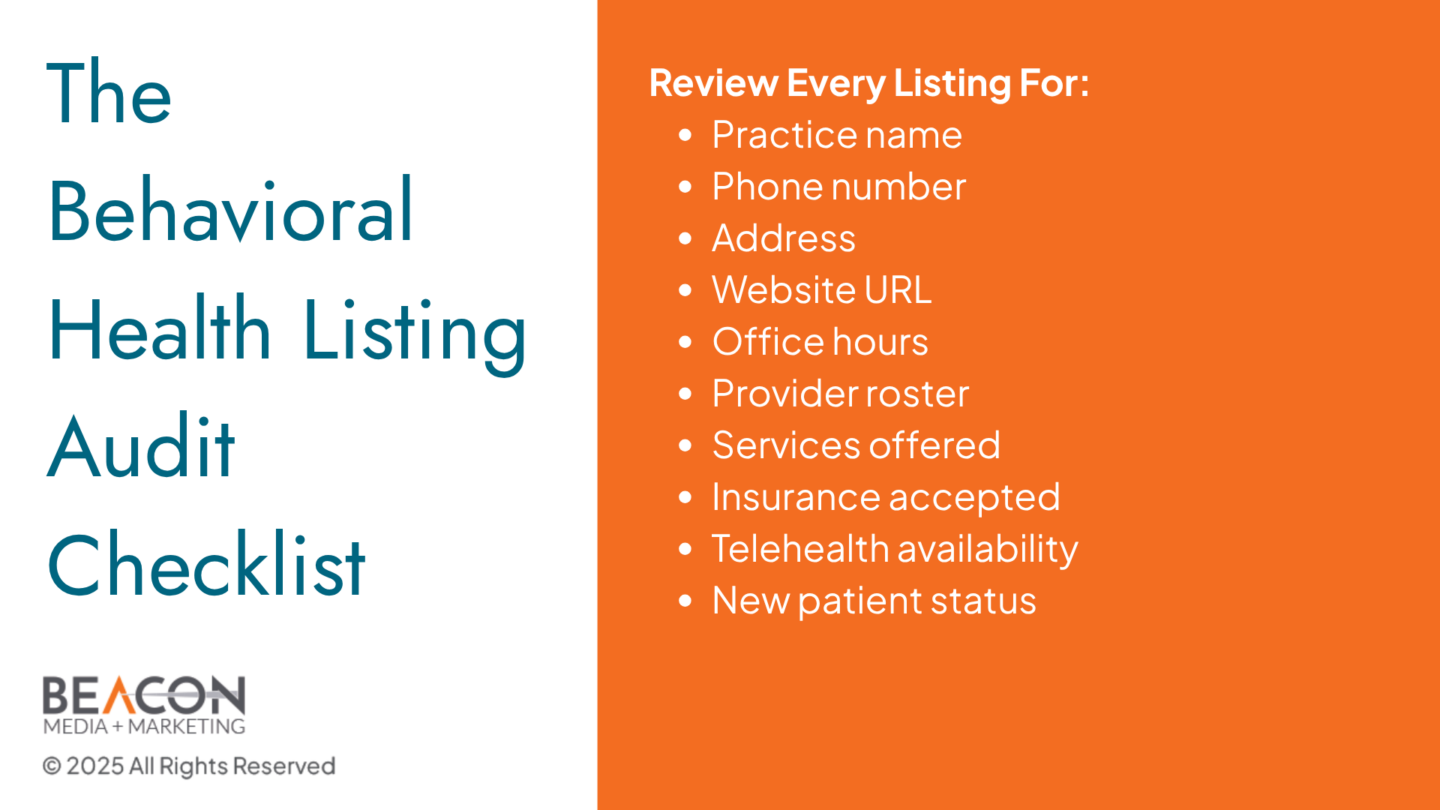
Profiles should accurately reflect:
- Practice name
- Address or service area
- Main phone number
- Office and intake hours
- Website and appointment links
- Services and levels of care
- Conditions treated
- Age groups and populations served
- Telehealth availability
- Current providers
- Insurance information
- Accessibility details
- New-patient availability
The amount of space will vary by platform, but the central details should remain consistent. Shorter profiles can link to a location or service page with more complete information.
Descriptions should also use language that patients understand. Internal program names and clinical terminology may be familiar to staff but confusing to someone seeking care for the first time.
How Can Marketing Teams Keep Listings Current?
Creating profiles is usually easier than maintaining them. An effective process connects marketing with the teams that know when providers, locations, hours, services and insurance participation are changing.
Create a Central Source of Truth
Maintain one approved document or system containing the current information for every location. This may include official names, addresses, phone numbers, hours, URLs, descriptions, services and insurance details.
The source should identify who owns each field and when it was last verified. Without a central reference, teams may update one platform using information that has already changed elsewhere.
Assign Clear Ownership
Listing management often becomes inconsistent when responsibility is spread across several departments. Assign one person or team to oversee account access, routine reviews and requested changes for each major platform.
Backup access should also be maintained so profiles aren’t tied to one former employee or an account no one else can enter.
Connect Updates to Operational Changes
Listing updates should be included whenever the practice:
- Opens or closes a location
- Changes phone systems or hours
- Adds or removes a provider
- Launches or ends a service
- Changes insurance participation
- Expands or reduces telehealth
- Rebrands or changes its website domain
Adding these steps to existing onboarding, offboarding and operational checklists is more reliable than expecting the marketing team to discover changes later.
Review Priority Listings Regularly
Even when no major changes have occurred, priority profiles should be checked on a recurring schedule. Quarterly reviews may be enough for a smaller organization, while multi-location practices may need more frequent monitoring.
Complete the review from the patient’s perspective by searching the practice’s name, opening website links, checking directions and calling listed phone numbers. A simple inventory can also track profile URLs, account owners, access status, review dates and pending corrections.
Are Your Listings Making It Easier to Find Care?
Prospective patients already face emotional, financial and logistical barriers when deciding whether to seek behavioral health care. Conflicting phone numbers, old addresses and unclear service information only make that process more difficult.
Accurate listings give people a clearer path from initial research to direct contact. They help patients understand where the practice is located, what services it offers and how to reach the right team, while giving search platforms more complete information about the organization.
A strong website remains essential, but it cannot correct every outdated profile elsewhere online. Behavioral health practices need a connected digital presence that carries the same reliable information across the channels patients use.
Contact our team at Beacon Media + Marketing today to strengthen your practice’s digital footprint.