Marketing

See Our Blogs

Explore insights on SEO, AI, and digital marketing strategies designed to help your business grow, stay visible, and adapt in a constantly evolving online landscape.

Beacon_Icon_resouse

Originally published on July 20, 2015. Updated on March 4, 2020.

Back in the 1960s, marketing was relatively straightforward. Let’s be real, you’re probably picturing the orange tones and box pleats of the advertising world featured in the TV show Mad Men, complete with boardroom discussions, concept presentations and an expensive media buy.

The industry was turned on its head with the emergence of the Internet in the 1990s. The past 20 years have seen drastic changes, with advancements in technology and the development of social media. Let’s quickly compare traditional marketing and digital marketing.

From bricks and mortar to online

THEN: Most businesses only had physical locations. This meant it was much more difficult for new customers to find businesses they had never heard of, that is, unless they saw an advertisement somewhere. They couldn’t look up anyone for reviews. And what were you supposed to do when you needed to contact a business? Remember their phone number? Or use a PHONEBOOK? Word of mouth was king and reputation was everything when it came to owning a local market.

NOW: Many modern businesses no longer require physical locations, operating completely online. Many have both. Some have physical locations only. As time passes, it’s becoming increasingly difficult to do business the old-fashioned way, because having on online presence means missing out on a huge potential expansion of customers. Customers want convenience and trust. By that, we mean they want to be able to find you easily when they need you, and they want to be able to look you up in advance to make sure you offer exactly what they’re looking for and that you’re reputable.

Having an online presence is critical in 2020. Schedule a free consultation today to talk about your website needs.

From monologue to dialogue

THEN: Marketing was a one-way street, informed by gut-feel and educated guesses. Companies would give snippets of information to potential customers, trying to persuade them to buy or use their products or services. To a large extent, customers were unaware that other options existed. If someone bought a car from Ford, for example, they were likely to continue buying from Ford because that’s what they had used in the past and they knew it to be trustworthy and reliable.

NOW: Engagement is crucial to success in a digital world. Customers feel like they can trust a company that engages with their customers, because that reminds them that they’re dealing with real people. It’s a two-way street, because businesses can utilize the feedback given via the Internet to come up with new ideas and solve problems. Furthermore, positive reviews go a long way to encouraging other potential customers to take the plunge. These are marketing gold.

Read more: 10 tips for optimizing your social media presence. 

From outbound to inbound

THEN: Traditional marketing focused on the idea of taking your business to your customers. Huge amounts of money and time were invested in buying advertising space on billboards, newspapers and magazines, as well as commercial slots on television and radio. Sales people would cold-call people and go door-knocking to find new business. Essentially, information was forced upon the public, casting a very wide net in the hope of getting a few bites from the right buyers.

NOW: Digital marketing focuses on the idea that customers will find you when they want you. As such, the idea is to make yourself as easy to find as possible. This means an active digital presence, quality content on your website and social media channels and a strong focus on search engine optimization (SEO). Rather than shouting, “buy this!” you can think of it as saying “enjoy this information we’ve provided.” Your content needs to be educational, helpful or funny to build trust with potential customers. A stellar website is key to helping your company reach its potential.

Ready to get started? We are a digital marketing agency based in Anchorage, AK, and Reno, NV. We work with clients all over the United States. Schedule a free consultation!

Next-level digital marketing

Every successful digital marketing strategy requires three basics: a website, a social media presence, and quality content. You can spend as much or as little as you like when it comes to establishing your digital presence and getting started. The most important thing is simply that your business exists online so that potential customers can find you easily.

Here’s how to take your digital marketing strategy to the next level:

Website

Your website sets the foundation for your entire strategy. Good design can lead to stronger connections, more sales leads and a better conversion rate. If you’re transferring to digital from a traditional marketing strategy, it might help to think of it as an online brochure that showcases your products and services and gives customers an idea of what your business is about.

Here are the most important things to keep in mind:

  • Lead generation: Didn’t think you could get a measurable ROI from a website? Yes, you can.
  • Automation: Your website will act as a virtual sales rep, qualifying leads while you sleep.
  • User experience: Guide your prospects on a journey that leads to doing business with you.
  • SEO optimization: Gain more customers because they can find you online when they need you.
  • Mobile optimization: Most web visitors use mobile devices. Use that to your advantage.
  • Multimedia optimization: Videos and graphics create human interactions with customers.
  • Professional appearance: Bring in the right customers by creating the right first impression.

Sign me up! Click to learn more about our website and development service.

Social Media

Social media is the best way to connect with the people who want to do business with you. The key is to prioritize genuine customer engagement. There are lots of different theories about how to do this best, but we think it’s simple: remember you’re talking to HUMANS. Lots of companies fall into the “sell, sell, sell” trap, but the truth is that prospective customers are real people with real problems.

Here are some things to consider in developing your strategy:

  • Team brainstorming: Good ideas can come from anywhere, so utilize your full team.
  • Campaign objective: Define a clear and measurable goal for every campaign to stay consistent.
  • Campaign budget: Run your ads at the budget that will receive optimal ROI and save.
  • Target audience: Delivering your message to the right people will make sure they take action.
  • Editorial calendar: Know what’s coming up next in your social media content and promotions.
  • A/B testing: Test your ads and audiences to learn what works and optimize messaging.
  • Creative media: Show people interesting content that encourages them to engage.
  • Reporting: Daily monitoring and regular reporting is critical to success.

Not sure where to start? Learn more about our social media marketing service.

Quality Content

Imagine a world where you’re at the top of every Google search. Sounds good, right? It all comes down to content marketing. Quality content generally comes into two forms: articles and videos. The idea is to create content that is wonderful to consume while being full of keywords that will help you rank on search engines, working hard to flood your business with qualified leads.

Here are the basic concepts you’ll need to get started:

  • Editorial calendar: Make sure you cover your bases and stay inspired for the future.
  • Best practices: Trends and algorithms change, so stay up-to-date with the latest advice.
  • Headlines: Get clicks with headlines that have been approved by a title optimization algorithm.
  • Subject matter experts: Interviews with experts will position you as a thought-leader.
  • Research: Make sure you share good information that is accurate and interesting.
  • SEO: Use keywords, metadata and backlinks to make sure your content ranks in search.
  • Multimedia: Good images and videos go a long way to increasing engagement and trust.
  • Calls to action: Your content needs to create results, so include a strong call to action.

We get it, this is a lot to take in. Learn more about content marketing and video marketing.

To go ahead and get started, book your free consultation today!
Originally published on November 27, 2015. Updated on February 6, 2020.

We wish we had a dollar for every time a client told us: “I don’t shop in the ad section when I shop on-line”, or “I just scroll right past the ads”. Seriously.

Google.com is the most popular website in the world. It’s been estimated that it handles as many as 7 billion searches a day, while a survey conducted in 2019 revealed that as many as 63% of internet users would click on Google ads. It’s no surprise, then that Google Ads (formerly known as Google Adwords) brings in as much as $100 million a day in revenue.

Let’s put it another way: Google reports that advertisers make $8 for every $1 they spend. Trust us when we say it can be a very powerful lead-generation tool for your business.

What Do Google Ads Look Like?

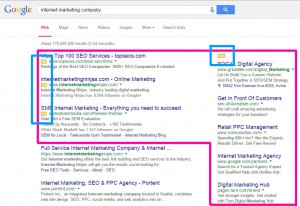
Before we go any further, it’s important that you understand what Google Ads look like and where they appear. Here’s a visual that shows you were the advertising places normally sit:

sem

The highlighted area is the paid ads on Google. Yes, other search engines offer advertising (including Bing and Yahoo), but since more than 90% of global internet searches are conducted through Google, we recommend focusing your efforts here.

It’s based on a bidding system, which basically means you can select the maximum amount you’re willing to pay for someone to click, see or engage with your advertisement. This means you can design a strategy according to your budget – but remember, the more you bid, the better your placement.

The good news is that you can dial it to specifically target your ideal customers – for example, people in your local area, people in a particular income bracket, and people with specific search interests.

This means it’s much more focused than traditional advertising methods, because you’re only talking to people who are likely to be interested in the products or services your business has to offer.

It’s also much easier to track their success, so you know whether they’re working or not. The best way to do that is by signing up for Google Analytics (you can learn more about that here), because this will show you who is clicking on your ads so you can refine them until you’re hitting the right target.

Designing A Google Ads Campaign

Balancing Organic Search and Paid Search

There are two ways Google can help generate leads for your business: organic search and paid search. Organic search is implemented through a process called Search Engine Optimization (commonly referred to as SEO). This post is going to focus on paid search, but if you’re interested in learning more about how you can use SEO to optimize your website, check out these blog posts:

It’s important to strike a balance between the two. Studies show when you place high organically as well as have effective ads you actually increase your click rate to your ads by 40-65%. In today’s world, that means they work hand-in-hand to help grow your business.

Google Ads Fundamentals

Here are seven essential tips to remember when setting up a Google Ads campaign:

1. Define clear goals.

The point of almost every campaign is to generate leads and grow sales, not to promote brand awareness. That means you need to be really specific in defining your desired outcome. For example, is your goal to have people fill out an online form? Call you? Make an appointment? Purchase one of your products? This will help you set up your ads so that they work as effectively as possible to achieve this outcome.

2. Keep your target audience in mind.

One simple way to do this is to use the marketing principle of AIDAS:  Attract, Interest, Desire, Action, Satisfaction. Basically, what this means is that you need to “attract” the searcher based on the search terms, raise their “interest” by offering a special, you need to convince them they “desire” your product, include a call to “action”, and then make sure to provide “satisfaction” when they choose your website. This is a really helpful framework when it comes to choosing the exact wording you’ll use.

3. Use specific keywords.

Keywords are the search terms people will use when they’re looking for a particular product or service. It’s important to be specific, because anything too broad will drown amongst all of the other suppliers – for example, if you’re looking to boost the duct-cleaning arm of your HVAC business, “Duct cleaning services” will be more effective than “HVAC services”. The other important keyword is to include your location, because this will generate quality leads. For example, “Lake Tahoe tandem bike rental” will do better than “tandem bike rental”. Using the right keywords will get the most from your investment.

4. Have a great landing page.

Website design has never been more important. Think of it as your best salesperson – in order to convert a successful sale, you need to make the right impression from the start. A “landing page” simply means the page your potential customers will see when they click through the ad, which serves two purposes: to give them the information they’re looking for and to help you track the success of your campaign. It needs to deliver on customers’ expectation – for example, if your advertisement featured emergency dental services or custom-build machinery, you need to provide that information upfront. If your website has brought in a new customer, they don’t owe you anything. They’re not going to put in any effort to find the right page. You need to make it easy for them.

5. Think about mobile audiences.

Google has reported that over 50% of the world’s searches will be done from some sort of mobile device, so make sure you factor this in when you’re designing your ad. Use a strong call to action in your ads like “Click to call today for 10% off”, make sure your contact details are easy to find, and ensure your landing page is optimized for mobile to give them a great user experience and increase your conversion rate.

6. Always do A/B testing.

When setting up your goal for your Google Ads campaign, make sure that you create multiple variations for your ads and then monitor their results, revise them, and then test them again! One word or tag line can make a huge difference in your ads. Running a few experiments early will help you get the hang of them and find out what works best for your intended audience. By doing the testing you will find which ones provide the best click rate, lowest cost per click, and also the highest conversion rate, which will make a big difference over time.

7. Monitor and tweak them as you go. Don’t forget about your ads! Checking in regularly will make sure your message is always optimized with the best keywords, because you’ll be able to tell who is clicking, from where, and what else they’re viewing on your website to identify future advertising opportunities. (If you’re not sure what metrics you should be tracking, you can check out this blog post we prepared earlier.) By knowing what works and doesn’t work, you will be able to run a successful Google Ads campaign, increase the number of leads you generate, and ultimately convert sales.

Still have questions? We’d love to talk to you about how Google Ads can help your business. Feel free to call us on 907-563-6008 or send us an email.

We may not be able to take you skiing, camping or hiking, but we can help you grow your outdoor clothing and equipment shop so you can help others get out there! Read on to find out how Google ads put you right in front of your customers.

Google ads put your business at the top of the search results page, on the most used search engine in the world. Google accounts for 77% of search engine users and the first five results receive 67.6% of clicks, according to Forbes.

This means that if you want your business to be seen you need to be at the top of Google, otherwise it’s like you’re not on the internet at all. Here we’ll explain what Google ads are, and how they can help you get your business right in front of customers. We’ll also tell you what you need to know to get started yourself!

Since the outdoor equipment industry has been identified as an emerging sector for Alaska, now is the perfect time to grow your business. The sector is growing significantly due to a lessening in the severity of the climate. The Arctic is warming twice as fast as the rest of the world, and this has the result of reducing the length of the snow season in Alaska. As most visitors to the state come in the summer months, and many take advantage of the great Alaskan outdoors, you can expect to see an increase in visitor participation in outdoor activities.

What are Google ads?

That’s enough data for now! Let’s move on to what Google ads are, then we’ll look at how they can be useful for the outdoor equipment industry specifically.

Most people are familiar with the spooky feeling of seeing an ad about something you were only just thinking about. This happens because you’ve been targeted by something called “remarketing”.

Remarketing is the practice of having advertisements for websites or products follow you around the internet.

These ads can be generated because you visited a website, or because Google has determined your interests from tracking your online activity. As a business owner using Google ads, you can make use of this kind of advertising power.

There are two types of google ads:

  • Display ads: these pop up on websites, they are usually a graphic or image and can be identified by grey “advertisement” text above them.
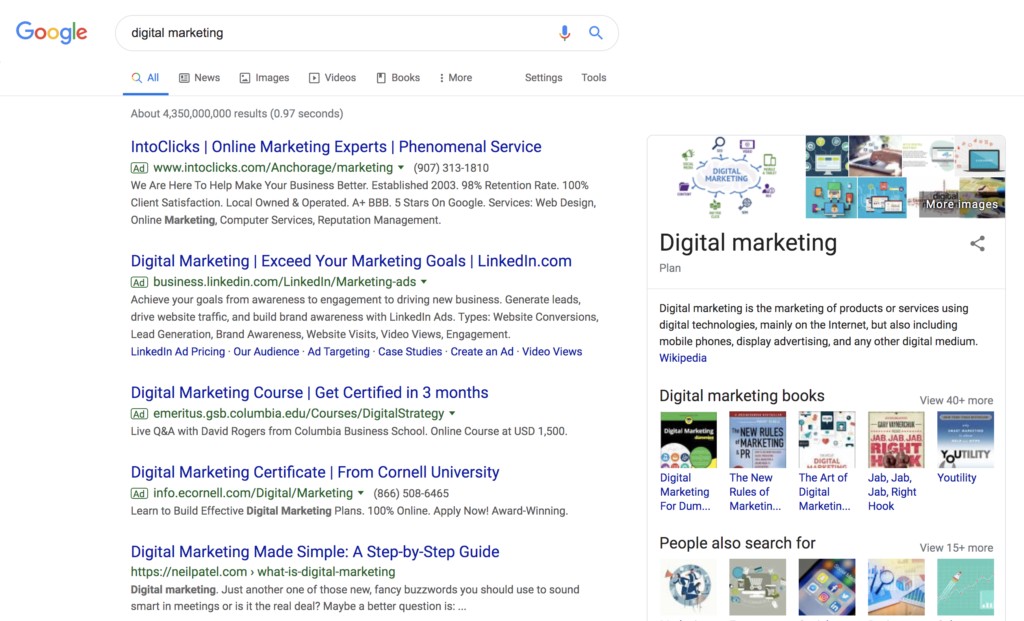
  • Search ads: these appear at the top of your search results page and can be identified by a small green box with “ad” to the left of the URL.

Clicking on these ads charges the business who runs them, hence the name “pay per click” or “PPC”, which we’ll get into in more detail in the next section.

Paid ads are generally at the very top of the search results page, below them are the “organic” results. Here at Beacon, we recommend strategies for both paid ads and organic ranking for our clients.

Google search ads comprise only three parts: headline, URL, and description. Display ads, on the other hand, can come in up to 16 combinations of logos, graphics, headlines, and descriptions!

How do Google ads work?

When starting to look into Google ads, it is important to understand the algorithm, bidding structure, and cost. This is all managed through GoogleAdwords, which you will want to create an account for, which you can do here.

The Algorithm

You may have heard this magical-sounding term “The Algorithm” which has come to public prominence in recent years, related to platforms like Facebook and Twitter. Here we’ll explain what is meant by the word algorithm in the context of Google ads.

Google uses an algorithm to determine which ads you see when you search. In the fraction of a second after you press search, google takes an inventory of all the ad accounts that contain keywords or phrases used in your search.

Say you search for “outdoor clothing and equipment shop near me”. A business trying to increase their outdoor equipment sales will have ads on google which are included in the inventory search.

But how did they get it included in the inventory?

The business will have bid a monetary amount that they are willing to pay every time someone clicks on their ad. This makes it a sort of auction, and the winner is determined by two factors:

  1. The maximum cost-per-click (CPC) bid you have set
  2. The quality score of your advertisement

The second point here is very important.

Google is a business, they want to make money. The best way for them to do this is to provide quality content so that people come to trust and rely on their service. They have a near-monopoly on search engine use which they built by providing the best content to people.

The quality score is determined by two factors:

  1. Past performance of your ad, ad group, and account in general.
  2. The relevance of your chosen keyword, ad (title, URL, and description), and landing page to the search and to each other.

Let’s just explain the terms “ad group” and “landing page”.

An ad group is the group of keywords that you are trying to rank your ad for. The landing page is the page users “land” on after they click on your ad. The ad you write and the landing page should both use the keyword you are targeting and be focused on the topic you are discussing.

The factors we just discussed culminate in a simple equation that determines your ads final rank on the results page:

CPC Bid x Quality Score = Ad Rank

Google display ads work slightly differently, with bids made on ad groups, rather than keywords. You also have the ability to bid on impressions rather than clicks. Impressions are the number of times your ad was delivered, i.e. how many times it was “seen” by searchers. In this case, we talk about “cost-per-impression” or “CPM”.

How much will Google ads cost my outdoor clothing and equipment shop business?

We’ve mentioned that you will be charged every time someone clicks on one of your outdoor equipment business’s google ads.

The equation to determine the cost per click is:

Next highest ad rank/Quality Score + $0.01 = CPC

This means that the higher your quality score, the lower your costs. Again, this is due to Google’s own self-interest in providing quality to users. It is important to note that the CPC will never go above your maximum bid.

Can Google ads grow my outdoor clothing and equipment shop business?

Ok, we’ve covered the ways google ads works, but can they really grow your business?

The answer is, absolutely!

But it is not guaranteed.

It is important to understand the level of competition in the area you are targeting. Some industries, in certain locations, have more competition than others. For example, the CPC in the legal industry in anchorage, at Beacon HQ has been as high as $50!

Spending this amount per click is unlikely to be worthwhile unless you have very high profit margins, especially as a click is not necessarily a customer.

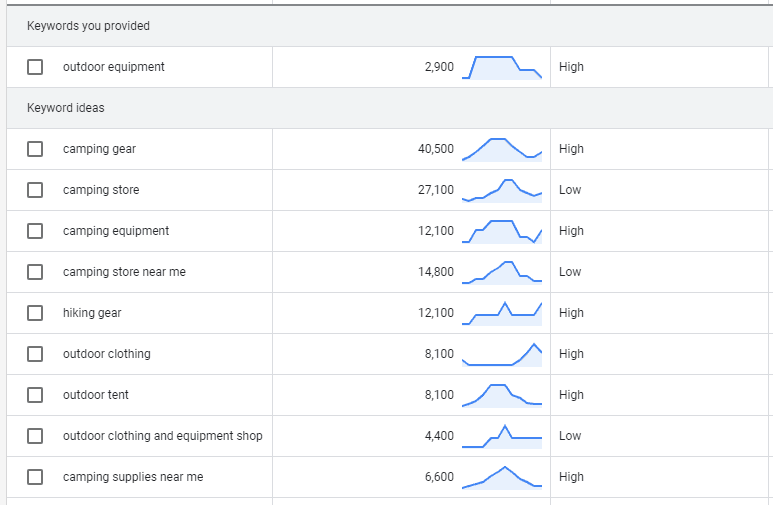
Keywords for “outdoor equipment” have quite high competition in our area, although the prices are still relatively low. We might instead choose to use “outdoor clothing and equipment shop”, which has low competition while retaining high search volume. Remember, you may find that the situation is different where you are.

A competitive industry shouldn’t discourage you, however!

We at beacon excel at creating quality ads, and that goes a long way to reducing costs and ranking your ads higher than the competition.

So, how do we do it?

  • For every service we want to advertise, we use a budget of at least $300 a month.
  • We always find some way to differentiate the services we are advertising by using more nuanced keywords.
  • Our team makes it a priority to create quality, relevant ads and landing pages.

Are you ready to give it a go? We hope this article will serve as a handy reference while you’re getting started!

On the other hand, our team is Google Partner Certified and we are constantly working to achieve the best results for our clients.

If you are interested in hiring Beacon to tackle advertising for you, you can schedule a free consultation, here!

Recently, on the way to work, I heard a radio ad that caught my attention.

It was for an imaging provider. They were offering the latest and greatest in imaging technology and procedures. Radio ads don’t usually catch my attention, but this one made me pause. A marketer by trade, I began to get inside my consumer brain to explore exactly why this particular ad was so effective.

Here’s what I discovered:

  1. I had been looking for an imaging provider (need)
  2. I had been in need of imaging services for over two years now (pain)
  3. I didn’t want to go to just anyone because the procedure is typically painful (pain)
  4. I was aware of non-painful, alternative methods (education)
  5. I didn’t know who offered them (need)

It was the perfect culmination of events. I just so happened to turn the radio on that morning during the time this provider’s radio spot was running, I just so happened to be in a season of life where I needed their services, and I just so happened to have enough consumer education to know that they offered exactly what I was looking to find.

The crazy thing is I didn’t even call the number at the end of the ad! Nor am I planning to anytime soon. But when the time comes and the stars align just right again, you can be sure that this provider has my consumer preference.

This experience did a few different things for me. First, it made me realize just how difficult it can be to win people’s business (and how incredible it is that we’re so great at it at Beacon!). Second, it reinforced the importance of targeted, consumer data-based digital advertisements versus the shotgun approach of traditional media like radio.

Finally, it re-centered my definition of marketing.

Marketing is not about who can talk faster, or close better. It is about a deep psychological understanding of customer needs. – Michael Brenner, What Is Marketing?

Handy Definition of Marketing

When I got home that night and had some more time to mull over the events of the day, I pulled out my iPhone and Googled, “What is marketing?” It’s a slightly embarrassing search for a marketer, especially one who took numerous academic courses on marketing in school, but sometimes we all need to be reminded of “the main thing.”

A particular part of the Wikipedia definition caught my eye, “Marketing is the study and management of exchange relationships.” “That’s it,” I thought. Marketing is literally just taking people like me, everyday people who listen to the radio and Google simple searches on their smartphones, and finding a mutually beneficial exchange of value that you both agree upon, typically your services in exchange for their money.

“Marketing is the study and management of exchange relationships.” – Wikipedia

I thought about everything that this involves, from finding and targeting the right people using data like demographics and life circumstances, to creating the right offer using differentiation and customer education where necessary. A fresh framework for marketing began to form in my mind.

Suddenly, I could see that everything that we do at Beacon falls neatly into that framework.

All Marketing is Inbound Marketing

We are a digital marketing agency. That means we focus on digital media such as websites, videos, social media posts, and blogs rather than traditional media like print, radio, and TV. We do so because we believe it is the most effective. Not that we don’t use traditional media in combination with digital media sometimes as a part of a holistic strategy, but we prefer to invest our money (and our client’s money) where we know we can get results.

As I mentioned earlier, digital marketing is highly targeted, whereas traditional marketing takes more of a shotgun approach. With digital marketing, you can show people ads based on their demographics, life situation, interests, and even outwardly expressed needs. You can also track their responses. Because everything is internet-based, we can follow every like, comment, share, click, and convert (or bounce). It’s kinda hard to know if someone called or visited your website from a print, radio, or TV ad. There are methods, but they all come back to digital tracking in the end.

One of the core philosophies of digital marketing is called “inbound.” It’s the idea that if you know who you want to serve, if you truly understand them in all of their wants, needs, pains, and dreams, and you put valuable information for them in the places that they spend their time, they will notice you and pursue a business relationship. Of course, in the age of the internet, pretty much everybody spends a great portion of their time online. 

This is how we create exchanges at Beacon. We market online. We conduct deep customer research and practice A/B testing on as many demographics and other customer markers as we can get our hands on until we have the perfect target audience. We find out exactly what they’re searching online down to the keywords and phrases they use to communicate their problems and desires. Then, we craft our value-driven brand message and produce helpful information.

Most Important Part of Marketing

What is a brand message? To us, it is an empathetic messaging that will resonate with our target audience given what we know about them.

The truth is, the provider I mentioned at the beginning could have done a lot more by way of brand messaging. If they had focused more on what their technology means for the patient, as in, less pain, rather than just how cool and awesome it is, they would have had a chance of capturing more than just people like me. I had to read between the lines. Fortunately for them, I knew a thing or two about imaging technology.

A brand message is more than just empathetic statements. It is also empathetic action.

I am a content writer, and 90% of my time is spent producing information that helps the customer along their journey. I answer commonly searched questions, write “how-tos” and “quick guides,” and generally put written form to the solutions our clients are offering their customers.

This does more than simply educate the customer. When we produce empathetic and valuable content like this for our customers, we show them that we are the kind of people who have the answers they are looking for. The result? They want more from us, which quickly becomes our products or services themselves.

“Traditional marketing talks at people. Content marketing talks with them.” – Doug Kessler

If I could summarize all of this succinctly in one statement it would be this, “know thy customer.” If marketing is the study and management of exchange relationships, then the obvious first step is knowing who you are relating to and what they might want to exchange. Inbound marketing is one of the best ways to find and foster exchange relationships through data-based targeting and empathetic brand messaging.

We are seeing incredible results for our clients who use this marketing framework every day. If you are interested in getting back to “the main thing” in your marketing, we would love to talk! You can schedule a free consultation with us at the link.

As always, happy marketing.

Looking for the digital marketing tools that will knock your next campaign out of the park?

As a digital marketing agency, we have a lot of experience with the tools that help (and some lessons learned with the ones that hinder).

Today, we only use the best.

Want to know what our top 5 digital marketing tools are?

Well, today you’re in for a treat.

What Is a Digital Marketing Tool?

Before we begin, let’s get an important definition straight.

What is a digital marketing tool?

A digital marketing tool is any web-based technology that can be used to advance your digital marketing efforts.

“A digital marketing tool is any web-based technology that can be used to advance your digital marketing efforts.”

There are digital marketing tools for email marketing, for customer relationship management, for marketing automation…just about anything you can think of!

Today, we’re going to talk about digital marketing tools that fall into three categories:

  1. Website marketing tools
  2. Search marketing tools
  3. Social media marketing tools

Let’s begin.

Your Foundation: Website Marketing Tools

To start, we’re talking about website marketing tools, because your website is the foundation of your entire digital marketing campaign.

When we say, “website marketing tools,” we mean the system you choose to build your website on, better known as the “content management system.”

“A content management system is a system you choose to build your website on.”

In the world of digital marketing tools, there are many content management systems to choose from.

You have probably heard of many of them before: WordPress, Wix, Shopify, Squarespace, etc.

The #1 content management system on the internet is WordPress.

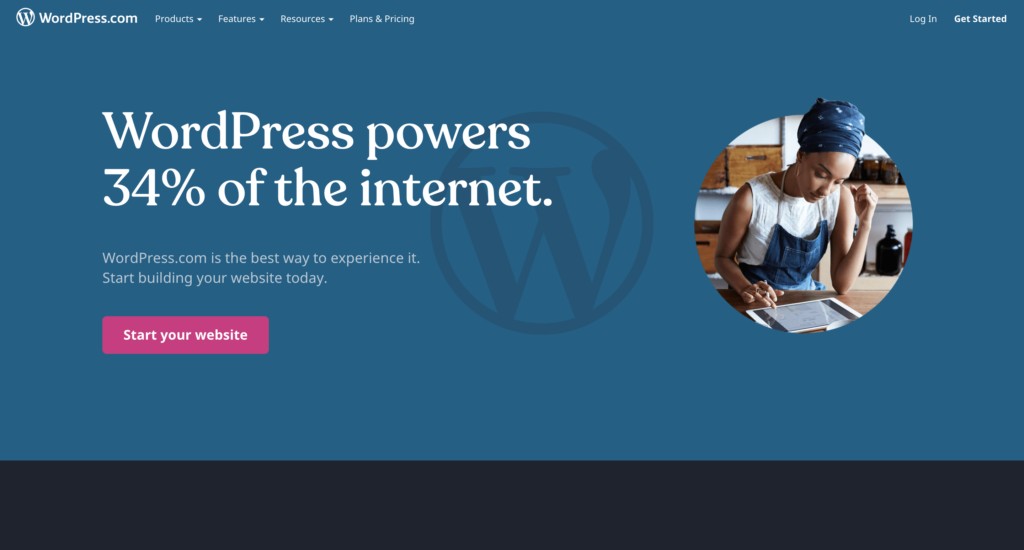
WordPress, the #1 website marketing tool.

Top Digital Marketing Tools #1: WordPress

WordPress powers 34% of the internet according to W3Techs, a technology survey firm.

WordPress powers 34% of the internet according to W3Techs.

Let that statistic settle in for a second.

Thirty-four percent of all websites across the globe run on WordPress.

This makes WordPress the top website marketing tool.

It’s the one that we use for all our client websites (including the website you are reading now!).

Why do you think 34% of us digital marketers are using WordPress?

We recently wrote a blog on why WordPress is so popular for new websites.

Here is a brief summary of the benefits of WordPress:

  1. WordPress is free and open to everyone
  2. You can build any kind of website you want on WordPress
  3. WordPress is easy to use
  4. You don’t have to learn to code to use WordPress
  5. You can get WordPress support just about anywhere
  6. WordPress is scalable and can handle business growth
  7. WordPress integrates with most business software
  8. With WordPress, you own your business website – not so with the “other guys!”
  9. WordPress is the best blogging platform in the world
  10. WordPress is SEO-friendly
  11. You can upload photos, videos, and documents
  12. WordPress is mobile-friendly
  13. WordPress is safe and secure
  14. It’s just plain popular!

And that’s just the abbreviated version!

If you would like to learn more, read the blog.

For now, suffice it to say that you should be using WordPress over anything else if you want the best of the best among website marketing tools.

Next Steps: Search Marketing Tools

Once you’ve chosen the best digital marketing tool for your website (that’s WordPress), you’ll want to promote it on the top channels.

Naturally, the first channel you’ll be promoting your website on is the search engine.

The #1 search engine in the world is Google.

Google offers a couple different search marketing tools for you to take advantage of.


Top Digital Marketing Tools #2: Google

Google boasts an 88% market share according to Statista, another survey firm.

“Google boasts an 88% market share according to Statista.”

If you’ve been in business for any significant amount of time, then you’ll understand the value of market share.

You’ll also understand that an 88% market share is unheard of.

What this means is that all other search engines in the world–be it Bing, Yahoo!, or something as obscure as DuckDuckGo–capture only 12% of all search traffic combined.

This makes Google the top search engine.

A. The Google Algorithm (Search Engine Optimization)

The first Google search marketing tool we’re talking about here isn’t so much a tool as it is a way to approach a tool we can’t access.

What we’re referring to is the Google algorithm and search engine optimization (SEO).

The Google algorithm is not public knowledge.

However, it is the tool Google uses to determine which websites rank on the first page (and which get buried on anything lower).

Google does not publish their algorithm in order to keep things fair.

Nonetheless, digital marketers like us are always seeking strategies for ranking on Google.

This discipline is called search engine optimization (SEO).

Search engine optimization (SEO) is making your website as Google-friendly as possible to achieve a high ranking among the search results.

“Search engine optimization (SEO) is making your website as Google-friendly as possible to achieve a high ranking among the search results.”

Although the Google algorithm is not available for public eyes, there is a lot we digital marketers have learned through testing, experimentation, and leaks over the years.

These SEO strategies are very valuable, making them an important aspect of Google search marketing.

B. Google Ads

A secondary search marketing tool is Google’s own advertising platform, Google AdWords.

Google AdWords is used to pay for search results, often in combination with unpaid SEO strategies.

“Google AdWords is used to pay for search results, often in combination with unpaid SEO strategies.”

You’ve probably seen Google ads before, they’re the first couple results on most search pages, indicated by a little, green “ad” box:

The Top 5 Digital Marketing Tools and Why They’re the Best

If you’re struggling to rank among the Google search results, Google ads are a great way to get some traction on the first page.

They’re also a great way to get on the top of the results page.

For these reasons, Google ads are another important aspect of Google search marketing.

The Gold: Social Media Marketing Tools

Let’s just say your website is on WordPress, it’s achieving first-page ranking on Google, and you’ve made good use of Google Ads…

What other digital marketing tools could you be using to get your campaign message in front of as many people in your target audience as possible?

There’s a large part of digital marketing that we haven’t addressed yet: social media.

People spend 2 hours and 24 minutes on social media each day, that’s 71% of the 3 hours and 22 minutes they spend on the internet over that same span of time.

“People spend 2 hours and 24 minutes on social media each day, that’s 71% of the 3 hours and 22 minutes they spend on the internet over that same span of time.”

Our top three social media marketing tools are Facebook, Instagram, and YouTube.

The Top 5 Digital Marketing Tools and Why They're the Best

Top Digital Marketing Tools #3: Facebook

Facebook has 2.41 billion monthly active users, making it the #1 social media platform in the world.

“Facebook has 2.41 billion monthly active users.”

It is seconded only by YouTube (technically a video marketing platform) (also owned by Google, *wink wink*) and Instagram, it’s own subsidiary.

What makes Facebook so popular?

Only you, the user, can tell us.

The success of Facebook is largely due to how big it became in a short amount of time, squashing all competition.

Being first to market is as good as gold.

But that success is reinforced by its value to the end-user.

Facebook was created for humans interested in other humans, which is all of us.

It allows us to take a sneak peek into one another’s lives, answering questions that had gone unanswered before at the rapid speed of the internet.

And so it became the best social media marketing tool available.

The Top 5 Digital Marketing Tools and Why They're the Best

Top Digital Marketing Tools #4: Instagram

Instagram is Facebook’s subsidiary that has over 1 billion monthly active users.

“Instagram has over 1 billion monthly active users.”

For this reason, Instagram is the #2 social media marketing tool in the world, unless you count YouTube (which is a slightly different animal, but we will talk about it next).

What is the value of Instagram?

Two primary points here.

1. Instagram was created to be a visuals-oriented platform.

Instagram is pictures-first, then text.

It lends itself well to artistic and engaging images.

In this way, it cuts out all the clutter that Facebook has become littered with–long, text-based posts, articles, funny photos, kitschy graphics, and memes.

(There is a place for those things but it’s Facebook, not Instagram.)

People who want a streamlined, clean, and simple social media experience love Instagram.

That’s a big reason why it has become so popular.

2. Instagram caught on with the millennial audience.

Another reason for the rise of Instagram is that the millennial audience has taken this social media platform by storm.

64% of 18-29-year-olds use Instagram according to SproutSocial.

“64% of 18-29-year-olds use Instagram.”

Just like Facebook entered the social media market loud and fast, making it the best, millennials took over Instagram so it became the place to be.


The Top 5 Digital Marketing Tools and Why They’re the Best

Top Digital Marketing Tools #5: YouTube

Earlier this Spring, YouTube crossed over into the 2 billion monthly active user camp.

Already the #1 video publishing platform in the world, this news only reinforced YouTube’s popularity.

Why is YouTube the top video marketing tool across the globe?

According to Social Media Explorer, there are five reasons:

  1. YouTube creators are compensated
  2. YouTube creates community
  3. YouTube mobilizes underrepresented talent
  4. YouTube is gamified and offers recognition
  5. YouTube welcomes competition

YouTube is generally a creators-first platform, making it very easy and valuable for creators to publish the educational and entertaining content that a good video sharing site is known for.

Are you ready to hit a home run on your next campaign with the best of the best among digital marketing tools?

We hope that you make good use of WordPress, Google, Facebook, Instagram, and YouTube.

These are the top by far because of the number of people who use them and the incredible experience they deliver.

If you are interested in partnering with an agency who uses these tools on a regular basis and understands their nuances, we would be happy to talk.

Please schedule a free consultation with us using our live scheduler.

To everyone else, best wishes as you tackle this next marketing push with the #1 tools on the market.

Happy marketing!

Originally published on January 19, 2016. Updated on May 30, 2019.

“Sticks and stones may break my bones, but words will never hurt me.”

That saying has been making the rounds on playgrounds for well over a century. It’s an adage that implies that words and insults can’t hurt whoever is the brunt of the comment.

If we’re being honest, it’s never really made any of us feel better, and that’s especially true in the age of digital marketing and social media. Words certainly can, and have, hurt plenty of companies over the years. Many people rely on social media reviews when they’re making purchasing decisions, so when they see a bad review that was handled poorly or ignored, they’re most likely not going to trust the company with their business.

Negative reviews aren’t all bad. Many companies have misguided fears and that result in an aversion to bad reviews, but that’s not the answer. It is impossible to make everyone happy, and if you’ve been in business for any length of time, you are going to have someone out there who is unhappy with something. Reasonable consumers understand this and will take it into consideration when scanning reviews. What do you do?

Take a bad review, handle it with respect and stellar customer service. Turn the situation around. You have the opportunity to mend any damage with the reviewer, build your reputation for making customers your top priority, and build trust with anyone that sees your response. Use negative reviews to your advantage!

Need help managing a marketing crisis? Schedule a free consultation today.

Bad reviews have been shown to improve conversion by 67%. If you handle them properly, having negative reviews can actually build trust with consumers.

Approach each negative review calmly

Make it a habit to check social media accounts for what people are saying about you. Don’t just rely on customers to post to your business page or to tag you, because many won’t. Choose a social media tool, such as Google Alert, that will tell you every time your name is mentioned on a blog, website, or in the news. There are other sites available that will also track social media sites for mentions as well.

Remember, it’s not you that the customer is upset with, it’s the situation. Take a few minutes to read through all of your reviews and mentions. Reply to the positive ones first. Then, when you’ve had a chance to process things, take a deep breath and go back to the negative ones. Facebook tracks business response times, displaying it as a badge on their pages, so try to reply within an hour of receiving a complaint.

Most importantly, never delete negative reviews. Customers want to know that you care about them and are reading what they have to say, discerning customers will notice an absence of negative reviews and may become suspicious – such is the nature of the Internet. Address each concern promptly, publicly and personally. (Of course, if they contain inappropriate language or are defamatory or otherwise offensive, then you should delete or report the comments. We definitely want you to be responsible social media users!)

“When you answer a negative review and address the upset customer, you are also speaking to the hundreds of other consumers that want to know how you conduct your business. Consumers understand that mistakes happen, so when they see a business trying to do the right thing, it builds trust.” ~ Phil Penton, President of Social Integrations.

Read more: Must-read tips to rocking your online reviews

Acknowledge the concern raised

Acknowledge the customer’s issue and let them know that it’s being looked into. Give them a sense of when and how they can expect a response. Don’t just copy and paste an automatic response to issues. Customers can spot those immediately, and they’ll feel as though they’ve been brushed aside. Keep your tone conversational, include their name, your position with the company (it gives you credibility), and mention their issue in your response.

Look into the issue and assign the appropriate person to handle it. Having an escalation plan for employees is helpful and will ensure more consistent customer service. The plan can tell staff who deals with various types of complaints, what can be done at each level to alleviate the issue, and who has the power to offer compensation.

Going the extra mile makes a big difference. People know that no business is perfect and that mistakes happen. Take ownership of what went wrong so that you recognize the problem and prevent further blame from being thrown at you. Owning the issue will allow you to focus on finding a solution instead of stemming a flood of anger.

It is vital to make sure to keep your tone conversational and natural and come across as genuine. It takes time to build trust with a customer but only seconds to lose it. Empathy and honesty (without blaming the customer) can fix almost every situation. You don’t have to have the answers, but you need to be willing to find them.

Read more: The future of marketing

Take your response offline

Don’t rely on free products and services to fix problems raised in negative reviews. You’ll find your policy will be abused if this is your first line of defense. Helping them find an answer or fixing the original problem should be your default action. Offering coupons, vouchers, or replacements can go a long way toward earning you a second chance. Follow up by encouraging the client to update their review if their second experience is better.

After your initial response to a complaint, see if you can take further conversations out of the public eye. This will give you a chance to work with the customer one on one, be more personal, and avoid other commenters from dog piling on top of you. Private messages, email, or even a phone call are ideal ways to continue the conversation.

Finally, always follow up.

Don’t assume that an issue is resolved just because you responded to it. Follow up with the customer to make sure that they’re satisfied. Taking the extra time to touch base is a personal touch that lets them know that you really do care about them and their relationship with you in the future. It also provides you with an opportunity to gain some feedback about your processes and make changes to prevent future hiccups.

You can’t make everyone happy all of the time, but you can be honest and open with your customers and you can make them feel valued. If you take the time to make amends with customers who have had a negative experience, then you’re more likely to get their business again, and they’re also more likely to recommend you to others.

Let’s develop a strategy to improve your online reviews. Schedule a free consultation!

Originally published on November 7, 2017. Updated on May 30, 2019.

About 10 days ago, I heard a respected industry person put forward the premise that marketers are really just paid to be good bullsh** artists. Of course, there was a lot more to the conversation than that. In fact, after asking about it later, it turned out that’s not really what they were saying at all.

It’s certainly not the first time or even 20th time I’ve heard someone make that claim of marketers in general. For some reason, the statement really got under my skin this time. I’ve heard it enough that it really made me question things. Is that a true statement? Am I just fooling myself in this field?

Marketing Needs Shared Values

I decided to examine myself and be willing to answer the question honestly whatever the outcome. Taking the deep dive into personal and professional motives has been challenging, but rewarding too. There are certain things I discovered about myself, and choices I’ve made, that sometimes do describe bullshi**ing. Yuck… that feels terrible to put into words.

Specifically, past clients that I questioned whether we were the best fit for them. Often we weren’t. Obviously, we didn’t produce stellar results. I’ve also worked with folks where I knew there was a disconnect between vision, ideas and values, but I was too intimidated to call it out.

The willingness to ignore my best self in those situations haunts me today.

Clearly, the first issue I had to look at is whether we are putting our client’s interests first and using our expertise to produce the best work possible on behalf of their goals and vision. At first, we sometimes failed at this, but as we grew into our shoes, so to speak, and our expertise started to take hold, we achieved this more and more.  To put it simply, we became industry experts not by working for our own success, but for our clients’ success.

I think that is the standard we can agree on for all professionals.

Authentic Marketing Works Best

The second issue is where the situation gets tricky. How can we really represent a client if we don’t wholeheartedly believe in their product, service or their values? The truth is we can’t.

That’s the key for us at Beacon Media + Marketing, and for myself personally. There has to be buy-in. There has to be a belief that the person and company we work with and represent is one that we stand behind. Anything less than that and some B.S. is going to be involved.

Part of the advantage of being 46 and gathering the self-awareness that I have so painfully acquired over these past many years is that I know and accept myself for who I am. When my heart is not aligned with a situation my stomach hurts, literally. A headache generally follows next.

In the past, I might have tried to stuff my feelings with food to numb the situation, but since I’m not doing that anymore (yay, to mindful eating and exercise!) I just feel terrible instead.

This does not in any way lead to great creative work or representing my client well. You see the problem. Even when I did go the B.S. route – it always turned out badly.

Return of Idealistic Marketing

Here’s what I know that I know now. I am an Idealist Marketer, and when I act against my beliefs, I am miserable, my work is uninspired and our company just doesn’t thrive.

On the other hand, when we believe in the company, people, and values for whom we are marketing we will put our heart and soul into the project. Creativity flows in a beautiful way and great results follow. Here are a few examples of the incredible businesses we’ve helped, who not only align with our idealism, but inspire it:

  • The HVAC company that employs more than 50 people in Anchorage, whose owners rode out the recession in the ’80s with less than 5 people remaining. It took 10 years to personally repay the debts and stand strong again so they could honor their commitments to our community and rehire staff. Their clients trust them so much that they often give them the keys to their house when they are vacationing in the winter. We’ve helped lower this client’s monthly marketing budget and substantially increase new leads over the past few years. It’s an honor to work with them because they represent the best of businesses in our city.
  • The property management company that has grown from 1 employee to more than 40 in the past 5 years. They started with the mission to educate our community and raise the standards for property management services in Anchorage. They have done just that. They offer free classes monthly, at their own expense, to DIY Landlords and they constantly educate their staff and provide best practices in their profession. They have not only raised the standards in Anchorage but provided new jobs. We’ve provided their marketing throughout their growth over the past 5 years and it has always been an honest reflection of who they are.
  • The non-profit online homeschool program that was losing students to their competition and on the verge of laying off teachers. They have an incredible service and were struggling with the proper messaging to reach the specific parents and students most in need of their services. We were able to help raise their new student attendance and raise revenue by 15%. No teachers were laid off; in fact, extra teachers had to be hired to cater for new enrollments.

I could go on and on about the amazing clients that we get to work with every day. The folks we truly align with – the holistic dentist, the midwife who owns a freestanding birthing center – are making our communities better places. I realize that being an idealist marketer may not be for everyone, but it is absolutely where I feel we belong… this is where we’re going to stay.

Jennifer Christensen, Vice President of Marketing.

Want to connect with a marketing agency that understands your values? Schedule a free consultation today.

Originally published on July 10, 2018. Updated on April 22, 2020.

Almost every business owner has the same goal, whether they’re a small business or a national organization: sales. Numbers don’t lie, and increased sales are almost always the bottom line. But here is where things can get sticky.

Consumers are changing, they have changed dramatically over the last 5-10 years. Traditional sales methods are becoming less effective. Cold calling, for instance, has been seeing diminishing returns for quite a long while.

The question then is: what should a company do when they need more sales, but the methods they all know well aren’t working anymore?

Evolution of the sales funnel

Einstein is often credited with saying the definition of insanity is doing what you have always done while expecting a different outcome. We’re not sure if he actually said that, apparently there’s some debate on the matter. But we do agree with the concept. If you want a different result, you have to try something new! For many traditional sales teams, that something new is going to look a lot like marketing.

Let’s take a step back for a moment and explain what we mean (we’re looking at all the sales people who are frowning right now). Historically, there has been a rift between sales and marketing departments because sales funnels have been split into two parts. Marketing teams have focused on branding, target markets, etc. They create sparkly campaigns, and if they do their jobs well enough, leads come to the door. As soon as a consumer becomes a lead, they are handed over to the sales team, who walk them through the door. The marketing team really only has responsibility for the very top of the sales funnel; the rest is the jurisdiction of the sales team.

Traditional marketing methods worked well for a long time.

Then came the Internet, which forced the sales funnel to evolve. Today’s consumer has access to a tremendous amount of information instantly available on their smartphones. Instead of relying heavily on the word of a 60-second commercial and the great smile of the sales person, they are doing their research.

Have questions about digital sales funnels? Schedule a free consultation.

Marriage of sales and marketing

Modern customers, your sales, are looking up reviews, asking friends online, looking to industry thought-leaders, and going to make 75% of their buying decision before they even talk to you. Clients love it, but every business knows just how challenging it can be to meet your customer for the first time at the end of the funnel.

Don’t fret, there is a solution! It’s called smarketing!

No, we didn’t make it up, HubSpot did years ago. The answer for today’s sales and marketing teams is not necessarily a simple one, but it is powerful. It requires both teams to come together and work collaboratively toward the common goal of new sales and high customer retention. The key to sales in our current marketplace is relational, not transactional. Marketing and sales must now work together to come up with who is going to be reached (customers) and how they can be reached (marketing methods & messaging). It’s a marriage.

This is important, because marketing has become (and will continue to be) increasingly focused on technology as the tools available to deliver messages straight to consumers continue to get more advanced. At the same time, in a media-saturated world, the personal touch of a sales team has never been more important.

Thus, the process has changed. Once a consumer becomes a lead, they may very well bounce around the middle of the sales funnel as they keep researching and delving into the product or service in which they’re interested.

Read more: The evolution of marketing

The digital sales funnel

Digital sales funnels can be constructed in lots of different ways, but they all have four basic elements: awareness, education, engagement and conversion. Here is an example of what that might look like in real life:

  1. Awareness: Digital marketing is designed to bring people to you. The idea is to make yourself easy to find so that prospectives will reach out when they need your product or services. Targeted advertising through Facebook and Google can be very effective methods to reach new customers during the awareness phase.
  2. Education: Once people are interested in your product or service, you may need to educate them to convince them to continue down the funnel. A landing page is a key part of this, because it provides a location to send web traffic generated in the awareness phase and essentially provides the first opportunity to deliver a sales pitch. Why do prospectives need to come to you instead of your competitors?
  3. Engagement: Reaching the engagement stage of the funnel means you just got a lead. Congratulations! Engagement is a two-way street, so once a prospective client or customer reaches out to you, make sure you respond quickly to keep them warm. This could involve scheduling a free consultation, creating an auto-generated email reply promising a call within 24 hours, answering a question on social media, etc.
  4. Conversion: Congratulations! You’ve received the final stage of the funnel. The most important thing is to follow through. This is where the real human connection becomes critical. Sales people, do your thing.

As you can see, elements of marketing and sales blend seamlessly throughout the entire process.

Read more: Sales expert’s advice for maintaining relationships

New sales opportunities

There is a great opportunity here for the sales person willing to embrace their new role as a relational educator. It’s a big shift, because a key part of the role now is explaining to customers why they need you.

A prospect can appreciate the personal touch of being able to ask a real person questions about the product or service without the pressure of the sale. It becomes the tricky process of educating without selling, even as the sales person, you are marketing to the consumer. The marketing team manages the top of the funnel primarily; both teams share the middle, and the bottom is the domain of the sales team turned educator.

If you want to be successful in bringing in new sales; the only long-term answer is that sales and marketing must come together as a collaborative team to educate, engage, delight, and serve the customer. The time for silos has come and gone. Is marketing the new sales? Truthfully, one does not replace the other. Instead, they come together to form smarketing, something new that is better together than it was apart.

Ready to get started? Schedule a free consultation today.

ANCHORAGE, Alaska – June 1, 2018 – PRLog — Award-winning inbound marketing agency Beacon Media and Marketing announces the promotion of Jessica Muller, former Account Manager, to VP of Production. Her new role will focus on improving efficiencies in the production of creative work at the company. Muller is promoted just months after she was made Partner and Owner with the company in January of this year.

Two summers ago, Muller came to Beacon with a proposal. “Give me a year, and I will centralize your accounting system,” she said. Muller was connected with Beacon through her husband Rob, a current employee. She was also connected through the Alaska Inbound Marketing Summit (also known as AIMS), a Beacon event that Muller contributed to as Event Coordinator that year. The AIMS event took off, and Beacon knew that Muller had talent. The Beacon team accepted Muller’s proposal–She was brought on to spearhead the accounting department immediately.

After hiring Muller, it was quickly discovered that she had other talents. Not only was she highly skilled in accounting, but she had a knack for marketing and work in other areas as well. She developed a flair for the creative side of Beacon’s work, and started to take on increasing responsibility in campaign management. Jennifer Christensen, the Co-Founder and VP of Marketing at the company, noticed Muller’s abilities. Christensen took Muller on as a right-hand assistant in her work managing client accounts.

By the summer of 2017, Muller was attending exclusive meetings with the executive team in order to get the information she needed to centralize the company’s accounting department. Once the accounting department was in a good place, Muller had more time to pursue her talents in other areas. She started looking at the systems and processes of Beacon and making them increasingly efficient. Her labors paid off when in the fall of 2017, she accepted the Small Business Development Award from the Alaska Chapter of the American Marketing Association on behalf of the Beacon team. The award was the true turning point for Muller’s career.

The executive team credited Muller with the work that earned the AMA award and unanimously voted Muller on as a Partner with Beacon. Christensen went above and beyond and gifted Muller with part of her ownership in the company as well. Effective January 1, 2018, Muller became a fellow Partner and part-owner on the executive team. Just months later, she was made Vice President of Production for her ability to streamline the systems and processes of the company.

“When I came to work at Beacon, I always felt like it was more than ‘just a job,'” Muller says, “I was investing and building something. It was really special to me that they (the executive team) felt that way too–That we are a team, and that what we accomplish is valuable and makes a difference every day. It was particularly special to me that as a group they trusted me to have a voice in leadership, and that as a person Jenn and I had such a great relationship.”

Christensen comments on what motivated her to gift Muller part-ownership in the company, “Long before Jess was given ownership, she had the dedication and character of an owner,” Christensen says, “From day one she cared and gave everything she had for Beacon to thrive, not just survive. She felt like the missing piece–Once we had her on the team, everything started to fall into place. Everyone on the team agreed that it was the right thing to do.”

Adrienne Wilkerson, Co-Founder and President of Beacon echoes Christensen’s statement on Muller’s initiative, “I’m so thankful to have Jess’s considerable talent and insight here at Beacon. Her ability to instinctively anticipate jogs and turns is amazing. She is a joy to work with!”

This June, Muller celebrates her two year work anniversary with the company. Commenting on her vision for the VP of Production position, she says, “I want to make what we do as efficient as possible so we can do it for the most people. I have seen the result of our work have a serious impact on our community. My role will increase our capacity to do that even more.”

About BEACON MEDIA + MARKETING
Beacon Media + Marketing is an Alaska-based digital marketing agency cutting through the fog of the convoluted marketing industry to shed light on real solutions. Their services include everything from social media marketing to corporate branding to web design. Learn more at BeaconMM.com.

Contact
BEACON MEDIA + MARKETING
Jordan Inks
***@beaconmm.com

Before we share our three secrets to success with Inbound Marketing, It’s important that one has a basic understanding of what Inbound Marketing is and how it differs from, “Old School” or “outbound” advertising.

The concept of Inbound Marketing all boils down to common sense. It refers to online marketing activities that direct visitors to you (Inbound), rather than marketers having to go out to get a prospects’ attention (Outbound). Inbound Marketing earns the attention of customers, makes the company easy to be found, and instantly includes your company in the clients conversation of their needs. The Inbound approach draws customers to your website by engaging clients with interesting and valuable content.

“The Inbound Methodology is: The best way to turn strangers into customers and promoters of your business.” Hubspot explains.

When businesses begin to think like their potential customers, that’s when the lightbulb goes on. The statistics are overwhelming. 86% of the buying population no longer trust “outbound advertising” no longer are the days when a business can put out a message about themselves that doesn’t match what the client feedback and experiences are. At best, the message is ignored, at worst, it’s refuted publicly through social media channels. For example, GAP’s attempt last year to present a new logo and image was blasted by followers and fans alike until GAP actually pulled the new branding campaign and reversed its position.

Inbound Marketing

If potential customers don’t trust your business’ “outbound” message, you might ask what’s the point of marketing at all? This is exactly the point- the same people who don’t trust your advertising message do trust their friends reviews and recommendations at a whopping 77% and interestingly they trust Google’s recommendations even more at 92%… That’s where Inbound Marketing comes in. You are delivering information to people that they really are interested in, making sure your reviews and targeted placements are showing up in the correct searches so that they share it and recommend you to their friends. Basically, you are meeting your current and potential new clients where they are at instead of telling them to meet you  on your terms.

You may wonder how you can start applying this to your business.  Here’s Our Three Secrets to Success that have helped us grow our business over 300% and many other businesses in Alaska and beyond using Inbound Marketing.

  1. Learn about your customers. Its not just their demographics, but their interests, and their preferences. How can you start providing helpful information if you don’t know what they are interested in? If you are selling running shoes, your target demographic may be very interested in what the best running trails are in the area. If you are providing those answers and solutions to your clients deeper interests and needs- you will have raving fans indeed.
  2. Be More Helpful! When your potential client interacts with you whether it be on your website, Facebook or Instagram- Are you more helpful than your competitors? Is your website user friendly and easy for them to find what they need? Do you have videos explaining your product or service? Do you respond to questions on social media when they are asked? Being more helpful and easy to work with is a natural extension of the Inbound Marketing process. You’ve already gotten their attention by providing the information they are interested in- now convert them to clients by making it easy to do business with you.
  3. Master Your Niche and Delight Your Fans! If you really want to be successful using Inbound Marketing you need to know your stuff. Work to become an expert in your field and then share that information freely. At first, it seems counterintuitive to give away your expertise, but when you realize that it’s in the the very act of giving away helpful and useful information that establishes you as the expert and the person/company they want to do business with- then- it’s worth it. We’ve put this into practice in our own industry. We founded the Alaska Inbound Marketing Summit, which brings to Alaska the best of the best in the industry from Facebook, Google, Hubspot Partners, LinkedIn, Pinterest & more. This one day annual event with knock your socks off with Inbound Marketing knowledge. We’re giving away our knowledge, connections and best practices to potential clients and competitors alike. Our efforts in putting this event together have produced an incredible fan base, new clients, awards and speaking engagements all over the state. We’ve established our niche and hope to continue to delight our fans for many years to come.

I hope these three secrets of our success inspire you to jump in to this new world of Inbound Marketing. There’s no question that Inbound Marketing is winning the battle in the advertising and marketing world- more and more dollars are being spent on these methods and the stats show that the return on investment yields a triple return from traditional advertising. That’s great news for all my small and medium business friends- saving money on marketing and increasing sales is always a good thing!

If you have questions on how Inbound Marketing can or will help your business – send us a message, tweet, Facebook message, email or even a phone call (907-563-6008). We are truly thrilled and excited to help Alaska become a leader in Inbound Marketing’s best practices!

Fall is rapidly descending on the US, and the summer is winding down, especially in Alaska. As we all prepare to settle back into the fall routines for many of us business owners, that means it will soon be time to start planning for next year. One of the main things that should always be part of planning for the next year is budgeting, where are you going to spend your hard-earned money. Where is the money going to benefit your company the most? Many Alaskans are facing uncertainty and recession like environments in their industries. Therefore, where the money goes becomes even more important. Sadly, it is common for businesses facing hard times to consider cutting their marketing budget, while this is the worst thing you can do. Marketing keeps the flow of clients steady, which in turn keeps much-needed cash flowing through your business.

How Much of Your Revenue Should Go to Marketing?

Traditionally the rule of thumb is that your marketing budget should be between 5-10% of your total revenue. According to recent surveys of businesses across the US, we can see that companies are now allocating on average between 7-12% of the total revenue for marketing. Those who are wanting to increase their market-share, especially during slow times, are usually on the higher end of those averages while companies that are more focused on moderate growth or maintaining their current market share are falling on the lower end.

Interestingly enough, the businesses under $25 million a year in revenue tend to spend more on marketing, usually in the range of 10% or more of their total revenue. The type of business you are in can also affect how much you invest in your marketing. For example, a recent CMO Study found that business to business firms (B2B) typically spent about 7-8% of their total revenue on marketing while business to consumer companies (B2C) averaged 9% of their revenue on marketing.

One quick item I want to point about these numbers is that the 7-12% listed includes marketing staff salaries, marketing agency fees, and direct marketing costs. Some companies manage all of their marketing in-house and only have salaries and direct marketing costs. Other companies leverage marketing agencies, which means they have the fees associated with the agency and the direct marketing costs. Still, other businesses have found that a hybrid of the two is the most effective. They will have in-house people as well as an agency and the direct costs. Direct costs include pay per click fees, Facebook fees for promoted posts and ads, Google AdWords, digital ads, TV and radio airtime purchases, and printed advertising costs.

Where Should I Spend my Marketing Budget?

The answer to this question is going to vary based on your goals and your marketing budget. First off, take a look at the chart below. Based on historical data and current trends, eMarkeeter is predicting that in 2017, spending on digital advertising will surpass TV for the first time! We’ve been rapidly approaching this tipping point as TV marketing consistently loses effectiveness and people increasingly turn to digital. Likewise, the disruption of the digital world is eating away at the print advertising world. HubSpot consistently reports that inbound marketing (also called digital or content marketing) costs 62% less per lead than traditional advertising. This means that while TV may still be getting over a 1/3 of the marketing budget, it is significantly less effective than the 38.4% of the budget being spent on digital advertising.

If you are considered a “mid-sized” company, which means you have revenue of $10+ million, then your marketing budget is going to be larger, and you can afford to spend money on TV advertising, even if it the return on investment isn’t as good as digital marketing. If you are a small business with revenue between $750,000 to several million or a micro-business with revenue under $750,000, then I would strongly advise you focus on digital marketing due to its much higher return on investment.

Now those revenue numbers are my own and not based on information from the Small Business Administration (SBA) because but the hard thing is that no one can agree on what is a small business, a mid-sized business, and big business. Plus there is the emerging term of “micro-business” now. According to a recent US Census survey, businesses with nine employees or less make up 95% of the “small-business” classification. Additionally, the solo-entrepreneurs and freelancers (so-called micro-businesses) make up 78% of all businesses in the US! Yet the SBA says a “small-business” can have up to 199 employees and revenue of $25 million. Those of us in the 95% know we have different marketing needs and entirely different structures than companies with almost 200 employees.

Okay, enough of the rant, the bottom line is that you need to have a marketing budget and it must contain digital advertising pieces. Traditional advertising methods of print, radio, and TV have a rapidly dwindling place in a marketing plan. An effective marketing budget does not have to be hundreds of thousands of dollars. Take a good look at your revenue, commit to spending at least 7% of it on marketing and check out our blog What Should Your Marketing Plan Include for tips on what to spend your money on. Take a good look at your local digital marketing experts, get competitive quotes, and figure out the company that is going to help you reach your goals and you’ll enjoy working with.