Sabrina Martinez

Chart The Waters

Explore insights on SEO, AI, and digital marketing strategies designed to help your business grow, stay visible, and adapt in a constantly evolving online landscape.
Beacon_Icon_resouse

So you’ve made the decision to grow as an orthodontics practice. Great! Now what?

You know that digital marketing is the first step to reaching prospective patients. Your website needs freshening up, you need to run Facebook Ads, and you need to boost your Google ranking. It can be intimidating and time consuming when you’re first starting out. How do you get all of these pieces working together to your advantage?

We’re glad you asked. After over 20 years in the marketing industry, we’ve developed the ultimate step-by-step guide to digital marketing for orthodontists that will send new patients flocking to your doors. Find out what we consider to be our “secret sauce” below.

Want to talk strategy? Schedule a free consultation.

Quick overview of orthodontics marketing

If you want to register more patients for your orthodontics practice, you have to think like your prospective patients! It is well-known in the digital marketing industry that people go through four stages as they are being convinced to buy: Attract, Engage, Convert, and Close.

We’ve added one more: Prepare. Orthodontics marketing doesn’t work unless you’re organized, with a crystal clear strategy in mind. Make sure your digital ducks are all in a row before you launch into the buying cycle, and you should see results in a matter of months!

1. Prepare your orthodontics marketing strategy

The foundation of an effective digital orthodontics marketing plan is strong branding and an optimized website. Without these elements, your strategy will struggle to get off the ground. Here is what we mean when we talk about branding and website design:

  • Branding and graphic design: Your brand, including the logo, colors, and fonts of your orthodontics practice, is one of your greatest assets. It visually communicates to prospective patients who you are and what you do. Without a strong and consistent brand, your orthodontics marketing strategy won’t be effective. Prospective patients will be confused, and less likely to remain loyal, if they see different visuals representing your practice in different places online. Make sure you have an authoritative style guide, outlining which logo, colors, and fonts you can use, to keep you on-brand throughout your digital marketing.
  • Website design and content: Your website is the first impression you give, and the primary source of the content Google will read to rank your position online. Therefore, it’s vital that your orthodontics marketing strategy includes a clean, seamlessly designed website with a good structure and keyword-optimized content. This means writing each service page focused on including a specific service-related keyword (such as “Invisalign”) so that Google knows what you’re talking about. This is called “Search Engine Optimization” or “SEO.” Clean up your website if you can and rewrite your services if you need to before you begin marketing online.

Ready to get started? Let’s talk orthodontics marketing.

2. Use orthodontics marketing to attract patients

Your orthodontics marketing strategy begins with the “Attract” phase. Here, you should identify prospective patients as people in your area who are starting to become unhappy with their appearance, people who are beginning to notice issues caused by the alignment of their teeth or jaws, or parents who are wondering if their children might need orthodontic work. As a result of this heightened awareness, many of these people are asking questions online, typing them into their browsers or asking friends over social media. All of these people in your region can be targeted and attracted to your business using the following digital marketing tools:

  • Social media marketing: You’ve probably already created a Facebook page for your business and tried to run some Facebook Ads. This is undoubtedly the place to be if you want to reach as many people as possible – in fact, Facebook has 214 million users in the United States alone. That’s almost 66% of the population! Platforms like Facebook and Instagram allow you to target these people based on location, their demographics, the groups they follow, their interests, and more, showing your advertisements in their news feeds. This is gold when it comes to your orthodontics marketing strategy. Post consistently with your target marketing in mind, answering questions they may have as they engage with you online. Always, always include a call to action in your posts and advertisements, either by linking back to your website or providing a phone number people can call to schedule an appointment.
  • Google Ads: Never underestimate the power of Google Ads. One of the first things any modern, prospective patient is going to do as they are looking for an orthodontist is research online. Did you know you can put your practice in the number one spot on the Google results page with Google Ads? They show up at the top of the page in the “ad” section whenever a prospective patient searches using the keywords you choose to target through your ad account – for example, you could target “Invisalign.” Be sure to use a catchy title and point the ad toward a relevant, keyword-optimized service page on your website for best results.
  • Blog marketing: A great way to target the *exact* questions prospective patients are searching online is to write a blog answering their question! This is an essential part of every orthodontics marketing strategy. Google Autocomplete is a great way to do this. Simply type in a word like “Invisalign,” see what pops up, and write a blog answering the question. Easy! If you blog regularly (we recommend one to two times per week if you are able), you’ll notice your web traffic increase substantially! The most important thing is to be consistent.

Looking to outsource your orthodontics marketing? Call us.

3. Orthodontics marketing that engages

Once you have attracted potential customers, your next goal should be to have them stick around. Keep your followers coming back with higher levels of content that answer more of their questions about orthodontics, establish your credibility, and begin to develop a virtual relationship. Use the following orthodontics marketing tools to engage prospective patients:

  • Video marketing: Now that your followers know that they can find quality content from you on social media, they will be on the lookout for more. Video is one of the most easily consumable forms of content and a very effective way to get your message across. Create short, 30-60 second video productions that talk about the benefits of becoming a patient at your orthodontics practice or that answer common questions to keep people engaged.
  • Social media quizzes: Social media quizzes are also becoming increasingly popular online. Create an engaging quiz such as, “What does your smile say about your personality?” Be as serious or as silly as you like – it all helps develop your brand personality. Remember that this stage of your orthodontics marketing strategy is all about engagement! Include a call to action at the end to encourage people to call or visit your website.

Need help developing your messaging? We’re the experts.

4. Convert using lead generation

After your orthodontics marketing strategy has attracted and engaged prospective patients, you can ask them for something in return. At this point, your followers are interested and will be willing to give you something, such as their email address or their availability for an appointment. Convert these people to leads by requesting their contact information using the following tools:

  • Landing pages: Landing pages are generally the pages on your website that a customer lands on after they have clicked on an advertisement or a call-to-action, however, many landing pages are built with one goal in mind: conversion. These landing pages offer something valuable in return for prospective patients’ contact information. It could be an eBook, free consultation, or whatever you choose (see below)! When creating a landing page, be sure to write a catchy headline, use relevant images, and write concise, relevant content to the topic at hand, always driving the visitor closer to the call to action of submitting their contact info.
  • eBooks: eBooks are a fun way to repurpose the blogs written in the “Attract” stage of your orthodontics marketing strategy! Compiling and indexing relevant blogs into an eBook gives you a valuable piece of content to deliver to prospective patients in exchange for their contact information. For example, after you have answered a comprehensive set of questions about braces, you can create an eBook entitled, “What You Need to Know Before You Get Braces.”
  • Other: There are many ways to capture contact information that are not limited to landing pages. For example, you should have a contact form setup on your website and strongly consider installing a chatbot if your orthodontics practice has the time to manage it. Chatbots can request that visitors enter their email address and/or phone number before they chat. You could also offer free subscription to email updates whenever you publish a new blog or a free subscription to an e-newsletter if you have time to regularly email prospective patients as well.

Struggling to convert leads? Let’s assess your strategy.

5. Final stage of your orthodontics marketing plan

The “Close” stage is the final stage where a prospective patient makes the decision to register with your orthodontics practice. Now that you’ve reached the end of your orthodontics marketing strategy, make it as easy as possible for them to give you their business using a simple sales tactic:

  • Free Consultations: Free consultations require no commitment and allow prospective patients to take a no-strings-attached peek into your practice. By making the first step, however, they are taking action that will give them a favorable predisposition to you over your competitors. Offer a free consultation form on your landing page or website to take prospective patients through the final stage of the buying cycle.

After you have completed the “Close” stage, you’ve done it! You have successfully taken a prospective orthodontics patient through the buying cycle using an effective orthodontics marketing plan. Now all that’s left is to stay consistent with all of these tools and techniques to keep them coming!

If all of these stages and tools sound too overwhelming, please know that they can easily be built up over time. That said, it is imperative that you complete them regularly and in a reasonable timeframe if you want this orthodontics marketing strategy to be effective. Please know that we have done this for many practices over the years and we would be happy to talk strategy with you.

Ready to get started? Schedule a free consultation today.
What is a brand story? It’s a narrative about your business that inspires a positive emotional reaction. It’s not about showing and telling people about your brand, like traditional advertising, but combining facts with feelings as you explain how your business came to be and what drives you.

Storytelling isn’t a new concept in digital marketing. It’s easy for a tourism business to inspire people, for example, by creating a narrative around the kind of experience a visitor will have if they visit that destination or engage that service. It’s also easy to inspire people with a start-up, because usually there’s a strong values-based reason as to why the founder took action.

Brand stories for finance companies should focus consider the following elements:

  • Who are you and what do you stand for?
  • What problems do you help solve?
  • What experience do you redefine?
  • Why should people trust you?
  • Who is your community?
  • How do you do good?

Think about these questions as you read on. We’ll come back to them in a little bit.

Ready to talk to the professionals? Schedule a free consultation.

Modern marketing leans on brand stories

Historically, most businesses used a model best described as “interruptive marketing.” It’s called this because it essentially involved interrupting people to capture their attention, educate them about your services, and convince them to engage – think direct mail, cold calls, door knocking, etc.

However, the digital age turned this model on its head. As consumers became more tech-savvy, they became more educated, which meant they were in total control of the kind of information they read. Being interrupted all the time with brand messages became a nuisance, which was off-putting.

The way we market had to change at a fundamental level, which is why the industry evolved and adopted a new philosophy known as “inbound marketing.” Inbound marketing is essentially the practice of yourself easy to find, so people can access your services when they want or need them. They come to you; you don’t go to them. It’s an entirely new way of thinking.

That’s where the brand story comes in. Prospective clients will find you in many different ways. You’ll need a strong social media strategy and a strong SEO strategy to ensure you’re present in all the places they’ll be likely to look when they’re trying to find a financial services company.

Once they choose to click on one of your links, the brand story will be front and center. This means two things: acknowledging their problem, and explaining how you’ll act to solve it. Make it persuasive, because this is your chance to inspire them to take the next step.

Read more: What is StoryBrand marketing and how does it benefit my business?

Creating a brand story for your business

Let’s circle back to the questions above. The reason we ask them is so we can find out what makes your business unique. What separates you from your competition? Ultimately, this will be at the heart of all of your company messaging, because it’s the first step to explaining why someone should choose you. You need to create a brand in which your employees and clients can take pride.

It’s not necessarily about being the best (although that doesn’t hurt). It’s about the relationship you develop with your clients and the experience they have doing business with you. Your mission statement is a good place to start. What are your values? These should be reflected in your brand story, to help people understand what you’re about and see if your values align with theirs.

Once you’re clear about your guiding principles, you can develop your story.

Here’s something to think about: benefits sell; features don’t. Anyone working in the finance sector can list all of their services and launch into a length explanation of each. Does anyone want to hear that? It may sound harsh, but the answer is not really. They don’t want to wade through a bunch of technical financial information and create a spreadsheet comparing your services to that of your competitor. What they do want, however, is to find out how you’re going to help them.

Every brand story should focus on the consumer. They’re the main character. Create a story that validates their problem, shows that you understand, and lets them know you’re on their side.

You need to immediately acknowledge their problem and explain how you’re going to act on it. You need to explain the benefits of your services. Most importantly, you need them to buy into your story – they need to align to who you are, what you stand for, and what drives you.

Read more: Why is corporate branding important?

How to actually write a brand story

By now, you’ve realized that a “brand story” doesn’t mean a novel. We’re not asking you to write a book about your childhood, your formative years, your struggles, and your hopes and dreams (although if you do go ahead and write a personal memoir, we’ll definitely help market it).

Instead, think of your brand story as your 30-second elevator pitch. Say you’re riding in an elevator with a prospective client. They ask what you do. You only have a few floors to make an impression. What are the key things you’ll want them to know when the bell dings and the doors open?

HubSpot, a marketing software developer, says the key is to “tell your brand’s story, not its highlight reel.” No-one wants to listen to someone brag about their achievements for 30 seconds. However, a genuine human connection – such as a story of overcoming adversity, or solving a problem with a values-based solution – will be relatable, and memorable for all the right reasons.

If you’re not sure where to start, make it a tale of overcoming adversity. It’s a classic model of having an ideal, pursuing a goal, getting knocked down, and ultimately finding success that never fails to be persuasive. People love to root for an underdog and see them prevail.

Read more: An expert guide to content marketing

Putting brand stories to work

Once you’ve had a brainstorm, defined your answers to the questions we listed at the start of this blog post, and organized your thoughts into a few paragraphs, it’s time to put them to work.

First of all, we recommend putting a summarized version on your homepage – this only has to be one or two sentences. For people who enter your digital ecosystem through the front door, it will capture the heart of what your business is about and create a good impression immediately.

The full version of your brand story should live on the “About” section of your website. This is generally the second most-visited page on any website, because once people are on your webpage (whether they enter through the homepage or a side window, like a blog post), they’ll want to confirm that your business is legitimate. This will give them a sense of who you are and what you’re about, which will encourage them to invest the time reading the rest of your web content.

In order to maximize the impact of your brand story, we also recommend expanding on your philosophy in a blog post (or series of posts), and sharing snippets of your story on social media. This will ensure your messaging is consistent, which will help prospective clients get to know you.

There’s nothing better than having a meeting with someone who says, “Oh, you’re the company who ___.” Bazinga! That’s why stories are at the heart of modern marketing: we create a story, develop a genuine connection, inspire someone to take the next step, and generate a lead.

Ready to develop your brand story? Schedule a free consultation.

Going to the dentist involves a huge degree of trust. Often, your patients are nervous about visiting you, and they rely on you to correctly diagnose and treat any problems they may be having. It can also be very expensive, depending on what they need done and whether their insurance covers it. As such, it’s really important that your dental practice’s marketing strategy revolves around trust.

Successfully building trust requires a few different elements. Transparency and legitimacy are important, so it’s critical that you ensure your website is up-to-date, that you have a Google My Business profile, and an active social media presence. This lets people find you when they need you, and check you out to see what kind of practice you run and whether you’re the right fit for them.

However, the oldest and best form of marketing is word of mouth, and the best way to capitalize on this is by incorporating online reviews into your strategy. This allows people to check what others have said about your business, and get a sense of the experience they might have if they choose you. We’ll run you through the basics of Facebook and Google reviews as well as website testimonials.

Need to call the professionals? Schedule a free consultation.

Making the most of Facebook reviews

When you set up a business page on Facebook, you’ll automatically get a “Reviews” tab. This is a page where your patients can create posts, give you a rating, and decide whether to recommend you. All posts are open to the public, which means they’re really valuable for two reasons. First, they let you get a sense of what people really think about your customer service. Second, they’re really compelling for people researching new dentists online – after all, you can write whatever you like about your practice on your website, but the public is an independent judge.

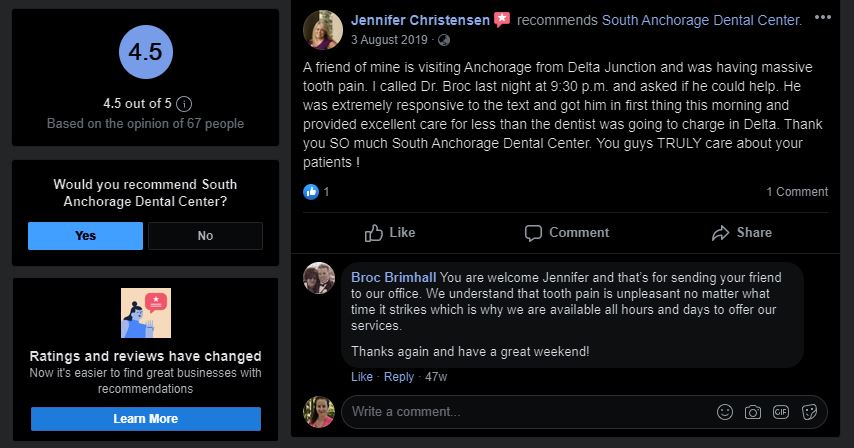
Here’s an example from our client, South Anchorage Dental Center:

Dental marketing

As you can see, there is a rating out of five, and a simple button people can select to recommend the dental practice to their friends. Anyone can click through and read the comments.

The other important thing to note is the response. Dr. Broc Brimhall is one of the dentists working at this office, and he responded promptly to acknowledge the positive review, thank the patient, and explain why the experience they had reflected the practice’s mission statement. This is a great example of best practice in managing Facebook reviews. It’s not every day a patient leaves a positive review, so if they take the time to do it, let them know that you appreciate it. It’s quick and easy and will show anyone else reading the page that you’re responsive and polite.

Read more: 10 tips for optimizing your social media presence

Optimizing your Google reviews

If you haven’t already set up a Google My Business profile, do it now. It’s a free tool that creates a business listing and ensure you can easily connect with patients (and prospective patients) across Google Search and Maps. For example, if someone types “emergency dentist near me” into the search bar, having an active profile means your practice will show up at the top of the results page.

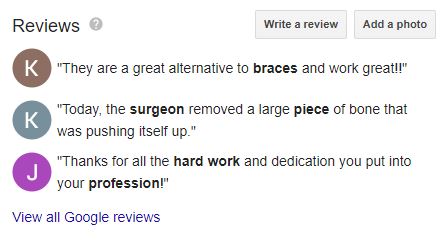
Google My Business results are displayed in a column on the right-hand side of the Google results page. They include a map, a rating out of five stars, a list of basic details (such as address, hours, and phone number), popular times, and then – you guessed it – a reviews section.

Here’s an example from our client, Mandanas Dental:

Dental marketing

People can then click through to read the full list. Just like Facebook, Google My Business providers the business owner an opportunity to reply to all comments. It’s a great way to reinforce your connection with people, increasing the chance that they’ll come back to see you again the next time they need a dentist. It’s also a great way to address concerns raised in negative reviews.

Stay tuned, because we’ll circle back to this a little later.

Read more: 10 tips to improve your website’s ranking on Google

Making website testimonials work for you

When a company displays testimonials on its website, we marketers call that “proof.” Essentially, that means proof your dental practice is as good as you say it is, validated by a third party.

There are a few different ways you can do this. For example, you can share things people have said in Facebook or Google reviews on your page, you can provide links where people can click through to read those reviews, you can ask patients to fill out a survey after their appointment, or you can reach out to long-term patients via email or text and ask them directly.

Once you have a range of testimonials, you may find it helpful to incorporate some of them onto highly-trafficked pages, such as your home page, about page, and contact page. Depending how many you have, you may even consider creating a dedicated reviews page.

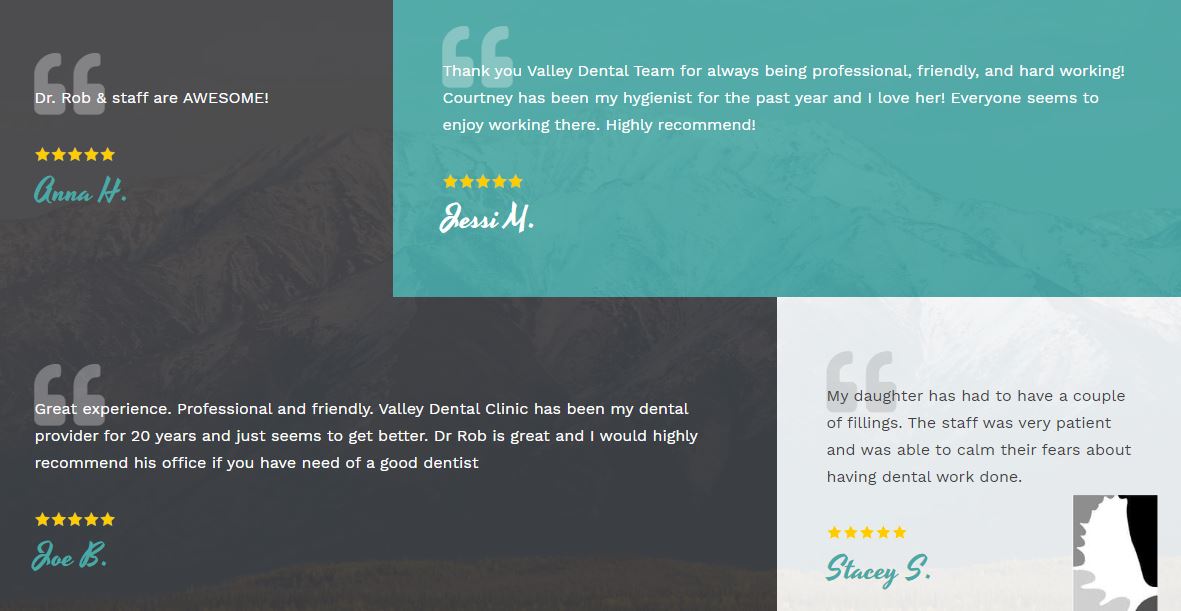
Here’s an example from our client, Valley Dental:

Dental marketing

This practice has provided quality family dentistry services in Wasilla, Alaska, for many years. Dr. Robert W. Robinson III (affectionally known as Dr. Rob) took over the practice from his father in 1999. Dr Robinson Sr. started the clinic back in 1973, so it has a proud history in the area.

They’ve collected a huge number of glowing reviews over the years, so it makes sense to display them front and center on the homepage. It’s one of the first things people will see, and it immediately creates a positive first impression that invites visitors to take action and schedule an appointment. Don’t underestimate the persuasive power of these simple statements!

Read more: 5 website design trends you need to watch this year

How to handle negative reviews

Unfortunately, at some point in your career, it’s inevitable that you’ll have to deal with a negative comment. Perhaps you dropped the ball. Perhaps your patient was having a bad day. Whatever the reason, it’s important that you can deal with them promptly and professionally, because many consumers read online reviews before engaging the services of a dental clinic.

Remember what we said at the start about trust?

The good news is that negative reviews aren’t necessarily bad. For one thing, they allow you to keep your finger on the pulse of public perception so you can proactively manage your reputation. For another thing, they allow you to identify areas where you can improve your business.

They also provide a great opportunity for people to learn about your character and your values. Yes, negative reviews can sting. It’s totally normal to feel a range of different things – disappointment, frustration, anger, injustice, and more. However, other people can see when you respond quickly and calmly, and offer to make things right. It gives them confidence that, since you valued that patient’s experience, you’ll value their experience as well and do your best to look after them.

Read more: 6 must-read tips to rocking your online reviews

So there you have it: managing reviews 101. If you’d like help managing your online reviews, or some advice about how to make them work for your specific circumstances, schedule an appointment. We’d love to discuss this with you over tea, coffee, or something stronger.

Social media is a great way for all kinds of contractors to develop and build their reputations. It’s perfect for local businesses looking to connect with local community members, because positive engagement – such as likes and comments – essentially equates to free advertising. The more people interact with your page, the more people will see it, the more leads you’ll generate.

The king of all social networks is Facebook, so we’re going to focus our discussion there, providing a few examples from our client SpitShine Gutter Cleaning, which is based in Anchorage, Alaska.

Looking to outsource your social media management? Schedule a free consultation.

Make sure your profile is complete

The most important thing to do in marketing a construction services business on Facebook is to make sure your profile is complete. That means filling out all the details about your services, prices, address, contact details, and website, to ensure people can find you when they need you.

A quick Facebook search is a great way to check that a business is legitimate, so it’s also really important to add profile and cover images so people can see straight away that you’re the real deal. Once you’ve set up your page, you can start to develop a marketing strategy.

Need help getting established? Read about our Social Media Management service.

Capitalize on Facebook video

According to SproutSocial, videos are increasingly becoming the most popular types of posts on Facebook, accounting for about 11% of all content. They garner up to 8 billion views per day! There’s a lot of interest, so how can you maximize the impact of your videos?

First, it’s important to remember that most Facebook users view content on their phone. Facebook reports that optimizing videos with this in mind has a 27% higher chance of creating brand lift than videos not designed to be mobile-first. This means shooting video as square (1:1) or vertical (9:16).

Second, about 85% of people watch Facebook videos without sound. That means the visuals are really important! The majority of Facebook users are on the platform because they want to catch up with family and friends and be entertained, so keep this in mind when you post content.

Here’s a great example:

https://www.facebook.com/spitshine/posts/4394702143880809

As you can see, it’s vertical, with a clear and simple caption and no need for sound. There has been a huge trend in recent years towards visually satisfying content – for example, seeing something organized, seeing something cleaned, seeing something complete, etc. This video capitalizes on the trend, because it’s just so satisfying to watch the dirt lift from the wall like magic.

“But what does it do for my brand message?” we hear you ask. As a general rule, we recommend 80% serving, 20% selling. That means 80% of your content should be interesting, informative, entertaining, or otherwise add value to people’s days in some way. Pieces of content like this are a great way to build awareness of your brand, because it’s very likeable. It doesn’t cost anything for people to like the post or tag their friends, which boosts your reputation locally.

Once you’ve built up enough trust with your local community members, you can start selling – for example, letting people know about limited time offers, new deals, and so on.

Need some help building confidence on camera? Read about out Video Marketing service.

Proactively manage your reputation

The best thing about Facebook is the opportunity it provides for you to connect directly with customers and prospective customers. You can deliver messages straight to their pockets, which is a great way to address concerns and comments. On top of that, it creates a sense of legitimacy and transparency, because people can see you’re a real person running a real business.

Every business has ups and downs. Sometimes things will go well, and you’ll get a bunch of five-star reviews. Other days, you may get some complaints. We’ve definitely been there – in fact, if you’re interested, you can read this article we wrote with six tips to rocking your online reviews.

Billy Forsyth, SpitShine’s founder, is really proactive about this. His business has grown exponentially this year, which has presented some challenges – for example, there are more jobs, and more team members, which makes it harder to guarantee the level of quality. He recently went live to address some concerns, and talk about the best way to make things right. It’s cool, calm, and compelling.

https://www.facebook.com/spitshine/videos/268658894388350/

He’s a busy business owner, so he doesn’t have time to sit and record a perfect video, but by doing a Facebook live while he’s on the move between jobsites, he invites the viewer into the conversation. The best thing about this video is it reinforces the company’s commitment to quality service, while reassuring viewers that it’s something he’s always striving to achieve in his work.

Read more: How much does it cost to hire a marketing agency?

Help customers solve problems

Modern customers have a world of information available at their fingertips, which means the internet is the first place they turn when they need to solve a problem. Facebook is a great way to make it as easy as possible for them to find you! The best way to do this is to post content showing yourself at work, so they can see exactly what you do, and how you can help them solve problems.

Take the following post as an example:

https://www.facebook.com/spitshine/posts/4372970059387351

It’s simple, and effective. If your gutters look like that, a) you’re going to have a serious drainage problem, and b) getting up there to clean them out yourself is clearly going to be dangerous. As a homeowner, your customers can precariously dangle close to the edge to try and clean them out, try their luck with a super long ladder… or call the experts. It makes the choice super simple.

The other great thing about this post is that it uses searchable keywords. The words “gutter cleaning” are in the company’s name, which is great, and the post itself reinforces the word “gutter” again. It means when people in the Anchorage area type terms like “gutter cleaning” into the search bar, Facebook is much more likely to list SpitShine in the results. Every little bit helps.

Read more: Is marketing the new sales?

Let people get to know you

We said it before and we’ll say it again: people like doing business with people. That’s why it’s so important to let your personality shine through your social media accounts. Yes, people want to see the amazing work you do, but they also want to see who you are as a person – especially since, as a contractor, you’ll be working in and around their home. It’s quite an intimate thing.

This is something Billy does really well. The post below is bright and positive, showing that he’s a hard-working dad looking to provide for his family. Including his wife and kids doesn’t necessarily sell gutter cleaning services, but it shows prospective customers he’s the real deal. You can see straight away that he’s a nice guy, which makes you much more likely to trust him.

https://www.facebook.com/spitshine/posts/4372927046058319

The key to successfully marketing a contracting service on Facebook is to be as consistent as possible. That means posting regularly, staying up-to-date with trends, and replying to all questions and comments as quickly as possible. At the end of the day, it’s simply an extension of your customer service, so it’s important that you make sure you create the right first impression.

Ready to get started? Schedule a free consultation.

Originally published on December 1, 2015. Updated on June 29, 2020.

The term “landing pages” is one you will hear fairly often in discussions about websites and marketing techniques. There’s a very good reason for that: landing pages can be one of the most valuable assets in your digital toolkit. So what exactly are they? And why do you need them?

Landing pages are web pages that visitors land on when they follow an offer and click through to your website. Designed to convert visitors to your website into leads for sales, landing pages will gather information about potential customers using a simple form.

There are two key ways that landing pages will help you.

  • Landing pages can gather information like email addresses as well as lead demographics, interests, and concerns. With this information your sales team can build strong relationships with leads and keep their focus on the most qualified contacts.
  • They can lead to higher conversion rates, which means more customers for you and more profit potential for your business. Landing pages are your digital representative twenty-four hours a day, seven days a week, helping your work as efficiently as possible.

Want to talk landing pages? Schedule a free consultation.

What are landing pages used for?

Landing pages
For more great landing page examples, check out this blog from Hubspot.


A perfect landing page is not a sales pitch asking for information that the visitor doesn’t want to give up. A well-designed landing page will convert at least 20% of its visitors into leads by guiding them and warming them up. Here are eight jobs landing pages can accomplish for you.

  1. Landing pages are an opportunity to persuade visitors that what you’re offering them has value equal to, or greater than, the information you’re asking from them.
  2. Landing pages offer grounded, real benefits. Not abstract features. When you have a problem, you need the solution and the features don’t really matter as much.
  3. Landing pages help your visitors feel like they’re understood. It can show them that you know about their problem, you understand their frustration, and you can help them. Understanding leads to empathy. Empathy leads to connections.
  4. Landing pages will give your lead something of value in exchange for personal information. But it won’t take a lot of their time. They can get a solution or learn something new and move on with their busy schedule.
  5. Landing pages provide social proof of your value. Your leads will feel safer knowing that other people have done what they’re thinking of doing and benefitted from it.
  6. Landing pages will trigger one of the six psychological principles that influence people – scarcity. Scarcity will encourage them to act sooner rather than later.
  7. Landing pages point out a gap in the visitor’s knowledge and then provide a way to fill it. Curiosity can be piqued and your visitors will develop a need to know more.
  8. Landing pages make your leads feel important. By showing them that what you offer is important information or a valuable solution you are telling them that by association they are important and valuable as well.

Read more: How to create a high-converting landing page.

How to design landing pages

Landing pages come in every different shape, size, and structure imaginable. There are no rules when it comes to design, but the best landing pages have a few important elements in common:

  • Strong keywords to ensure the page is as searchable as possible.
  • A simple layout that ensures visitors can find what they need in seconds.
  • Educational and persuasive content that answers questions they may have.
  • An engaging design with helpful headings and images that looks sharp.
  • Clear calls to action that make it easy for visitors to take next steps.

If you’re new to the idea of landing pages, there are a couple of ways you can proceed.

If you plan to build the landing pages yourself, we strongly recommend A/B testing to see what design elements are most persuasive. Play around with the layout, color, and images. Try a couple of variations in the headings and text to see what resonates best with your readers. Be prepared to make a few adjustments here and there to ensure your pages are working as effectively as possible.

It’s important to remember that one size doesn’t always fit all. Running a variety of different offers, targeted to a variety of different demographics, will broaden your reach exponentially. Studies have shown that having more than thirty landing pages on your website will generate 7x the number of leads than websites with less than ten. Different people like different things, and keeping this in mind will ensure you target all the different elements people will find persuasive. The results can be huge.

You may also want to consider bringing a marketing agency on board. Marketing agencies design custom landing pages all day, every day, and they’ll have a pretty good idea of the types of things that work best in your industry. Outsourcing the design and development of your landing pages also means they can run things like A/B testing for you and make all the necessary adjustments, which means you can invest your time and energy into other parts of your business.

Read more: 5 website design trends you need to watch.

Why landing pages are important

As we said right at the start of this blog post, a landing page is essentially your digital marketing representative. It can help you convert leads every day of the year, even while you’re doing other things. Done right, they’ll become a key component of your digital sales funnel.

Within seconds of viewing a landing page, a visitor should have enough information to decide if they want to accept your offer and continue through the buyer’s journey with you. This split-second decision can mean more leads and conversions or it can mean more bounced visitors to your site.

If you don’t have enough landing pages, then you’re missing out on a plethora of opportunities to gather valuable information on potential leads. So what are you waiting for?

Ready to get started? Schedule a free consultation.

Originally published on December 11, 2015. Updated April 3, 2017, and June 25, 2020.

Digital marketing has a lot of jargon, and when you first hire a marketing agency, you’ll probably hear them mention something called a landing page. Rather than making you sit there, scratching your head, let’s quickly run you through the basics of how to create a high-converting landing page.

What is a landing page?

At its most basic, a landing page is any page where you send your website visitors so that you can offer them something in return for information. Generally, it’s designed to rank high in Google results for a targeted keyword search – for example, if you’re trying to get students to sign-up for a course, you’re trying to get homeowners to sign-up for a special deal, you’re trying to get investors to sign-up for a real estate seminar, you’re trying to get local residents to sign-up for a competition, or you’re trying to get customers to sign-up for something like a free consultation or free download. You can also share it on your social media posts so people go straight to the page that has the information they need.

They keyword here, in case you haven’t noticed, is sign-up. 

A landing page is a sales page. It needs to contain all the details of whatever product or service you’re trying to sell, presented in a persuasive way that will make people want to sign-up and learn more. When they sign-up, they become a lead. They’re passing along some personal information, including their name and contact details, and inviting you to begin a conversation with them. This practice is called inbound marketing, because instead of chasing a customer, you’ve provided the information they need and they’ve come to you. This makes them much more receptive to your message.

Still with us? Basically, a landing page is a standalone sales page that will create a positive impression of your company, build trust between you and the visitor, and increase your conversion rates.

Ready to get started? Schedule a free consultation.

How do landing pages convert sales?

Another term you’ll hear marketers casually throwing around is conversation rate. A conversion rate is the percentage of people that are converted from visitors to your site into qualified leads. This is what we talked about before, when they sign-up and invite you to begin a conversation.

How to create a landing page?A landing page can achieve high conversion rates at any stage in the buyer’s journey. But in order to do that, you’ll need to identify which stage your target is at, create an offer that will help them, and write your page using content and context that is appropriate to their position.
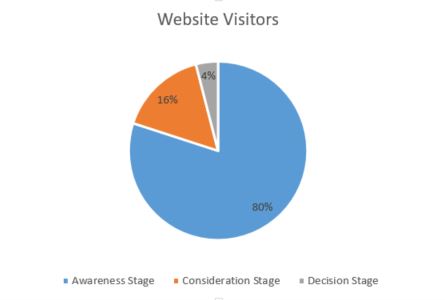
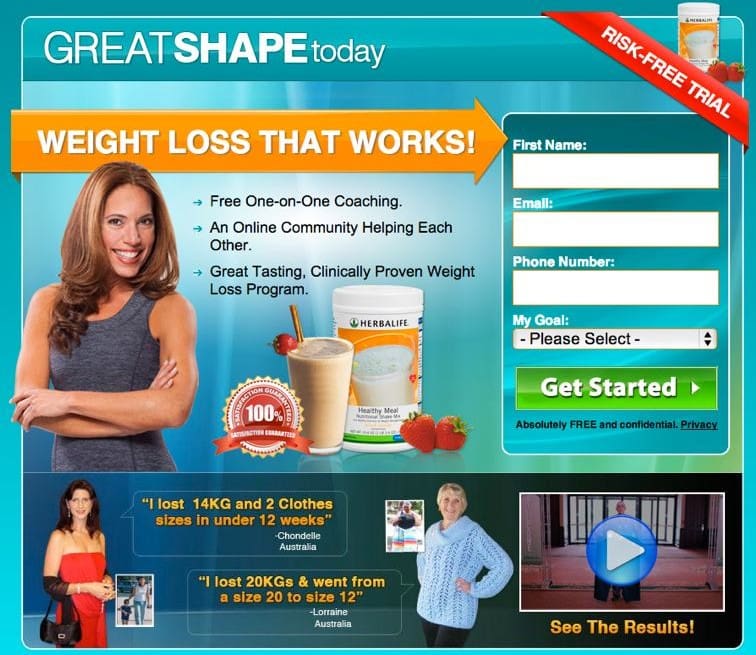
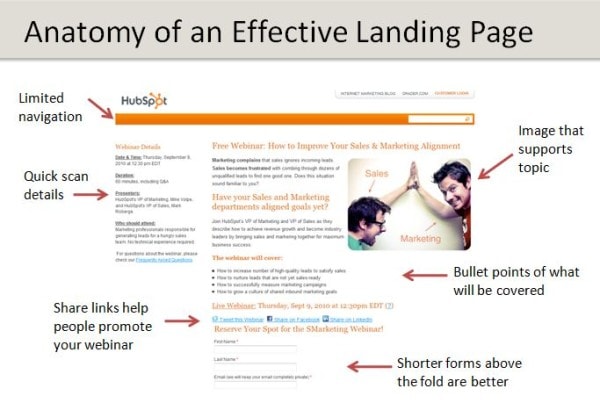
Since the vast majority of website visitors are in the awareness stage of the journey when they visit your page, more of the landing pages you create will focus on them. You’re inviting them to take the next step and engage with you. Once they engage with you, you can educate them about why they need you. Once you educate them, you can work toward driving the sale. This process is known as the sales funnel, which is another term you’ll get used to hearing.

Learn more: Is marketing the new sales?

How do I create a landing page?

Landing pages come in all different sizes and shapes, but when it comes to creating a high-converting landing page, you’ll start to notice a few basic elements that are consistent across the board. Stay with us, because we’re about to run you through a few real-life examples so you can see what we mean.

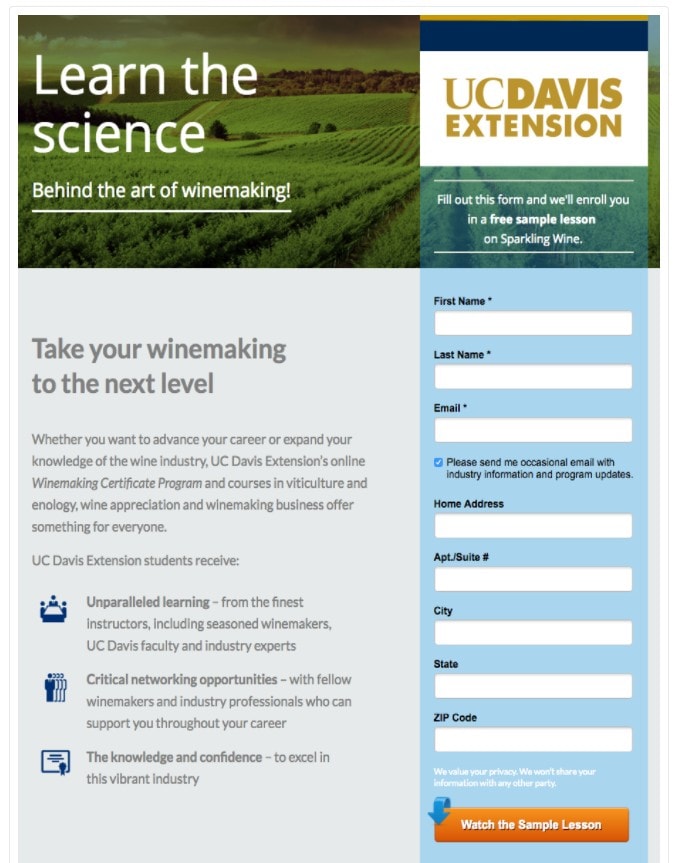
  • Unique offer: Your landing page should have an attractive and unique offer, designed to solve a problem, answer a question, or give knowledge. Your headline should be clear and precise. If you feel that you need to add more information you can always add a sub-header. Example: Here’s a fun and unique offer from the University of California, DavisHow to create a landing page?
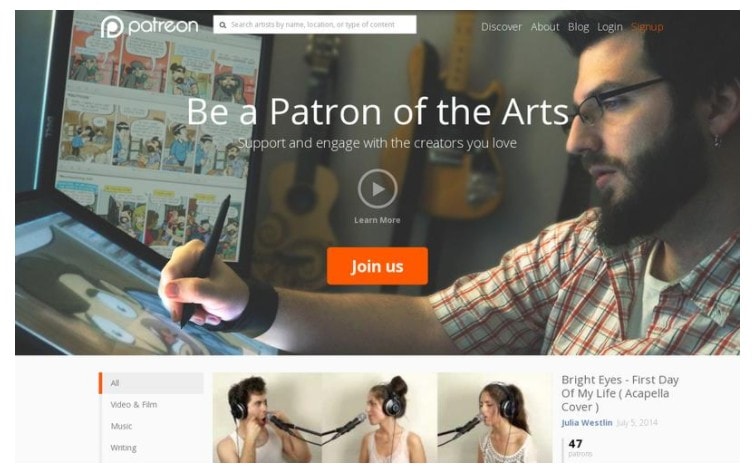
  • Related image or video: The image you choose for your landing page should clearly relate to your offer. A short video is a great chance to show your product or offer a sample of your expertise and knowledge. Example: Check out this powerful landing page from Patreon.How to create a landing page?
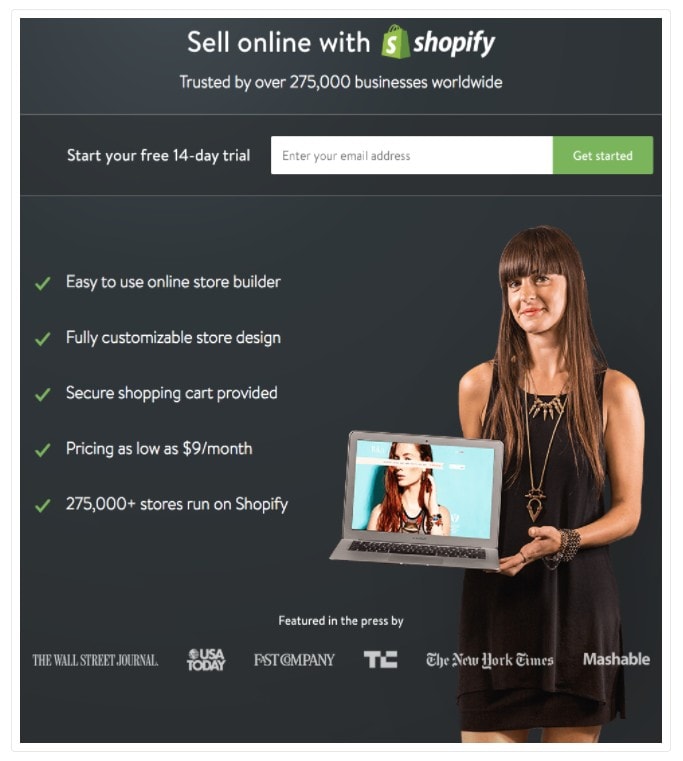
  • Benefits and value proposition: Make sure your landing page include a short explanation of how this offer can make your target audience’s life easier, solve their problem, or answer their question. Try to avoid the features of your offer and focus on how the features will benefit your customer. Example: This example from Shopify does a great job establishing value. How to create a landing page?
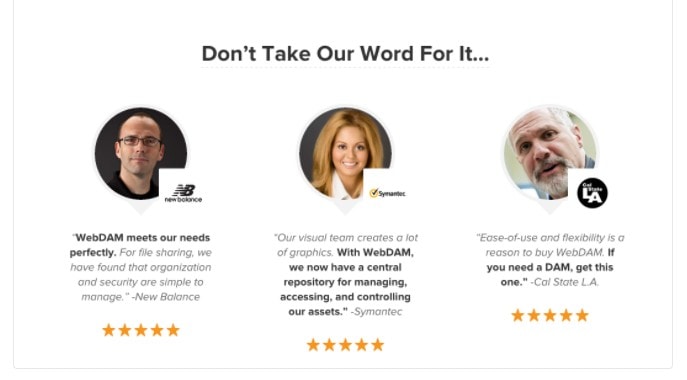
  • Trust elements and social proof: If you want someone to give you their personal information, or their hard-earned money, then they need to trust you. Your landing page should show visitors that you are qualified, trustworthy, and in demand. Example: Add aestimonials, awards, or press coverage. Check out this great example from WebDAM.How to create a landing page?
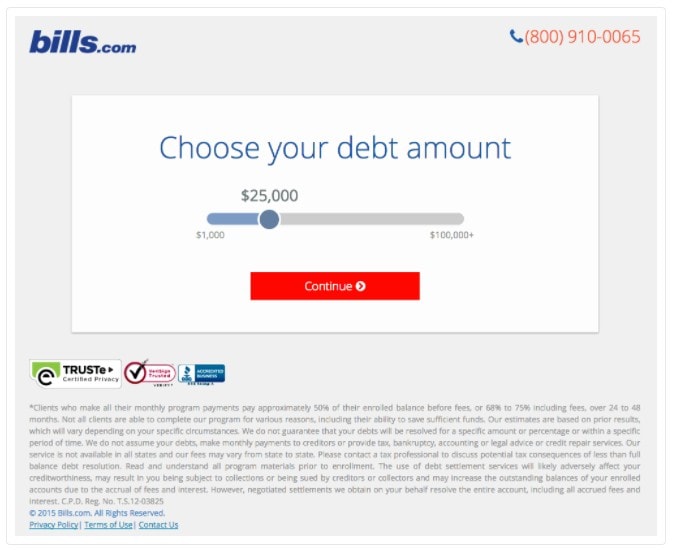
  • Simple structure: Your landing page should be able to answer a vital question within the first few seconds that it’s viewed. Your potential customer should be able to see what the offer is, how it can benefit them, why the need it now, and how they can get it. To make this easier you want to avoid clutter on the landing page. Example: Bills.com.  How to create a landing page?
  • Opt-in form: Make sure that you’re customizing the the title and submit button on your landing page to match your offer. Limit your form fields and only ask questions that will help you learn about your lead and what they want. Remember that the information that you ask for should be equivalent to the value of what you’re offering. Recent studies have shown us that a two-step opt-in has a higher conversion rate than the traditional single page. A single page opt-in is one in which your landing page also contains the opt-in form. With a two-step opt-in the first step is to click on a link to show interest and the second step is to opt-in and provide information. Example: This great opt-in page keeps it simple and clear!

How to create a landing page?

  • Sharing options: Make sure that your landing page is easy to share. Add buttons from your favorite social media sites! It’s highly likely that if your visitor finds your offer helpful then there is someone else within their social circle that will also benefit from it.

How to create a landing page?

What are landing pages used for?

There you have it! Landing pages are a simple and powerful tool to invite people to start a conversation with you about your product or service. Deciding on a strategy and structure can be a little tricky, so you may want to consider hiring a professional marketing company. They’ll refine your sales funnel in no time, so you can increase your conversion rate in no time.

Have questions? Give us a call and let’s get started.

It’s time to scale your business. Congratulations! It’s taken a lot of hard work, paired with many long hours, endless cups of coffee, creative problem solving, and commitment to get to this point. Now that you’ve entered a growth phase, it’s time to think strategically about next steps.

The best way to generate new leads and convert sales is to invest in marketing. The construction industry requires a unique approach, due to the large investment typically required to start work on new projects, which is why trust and transparency must come first in any strategy you implement.

Here, we’ll run you through a marketing plan tailored for construction companies.

Want to skip ahead? Schedule a free consultation.

Digital marketing 101: Strategizing for growth

There are lots of different elements that go into a successful digital marketing campaign. Historically, sales have been driven by word of mouth. You did a great job on someone’s home, so they recommended you to a friend, who recommended you to a cousin, who recommended you to a grandparent, who recommended you to a neighbor. Great! You’ve had jobs lined up back-to-back for a whole year… and then the internet came along and changed sales funnels forever.

Today’s client has access to a tremendous amount of information, and it’s all available at their fingertips. According to Think With Google, 53% of people say they always do research before they buy to ensure they’re making the best possible choice. If you don’t have a strong online presence, you’re automatically excluding more than half of your prospective client base.

A great website will form the basis of your entire construction marketing campaign (you can read more about that here). Once that’s up-to-date and running well, you can look at marketing services. Typically, that means a combination of digital advertising, social media marketing, and content marketing (this can mean a few things, but we’re going to focus on video) to ensure as many people know about you as possible. These will hit three key pillars: reach, engagement, and transparency.

Also Visit: construction contractors near me

Maximizing reach with digital advertising

When we talk about digital marketing, we mean Google Ads and Facebook Ads. These are awesome tools when it comes to building brand awareness in your community, because they allow you to target the types of people most likely to utilize your service. For example, if you find that most of your business comes from college-educated women aged 40-45 with young kids, living in your city, you can select these options in the back end and your ads will be distributed accordingly.

Both Google Ads and Facebook Ads operate on pay-per-click (PPC) models, which can be very cost-effective. You can set a budget, a number of days, and a maximum amount you’re willing to bid per click. After that, the price depends on the amount of competition in your local area.

You’ll need to include a click-through link for each ad you make, so direct traffic to the most helpful page on your website to maximize the chance of the digital passer-by becoming a genuine lead. If your goal is brand awareness, your homepage is a great option. If you’re showcasing a particular service, link to your services page. If you have a special offer, create a dedicated landing page.

There are a few different ways you can configure your ads to maximize their impact. Google Ads, for example, can be created with either search of display functionality. Search ads are linked to keywords – they’re they first couple of results that pop up at the top of every results page. Display ads, on the other hand, appear as visual ads on Google assets all over the internet.

Where possible, we recommend A/B testing both Google Ads and Facebook Ads so you can optimize the wording, imagery, and call to action to ensure your getting the best value.

Read more: Learn about Google Ads or Facebook Ads in greater detail

Boosting engagement with social media marketing

Once your website is up and running, you can also develop a social media strategy. Social media is great, because you can keep you finger on the pulse of what’s happening in your community and connect directly with customers (and prospective customers) in a casual and fun way.

It’s perfect for the construction industry, because it capitalizes on people’s natural nosiness. Everyone wants to know what’s going on in their area, and you can use this to your advantage if you factor curiosity into your strategy. Keep people informed. Give them a sneak peek into new developments. Let them know about permits that have been approved and invited them to share the experience when you break ground on new projects.

Social media is a beast that needs to be constantly fed. In a perfect world, that means daily updates, but that might not be practical for you. To get the most value for your time, we recommend putting a bit of thought into choosing the platform (or platforms) where you can maximize your impact.

A Facebook page is essential. This is the largest social media platform, particularly among homeowners, and it’s a great way to connect with members of your community. If you do a lot of commercial projects, then we recommend a LinkedIn page as well. This will allow you to connect with other business leaders and key decision makers, ensuring your finger is on the pulse of all upcoming RFPs in your area. If you specialize in some way, for example, with architecture or design, you might also consider an Instagram account as a way to showcase your craftsmanship.

They key to social media success is consistency. Consistency, consistency, consistency. This means consistently posting new content, as well as consistently interacting with your community. Reply to all comments on your own page, and then like and comment on some posts from other people in your area. Allocate a few minutes each day to click and scroll to boost your engagement.

Want to outsource this? Read about our social media management service

Highlighting transparency with content marketing

When was the last time you read an entire blog? Okay, you’re reading this one, but only because you’re invested in the topic and looking for specific advice. Video is the way of the future, and no digital marketing strategy is complete without video elements. Why tell your customers something if you can show them? Video conveys authenticity and transparency, because it allows your clients to get an idea of who you are and what you’re about. It proves your legitimacy.

Videos can be as formal or as informal as you like, but they do need to look good. You can stream a live video from a jobsite on your mobile phone for free, or hire a professional videographer to help you shoot a few videos to feature on your website and social media platforms. Either way, its important to ensure you can be seen and heard, which means you need to think about light and sound. You also need to think strategically about what you’re going to say. Indulging people’s curiosity is great, but rambling is not. Try to keep each video focused on one main point.

Need some help to get started? Schedule a free consultation.

Exceptional customer service should be at the heart of specialty construction marketing.

We’re often asked if inbound marketing works for specialty construction companies, including builders, roofers, painters, landscapers and more. The short answer is yes, because customers use the internet as their primary tool to research services before making decisions.

The secret to making it work is to think of it as a customer service tool more than a sales tool. More often than not, customers will come to you with a problem. For example, they may need to make space for their growing family, update a kitchen or bathroom to increase functionality, or repair a leaking roof or damaged wall. Your digital presence should be dedicated to helping them.

We get it – marketing is probably the last thing on your never-ending to-do list, but it’s a really important thing to consider when you’re planning to scale your business.

Stay tuned and we’ll run you through the basics of construction marketing strategy.

Want to talk to a real person? Schedule a free consultation.

Step 1: Refresh your website

If you have a website, great! We recommend overhauling it every 2-3 years to ensure all the information is up-to-date, that the look and feel is fresh and accessible, and that all the technology is working properly. A great website will form the foundation to your entire marketing strategy, because it provides prospective customers with the chance to make sure you’re the real deal.

If you don’t have a website, no problem! It’s entirely possible to build a website yourself, but it’s a pretty big undertaking and you’ll need to get up to scratch with the technical side of things pretty quickly. We recommend hiring a professional marketing company, because they’ll be able to get you up and running much quicker, while optimizing the content for readability and SEO.

(Don’t worry, we’ll explain SEO in a minute.)

They’ll expect to see an informative home page, an about page that explains who you are and what you’re about, and a service page that explains exactly how your business can help them. You’ll need to have a clear and simple contact page, to make it easy for people to reach out to you, and we recommend listing your phone number on every page so they don’t have to search for it. Basically, it’s a digital store front, and you want to create the best first impression possible. Focus on creating an exceptional experience right from the start.

Green-lighting a job in the construction industry, whether B2B or B2C, usually requires a sizeable investment, so customers will want to know who you are and why they should trust you. To that end, we recommend including some photography – people are much more likely to trust a website with photographs, because it’s easier to confirm that they’ll be dealing with a real person.

Read more: 5 website design trends you need to watch this year

Step 2: Register for Google My Business

You may not have heard of Google My Business, but it’s an absolute essential. It’s a free tool for businesses to manage their online presence across Google, which includes both its Search and Maps functionality. This is really important when it comes to local leads.

For example, if someone Googles “general contractors near me,” the search result will include a map of your local area with pins on all the relevant businesses in the area who have Google My Business. They’re generally listed in order of SEO-friendliness (there’s that word again, we promise we’ll get to it soon!), with an option to click through to the website or get directions.

According to BrightLocal, 64% of consumers use Google My Business to find addresses and phone numbers of local businesses. It’s the modern version of a telephone book, and an absolute no-brainer in terms of generating new leads. Google says that businesses with complete profiles are likely to get seven times as many clicks as those without.

Aside from appearing in search, Google My Business is also a great way to let people know what hours you work, when you’re closed for holidays, updates that affect your business (the COVID-19 outbreak is a great example), as well as photographs of your work to increase your credibility. Communication is the key to good service.

Importantly, it also has a reviews function. Asking happy customers to write a quick review is also a great way to improve your credibility, and may boost leads.

Remember, this is about serving the customer, so you need to make it easy for them.

Read more: 10 tips to improve your website’s ranking on Google

3. Boost your SEO

A-ha! Here’s that paragraph we promised at the start. SEO means “search engine optimization,” and it refers to a group of strategies designed to make sure people can find you when they need you. The easiest way to do this is to ensure your website ranks on Google for related searches.

So how do you do that? You need to find out all the keywords people are likely to type into Google to find businesses like yours – for example, general contractor, plumbing services, electrical services, tiling services, and so on. One great way to do this is by typing a few different options into the search bar and seeing what Google Autocomplete returns. You can also use tools like Google Trends to see what topics are ranking in your area and compare different words to see what’s stronger.

Once you’ve identified the keywords, you need to make sure you include them on your web pages. Again, they’re like signs at the front of a store. What’s inside? What do you offer?

Another strategy that can significantly boost your SEO is to start a blog that answers commonly-searched questions. For example, how to fix a leaking tap? How to fix a hole in the wall? How do I select the right contractor? How much do contracting services cost? These serve two purposes: first, they include searchable phrases that might help your website rank higher on Google’s results page. Second, they immediately position you as being an expert and your business as being helpful.

This shows prospective customers that your customer service is top-notch, right from your very first interaction with them. Don’t worry about giving information away for free, the truth is that talking people through common problems step-by-step simply helps them understand what’s required before they go ahead and engage your services. Transparency is the key to trust.

Read more: How to write a blog that will help grow your business

Digital customer service

Nothing replaces a personal connection and a beautiful construction job. However, with more customers searching for local services online than ever before, it’s a digital marketing strategy is just as important when it comes to growing your construction business. A credible website, a current Google My Business listing, and a helpful blog will give prospective customers a taste of the service on offer and encourage them to take the next step toward engaging your services.

And who knows? It might start with patching a hole in a wall, then turn into a new deck, a kitchen renovation, and a whole new build. The possibilities are limitless.

Ready to scale your business? Schedule a free consultation.

Ahh, new customers. The best thing in the business world. It’s a surefire way to tell your marketing strategy is working and that your business is on the cusp of scaling up. Exciting times!

Get your marketing strategy right, and each new customer could become a lifelong patient. Do it wrong, however, and you may find them walking out the door (never to return) – or worse, leaving a negative review. Marketing is all about customer expectations. You need to find something that ignites their interest at the start, then ensure you teach them enough about who you are and what you offer to ensure nothing takes them by surprise when they actually come to see you.

In this post, we’re going to take you through the fundamentals of branding, which includes finding your niche and separating yourself from your competitors. We’ll use two of our clients – South Anchorage Dental Center and Mandanas Dental – as examples. As you’ll see, they both operate in the competitive market of Anchorage, Alaska, but cater to vastly different clientele.

Prefer to chat over the phone? Schedule a free consultation.

Fundamentals of dental branding

First, let’s quickly compare the two dental centers.

South Anchorage Dental Center (SADC) is a thriving dental practice that specializes in family dental care and convenience. The two dentists, Dr. Broc Brimhall and Dr. Derek Green, use cutting-edge techniques to provide a vast number of dental procedures, enabling patients to receive all their dental needs under one roof, and they love working with kids. Its branding is blue-toned, which is calming, with a uniquely Alaskan logo that includes a Dall sheep. Its website includes plenty of images, designed to create a friendly look and feel that welcomes the whole family.

Mandanas Dental is run by Dr. Owen Mandanas, who worked in general dentistry for 17 years before pivoting her practice towards integrative dentistry. That means she acknowledges the significant impact oral health has on the entire body, and looks to help patients find the safest and most natural solutions to meet their needs. She is incredibly passionate about wellness, and can helps patients with issues such as sleep apnea. Her branding is green, purple and orange, which creates a feminine and earthy tone. Her logo represents the sun and the mountains, and the website includes lifestyle shots – such as kayaking – to emphasize the focus on wellness.

As you can see, branding tells an entirely different story for each business.

Both are exceptional dental practices, with a commitment to providing the best care possible, but they have different focuses that are likely to align with different types of patients. Branding is important, because the goal of marketing is to help businesses connect with clients and meet their needs. That means we need to ensure the right patients find the right practice.

Read more: Why is corporate branding important? (VIDEO)

Dental marketing

Finding your niche in business

So how do you develop a brand that tells your dental practice’s unique story? How can you make sure you stand out from your competitors? The answer is to find your niche.

The best place to start is with your company’s mission statement. By this, we don’t mean airy statements filled with nice-but-vague buzzwords. What is your purpose? A mission statement should be a simple and clear sentence that drills down to the heart of why you’re in business. What matters to you and why? Why are you a dentist? What aspect of practice interests you most?

Once you’ve identified your vision, you can start marketing. You can develop business goals that align with the purpose set out in your mission statement. You can develop clear and actionable steps to achieve those goals. You can define your company culture, which will empower your team members to make decisions and work to the best of their abilities. You can grow.

You can also develop messaging that ties it all together.

Take SADC’s mission statement: “Come as a patient, leave as family.” It says a lot about the values of the practice, they kind of experience they strive to achieve, and the type of people they want to attract. It also shows their commitment to helping patients achieve lifelong oral health.

The Mandanas mission statement is equally strong: “Where healthy living, healthy breathing, healthy sleeping, and dentistry meet.” It’s very compelling for clients interested in integrative dentistry, because it clearly identifies the practice’s focus on holistic dental treatment.

As you can see, both are simple and innately practical. Tying your marketing strategy back to this statement will ensure your messaging is clear and easy for prospective customers to understand. They’ll be able to quickly figure out whether you’re the right fit for them or not before making contact, which will make sure your leads are as highly-qualified as possible.

Read more: 3 reasons why having a mission statement matters

Bringing your brand to life on social

Once you’ve found your niche, created your mission statement, and developed your brand, it’s time to start sharing your brand story with the public.

The best way to do this is on social media – and for the purposes, of this post, we’re going to focus on Facebook. It’s the biggest social media network in the world, and its focus on engagement and connections means it’s perfect for local businesses. It also has a sophisticated advertising platform available in the form of Facebook Ads. (We’re not going to discuss that today, but you can learn more here about what Facebook Ads are and how you can use them.)

Successful social media strategies require consistency. Regularly sharing interesting content with your audience maximizes the chance that people will see it, interact with it, and click through to learn more. Once you have them on your website, you can convert them into a lead. It may start slow, but trust us when we say your audience will grow over time.

The next question is what to actually share. You may find it helpful to develop a content strategy, planning out posts a week, a month, or even a few months ahead. This will ensure you always have something up your sleeve and that everything you post ties back to your overarching content strategy. As a general rule, we recommend an 80/20 rule – 80% of your content should serve, while 20% of your content should sell. People use Facebook in their free time, and no-one wants to have brand messages shoved down their throats. They do want to be informed and entertained, however, so keep this in mind when you’re developing your content plan.

Read more: 10 tips for optimizing your social media presence

It’s also important to make sure your content is visually captivating. You’ll only get a second to catch someone’s eye as they’re scrolling through their feed, so we recommend using video wherever possible, and ensuring every other post includes an image.

Here is an example so you can see what we mean:

https://www.facebook.com/ladydentistanchorage/posts/10158870171176800

It’s also important to capitalize on newsworthy events that affect your patients. This is a great way to “sell” while still being incredibly helpful and making sure they don’t miss out on important dates – for example, July 1st, which is when Medicaid plans renew.

Here’s an example of a really helpful prompt with a great image:

https://www.facebook.com/south.anchorage.dental/posts/1600629253438585

Now you have enough information to get started! If you’d like to talk to the experts about making your dental center stand out from the crowd so you can grow and scale your business, give us a call. Our branding and social media marketing experts would love to help.

Ready to start? Schedule a free consultation.

Trust is the cornerstone of the financial industry, which means customers want to be sure of a few things before they engage your services. At the top of the list are expertise, transparency, and accountability. They want to know who you are and what motivates you.

That’s why referrals have always been, and will continue to be, the most powerful form of marketing in this sector. They’re a huge source of new business because they prove that your company can be trusted to deliver services that will meet the customer’s expectations.

Essentially, someone else has done the hard work and taken the leap of faith for you.

However, the next generation of consumers are a little bit different. They’re digitally native, having grown up with a wealth of information at their fingertips. They’re confident and capable at doing their own research online, which presents exciting new marketing opportunities.

Here, we’re going to run you through three effective finance marketing strategies you can use to build trust in your community, boost your reputation, and grow your customer base.

Prefer to chat in person? No problem, please schedule a free consultation.

1. Capitalize on word of mouth

As we already know, referrals are incredibly powerful in finance marketing. There are a few different ways you can utilize them to enhance your marketing strategy.

For starters, why not offer a referral incentive? American Express is a great example of this. The company offers two types of frequent flyer deals: a sign-up bonus for new customers, and a referral bonus for existing customers who recommend and convert new customers. All they have to do is share a link generated through their account, and boom. Referral. It’s a genius idea, and a great way to expand the circle of trust around each customer.

It’s also important to make sure you get written referrals, in the form of testimonials and reviews. These are incredibly value to modern consumers, who will inevitably scope out your website before reaching out to you directly. There are a few ways you can incorporate them into your strategy:

  • Add a testimonials page to your website and include comments from customers.
  • Ensure your Google My Business page is up-to-date and check the comments frequently.
  • Share snippets of testimonials/positive customer feedback on your social channels.

Make it part of your standard business practice to ask for customer feedback at the end of every project. Positive feedback is great to share, while negative feedback is a helpful tool to improve the way you do business in future. It’s a win-win situation and a powerful way to build credibility.

Read more: Start building trust with your community through finance marketing

2. Automate your sales process

Automation may seem like a strange recommendation. How can that help boost your business? The truth is that it’s possible to make your website make money for you while you sleep. Automating your processes means it will act as a 24/7 sales representative, constantly generating new leads.

The best place to start is by auditing your website. Is it up-to-date? Engaging? Is the information helpful? Does it look modern? Does it accurately reflect your brand story? Is there a strong call to action? How hard is it for a customer to take the next step to doing business with you?

Generally, a customer will enter your sales funnel in one of two ways:

  1. They’ll be recommended your services either directly through word-of-mouth, or indirectly if someone in their circle engages with your online content and causes it to enter their feed. In this case, they’ll enter your digital ecosystem through Facebook or your homepage.
  2. They’ll be actively looking for help with a problem, in which case they’ll likely use a social media platform or a search engine to find financial services in their area. In this case, they’ll enter your sales funnel through a search result, e.g. Google My Business or a blog post.

Once they’re on your website, the ball is in your court. The most important thing is to provide helpful information that helps answer their question or address their problem. That will immediately create a positive impression, and encourage them to take the next step toward fixing it.

Every page on your website should invite them to take action. It doesn’t matter what this is – for example, they can schedule a free consultation, sign-up for a newsletter, enter their contact details into a form and receive a free PDF, and so on. They key is to build enough trust that they’re willing to part with some personal information, such as an email address, and invite you to respond.

You can also take steps such as installing chatbots to answer frequently asked questions on the spot, without having to be constantly logged into your website, and create dedicated landing pages (complete with video) for specific search terms to create a personalized experience.

Automating this process means every customer’s journey is smooth from the start.

Read more: Anatomy of a high-converting landing page

3. Content, content, content

Content marketing is a great way to convert searchers into new clients, which is why we recommend it as part of every comprehensive finance marketing strategy. There are a few reasons for this.

First and foremost, it helps your website attract the attention of search engines, because it uses many combinations of keywords that help answer common search terms. This is an excellent way to connect with people who are avidly searching for the services of businesses like yours.

Second, it helps establish your credibility as a thought-leader in your field. Show prospective customers how knowledgeable you are by answering frequently asked questions, offering your thoughts on industry developments, letting them know about new opportunities, and so on.

Third, it keeps your website fresh and bolsters your efforts on other platforms, such as social media. Facebook and LinkedIn are always hungry for new fodder, so if you provide information that is interesting and helpful, it will generate engagement from your community and help build awareness of your brand. This will ensure you’re top-of-mind when they’re looking for financial advice.

Fourth, it gives you great advertising content. If you’ve written a stellar blog that answers a trending question, boost it with Facebook or Google Ads. Both work on a PPC model, which means they can be very budget-friendly, and will put your content in front of many sets of fresh eyes.

Content can be done in many different forms, but for financial services marketing, we recommend informative blog posts of 1200+ words as well as interesting explainer-style videos around 3-5 minutes in length. That way, your content will be long enough to be authoritative, but short enough to be easily consumable. Ensure you write catchy headlines to capture people’s attention.

Read more: How to write a blog post that will help grow your business

Finance marketing strategy in a nutshell

As we said at the beginning, successful finance marketing campaigns focus on building trust with prospective customers. That means you need to take every opportunity to project your authority in the field and make sure people understand that you can answer their questions.

Each one of these strategies will help you generate new digital leads; however, used together, they provide a comprehensive roadmap that will take your next marketing campaign to a new level.

Ready to get started? Schedule a free consultation.

Good dental centers are built on great reputations. If you help someone with an emergency root canal, make a child’s first visit to the dentist fun, or solve a problem during a routine check-up, your patient will have a positive experience. You can bet your bottom dollar they’ll tell their friends. Word of mouth is the oldest form of marketing, and it’s incredibly powerful.

When the time comes to scale your business, however, you’ll need to develop a digital marketing strategy. This is an essential tool when it comes to bringing in more clients.

Here are five genius ways to grow your practice quickly and easily.

Just want to talk to an expert? Schedule a free consultation.

Content Marketing 

Imagine a world where your practice is at the top of every Google search. Sounds good, right? That’s what content marketing aims to achieve. Here are the core elements.

Read more: Learn the basics of content marketing.

Blogging 

Blogging is one of the most powerful tools for growing your client-base as a dental practice. Its value comes in its longevity. A post written today could still be a key part of your sales funnel years from now. If you’re wondering how a blog can be part of a sales funnel in the first place, let us explain.

First, it’s an effective way to add combinations of keywords to your website to boost the search engine optimization (SEO) of your website, which builds awareness of your practice’s brand. It’s also a fantastic way to answer frequently asked questions and help people understand that you can help solve their problems, which will generate leads. Content lets your brand personality shine, which ensures people have a positive experience while interacting with your business.  

Blogging, building awareness, generating leads, and demonstrating brand personality all help to draw potential clients to your website, where they can learn about the services you offer. The last of these can be particularly beneficial for dental practices, as many people feel uncomfortable visiting a dentist, so being able to show some personality and warmth in your blogs can alleviate that.  

Read more: Learn the tried and tested blogging technique we teach our clients.

SEO 

SEO (search engine optimization) should be a major focus of your digital marketing strategy if you want to be successful. It makes your content easy to find on search engines, which allows customers to find you when they need your products and services, which generates leads and allows you to grow your dental practice! There are five key components we use for SEO for our clients.

The first is keywords, the terms people search when they are looking for information. In addition to the obvious single words that you may be familiar with, we also use “long-tail keywords.” These are actually phrases, such as “SEO for dental practices,” and are terms that people are likely to search.

The second key component in SEO is called backlinking. Search engine use links as a sort of referral system. Think of it as the website posting the link is saying that the website the like goes to is worth checking out. This helps webpages rank higher in search results. Now that we’ve pointed it out, you might notice the links scattered throughout this post.

Read more: Find out the other three components of our SEO strategy here.

Social Media 

Social media is now an essential element of every successful digital marketing strategy. It is an easy way of connecting directly with your client base and can allow you to provide a more personal touch. It also opens up a two-way dialogue with your clients, allowing them to provide criticism and feedback of your service, which is invaluable when you want to grow your practice.

There’s an ever-growing number of social media platforms and the way they are best used varies between them. The biggest is obviously Facebook, however, its user-base tends to be older now as younger people gravitate towards newer platforms. Among these are Twitter and Instagram; Instagram in particular is a great platform for what we call “influencer marketing,” which involves people with lots of followers making honest reviews about a product or service in return for payment or free goods/services. The latest platform to come to prominence is TikTok, which is super popular among young people and has also seen lots of successful influencers. 

The right platform for your practice will depend on your target demographic, as well as the amount of time and money you’re able to spend to develop and share your messages.

Read more: Which social media platforms work best for dental practices? 

Digital Advertising 

Facebook Ads 

Facebook Ads is one of the biggest revolutions in advertising in recent times. Because of the huge amount of data Facebook collects about its users, you’re able to target your dental practise to exactly the demographic you want to be serving! Facebook ads are also dynamic, so you can constantly tweak them to improve outcomes and test wording and imagery optimize performance.

An effective process for determining the best way to run ads is called A/B testing. In this model, you can run two different versions of the same ad at the same time, with different text or images, to see which one performs best. That way, you get immediate feedback on what works and what doesn’t, so you can ensure you’re getting the maximum impact possible from each ad.

Read more: What are Facebook Ads and how do we use them?

Google Ads 

Google is the world’s most popular website, and it has been estimated that as many as 63% of users would click on Google Ads. It’s been estimated that it handles as many as 7 billion searches a day, meaning that there’s a huge amount of potential in putting your dental practice in people’s eye-line. Google reports that its advertisers make an average of $8 for every $1 spent. That’s an 800% ROI!

Most people probably already know what Google Ads look like, but you may not realize that there are two different systems that underpin the two types. The first type is Search Ads. These typically show up at the top of your search results page and can be distinguished from “organic” results by the little green box with “ad” in it next to the URL. The system used to rank these ads is called pay-per-click. This means that companies bid a maximum amount they are willing to pay each time someone clicks on their ad. This, along with data about the usefulness of the ad and the page it sends people to, is used to determine whether your ad beats out the competition to be shown in the best spots. 

The second type of ad is the display ad. These allow visual imagery to be used alongside text and are shown on websites, typically down the sides or across the top of webpages. They can be identified by a small grey box that says “ad.” The pricing structure for these differs because they can be used differently. The use of visuals means you can achieve the goals of your marketing campaign without having people actually click on the ad. This is why this type of ad is based on a pay-per-impression structure, where the company pays each time someone “sees” the ad.  

Read more: Do Google Ads work for marketing your business?

Ready to get started?

We hope this post shows some of the ways you can rapidly grow your business. You can do them yourself, but if you’d like some professional help, we have years of experience and a strong track record in dental marketing.  Schedule a free consultation.

Every good finance marketing campaign starts with trust.

When you help someone with their finances, they’re not just trusting you with the numbers. They’re trusting you with their livelihood. It doesn’t matter if you’re running a credit union or offering a new POS solution for small retail stores; you can have a profound impact. You can help them solve problems they’re facing every day to improve efficiencies and improve their bottom line.

There are two key aspect of trust that you can develop with digital marketing services.

The first is credibility, and the second is transparency. Clients want to get to know you a little bit, so they have an idea what kind of business they’ll be working with. That means communicating to them that you’re qualified to help, and an expert in your field, and that engaging your service will be the start of an open and honest relationship in which you have their best interests at heart.

Ready to get started? Let’s dive in.

If you’d prefer to skip straight to a conversation, schedule a free consultation.

Trust starts with a website

It may seem elementary, but the first and most important thing you can do to start building online is to have a good website. This isn’t something you can just set and forget. A good website is something that you’re constantly updating with fresh information, to ensure all the content is up-to-date and that it has a contemporary, professional and engaging look and feel.

A website is essentially a digital storefront. Bear with us a moment and picture two offices side by side. One has gleaming windows, fresh paint and clear signage that indicates exactly what products and services are on offer. The other has cracked tiles and cobwebs under the eaves, with a sign that is now missing a few key letters. Which would you trust to help your business?

A good website needs a few key elements:

  • A well-organized structure. Keeping things clear and simple means clients, and prospective clients, can quickly find the information they need. This is the first impression you make, so if your website is helpful, they’ll assume you are too and be more likely to proceed.
  • Concise, helpful information. Modern consumers favor straightforward text, broken up into bite-sized chunks that make each page easy to skim-read. That means using keywords, headings, bullet points and other formatting devices to convey information.
    • An engaging “Home” page. Make the right impression with an attention-grabbing homepage that captures your company’s personality and expertise.
    • A polished “About” page. This is where you demonstrate your qualifications, with brief bios of key team members, as well as any professional affiliations.
    • A helpful “Services” page. Clearly set the services you provide, including a brief sentence or two explaining how you can help your clients.
    • An active “Resources” page. Blogging is great way to capture people’s interest. Blogs are laden with keywords that perform well in search, and can be used to educate clients, answers FAQs, and position yourself as a thought leader.
    • A simple “Contact” page. Don’t make clients play hide-and-go-seek to find your phone number. Ensure your contact details are intuitive and easy to find.
  • Strong visuals. Imagery goes a long way toward creating a sense of transparency. Corporate photos are a powerful way to do this; corporate video will take it a step further. This allows people to see and hear you, so they get a sense of what it will be like to engage you.
  • A clear call to action. What’s the next step you want new clients to take? Arrange a phone call? Schedule a free consultation? Sign-up for something? Make it clear on every page.

Read more: 5 website trends you need to watch this year

Google boosts credibility

Secondary to a good website is a Google My Business profile. This is one of the most powerful ways you can use search engine traffic to generate new leads., because it makes you discoverable to anyone who searches terms like “best accountant in ___” or “best credit service in ___”, etc.

Most importantly, it improves your SEO in your local area, and keeps clients informed about your details – for example, your opening hours, your phone number, and any updates such as holiday closures, expanded services, and so on. It also boosts consumer confidence because it creates a public forum for reviews (we’ll circle back to this a little later in this post) and you can add photos.

Every business automatically has a Google My Business profile. All you have to do to get started is sign into www.google.com/business, fill in the details, and verify that you own it.

Read more: 10 tips to improve your website’s ranking on Google

Power of online reviews

Word of mouth is the original and best form of marketing. Since the first business was invented, people have been talking to their friends, family and co-workers about what they did and how they helped. It’s the simplest and easiest way to generate leads, because if one client tells another person they had a good experience, they are more likely to trust you.

Reviews are the digital equivalent. The internet is made up of a community of strangers, so trust is never assumed, but people will be much more likely to trust businesses if others have had good experiences. Google My Business provides an excellent platform to facilitate this.

Once you set up your profile, ask your long-term clients if they’d mind leaving a review. Make it a standard business practice to ask clients to leave reviews when you finish up different contracts. Ask colleagues, business partners, and even employees to leave reviews.

“That’s great,” we hear you thinking, “but what if I get a negative review?”

Negative reviews are a scary prospect, but they don’t actually have to be a bad thing. For example, they can be a great way to identify opportunities to improve your services and business practices, improving customer experience and increasing efficiency and maybe even profitability.

They’re also a powerful way to demonstrate the character of your company. You may need to take a deep breath and calm down for a second before you reply, but it’s important that you do respond to every single comment left on your platform. Your replies will also be public, so they allow other people to see that you are efficiently, polite and professional. Addressing grievances through reviews also shows your commitment to customer service. Who knows, if you’re able to solve a problem, you may even be able to turn the negative review into a positive!

Read more: 6 must-read tips to rocking your online reviews

Testimonials as proof

Another really effective way to prove your trustworthiness is to incorporate testimonials on your website. All you really need is a positive comment attributed to a real person.

For example, you could use an excerpt from an email one of your clients has sent with positive feedback on a project (with their permission of course). Testimonials can be as long or short as you’d like, as long as you can show prospective clients that they can from a real person at a real company. They are incredibly persuasive – since they’re placed on your website, customers will be perfectly poised to respond to the call to action. It could be the final gentle nudge they need.

Have questions about implementing these strategies? Schedule a free consultation.