Going to the dentist involves a huge degree of trust. Often, your patients are nervous about visiting you, and they rely on you to correctly diagnose and treat any problems they may be having. It can also be very expensive, depending on what they need done and whether their insurance covers it. As such, it’s really important that your dental practice’s marketing strategy revolves around trust.
Successfully building trust requires a few different elements. Transparency and legitimacy are important, so it’s critical that you ensure your website is up-to-date, that you have a Google My Business profile, and an active social media presence. This lets people find you when they need you, and check you out to see what kind of practice you run and whether you’re the right fit for them.
However, the oldest and best form of marketing is word of mouth, and the best way to capitalize on this is by incorporating online reviews into your strategy. This allows people to check what others have said about your business, and get a sense of the experience they might have if they choose you. We’ll run you through the basics of Facebook and Google reviews as well as website testimonials.
Need to call the professionals? Schedule a free consultation.
Making the most of Facebook reviews
When you set up a business page on Facebook, you’ll automatically get a “Reviews” tab. This is a page where your patients can create posts, give you a rating, and decide whether to recommend you. All posts are open to the public, which means they’re really valuable for two reasons. First, they let you get a sense of what people really think about your customer service. Second, they’re really compelling for people researching new dentists online – after all, you can write whatever you like about your practice on your website, but the public is an independent judge.
Here’s an example from our client, South Anchorage Dental Center:
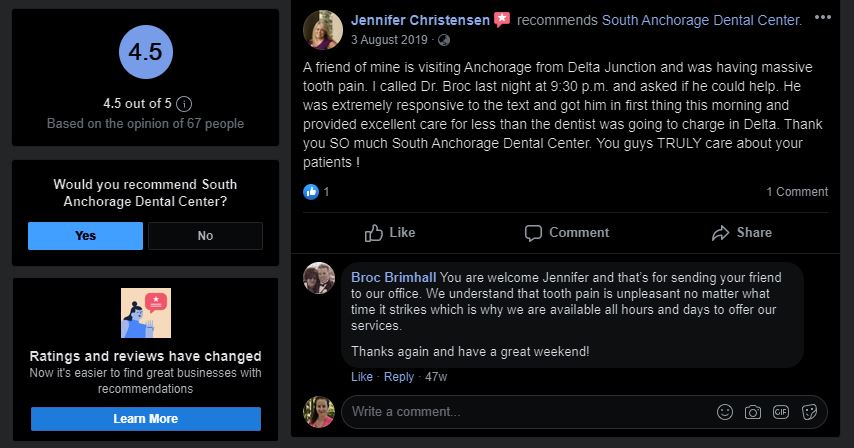
As you can see, there is a rating out of five, and a simple button people can select to recommend the dental practice to their friends. Anyone can click through and read the comments.
The other important thing to note is the response. Dr. Broc Brimhall is one of the dentists working at this office, and he responded promptly to acknowledge the positive review, thank the patient, and explain why the experience they had reflected the practice’s mission statement. This is a great example of best practice in managing Facebook reviews. It’s not every day a patient leaves a positive review, so if they take the time to do it, let them know that you appreciate it. It’s quick and easy and will show anyone else reading the page that you’re responsive and polite.
Read more: 10 tips for optimizing your social media presence
Optimizing your Google reviews
If you haven’t already set up a Google My Business profile, do it now. It’s a free tool that creates a business listing and ensure you can easily connect with patients (and prospective patients) across Google Search and Maps. For example, if someone types “emergency dentist near me” into the search bar, having an active profile means your practice will show up at the top of the results page.
Google My Business results are displayed in a column on the right-hand side of the Google results page. They include a map, a rating out of five stars, a list of basic details (such as address, hours, and phone number), popular times, and then – you guessed it – a reviews section.
Here’s an example from our client, Mandanas Dental:
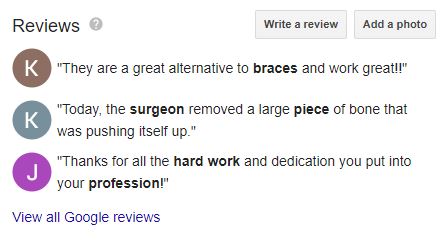
People can then click through to read the full list. Just like Facebook, Google My Business providers the business owner an opportunity to reply to all comments. It’s a great way to reinforce your connection with people, increasing the chance that they’ll come back to see you again the next time they need a dentist. It’s also a great way to address concerns raised in negative reviews.
Stay tuned, because we’ll circle back to this a little later.
Read more: 10 tips to improve your website’s ranking on Google
Making website testimonials work for you
When a company displays testimonials on its website, we marketers call that “proof.” Essentially, that means proof your dental practice is as good as you say it is, validated by a third party.
There are a few different ways you can do this. For example, you can share things people have said in Facebook or Google reviews on your page, you can provide links where people can click through to read those reviews, you can ask patients to fill out a survey after their appointment, or you can reach out to long-term patients via email or text and ask them directly.
Once you have a range of testimonials, you may find it helpful to incorporate some of them onto highly-trafficked pages, such as your home page, about page, and contact page. Depending how many you have, you may even consider creating a dedicated reviews page.
Here’s an example from our client, Valley Dental:
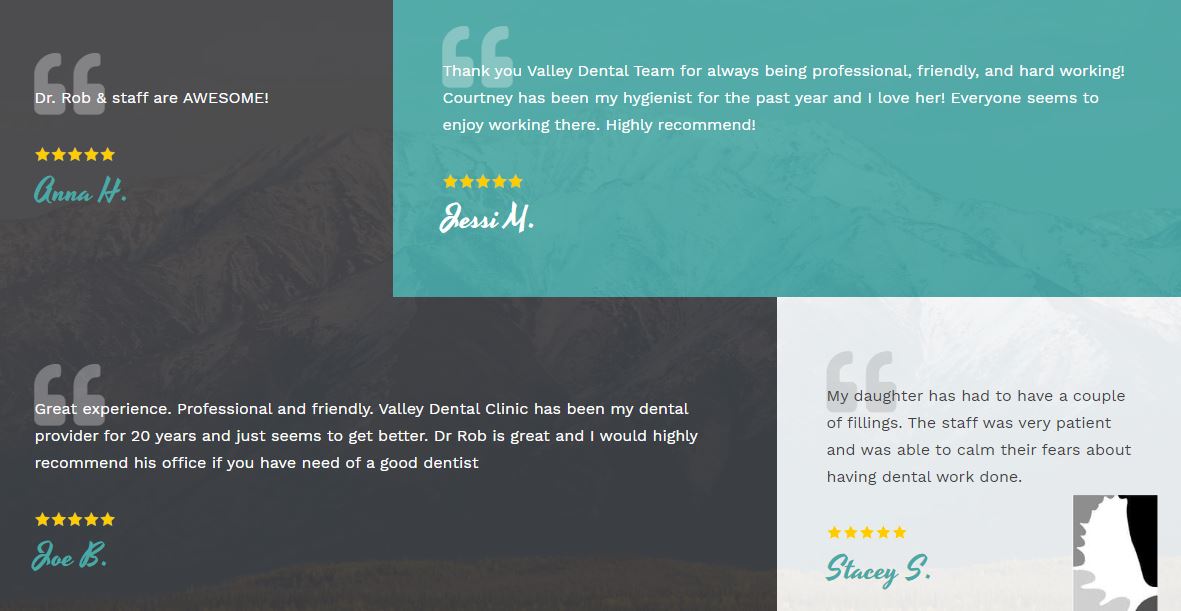
This practice has provided quality family dentistry services in Wasilla, Alaska, for many years. Dr. Robert W. Robinson III (affectionally known as Dr. Rob) took over the practice from his father in 1999. Dr Robinson Sr. started the clinic back in 1973, so it has a proud history in the area.
They’ve collected a huge number of glowing reviews over the years, so it makes sense to display them front and center on the homepage. It’s one of the first things people will see, and it immediately creates a positive first impression that invites visitors to take action and schedule an appointment. Don’t underestimate the persuasive power of these simple statements!
Read more: 5 website design trends you need to watch this year
How to handle negative reviews
Unfortunately, at some point in your career, it’s inevitable that you’ll have to deal with a negative comment. Perhaps you dropped the ball. Perhaps your patient was having a bad day. Whatever the reason, it’s important that you can deal with them promptly and professionally, because many consumers read online reviews before engaging the services of a dental clinic.
Remember what we said at the start about trust?
The good news is that negative reviews aren’t necessarily bad. For one thing, they allow you to keep your finger on the pulse of public perception so you can proactively manage your reputation. For another thing, they allow you to identify areas where you can improve your business.
They also provide a great opportunity for people to learn about your character and your values. Yes, negative reviews can sting. It’s totally normal to feel a range of different things – disappointment, frustration, anger, injustice, and more. However, other people can see when you respond quickly and calmly, and offer to make things right. It gives them confidence that, since you valued that patient’s experience, you’ll value their experience as well and do your best to look after them.
Read more: 6 must-read tips to rocking your online reviews
So there you have it: managing reviews 101. If you’d like help managing your online reviews, or some advice about how to make them work for your specific circumstances, schedule an appointment. We’d love to discuss this with you over tea, coffee, or something stronger.