Social media is a great way for all kinds of contractors to develop and build their reputations. It’s perfect for local businesses looking to connect with local community members, because positive engagement – such as likes and comments – essentially equates to free advertising. The more people interact with your page, the more people will see it, the more leads you’ll generate.
The king of all social networks is Facebook, so we’re going to focus our discussion there, providing a few examples from our client SpitShine Gutter Cleaning, which is based in Anchorage, Alaska.
Looking to outsource your social media management? Schedule a free consultation.
Make sure your profile is complete
The most important thing to do in marketing a construction services business on Facebook is to make sure your profile is complete. That means filling out all the details about your services, prices, address, contact details, and website, to ensure people can find you when they need you.
A quick Facebook search is a great way to check that a business is legitimate, so it’s also really important to add profile and cover images so people can see straight away that you’re the real deal. Once you’ve set up your page, you can start to develop a marketing strategy.
Need help getting established? Read about our Social Media Management service.
Capitalize on Facebook video
According to SproutSocial, videos are increasingly becoming the most popular types of posts on Facebook, accounting for about 11% of all content. They garner up to 8 billion views per day! There’s a lot of interest, so how can you maximize the impact of your videos?
First, it’s important to remember that most Facebook users view content on their phone. Facebook reports that optimizing videos with this in mind has a 27% higher chance of creating brand lift than videos not designed to be mobile-first. This means shooting video as square (1:1) or vertical (9:16).
Second, about 85% of people watch Facebook videos without sound. That means the visuals are really important! The majority of Facebook users are on the platform because they want to catch up with family and friends and be entertained, so keep this in mind when you post content.
Here’s a great example:
https://www.facebook.com/spitshine/posts/4394702143880809
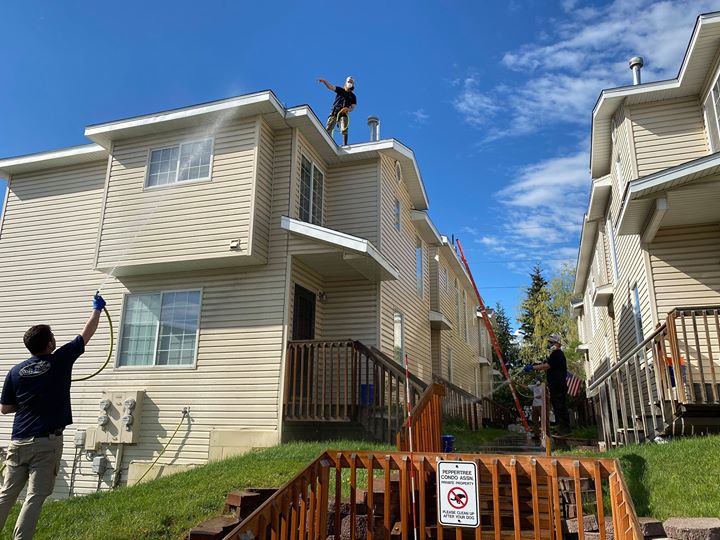
As you can see, it’s vertical, with a clear and simple caption and no need for sound. There has been a huge trend in recent years towards visually satisfying content – for example, seeing something organized, seeing something cleaned, seeing something complete, etc. This video capitalizes on the trend, because it’s just so satisfying to watch the dirt lift from the wall like magic.
“But what does it do for my brand message?” we hear you ask. As a general rule, we recommend 80% serving, 20% selling. That means 80% of your content should be interesting, informative, entertaining, or otherwise add value to people’s days in some way. Pieces of content like this are a great way to build awareness of your brand, because it’s very likeable. It doesn’t cost anything for people to like the post or tag their friends, which boosts your reputation locally.
Once you’ve built up enough trust with your local community members, you can start selling – for example, letting people know about limited time offers, new deals, and so on.
Need some help building confidence on camera? Read about out Video Marketing service.
Proactively manage your reputation
The best thing about Facebook is the opportunity it provides for you to connect directly with customers and prospective customers. You can deliver messages straight to their pockets, which is a great way to address concerns and comments. On top of that, it creates a sense of legitimacy and transparency, because people can see you’re a real person running a real business.
Every business has ups and downs. Sometimes things will go well, and you’ll get a bunch of five-star reviews. Other days, you may get some complaints. We’ve definitely been there – in fact, if you’re interested, you can read this article we wrote with six tips to rocking your online reviews.
Billy Forsyth, SpitShine’s founder, is really proactive about this. His business has grown exponentially this year, which has presented some challenges – for example, there are more jobs, and more team members, which makes it harder to guarantee the level of quality. He recently went live to address some concerns, and talk about the best way to make things right. It’s cool, calm, and compelling.
https://www.facebook.com/spitshine/videos/268658894388350/
He’s a busy business owner, so he doesn’t have time to sit and record a perfect video, but by doing a Facebook live while he’s on the move between jobsites, he invites the viewer into the conversation. The best thing about this video is it reinforces the company’s commitment to quality service, while reassuring viewers that it’s something he’s always striving to achieve in his work.
Read more: How much does it cost to hire a marketing agency?
Help customers solve problems
Modern customers have a world of information available at their fingertips, which means the internet is the first place they turn when they need to solve a problem. Facebook is a great way to make it as easy as possible for them to find you! The best way to do this is to post content showing yourself at work, so they can see exactly what you do, and how you can help them solve problems.
Take the following post as an example:
https://www.facebook.com/spitshine/posts/4372970059387351
It’s simple, and effective. If your gutters look like that, a) you’re going to have a serious drainage problem, and b) getting up there to clean them out yourself is clearly going to be dangerous. As a homeowner, your customers can precariously dangle close to the edge to try and clean them out, try their luck with a super long ladder… or call the experts. It makes the choice super simple.
The other great thing about this post is that it uses searchable keywords. The words “gutter cleaning” are in the company’s name, which is great, and the post itself reinforces the word “gutter” again. It means when people in the Anchorage area type terms like “gutter cleaning” into the search bar, Facebook is much more likely to list SpitShine in the results. Every little bit helps.
Read more: Is marketing the new sales?
Let people get to know you
We said it before and we’ll say it again: people like doing business with people. That’s why it’s so important to let your personality shine through your social media accounts. Yes, people want to see the amazing work you do, but they also want to see who you are as a person – especially since, as a contractor, you’ll be working in and around their home. It’s quite an intimate thing.
This is something Billy does really well. The post below is bright and positive, showing that he’s a hard-working dad looking to provide for his family. Including his wife and kids doesn’t necessarily sell gutter cleaning services, but it shows prospective customers he’s the real deal. You can see straight away that he’s a nice guy, which makes you much more likely to trust him.
https://www.facebook.com/spitshine/posts/4372927046058319
The key to successfully marketing a contracting service on Facebook is to be as consistent as possible. That means posting regularly, staying up-to-date with trends, and replying to all questions and comments as quickly as possible. At the end of the day, it’s simply an extension of your customer service, so it’s important that you make sure you create the right first impression.
Ready to get started? Schedule a free consultation.