Marketing for Addiction Recovery Providers

Connect With More People Ready for Recovery

We help addiction treatment centers, recovery programs, and detox centers build trust, increase visibility, and connect with individuals actively searching for help.

Launch Your Addiction Recovery Clinic Into a New Phase of Growth

Referrals Slowing Down? Admissions Feeling Unpredictable?

The addiction recovery landscape is more competitive than ever. Between changing referral patterns, increased competition, and evolving search behavior, many organizations struggle to maintain a steady flow of qualified inquiries. Effective marketing isn’t about reaching everyone—it’s about connecting with the right people at the right moment.

Our team helps recovery organizations improve visibility, strengthen trust, and create marketing systems designed to support sustainable admissions growth over time.

Expert Marketing Solutions for Addiction Recovery Organizations

CASE STUDY

0 %
Increase in conversions
for Beyond Health Care
0 M
Reach on IG in 3 months
for Horizon Services
0 %
Increase in conversions from web traffic for HopeWay Mental Health

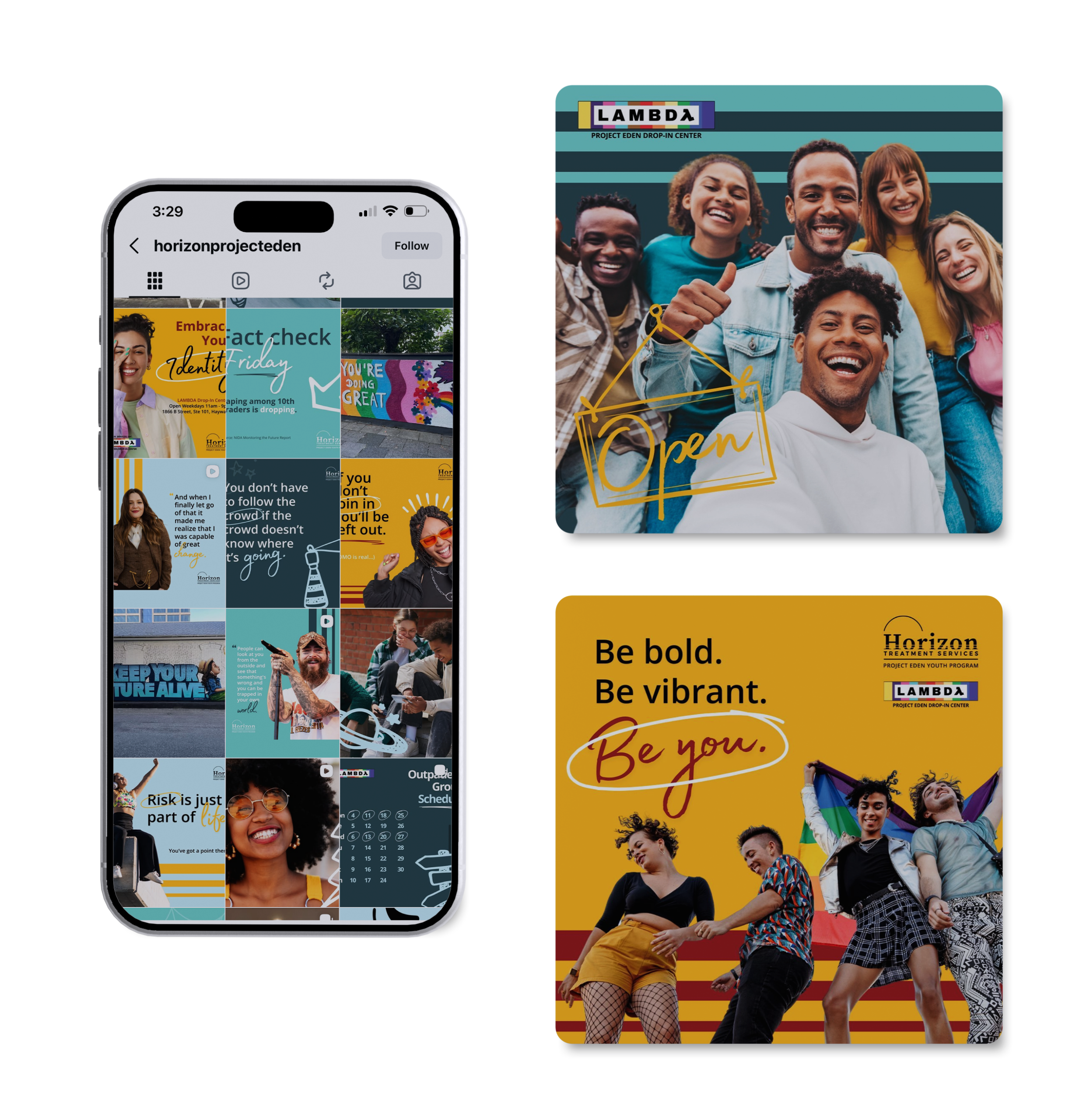
How We Helped a Recovery Program Generate Over 1Million Engagements

When Horizon Services Project Eden needed to increase community awareness and connect with more people seeking recovery resources, we developed a focused social media strategy built around education, engagement, and consistent outreach.

In just three months, the campaign generated 1.35 million Instagram impressions, reached more than 1 million people, and drove over 1,800 profile visits—significantly expanding visibility and strengthening community engagement.
Are You Providing Great Care but Still Hard to Find Online?

Many treatment providers offer exceptional care but struggle to communicate what makes their program unique. From detox centers and outpatient programs to residential treatment facilities, standing out requires more than a website and a few social posts.

We help addiction recovery organizations clarify their message, strengthen their online presence, and build trust with individuals and families seeking help during critical moments.

Our Specialized Addiction Recovery Marketing Services

Addiction Treatment SEO + GEO

Improve visibility in search results and AI discovery and connect with individuals actively looking for recovery support.

Addiction Recovery Content Marketing

Build authority and trust through educational content designed for clients, families, and referral partners.

Addiction Treatment Website Design

Create a professional online experience that encourages engagement and supports admissions growth.

Paid Advertising for Recovery Centers

Reach high-intent audiences through targeted campaigns built around compliance and performance.

Addiction Recovery Branding

Develop a clear, trustworthy identity that reflects your mission and differentiates your organization.

Recovery Center Marketing Strategy

Create a roadmap for sustainable growth backed by data, audience insights, and real-world performance.

Keep Your Recovery Center Visible Where Patients Search

Your recovery center’s website should continuously evolve to help prospective patients and families find trusted treatment options. We refine existing content, strengthen topical authority, and improve the signals that Google and AI-powered search platforms use to recommend addiction treatment providers.

Treatment-Focused Content

We continuously update your treatment pages with accurate, comprehensive information that helps patients understand their options while improving AI visibility.

Admissions Journey Optimization

We refine your existing content to answer the questions prospective patients and families ask most, making it easier to move from research to admission.

SEO + GEO-Ready Foundation

We’ll enhance visibility through modifications designed to support search engine performance, generative engine optimization (GEO), and AI discoverability.

Ongoing AI Visibility

Search behavior continues to evolve. We continuously optimize your website so your recovery center remains competitive across Google and emerging AI search platforms.

Recovery Authority

We strengthen the connections between your treatment programs, conditions, therapies, and educational resources to build long-term topical authority.

Better Patient Experience

We improve navigation, internal linking, and page organization so visitors can quickly find the information they need during a difficult time.

logo

Climb Aboard With a Customized Marketing Plan 

Ready to help more people find recovery? Let’s build a marketing strategy designed around your organization, your goals, and your mission.

Ken_Headshot

Explore Our Insights

Take a closer look at the tools, tips, and strategies that help your practice grow with confidence.

Single-platform dependency is the marketing equivalent of keeping all your money in one bank account with no backup.

Everything is fine until it isn’t. An algorithm shifts. A platform changes its ad policy. A competitor outbids you on every keyword you’ve been relying on. Google rolls out a core update and your page-one rankings disappear overnight. Any one of these things can happen, and for practices that have built their entire patient acquisition strategy around a single channel, any one of them is enough to crater inquiry volume for weeks or months.

The mental and behavioral health practices that navigate the digital marketing landscape most consistently are the ones that have distributed their visibility intentionally across multiple platforms and channels. Not randomly. Not everywhere at once. But strategically, with a clear understanding of which channels serve which stages of the patient journey and why.

Building that kind of strategy isn’t complicated. But it does require letting go of the idea that one platform is enough.

Wondering how diversified your current marketing actually is? Let’s find out together and build a strategy that holds up through whatever comes next.

The Rundown

  • Single-platform dependency is a structural vulnerability, not just a missed opportunity. Any platform can change, and practices built entirely around one of them are one update away from a visibility crisis.
  • A diversified strategy doesn’t mean being active everywhere. It means being intentionally present across the specific platforms where your ideal patients are at each stage of their journey.
  • The healthcare marketing and communications market is rapidly moving toward omnichannel strategies, with the global market projected to reach $24.55 billion in 2025 as organizations recognize that multi-platform presence drives more resilient patient acquisition.
  • Platform diversity should be built in layers: owned assets first, then earned visibility, then paid channels, so the strategy holds up even when any single layer underperforms.
  • Consistency across platforms matters as much as presence. A practice that shows up on six platforms with inconsistent messaging is less effective than one that shows up on three platforms with a coherent, patient-centered voice.

Why Is Single-Platform Dependency Such a Significant Risk for Mental and Behavioral Health Practices?

Because the platforms practices depend on most are the ones that change most frequently.

Google’s algorithm updates dozens of times per year. Meta changes its ad targeting capabilities in response to privacy regulations. Psychology Today adjusts its search algorithm and suddenly profiles that were appearing on page one are buried. Any of these shifts can meaningfully affect a practice’s patient inquiry volume, and they happen with little to no warning.

The healthcare marketing landscape is evolving rapidly in response to exactly this dynamic. Industry analysis projects the global healthcare marketing and communications market to reach $24.55 billion in 2025, with omnichannel strategies cited as the primary driver of resilient patient acquisition. The shift isn’t just about reaching more patients. It’s about building a marketing presence that doesn’t crumble when any one channel has a bad month.

For a mental and behavioral health practice, the consequences of a visibility disruption aren’t just financial. They affect care access. When a practice’s inquiry volume drops because an algorithm changed, the patients who would have found that practice find someone else instead, or don’t find anyone and give up. That’s not a marketing problem in isolation. It’s a patient care problem that starts with a marketing vulnerability.

What Does a Well-Diversified Marketing Strategy Actually Look Like?

It looks like a practice that has built its visibility in three distinct layers, and understands why each layer matters.

The first layer is owned assets. These are the things your practice controls completely: your website, your blog content, your email list. No algorithm can take these away from you. A well-optimized website with strong content is an asset that compounds over time and belongs entirely to the practice. This is the foundation everything else builds on.

The second layer is earned visibility. Reviews, directory listings, mentions in community platforms, social proof across third-party sites, referral relationships. These are things your practice earns through consistent quality and presence rather than paying for directly. They’re also significantly more trusted by patients than anything you pay to put in front of them.

The third layer is paid channels. Google Ads, Meta Ads, Microsoft Advertising, directory premium placements. These generate immediate visibility and can be scaled up or down quickly. But they’re also the most volatile layer, the one most affected by external changes, and the one that stops producing results the moment you stop funding it.

A diversified strategy doesn’t lean entirely on any one layer. It treats all three as complementary, with owned assets providing stability, earned visibility providing trust, and paid channels providing reach.

Which Platforms Should Be Part of a Diversified Mental Health Marketing Strategy?

The answer depends on which patients you’re trying to reach and at what stage of their journey. But for most mental and behavioral health practices, the core platform mix should include at least one channel from each of the following categories.

Search visibility:

  • Google, through both organic SEO and paid advertising, remains the highest-volume search channel and the one most patients still use as their primary starting point
  • Bing / Microsoft, for the meaningful share of patients using Microsoft devices, older demographics, and corporate computers, and as the engine powering Microsoft Copilot AI recommendations
  • AI search tools like ChatGPT, Perplexity, and Google’s AI Overviews, which are increasingly surfacing provider recommendations and favor practices with strong multi-platform authority

Directory and local visibility:

  • Psychology Today and specialty directories for decision-stage patients actively filtering by specialty and insurance
  • Google Business Profile and Apple Maps for local search and voice search visibility across iOS and Android devices
  • Healthgrades and Zocdoc for the patients who start their search on healthcare-specific platforms rather than general search engines

Social and community visibility:

  • Instagram and TikTok for awareness-stage patients discovering practices through content before they actively search
  • Facebook for older demographics and community-based visibility, including local group presence and targeted advertising
  • LinkedIn for B2B referral relationships with EAPs, corporate HR departments, and healthcare professionals who make referrals

Strategy LayerExamplesWhat It ProvidesVulnerability If It’s the Only Layer
Owned assetsWebsite, blog, email listStability; permanent visibility that compounds over timeSlow to build; needs consistent investment to maintain
Earned visibilityReviews, directories, referrals, community mentionsTrust; the highest-credibility form of visibility availableCan’t be purchased or accelerated quickly when volume drops
Paid channelsGoogle Ads, Meta Ads, Microsoft Ads, directory premiumsImmediate reach; scalable on demandStops working the moment you stop paying; subject to platform changes
Social platformsInstagram, TikTok, Facebook, LinkedInAwareness; pre-trust building with patients not yet searchingAlgorithm-dependent; organic reach can be suppressed without warning
AI and emerging channelsChatGPT, Perplexity, Copilot, Google AI OverviewsFuture-facing; growing share of patient discoveryNot yet predictable; dependent on the quality of multi-platform presence

How Do You Maintain Consistent Messaging Across Multiple Platforms Without It Becoming a Full-Time Job?

By building a core message architecture first, and then adapting it to each platform rather than creating something entirely new for each one.

The biggest reason practices resist multi-platform marketing is the perceived workload. And it’s true that showing up on six platforms poorly is worse than showing up on two platforms well. But maintaining a consistent presence across multiple channels doesn’t require producing original content from scratch for every platform every week.

It requires having a clear answer to three questions: who are we, who do we help, and why does that matter to them? Once those answers are clear, the content across every platform is a different expression of the same core truth rather than a completely independent creative exercise.

A blog post becomes a series of social captions. A clinician bio becomes a short video introduction. A FAQ page becomes an Instagram story series. The core content is created once, and the adaptation for each platform takes a fraction of the original effort. Systemizing this process is what separates practices that maintain a strong multi-platform presence without burning out from those that try, fail to sustain it, and retreat back to single-platform dependency.

At Beacon, we help mental and behavioral health practices build exactly this kind of efficient multi-platform content system, so consistent visibility doesn’t require a full-time marketing hire.

What’s the Biggest Mistake Practices Make When Trying to Diversify Their Marketing?

Trying to be everywhere at once without a strategy for any of it.

Platform diversity without intentionality is just noise. A practice that creates a TikTok account, posts twice, and abandons it isn’t building multi-platform visibility. It’s creating a digital footprint that signals inactivity to any patient who finds that dormant profile. A practice that claims a Bing Places listing but never updates it isn’t helping its Bing visibility. It’s potentially hurting it with outdated information that contradicts what appears elsewhere.

The right approach is sequential, not simultaneous:

  • Start by auditing what already exists. Most practices have more digital presence than they realize, and a significant portion of it is outdated, inconsistent, or actively working against them.
  • Fix and optimize before expanding. A clean, current, consistent presence on four platforms is more effective than a scattered presence on ten.
  • Add one new channel at a time, with a clear plan for what that channel is meant to achieve and how success will be measured before moving to the next one.
  • Prioritize by patient stage. A practice that needs more top-of-funnel awareness should invest in social media before adding another paid search channel. A practice that has strong awareness but weak conversion should focus on directories and website optimization before expanding reach.

How Do You Know When Your Strategy Is Diversified Enough?

When losing any single platform for a month wouldn’t cause a crisis.

That’s the practical test. If Google went down tomorrow, would your practice still have meaningful visibility through directories, social media, direct traffic to your website, and referral pipelines? If Meta changed its ad targeting overnight, would you still have organic channels generating warm leads? If Psychology Today restructured its search algorithm, would you still be findable through other directory platforms and search engines?

The answer for most practices right now is no. And that’s not a criticism. It’s a starting point. Building toward yes is a process, and it starts with an honest audit of where the practice is currently visible and where it’s entirely absent.

The practices that weather platform disruptions without a dip in patient volume aren’t lucky. They’re built differently. And building differently is a strategic choice that’s entirely available to any practice willing to approach its marketing with the same intentionality it applies to its clinical work. Our strategy team helps mental and behavioral health practices build that kind of resilient, multi-platform marketing foundation from the ground up.

A strategy built on one platform is a strategy with one point of failure. Start the conversation with Beacon today, and let’s build something more durable than that.

Google isn’t going anywhere. Let’s just get that out of the way upfront.

But if your entire digital marketing strategy begins and ends with Google, you’re building visibility on a single foundation in a patient landscape that has quietly grown at least five more floors. Today’s prospective mental and behavioral health patients aren’t just searching on Google. They’re asking Bing. They’re scrolling TikTok. They’re reading Psychology Today profiles, Healthgrades listings, and Reddit threads. They’re typing questions into AI chatbots and trusting what comes back.

The practices that are winning new patients consistently in 2026 aren’t the ones with the best Google strategy. They’re the ones that show up across the full spectrum of platforms where patients are actually doing their research. And most behavioral health practices are nowhere to be found on at least half of those platforms.

So the question worth asking right now isn’t “how do I rank better on Google?” It’s “where else should I be?”

Not sure where your practice is visible and where it’s invisible? Talk to our team at Beacon today and let’s map your full digital footprint.

The Rundown:

  • Bing and other search engines are capturing a meaningful and growing share of health-related searches, particularly among older demographics and Microsoft device users.
  • Provider directories like Psychology Today, Healthgrades, and Zocdoc are often the first stop for patients specifically looking for a mental health provider, not just any search engine.
  • Social media platforms, especially TikTok and Instagram, are functioning as discovery channels where patients encounter practices before they’re actively searching.
  • AI search tools like ChatGPT and Perplexity are increasingly surfacing provider recommendations, and the practices with the strongest multi-platform presence are the ones getting named.
  • Maps and local business listings beyond Google Maps, including Apple Maps and Bing Places, are influencing patient discovery in ways most practices have never optimized for.

Why Is Google No Longer Enough for Mental and Behavioral Health Visibility?

Because patient behavior has fragmented across platforms faster than most marketing strategies have adapted.

It wasn’t a dramatic overnight shift. It was a slow accumulation of small changes: TikTok becoming a place where people learn about mental health, AI chatbots becoming a place where people ask for provider recommendations, Bing quietly capturing a growing share of searches from Microsoft device users and older demographics, directories becoming the default starting point for patients who already know they want a therapist and just need to find the right one.

A peer-reviewed study on social media and patient decision-making found that 96.2% of patients now have personal social media accounts, and platforms like Instagram and X have become meaningful tools for researching healthcare providers. That statistic alone is enough to make the case that Google-only visibility is leaving a significant audience unaddressed.

The patients searching for a therapist today are not a monolithic group. They’re different ages, with different platform habits, different levels of mental health literacy, and different comfort levels with different types of content. Meeting all of them where they are requires showing up across more than one channel. And the practices that do are quietly building a compounding visibility advantage over those that don’t.

Should Behavioral Health Practices Be Investing in Bing?

Yes, and it’s one of the most consistently overlooked opportunities in mental and behavioral health marketing.

Here’s the reality: Bing processes billions of searches per month and has a disproportionately strong user base among older adults, Microsoft device users, and corporate computer users, all of whom represent a significant segment of mental and behavioral health patients. And because most practices and most of their competitors have focused almost exclusively on Google, the competitive landscape on Bing is dramatically less crowded.

That means lower cost-per-click in paid advertising, less competition for organic rankings, and a more accessible path to page-one visibility for searches that would require significant effort on Google.

What Bing investment looks like in practice:

  • Claiming and optimizing a Bing Places for Business profile, which is Bing’s equivalent of Google Business Profile and directly influences how the practice appears in Bing local search results
  • Running Microsoft Advertising campaigns alongside or instead of Google Ads for certain high-intent keywords, often at a meaningfully lower cost per conversion
  • Ensuring the practice website is indexed and performing well on Bing through Bing Webmaster Tools, which is free and provides actionable insights separate from Google Search Console

And here’s the kicker: Bing powers a significant portion of AI-generated responses through Microsoft Copilot. Optimizing for Bing isn’t just about Bing searches anymore. It’s about influencing the AI-generated recommendations that Copilot users are receiving when they ask for a therapist recommendation.

What Role Do Provider Directories Play Beyond Google?

A massive one, and most practices have barely scratched the surface of managing them effectively.

Provider directories like Psychology Today, Healthgrades, Zocdoc, and TherapyDen aren’t supplementary to Google. For a specific and important segment of patients, they’re the primary discovery tool. These are the patients who already know they want a therapist and are specifically filtering by specialty, insurance, location, and availability. They’re not in an exploratory phase. They’re in a decision-making phase. And they’re using directories to make that decision.

The challenge is that most practices set up their directory profiles once and never revisit them. Which means:

  • Photos are outdated or missing entirely, sending an immediate signal that the profile hasn’t been tended to
  • Specialty language is generic and doesn’t match the specific search terms a patient might use to filter for the presenting issue they’re dealing with
  • Insurance and fee information is incomplete, causing patients to move on to a profile that answers those questions without requiring a phone call
  • The bio reads like a credentialing form rather than an introduction, giving a searching patient nothing to connect with emotionally before they decide to reach out

Directories also increasingly feed AI search results. When a patient asks ChatGPT or Perplexity to recommend a therapist, those systems pull from the same data sources that power directories and search engines. A well-maintained directory presence isn’t just good for the directory. It’s good for AI visibility too.

PlatformPatient Type It ReachesInvestment RequiredWhy Most Practices Ignore It
Bing / MicrosoftOlder adults; Microsoft device users; corporate employeesLow–Medium; Bing Places free; Microsoft Ads affordableGoogle dominance creates tunnel vision
Psychology Today / HealthgradesDecision-stage patients filtering by specialty and insuranceLow; profile setup with consistent maintenanceSet-and-forget mentality; profiles go stale
Apple Maps / Bing PlacesiPhone users and voice search users asking Siri for recommendationsLow; free to claim and optimizeMost practices only think about Google Maps
TikTok / InstagramYounger patients in awareness and consideration stagesMedium; requires consistent content creationPerceived as entertainment rather than discovery
AI tools (ChatGPT, Perplexity, Copilot)Tech-forward patients of all ages seeking curated recommendationsIndirect; built through strong multi-platform presenceMost practices don’t know they’re influenceable
Reddit / Community ForumsPatients in research phase seeking peer validationLow direct; influenced by brand presence and content qualityFeels uncontrollable and therefore ignored

Is Social Media a Discovery Channel or Just a Branding Tool for Mental Health Practices?

Both, but most practices are only getting the second one.

TikTok and Instagram have evolved into genuine search and discovery platforms, particularly for younger adults navigating mental health decisions for the first time. A significant and growing number of people are finding mental health content, encountering practice names, and forming impressions of providers through social media before they ever open a browser and type something into a search bar.

That means social media isn’t just about engagement or follower counts. It’s about appearing in the place where a patient’s first awareness of a practice can form. And a practice with no social presence, or a dormant one last updated eight months ago, is invisible to that entire segment of the patient population.

The discovery function of social media is built through:

  • Consistent content that uses the language patients actually search for on social platforms, including condition-specific terms, experience descriptions, and the kinds of questions people type into TikTok’s search bar
  • Clinician-led content that builds personal familiarity with the people behind the practice, since social discovery is fundamentally about people encountering people, not brands encountering browsers
  • Hashtag and keyword strategy tailored to social search behavior, which is different from traditional SEO and requires understanding how each platform’s algorithm surfaces content to new audiences

How Do AI Search Tools Factor Into Post-Google Visibility?

More significantly than most practices realize, and the window to get ahead of the curve is still open.

When a patient asks ChatGPT “who is a good therapist for PTSD in Austin?” they’re not getting a list of search results. They’re getting a synthesized recommendation based on the information those AI systems have been trained on and can access. And the practices that appear in those recommendations aren’t necessarily the ones with the highest Google rankings. They’re the ones with the most consistent, authoritative, and cross-platform presence.

AI visibility is built through:

  • A website with clear, specific, well-structured specialty content that gives AI systems something authoritative to cite when a patient asks a relevant question
  • Consistent presence across directories, social media, and local listings, since AI tools learn from what appears across multiple reputable sources rather than from a single platform
  • Educational content published regularly that positions the practice as a knowledgeable resource on the topics its ideal patients are researching

The practices investing in AI visibility now are building an advantage that will compound as AI search adoption continues to grow. And the investment required isn’t separate from everything else discussed in this post. It’s the cumulative result of doing all of it well. Our SEO + GEO team helps mental and behavioral health practices build the kind of multi-platform presence that feeds both traditional search and the AI-powered channels that are increasingly shaping how patients find care.

How Should a Practice Prioritize Where to Invest First?

Start with what’s free and broken, then build toward what’s strategic and new.

Most practices have unclaimed or neglected platforms that are costing them visibility right now without any additional investment required to fix them. Apple Maps. Bing Places. Outdated directory profiles. Inconsistent business information across platforms. These are the low-hanging fruit, and they represent genuine lost visibility that can be recovered with a few focused hours of attention.

Once the basics are covered, the strategic investments follow in order of audience size and patient intent: directories for decision-stage patients, social media for awareness-stage patients, and paid advertising on undercompetitive platforms like Bing for ready-to-book patients who aren’t finding the practice on Google.

The goal isn’t to be everywhere at once. It’s to be in every place where your ideal patient is likely to encounter your practice on their journey from “I think I need help” to “I have an appointment.” That journey is happening across more platforms than it ever has before, and the practices that show up consistently across it are the ones that fill their schedules first. Our marketing strategy team helps practices map that full journey and build a prioritized investment plan that reaches patients at every stage, not just the ones already searching on Google.

Google is the start of the conversation, not the whole conversation. If your practice isn’t showing up beyond it, you’re leaving patients on the table every single day. 

Reach out to Beacon today, and let’s build a visibility strategy that meets patients wherever they’re searching.

Here’s a thought experiment worth sitting with.

The principles that define exceptional mental health care, such as empathy, consistency, clear and honest communication, genuine presence, and meeting a person where they are rather than where you wish they were, are not principles that get checked at the door when a clinician closes their session notes and turns to marketing.

Or at least, they shouldn’t be.

But for most mental and behavioral health practices, there’s a jarring discontinuity between the quality of care delivered inside the session and the quality of the experience delivered outside it. The clinical encounter is warm, specific, patient-centered, and thoughtfully designed around the person’s needs. The website is generic. The social media is inconsistent. The intake form is impersonal. The confirmation email sounds like it was written by a compliance department.

What would change if that discontinuity were closed? If the same intentionality that shapes patient care also shaped every patient-facing marketing touchpoint?

The answer is: quite a lot. And the summer slowdown is the right window to start finding out.

Want to close the gap between the care your practice delivers and the experience it projects? Connect with Beacon today, and let’s build a marketing approach that reflects the quality of care inside your practice.

Key Takeaways:

  • The core principles of effective therapy, empathy, consistency, and patient-centered communication, are the same principles that make mental health marketing work. Applying them to both produces a practice that feels coherent from the outside in.
  • Patient-centered communication in psychotherapy has been shown to enhance therapeutic alliance, improve treatment adherence, and produce better mental health outcomes. The same orientation, applied to marketing, improves patient acquisition and retention.
  • A practice that treats marketing like patient care meets patients at their actual stage of the journey rather than pushing a message designed for a different moment.
  • Consistency is as important in marketing as in therapy. A practice that shows up differently across platforms is sending the same signal as a clinician who is warm in one session and distant in the next.
  • The summer slowdown is the right window to do the reflective, intentional work of aligning marketing with the values already present in clinical care.

What Do Effective Therapy and Effective Marketing Actually Have in Common?

More than most practice owners have ever thought to compare.

A narrative review published in PMC examining patient-centered communication in psychotherapy found that consistently centering the patient’s perspective, needs, and emotional state enhances the therapeutic alliance, improves treatment engagement, increases satisfaction, and produces meaningfully better mental health outcomes. The research examined 53 studies across multiple therapy modalities and found that the orientation toward the patient, rather than toward the clinician’s agenda or institutional protocol, is one of the strongest predictors of effective care.

That finding maps directly onto marketing.

Marketing that centers the patient’s perspective, their questions, their fears, their stage of readiness, their need to feel seen before they feel sold to, consistently outperforms marketing designed around the practice’s own agenda, its services, its credentials, its call-to-action schedule.

The parallel isn’t a metaphor. It’s a structural truth about how trust is built in a specialty where trust is the entire foundation of the service being offered.

What Would Empathy Look Like as a Marketing Principle?

It would look like content that meets patients in their actual emotional state rather than the state you wish they were in when they found you.

A skilled clinician doesn’t open a first session by presenting their credentials and asking what the patient wants to work on. They create a space where the patient feels safe enough to share what’s actually going on. They ask questions that demonstrate genuine curiosity. They listen for what isn’t being said as much as what is.

Empathetic marketing does the same thing, in a different medium.

It starts with content that says “here’s what you might be experiencing” rather than “here’s what we offer.” It uses language that a patient would use to describe their own situation rather than clinical terminology that creates distance. It acknowledges the emotional reality of looking for a therapist, the vulnerability, the uncertainty, the courage required, rather than pretending the patient is simply a consumer making a routine purchase.

In practice, empathetic marketing looks like:

  • Blog posts that describe experiences in the first person, naming what it feels like from the inside rather than what it looks like from a clinical perspective
  • Social content that validates the difficulty of the decision to seek help without dramatizing it or making it feel heavier than it already does
  • Website copy that speaks to what a patient is hoping for when they reach out, not just what the practice is ready to provide
  • Confirmation emails that acknowledge the courage it took to make contact, treating the first touchpoint as the emotionally significant moment it actually is

What Would Consistency Look Like if Applied to Marketing the Way It’s Applied to Care?

It would look like a practice that feels like the same place, with the same values and the same voice, across every platform a patient encounters before and after they book.

Therapeutic consistency, showing up the same way session after session, maintaining the same boundaries, the same warmth, the same level of engagement, is one of the most important elements of the therapeutic relationship. It signals to a patient that the clinician can be counted on, that the environment is predictable, that it’s safe to be vulnerable because the response will be consistent.

Marketing consistency works the same way. A patient who finds the practice on Instagram, then visits the website, then reads the Psychology Today profile, then receives a confirmation email, is building a composite impression across all of those encounters. If each one feels like a different version of the practice, the composite impression is confusion rather than trust.

Consistent marketing presence means:

  • The same tone and warmth across the website, social media, directories, and intake communication, so every encounter feels like it came from the same place
  • The same specialty language and positioning across all platforms, so a patient who finds the practice through different channels always arrives at the same clear understanding of what the practice does and who it serves
  • The same visual identity and quality of presentation across every platform, since visual inconsistency sends the same signal as tonal inconsistency: that nobody is paying attention
  • The same level of responsiveness regardless of channel, because a practice that replies to Instagram comments within hours but takes two days to return a phone inquiry is communicating something about its priorities that a patient will notice

Clinical PrincipleHow It Works in TherapyHow It Translates to MarketingWhat It Looks Like in Practice
EmpathyMeeting the patient where they are emotionally rather than where the clinician’s agenda needs them to beCreating content that speaks to the patient’s actual stage and emotional state rather than pushing a booking message regardless of readinessAwareness-stage blog posts; validating social content; copy that acknowledges the difficulty of seeking help
ConsistencyShowing up the same way across sessions so the patient can trust the environment is predictable and safeMaintaining the same tone, voice, and quality across every platform and touchpoint a patient encountersAligned website, social, directory, and intake communication; regular publishing cadence; prompt response across all channels
Clear communicationExplaining what to expect, what the process looks like, and what the patient’s role is so uncertainty doesn’t become a barrier to engagementProactively answering the questions patients are afraid to ask: cost, insurance, first session, what happens after contactFAQ pages; “what to expect” content; warm confirmation copy; transparent fee and insurance information
Genuine presenceBeing fully engaged with the patient’s experience rather than going through the motions of a clinical protocolCreating content and communication that feels authentically human rather than templated or performativeClinician-led social content; bios written in real voices; reviews responded to personally; genuine community presence
Meeting patients where they areNot assuming the patient is at a particular stage of insight or readiness; starting from where they actually areMarketing to all stages of the patient journey, not just the ready-to-book patientTop-of-funnel awareness content alongside conversion-focused channels; seasonal messaging that matches patient mindset
Non-judgmentCreating a space where the patient doesn’t feel evaluated or shamed for their experienceUsing destigmatizing language throughout all content and communication that treats seeking help as a normal, courageous actWebsite copy that normalizes therapy; social content that reduces stigma; intake forms that don’t ask for clinical detail before trust is established

What Would Clear Communication Look Like if Applied to the Patient Journey Before the First Session?

It would look like a practice that answers every significant question a patient has before they have to ask it.

In therapy, unclear communication, vague treatment goals, unexplained processes, and ambiguity about what the clinician’s role is versus the patient’s undermine the therapeutic alliance and reduce engagement. Clarity isn’t just helpful. It’s therapeutic.

Applied to marketing, the same principle suggests that a practice should proactively communicate everything a patient needs to know to feel safe taking the next step, before they have to call and ask. Cost. Insurance. What happens at the first session. How long before they’ll hear back. What telehealth looks like. Who would be the best fit for their situation.

The practices that apply this principle consistently have websites, FAQ pages, and intake communications that feel like they were written by someone who genuinely understands what it’s like to be on the other side of the desk for the first time.

And that understanding, communicated before the first session, produces something that most practices think only happens inside therapy: a sense of being genuinely cared for by people who know what they’re doing and are glad you reached out.

How Does Applying Clinical Values to Marketing Change the Way a Slow Season Is Used?

It changes the whole frame.

A practice that treats marketing like patient care doesn’t approach a slower summer as a problem to survive or a budget line to cut. It approaches it the way a skilled clinician approaches a session with a patient who is in a quieter, more reflective phase of their work: as an opportunity to do the deeper, foundational work that the noisier phases don’t allow for.

That means using the slow season to:

  • Audit every patient-facing touchpoint for whether it reflects the values of empathy, clarity, and genuine presence that define the clinical work
  • Rewrite the content that doesn’t meet that standard, starting with the clinician bios, the homepage copy, and the confirmation email that every new patient reads before their first session
  • Build the content that speaks to patients at earlier stages of the journey, the awareness-stage posts and social content that reach people before they’re ready to book but after they’ve started to wonder if help might be possible
  • Review the intake process for every point where the patient-centered principles applied in the session room have been abandoned in favor of operational convenience

This is the work that separates practices that are excellent clinically from practices that are excellent in every dimension. And it’s the work that builds the kind of patient experience, from first encounter to first session, that generates referrals, retention, and the kind of reputation that fills a schedule without constant advertising spend. Our SEO + GEO team helps practices build exactly this kind of patient-centered presence, translating the values already present in clinical care into every piece of content and communication that patients encounter before they ever walk through the door.

What Is the Single Most Powerful Shift a Practice Can Make Right Now?

Reading every patient-facing piece of content and communication through one simple question: would a person who came to this practice for the first time feel seen, understood, and safe?

Not impressed. Not informed. Seen, understood, and safe.

Those three things are what good therapy offers. And they’re what good marketing should offer too, in the specific and limited way that content and communication can offer them before a therapeutic relationship has even begun.

The website that answers that question with yes, consistently and across every page, is the website that converts cautious browsers into motivated patients. The social media that answers it with yes is the social media that builds the kind of pre-trust that makes a patient feel like they already know the practice before they’ve ever visited. The intake process that answers it with yes is the one that protects the courage it took to reach out instead of eroding it at the final step.

That’s what treating marketing like patient care produces. Not a different brand or a different strategy. A coherent practice, where the values that define the clinical work extend into every experience a patient has with the practice, starting long before the first session and continuing long after it.

And the summer slowdown, with its quieter pace and its rare gift of reflective bandwidth, is the most natural window in the year to start building that coherence deliberately. Our strategy team helps mental and behavioral health practices close the gap between the care they provide and the experience they project, so every patient who finds them feels the same quality of attention before they book as they’ll receive once they do.

The values that make your practice exceptional clinically are the same ones that will make your marketing exceptional. All it takes is applying them consistently to both. 

Reach out to Beacon today, and let’s build a practice presence that reflects the quality of care you’re already delivering inside the room.

Mental Health Marketing FAQs​

Why is it so difficult to attract qualified admissions consistently?

Many addiction recovery organizations rely heavily on referrals, word-of-mouth, or a handful of marketing channels to generate admissions. While those sources can be valuable, they can also create unpredictable fluctuations in inquiries and admissions over time.

A strong marketing strategy helps create multiple pathways for people to discover your organization. By improving visibility, strengthening trust, and connecting with individuals actively seeking help, marketing can support a more consistent and sustainable admissions pipeline.

This is one of the biggest challenges facing recovery organizations today. Many providers offer similar services, making it difficult for prospective clients and families to understand what makes one program different from another.

Effective marketing helps clarify your message, highlight your unique approach to care, and communicate your organization’s value in a way that resonates with the people you’re trying to reach. The goal isn’t simply to be louder than competitors—it’s to be clearer and more memorable.

Most people seeking addiction treatment spend significant time researching options before reaching out. They want to understand your programs, your philosophy, your team, and whether your organization feels trustworthy.

Through thoughtful content, strong branding, and a professional online presence, marketing helps build credibility before the first phone call ever happens. This often leads to stronger engagement and more qualified inquiries.

The timeline depends on your goals, competition, current visibility, and the marketing channels being utilized. Paid advertising can often generate awareness and inquiries more quickly, while SEO and content marketing typically require several months to build momentum.

The strongest long-term results usually come from combining short-term and long-term strategies. This creates immediate opportunities while simultaneously building a stronger foundation for future growth.

This is one of the most common concerns we hear from addiction recovery organizations. Too often, marketing reports focus on vanity metrics that don’t clearly connect to admissions, inquiries, or organizational growth.

We believe marketing should provide clarity, not confusion. By tracking meaningful performance indicators such as visibility, engagement, lead quality, inquiries, and overall growth trends, you gain a much clearer understanding of what’s working, where opportunities exist, and how your investment is contributing to your mission.

Ready to Grow Your Recovery Organization?

Your work is so important for your community, and we’d love to be a part of it. We’ll help you improve visibility, strengthen trust, and connect with more people seeking recovery and support.