Explore insights on SEO, AI, and digital marketing strategies designed to help your business grow, stay visible, and adapt in a constantly evolving online landscape.
Originally published on July 18, 2013. Updated on May 31, 2019.
Is it important for CEOs to be active on social media?
My answer to this question is a resounding YES! Social media is here to stay, and it’s becoming more and more critical to our communication systems. While I believe there are some legitimate concerns, they are far outweighed by the benefits.
According to recent research by CEO.com from 2019, 70% of Fortune 500 CEOs have no social media presence at all. That means of 500 CEOs only 19 have accounts on Twitter and only five of them have ever posted a tweet. Now, I’m sure some of you are scoffing, because why would a successful CEO worry about Twitter? They have people for that, right? Well I’m sure they do, however there is a huge missed opportunity for CEOs who are not leveraging social media to help their companies.
Most studies I have read list LinkedIn as the one social media outlet they do participate in, which isn’t surprising. This is a key tool for networking with other professionals and colleagues. It’s also one of the most professional and structured for business interactions and therefore the “safest.”
When we step outside of just the Fortune 500 companies and look at CEOs across America, 50% use Twitter, 47% use LinkedIn, 45% use Facebook. So, if you are a CEO, what are the benefits that could entice you into committing to using these powerful tools and what is keeping you from taking the leap? Why should you choose to be a connected CEO?
Human connections are everything. In fact, about 66% of consumers say their perception of a CEO impacts their perception of a company! When a CEO chooses to engage customers, vendors, employees, and the public as the face of the company s/he has the opportunity to humanize the brand and give people someone to whom they can relate.
Sir Richard Branson of Virgin Group is a dynamite example of being a relatable face of his company. If you are concerned about the possible PR implications of interacting directly with the public, take some lessons from your PR departments and stay connected with them to understand what is going to help and hinder the public image.
Attract high-quality talent
About 80% of employees say they would rather work for a “social CEO.” Being connected and interacting with the public allows a CEO to communicate that they are more approachable and innovative (and by extension, their company is as well). It means that CEOs need to take the time to learn how to interact on social media channels.
You are sending out the message that you are relevant. Social media is not just for “young people” anymore. If you are going to lead and develop your staff, part of that is meeting them where they are and learning to communicate with mediums they understand and value. The days of the ivory tower are quickly disappearing and the successful CEOs are figuring this out and adapting.
Customers want to engage with you, and social media provides an opportunity to do that. It’s a great way to keep your finger on the pulse of the community that surround your company.
Social media provides a wealth of feedback in an instant, offering the kind of insights that were historically only available through surveys, forms, and lengthy interview processes. CEOs now have the unique ability to be part of providing customer service and bringing a level of transparency that is fast becoming critical to the growth of their companies.
Understandably, many CEOs are wary of getting involved and feel that interaction on that level is too risky. However, there are processes that can be put into place with a company’s PR department or company to mitigate the risk of something being said that shouldn’t have been.
The truth is that the absence of a CEO on social media is huge and noticeable hole that may have a more negative effect than an honest mistake on a company’s long-term PR strategy.
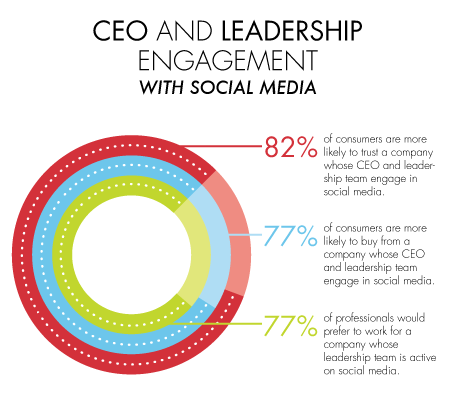
I want to leave you with some stats that are powerful in and of themselves and if you are thinking about taking the plunge and becoming a connected CEO, then come back in two weeks and check out my next blog with tips on how to effectively manage your social media presence.
Originally published on January 19, 2016. Updated on May 30, 2019.
“Sticks and stones may break my bones, but words will never hurt me.”
That saying has been making the rounds on playgrounds for well over a century. It’s an adage that implies that words and insults can’t hurt whoever is the brunt of the comment.
If we’re being honest, it’s never really made any of us feel better, and that’s especially true in the age of digital marketing and social media. Words certainly can, and have, hurt plenty of companies over the years. Many people rely on social media reviews when they’re making purchasing decisions, so when they see a bad review that was handled poorly or ignored, they’re most likely not going to trust the company with their business.
Negative reviews aren’t all bad. Many companies have misguided fears and that result in an aversion to bad reviews, but that’s not the answer. It is impossible to make everyone happy, and if you’ve been in business for any length of time, you are going to have someone out there who is unhappy with something. Reasonable consumers understand this and will take it into consideration when scanning reviews. What do you do?
Take a bad review, handle it with respect and stellar customer service. Turn the situation around. You have the opportunity to mend any damage with the reviewer, build your reputation for making customers your top priority, and build trust with anyone that sees your response. Use negative reviews to your advantage!
Bad reviews have been shown to improve conversion by 67%. If you handle them properly, having negative reviews can actually build trust with consumers.
Approach each negative review calmly
Make it a habit to check social media accounts for what people are saying about you. Don’t just rely on customers to post to your business page or to tag you, because many won’t. Choose a social media tool, such as Google Alert, that will tell you every time your name is mentioned on a blog, website, or in the news. There are other sites available that will also track social media sites for mentions as well.
Remember, it’s not you that the customer is upset with, it’s the situation. Take a few minutes to read through all of your reviews and mentions. Reply to the positive ones first. Then, when you’ve had a chance to process things, take a deep breath and go back to the negative ones. Facebook tracks business response times, displaying it as a badge on their pages, so try to reply within an hour of receiving a complaint.
Most importantly, never delete negative reviews. Customers want to know that you care about them and are reading what they have to say, discerning customers will notice an absence of negative reviews and may become suspicious – such is the nature of the Internet. Address each concern promptly, publicly and personally. (Of course, if they contain inappropriate language or are defamatory or otherwise offensive, then you should delete or report the comments. We definitely want you to be responsible social media users!)
“When you answer a negative review and address the upset customer, you are also speaking to the hundreds of other consumers that want to know how you conduct your business. Consumers understand that mistakes happen, so when they see a business trying to do the right thing, it builds trust.” ~ Phil Penton, President of Social Integrations.
Acknowledge the customer’s issue and let them know that it’s being looked into. Give them a sense of when and how they can expect a response. Don’t just copy and paste an automatic response to issues. Customers can spot those immediately, and they’ll feel as though they’ve been brushed aside. Keep your tone conversational, include their name, your position with the company (it gives you credibility), and mention their issue in your response.
Look into the issue and assign the appropriate person to handle it. Having an escalation plan for employees is helpful and will ensure more consistent customer service. The plan can tell staff who deals with various types of complaints, what can be done at each level to alleviate the issue, and who has the power to offer compensation.
Going the extra mile makes a big difference. People know that no business is perfect and that mistakes happen. Take ownership of what went wrong so that you recognize the problem and prevent further blame from being thrown at you. Owning the issue will allow you to focus on finding a solution instead of stemming a flood of anger.
It is vital to make sure to keep your tone conversational and natural and come across as genuine. It takes time to build trust with a customer but only seconds to lose it. Empathy and honesty (without blaming the customer) can fix almost every situation. You don’t have to have the answers, but you need to be willing to find them.
Don’t rely on free products and services to fix problems raised in negative reviews. You’ll find your policy will be abused if this is your first line of defense. Helping them find an answer or fixing the original problem should be your default action. Offering coupons, vouchers, or replacements can go a long way toward earning you a second chance. Follow up by encouraging the client to update their review if their second experience is better.
After your initial response to a complaint, see if you can take further conversations out of the public eye. This will give you a chance to work with the customer one on one, be more personal, and avoid other commenters from dog piling on top of you. Private messages, email, or even a phone call are ideal ways to continue the conversation.
Finally, always follow up.
Don’t assume that an issue is resolved just because you responded to it. Follow up with the customer to make sure that they’re satisfied. Taking the extra time to touch base is a personal touch that lets them know that you really do care about them and their relationship with you in the future. It also provides you with an opportunity to gain some feedback about your processes and make changes to prevent future hiccups.
You can’t make everyone happy all of the time, but you can be honest and open with your customers and you can make them feel valued. If you take the time to make amends with customers who have had a negative experience, then you’re more likely to get their business again, and they’re also more likely to recommend you to others.
In simple terms, if you want to reach your target audience exactly where they’re searching online, Google is undoubtedly the best platform to utilize. And we can’t wait for you to witness the immense power of Google advertising!
However, before you dive in, there are a few essential aspects you should be aware of. While Google ads are a great way to get your brand noticed and increase your consumer base, being clued in on the way Google operates is the first step toward developing and understanding your advertising campaign.
Here, we’ll dive into what Google advertising entails, how it operates (including the algorithm and associated costs), and most importantly, what steps you can take to ensure the success of your medical spa campaign.
No matter if you’re in the medical spa industry or any other, we all relate to common experiences. So, let’s illustrate a common process with a real-life example.
Have you ever had a conversation with a family member or friend about something, such as the college your sister is attending or the product your mom uses, only to find that very topic appearing in an advertisement on a website you visit the next day?
It can be a bit freaky, right?
This occurrence is likely due to being targeted by a Google display ad that utilizes a technique called “remarketing.” Google employs this tool to place ads on various websites throughout your browsing experience, tailoring them based on your interests and the websites you frequent.
As a medical spa, Google ads will give you access to similar tools.
Now, let’s dive into the two types of Google advertisements.
The first type is Google display ads, as mentioned earlier, which resemble the LastPass ad displayed below.
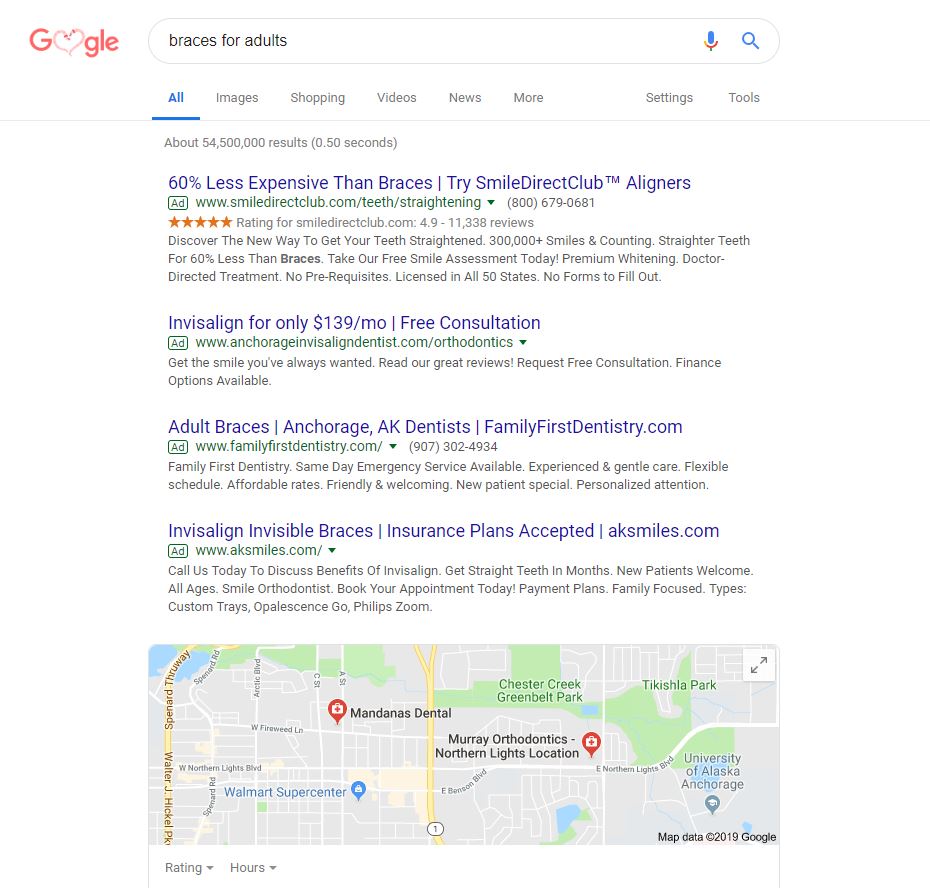
A Google search ad can be easily recognized by the small, green “Ad” label displayed next to the URL beneath the page title.
When you click on one of these ads, the business behind them incurs a charge. This payment model is commonly referred to as “pay-per-click” or “PPC” in the marketing industry.
Below the paid advertisements, you will find the section we commonly refer to as “organic” results.
At Beacon, we recommend that our clients running med spa Google ads also use a strategic mix of paid ads and tactics to achieve rank organically.
In addition, there are a few critical aspects you should be aware of regarding the two distinct types of Google advertisements.
Google search ads consist of three essential elements: a headline, a URL, and a description. In contrast, Google display ads provide a greater level of flexibility.
For med spas, when it comes to Google display ads, you have the opportunity to utilize up to sixteen unique combinations of logos, graphics, headlines, and descriptions! This allows for a wider range of creative options to capture the attention of your target audience.
How Does Google Advertising Work?
To be effective in Google advertising for medical spas, you will want a solid understanding of the Google advertising algorithm, bidding structure, and cost.
All of this is managed through a program called Google AdWords, which you will want to create an account with when you are ready to get started.
The Google Advertising Algorithm
Google’s operations are truly remarkable. And it’s truly astonishing how swiftly and seamlessly everything unfolds when performing a search.
From the perspective of Google advertising when running Google ads, within that split second, Google takes stock of all the ad accounts that contain the relevant keywords or phrases utilized in the search.
Let’s say your medical spa aims to rank for the search query “botox near me.”
When someone searches for “Where can I get botox in my location?”, your ad account will be included in Google’s inventory. But how do you communicate to Google the keywords and phrases you wish to rank for?
You do so by bidding a monetary amount that you are willing to pay if someone clicks on your ad (remember, it’s pay-per-click!).
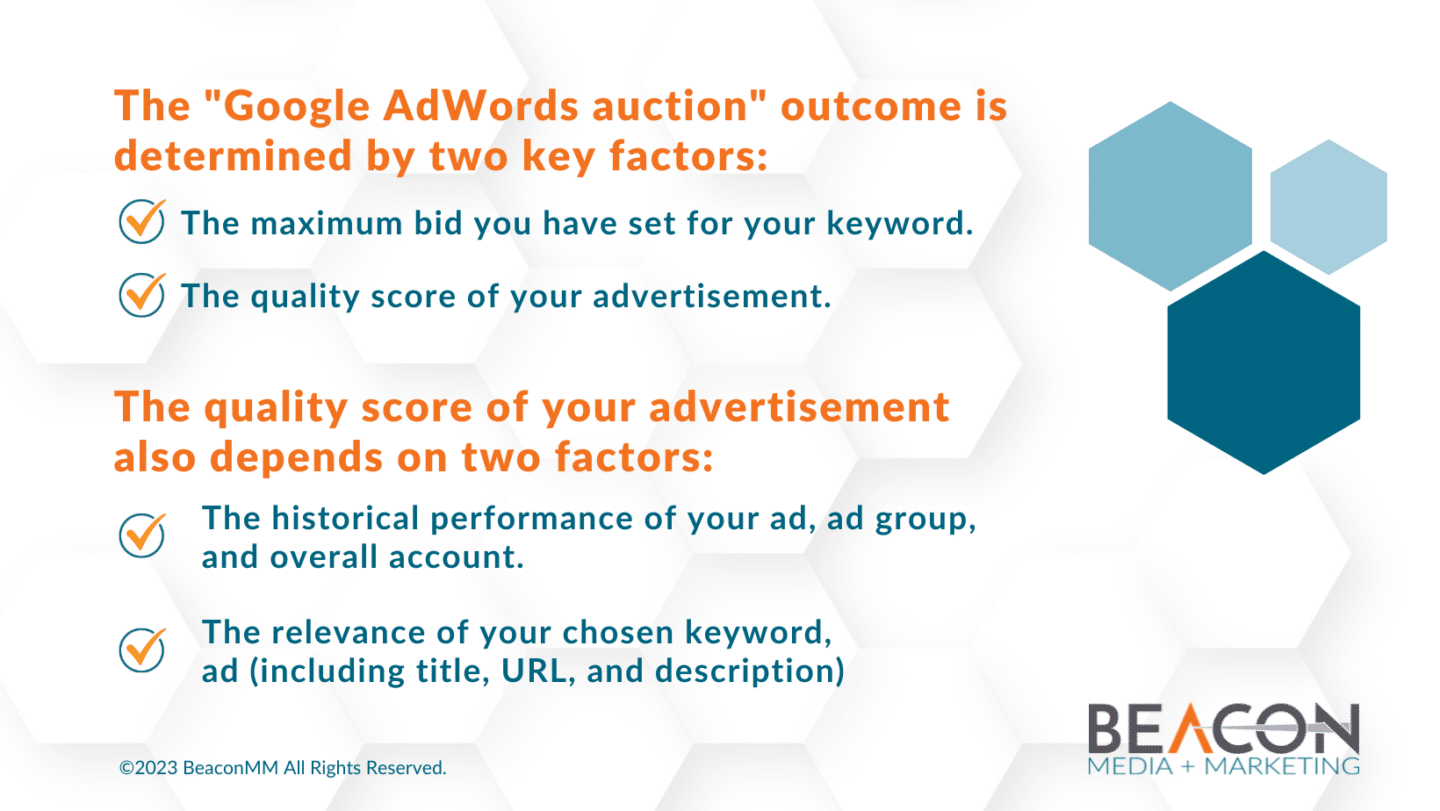
For this reason, many marketers refer to this process as the “Google AdWords auction.” And the outcome of this auction is determined by two key factors:
The maximum bid you have set for your keyword.
The quality score of your advertisement.
Pay close attention to that last point. As a profit-driven entity, Google places great importance on delivering a high-quality search experience to its users, and this includes the advertisements displayed!
Satisfied Google users translate into increased market share and greater revenue for Google. And this is a crucial aspect to keep in mind as you craft your Google ads for medical spas. Thus, the quality score of your advertisement itself also depends on two factors:
The historical performance of your ad, ad group, and overall account.
The relevance of your chosen keyword, ad (including title, URL, and description), and landing page to the search query and to each other.
In addition, two terms you may not be familiar with are “ad group” and “landing page.”
An ad group refers to the collection of keywords you are targeting with your ad.
Your landing page is the specific page to which your ad directs users — a page where they “land” after clicking on your ad. Clever, isn’t it?
Both the ad you write and the landing page you link to should incorporate your chosen keyword and maintain a focused approach on the relevant topic. And all these factors culminate in the following equation that determines the final rank of your ad on the search results page:
CPC Bid x Quality Score = Ad Rank
On the Google display ad front, the auction process differs slightly.
For display ads, maximum bids are established at the ad group level, rather than for individual keywords.
Moreover, you have the option to bid based on impressions, which represents the number of times your ad is displayed to users.
This bidding method is commonly known as “cost-per-impression” or “CPM” bidding.
Remember: “As a company that wants to make money like everybody else, Google values delivering a quality search experience to its users, which includes your advertisements! Happy Google users = more market share = more money for Google. This is an important thing to remember as you write your ads.”
How Much Google Advertising Will Cost Your Medical Spa
As mentioned, when you run Google ads, you will be charged every time someone clicks on one of your medical spa’s Google advertisements.
The equation to determine the cost-per-click (CPC) is as follows:
Next Highest Ad Rank / Quality Score + $0.01 = CPC*
If you did well with ratios and statistics in school, you will realize that the higher the quality score of your ad is, the lower your cost will be. And this reinforces Google’s commitment to quality.
*Note: The cost-per-click will never go above your maximum set bid.
Can Google Advertising Grow My Medical Spa?
Having a great position in search engine results is one thing, but Google advertising can absolutely grow your medical spa!
However, we must emphasize that success is not guaranteed, unfortunately. This is because various factors, such as the level of competition within the medical spa industry in your specific area, can significantly impact the performance of your Google ads.
Certain industries and locations tend to have higher levels of competition than others, and the choice of search terms also plays a pivotal role.
To illustrate this point, let’s take an example from Beacon’s headquarters in Anchorage, where the cost-per-click in the legal industry has soared to as much as $50!
Given the absence of substantial profit margins, it would be unwise to allocate such a significant budget for every click through your Google ad, particularly when you consider that a click represents a lead rather than a confirmed customer (at least for the time being). It is crucial to note that these results may vary in your specific location.
Correspondingly, the bid figures we observe tend to be relatively high, indicating a high level of competition within the medical spa industry and widespread adoption of Google advertising within the community.
How do we come to this conclusion, you may wonder, apart from the “high” and “medium” markers on these results?
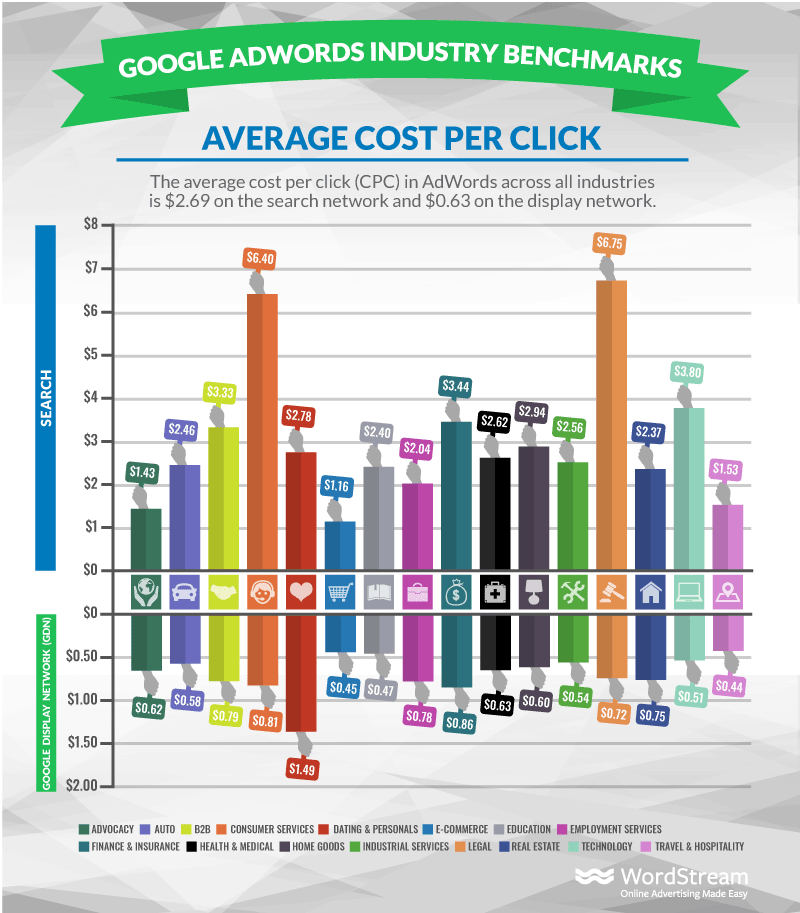
Because we rely on industry benchmarks to gain insights into the landscape and dynamics of the field.
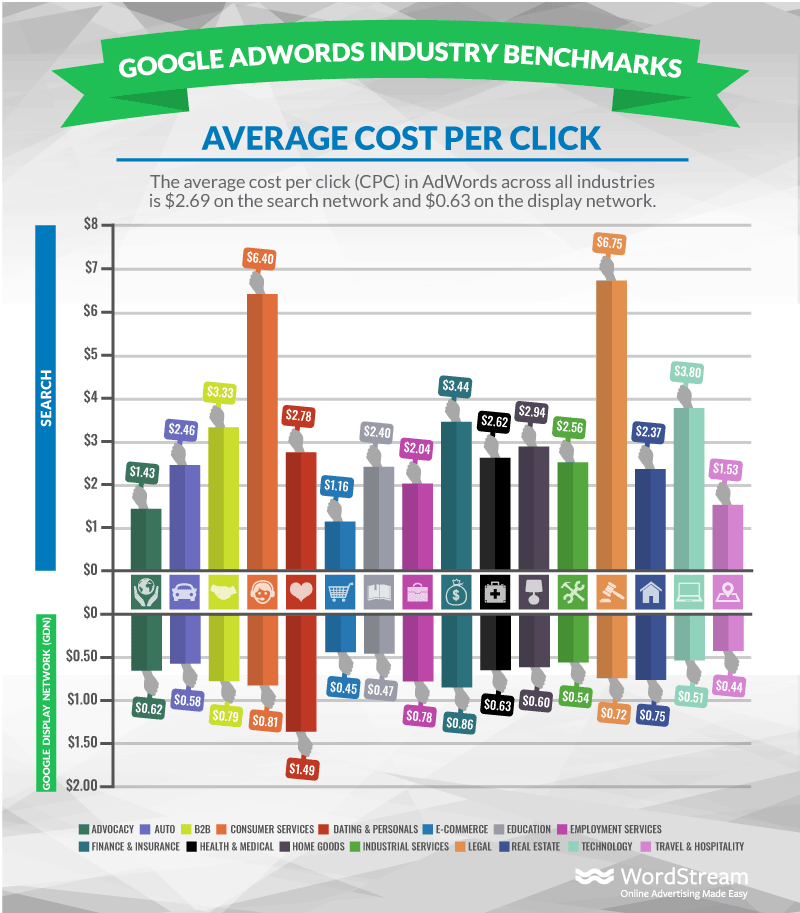
Source: WordStream (at the date of this blog post)
Let’s examine the “Health & Medical” industry as a whole to gain insights. The average cost-per-click in this industry stands at $2.62, which is lower than the lower end of the bid range in our findings.
Don’t let the moderate competitiveness of the medical spa industry discourage you. Creating high-quality, relevant ads that generate valuable leads can make a significant difference for your marketing campaign.
At Beacon, our Google team consistently achieves below-average cost-per-click for our clients, resulting in substantial cost savings.
Curious about our approach? For each service we advertise, we allocate a budget of at least $300 per month, often more. This corresponds to our recommended minimum cost-per-click budget for each keyword across 1-3 ad groups.
We always strive to target niche keywords that have lower competition but effectively capture internet users searching for specific services. As an example, at Beacon headquarters in Anchorage, we focus on marketing for a holistic dentist. Instead of targeting broad terms like “family dentistry,” we prioritize “holistic dentistry” as it offers lower competition and is easier to capture. The results we’ve achieved for this client have been truly remarkable.
Our team prioritizes the creation of quality, relevant ads, and landing pages to generate leads so you can reach potential customers. And few things contribute as significantly to the success of a Google advertising campaign as this approach. Crafting clear, concise, and compelling ads that lead users to the appropriate pages with relevant keywords is paramount.
Are you feeling prepared to launch your first Google advertising campaign for your medical spa?
We hope this article serves as a valuable resource as you embark on this endeavor!
For all medical spa owners, if you feel overwhelmed or lack the time to handle Google advertising for your medical spa, we would be delighted to offer our Google advertising services to you. Our team holds Google Partner certification and stays abreast of the latest developments in Google advertising to deliver the best possible results for our clients.
“Your brand is what people say about you when you’re not in the room.” – Jeff Bezos
If you are ready to brand or rebrand your medical spa and you want more than the humdrum logo you can get off a popular freelancing website for $5, this blog is for you.
We are going to share with you a branding process that has taken us over 20 years to refine.
It is the formal process that we use with all of our corporate branding clients.
This process is truly all-encompassing, from discovering your brand identity to selecting the right icons, colors, and fonts to make your medical spa shine.
Let’s get going!
First: What Is a Brand?
For starters, we are going to clarify what we mean by “brand.”
What is a brand?
We firmly believe that a brand is more than just a logo.
Your brand is what your customers perceive about your medical spa, who you are, and what you do.
According to Jeff Bezos, “Your brand is what people say about you when you’re not in the room.”
So who are you?
Answering this question will provide you with the context that you need to put your brand in the format that most people expect it: icons, colors, and fonts.
We begin our branding process by getting to the bottom of this question in a discovery meeting.
The Brand Discovery Meeting
Our brand discovery meeting is a key part of the branding process as it sets the tone for everything that follows.
The goal is to get all of the brand decision-makers in one room and dig deep into the medical spa’s present perception and vision for the future.
Please do not attempt to rebrand your medical spa without the buy-in of executive leadership! This can lead to different ideas about what your brand currently is and what it could be.
We typically ask a long series of honest questions, such as:
Tell us who you are and what you do in two sentences or less.
If your brand “promises” something to your customers, what is that promise?
What kinds of things does the community think about your medical spa? What would you like them to think?
Given your competition, how are you different? Are you high-cost, but high-value? Do you consider yourselves innovators in the way you do business? Have you changed the way your community thinks about the medical spa industry?
What are your mission, vision, and values?
Give these questions due-diligence, and you may be surprised by what you learn about your business.
How to Name Your Medical Spa
If you do not already have a name for your medical spa, this is the first step for you.
Depending on the results of your discovery meeting, you may have a great lead on a new name.
Here are some ideas that can help you solidify a name:
What are competing medical spas naming themselves? Although you (clearly) do not want to take one of their names, this can be a helpful launching pad for your own creative ideas.
Does the doctor have a strong reputation in your community? If so, you may want to incorporate his or her name in the medical spa name.
You may want to use your location (city, state, or region) in your name.
When you were in the discovery meeting, were there any words used to describe your medical spa that resonated with you? For a more abstract naming approach, you could use a noun, adjective, or verb that says something about your medical spa.
For teams using that last approach, we highly recommend pulling up a thesaurus.
As silly as it may sound, we have found some of our favorite client names with thesaurus in hand.
Time for a Tagline
Taglines are opportunities.
If you cannot capture enough of the amazing qualities of your medical spa in a name, you may be able to do it in a tagline.
Taglines are important for your brand messaging.
Once your tagline has been made, everything you write for marketing your medical spa should be able to connect back to your tagline.
This makes it imperative to get a tagline right.
While you are brainstorming a name, take a few of your “second place” concepts and see if they might not fill out your name as a gorgeous tagline.
How to Pick the Right Icons, Colors, and Fonts for Your Medical Spa
If you are not trained in art or design, you may find it difficult to communicate concepts of reputation in visual forms like icons, colors, and fonts.
We are going to outline a few tools to help you start thinking this way.
It all comes down to human psychology and how we mentally and emotionally perceive objects of designed, informed by our nature and our nurture.
Understanding Iconography
The icon is the part of your brand that most people consider “the brand” or “the logo.”
It is the part of the logo that uses form rather than text to visually communicate something about your medical spa.
Your icon may represent aspects of your name, your location, or your mission.
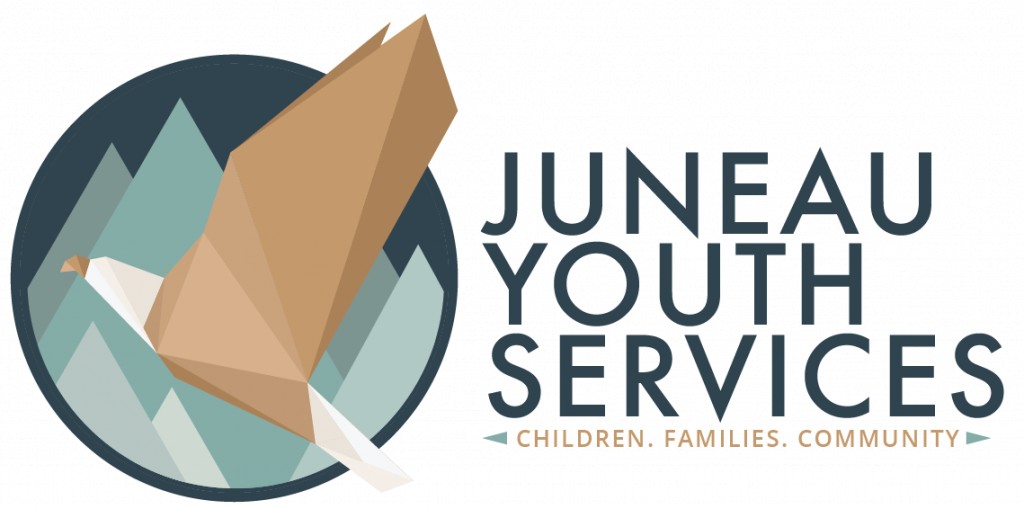
JYS is a mental health service for youth and their families.
When youth participate in JYS, the goal is to inspire hope and freedom for their present and future.
Because JYS is in Juneau, Alaska, and to communicate the freedom JYS youth and families feel when they receive treatment, we used mountains and a bald eagle in their icon.
Icons are extremely versatile–more so than a full logo including all of the fonts and colors.
An icon can be used in a variety of ways, as art on promo products, watermarks on forms, and more.
There are some emotions that you will want associated with your medical spa, and some that you will not.
Take a quick look at what some colors mean to our emotional minds:
Red – Red comes in a variety of shades, each with their own distinct meaning! Red could say “temptation,” “stop and pay attention,” “warning” or “danger,” “celebration,” “love,” or “femininity.”
Orange – Mmm, orange. We often associate this color with tasty food! A gentler version of red, orange can also communicate qualities like “light” and “life.”
Yellow – Just like orange, red can mean light and warmth. Like red, it can catch attention too. Yellow in its gold form represents wealth, luxury, and rank. In other shades, yellow can mean joy, optimism, or comfort.
Brown – If you take a natural approach to beauty at your medical spa, you may want to use brown! Brown portrays earth, wholesomeness, the outdoors, organic products, and all-natural ingredients.
Blue – No, blue does not just mean “sad.” Blue tells our emotional minds to be at peace, reminding us of tranquility, mystery, depth, and strength. It is also used in the health and wellness industry.
Green – Green can be a hard color to get right. It comes in the most shades of any color in the world and it has a wide range of emotional associations! Green can mean anything from new beginnings to relaxation depending on which green you choose.
Purple – A mix of red and blue, purple can take on the attributes of both! If it leans in the direction of red, purple communicates energy and intensity. If it leans blue, purple takes on a calmer and loftier feel.
Adobe offers a fantastic online color wheel tool for selecting color palettes.
Colors and how they relate to each other is a science that is governed by mathematical laws.
Depending on what colors you choose, the Adobe tool will automatically adjust the other colors in the palette according to a color algorithm, to keep the palette looking great.
Experiment with the color wheel until you find the exact feel you are looking for.
Matching Typography
You may not realize it, but just like with icons and colors, typefaces matter for communicating the brand of your medical spa.
Once again, different choices will portray different emotional feels.
Let’s talk about a few obvious examples.
Think about a horror film and what kind of font might make it on the cover.
You are probably picturing something scratchy, screamy, disjointed, or broken.
Now think about your favorite online publication and the font used there.
The font that comes to mind is likely clean, sophisticated, and editorial.
Matching typography to the other elements of a logo is often a matter of font study and gut instinct.
Browse through the fonts on Google Fonts and see if anything stands out to you.
You may want to run a list of 3-5 fonts by your branding team to see if they get the same thing you do from the fonts you have chosen.
How to Manage Your Medical Spa Brand
After you have put hours into perfecting your new medical spa brand, you will want to do everything you can to protect it!
That’s where brand management comes in.
At Beacon, we provide all of our branding clients with a style guide that tells the staff what the logo, colors, and fonts are, as well as how they should and should not use them.
This is an important step that you should consider if you want to maintain a strong brand.
Brands can easily be tainted or confused if they are not protected.
~
As we mentioned at the beginning of our blog, this branding process is the very process that we use for all of our medical spa clients.
We hope that it helps you and your team clarify your brand!
If you would like to partner with the Beacon team in your branding, we would love to work with you.
Whether your business is in Reno or any other part of the country, you should know what Google advertising is, how it works, and how to make it work for you.
Today, we will discuss these topics as well as the Google advertising algorithm, and how much Google advertising costs. We’ll even throw in some of our agency best practices!
Enjoy!
What is Google Advertising?
Have you ever told a friend about a product you were thinking about buying, a place you were thinking about traveling to, or a musician you would like to go see, only to have an ad for that very topic pop-up on the next website you visit?
If so, you know what Google advertising looks like, even if you can’t put a name to it.
Google advertising takes two forms.
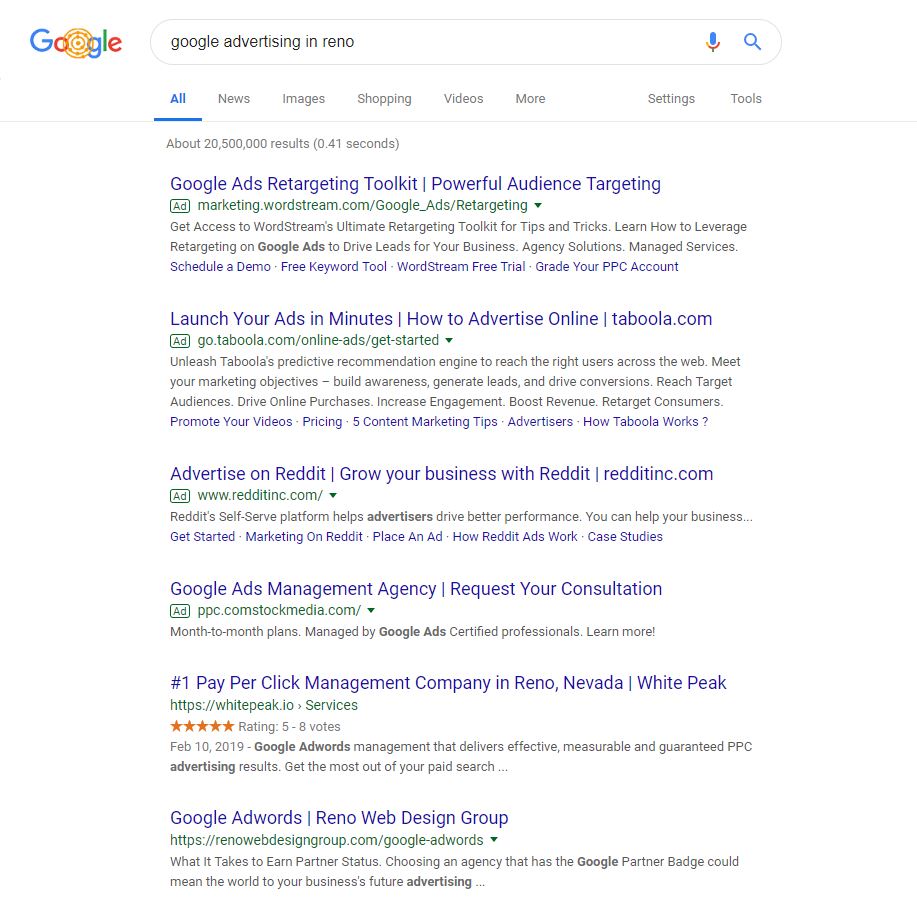
The first is the results that populate at the top of the search engine results page (SERP), indicated by a little green “Ad” box to the left of the URL. See below:
The second is the display advertisements that travel with you from website to website.
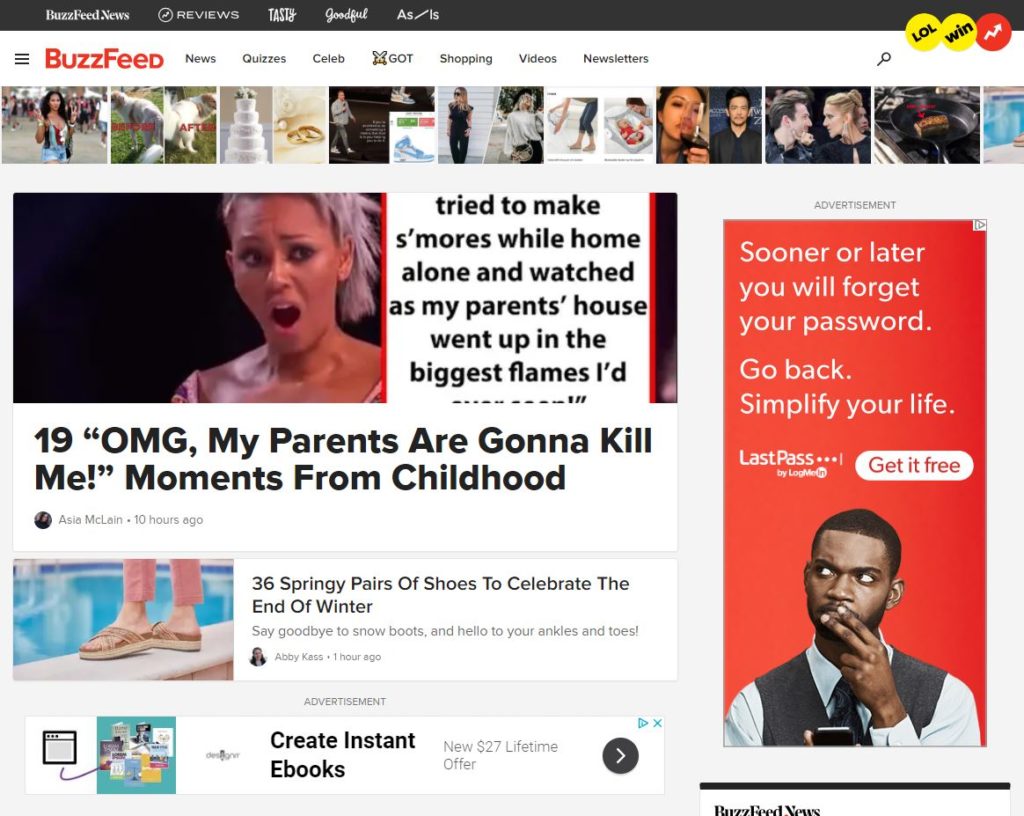
There are actually two Google display ads in the screenshot below. Can you find them amid all the noise on BuzzFeed?
They are indicated by little, grey “advertisement” text above each:
Whenever you click on the first kind of Google ad–the one displayed on the results page–the advertiser is charged a fee.
This is why we marketers call Google advertising “pay-per-click” advertising or “PPC.”
We call everything below the Google ads on the results page “organic” results because no one is paying for them to rank, they are simply considered relevant to the search performed by the Google algorithm.
It is challenging to rank in organic results, which is why so many Reno business owners consider Google advertising an attractive marketing tool. That said, ranking organically is “free”–requires no ad spend, only the cost of the production of content–and therefore incredibly valuable to the businesses who “make it.” We recommend an integrated strategy, paid and organic, at Beacon.
“Results page” Google ads are made of just text–a headline, a URL, and a description.
“Website” Google ads are called “Google display ads” and they are comprised of headlines, descriptions, logos, and graphics–a bit more diverse, they can come in sixteen different formats.
Google display ads “follow you” from website to website by a marketing tool called “remarketing.”
When you visit the website of a business that uses remarketing and then go somewhere else online–if the next website allows Google display advertising–Google will pull ads from the first business onto the second website.
The idea is to encourage you to come back and do business with the first!
How Does Google Advertising Work?
Both results page Google ads and website display ads are created and managed in a program called Google AdWords.
After that, you will need to learn a few things about how the Google advertising algorithm works so you can create effective advertisements.
The Google Advertising Algorithm
What happens when you perform a search on Google?
An incredible amount of work, all in a split second!
In regard to AdWords, the first thing Google will do is find all of the accounts that would like to rank for the terms used in the search.
For instance, you may be trying to rank for “(your services) in Reno.”
If someone searches, “How can I get (your services) in Reno?” your AdWords account will be considered in Google’s sweep.
The way you tell Google that you would like to rank for a particular search term, or, keyword is by bidding money on it in AdWords.
So really, any given search is an “auction” of sorts for Google AdWords advertisers!
Here are the factors that go into the AdWords auction:
The maximum bid you have set for your keyword
The quality score of your advertisement
As you can see, Google not only cares about monetary value, but also about the quality experiences it is delivering to its users.
A “maximum bid” is the maximum amount you are willing to pay if someone does indeed click on your advertisement (remember, this is pay-per-click).
Another term for maximum bid is “cost-per-click (CPC) bid.”
Your “quality score” is calculated by additional factors:
Past performance of the ad, ad group, and your account in general
The relevance of your selected keyword, ad, and landing page to the search and to each other
What is an “ad group?” What is a “landing page?”
Ad groups are the groups of keywords that you are trying to rank your ad for.
A landing page is the page that you send users to after they click on your advertisement, and it should be directly related to the topic that your keyword indicates.
Here is the equation that determines your ad’s rank after the AdWords auction:
CPC Bid x Quality Score = Ad Rank
The AdWords auction for display ads is a little different from the auction for results page ads.
In this case, CPC bids are set on the ad group level, not for individual keywords.
With display ads, instead of bidding on clicks, you can also bid based on impressions, the number of times your ad was delivered.
The term for this is “cost-per-impression (CPM) bidding.”
Fun fact: It is in Google’s best interest to rank your ad higher if it is high-quality and relevant! That’s because relevance and quality mean a better user experience for Google’s users. The better the experience, the more likely users are to prefer Google as a search engine, the more money Google makes. The more users Google has, the more clicks you receive, the more customers you get as a relevant advertiser on Google. It all checks out!
How Much Google Advertising Will Cost Your Reno Business
In pay-per-click, each time an internet user clicks on one of your Google advertisements, your Reno business will be charged for that click.
What determines the going rate? This equation right here:
Next Highest Ad Rank / Quality Score + $0.01 = CPC*
How good is your algebra?
What you will notice from this equation is that, the higher your quality score is, the less you must pay per click.
Once again, Google rewards advertisers for relevance.
*Please note that the cost-per-click will never go above your set maximum CPC.
Can Google Advertising Grow My Reno Business?
Here is an answer that you may not like, but is absolutely true: It depends.
The factors that determine your rank on Google are not only your bid and relevance, but also the amount of competition you have for Google AdWords, in your industry, in Reno.
Some industries and locations see a lot of competition, while others see very little.
At Beacon headquarters in Anchorage, in the legal industry, we have seen cost-per-click upwards of $50!
This would be a deal-breaker for some clients, to whom we might recommend an organic strategy or place more emphasis on social media marketing, depending on the competitive landscape.
Others are perfectly comfortable paying this rate because they have seen how the $50 they spend on one, qualified click has a massive return on investment.
For Reno, here is a breakdown of the keyword competition for three of the top industries currently in the market:
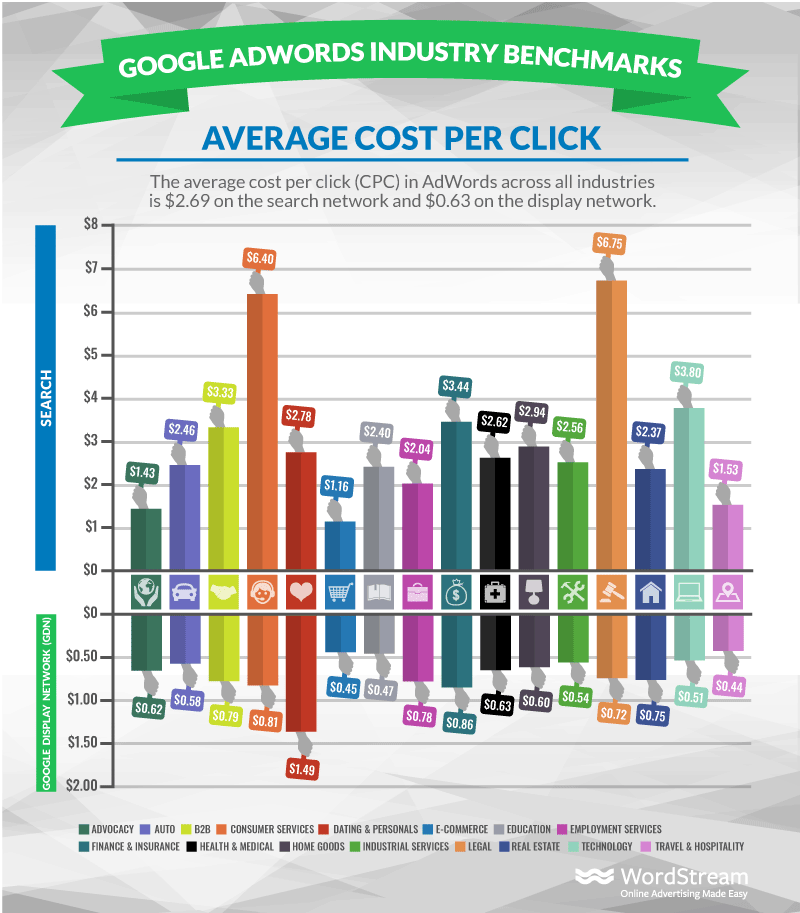
In general, you want to see high average monthly searches (comparatively), low to medium competition, and cost-per-click (CPC) that are lower than industry average (see chart below).
Please note that the actual cost-per-click is a different figure than the maximum cost-per-click bid.
Source: WordStream (at the date of this blog post)
As you can see, cost-per-click in Reno is right around industry average for healthcare, whereas technology is very low, and there is little to no data for Google to report on startups.
However, just because your industry reports a certain average cost-per-click does not mean that your cost-per-click will be the same.
Relevance goes a LONG way in Google advertising.
At Beacon, we frequently achieve cost-per-click below industry standards.
Here are some of our own best practices for Google advertising that we have developed over the years:
For every service advertised, you should have a budget of at least $300 per month (we recommend more). This means a minimum cost-per-click budget on each keyword in about 1-3 ad groups.
You should find a niche that differentiates your business in your industry for more nuanced keywords. The more nuanced your keywords are, the less competitive they are, and the more likely they are highly relevant to the internet users who are searching them. For instance, we have seen great results in Google ads for a local dentist. In our advertising for her, we don’t simply use the term “dentist,” but rather, “holistic dentist,” because that is what she is and FAR fewer local dentists are competing for this specific phrase.
Create relevant ads and landing pages. Make sure your ads are compelling, to-the-point, and send people to a landing page that is keyword-optimized for the keywords you are targeting. Keyword-optimized means that the keyword appears across headers and text on the page.
How can you make Google advertising work for your Reno business?
To sum it all up, you MUST do competitive keyword research, niche your business, spend enough money to see results, set appropriate CPC bids, and create highly relevant ads.
“Is that all?” You may be asking, sarcastically.
If this is a little too overwhelming, we get it–It has taken us years to perfect our Google advertising strategy at Beacon.
Today, we have a Google Partner certificate, and we greatly enjoy helping other Reno businesses grow using Google ads!
If you are interested, please reach out to our President Adrienne Wilkerson to schedule a free consultation using our Acuity scheduler.
Adrienne is on-location in Reno and she would be more than happy to talk to you in person, over the phone, or via video chat!
If not, we hope you find these resources helpful and we wish you the best as you make Google advertising work for you!
Originally published on August 3, 2013. Updated on May 31, 2019.
So you want to be a connected CEO? You want to take the plunge?
Great! But where do you actually start?
Corporate social media 101
Make sure your company has a social media policy that both the PR and HR can agree and live with. Then stick to it. This may seem obvious, but depending on your industry, there can be some tricky areas to navigate when communicating via social media.
Decide which social media platforms you want to “own” as the company’s CEO. There is a lot out there and it’s easy to get burned out. We recommend picking three to focus on and master. We also recommend checking with your PR/Marketing department to find which ones they believe to be the most effective for your company and industry.
Be consistent! It would be better to not do social media or only use one social media outlet than to be sporadic. Set up yourself on a schedule for posting and/or blogging. Some social media platforms like Twitter take a lot more time and should have multiple posts a day to be effective, others like a blog could have one post a week.
Establish and maintain a voice. Social media is just that, social. It is all about conversations. Be yourself and communicate the way you would naturally do with a friend or colleague. People want to connect with the real you, they are looking to feel connected to you and therefore the company you lead.
Finally, we highly recommend having a least one person who can be a second pair of eyes to double check content, basic typos, or other things we might miss composing material. After we take the time to actually post, the last thing we want are typos in our material. Twitter is a little more difficult since it is probably the most casual and spontaneous of the social media outlets. But even so, if you’re responding to a PR issue or posting a response to a national or international crisis for instance, it is better to take the time and get the post proofed prior to sending it out.
Have questions? Schedule a free consultation today.
Ready to finally get a social media strategy up and running for your business? With as competitive as the Reno market is becoming, now is the time to get your social media off the ground.
Our team has fine-tuned the following best practices after 20 years in the marketing business. First, we’ll cover the platforms you’ll want to be on, how they work, and what your posting schedule should be. Then we will get into our secret to consistent publishing, the editorial calendar! We will also cover paid social media advertising at the end.
Enjoy our expertise at your fingertips!
Facebook Is the #1 Social Media Platform, Use It!
Facebook is the most popular social media platform of the whole gamut, no question. That said, we’ve gathered a few important statistics to give you a frame of reference.
It may sound crazy, but almost 75% of online American adults use Facebook.1 Monthly active users for Facebook totaled at 2.32 billion at the end of 2018, just about one-third of the population of the world.2
We love Facebook for marketing because it has fantastic targeting tools. If you are using paid advertising on Facebook (see the last section of this blog), you can target audiences with your content based on their location (say, Reno), title, income, interests, etc. This allows you to narrow your focus so you are spending money on just the exact group of people you want to, no more, no less.
Posting Schedule
Our recommended posting schedule? Three to five times per week. This is just enough content to keep people engaged without numbing or frustrating them with the frequency at which they see your brand. Use an editorial calendar to determine the content of these posts (we will talk about this in a moment).
For a brief summary of the information shared in this blog, watch Social Media Manager Sarah Testen discuss social media marketing on Beacon’s Digital U!
Instagram for Reno
If your target audience includes anyone born in the 21st century, you will want to be on Instagram. The most active users on Instagram are between 18 and 29 years old,3 and 72% of teenagers say that they use Instagram.4
Struggling to know what to post on Instagram? Here’s our rule of thumb: “Everything that goes on Instagram can be shared on Facebook, but not everything that is shared on Facebook should go on Instagram.” Instagram content is a bit of a strange animal–Unless you are posting warm, engaging images shot in good perspective with interesting subject matter, you are unlikely to get engagement. Not all Facebook content has to be this way.
Instagram can be summed up in one word: Visual. If someone on your Reno team has a natural bend for photography, consider putting them on Instagram publishing as a special social media project.
How do you capture engaging photography when the subject matter is your business? Think strategically about your products and services. If you are a product-based business, it’s a no-brainer–Take photos of your products at interesting angles and with beautiful back-drops! If you are service-based, maybe you take more shots of your team in-action or before-and-after photos of your client when they experience your services.
Posting Schedule
Using your editorial calendar (we will talk about it soon, we promise!), plan to publish a couple posts per week that have strong visuals to your Instagram account.
You Should Be Social Media Marketing on LinkedIn, Too
Thought LinkedIn was dead, or at best, stuffy? Think again!
LinkedIn has recently made a come-back and the primary beneficiaries are business-to-business companies. If your Reno business is targeting other businesses, you will want to be on LinkedIn, which is also great for vendor relationships and reaching job seekers.
Here’s a winning statistic for you: Of all social traffic to business-to-business websites and blogs, LinkedIn contributes 50%.5 Unlike Facebook, LinkedIn only has 154 million users, but this is a highly select group of people.6 We’re talking about senior-level staff and company decision-makers. If you are looking to grow, LinkedIn is a great social media platform for finding personnel, with 40 million students and recent college graduates on the platform.7
The best content for LinkedIn is local (Reno) business and industry news as well as personal coaching/life advice. Considering the demographics of the platform, this should not be surprising!
Posting Schedule
Depending on the goals of your company–if it is business-to-business or not–we recommend a posting schedule of three to five times per week. If you are not B2B, you should only be on LinkedIn if you are strengthening vendor relationships or in the process of hiring new staff.
An Editorial Calendar Will Help You Publish Consistently for Your Reno Audience
Now for the moment you have all been waiting for! *drumroll please* The editorial calendar!
Very few people can maintain a consistent publishing schedule on social media without a strong editorial calendar. The reality is, even if you are a creative genius, you will have your ups and downs. If you expect yourself to be able to sit down in front of your computer or pull out your smartphone three to five times per week and come up with a brilliant post idea on the fly every time, you may be sorely disappointed. But if you have a plan–something an editorial calendar provides–you will find your genius comes much more naturally! Here is an example page from one of our clients’ editorial calendars to show you what we are talking about, blurred for anonymity:
This is a “post type” page. It gives an example post idea for the client that they can use as a general category for one type of post to publish each week on their social media. In a given editorial calendar, you can have five to ten of these post types for content creators to choose from. Post types accomplish two things, #1 they take the think work out of day-to-day social media publishing, and, #2 they create consistency for followers.
At the start of service for each of our Reno social media clients, we come together as a team and brainstorm post types based on our research and knowledge of the client, their goals, the market, competition, target audiences, trends, and more. Here are some general post type ideas that frequently surface in our brainstorm meetings:
Educational (like the example above) – Educational posts provide audiences with the baseline of knowledge they need to engage with your business. They also have the power to change incorrect perceptions about your industry or the product or service you provide. Educational posts can establish your business as a thought leader with authority in your subject matter.
Blog/Article Shares – Consider maintaining a blog for your Reno business. It provides great content for this particular post type. Not only does writing your own blog content establish more authority for your business, it also drives audiences to your website instead of somebody else’s for industry knowledge, with the chance of converting them to customers.
Human Interest – This is one of our favorite post types. Everyone loves stories about fellow humanity and the challenges we all face and overcome. Human interest posts typically feature an image of the person of interest, perhaps a quote from an interview with them, and their story. Note: These types of posts work well for some industries, not others, and there must be a clear and obvious connection between the series and a business goal. For a strong example of a group that harnesses human interest, see Humans of New York.
Behind-the-Scenes – We all want to know what happens behind-the-scenes. Posts like these give audiences the sense that they have an intimate knowledge of your business, which can create trust and loyalty. They promote transparency and authenticity. Publish shots of your Reno team at work providing your service or the manufacturing process behind your product.
Before and After – The more concrete you can make the benefits of your product or service, the better. Before and after posts scream the value of what you provide loud and clear.
Lifestyle – Nothing is more impactful for selling your product or service than tying it to the lifestyle that your target audience wants to live. They are already bought-in to the lifestyle they want, so it is a small step to go from there to your offerings! Posts like these use smiling, happy photos of the people in your target demographic enjoying what you provide.
Videos – Video is the most easy-to-consume form of media out there. It is the low hanging fruit of social media engagement. Produce a promo video for your business!
Events – Host or sponsor a lot of events in Reno? Your social media is exactly where you should be sharing them.
Promotions – If you run a lot of deals and specials at your business, you definitely want to be sharing these offers on social media as well.
Contests – Social media contests naturally produce significant engagement. Everybody wants to win something! We typically run photo contests where followers are asked to share a picture from “their last vacation” or “their favorite food”–something related to our client’s product or service.
Quizzes – Quizzes are equally engaging. Ever clicked on a link to find out, “Which character from The Office are you?” If so, you have experience with social media quizzes. We use a tool called Lead Quizzes to generate questionnaires for our clients. The great thing about quizzes is that they can ask for an email address to get started, which gives you a lead.
Campaigns – We use social media campaigns whenever we want to push a particular message, service, or promotion for one of our clients. Campaigns are typically a little more in-depth than simply brainstorming a post type.
In addition to creating an editorial calendar, we also recommend that you schedule your social media posts in advance. Facebook Business Manager allows for the drafting of posts as well as scheduling. As a practice, our team creates posts at least a week in advance of when they should go live. This also helps keep us on track so that we do not get stuck on creative for a particular day.
Give Social Media Boosting and Advertising a Try!
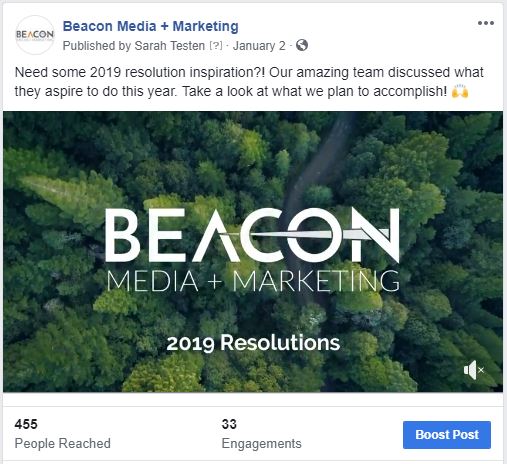
Ever wondered what that blue, “Boost Post” button is at the bottom of your business’s Facebook posts?
Boosting is one way that Facebook allows you to pay to reach more people than just the followers on your page. You are also able to do the kind of targeting that we mentioned at the beginning of this blog with Facebook boosting.
After recent Facebook algorithm changes, it can be impossible to grow your following without using paid advertising. This is because Facebook will only share your content with your followers and their friends unless you pay. If you want to reach new audiences, you have to put some money forward.
There are two ways that you can pay for Facebook advertising. One is by clicking the little blue button and following the prompts to create an audience, set a budget, and select how long you would like your ad to run. The other is by using a Facebook Ads Manager. There is a lot more you can do in Ads Manager–including A/B testing your ads–if you have the knowledge and time to dive deep. It also provides a lot of useful analytics.
We recommend that clients spend a minimum of $300-$500 each month, purely as the budget for the paid ads, distributed across two to three advertisements. That in mind, no matter how much you spend, your ads will flounder if you do not know how to target properly (location: Reno, etc.). For more information on that subject, read our blog on Facebook Ads Manager.
~
Get ahead of the competition in Reno! Plan and launch an integrated social media strategy. We’re rooting for you and your business as you find what works best.
If you would like the assistance of a local digital marketing agency in the brainstorming and implementation of your social media strategy, we would love to get the conversation started. Our President Adrienne Wilkerson is currently offering a free consultation to anyone who is interested. Adrienne is onsite in Reno and she would be happy to meet with you in person if you’d like!
“Your website is potential customers’ first impression of your business.” – #TeamBeacon
If you are like most busy business owners or marketing professionals in Reno, you probably have an outdated website that has been floating in the internet abyss for years now, just waiting for some tender loving care.
Although website experts recommend a redesign every 2-3 years, a lot of folks struggle to keep up with this pace.
Every time a significant industry trend changes, a new product or service is added to your business, or new staff are hired or fired, you face another website update.
Sometimes you simply need to start from scratch.
Never fear, our proven process is here!
~
Cheesiness aside, we truly have an excellent website design process that has been 20 years in the making.
It is this process that we are going to share with you today!
Our desire is that, as you read this article, a concrete path forward begins to clarify in your mind. Enjoy!
1. Schedule a Meeting with Your Reno Team
Your first step is a meeting of the minds.
It is likely that everyone on your Reno team has a different idea about why you are designing a new website, what your goals are, and what a strong website looks like.
Use the power of collaboration to refine your collective vision!
Ask your Reno team some key questions to discern a path forward–we have outlined some of the questions we ask our clients below.
Request that the team comes prepared having looked at some websites they like as well as some that they dislike.
What are your overall business goals? Is there any area of your business that you would like to grow?
Why do you want a new website design? List two goals that you would like a new website to achieve.
Of all the information on your website, which is the most important for customers to find quickly? What are your primary products or services?
What features stand out to you on websites that you like the look and feel of?
Is there any imagery that you want on the website? Any that you don’t? Do you have a brand guide?
The goal of this meeting is to discovery concrete features and specifications for your new website design.
For example, do you want Reno customers to schedule appointments directly online? In the design phase, you will need to be sure you have a plugin that allows for this.
Also discuss your current marketing strategy–differentiators and target audiences–to ensure your new website design aligns with your marketing efforts.
2. Create a Site Map and Wireframe for Your Website Design
Industry terms like “site map” and “wireframe” may sound daunting, but they are actually fairly simple when stripped away to the basics.
A site map is simply a flowchart of the information you want on your website and how it should be organized.
The simplest site map takes the form of a bulleted list, for example:
Home Page
About Us
Services
Service A
Service B
Service C
Blog
Contact Us
This is the most basic site map format that we recommend to our Reno clients.
Of course, your new website design may be a bit more complicated with multiple service pages, an “Events” tab, or perhaps a place for published deals, but you get the gist.
Your site map is the foundation for your website wireframe, which is why we have included these two elements in the same step.
What is a wireframe?
According to Google, a wireframe is:
“…An image or a set of images which displays the functional elements of a website or page, typically used for planning a site’s structure and functionality.”
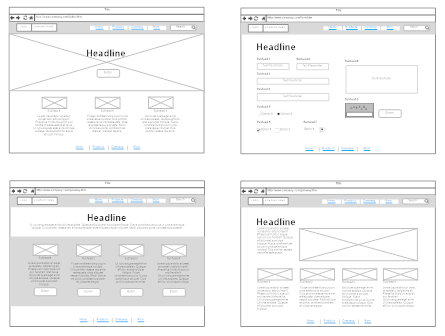
At its core, a wireframe is a sketch–a mock-up–a drawing of your website pages and how you want them to be laid out.
A wireframe is not as detailed as a fully developed site; it is simply lines, boxes, and perhaps a few images if you have them at this point.
Taking your site map in hand, create a wireframe for each of the pages listed, portraying where you want all headlines, images, written content, and buttons to go:
Wireframing can be a bit harder than creating a site map at first.
If you would like to practice before you wireframe your own original website design, a great way to learn is to look at the elements on a page of a strong Reno website and try to imitate the layout in wireframe form.
~
At Beacon, we love our free online tools!
Although we use paid software called Adobe XD for our wireframes, there are a lot of free options available online.
Take a look around and find something that you are comfortable with using.
We recommend a software that offers templates and drag-and-drop features for beginners.
MockFlow is popular and offers a basic package for new users.
~
In your wireframe, it is okay to use filler text such as “lorem ipsum,” but you will want to be thinking about your final content as early in the process as possible!
3. Write the Website Content with Your Reno Team
Once again taking up your site map, write content for each of the pages you are planning for your new website!
Keep the following best practices for website content in mind as you go.
A. Reno Relevant Keywords
Keywords are the words and phrases customers are searching to find you and the products and services you offer, for example, “website design in Reno.”
In order to rank on the first page of Google for these searches, you must tell Google that you are relevant to those keywords in its own terms.
Google likes to see relevant keywords incorporated throughout website content–this is called search engine optimization (SEO).
Focus on 1-2 relevant keywords per page of your website and place them naturally throughout the content.
Write 400-600 words on each page for the best results, but watch yourself!
Do not overuse your keywords of choice.
This is something called “keyword stuffing” and it is not acceptable to Google or to the customers who read stuffed content.
B. Eye-Catching Headers
Fashion is just as important as function when it comes to website content.
In some aspects you are writing for Google, in others, you are writing for your Reno customers.
To keep customers engaged and to satisfy Google’s requirements, use strong formatting practices such as short paragraphs, pull quotes, bullet points, imagery, and eye-catching headers.
Headers indicate to users the end of one thought and the start of another.
They are also important for SEO!
Place the relevant keywords you have chosen in your headers to boost your rankings.
Once you place the content on your website in the development phase, specify that the headers are either “H2” or “H3” in the content management system you are using, whether that be WordPress or something else, for best results.
C. Quality Website Content
Another important metric considered by Google is the quality of your content.
This is measured by parameters like “unique words” and “bounce rate,” or, the rate at which users visit your website and leave.
To encourage people to stay, write unique, compelling content that is from your distinct point-of-view!
Speak directly to customers in second-person using the word “you.”
Empathize with their challenges in Reno and present your product or service as a tool they can use to overcome them!
~
Something that must be a part of every website page is a call-to-action (CTA) at the very end of your content.
This is a proposed step that the reader can take to act on what they have just read!
For example, at Beacon we would say, “schedule a free consultation to learn more about our website design services,” linking to our scheduler where appropriate.
4. Implement Your New Website Design
The content you write, the wireframe you create, and the site map you plan all form the groundwork of your new website design.
Once these pieces are in place, it’s time to get started!
At Beacon, we use an advanced WordPress plan that allows us to custom develop all our Reno clients’ websites.
WordPress also offers several packages for beginners that do not require the skills of a web developer.
These packages allow you to select pre-developed themes and customize them according to your brand!
“Your brand is what people say about you when you’re not in the room.” – Jeff Bezos
Reno, Nevada is a competitive market with a myriad of companies moving in to gain from a growing economy. Now is the time to set your business up for success with a strong branding package! This blog is for you if:
You have just entered the Reno market and you need a brand that will blow the competition out of the water.
You have been a long-standing business in Reno and you are looking to update your brand.
Today, we’re going to walk you through our proven branding process (over 20 years in the making!), from discovery to finding the right logo, colors, and fonts for your business. We hope this helps your team clarify your brand!
What Is a Brand?
Your brand is the visual representation of who you are and what you do. It takes the form of the logo, colors, and fonts you choose for your business. When customers see your brand in Reno, they should be able to immediately recognize that it is your unique company identity. A brand should say something positive about your reputation. We are going to talk about the identity discovery process in a moment, but here is a quick glance at the branding journey ahead and what it entails:
Your job is to capture your reputation if it is strong
Your job is to discover your reputation if you do not know what it is
Your job is to pivot your reputation if it has been negative in the past
How can all of this be accomplished with a logo, colors, and fonts?
Let’s get started and find out!
The Discovery Process
When we onboard new Reno clients at Beacon, we take them through a list of questions to help them capture, discover, or pivot their brand. The first step is to make sure all the decision-makers are in the same room and paying attention to the process. Then we let the discovery begin!
It is important that the decision-makers on your team are won over to the branding process. Changing a company reputation is not easy, and requires the intent focus of everyone involved.
Some of the questions that we cover with our clients include:
Give us your elevator pitch in two sentences or less. Who are you and what do you do?
Your customers should feel assured by your brand. What can you promise them?
Are you aware of any current perceptions about your business? What would you like to be known for?
What is your niche in the Reno market? Are you cheap but high-value? Expensive with personalized service? Unique in your service offerings? Well-respected in the community? Intelligent and educational?
What is your long-term vision?
Our brand discovery meeting typically covers target audience, competitors, and differentiators as well. Be sure to bring up these questions when you get together with your team.
Naming Yourself
The very first step in branding your business is coming up with a name and a tagline. If you do not have one already or you need to make a tweak to your current name, this is for you! We have compiled a list of tips for the brainstorming process:
Consider the names of other businesses in Reno that are in your industry! You certainly do not want to appear to be imitating these companies, but they can give you a good starting place for your own creative ideas.
If you are a family business, think about including the family name in your company name, especially if your family has a great reputation in Reno.
You may want to include the location of your business (state, region, or city) in your name if you are focusing heavily on Reno.
During your discovery meeting, certain nouns or adjectives may have stuck out as resonating with your mission and purpose. If so, use these!
Sometimes the best way to find a name for your business is to pull out a thesaurus, whether online or in-hand. If there were particular words that resonated with you, search these terms in the thesaurus and see which synonyms might make a great name!
The Tagline
If you are struggling to capture your company identity in your name alone and logo alone, a tagline can be a great way to communicate more! We frequently come up with more than one concept with our clients during their discovery meeting, and we use the tagline to incorporate some of the “secondary” concepts we discovered.
It is not crucial to create a tagline for your business, but it is recommended. The process alone will help you clarify your core messaging, carrying over into all your marketing channels, from your website to social media.
Picking Icons, Colors, and Fonts
It can be challenging to capture the identity of a business using icons, colors, and fonts. Fortunately, we have psychology on our side! Forms and colors have a mental and emotional impact on the people who view them, whether they are from Reno or otherwise. Although the way this works is a fascinating discussion, we will try to keep our explanation as high-level as possible today. Your choices here are vastly important and we don’t want to drown you in the details!
Iconography
The icon in the logo is the graphic that accompanies your name, and it is what most people think of when they think of a logo in the first place (think of the McDonald’s arches or the Nike swoosh). Your icon should visually communicate something about who you are or what you do. In the below example, we gave Juneau Youth Services (JYS) a logo with an icon composed of mountains and an eagle. We wanted to communicate the fact that JYS is located in Juneau and that there is freedom in getting the help that you need.
Icons can be extremely versatile. Many icons become assets for the design of promotional products, watermarks on company forms, or a standalone logo for businesses that have achieved enough brand recognition in Reno.
For your logo icon, think back to your discovery meeting and remember some of the concepts you discussed. We often browse Pinterest to get the creative juices flowing and to create a board of ideas. Try searching “logo ideas for Reno” and see what pops up. Another great site for icon ideas is The Noun Project, which contains icon assets created by artists from around the world.
The Color Wheel
The part of your logo that will emotionally connect with your target audience in Reno the most is the colors. It is very important, therefore, to select colors that express exactly what you want! In a recent blog, we discussed the color wheel and which colors correspond to which emotions. Here is a brief summary of some of those concepts:
Red – Reds come in a wide variety of shades, communicating a wide variety of things, from temptation, to warning to pay attention, to danger, to celebration, to love, to femininity.
Orange – Because orange is a softer version of red, it can communicate softer versions of the emotions associated with red, such as light and life. Oranges are also frequently associated with food, making them appetite stimulating.
Yellow – Yellow is a bright color that can create emotions of joy, optimism, and comfort. As a gold, yellow creates associations with wealth, luxury, and rank. Light and warmth are often associated with yellow, and the color catches attention like red.
Brown – Organic, all-natural, and outdoorsy Reno businesses would all do well to create a brand using brown. This color reminds viewers of earth and wholesomeness.
Blue – Blue creates feelings of tranquility, mystery, depth, and strength. It is frequently used in the tech and health and wellness industries, specifically.
Green – More diverse than any other color in the world, the various shades of green can communicate everything from new beginnings to relaxation.
Purple – Purple is a fun color because it is a mix of red, blue, and their associations. If a purple is redder, it will communicate energy and intensity. If the purple is on the blue end of the spectrum, it will elicit feelings of calm and loftiness.
Not all colors come in the same quality or hue. For this reason, Adobe has created a free online color wheel that can be used to select colors that go well together. The wheel will automatically adjust according to the colors you choose. Take a look at this tool with your team and play around with it to find a set of colors that you like!
Typography
There are two kinds of people, those who geek out about typography, and those who do not! For those who do not, typography is more important than you may think. Just like with the icon and colors of your logo, your typeface communicates something about who you are. Some fonts fit with the theme you are going for while others will work directly against it.
Google has a fantastic, free online font tool that you can use to take a look at the kinds of fonts available (you can also download their fonts for free). What’s neat about Google Fonts is that it lets you type your desired name and tagline into the font boxes provided to see what they would look like.
In a lot of cases, finding the right font for your logo takes gut instinct. When you are browsing Google Fonts, take a moment to find the feelings each individual font creates within you. It might be challenging, but try to discover why that particular form elicits those feelings.
Some fonts might come across as “editorial” to you simply because you have seen them on a news site in the past. Others might strike you as “creepy” because they were a part of the last horror show you watched on Netflix. It is likely that your fellow residents of Reno feel the same way because they were exposed to the same media associations. Depending on your industry, you may gravitate toward a particular font that is frequently used.
Try to come up with a list of 3-5 fonts that give you the right “feels.” Run them by your team to see if they have the same reaction. This will be a good litmus test for your gut instinct, and maybe help you land on the final font for your logo!
Brand Management
After you have created your brand, you must protect it. Especially at the beginning when your team is excited to use your new logo, colors, and fonts, it is important to set a standard for how they should be used. This will reap dividends for the future integrity of your brand in Reno.
Some teams create large corporate policies while others simply use a single-sheet style guide. We find that the latter is just as effective as the former, but we provide both upon request to our Reno clients. Please do not skip this step if you want to preserve your new brand!
Our goal today was to assist you in your branding journey. We hope you have learned a lot of helpful information about the tools available that you can take back to your team! If you have any questions about the process outlined here, our President, Adrienne Wilkerson is available to talk with you. She has been branding small to mid-size businesses for over 20 years and she would love to work with you! We offer a free consultation to everyone who is interested in our services.
Since top tech companies like Apple, Microsoft, Amazon, and Tesla have moved into the area, businesses in supporting industries have flooded Reno to provide necessary goods and services to employees and their families.
If you are one of these businesses or a business affected by the influx of competition, you have probably boosted your marketing efforts to get your voice heard above the crowd!
We’ve put together this handy, digital marketing strategy to help you do just that.
Digital marketing is the most effective form of marketing for reaching the biggest number of the most qualified leads for your business.
After 20 years in the marketing industry, we have developed a digital marketing funnel that delivers some pretty amazing results.
Learn more about our digital marketing funnel and how it can help you bring in new business in Reno!
How to Use Digital Marketing to Bring in New Business in Reno
Digital marketing only works if your strategy is geared toward the people you are trying to reach, so we will be using their thought process to guide our strategy.
No matter where you are from, Reno or otherwise, customers go through a thought process when they are making purchase decisions.
In marketing, we call this process the “four stages of the buying cycle.”
The stages of the buying cycle are Attract, Engage, Convert, and Close. There is also a fifth stage that should come before all of the rest in a successful digital marketing strategy. We call it, “Prepare.”
In each stage of the customer thought process, we use a different digital marketing tactic to address the specific state of mind our customer is in. We do this to bring them one step closer to becoming new business for us!
1. Prepare for Digital Marketing
It is important to have a strong brand and website before you begin digital marketing, especially in a competitive market like Reno.
Both your brand and your website contribute to helping your customers understand who you are and what you do.
The “Prepare” stage is all about getting your digital presence ready to put it in front of as much of your target audience as possible, to drive leads.
Branding
The logo of your Reno business is your first impression to customers.
Your brand should visually communicate who you are and what you do in a split second.
Businesses with weak brands confuse their customers with mismatched fonts, a mix of colors, and nonsensical logo variations to boot!
If you do not already have a strong brand in your digital marketing arsenal, invest in getting your logo, colors, and fonts redone.
Make sure the agency you work through provides you with a style guide which helps your staff know how to preserve the integrity of your brand.
First, it is where customers can learn about who you are and what you do.
Second, your website is what Google uses to determine where you should rank online for searches in Reno.
The structure and content on your website should be optimized for both of these “users.”
For customers, your website should load quickly, navigate intuitively, and read easily.
For Google, your website should also function seamlessly, make structural sense, and contain “keyword-optimized” content.
To “keyword-optimize” your content is to make sure all of your pages have a specific focus keyword that you incorporate naturally throughout the text, headlines, and metadata.
This tells Google what you are talking about in its own, algorithmic language!
If your website is not in a good spot–loading slowly, difficult to navigate, or unoptimized for Google–get it up to speed before you commence your digital marketing strategy!
2. Attract Reno Customers
After you have prepared your brand and your website for digital marketing, it is time to “Attract” new customers!
The first step here is to identify who your customers are.
Obviously, they are from Reno–But what are their other demographics?
Once you have identified the ages and interests of your target audience, think about their behaviors.
When your target audience is thinking about buying something, what do they do?
Likely, they have a heightened awareness about a need they are trying to meet, or maybe they are directly searching for a solution to a problem they are trying to solve.
If you can tie their need to your product on social media or provide answers to the questions they are asking on Google, you will attract these prospective customers to your business!
Social Media
It is probable that you already know the power of social media for reaching large numbers of target customers, but just in case, here is a statistic to confirm your suspicions:
In the United States alone, Facebook has 214 million users, that’s almost 66% of the population!
If you want to reach the people of Reno, social media is the way to go.
Social media platforms like Facebook and Instagram allow you to target people by location (such as Reno!), demographics, the groups they follow, their interests, and more.
With targeting, eye-catching imagery, and engaging content, you can capture the attention of the people who could use your product or service the most.
If you do not have social media as a part of your digital marketing strategy, set up business accounts with the platforms that your target audiences use the most and get publishing!
Google Advertising
To reach the people who are searching on Google, you have to get on Google.
Google ads sit at the very top of the results page for the specific keywords and searches you choose to target.
You can also set location targets, such as Reno.
Google advertising that performs best (gets the most clicks) has strong titles and content.
If you are not already using Google advertising to attract new business in Reno, now is the time!
Blogging
Whereas Google ads are paid and sit at the top of the results page, blogs are organic (unpaid) and sit just below, in the content section.
You might think, “If blogs are not on the top of the results page, why blog?”
The reason is twofold.
For one, not everyone trusts Google ads (clicks on them).
For two, blogs can go much further for pulling in customers who research their options.
With blogs, you can answer specific, long-form questions in a thorough way that creates trust and brand preference in potential customers.
We use a tool called Answer the Public to help us know what people are asking online.
For example, when you search “digital marketing,” you get a plethora of questions people are searching, such as “What does digital marketing do?” and, “What is digital marketing all about?”
If you use this tool, soon enough, you will have a list of blog topics to write on.
If you blog consistently (2-3 times per week at 1,600-2,000 words if possible) and learn how to target your blogging well (location: Reno), it will substantially increase your website traffic and the number of leads you have coming in online.
If you are just getting started with your blog, 1-2 blogs per month at 400-600 words each can also work with strategic targeting.
3. Digital Marketing That Engages
Once you have attracted Reno customers, you want to get them coming back for more.
Certain forms of content are more naturally engaging than others.
We often use the following digital marketing tools to engage target audiences.
Video Marketing
The most easily digestible form of media, video is a quick way to earn engagement!
Create short (30-60 second) video productions with your team that are relevant to Reno customers, perhaps presenting the benefits of your product or service or answering questions in a fun or silly way.
These videos should be published on your social media.
Social Media Quizzes
Social media quizzes have become a popular way to produce engagement online.
You have probably participated in one yourself without knowing it!
When was the last time you answered questions to find out something like, “Which Parks and Recreation character are you?”
Develop a quiz that is relevant to Reno residents and publish it to your social media.
Take free reign to be (appropriately) fun and silly with your quiz!
The goal of the quiz is to collect leads, names and email addresses.
Also include a “call to action” at the end of your quiz to relate the content to your product or service and encourage people to reach out to your business!
4. Convert Using Lead Generation
Do not wait long after your customers are attracted and engaged to “Convert.”
There is a small window where customers are ready to commit something to their newfound interest in your business.
Make it as easy as possible for them to give you their information, asking for an email address.
Always, always, always provide something valuable in exchange.
You can use a few, key digital marketing tools to generate leads for your business.
Landing Pages
Landing pages are specific pages on your website that you design with customer conversion in mind!
In general, a landing page provides a brief description of the offer you are making, requests contact information, and provides something valuable in return for that information.
Point customers to your landing page from your social media or Google advertising, then offer them something like an eBook or a free consultation (see below).
eBooks
Seeing the word “book” probably overwhelms you just a little bit.
“Do I really need to write a book to generate leads for my business,” you may be asking.
An eBook is actually very easy to make if you have been blogging diligently.
Gather all of the blogs you have written–the questions you have answered for Reno customers–and compile them into and organized PDF with a table of contents.
Viola! You have a valuable eBook that you can give to customers in exchange for their contact information.
Other Forms of Lead Generation
Your website is where you should be pointing your target audience to capture leads.
You can set up multiple places on your website that capture contact information besides your landing page.
Most websites have an intuitive contact form in their menu.
You can also add a chatbot to your website that follows customers across the pages, asking for the same information as the contact form before they commence a chat session.
Additionally, you can add a form for customers to sign-up for a free subscription to your newsletter or email updates.
5. Close New Reno Customers!
In the last stage of the buying cycle–“Close”–customers make the decision to purchase your product or service.
Make this as easy for them as possible.
One of our favorite tools for this is the free consultation.
Free Consultations
Free consultations are non-commital.
They allow the customer to dip his or her toes in the water before taking the dive to start business with you.
This might sound like it benefits them more than you, but there is nothing farther from the truth!
Once customers have put their foot in the door, they have made a step toward commitment that creates preference toward your business in their mind.
On your website, create a form for customers to register for free consultations and experience the benefits for yourself!
We hope you feel confident taking your target audience through the buying cycle now that you have all of the digital marketing tools to Attract, Engage, Convert, and Close!
If you would like to hire a local digital marketing agency to help you navigate the competitive waters of Reno, we would be happy to talk with you.
Our team enjoys the opportunity to partner with local businesses and help them achieve their goals for growth.
You can schedule a free consultation with President Adrienne Wilkerson, here.
“The best place to hide a dead body is on the second page of Google.” – Anonymous
A lot of the practice managers we meet have a gut instinct that they need to be advertising on Google, but few know exactly what Google advertising is, how it works, and whether or not it can truly help them grow their practice. They’ve heard the terms–Google AdWords, PPC, even search engine optimization–but they don’t know what it all means. We’re here to shed some light on these subjects and to tell you that yes, Google advertising can help you grow your orthodontics practice, but there are some important factors that you need to know. You’ll learn about the Google advertising algorithm, how much Google advertising costs, and much, much more! Enjoy!
Bonus: We threw in some of our agency best practices at the end. Check it out!
What is Google Advertising?
Have you ever performed a search on Google and wondered why the top several results have a little green box that says “Ad” next to them? Or have you ever visited a website only to have their advertisements follow you to the next site you visit? If so, you have encountered Google advertising.
When you perform a search on Google, you are taken to something we marketers call a SERP (search engine results page). This is simply the page on which Google displays all of the results of your query. The SERP will be formatted differently depending on your search, but in general, Google Ads are the results displayed at the top of the page:
Google Ads are called “paid” results because the advertiser must pay whenever an internet user clicks on them. That is why in the marketing world we call Google advertising “pay-per-click” or “PPC” advertising. The results below this area of the SERP are called “organic” results because they are chosen by Google strictly according to their relevance to the search, as in, there is no additional paid incentive.
It can be tough for an orthodontics practice to show up in the top of the organic results. That is why Google Ads are so appealing to many practices. At Beacon, we recommend a strategy that incorporates both Google Ads and techniques to rank organically.
Google Ads are created using Google AdWords, and they are typically comprised of three components, a headline, URL, and description. The advertisements that you see on the websites you visit are a little bit different, however. These are called Display Ads, and they can come in sixteen different formats combining logos, graphics, headlines, and descriptions. Here are some examples of Display Ads being run by Listerine on WebMD:
As you can see, Display Ads look very different from the ads shown in the SERP, and allow for a lot more visual, creative freedom. When you see Display Ads that seem to “follow” you from other sites you have been visiting, this is because the advertisers are trying to reach you through something called “remarketing.” Remarketing is a kind of advertising enabled by Display Ads that allows advertisers to show ads to you if you have already visited their website, enticing you to come back. It is very effective!
How Does Google Advertising Work?
Both the Google Ads that are displayed in the SERP and the Display Ads that are shown on websites are created using Google Adwords. To create a Google AdWords account for your orthodontics practice, follow their sign-up guide.
Registering for an account is one thing, but creating advertisements is another. Getting those advertisements to show up when other orthodontics practices are competing for the same advertising space proves to be an even greater challenge! Let’s talk about the Google advertising algorithm and how it works, then we’ll dive into how you can use Google advertising to grow your orthodontics practice.
The Google Advertising Algorithm
A lot happens in the split second it takes to perform a search on Google.
Whenever someone performs a search, Google takes a look at all of the AdWords accounts it has on record, checking for advertisers who are trying to rank for relevant keywords. For example, an advertiser who wants to rank for searches like, “Can I get braces as an adult?” might be trying to rank for the keyword, “adult braces.” Advertisers tell Google that they want their ads to rank for certain keywords by bidding a monetary value on them. This makes every Google search an auction of sorts for advertisers.
How does Google choose who wins? The algorithm looks at two factors:
The maximum bid you have set for your keyword
The quality score of your advertisement
Your maximum bid is how much you are telling Google you are willing to pay if an interested party clicks on your ad. It can also be called your cost-per-click (CPC) bid. The quality score is comprised of additional factors:
Past performance of the ad, ad group, and your account
The relevance of your selected keyword, ad, and landing page
Ad groups are the groups of keywords that you are trying to rank your ad for. Landing pages are the page you send interested parties who click on the URL in your ad to. All of this comes together in one simple equation that selects winners:
CPC Bid x Quality Score = Ad Rank
Display Ads work very similarly to Google Ads with only a few key differences. In the case of Display Ads, CPC bids are set on an ad group level, not for individual keywords. In addition, you can bid based on impressions–the number of times your ad was delivered–instead of clicks if you like. These are called CPM bids.
Why does Google rank ads based on relevance? The more relevant results they return to their users, the more their search engine is used and loved, the more money they make! It is in Google’s best interest to connect you with the right customers.
How Much Google Advertising Costs
As the name pay-per-click implies, your orthodontics practice will be charged every time an interested party clicks on your ad. This rate is determined on a case-by-case basis according to the following equation:
Next Highest Ad Rank / Quality Score + $0.01 = CPC*
Take a look at this equation for a second. Notice anything interesting? The higher your quality score is, the less you will have to pay per click. Google rewards advertisers for relevance. How cool is that?
Advertisers are rewarded for the relevance of their ads in how much they are required to pay! The more relevant the ad, the higher your quality score will be, and the lower your cost-per-click will be.
*The cost-per-click will never go above your maximum set CPC.
Can Google Advertising Grow My Orthodontics Practice?
There is not a simple “yes” or “no” answer to this question. As we have seen, Google advertising can make your practice show up first in search results, but this is dependent on a lot of factors such as bid, relevance, and especially the number of other orthodontics practices you are competing against.
Certain industries and certain locations are more competitive than others. At our location in Anchorage, the legal industry sees cost-per-click of up to $50! For credit card processing clients, we are looking at between $25-$53 CPC. Here is a breakdown of the top three keywords in orthodontics for Alaska:
On the low end, those are reasonable bids. According to industry benchmarks, the average cost-per-click for the health and medical industry (the closest to orthodontics recorded) is closer to $2.62:
Source: WordStream (at the date of this blog post)
That said, relevancy in advertising can do a great deal for bringing down cost-per-click prices. At Beacon, we typically run Google Ads that have CPC below industry benchmarks.
Over the years, we have developed best practices for our own Google AdWords team to grow their accounts. Here are a few key pointers that we recommend to new clients:
Do not attempt to run Google Ads on a budget less than $300 per service advertised. This amounts to 1-3 ad groups and minimum cost-per-click budget on each keyword.
Choose a niche that differentiates your orthodontics practice from everyone else. For example, we run Google Ads for a holistic dentist–These keywords are easier to target than general dentistry.
Write strong ads, but also optimize your landing pages for the keywords you are using in your ads. Doing so will boost your quality score.
In summary, if you do your research on the competitiveness of relevant keywords in your area, find a niche, spend the right amount, and create high quality score ads, you can grow your orthodontics practice using Google advertising. As we mentioned earlier, however, we typically recommend a strategy that incorporates more marketing channels than simply Google AdWords. For one client, we were able to deliver over 180 leads in one month (that’s over five leads a day) using an integrated Facebook and Google AdWords strategy.
If all of this is a little overwhelming, we completely understand–the pay-per-click advertising industry uses a lot of terms and technology! We have spent many years sorting through the ins and outs of Google Ads and Display Ads as an agency. Our team has earned the Google Partner certificate and we would love to help you grow your orthodontics practice using Google advertising. Please reach out to our VP of Marketing Jennifer Christensen to schedule a free consultation if you are interested.
Calling all teacher grammar nazis and office managers who care! Spelling errors can wreak havoc for private school reputations, especially when they are put on the pedestal of the school’s social media account or website. Many parents and students alike care a lot about spelling. For some, hard-line grammar principals drive enrollment decisions. Making a childish spelling mistake could mean the difference between enrolling a new student in your school and competing against them in the next local spelling bee, so get wise and learn about some of the most common spelling error pet peeves!
Your/You’re
Contrary to popular belief, “your” and “you’re” are two different words! They are called “homophones,” words that sound the same but have different spellings and meanings. Even long-time writers who know the difference between homophones sometimes make simple mistakes using them, so watch out!
The word “your” is a possessive (indicating ownership) and means “belonging to you,” for example, “You should eat your watermelon.”
The word “you’re” is not only one word, but it’s also two! “You’re” is a combination of the words “you” and “are” separated by an apostrophe. Words like “you’re” are called “contractions.” Use “you’re” in a sentence like, “You’re eating watermelon”
Their/They’re/There
The words “their,” “there,” and “they’re” are also homophones, and mixed-up just as often as “your”/”you’re!”
Just like “your,” “their” is a possessive. It means “belonging to them,” for example, “They should eat their watermelon.”
The word “they’re” is just like “you’re,” a contraction. It’s a combination of the words “they” and “are.” Use “they’re in a sentence like, “They’re eating watermelon.”
“There” on the other hand indicates a place, such as “They should eat watermelon over there.”
Its/It’s
Ah, apostrophes. They can really trip us up! If you don’t know the difference between “its” and “it’s,” it’s time to learn!
Without an apostrophe, “its” is a possessive like “your” and “their.” “Its” means “belonging to it.” For example, you could say, “The robot should eat its watermelon.”
With an apostrophe, “it’s” is another contraction. “It’s” combines the words “it” and “is.” For example, you could say, “The robot, it’s eating watermelon.”
To/Too
The words “to” and “too” are small and easy to miss, but no less important to get correct!
Think of “to” as your default option–it can be used in most contexts. “To” indicates direction, such as in the sentence, “We should go to the store to get some watermelon.” Before you use “to,” however, check to see if the word “too” is applicable.
The word “too” can be directly substituted with the word “also”–they mean the same thing. For example, “I, too, would like some watermelon.” This word can also be used to indicate intensity, such as, “One can never have too much watermelon.”
Than/Then
There is nothing worse than using the wrong form of “than/then.”
If you want to compare things, use “than.” For example, “I’d rather have watermelon than cantaloupe.”
If you want to indicate an order of events, use “then” For example, “We are going to the store then we will eat watermelon.”
As an institution of learning, private schools are expected to maintain a certain level of accuracy in subjects of writing, grammar, and spelling. Spelling errors could communicate to parents and students that your school does not take its job of professional education seriously! Flawless spelling is especially important for digital marketing, where school messages are broadcasted to potential students. If you would like someone with a keen eye for spelling errors to manage your social media or blog marketing, reach out! Here at Beacon, we can not only monitor your online reputation, but increase enrollments!
 Skip to content