Sabrina Martinez

Chart The Waters

Explore insights on SEO, AI, and digital marketing strategies designed to help your business grow, stay visible, and adapt in a constantly evolving online landscape.
Beacon_Icon_resouse

Content marketing is a powerful marketing tool for a few reasons.

For one thing, it’s an effective way to add combinations of keywords to your website to boost your SEO, building awareness. For another, it’s a great way answer questions and educate people about why your products and services are the best option for their needs, generating leads. Content lets your brand personality shine, which ensures people have a positive experience while interacting with your business.

Content marketing comes in lots of different forms, but for the purposes of this post, we’re going to talk about nailing the humble blog. Blogging may sound a bit silly at first – after all, how is an article tucked away on your website going to boost your business? Truthfully, it’s an essential component of an inbound marketing strategy, and when it’s done well, it will work hard for you for a long time to come.

If you’re new to writing, it can be a bit intimidating. The truth is that you can follow a really simple formula. It’s a bit like a recipe – if you know what ingredients you need, you can just mix them together and know that you’re creating something that will work. Here’s a five-step method that we use for all our own blog posts.

Looking to outsource this? Schedule a free consultation.

Step 1: Know your goal

Every piece of content should serve a specific purpose, so the most important thing is to figure out exactly what you’re trying to achieve by writing the blog post. This will make sure you stay on track. For example:

  • Are you trying to build awareness of your brand and attract a new audience?
  • Do you want to win people over to your viewpoint or opinion?
  • Are you promoting your product or service?
  • Are you educating people or raising awareness?
  • Are you reporting on a new and important piece of news that is relevant to your industry?
  • Are you answering questions and looking to increase your reputation as an expert?

Having a clear goal will also help you choose a topic that addresses a specific issue. This is really important for SEO purposes, but also readability, because it will stop you from rambling and losing people’s interest.

Read more: Seth Godin is still right, content marketing is the only marketing

Step 2: Define your audience

Once you know what you’re trying to achieve, think carefully about the target audience. This will impact the way you present your information, because you’ll need to identify the tone and style of content most likely to resonate with them. Think about things like location, age, income level, education level, and pain points.

Read more: What are buyer personas and how can they convert leads?

Step 3: Research

There are three key components to researching a new blog post: competition, keywords and facts.

Research your competition

What are your competitors doing? Scope them out before you start to write your piece, so you can see what’s already being done and look for gaps in the market that your content can fill. Regurgitating content everyone else is doing is essentially a waste of time, because it will be really hard to make your content stand out in order to build your brand and start driving traffic to your website. Instead, look around and see if you can find a niche, and use this as the basis of your content marketing strategy. If people are looking for information on that topic, and you’re the only one providing helpful information, you’ll start capturing attention for all the right reasons.

Research your keywords

Once you’ve identified your goal, defined your audience and found your niche, it’s time to research the most popular search terms on that subject. This will make sure people can find it when they’re looking for answers on this subject through search engines such as Google. There are lots of tools available to help with this. Google Keyword Planner and Google Trends are the obvious ones, but we also recommend SEM Rush and KeywordTool.io. They’re also a good way to identify any topics that are trending in your industry.

Read more: Pump up your SEO efforts in 2020 with these simple tricks

Research your facts

Check, and double-check, every piece of information your share on your blog. One of the biggest challenges of content marketing is the abundance of false information available online, and it will be really embarrassing if you’re ever called out for accidentally relying on a “fact” that isn’t actually true. Do your homework and trace facts back to their source. You can even link to them in your blog post, so people can check for themselves. Always make sure you’re sharing high-quality information. A little bit of research at this stage will go a long way to building your brand’s credibility and establishing its authority as a thought-leader in your field.

Step 4: Write your post

Now that you’ve assembled your ingredients, it’s time to follow the recipe.

Google’s reputation depends on its ability to fine high-quality content that quickly answers search queries. As such, there are a few simple things you can do to improve the chance the algorithm will find and rank your post.

  • Use the goal you identified in Step 1 to make sure your content stays on track. Convenience is important in attracting and sustaining the interest of modern consumers, because they have a wealth of information available at their fingertips. They want answers quickly, so it’s best to get straight to the point.
  • Use the keywords you identified in Step 3 to provide structure. You should aim to find 3-5 related keywords to incorporate into your blog post, to maximize its chance of showing up in search results. The most popular search result should form the title of your blog, while the next few will form the subheadings, and then you’ll color in the gaps in between. See what we mean about following a recipe?
  • Keep sentences simple. You’re not trying to write an award-winning novel, you’re trying to help the good folks of the internet, so make sure your writing is clear. When it comes to structure, you might find bullet points to be a helpful aid (like what we’re doing here) to help break things into bite-sized chunks.
  • Aim to write about 1,200-1,300 words on your topic. Search engine algorithms are programmed to favor longer posts, because these are more likely to answer search queries in sufficient detail.
  • Always run a spell-check to make sure your copy is sparkling clean.

Read more: Starting a blog (an expert guide to content marketing)

Step 5: Build your funnel

Great, you’ve written your blog post! You’ve picked a topic that meets your goal, optimized content for your target audience, found a niche in the market and packed it with searchable keywords, and created well-written copy. You’ve done all the hard parts, but it’s not time to put your feet up just yet. You need to incorporate that blog post into your sales funnel to ensure you maximize its value over time. Put that baby to work!

  • Share the post on your social media channels, and promote it through Facebook Ads and Digital Ads. This will build awareness of your brand. It will also educate clients about why they need you.
  • Link back to your post in future blog posts, to help educate customers about certain topics and explain why you can help solve their problems. This is really persuasive in the consideration phase.
  • Always incorporate a strong call-to-action that makes it clear exactly what next steps are required to proceed to the conversion phase of the path to purchase. For example, ask readers to schedule a free consultation, or direct them to a dedicated landing page that invites them to proceed.
  • Finally, keep blogging. Consistency is an essential part of every content marketing strategy, because each blog will build upon the good work of the last one, to create a comprehensive long-term strategy.

Blogging isn’t a “build it and they will come” scenario. Yes, a stream of fresh content will help your website rank higher in search; yes, keyword-optimized posts are likely to boost your spot on Google’s results page.

However, it’s capable of doing a lot more to help you. Integrating your content marketing strategy into your sales funnel will ensure you get the maximum impact for the time you invest in creating each post. This will go a long way toward building awareness, generating leads, and ultimately converting sales to grow your business.

Ready to get started? Schedule a free consultation.
Originally published on June 20, 2019. Updated on May 22, 2020.

In your personal or professional development, have you ever discovered something so innovative and earthshattering that you’re not quite sure how to incorporate it with your M.O.? Like, you’re frozen in your tracks, wondering if this new world will ever be compatible with the one you have always known?

We’ve been there. In fact, we’ve been there for the past several months thanks to a little thing called “StoryBrand marketing.” The marketing world is changing again. We knew it would. It’s nothing new. However, this time the marketing world is not just making a baby step. It’s making a quantum leap.

If the change required a change of technology, we would be on it in a heartbeat. But it does not. No, no, this change requires something much more difficult: a change of mind.

Let’s talk about StoryBrand and how it is radically altering the way we think about marketing.

Just want to talk it through? Schedule a free consultation.

What is StoryBrand marketing?

In 2017, Author and CEO Donald Miller wrote a book called Building a StoryBrand: Clarify Your Message So Customers Will Listen. He wrote it based on a proven process he developed at his Nashville agency, StoryBrand. The book quickly made the Wall Street Journal’s Bestsellers list and it is estimated that over 500k copies have been sold. Today, he shares the process in his Building a StoryBrand podcast and many classes, events, and free resources on the StoryBrand website.

So what is the StoryBrand marketing process? Well, before we dive deep into what StoryBrand marketing is, you need to know what the StoryBrand mentality is all about.

The driving thought behind StoryBrand marketing is this: Your customers don’t really care about you or your business (sorry, we know that’s a little harsh!). What they do care about is themselves, their life – their story – and how you and your business solve their problems to make it better.

On the first day of marketing school, you are taught the difference between “features” and “benefits.” Features are factual statements about what a product or service is, but benefits are statements about what a product or service does. Benefits tell customers how the product or service provides value to them, answering the question, “What’s in it for me?”

Benefits sell; features do not. For example, “low calorie” is a feature of Diet Coke, but “look good” (because you aren’t putting on weight) is a benefit.

For a long time, marketers have been unwittingly closing in on the StoryBrand mentality–they understood the importance of putting the customer first, but they didn’t quite hit the mark. The simple, “features vs. benefits” narrative was not the full picture.

StoryBrand marketing takes “benefits” a step further into something far more powerful: empathy.

Read more: Seth Godin is still right, content marketing is the only marketing

How to develop a brand story

From what we can see, humans have been telling each other stories since we first learned to communicate. Storytelling is hardwired into our DNA. Something that Miller recognized (and many before him, as he discusses in his book), is that all our stories follow the same format. Here is that format (the StoryBrand marketing process!):

  1. A Character (Hero)…
  2. Has a Problem (Villain)…
  3. And Meets a Guide…
  4. Who Gives Them a Plan…
  5. And Calls Them to Action…
  6. That Ends in Success…
  7. And Helps Them Avoid Failure.

Isn’t it beautiful? This is the storytelling format that we have been using to communicate with one another from the beginning of time. Can you think of any books or movies that follow this format? How about The Matrix?

  1. Neo (the chosen one)…
  2. Is confronted with the reality of his world (artificial intelligence is controlling everything)…
  3. And meets Morpheus…
  4. Who shows him what life is like when you are “awake”…
  5. And calls him to fulfill his prophecy…
  6. Leading to an agreement with the artificial intelligence…
  7. That prevents the destruction of all mankind.

The classics are easy examples. Star WarsThe Lord of the RingsHarry Potter… each of these audience favorites follow the format outlined above.

Now here’s the fun part: When we, as business owners, enter our customer’s story, we do so as the guide! StoryBrand marketing is:

  • Showing our customers that we also believe they are the most important character in the story (the hero)
  • Validating their problems and empathizing with their pain
  • Letting them know that we are their advocate and we can help (a guide)
  • Giving them a clear, easy way to succeed using our products and services
  • Outlining the victories they will have and the pitfalls they will avoid with our help

To summarize, StoryBrand marketing is both acknowledging and acting on our customer’s perception of our brand’s role in their story, to earn their business.

“StoryBrand marketing is both acknowledging and acting on our customer’s perception of our brand’s role in their story, to earn their business.”

Read more: 5 content marketing tips to improve your SEO

How does StoryBrand marketing benefit my business?

What makes StoryBrand marketing so hard?

Most people think of marketing as promotion–painting the business as the hero–when in reality we should be doing just the opposite!

How many times have you seen something like this on an advertisement?

“We are experts in our field because we have been working in this industry for over X years. Our staff receive the highest level of training and they are all certified professionals. We guarantee the highest quality in all our products because they undergo vigorous testing. Our customer service is second to none. We receive many awards. Give us a call.”

All the time, right? Now, how about something like this?

“What if you had control of your life? What if you felt like a child again? You deserve freedom. Let’s help you get there. By choosing the option that is right for you and joining our community, you can lift yourself up and find your way.”

These kinds of advertisements are a bit rarer, but wouldn’t you rather work with the second company than the first?

A medical doctor could point to the wall and show you his PhD, he could talk about his rigorous training and explain complex concepts to you using big words, but you won’t feel at ease until he tells you simply, “You are going to be okay. We are going to figure this out.”

Unfortunately, many businesses are stuck in the old way of marketing, talking about themselves and boasting about their successes, not their customer’s.

Read more: How to develop a comprehensive content marketing plan

Building credibility through stories

It can be really challenging to make the mental shift–to put yourself in your customer’s shoes–especially if your business has been self-focused for a long time.

It can also be difficult to accept the “risk” of taking the focus off of your business. “But don’t our customers need to know that we are the experts? Otherwise, they shouldn’t trust us!” Yes, establishing the credibility of the guide is a part of StoryBrand marketing, but it is just a small piece of the process. More frequently, we find that it is difficult for us as self-centered human beings (we all want to be the heroes of our own stories) to lean into focusing on the customer.

When businesses lean into StoryBrand marketing, something amazing happens:

  • The traction they couldn’t get on social media begins to materialize
  • The subscribers they couldn’t get on to their blog and email lists begin to appear
  • The leads they couldn’t get on their website begin to come in.

In short, they succeed in their marketing.

StoryBrand has created a free, interactive tool for businesses who are looking to use storytelling in their marketing. It is called a “brandscript.” By visiting mystorybrand.com, you can work through the tool to develop a brandscript for your business! The tool includes video descriptions of each section as well as an outline for you to follow, to make the process as simple as possible.

Meanwhile, we at Beacon Media + Marketing are currently rolling all our clients over to storytelling. On every website we design, social media account we manage, and video we produce, we are changing the voice to focus on the customer rather than the company. We firmly believe that this is the next step forward for our clients, and we can’t wait to experience the results.

Want to learn how storytelling can help sales? Schedule a free consultation.

Reno has a lot going for it. It’s famous for having glittering casinos, great weather, and since Lake Tahoe is just down the road, a lot to do outdoors. In 2018, the number of visitors to Reno topped 5 million for the first time, and we expect it to boom again later this year when COVID-related travel restrictions ease across the U.S.

It doesn’t matter if your preference is hiking, biking, skiing or watersports. The area has gear rental shops aplenty, day tours are a dime a dozen, accommodations are everywhere and plenty of businesses are vying for customers.

What can you do to make your tourism business stand out? The short answer is with an effective tourism marketing strategy. In this article, we’re going to run through the basics of tourism marketing, from strategies to plans and trends, to help you identify a few key ways you can make your business irresistible.

We’re going to use a hypothetical Reno RV rental business as an example.

Prefer to talk it through instead? Schedule a free consultation.

Tourism marketing strategy

Effective tourism marketing comes down to one simple idea: storytelling.

It’s a leisure activity, which means you’re vying for someone’s spare time. Reno has a well-established and highly-competitive tourism industry, but at the end of the day, your biggest competition doesn’t come from other businesses. It comes from the couch/Netflix/sleep. The easiest choice for a customer to make is to stay home, so you need to motivate them.

That means capturing their imagination. Every good tourism marketing strategy crafts a story that generates an emotion and makes that business irresistible. The first step is simply to brainstorm.

The next few paragraphs will run through a few simple questions to get started.

Curious about influencer marketing? We don’t discuss it in this article, but we’ve prepared another whole article that includes everything you need to know to get started.

Who is your ideal customer?

Tourism marketing strategies are only effective if they convert sales. That means you need to share the right message with the right person in order to start them on the path to purchase.

What kind of people are your best customers now? What kind of people would you like your future customers to be? What age? What income level? Families or singles? Local or interstate?

For example, if you’re operating a Reno RV rental business, you’ll know there’s a sweet spot in the market. But are you looking to explore new markets, like young people? Are you getting a lot of enquiries from people who want to do fishing trips? Do you want to enter the luxury market?

Figuring out these details early will help develop the tone and style of your campaign and will help you decide which platforms will be most effective. It will also come in handy later, when you start running ads on Facebook and Google and you need to target specific demographics.

Read more: What are buyer personas and how can they help convert leads?

What are your business goals?

Just to be clear, “I want more business” is not a business goal. Be specific. Having an ideal number in mind will help in a number of ways, for example, when it comes to setting a realistic budget.

Think about what resources you have available and what kind of growth you can accommodate in the short and long-term. It’s important to make sure you can meet the needs of all new customers – after all, digital marketing strategies are incredibly effective, but nothing beats word of mouth.

It might be as simple as “rent four additional RVs every month” or “increase RV sales by 5%”.

Once you’ve identified your ideal customer and set your business goals, you can set measurable key performance indicators. This is critical, because without them you won’t be able to tell if your digital marketing campaign is working or not. This will help you adjust things and refine things as you go.

Read more: 3 reasons why having a mission statement matters

What is your brand story?

Now we can get to the fun part, your brand story. The simplest way to start is by identifying what makes your brand unique. What’s the hook that makes your RV rental business the right choice?

As we mentioned earlier, an essential part of tourism marketing is capturing the imagination of your readers. What’s the story you want them to leave with? What kind of experience do you want them to have? Start at a holistic level – wrapping in the local scenery, local attractions, local experiences – and then drill down the value your business will add. How will it enhance their vacation?

Trust is really important, so your own personal story can be an important part of this. Why are you running this business? Where are you from originally and why did you move here? What’s your favorite thing to do in the local area? What’s your favorite thing about your customers?

It might be helpful to jot down some ideas as bullet points. These will form the basis of the text that will appear on your website, as well as the advertising you’ll run on Facebook and Google.

What do you need to get started? We’re can help with all aspects of marketing, including letting you know The Top 5 Digital Marketing Tools And Why They’re The Best.

Tourism marketing plan

Now that you know what you’re trying to achieve, it’s time to develop a tourism marketing plan that you can put into action to generate leads and start converting sales. Now, for the purposes of this article, we’re going to focus on digital media and not traditional avenues like print advertising.

There are four basic elements to factor in: your website, social media, search engine optimization (SEO) and video. None of these things works in isolation, so make sure you incorporate each one.

Website

A great website is the foundation of every successful digital marketing strategy. It’s the beating heart of your brand story and is the best opportunity for you to educate customers about your products and services. It needs to be simple and easy to use. If you’d like to learn more about websites, we’ve included some handy tips and tricks to help you through the design and build process in this article.

For an RV rental business, you should expect to create at least four pages: your home page, your about page, your booking/contact page and your “Find an RV” page. Make sure you have lots of good images of your RVs as this will really help build trust with your prospective customers.

Read more: Best practice for tourism website design in 2020

Social media

Remember how we talked about storytelling earlier? This is where it plays out. Social media is a great way to capture people’s imaginations, especially if they’re scrolling through their Facebook or Instagram feeds while they’re stuck in the office with a never-ending to-do list on a rainy weekday.

Every good tourism marketing plan will include two types of social media: organic and paid.

Put simply, organic is the kind of things you post from day-to-day to share your brand story. This means colorful and eye-catching pictures, warm and friendly captions, and helpful information. It generally serves two purposes, which is to capture people’s imaginations and starting building trust.

Paid social media is very strategic. You’ll have seen posts marked “sponsored” in your feeds on both platforms. These are highly-targeted messages designed specifically to generate traffic to your website and generate new leads. These work best is you target a very specific demographic and use them to offer something – for example, a special offer or a downloadable local travel guide – so that potential customers feel like they’re getting something of value from you.

You probably have a pretty good idea already about the types of people that are most likely to rent RVs from you. However, if you’d like to learn more about targeting a specific demographic or potential new demographics, the best way is to install Google Analytics on your website. This generates a lot of useful data about who is visiting your website. Here’s a post we wrote (which uses an HVAC case study, but the information is relevant to all small businesses) that will help.

Read more: 10 tips for optimizing your social media presence

Search engine optimization (SEO)

SEO is the name given to the practice of optimizing content to rank on search engines like Google. Search engines basically scour the internet for relevant keywords, so that when someone searches a term like “small business marketing”, they immediately get a list of articles that use those words.

This is really important in a tourism context, because local experiences are everything and there’s a lot of competition. With an RV rental business, for example, people need to know that you’re an RV rental business and they need to know where you’re based. That way, when they search “Reno RV rental”, your business will pop up at the top of the search results.

It’s pretty simple, really. The more content you publish with those key words, the more Google will assume you’re an authority on the topic and the higher your website will rank.

According to Google, 31.7% of users click on the first result on the list, so ranking is important.

Good SEO is both an art and a science. There are a lot of resources available online (for example, this post we wrote about How To Create A Show-Stopping SEO Strategy), but it may help to get some professional help when you’re starting out just to make sure you understand how it all works.

Video

Definitely include video into your tourism marketing plan. It’s a great way to integrate storytelling into your website and social media strategy and it will also help your content rank better on Google.

Again, picture your ideal customer at work on a grey Wednesday. They’ll be scrolling through their social media feeds on their lunch breaks or on their commutes to and from work, which is the perfect time for you to pounce with a dose of escapism and imagination. Take them on some mini-tours of your local area or show them the latest and greatest RV so they will want to learn more.

Honestly, we can’t stress the value of video marketing enough. Here’s an article (and a video) that will teach you why video marketing is so important.

Tourism marketing trends

Tourism marketing trends change all the time. It’s not just a case of things going into and out of fashion over time. Companies like Facebook and Google periodically tweak their algorithms, which can change the game overnight. The first and most important thing is to make sure the advice you’re getting is up-to-date. Look for articles and blog posts with recent date stamps.

2020 has been a little challenging for tourism marketers so far, with the advent of COVID-19. However, once health authorities give the all-clear, the tourism business will pick up quickly.

Here are some of the top tourism marketing trends we expect to see this year:

  • Increased visitation to smaller markets. People have always wanted to try new things and go to new places. As social media and the travel industry have grown, however, they also want to do things their friends and family haven’t already done. This is a great opportunity for smaller markets to kick their strategies into high gear to attract new business.
  • This ties in with the theme above. Tourists want to embrace unique experiences and opportunities and they want things to be tailored towards their individual needs. This is a great opportunity for RV rental businesses as no two road trips are identical.
  • Shorter booking windows. Perhaps we’re getting more spontaneous over time. Perhaps our desire to escape is stronger. Either way, booking windows are becoming shorter across the industry. This means having a simple and easy online booking process is critical.
  • Focus on small operators and “authentic” businesses. People deal with corporations all day, every day. When they’ve put on their vacation sandals, they want to deal with real people. There has never been a better time for savvy small and medium-sized businesses to seize opportunities to engage with new customers and give them an experience they’ll remember.
  • Rise of experience-based vacations. This means road trips, camping, fishing, hiking, eating and more. Experience-based vacations provide the opportunity to really invest in a particular place or type of trip. All you have to do is convince them the best way to do that is in an RV.

Read more: Essential tools for tourism marketing

Tourism marketing companies

Want to consult with a tourism marketing company in Reno? We can help.

Beacon Media + Marketing specializes in digital marketing, web services, social media and video services. We can advise you on the best approach and we can help with things like website development and video production. Our Reno office is located at 201 W Liberty Street, Suite 312.

Alternatively, you can reach out via our website.

SEO is essentially the dark arts of digital marketing, because the rules constantly change as search engines like Google update their algorithms. New tips and tricks that will help you find optimize your content for success are guarded as closely as the Chamber of Secrets (any other Potter fans out there?).

Here, we’ll run you through the basics that will help you Ravenclaw your way out of obscurity (okay, sorry, we couldn’t resist) and onto the first results page for your target keywords. It’s a really competitive arena, but the truth is simple: identify your keywords, analyze Google’s results, and create something better.

Oh, and make sure your website is working better than a Nimbus 2000.

Ready to add some magic to your strategy? Schedule a free consultation.

Identify your keywords

Keywords are at the core of every good SEO strategy, because they help people find you. The easiest way to start is by creating a list of what your business does, including all your products and services. HVAC? Insurance services? Flightseeing tours? Then list a couple of words that explain why you’re the best choice for each of those keywords. Certified? Local? Experienced? You’re already on your way to a winning SEO strategy.

There are two ways you can incorporate keywords into your content: short-tail (e.g. new furnace) and long-tail (e.g. Where to buy a new furnace in Reno, Nevada). Both are important, but because they’re more specific, long-tail keywords tend to be less competitive than short-tail keywords. It makes sense if you think about it, because rather than trying to compete with every other HVAC service in North America to make your “new furnace” page rank on Google, you’re instantly cutting the competition down to other local services. This will help your webpage skyrocket up the list of results, while qualifying any leads generated to those in the local area.

Read more: 3 ways to boost traffic to your website

Analyze Google’s results

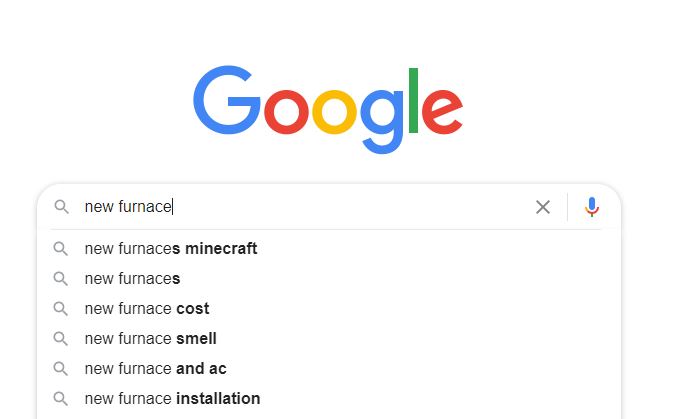
Once you’re confident that you’ve chosen the right keywords to summarize your business, go ahead and type them into Google. As soon as you enter some words into the search bar, Google’s autocomplete function will let you know what’s trending on that topic. This is really helpful, because it may help you tighten your strategy:

Google Results

To continue using HVAC as an example, assuming we disregard “new furnace minecraft” straight away (LOL), you can see that people are most interested in how much a new furnace costs, whether they can get a deal on a new furnace and new air-conditioner, and installation services. These are great topics that you can address in long-tail keywords to hone in on the questions people are asking in real-time. The more specific, the better.

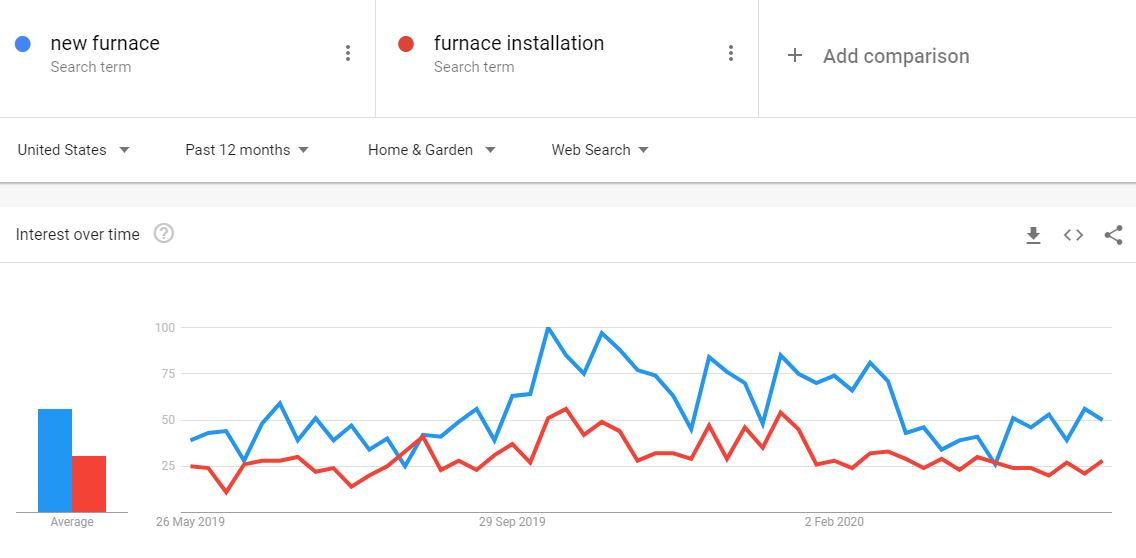
If you’re stuck between two terms, you can use the Google Trends tool to see which is performing better. Here’s an example, which compares all searches for “new furnace” and “furnace installation” in the United States for the past 12 months. It’s immediately clear that “new furnace” is a stronger search term.

Google Results

Now that you’ve tightened up your list, go ahead and actually search those terms.

Here are the results for “new furnace cost Nevada”.

Google Results

Desert Valley HVAC has jumped straight to the top of the list. Why? It’s the only one that actually includes prices in its excerpt. The others are vague, talking about “lots of things to consider,” “maintenance and repairs costs,” and “free quotes.” These are all great things to talk about in the blog post itself, however, when people want answers… they want answers. Simple and direct responses are likely to help you jump up the list.

This is just a random example, but it’s a helpful reminder that no-one is here to play a game of hide-and-go-seek. They want things to be as clear and easy as possible, so providing information upfront is actually more likely to drive traffic to your page. If people click through, and have a good experience, they may come again.

Read more: What should I track on Google Analytics?

Create something better

This is obvious, right? As soon as you’ve seen what your competitors are doing, look for strengths and weaknesses and do what you can to exploit them. Do something differently, like adding pricing details. Add a hook, like a special offer. Make it look as good as it can, with snappy wording and sparkling clean copy.

Let’s talk through another example, this time looking at the tourism industry. Beacon Media + Marketing has an office in Reno, Nevada, so let’s go with “Lake Tahoe bike rental.”

Google Results

This is a different game. The first spot (which isn’t shown in the picture), is snapped up by an advertisement from Anderson’s Bicycle Rental. This is an incredibly powerful tactic to boosting traffic to your page, because Google Ads work on a pay-per-click method based on a bidding system. If none of your competitors are advertising for the exact combination of keywords you’re using, you can put yourself right at the top of that food chain.

Read more: Do Google Ads work for marketing your business?

The next three results on the page are taken by Google My Business listings. Every business automatically has a Google My Business listing, so it’s really important you go ahead and claim yours as soon as possible. Just type your business name into Google and click the “Own this business?” link on the right-hand side.

Once you’re in, you can optimize your listing by adding details about what you do, opening and closing hours and special offers. Importantly, you can also respond to all reviews and comments filed by the public. If you have great reviews, awesome! Keep doing what you’re doing. If you have negative reviews, respond calmly. Thank the person for their feedback and explain how you’re planning to fix the situation. You may find it’s beneficial to take this conversation offline, so invite them to call or email you to discuss the problem.

If you check out the three listings in the image, you’ll note Anderson’s Bicycle Rental is at the top of the list, followed by Tahoe Bike Company and Over the Edge. Click into each business’s profile and check out what they’re doing that you’re not. This is a really simple way to implement best practice.

Read more: Google My Business is the perfect tool for tourism marketing

Tidy up your tech

The other essential is to make sure your website is optimized and running smoothly. Even the best strategy in the world won’t help if your website is a mess! If you’re new to the world of websites, the Google Webmasters have published a really handy Search Engine Optimization (SEO) Starter Guide. It’s a really helpful DIY tool for anyone looking to give their SEO strategy a boost from the back-end of their website.

We’ve spoken about some of the technological aspects that can boost SEO before. For example, backlinks, headings and sub-headings, metadata and images (you can read more about that here). We’ve also talked about the ways in which Google judges your site based on mobile-friendliness (that blog post is here).

However, Google’s guide will run you through current best practice on things like:

  • Helping Google find your content
  • Managing your appearance in Google search results
  • Organizing your site
  • Optimizing your content
  • Activating your images for SEO

It’s worth a look, as you may find there are a lot of easy wins hidden in your website.

One example is making sure your pages are titled correctly – for example, a page titled “furnaces and boilers” will do exponentially better than a page titled “page three.” Similarly, an image titled “Lennox furnace” will do you many more favors than an image titled “IMG_1234.” In a game as competitive as SEO, it’s worth investing the time to take care of the easy wins so that customers will come knocking on your digital door.

Want to ask the professionals? Schedule a free consultation.

Originally published by Beacon Media + Marketing. Updated and revised by Jennifer Gracey, Web Content Strategist & Writer on 07/14/23.

Making a significant post-COVID comeback, the tourism industry is roaring back to life with exciting opportunities in tow for travel agency and hospitality-based businesses, brands, destinations, and cultural and heritage experiences in the city.

In fact, CEO and President of U.S Travel Association, Geoff Freeman is on record saying, “Robust domestic leisure travel demand has been the driving force in the overall [travel] industry’s post-pandemic comeback… the surge we experienced in [2022] is starting to moderate, we expect [the trends in] this top customer segment to remain resilient in coming quarters.”

If you’ve not yet prepared your tourism marketing strategy, now is the best time to begin. Especially if you’re aiming to get and stay ahead of the competition by capturing your portion of the market share. Whether your primary clientele caters to domestic leisure, domestic business, or international inbound travelers, incorporating some (or all) of these 5 focus areas into your overall tourism marketing strategy will help your marketing campaigns gain traction, attract, and produce results.

Want help with your tourism marketing strategy or just want to talk business?  We’re here for that! Schedule a free consultation.

1. Marketing for Hospitality  

If you’re marketing your business in the hospitality sector, showing your potential customers what a great experience they can have is as important as telling them. Whether you run a restaurant, or a boutique accommodation experience, showing your customers and guests where they’ll be staying and eating allows them to not only feel confident they’ll enjoy the experience. But, it also allows them to more accurately visualize themselves having the same experience. 

Visual Storytelling: What’s your story?

Taking time to review where you’re currently with your story-craft and overall tourism marketing strategy will be tremendously helpful in determining what direction to take things next. Set aside some time to do an in-depth internal audit of your company’s visual imagery. You’ll want to look at your:

  • Website
  • Blog Posts & Articles
  • Social Media Profiles (FaceBook Page, Instagram, Twitter, Linkedin, Pinterest, TikTok, etc)
  • Google Business Profile
  • Crowd Sourcing & Review Sites (Yelp, Foursquare, etc)
  • Listings on Booking & Reservations Sites (Booking.com, Expedia, Airbnb, etc)
  • Anywhere else your hospitality company appears online

There are some significant questions you’ll want to ask during your visual imagery audit. They should cover things like:

  1. Does everything I’m seeing across our customer-facing visuals look like my brand and the picture I want to paint for my visitors and future guests?
  2. Do our visuals match the experience guests and customers expect to have when they come?
  3. Do the colors, shapes, fonts, artwork, photographs, and videos tell a cohesive story that not only makes sense as a whole but, compels an emotional response from our customers?
  4. Does the imagery invoke a positive or negative emotional response? Why? How?
  5. Has the approach we’ve taken with our visual imagery so far been strategic and consistent in telling our brand story across the board or a hodge-podge mash-up?
  6. In order to level up our first impression to potential guests, is it time to rebrand or get more serious and focused in our approach to visual storytelling?
  7. Will it be a better investment of my time and skill sets to do a rebrand ourselves or hire branding and marketing professionals to really help elevate my brand? 

How do you use Google Business Profile?

If you’re not yet taking full advantage of Google Business Profile, you’re really missing out. Previously known as Google My Business (the name changed in 2021 in Google’s attempt to simplify the user experience) Google Business Profile is a powerful tool every business should take advantage of — particularly for companies, as it’s FREE. When utilized regularly, a well-set-up Google Business Profile can really help drive organic traffic to your company’s website.

Your Google Business Profile will contain the name and address of your company, operating hours, website URL, and a detailed description of your company and types of service offerings. It also allows you to post updates on special promotions or events, your customers and guests to post reviews, and more. If you’d like to learn more about Google Business Profile and what it can do for your marketing strategy, click on the linked article below for a more detailed overview.

Read more: Google My Business is the perfect tool for a tourism marketing strategy tourism marketing

Want to get started with Google Business Profile and not sure where to begin? Or need help getting the most out of this tool? Get in touch — as Google Certified Partners, we’re here to help!

2. Marketing Tourism Destinations 

Is your company a destination or experience-centric business? There many tools available for you to use in order to gain attention from visitors. Among the ones you’ll want to seriously look into and take utmost advantage of is: search engine optimization (SEO). SEO refers specifically to the strategic use of specific and related keywords that users type into their Google ‘search’ bar when researching a specific topic. When properly integrated into your tourism marketing strategy — having a well laid out SEO strategy exponentially increases the likelihood your webpages, blog posts, and other content appear higher in the SERP (search engine results page) on Google as well as other sites your company may appear on or have a profile set up with.

We’ll summarize a few of the techniques we use here, but if you want to learn more, this post we wrote on blogging for Arctic tourism is an illustration of how blogging can help get the word out about your destination and inspire people to come visit. 

SEO for Your Website 

A foundational premise of good SEO is: write engaging, informative, and relatable content people want to read. This is Google’s benchmark for providing quality content to people and continuing to build their reputation for being a good search engine. Really search engine optimization is your way of helping Google, and them helping you in return. Here are some more basics:

Read more: Top tourism marketing strategies for 2020 and beyond.

With the travel industry and tourism on the upswing, it’s safe to assume people are looking for your specific destination. Because of this, it’s important your website is the one they see at the top of their SERP on Google. By optimizing your content to rank for certain keywords (as mentioned already in the paragraph above) you increase your chances of getting eyes on your website. To help your site list higher on the results page than your competition here’s two of our top must-do SEO optimization tips:

  1. Use the name of your destination in headers and in your body text.
  2. Use the name of your destination in the alt-text of any images.

When auditing your existing website (or building a new one), it’s vital to remember: Your website is the online equivalent of your physical premises. And, it’s critical the way your website looks and feels to users should represent your company as accurately and relevantly as possible.

Information Maintenance: Keeping Your Website Accurate

Ensuring your website stays up-to-date and easily accessible by providing information people want to find in the places they expect to find it is critical when talking about tourism marketing strategies and how to give your potential guests a positive first impression.

Initially, people may use your site as a tourist information resource. And this is where providing them with accurate, high-value, and actionable information encourages them to take the next step by visiting you in real life. To learn more about the process we use at Beacon for building websites for our tourism and hospitality clients, click the link just below:  

Read more: 10 tips to improve your website’s ranking on Google

Content Marketing: Key to Capturing Your Audience’s Attention

In a nutshell, content marketing is: Marketing intended to garner an audience’s interest in products or services. It does not involve direct selling and nor does it typically involve paid ads. Content marketing does, however, make use of both written and visual content to show what your business offers, build support, and reinforce your SEO strategy. In fact, the purpose of content marketing is often categorized in the following ways: educate, entertain, inspire, and convince. This is where blogs and social media really help to build out a brand’s content marketing strategy. The most obvious forms of content marketing are:

  • text (such as blog posts)
  • video
  • imagery
  • customer reviews 

Blogs

If you’ve not already developed a robust blogging strategy for your company, you’re truly missing out. Why? Well, they’re truly a perfect match for your tourism marketing SEO strategy! Blogs are an excellent convergence point for the integration of features Google loves. Blogs can also be used to implement a few sneaky tricks in order to get extra engagement. 

The Inbound Marketing Approach

At Beacon, when writing blogs for our clients, we make use of a philosophy called inbound marketing. Inbound marketing is best understood with a bit of help from a cat. For example:

What happens if you stand up suddenly and begin chasing a cat? Typically skittish animals, the cat will be surprised at your unexpected and sudden movement then scamper off as fast as it can.

What about if you stand perfectly still while holding out something our cat really wants (like a piece of freshly cooked grilled fish?) If it’s like many cats we know, it’ll come right up to you and quite happily take the fish from your hand.

In this illustration, think of your clients and customers as the cat. Inbound marketing tells us to, “Provide clients and potential guests with content they find useful and interesting.” That way, when they’re in need of your particular services, they’ll remember you and trust your business.

In the context of tourism, this could mean: writing insightful, value-added blogs highlighting the locations you run tours in, the specific activities you organize, the equipment that you rent out, etc. 

The Waterfall Method

We also make use of the waterfall method. This is a strategy that makes Google’s algorithm rate your blog posts more highly. Google really likes it when external websites provide links to your pages. These external website links are the digital equivalent of the more traditional word-of-mouth customer referral.

The reward is: Because someone likes your content enough to refer and promote it to others, Google notices and ranks your page higher thus moving you up in the SERP.

The caveat is: External links just because someone liked your content aren’t easy to come by. To help things along, we use our own blogs to provide those links by creating a waterfall structure of interlinked content! By writing an overarching “summary” blog designed to provide a high-level overview of a specific subject or group of interrelated topics, and then writing more detailed blogs on each facet of that subject, we link all the blogs together. Thus encouraging Google to trust that the content in each post is useful. 

Read more: What’s in a headline? How to write to get attention

Videos

Video marketing is something we’ve discussed lots lately and for good reason: Video is the closest we come to genuine human interaction, without physically being together in person. This is why video is so exceptionally powerful right and why it’s only going to continue growing in relevance and importance as a powerful communication and connection tool. 

A Powerful Visual Content Marketing Tool

We’ve written before about stats that show why you should be using video. (Those are available here.) The important takeaway is: video can and should be used everywhere. This includes in blogs to provide a quick synopsis or to further illustrate/highlight a key feature. They can run in your ads, on your website as a personal introduction, or welcome to the company — a message from or interview with the founder is always great. In short, videos should appear anywhere and everywhere you post content about your company.

Video is Memorable

People love video because it’s easy to consume and makes it easier for people to recollect the information presented. To briefly tie this back to something we mentioned before, “Give the consumer what they want and they’ll come back time and time again.”

The tourism marketing and hospitality industries are particularly well-suited to video. You’re offering experiences that people already crave, which look visually appealing, and that inspire people. Make the most of it!

Read more: How to start a dynamic video marketing campaign

3. Marketing Heritage and Cultural Tourism  

When marketing heritage or culture, the most important and foundational thing you can do is: identify your target audience. When doing this, keep in mind, different aspects of heritage or cultural traditions may appeal to different demographics. You’ll have the most success in this as you work to tailor your marketing plans and strategies to appeal to the interests of each of those specific demographics. 

Content Marketing and Immersive Experiences

When we discussed content marketing in point two above, we pointed out its ability to immerse people in the experience. This immersive experience aspect is even more valuable when talking about marketing something as story-based as culture and heritage.

Harness the Power of Story-telling Mediums

The use of high-quality, engaging written and video content really allows you to showcase the story of your site or attraction. By giving them a taste of what it looks, sounds, and feels like to be there and feel the age or the atmosphere of a cultural site is an incredibly effective way of drawing them and giving them a small taste of the reality. 

Direct Advertising: How to Draw Attention

In order to draw even further attention to your company and more specifically, the cultural and heritage sites you run — making successful use of direct advertising is important. With paid Google and Facebook ads, it’s possible to make use of all the content marketing mediums: text, imagery, and video. By strategically weaving them all into your marketing strategy, you’ll really show off the best of your company and everything you’re offering customers. The outcome of this brings us back to our cat illustration from point two: You’ll have far more hungry cats coming up to you looking for that tasty, appealing morsel of their own volition than you’ll get chasing them around.

If you want to learn more about social media advertising or Google advertising, these two articles are great places to start.

Want to talk strategy or ask us some questions about the waterfall strategy we used in this blog post? Schedule a free consultation and let’s chat!

There are lots of different factors that Google’s algorithm takes into consideration when deciding whether or not to rank your webpages and blog posts on its results page. Things like keywords, backlinks, headings and sub-headings, metadata and alt-text all play a part in helping the algorithm understand whether or not a page provides a high-quality answer to a search query.

One thing you might not have considered before is mobile friendliness.

Recently, Google’s developers rolled out a handy mobile-friendly test. It allows you to drop in your website’s URL or code so Google. It takes a few minutes to run, and hey presto! It spits out a results page that will let you know whether or not your website is up to scratch.

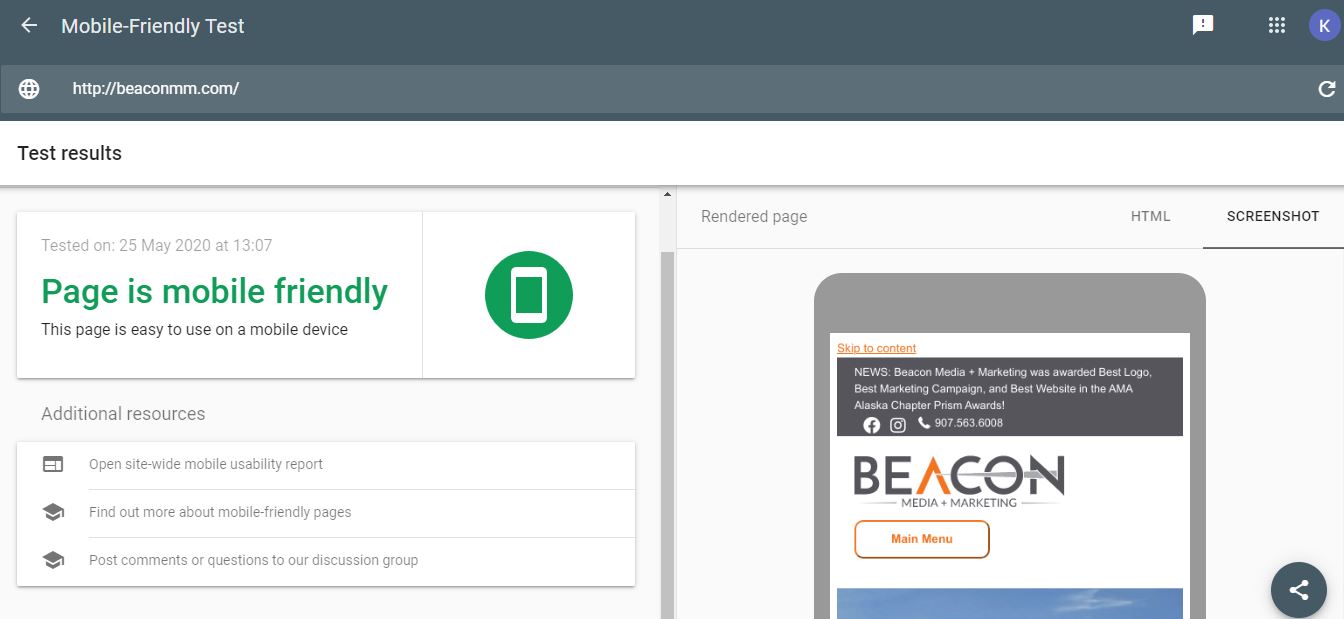
Here’s an example, using the Beacon Media + Marketing site:

Google Mobile Friendliness Test

As you can see, the page works. However, it also spits out a list of errors – for example, things like images – that could be replaced, edited or optimized to ensure results are optimal.

Want to talk to a real person? Schedule a free consultation.

Why is mobile-friendliness important for SEO?

Google’s developers actually want to help you create content that ranks. Why? Google distinguished itself from its competitors early in the search engine race by ranking high-quality results for every search query. It has a vested interest in ensuring internet users quickly find the answers they’re looking for, which is why the algorithm has been programmed to look for webpages that are informative, well-written, and fast-loading. It’s designed to give people what they want.

Mobile-friendliness is a key part of this. According to the description on the mobile-friendly test tool page, Google notes that smartphone traffic has exceeded desktop traffic in many countries:

“In the USA, 94% of people with smartphones search for local information on their phones. Interestingly, 77% of mobile searches occur at home or at work, places where desktop computers are likely to be present.”

That’s why it’s important to optimize design so it can be viewed seamlessly across a variety of devices. If text is too small, or the website uses Flash software (which isn’t supported by most devices), the user is likely to have a bad experience, which means they’ll click away and look elsewhere.

This isn’t good for you, because you’ll lose potential leads, but it’s also not good for Google, because its business model depends on giving people the best information as quickly as possible.

Read more: 6 expert ways to add SEO to your website

Errors that will affect mobile-friendliness

Lots of little things can have a detrimental impact on the way your website ranks for mobile friendliness. Here are some of the common ones Google identifies:

  • Incompatible plugins. We recommend redesigning your website every two or three years to ensure it’s up-to-date with the latest technologies and best practice. Old plugins can cause all sorts of problems, ranging from technical glitches to bad SEO rankings. A web developer will be able to help you clear all those things up and optimize your code.
  • Viewport not set. Modern websites need to specify a “viewport property,” which basically tells the browser how to adjust the page to fit onto each device. It’s important because different elements like text, images, video and links may need to shuffle into different spots to be accessible on screens of different sizes.
  • Content wider than screen. If this sounds familiar, you’ve got a big problem. In the early days of mobile phones, people were happy to zoom in and out on different parts of a website to find the information they need. Modern consumers, however, want answers five minutes ago. The internet is a fiercely competitive place, so if consumers can’t find what they need, they’ll simply look to your competitors. Make it easy for them.
  • Text too small to read. Again, consumers won’t work harder than they need to, so make your website as friendly and inviting as possible.
  • Clickable elements too close together. This is a really important one now that mobile devices have grown in popularity. When you’re using a desktop computer, it’s easy to use the mouse to deftly click on any elements that you please, but people’s fingers aren’t so precise. Spacing clickable elements out will make it much easier to access information on the move.

Read more: 9 telltale signs it’s time to re-design your website

Cost of building a mobile-friendly website

How much is one customer worth to you? Chances are, that’s already made a new website worthwhile. The cost of developing a new website can vary widely, depending how many webpages you’ll need, how customized it needs to be, and what interactive features you need to include. However, all modern web developers will ensure your site is mobile-friendly.

At lower price points, many web development companies offer templates you can choose from. These templates will be optimized for things like online stores, hospitality businesses with booking systems, portfolios, and so on. They’re great for small businesses, because they’ll get you up and running and will allow you to overhaul your site with a fresh design and optimized SEO strategy.

At higher price points, you may be looking at a custom build. This is the best choice if you’re looking to create something unique, incorporate lots of interactivity, and potentially win awards. These websites will be built with your needs in mind from the ground up, which means they will be a better choice for medium-large companies looking to optimize a lot of information.

Either way, a web development company will meet with you to talk about your needs, analyze your competitors, identify your likes and dislikes, define your goals and ensure your vision comes to life. Over the past few years, mobile-friendliness has become a key part of this process.

Read more: Website design and development services

Making a mobile-friendly website

Mobile friendliness serves two purposes: it increases the likelihood that Google will rank your website on its results page, and it increases the likelihood that internet users will stick around long enough to actually read your content, engage with your site, and potentially become a lead.

The best way to make your website mobile-friendly is to ensure the back-end is sparkling (i.e. that the digital nuts and bolts are all working) and that the design is simple. Fortunately, modern website design favors trends like oversized fonts, slabs of color, visible grids and videos. These elements are all quite blocky, which means it’s easy to arrange them in different ways to suit different devices.

Google is estimated to process about 40,000 queries every second, or about 3.5 billion searches per year, so it’s important to do everything you can to stand out from your competitors. A functional website forms the core of every successful digital marketing strategy, so once your website is working as it should, you’ll be able to develop social media and content strategies that make a splash.

Ready to get started? Schedule a free consultation.
Big opportunities are coming for tourism marketing!

With America beginning to open up for the summer, the market is going to be getting very competitive. Fewer people are going to be vacationing at the start, but businesses will be wanting to open as soon as possible to get their cash flow going again. This means you’ll be competing for a smaller clientele. It’s important that you start preparing for this now so that you can beat out the competition and retain your market share, or even increase it!

So what is market share?

Market share is defined by Investopedia as “the percentage of total sales in an industry generated by a particular company.” It essentially represents the number of sales your company make in an industry, and how you compare with your competitors. Gaining market share means that you are gaining customers faster than your competitors.

Here are some tips to help you maximize your impact with the right kind of marketing.

(We’ll share a few helpful links along the way where you can learn more about the topics we cover. Most of them refer to marketing Arctic tourism, but the principles apply to any type of tourism business. We’re also happy to answer any questions you have, so please feel free to schedule a consultation.)

Building brand awareness

In this period before people start booking their next vacations, it’s super important to build awareness of your brand. This ensures you’re front of mind when people are ready to book their next vacation.

Your brand is your visual identity – it is what people think of when they think of your tourism business, so it needs to reflect your reputation and what people think of you. When we create brands for our clients, we go through a process called the “brand discovery meeting” to help clients understand their brand story. It’s an opportunity to involve your whole team and get creative to help figure out what story you want to tell.

When we have a brand discovery meeting with our clients, we like to guide them with a series of questions:

  • Describe your business in two sentences or less. What is your “elevator pitch?”
  • A brand is a promise. What does your brand promise its customers?
  • What is the current perception of your tourism business? What is the desired perception?
  • How do you want to position yourself in the marketplace? Are you the “value” company? The expensive boutique? The innovator? The “tried and true?” The academics? The quick fix? The thought leaders?
  • What is your big-picture mission?

Your primary focus in this part of the process involves identifying your competition and figuring out how you can differentiate yourself from them. This is especially important in a reduced market. Differentiating yourself early on allows you to put your company in a position where potential customers think of you first. You also want to identify your target customers and work out how you can appeal to them.

Once you’ve understood what your brand is, and how you’re going to adjust it, you must maintain it.

Read more: 5 steps to build a strong brand for your Arctic tourism business

Maximizing inbound leads

In order to get customers, you need to be getting leads. The more leads you get, the more customers you’ll get, the more your market share will grow. So, how do you maximize your leads?

Up-to-date website

Your website is the most important part of your online presence. It represents your physical location in the digital world. You want your tourism business to look good, provide people with the information they need and inspire them to get to know more about you. This applies both in the real world, and online.

Websites should be updated or redesigned entirely every 2-3 years. This is because best practises change so frequently online and you need to keep up to date so that you don’t fall behind the competition. Additionally, you’ll want to make sure your staff, products, and services are all up to date.

Here are the steps:

  • Meet with your team: We always recommend that web design be a team process. Get everyone, or at least the key players, in your business in one room and try to answer some key questions. We recommend asking yourselves what the purposes of the website are, what information you want customers to be able to find, what features you like about other websites in the same industry.
  • Map out your design: Using a document known as a wireframe, we map out the location of all components of the website. That includes text boxes, images, videos, headers, etc. This is complemented by a sitemap, which describes the interaction between all the pages of your website.
  • Content: Once the website is fully mapped, both in terms of pages and contents, it is time to actually write the content to go in those boxes! This is the time you really want to start thinking about Search Engine Optimization. Simply put, this is the process of making sure your web content is easy for search engines to find. To find out more about SEO, check out our blogs on web design and blogging for arctic tourism.

Read more: Beautiful web design can boost your Arctic tourism business

Targeted advertising

Targeted advertising has become increasingly popular in recent years. It allows you to put ads on Facebook, Google, and other platforms which are based on people’s online behaviour. So as a tourism business, you could target people who have been looking at vacations in your area, or people who have shown an interest in the tours and experiences you offer. It’s incredibly powerful – you can click here to learn more about retargeting.

Active social media

Social media is another vital aspect of a business’s online presence. One of the best things about it is the opportunity to interact with people in an organic, natural way. This gives the opportunity to present your tourism business’s unique culture and present a welcoming face to potential customers. Best practice varies from platform to platform, so here is an insight into social media best practice for businesses.

SEO

SEO (or Search Engine Optimization) is all about pleasing the algorithm Google uses to rank results on their search results pages. One of the most important things Google looks for is quality. If you provide content that people want to read, Google can recognize this. You can make sure that your content does this but researching what people are asking about certain topics and writing content that answers those questions. Here are some tips to create a show-stopping SEO strategy for your business.

Converting bookings

So, you’ve reached potential customers and piqued their interest in your tours and activities. Now, how do you convert those leads into bookings?

Sales funnel

One of the most successful strategies for converting customers is the sales funnel. This uses a multi-stage process to gradually draw potential customers further into the “funnel.”

The first stage is the awareness stage, where you first gain their attention. Next, you get their interest. This is where you use your content to present solution to people who are looking. The goal at this stage is to remain in people’s consciousness, by having them subscribe to your mailing list or social media. The third stage is the action stage. At this point, the person becomes a customer and closes a deal with you. Finally, and perhaps not obviously, there is another stage of the funnel: retention.

The best customer is the repeat customer. Keeping them happy will keep them coming back for more – perhaps every summer for the rest of their lives. Running a successful tourism business and creating happy memories for your customers will mean adding new customers at the top of the funnel, but also growing the pool of repeat customers at the bottom. Is there anything better than becoming part of a family legacy?

Human connection

We discussed earlier how this is the perfect time to start marketing to prepare for reopening your business. A great tool you can use to bring in customers is your authenticity and real human connection. This period has demonstrated the value of human connection as many people have been deprived of it.

We hope this post will provide some insights into the tactics you can use to get your tourism business ready to reopen in the coming weeks and months as people start looking to go on vacation again.

If you want help marketing your tourism business you can schedule a free consultation.

Website design for tourism businesses is really fun.

It’s an opportunity to showcase the best of your local area, explain why it’s unique, and educate visitors (i.e. your potential customers) about the types of experiences that you have to offer.

The best part is that because tourism is an innately visual industry, you can play around with photographs, videos, color and styling to make your website as gorgeous as the scenery.

In this article, we’re going to run you through the basics of website design, including how to design a website, website design cost, website hosting and website ranking – basically, how to make your business appear on Google. This is essential so that visitors to your area will find you.

We’re going to use one of our clients, Kodiak Sportsman’s Lodge, as a case study.

Want to skip ahead? Schedule a free consultation.

Principles of good website design

How to design a website?

A business website should serve two purposes: educate customers about your service and convert sales. It doesn’t matter if you’re designing a website for a gear rental company, offering boutique tours or advertising boutique experiences – the website will always serve the same function.

To maximize its effectiveness, there are a few things you should know.

  1. Images! Images, images, images. Have we mentioned images yet? Pictures really do tell a thousand words, especially where tourism is concerned, because if you’re selling an experience, you’re selling a feeling. You need to capture that feeling with images in order to capture the imaginations of your prospective customers and make them want to learn more.
  2. People read from left to right and from top to bottom. That makes the top left corner of your page prime real estate. Make an impact! Figure out what makes your business unique and lead with that so that people immediately get a sense of what you’re about.
  3. Less is more. Your page needs to be simple and easy to understand to that prospective customers can find what they’re looking for quickly. You only get a few seconds to make an impression so it’s important that you use your website visitor’s time wisely.
  4. Your website needs to work. We live in a digital age where people have no patience for videos that won’t load or websites that are packed with technical glitches. It’s worth investing in a professional build to make sure your site functions as it should.
  5. Stay active. In order to reflect your business correctly and to make sure your page ranks on Google and maintains its authority, your need to keep adding content to your website. Most businesses do this in the form of a blog (more on that later), so keep this in mind.

Want to read more? We wrote another blog that talks specifically about building a strong website for an Arctic tourism brand. Click here to check it out.

Website design ideas

Every time a new person visits your website, you have the opportunity to convert a sale. However, as we mentioned before, you only get a few seconds to make an impact and draft them in.

In a minute, we’re going to show you an example of a website done right.

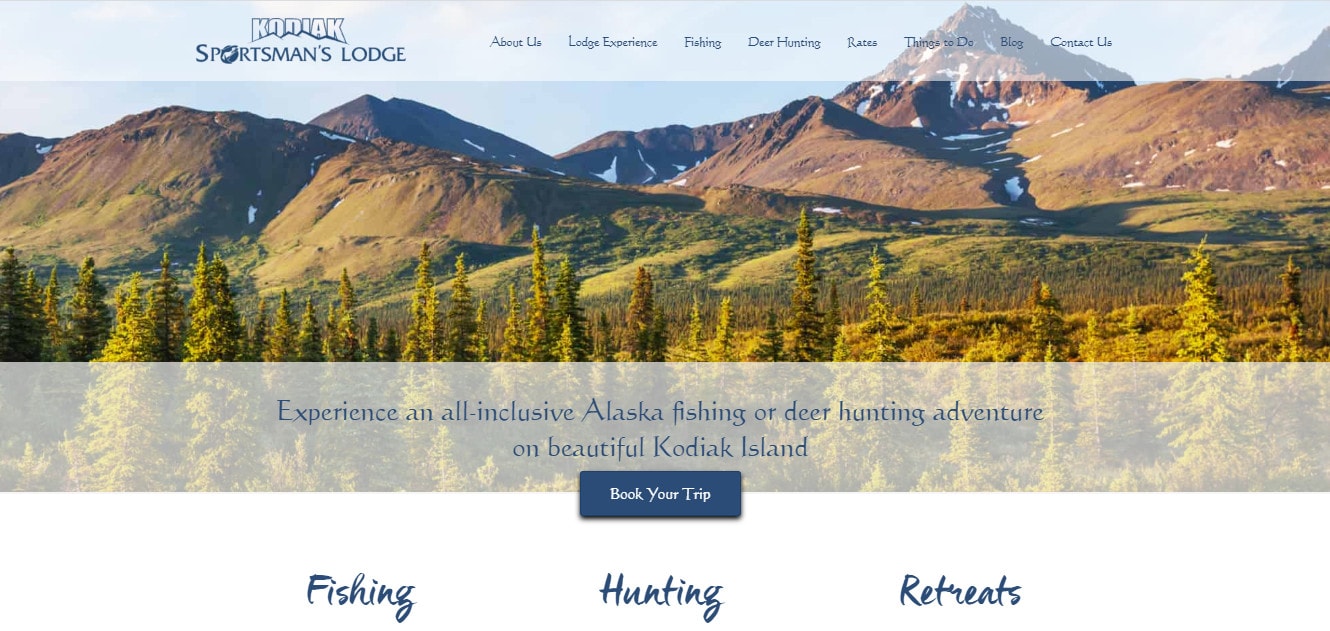
It was designed and built by the team at Beacon Media + Marketing for Kodiak Sportsman’s Lodge, a boutique fishing and hunting lodge located in Alaska. It offers some of the best salmon and halibut fishing in the world as well as unique opportunities to hunt the local Sitka Black Tail deer.

As you can imagine, these are once-in-a-lifetime experiences.

Here is the homepage:

Tourism website design

As you can see, you immediately get an idea of what experiences are on offer. A beautiful landscape image sets the scene and the short, simple text lets readers find exactly what they’re looking for.

As a reader, you can feel your eye flow through the page from the logo, through the picture, to the “Book Your Trip” button. The subheadings and synopses make the choice of adventure simple.

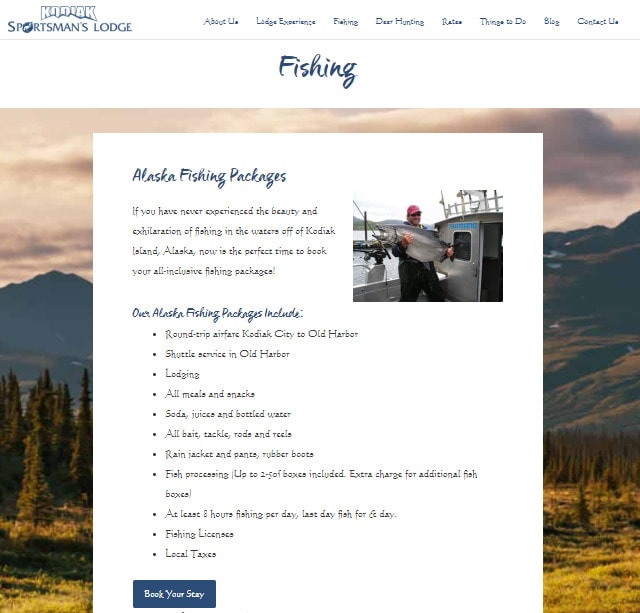
Here is the fishing page:

Tourism Website Design

Again, images are essential to set the scene and capture the imaginations of your visitors. The use of bullet points keeps the text simple and easy to understand, and again there is a call to action in the form of a “Book Your Stay” button to ensure the process of converting a sale is straightforward.

The next logical question is whether or not it works.

Here are the facts. This page was developed in June 2019 and we began providing regular marketing support from January 2020. The difference is enormous – in December 2019, it had an average of 57 views per day, but in February 2020, that number has grown to 251. We helped generate 23 leads.

Read more: 5 website design trends you need to watch this year

Website design cost

Websites can be as cheap or as expensive as you like, depending on the result you want. There are lots of tools available to help you build your own websites on a budget, for example:

  • Build a website with WordPress: WordPress is an online, open-source website creation tool written in PHP. It’s one of the easiest and most powerful website content management tools available today and can be very cheap to create.
  • Build a website with Squarespace: Squarespace is an all-in-one solution for anyone looking to create a website or online shop. It has a very intuitive interface, making it very quick and easy to get started, but it’s more expensive than WordPress.
  • Build a website with Wix: Wix is another simple and easy website builder that can get you off the ground in no time. Like Squarespace, you start by choosing a template and adding your own words and images, but this platform is slightly cheaper.

However, it’s definitely worth enlisting the help of a professional marketing company.

Marketing companies don’t just build the website. They help you choose the right keywords, refine your copy to ensure it creates a good user experience and makes your website an authoritative source of information, optimize the design to lead people through the page to your call to action and make sure the technical parts of the website are running smoothly.

This is essential to getting your website ranking on Google so customers can find you.

The price varies depending on the company you choose and the size of the website, but they will know exactly how to help you start generating leads from prospective customers.

We build websites! You can contact Beacon Media + Marketing today for a free consultation or click to read about our website design and development service.

Website hosting for tourism businesses

Hosting a website

Website hosting refers to the place where all the files that make up your website actually live. Often, people pay for this when they buy their domain name. Once you have hosting, you can start building your website, because you’ll have a location where you can save things like images and text.

All websites on the internet need hosting and it’s worth paying for a quality hosting service so that you can be sure your files are backed up and you’ll have access to help if something breaks.

We typically build websites using a program called WordPress because it’s industry-standard technology and fully customizable. WordPress has a number of recommended hosting providers, including Bluehost, SiteGround, HostGator, DreamHost and GreenGeeks. However, it’s definitely worth making some enquiries with a professional marketing agency, because good hosting will make a big difference when it comes to editing your site, working on the back-end, and making sure it’s as fast as possible.

Read more: 9 telltale signs it’s time to re-design your website

Choosing a website domain

A website domain is the address of your website. The internet is basically a giant jumble of computers and servers and cables and a domain provides an address that people can type into the URL bar at the top of their browser to find you.

Ideally, your website domain will be the same name as your business – if we refer to Kodiak Sportsman’s Lodge again, then the ideal domain is kodiaksportsmanslodge.com. In most cases, you should be able to buy it without a problem. If that name is already taken, you might be able to buy it from the owner, or you can create a variation like kodiakfishinglodge.com, kodiakhuntinglodge.com or even kodiaksporsmanslodgeak.com. As long as it’s simple, it will work.

Website ranking

Making your website show up on Google is critically important to your online success.

The first step is setting up your free business profile on Google My Business. You will be familiar with this already – this allows your business to pop up with details of your opening hours, contact details and website as soon as prospective customers search for you.

The second step is content. The first and most important is to make sure the text on your website is filled with the types of keywords people will likely be searching to find you. In the case of Kodiak Sportsman’s Lodge, for example, words like “Alaska”, “Fishing”, “Hunting” and “Lodge” are all easy wins. The second way is through blogging, which we referenced earlier in this article.

Publishing frequent blog posts (again, laden with key words) will tell Google that you’re an authority in your subject matter. That means any time people search for relevant keywords, your website will rank higher. As more people click on it, it will make its way to the coveted position at #1. If you think about it, 1.7 billion people use Google every day, and 31.7% of them click on whatever result comes up in the #1 spot. Again, it’s an easy win. As of March 2020, Kodiak Sportsman’s Lodge is #1 in terms of organic search traffic for and #2 in terms of organic keywords for its subject matter.

Finally, consider running Google Ads. Google offers paid advertisements which appear in Google search results. These are targeted to appear when users search particular keywords, or combinations of keywords, and can be buttoned down to particular demographics. For example, if you know your ideal customer is a man in his 50s, you can allocate your advertising spend to people who fit that mold. The results speak for themselves – again, to use Kodiak Sportsman’s Lodge, in March 2020 it’s performing at #1 in terms of paid keywords and #2 in terms of paid search traffic.

Want to learn more? We are experts in using Google Ads to boost your business. Here’s a blog we wrote about using them to help your outdoor clothing and equipment shop.

Website design company

If you’re looking for a company to help design a website for your tourism business, you’re in the right place. Beacon Media + Marketing can assist with everything from branding to website design and development, as well as digital marketing, social media and video services.

Ready to get started? Schedule your free consultation today.

The tourism industry has faced unprecedented challenges in 2020, but restrictions are lifting, and the time is coming for the sector to make a comeback. That means you need a strategy, and you’re going to need to pull it together relatively quickly.  

Why is tourism marketing important? Well, when the economy starts to re-open and people start thinking about their vacations again, companies are going to be competing to win customers, but from a smaller pool as tourism tentatively resumes.

Since you’re going to be competing harder than before, you’re going to need to make sure that everything counts. Also, as people are more likely to take local trips rather than interstate or international, you’ll need to switch your marketing focus to capitalize on domestic travelers. These will form your core audience for at least the next few months.

So, how do you compete effectively in this market? You’re going to need to start thinking about this in advance and creating a strategy that you can implement in sufficient time to get a head start over your competitors. Here are three highly-effective options to consider.

Want to talk to a real person? Schedule a free consultation today.

SEO: You’re open for business!  

Right now, people have plenty of time to research their vacations and daydream about where they’ll go when it’s safe to do so. There’s one main place they’re doing this: Google!

It’s surely no surprise that most people never look beyond the first page of Google. One study even found that only 0.78% of searchers clicked on something on the second page of Google. Obviously then, it’s imperative that you appear at the top of people’s search results if you want to be competitive. This means your Search Engine Optimization (SEO) strategy needs to be on point.

If you haven’t already claimed your business listing on Google My Business, do it now. That’s essential to helping tourists find you (instead of your competitors!). Once you’ve taken care of that, give your website a quick overhaul to make sure everything is up-to-date, including details of your products and services, pricing and contact details for the upcoming season.

It’s worth considering a pop-up or a banner to let people know you’re open and accepting bookings. Many businesses have let their websites sit and gather technological dust during the lockdown, which can make it hard for customers to know whether you’re open or not.

Take the guesswork out of it by making everything as clear as possible.

Content marketing for tourism

SEO is not a stand-alone tool. Rather, it should be incorporated into as much of your online marketing as possible. It particularly lends itself to content marketing, especially in tourism where a brand’s story is such an essential component of the customer’s experience.

Content marketing includes all production of digital content, including blogging, video marketing, social media, and user-generated content such as reviews. Let’s take a look at some of the content marketing methods you can utilize: 

  • Blogging is one of our main services at Beacon and is a highly effective method of getting your website to rank on Google. This is because it capitalizes on multiple SEO techniques. Blogs promote the use of keywords, which target topics that people are searching for, so it’s an easy way to provide useful content to consumers. Now is the perfect time to be putting out content online, as people have more time than ever to read it! If you’re interested in learning more blogging for tourism, check out this post on the ways blogging can boost Arctic tourism.
  • Video marketing is another powerful tool that Google loves for SEO. It also really helps your customers as it’s easily digestible and has been shown to have higher retention rates than text. This article by WordStream has some incredible statistics on the success of marketing with video, for example, “Sixty-four percent of consumers make a purchase after watching branded social videos.” To learn more about video marketing, check out our blog post, here. 
  • Social media marketing is a rapidly expanding, highly effective technique. It allows you to connect more directly with customers. This, when done well, can be a valuable tool that adds credibility and a personal touch to your business’s online presence. The goal of social media marketing is essential to promote positive stories about your school. While doing this, it’s also important to effectively manage negative feedback. If you want to learn more about social media marketing, check out this blog we wrote on optimizing social media for schools (don’t worry, it’s just as effective in tourism!). 
  • User-generated content is always compelling, but it’s particularly persuasive in tourism because people love to share their vacations! The PESO model for content marketing strategy includes Paid Media, Earned Media, Social Media, and Owned Properties. In this context, social media includes reviews as well as content shared on platforms such as Facebook. Reviews are critical for online success, as they allow potential customers to see that your business is as good as you claim it is. It’s also important to remember that a well-reasoned and polite response to a negative review or comment can reflect better than a 5-star review!  

Influencer marketing for tourism

Influencer marketing is a strategy that has grown enormously in recent years with the rise of video content on social media platforms. Influencer Marketing Hub is a great place to start if you’re looking to learn all about this growing industry. Ready for a crash course? Great!

Influencer marketing is described by Influencer Marketing Hub as an amalgamation of both traditional celebrity endorsement and modern content marketing. Influencers are able to build their brands online, usually on video platforms such as Instagram, TikTok, and YouTube, by establishing themselves engaging content creators and trustworthy and impartial authorities on different brands.

Influencer marketing is especially successful in tourism, because inspiration is everything. They can share their experience with their audiences, and potentially inspire thousands of people – whether that’s the magic of gliding over the crystal clear waters of Lake Tahoe on a paddleboard, the awe of climbing their first mountain in Alaska and taking in the view, or the joy in sharing a truly wonderful meal. It’s also really helpful in establishing trust and distinguishing you from your competitors.

Influencer marketing is a strategy that aims to emulate the advice one receives from a trusted friend, and successful influencers regularly put out content that generates strong engagement from subscribers and followers. One article in The Guardian says that “almost half of marketers spent more than 20% of their budget on influencer marketing” in 2019.

It lends itself to tourism particularly well, as people are always keen to see pictures and videos of beautiful places and people having fun. Many businesses have had success in luring influencers by offering free stays in hotels, free tours, and free experiences in return for the exposure to a targeted audience. 

Right now is the perfect time to engage with influencers. Summer is coming, America is beginning to open up, and social media use is at an all-time high!

We hope you’ve found this post helpful in providing some ideas that you can use to prepare for the end of lockdown. We have a whole host of useful articles on our blog, which you can use for a more in-depth look at the services we offer and some of our insider tips and tricks.

Ready to get started? Schedule a free consultation with our experts today.

Recent months have highlighted the importance of health, and the fact that we so often take it for granted. Everyone has been forced to slow down, take stock, and contemplate the directions our lives are taking. It’s caused many of us to re-evaluate our priorities, including the way we see our health.

This process is opening up a tremendous marketing opportunity for functional medicine practices. Traditional medicine is at the frontline of the fight to save lives, but functional medicine offers people a chance to look at things like building their immunity and addressing chronic health issues to increase their chance of staying healthy and fighting off viruses.

Dr. Robert DeMartino (also known as Dr. Rob) is a chiropractor and functional medicine expert who runs Superior Health Solutions in Las Vegas, Nevada. He says his practice is currently focused on helping people take back some control over the situation at hand and regain their power.

“However this looks whenever we come out of this… health is going to be a pre-requisite. It should have always been, ultimately, but health is going to be a prerequisite of going back to living… are you healthy enough to re-enter public areas? Are you healthy enough to go back to work?

“Obviously, we want to protect people who are, but we also want to give solutions to others and not just say, ‘Sorry, you drew the short end of the straw, there’s nothing you can do about it.'”

There has never been a more important time to develop and implement an inbound marketing strategy. There is a big demand for health advice, and current circumstances have opened many people’s minds to solutions outside traditional medicine. People are searching for answers, which means you need to make it as easy as possible for them to find you and your practice.

Need help developing a strategy? Schedule a free consultation today.

Marketing functional medicine practices

Dr. Rob says his practice is implementing a two-fold strategy to help people.

First, they acknowledge that many of the patients they treat are at risk – for example, people with autoimmune diseases and chronic diseases that may make them more susceptible to catching the virus. They’re working very hard to help keep them well.

Second, they’re trying to increase public education about health. CDC figures indicate that about 60% of Americans have one chronic disease diagnosed, and about 40% have two diagnosed.

“It’s something we’ve been talking about forever,” he explains, adding that he hopes one positive aspect to arise from the current situation is that it will increase public awareness.

“The other bright side of this, and there’s not been many, is it’s bought a lot of us time. Time is another incredibly valuable thing. How do you use that time? How do you use it effectively to maybe look into some health stuff that’s outside of the box?”

The best way to increase public education is through content marketing. This means creating and sharing valuable information through your website and social media channels answer questions your prospective patients are likely to have and let them know you can solve their problems.

The key is to provide quality information in an open an accessible manner. If they find the information they need, they may follow up with a question or sign up for an e-newsletter. Boom! You’ve just got a lead. If not, they may click away and start looking elsewhere.

Ready to get started? Contact us today.

Developing a content marketing strategy

Functional medicine is a fascinating space, because it’s still relatively unknown to the public. It’s your job to educate them about what it is, what symptoms can be treated, and how it works. There are a number of options you can try to position yourself as a thought-leaders:

  • Blogging. An active blog is a powerful tool, because each post will be laden with key words that make your website more likely to rank on Google when people are searching for related topics. You can offer advice, answer frequently-asked questions, comment on issues in the media or explain one of your services or technologies to attract attention.
  • Social media. Facebook is the most powerful marketing tool in the world, with more than 1.62 million active daily users. It’s primarily a personal network, which means posts work best when they’re interesting and informative or playful and fun. This is a great way to share fun facts about your practice, bust common myths and interact via polls.
  • Video. Video is a great way to dive deep into a topic in a friendly and accessible way. It also builds trust, because it helps build emotional connections with prospective customers. They’ll feel like they know you a little bit, which will go a long way toward generating a lead.

Read more: 10 tips to optimize your social media

The next step is distribution – after all, there’s no point creating all this great content if no-one can find it. Every successful marketing strategy considers the following options:

  • Website and social media. These tools are what you’ll use to create a first impression. Just like having a clean and professional clinic, you need to ensure your website is up-to-date that your social media accounts are complete so that you come across as polished.
  • SEO. Search engine optimization is a strategy that ensures the content you create ranks on search engines. The best way to do this is by using lots of keywords that people are likely to search in the content you write, and by ensuring that your content is if good quality.
  • Google Ads.Google Ads come in two forms: search and display. Search ads are the ones that appear at the top of the results page when you look for something; display ads appear as banners on other websites. These are highly-targeted, to ensure the right people are seeing your message, and operate on a pay-per-click system.
  • Facebook Ads. Facebook is a great place to share and promote blogs, videos and more. These are also highly targeted, which means you can be very strategic in the way you target people.

Read more: What are Facebook Ads and how can they help your business?

Keeping yourself healthy

Finally, we asked Dr. Rob for a few tips and tricks that will help you stay healthy as restrictions lift and we all start going back to work. It’s never been more important to optimize our wellbeing!

“I always tell people you have to get healthy so you can live. You don’t live to get healthy,” he says. “You can’t spend your entire life just trying to build your health, at some point – all of our time is finite, right? Nobody gets to stay forever; we all check out at some point. What can you do to build on your health so that it doesn’t impede on your life?”

The first thing he says is to ensure you’re getting enough Vitamin D. Many of us will have spent the majority of our time in isolation indoors, so make sure you go out and get sunlight on your skin.

Next, he says, protect your sleep. Make sure you’re getting enough sleep every night, because that’s when your body heals. It’s tempting, while things are disrupted, to stay up late and sleep in longer in the mornings, but he warns a crazy sleep schedule will do you no favors.

Read more: The rise of the idealistic marketer

Monitoring your food intake is also really important. We’ve all heard of the “Quarantine 15” and we’ve all heard the siren call of our snack-filled fridges. Dr. Rob says it’s important to think of food as the fuel your body needs and try to avoid running to the kitchen every two minutes.

Finally, mental health is crucial – not just when it comes to staying happy and healthy in isolation, but in coping with the transition back to normal life once we all re-emerge.

“It brings us all back to family, and important conversations. I’ve been in more contact with people – not physically, but calling, texting, emailing, just checking up on friends. I feel like I’m making more contact now than sometimes I have in the past,” he says.

“We all need to focus on laughter and getting back to basics. What makes us healthy?”

Need help marketing your functional medicine practice? Schedule a free consultation.

Workplaces around the United States are starting to re-open. One by one, cafes are re-opening the doors, nail salons are welcoming customers, retail stores are dusting off the shelves.

The first office workers are resuming the daily commute, awkwardly trying to maintain a six-foot gap in tiny elevators and trying to figure out exactly what’s rotting at the back of the staff refrigerator.

Much has changed about the way we work. Small businesses went into survival mode, coming up with all manner of creative solutions to keep cash flowing. People working in professional services learnt how to set themselves up for success while working from home, without the constraints of suits or water-cooler conversations and without being able to hide behind presenteeism.

Some of us are looking forward to going back to the office. Others are feeling anxious. Whatever you’re feeling is perfectly normal; there are only so many times we can use the word “unprecedented.” But what if you’re thinking about not returning to the office at all?

Thinking about re-branding your business? Schedule a consultation with us today.

Professional opportunities

Nikki McGuire is the founder of Beacon Co-Work, a shared office space based in Reno, NV. It started as a side-hustle that got her into an entrepreneurial space, and she’s been in business for about two years. The rest of the time, she works as a senior clinical project manager for a company that does medical device research, managing everything from the logistics of new studies to billing.

She’s worked remotely for about a decade, and she had the idea when she realized there was enough demand to justify a second co-working space in “The Biggest Little City in the World.”

“It gets a little tiring to be at home all the time,” she explains. Her job is busy, and as she works in a medical-adjacent field, there has been no slowdown due to the outbreak of COVID-19. In fact, the company has begun working on some virus-specific projects, with technology such as ventilators.

“I’m probably busier than normal. Working at home, your work never leaves. If something is nagging me – like at 10 o’clock at night – after my son goes to bed, I’ll probably be at my computer working and just emailing things out and getting things done. It’s a drawback of being at home, because I’m not separating my work life at all.”

This is a common problem. At the end of a long day in the office, the act of walking out the door creates a physical separation between work and home. Many new remote workers find this aspect exhausting, because no matter what you’re doing, work is always in the back of your mind.

Read more: Setting yourself up for success while working from home (VIDEO)

Co-working challenges

Co-working businesses have undoubtedly taken a hit in recent weeks, as social distancing practices have required people work from home. Nikki says that while some members have chosen to withdraw from Beacon Co-Work, most have opted to stay in and plan to return when it’s safe.

“Obviously, co-working is intended to be a place where people can go when they don’t want to work from home,” she laughs. “I’ve given people the option of continuing to go to the office. It’s locked 24/7, so it’s technically closed to the public. Some people with private offices are still coming in.”

There has been a downturn in inquiries, but she says many people are subscribing to the newsletter. She speculates it’s because many new remote workers simply don’t want to work from home anymore. When this is over, she says, it’s looking like there will be a strong uptick in membership.

Therein lies an opportunity for remote workers in professional services. This is the new normal, and there has never been a better time to ask what you want and make your work fit around your lifestyle. If you’re thinking about not returning to the office at all, this could be the solution.

Read more: Remote-working survival guide for small businesses.

Maximizing productivity

Typically, remote working goes one of two ways. Either you power through your normal workload in a fraction of the time; or you procrastinate and stay in your pajamas, eating cereal straight from the box, scrambling to finish things at the very last minute when you feel a very real fear of being fired.

Again, this is perfectly normal – hey, we’re all adjusting to a big change.

“Given emotional climate of what’s happening right now, some people may be less productive at home. (Businesses) may see their workers are less productive when they’re at home, the emotional climate and the weight of what’s happening is definitely going to be a factor in whether or not some folks are more productive at home or less productive at home,” Nikki says.

“If people are smart, they’ll see this as an opportunity to prove they can be just as productive at home, and they’ll have that option in the future.”

There will never be another opportunity like this to stop, take stock of your business, re-evaluate your plan and craft a work-life balance that actually suits you and your employees. Look for opportunities in the market (like Nikki did). Take risks. Be bold. Change the way you work.

Beacon Media + Marketing specializes in helping professional services businesses rebrand. Whether you’re a dentist, an educator, an architect or an insurer, we’ll support the future of your work.

Ready to get started? Schedule a free consultation.

This year has been a wild ride for many businesses. Some have encountered unprecedented challenges, while others have seen remarkable growth. Telemedicine is one of them.

This is due to the rapidly changing health climate, with patients being encouraged not to visit physical medical practices, in order to reduce the spread of COVID-19. These issues increased public awareness of telemedicine and provided a valuable alternative for people who need healthcare.

Some experts suggest social distancing practices will extend as far into the future as 2022, so it seems that telemedicine is likely here to stay. Aside from the obvious benefits, like avoiding germ-filled waiting rooms, there are many advantages to delivering health services this way.

For example, people with mental health conditions may be more comfortable at home. Practitioners can work remotely, opening access to services for people living out of state or in rural or remote areas. It’s good for business, too – less physical space is required, which means practices can save on overheads such as rent.

How can you serve as many patients as possible during this time?

Ready to get started? Schedule a free consultation.

What patients will telemedicine help?

The vital first step in any successful marketing campaign is identifying your target audience. If you don’t know who you’re aiming your product or service at, you simply can’t market it effectively. Knowing who your service is aimed at will alter how you’ll market it – we’ll discuss that later.

For example, if your mental health practice wants to reach environmentally-minded millennials, you might point out that it reduces travel, thereby reducing vehicle emissions. However, if you’re targeting those with young families, it may be more effective to mention how much less hassle it is to have an appointment in your own home, rather than convincing children to go to a physical address. 

This is important when marketing mental health, as varying demographics have different rates of common mental health issues. For example, depression rates are higher among younger people.

There are a few questions you can ask yourself, to determine who exactly your target market is: 

  • What is their demographic? Think about age, income, location. All of these affect people’s relationships with their medical practice. 
  • Where are they located? In rural areas people may have less access to a doctor, while in busy cities people may want to avoid the hassle of taking the metro. 
  • What time of day do people want appointments? Telemedicine can be a great way of extending your hours by using a remote office in another time zone, allowing people to have an appointment before or after work, rather than taking time off. 

How will telemedicine solve their problem?

Every successful marketing campaign helps people solve a problem. Sore neck? See a chiropractor. Bleeding gums? See a dentist. Fuzzy vision? See an optometrist.

What do people need most from you? Your telemedicine service will be most successful if you know what the needs of your target market are so that you can not only design it around what will work best for them but also leverage those needs to show how it can benefit people. 

Knowing why people are using your service allows you to base your marketing campaign on those factors. Think of your customers like a cat (bear with us for a second here). The metaphor goes like this: when trying to entice a cat, don’t chase it, it will just run away. Instead, have what the cat wants, and it will happily come to you! You can read more about that  here.

In this metaphor, the cat represents your patients if you want to get more patients to use your mental health practices telemedicine service you need to show that it adds value to their lives.

Read more: Inbound marketing is perfect for functional medicine.

Make telemedicine services easy to access 

All health services require trust. Patients need to be comfortable with you. When it comes to a telemedicine environment, this means your services need to be easy to find and use. In practice, this means making it as easy as possible for your pre-existing patients to sign up for the online service. You could even go one step further and make this an automatic process!

If you make telemedicine easy, people will be more likely to use it. 

Of course, this needs to extend to new patients. Make sure your marketing shows how fast it is to sign-up! If your ads take people directly to a quick sign-up process, or if you provide an easy sign-up in your physical practice, or from your website homepage, you’ll get more conversions.

This is another vital aspect of marketing a service for those in need of urgent support – for example, regarding their mental health. Issues such as depression can make people less willing to go out, so making your service easy to reach will help those who need it.

Read more:  Developing a functional medicine marketing strategy.

Integrate telemedicine in your marketing 

This step may seem obvious, but it can really make the difference to a successful marketing campaign. Using social media is a great way of getting the word out, because it’s both cheap and effective! 

It is important to remember that different platforms tend to be used by different demographics. This can be a great advantage as it allows you to better target your service. For example, Facebook tends to be used by older users, while Instagram tends to have more of a millennial user-base.

Using the mental health example we listed earlier, research shows that it’s having a significant effect on young people. If you’re aiming to reach those people, and let them know that you can now support them with telemedicine services, then Facebook may be less effective than Instagram. You can read more about optimizing your social media here.

Another useful online tool which is really gaining prominence is Google My Business. This allows you to claim your Google Maps listing and allows you to post in the Business box that appears in people’s search results. Modern customers tend to know what they’re looking for, so if you want to learn more about how Google My Business works, check out our blog here.

You’ve probably already got a website and patients are already using it to find your contact details or make online appointments. This makes it the perfect place to convert some of those people to your telemedicine service. This can be a highly effective way of improving take-up. 

Hire a marketing company 

If you really want to capitalize on the current surge in demand, while positioning your practice for the future, it might be better to take advantage of the expertise a professional marketing team could bring. This would allow you to get information about your telemedicine service out there as quickly as possible, in a way that is sure to gain results. 

The team at Beacon Media + Marketing has years of experience in supporting medical practices. Let’s talk about how we can optimize your strategy and support your patients.