May 14, 2020

Chart The Waters

Explore insights on SEO, AI, and digital marketing strategies designed to help your business grow, stay visible, and adapt in a constantly evolving online landscape.
Beacon_Icon_resouse

Big opportunities are coming for tourism marketing!

With America beginning to open up for the summer, the market is going to be getting very competitive. Fewer people are going to be vacationing at the start, but businesses will be wanting to open as soon as possible to get their cash flow going again. This means you’ll be competing for a smaller clientele. It’s important that you start preparing for this now so that you can beat out the competition and retain your market share, or even increase it!

So what is market share?

Market share is defined by Investopedia as “the percentage of total sales in an industry generated by a particular company.” It essentially represents the number of sales your company make in an industry, and how you compare with your competitors. Gaining market share means that you are gaining customers faster than your competitors.

Here are some tips to help you maximize your impact with the right kind of marketing.

(We’ll share a few helpful links along the way where you can learn more about the topics we cover. Most of them refer to marketing Arctic tourism, but the principles apply to any type of tourism business. We’re also happy to answer any questions you have, so please feel free to schedule a consultation.)

Building brand awareness

In this period before people start booking their next vacations, it’s super important to build awareness of your brand. This ensures you’re front of mind when people are ready to book their next vacation.

Your brand is your visual identity – it is what people think of when they think of your tourism business, so it needs to reflect your reputation and what people think of you. When we create brands for our clients, we go through a process called the “brand discovery meeting” to help clients understand their brand story. It’s an opportunity to involve your whole team and get creative to help figure out what story you want to tell.

When we have a brand discovery meeting with our clients, we like to guide them with a series of questions:

  • Describe your business in two sentences or less. What is your “elevator pitch?”
  • A brand is a promise. What does your brand promise its customers?
  • What is the current perception of your tourism business? What is the desired perception?
  • How do you want to position yourself in the marketplace? Are you the “value” company? The expensive boutique? The innovator? The “tried and true?” The academics? The quick fix? The thought leaders?
  • What is your big-picture mission?

Your primary focus in this part of the process involves identifying your competition and figuring out how you can differentiate yourself from them. This is especially important in a reduced market. Differentiating yourself early on allows you to put your company in a position where potential customers think of you first. You also want to identify your target customers and work out how you can appeal to them.

Once you’ve understood what your brand is, and how you’re going to adjust it, you must maintain it.

Read more: 5 steps to build a strong brand for your Arctic tourism business

Maximizing inbound leads

In order to get customers, you need to be getting leads. The more leads you get, the more customers you’ll get, the more your market share will grow. So, how do you maximize your leads?

Up-to-date website

Your website is the most important part of your online presence. It represents your physical location in the digital world. You want your tourism business to look good, provide people with the information they need and inspire them to get to know more about you. This applies both in the real world, and online.

Websites should be updated or redesigned entirely every 2-3 years. This is because best practises change so frequently online and you need to keep up to date so that you don’t fall behind the competition. Additionally, you’ll want to make sure your staff, products, and services are all up to date.

Here are the steps:

  • Meet with your team: We always recommend that web design be a team process. Get everyone, or at least the key players, in your business in one room and try to answer some key questions. We recommend asking yourselves what the purposes of the website are, what information you want customers to be able to find, what features you like about other websites in the same industry.
  • Map out your design: Using a document known as a wireframe, we map out the location of all components of the website. That includes text boxes, images, videos, headers, etc. This is complemented by a sitemap, which describes the interaction between all the pages of your website.
  • Content: Once the website is fully mapped, both in terms of pages and contents, it is time to actually write the content to go in those boxes! This is the time you really want to start thinking about Search Engine Optimization. Simply put, this is the process of making sure your web content is easy for search engines to find. To find out more about SEO, check out our blogs on web design and blogging for arctic tourism.

Read more: Beautiful web design can boost your Arctic tourism business

Targeted advertising

Targeted advertising has become increasingly popular in recent years. It allows you to put ads on Facebook, Google, and other platforms which are based on people’s online behaviour. So as a tourism business, you could target people who have been looking at vacations in your area, or people who have shown an interest in the tours and experiences you offer. It’s incredibly powerful – you can click here to learn more about retargeting.

Active social media

Social media is another vital aspect of a business’s online presence. One of the best things about it is the opportunity to interact with people in an organic, natural way. This gives the opportunity to present your tourism business’s unique culture and present a welcoming face to potential customers. Best practice varies from platform to platform, so here is an insight into social media best practice for businesses.

SEO

SEO (or Search Engine Optimization) is all about pleasing the algorithm Google uses to rank results on their search results pages. One of the most important things Google looks for is quality. If you provide content that people want to read, Google can recognize this. You can make sure that your content does this but researching what people are asking about certain topics and writing content that answers those questions. Here are some tips to create a show-stopping SEO strategy for your business.

Converting bookings

So, you’ve reached potential customers and piqued their interest in your tours and activities. Now, how do you convert those leads into bookings?

Sales funnel

One of the most successful strategies for converting customers is the sales funnel. This uses a multi-stage process to gradually draw potential customers further into the “funnel.”

The first stage is the awareness stage, where you first gain their attention. Next, you get their interest. This is where you use your content to present solution to people who are looking. The goal at this stage is to remain in people’s consciousness, by having them subscribe to your mailing list or social media. The third stage is the action stage. At this point, the person becomes a customer and closes a deal with you. Finally, and perhaps not obviously, there is another stage of the funnel: retention.

The best customer is the repeat customer. Keeping them happy will keep them coming back for more – perhaps every summer for the rest of their lives. Running a successful tourism business and creating happy memories for your customers will mean adding new customers at the top of the funnel, but also growing the pool of repeat customers at the bottom. Is there anything better than becoming part of a family legacy?

Human connection

We discussed earlier how this is the perfect time to start marketing to prepare for reopening your business. A great tool you can use to bring in customers is your authenticity and real human connection. This period has demonstrated the value of human connection as many people have been deprived of it.

We hope this post will provide some insights into the tactics you can use to get your tourism business ready to reopen in the coming weeks and months as people start looking to go on vacation again.

If you want help marketing your tourism business you can schedule a free consultation.
Website design for tourism businesses is really fun.

It’s an opportunity to showcase the best of your local area, explain why it’s unique, and educate visitors (i.e. your potential customers) about the types of experiences that you have to offer.

The best part is that because tourism is an innately visual industry, you can play around with photographs, videos, color and styling to make your website as gorgeous as the scenery.

In this article, we’re going to run you through the basics of website design, including how to design a website, website design cost, website hosting and website ranking – basically, how to make your business appear on Google. This is essential so that visitors to your area will find you.

We’re going to use one of our clients, Kodiak Sportsman’s Lodge, as a case study.

Want to skip ahead? Schedule a free consultation.

Principles of good website design

How to design a website?

A business website should serve two purposes: educate customers about your service and convert sales. It doesn’t matter if you’re designing a website for a gear rental company, offering boutique tours or advertising boutique experiences – the website will always serve the same function.

To maximize its effectiveness, there are a few things you should know.

  1. Images! Images, images, images. Have we mentioned images yet? Pictures really do tell a thousand words, especially where tourism is concerned, because if you’re selling an experience, you’re selling a feeling. You need to capture that feeling with images in order to capture the imaginations of your prospective customers and make them want to learn more.
  2. People read from left to right and from top to bottom. That makes the top left corner of your page prime real estate. Make an impact! Figure out what makes your business unique and lead with that so that people immediately get a sense of what you’re about.
  3. Less is more. Your page needs to be simple and easy to understand to that prospective customers can find what they’re looking for quickly. You only get a few seconds to make an impression so it’s important that you use your website visitor’s time wisely.
  4. Your website needs to work. We live in a digital age where people have no patience for videos that won’t load or websites that are packed with technical glitches. It’s worth investing in a professional build to make sure your site functions as it should.
  5. Stay active. In order to reflect your business correctly and to make sure your page ranks on Google and maintains its authority, your need to keep adding content to your website. Most businesses do this in the form of a blog (more on that later), so keep this in mind.

Want to read more? We wrote another blog that talks specifically about building a strong website for an Arctic tourism brand. Click here to check it out.

Website design ideas

Every time a new person visits your website, you have the opportunity to convert a sale. However, as we mentioned before, you only get a few seconds to make an impact and draft them in.

In a minute, we’re going to show you an example of a website done right.

It was designed and built by the team at Beacon Media + Marketing for Kodiak Sportsman’s Lodge, a boutique fishing and hunting lodge located in Alaska. It offers some of the best salmon and halibut fishing in the world as well as unique opportunities to hunt the local Sitka Black Tail deer.

As you can imagine, these are once-in-a-lifetime experiences.

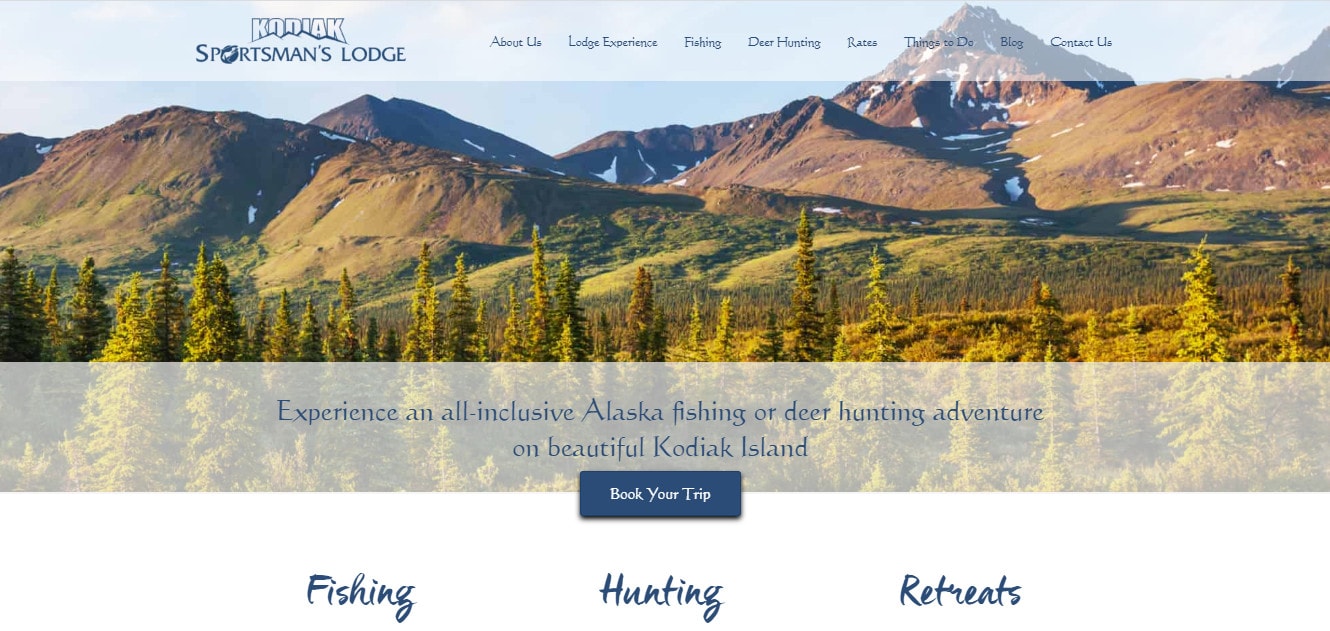
Here is the homepage:

Tourism website design

As you can see, you immediately get an idea of what experiences are on offer. A beautiful landscape image sets the scene and the short, simple text lets readers find exactly what they’re looking for.

As a reader, you can feel your eye flow through the page from the logo, through the picture, to the “Book Your Trip” button. The subheadings and synopses make the choice of adventure simple.

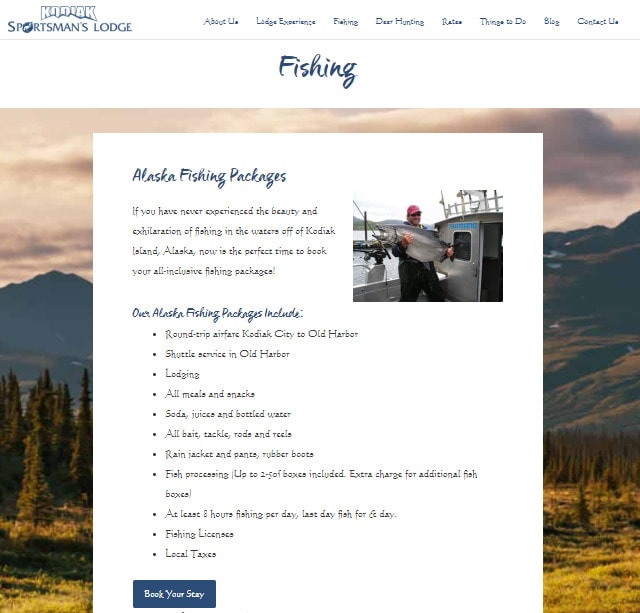
Here is the fishing page:

Tourism Website Design

Again, images are essential to set the scene and capture the imaginations of your visitors. The use of bullet points keeps the text simple and easy to understand, and again there is a call to action in the form of a “Book Your Stay” button to ensure the process of converting a sale is straightforward.

The next logical question is whether or not it works.

Here are the facts. This page was developed in June 2019 and we began providing regular marketing support from January 2020. The difference is enormous – in December 2019, it had an average of 57 views per day, but in February 2020, that number has grown to 251. We helped generate 23 leads.

Read more: 5 website design trends you need to watch this year

Website design cost

Websites can be as cheap or as expensive as you like, depending on the result you want. There are lots of tools available to help you build your own websites on a budget, for example:

  • Build a website with WordPress: WordPress is an online, open-source website creation tool written in PHP. It’s one of the easiest and most powerful website content management tools available today and can be very cheap to create.
  • Build a website with Squarespace: Squarespace is an all-in-one solution for anyone looking to create a website or online shop. It has a very intuitive interface, making it very quick and easy to get started, but it’s more expensive than WordPress.
  • Build a website with Wix: Wix is another simple and easy website builder that can get you off the ground in no time. Like Squarespace, you start by choosing a template and adding your own words and images, but this platform is slightly cheaper.

However, it’s definitely worth enlisting the help of a professional marketing company.

Marketing companies don’t just build the website. They help you choose the right keywords, refine your copy to ensure it creates a good user experience and makes your website an authoritative source of information, optimize the design to lead people through the page to your call to action and make sure the technical parts of the website are running smoothly.

This is essential to getting your website ranking on Google so customers can find you.

The price varies depending on the company you choose and the size of the website, but they will know exactly how to help you start generating leads from prospective customers.

We build websites! You can contact Beacon Media + Marketing today for a free consultation or click to read about our website design and development service.

Website hosting for tourism businesses

Hosting a website

Website hosting refers to the place where all the files that make up your website actually live. Often, people pay for this when they buy their domain name. Once you have hosting, you can start building your website, because you’ll have a location where you can save things like images and text.

All websites on the internet need hosting and it’s worth paying for a quality hosting service so that you can be sure your files are backed up and you’ll have access to help if something breaks.

We typically build websites using a program called WordPress because it’s industry-standard technology and fully customizable. WordPress has a number of recommended hosting providers, including Bluehost, SiteGround, HostGator, DreamHost and GreenGeeks. However, it’s definitely worth making some enquiries with a professional marketing agency, because good hosting will make a big difference when it comes to editing your site, working on the back-end, and making sure it’s as fast as possible.

Read more: 9 telltale signs it’s time to re-design your website

Choosing a website domain

A website domain is the address of your website. The internet is basically a giant jumble of computers and servers and cables and a domain provides an address that people can type into the URL bar at the top of their browser to find you.

Ideally, your website domain will be the same name as your business – if we refer to Kodiak Sportsman’s Lodge again, then the ideal domain is kodiaksportsmanslodge.com. In most cases, you should be able to buy it without a problem. If that name is already taken, you might be able to buy it from the owner, or you can create a variation like kodiakfishinglodge.com, kodiakhuntinglodge.com or even kodiaksporsmanslodgeak.com. As long as it’s simple, it will work.

Website ranking

Making your website show up on Google is critically important to your online success.

The first step is setting up your free business profile on Google My Business. You will be familiar with this already – this allows your business to pop up with details of your opening hours, contact details and website as soon as prospective customers search for you.

The second step is content. The first and most important is to make sure the text on your website is filled with the types of keywords people will likely be searching to find you. In the case of Kodiak Sportsman’s Lodge, for example, words like “Alaska”, “Fishing”, “Hunting” and “Lodge” are all easy wins. The second way is through blogging, which we referenced earlier in this article.

Publishing frequent blog posts (again, laden with key words) will tell Google that you’re an authority in your subject matter. That means any time people search for relevant keywords, your website will rank higher. As more people click on it, it will make its way to the coveted position at #1. If you think about it, 1.7 billion people use Google every day, and 31.7% of them click on whatever result comes up in the #1 spot. Again, it’s an easy win. As of March 2020, Kodiak Sportsman’s Lodge is #1 in terms of organic search traffic for and #2 in terms of organic keywords for its subject matter.

Finally, consider running Google Ads. Google offers paid advertisements which appear in Google search results. These are targeted to appear when users search particular keywords, or combinations of keywords, and can be buttoned down to particular demographics. For example, if you know your ideal customer is a man in his 50s, you can allocate your advertising spend to people who fit that mold. The results speak for themselves – again, to use Kodiak Sportsman’s Lodge, in March 2020 it’s performing at #1 in terms of paid keywords and #2 in terms of paid search traffic.

Want to learn more? We are experts in using Google Ads to boost your business. Here’s a blog we wrote about using them to help your outdoor clothing and equipment shop.

Website design company

If you’re looking for a company to help design a website for your tourism business, you’re in the right place. Beacon Media + Marketing can assist with everything from branding to website design and development, as well as digital marketing, social media and video services.

Ready to get started? Schedule your free consultation today.