November 30, 2021

Chart The Waters

Explore insights on SEO, AI, and digital marketing strategies designed to help your business grow, stay visible, and adapt in a constantly evolving online landscape.
Beacon_Icon_resouse

Social media platforms are no longer just a place to watch cute cat videos and post what you ate for lunch that day. They have evolved into an effective spot for businesses to market their products or services online and develop a deeper connection with their customers. And for many businesses, a great social media content strategy is the primary way to generate leads and see substantial business growth.

In the past, advertising often felt like a shot in the dark. A business would put out an ad and hope it would bring in more leads. Now, social media invites conversation between businesses and consumers. People like, comment on, and share content they find engaging. And all of these reactions become trackable data businesses can use to narrow down their target audience and evaluate if their strategy is working.

At Beacon Media + Marketing, we’ve watched many of our clients flourish with a lead-generating social media content strategy. Here are just a few of the amazing businesses we’ve had the chance to work with that saw real results from working with a social media digital marketing company:

  • Port Chilkoot Distillery gained 2,148 new Instagram followers and generated 290 leads in the first six months
  • Premier Health and Medicine gained an average of 78 quality leads a month and tripled new patient monthly onboarding
  • Anchor Lutheran School had 50K impressions on their social media video and saw a 34% increase in new student inquires
  • Any Mountain achieved a national reach of 2 million people and received over 100,000 views on their video

With the right structure and a clear plan in place, you can see results like this for your business. However, it’s not enough to simply post on social media. If you’ve created a social media account for your business and haven’t seen much audience engagement or return from your posts, it’s time to reconsider your social media strategy (or maybe create one to begin with). Here are five steps for getting intentional with your digital marketing and creating a social media content strategy that generates real leads.

Want to leave the strategy session to the lead-generation experts? Here’s how we take your social media to the next level.

1. Determine Your Marketing Goal

At the core of your social media content marketing campaign is your marketing goal. It is the base for the following steps we’re going to discuss and is the metric you use to determine your success. You might be thinking that your goal is to generate leads. That is what we promised you after all, right? Knowing you want to generate leads is a great step in the right direction, but you need to digger even deeper and come up with more specific, measurable goals for your business social media. Do you have a specific revenue goal you’re trying to hit? How many leads a month is your business capable of handling? How many of these leads need to convert and become customers for you to meet your revenue goals? Is there a particular item or service you want to sell more of?

You also want to determine a reasonable timeline for these goals, remembering that it can take months for your marketing efforts to really take off. And if you have a long-term annual goal, break it up into smaller chunks to track progress. For example, if you want to increase sales by 200% in one year, you can track sales growth on a monthly and quarterly basis to make sure you’re working toward this objective.

2. Identify Your Target Audience

Your social media content shouldn’t be written to capture the attention of anyone and everyone who might be on social media. It needs to be tailored to a specific target audience that are the most likely to be interested in and purchase your product or service. This can be broken down by gender, occupation, age, hobbies, or essentially any criteria that the people you did business with have in common.

For example, one of our target audiences at Beacon is mental health providers who are seeking mental health marketing services to connect with clients or grow their practice. 
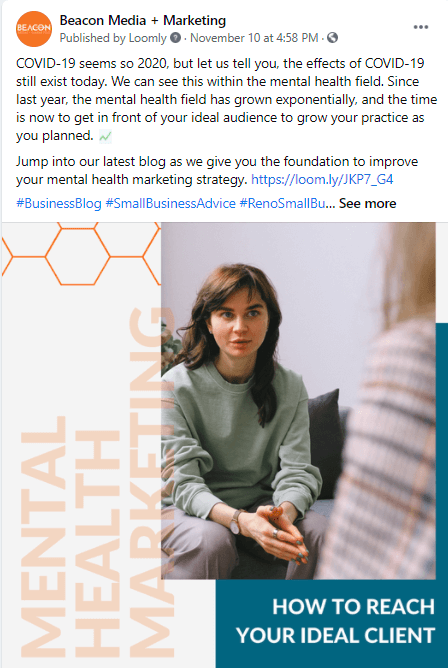
Facebook post from Beacon

Identifying your target audience in your social media strategy allows you to focus your money, time, and resources on people who are much more likely to engage with your content and turn into a lead. It also helps you strengthen your brand through the creative process, allowing you to focus on images and messaging that capture this specific audience group.

Not sure who your target audience is? Consider who you do business with most already. If you already have a social media account that’s been up and running for some time, look at who interacts with your content.

3. Choose Your Social Media Platforms

There are several social media platforms you can post content on, and not all of them are right for your business. You need to consider which platform will be most successful in helping you generate leads and accomplishing your marketing goal. And you need to know which social media platform your customers are actually using.

Let’s take a look at the top six social media platforms for business:

  • Facebook: A popular social media marketing platform for all audiences, Facebook has over 2 billion users a month. Whether you’re a B2B or B2C business, Facebook is an effective place to create content, put out ads, and generate leads.
  • Instagram: A platform that uses images and videos as content, Instagram is a great place to show, rather than tell, people about your offerings. There are over 1 billion monthly Instagram users, and it integrates seamlessly with Facebook. While older audiences are using Instagram more, this platform is most popular among younger audiences, with 71% of users being 35 and under.
  • Twitter: Twitter’s audience is smaller at approximately 350 million users and is great place to post updates and news. Since twitter has a tweet length limit of 280 characters, you don’t need to curate long content to connect with your audience and create content that’s worth retweeting.   
  • LinkedIn: For B2B marketing, LinkedIn is a strong choice for social media content marketing. As a more professional, formal platform, LinkedIn marries conventional social media marketing with professional networking. It’s easier to connect directly with the decision makers who will making purchasing decisions for their business and gain trust with B2B clients.
  • Pinterest: Like Instagram, Pinterest relies on visual content. However, this platform is unique as many people use it more like a search engine than to connect with others or share personal information. Pinterest is a place to learn new skills, increase productivity, find workout routines, or look for products to redecorate your house. It’s a great place to share information, like infographics and blog posts, and to market for an ecommerce business.
  • YouTube: The top social media platform for videos, YouTube has over 2 billion users a month and reaches every demographic. It’s a social media platform and search engine in one, and people use it to consume a wide range of content, from educational and marketing videos to comedy and entertainment.

4. Create a Social Media Content Calendar

Do you struggle to post on your business social media accounts regularly? A social media content calendar is a great way to keep you accountable and bring structure to your strategy. It helps to plan your posts at least a month ahead. It might look something like this:
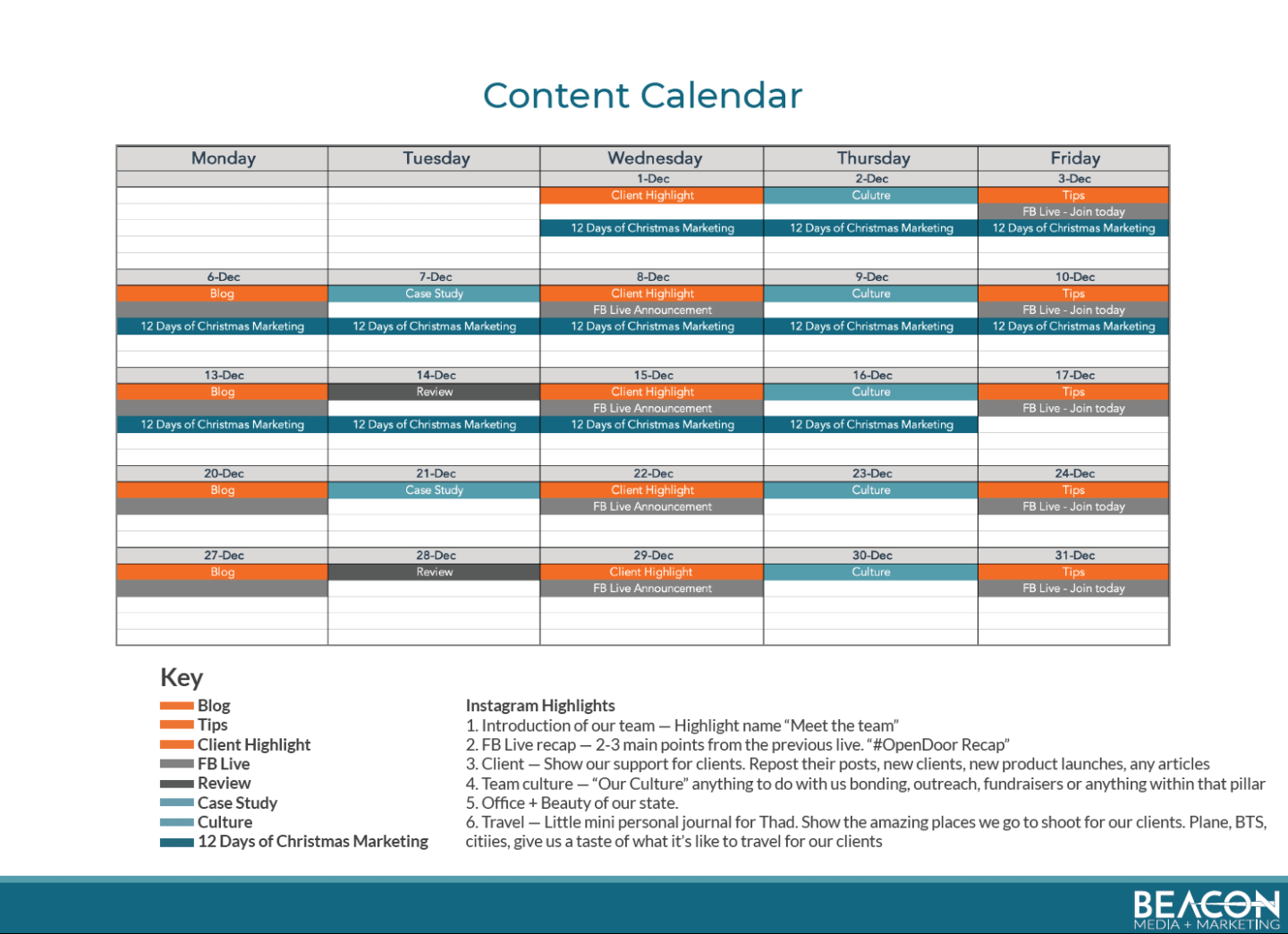
Beacon content calendar example

As you map out your month’s posts, here are a few considerations to keep in mind:

  • You need to find the right balance for posting. While you want to post on a consistent basis, you don’t want to overdo it. Many people find the sweet spot for business social media posts is about 3-5 posts a week.
  • Have a variety of content types. Get the word out about your new blog post, share an article on a relevant topic, post an infographic, add a new video or talk to your audience live. You can even assign a certain day of the week to a specific content type (e.g., you always post a video on Fridays.
  • Always include a visual. People are often drawn to visual content and may scroll past posts that are only text. Always include some type of visual in your posts, whether that’s an image, an infographic, or video.
  • Having a messaging plan. Your tone and voice should be consistent across all marketing and be created with your target audience in mind. Make sure every post you write is true to your brand and follows the same messaging strategy.

Your calendar can be as basic or complex as you want. You can simply layout your topics for the month or go a step further and include links for images, the title for your post, and a post snippet.

Social Media Calendar Template

Download our free social media calendar template for your business and start each month with a clear plan.

5. Generate a Social Media Graphics Template

We just mentioned how important visuals are for your social media posts. While your content calendar helps you keep consistent with your messaging and content distribution, a social media graphics template helps make sure every post is visually attractive and on-brand. This is especially important when posting on platforms like Instagram and Pinterest.

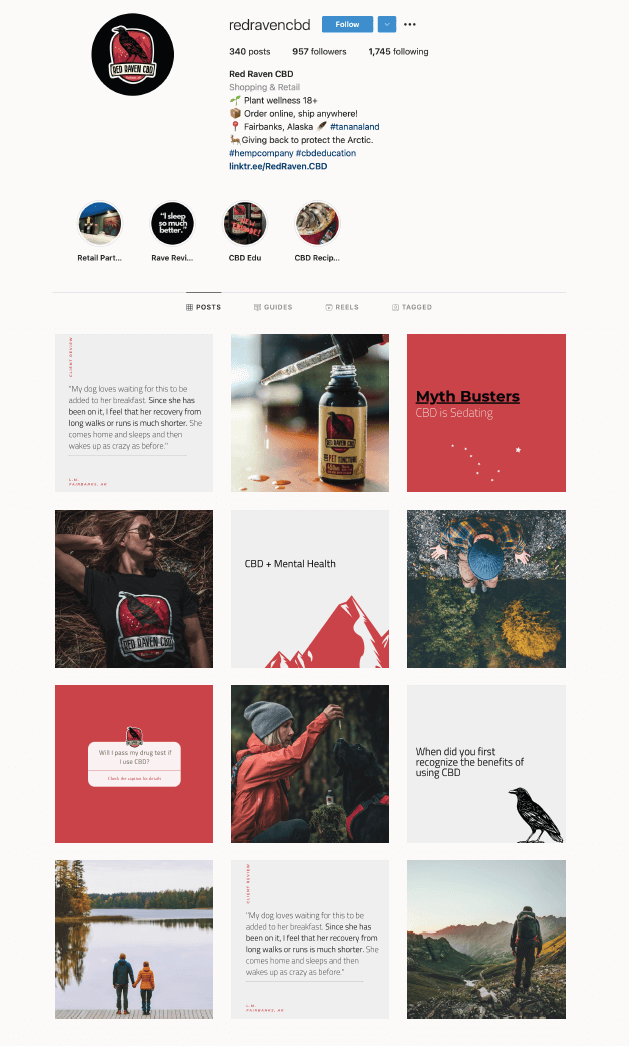
Here is an example from our client Red Raven CBD that showcases what a cohesive social media design looks like.
Red Raven Instagram graphics overview

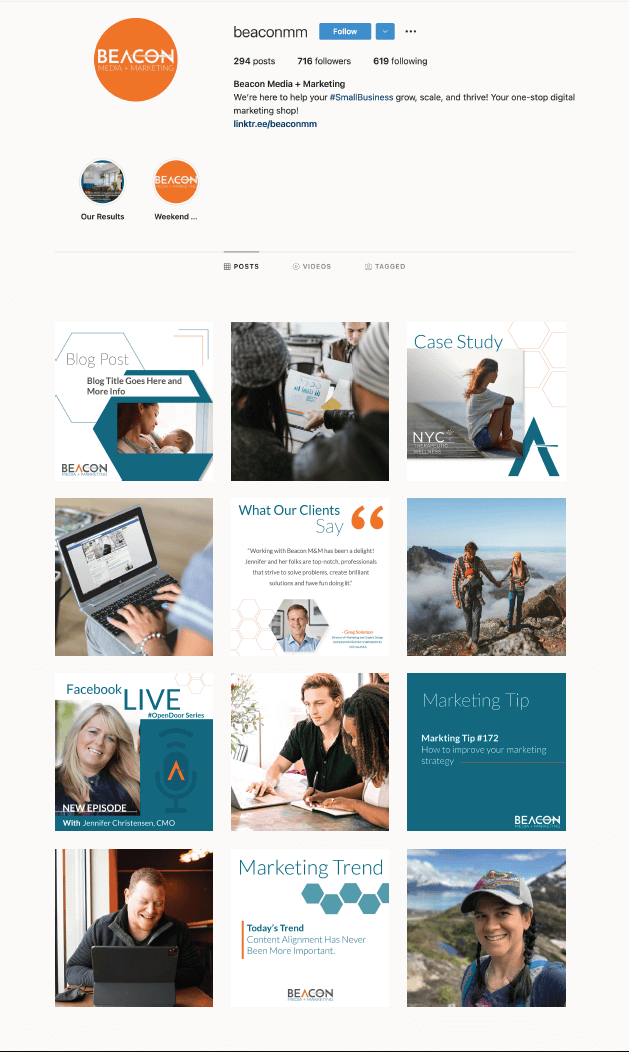
And here’s one more from our Beacon Instagram.
Beacon Media + Marketing Instagram Graphics Overview

Satisfying, right? By pulling from each of these brands’ colors, bringing in the logo, and adding a few elements that are consistent throughout each post, we’ve created posts that are not only visually appealing on their own but attractive from a big-picture POV as well.

Want to know how we did it?

  1. Use a program like Canva or Adobe InDesign to create your graphics. If you’re looking for something that’s free or beginner friendly, Canva is a great choice.
  2. Establish a couple of elements you’ll use throughout your posts. For example, Red Raven CBD uses the crow from the logo, mountain imagery, and the color red.
  3. Create a template for each kind of post you’ll be doing. You can use one template for testimonials, one for blogs, one for FAQs, etc. 
  4. Create a photo gallery of imagery that matches your brand. This can be a folder where you keep original photography, a Shutterstock collection with stock imagery, or a combination of both.
  5. Save your templates and switch out the messaging for each content type. This helps streamline the process and keeps your content cohesive.

Create a Lead-Generating Social Media Content Strategy With Beacon Media + Marketing

Are you struggling to do this whole social media thing on your own? Take your online presence to the next level and put out content that converts. Beacon Media + Marketing can handle your social media content from strategy to execution. We can help you get your brand out to the world in a way that appeals to your target audience and pushes them to take the next step.

Need help connecting with leads on social media? Start a conversation with us to see how we help.  

Originally published by Sabrina Martinez, Content Manager. Updated and revised by Jennifer Gracey, Web Content Strategist & Writer on 06/15/2023

Your website is the digital storefront for your mental health practice. It’s the digital epicenter of the heart and essence of your brand identity and how well people connect with it determines what gets communicated to your audience. It shows potential clients how you can help them solve the problem they’re having, eliminate their pain points, and address what’s important to them. Things like:

  • “What’s wrong with me?”
  • “How can I overcome my mental health challenges?”
  • “Will I ever be okay?”
  • “What do I have to do to feel better?”
  • “Where can I get help for…. this?”

Beautifully Designed Websites Matter

Your website is where about 50% of your potential clients visit before deciding whether or not to engage with your services any further. How your brand looks, sounds, and communicates information to website visitors impacts their decision making process significantly. In fact, you only have 10-15 seconds to convince visitors your website is worth their time and attention. Making an excellent first impression with an eye catching web design is imperative if you want potential clients to stick around long enough to discover what therapy you offer.

Solid Web Design Supports Brand Identity

While you may have your name, your practice or your clinic listed in all the prominent mental health directories, your website is the ultimate digital calling card. Having a strong web design is the foundation of building a solid online reputation.

In addition to being visually appealing, giving your existing and future clients a great user experience on your website serves multiple purposes. A well planned and mental health website design:

  • establishes trustworthiness, credibility and expertise in your niche.
  • sets expectations for the level of service, quality and professionalism your potential clients should anticipate from you.
  • educates and informs your audience.
  • tells your audience how (and where) to connect with you both on and offline.
  • visually signals to potential clients they’re the right clientele for your services
  • encourages website visitors to take the next step in their mental health journey by connecting with you.
  • creates brand awareness, fosters brand identity and brand recognition.
  • displays your services and treatment programs.
  • serves as the focal point for all your supporting digital marketing efforts.

Helping Therapists and Patients Connect

As a mental health provider, you know what you do is important. You also know there are countless individuals out there who desperately need your services. However, for them, taking the first step toward getting help is really hard. Nearly 1 in 4 adults and 1 in 6 children have a mental illness, but approximately 50% of people struggling with mental health issues don’t receive the treatment they need.

So how does one build a website that breaks down barriers and builds trust with potential clients online? At Beacon Media + Marketing, making beautiful, yet patient experience centered, UX-friendly mental health websites is a passion of ours. As we’ve supported online marketing efforts in the mental health industry over the years, we’ve discovered a few core principles every therapist website design needs to in order to convert a website visitor into a potential client.

Examples of Beautiful Website Designs

Want to see some beautiful examples of professional mental health websites? These are three of our favorite web designs that not only look attractive but have produced real results for each of our clients.

Tired of cookie-cutter, run of the mill therapist websites? Us too! Click here to learn about our mental health marketing and web design services.

1. Center for Grief and Trauma Therapy

Center for Grief and Trauma Website Preview

Website Design Highlights:

  • Strong call-to-actions on every page
  • Clear steps for getting started
  • Compassionate, compelling language
  • Strong brand and calming imagery
  • Detailed therapist bios and video

The Center for Grief and Trauma Therapy is a private practice out of Delaware and they specialize in treating people who are healing from grief and trauma. Our client had a vision for an easy to navigate WordPress website that wouldn’t overwhelm people. We accomplished this by having CTAs or call-to-actions on every page of the site and by making the contact button bright and easy to see in the header. We clearly outlined the patient process in four simple steps. Those steps were then neatly laid out on both the home page and services page.

A mental health website requires clear messaging, it must also authentically speak to what website visitors are feeling at that moment. When someone is struggling, decision making capacity and bravery (or courage) are often in short supply. This internal barrier can make seeking help from professional mental health providers hard. Capturing the right cadence and tone of voice will encourage someone to push beyond their dis-ease, take that next step, and reach out.

For the Center for Grief and Trauma Therapy, we knew we needed an excellent way to connect with potential patients. We needed to create a relatable and compassionate website that someone could visit, identify with and recognize, “That’s my loss.”

Experiencing loss or living through a traumatic event is often difficult to talk about. And many struggle putting into words how intrusive and profound their grief and trauma truly is. We wanted website visitors to feel seen, known and safe. To establish this practice as a judgment-free zone, we utilized phrases like:

  • “I feel like I’m grieving wrong.”
  • “I don’t know where to start.”
  • “I don’t know how I’m going to get through this.”
  • “I’m not sure I need therapy.”
  • “I feel like I’m totally stuck.”

Establish Yourself as a Credible Business

We also established the therapists at the Center for Grief and Trauma Therapy as experts in their unique field. With a specific niche in the mental health field, we established a strong brand with this website. The mental health website design incorporated the client’s original logo colors: a burgandy red and warm marigold yellow-orange. We also added in an earthy sage green to infuse the color scheme with a calming element. To enhance and build relatable dimensions to the visual aspects of this site, we placed images of nature throughout, to emphasize growth, serenity and calm.

Here at Beacon, we know building trust and credibility is a must in the mental health field. To facilitate this end, we give website visitors an opportunity learn about the therapists they may encounter. The home page features a friendly video of Christina Zampitella, owner of Center for Grief and Trauma Therapy. Additionally, created in-depth bios that highlighted each therapist’s story, a personal quote, their specialties, and relevant credentials. 

Want to capture your mental health niche with an incredible website that establishes you as an expert in your area? We can help!

2. NYC Therapeutic and Wellness

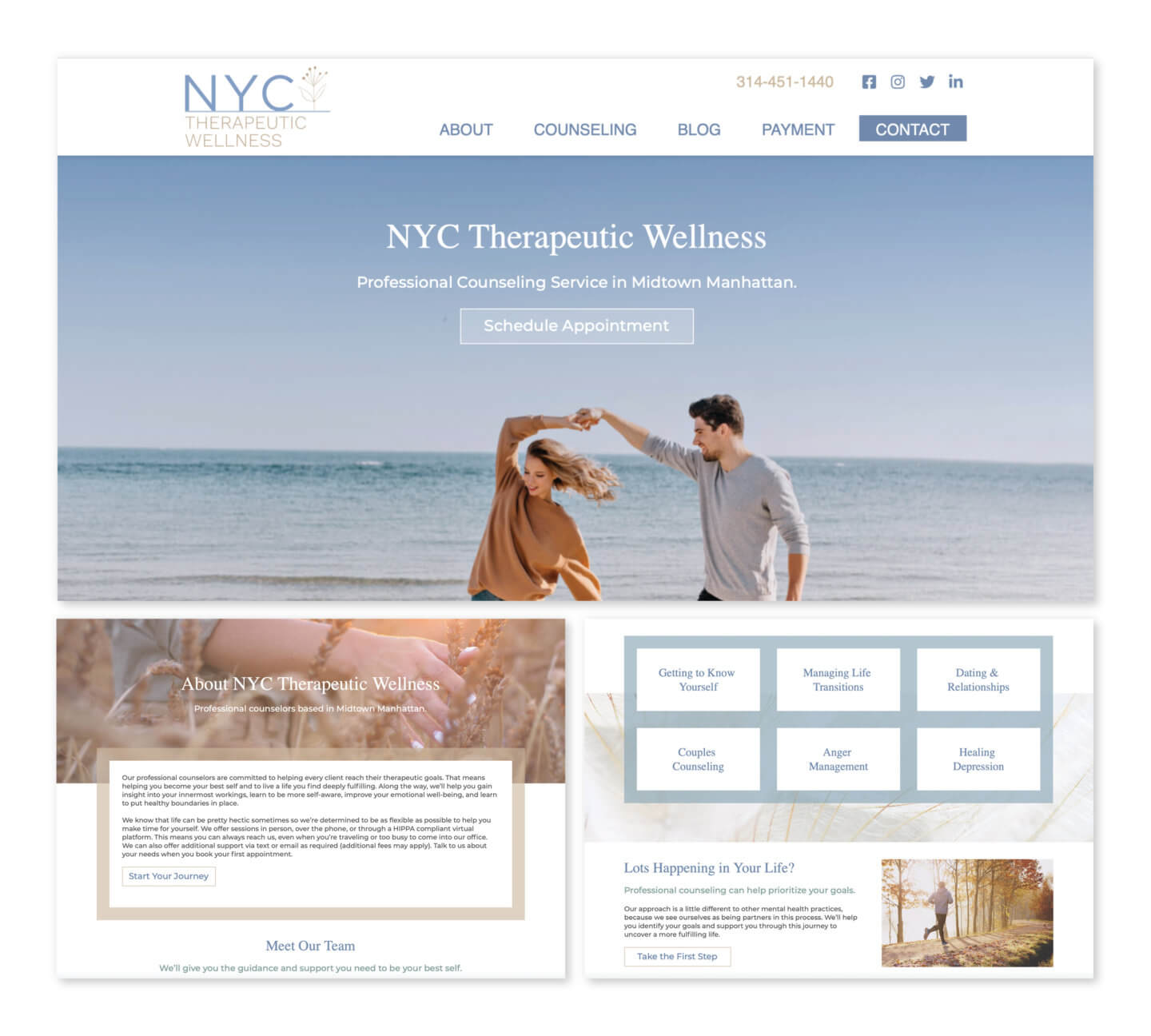
NYC Therapeutic Wellness Website Preview

Website design highlights:

  • Eye-catching header image
  • Calming shades of blue
  • Conversational, relatable messaging
  • Strong, frequent call-to-actions
  • Easy-to-find information
  • User-friendly contact form

The first web design element you may notice when opening the NYC Therapeutic Wellness website is the calming shade of blue used throughout. In general, blue is a great choice for a mental health practice that specializes in treating anxiety. The header image ties perfectly into the logo and brand colors for this client by displaying a wide, open blue sky and a happy couple in neutral colors at the seaside.

Coming in Strong with A Bold Promise

At the top of the home page is a strong promise: “We’re here to help you identify and break down the barriers that are holding you back.” We kept this concept in mind during our design ideation and build process and were intentional about removing barriers to access.

We knew our target audience for this site was going through a tough patch and needed help navigating the unfamiliar terrain. However, as mentioned in the first example, taking that first step is hard. If finding information or scheduling a first appointment is difficult, it’s easy for distraction, disinterest, frustration, anxiety, or doubt to creep in and cause a potential client to leave your site without ever reaching out. 

That’s why we made it as easy as possible for someone visiting the NYC Therapeutic Wellness website to find what they’re looking for. Each page contains multiple call-to-actions guiding people to schedule an appointment or take the first step. Additionally, we placed a grid at the top of the page listing out the practice’s counseling specialties.

The contact button is always strategically located at the top of the header, making it easy to click to the contact page and send an appointment request at any time. And the contact page itself makes the process of booking an appointment simple with options to: select a counselor, indicate one’s preferred appointment day and time, and write a short message.

Want a website that removes all barriers for access and fuels practice growth? Share your website goals with us.

3. Holistic CFT

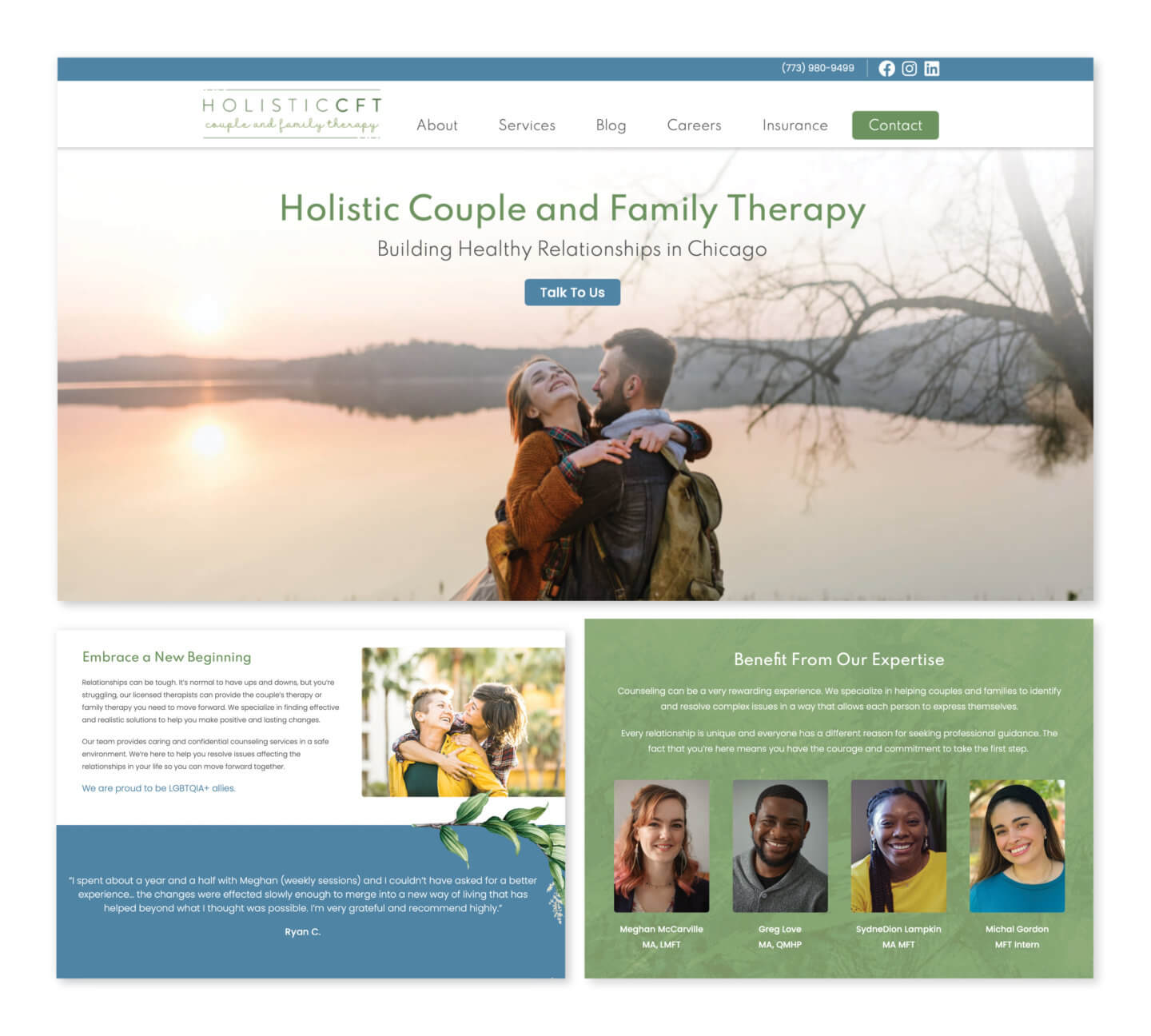
Holistic CFT Website Preview

Website design highlights:

  • Inclusive imagery and messaging
  • Easy-to-find services
  • Multiple call-to-actions
  • Calming color palette
  • Insurance tab in the main-navigation

Based out of Chicago, Holistic Couples and Family Therapy is a private therapy practice and their specialty is relationship counseling for individuals of all backgrounds. To capture the inclusiveness of Holistic CFT on their website, we used diverse images — including images of LGBTQIA+ couples and families. We also chose images showcasing couples across a wide age range and multiple ethnicities (including bi-racial couples.)

Emphasizing Inclusiveness and Making Visitors Feel Welcomed

Our goal was for couples and families from every background, including “non-traditional” couples, to see images on the website they could personally identify with. As well as non-verbally communicate that Holistic CFT is a safe, judgment-free place. We understand feeling different or unwelcome is a major barrier for people seeking mental health services, so we were intentional about sending a strong “everyone is accepted” message. And to eliminate any doubt, we added to the home page, “We are proud to be LGBTQIA+ allies.”   

Insurance coverage also is a deciding factor for patients when selecting their mental health provider. As Holistic CFT accepts most major insurance plans, we made this information easy for new patients to find by including an Insurance option in the main navigation area of the site. On the insurance page we made sure to list the insurance plans Holistic CFT accepts and include direct links to each provider’s page to help patients quickly check if they’re covered.

Want a website that captures the heart of your mental health practice and helps you stand out from other mental health professionals in your area? Tell us about your business.

Bring Your Mental Health Website Design and Patient Experience Goals to Life

Is your current mental health website design unattractive, disorganized, difficult to navigate or poorly functioning? Do you want a unique site that appeals to prospective clients, removes all barriers to entry and beautifully displays the amazing work you do? Beacon Media + Marketing can create a modern, user-friendly mental health website design that fits your vision.

If you’re ready to bring in new clients with a mental health website that converts, let’s talk. Start a conversation with us for more inspiration and to get started.