savvy marketing

Chart The Waters

Explore insights on SEO, AI, and digital marketing strategies designed to help your business grow, stay visible, and adapt in a constantly evolving online landscape.
Beacon_Icon_resouse

Originally published on July 20, 2015. Updated on March 4, 2020.

Back in the 1960s, marketing was relatively straightforward. Let’s be real, you’re probably picturing the orange tones and box pleats of the advertising world featured in the TV show Mad Men, complete with boardroom discussions, concept presentations and an expensive media buy.

The industry was turned on its head with the emergence of the Internet in the 1990s. The past 20 years have seen drastic changes, with advancements in technology and the development of social media. Let’s quickly compare traditional marketing and digital marketing.

From bricks and mortar to online

THEN: Most businesses only had physical locations. This meant it was much more difficult for new customers to find businesses they had never heard of, that is, unless they saw an advertisement somewhere. They couldn’t look up anyone for reviews. And what were you supposed to do when you needed to contact a business? Remember their phone number? Or use a PHONEBOOK? Word of mouth was king and reputation was everything when it came to owning a local market.

NOW: Many modern businesses no longer require physical locations, operating completely online. Many have both. Some have physical locations only. As time passes, it’s becoming increasingly difficult to do business the old-fashioned way, because having on online presence means missing out on a huge potential expansion of customers. Customers want convenience and trust. By that, we mean they want to be able to find you easily when they need you, and they want to be able to look you up in advance to make sure you offer exactly what they’re looking for and that you’re reputable.

Having an online presence is critical in 2020. Schedule a free consultation today to talk about your website needs.

From monologue to dialogue

THEN: Marketing was a one-way street, informed by gut-feel and educated guesses. Companies would give snippets of information to potential customers, trying to persuade them to buy or use their products or services. To a large extent, customers were unaware that other options existed. If someone bought a car from Ford, for example, they were likely to continue buying from Ford because that’s what they had used in the past and they knew it to be trustworthy and reliable.

NOW: Engagement is crucial to success in a digital world. Customers feel like they can trust a company that engages with their customers, because that reminds them that they’re dealing with real people. It’s a two-way street, because businesses can utilize the feedback given via the Internet to come up with new ideas and solve problems. Furthermore, positive reviews go a long way to encouraging other potential customers to take the plunge. These are marketing gold.

Read more: 10 tips for optimizing your social media presence

From outbound to inbound

THEN: Traditional marketing focused on the idea of taking your business to your customers. Huge amounts of money and time were invested in buying advertising space on billboards, newspapers and magazines, as well as commercial slots on television and radio. Sales people would cold-call people and go door-knocking to find new business. Essentially, information was forced upon the public, casting a very wide net in the hope of getting a few bites from the right buyers.

NOW: Digital marketing focuses on the idea that customers will find you when they want you. As such, the idea is to make yourself as easy to find as possible. This means an active digital presence, quality content on your website and social media channels and a strong focus on search engine optimization (SEO). Rather than shouting, “buy this!” you can think of it as saying “enjoy this information we’ve provided.” Your content needs to be educational, helpful or funny to build trust with potential customers. A stellar website is key to helping your company reach its potential.

Ready to get started? We are a digital marketing agency based in Anchorage, AK, and Reno, NV. We work with clients all over the United States. Schedule a free consultation!

Next-level digital marketing

Every successful digital marketing strategy requires three basics: a website, a social media presence, and quality content. You can spend as much or as little as you like when it comes to establishing your digital presence and getting started. The most important thing is simply that your business exists online so that potential customers can find you easily.

Here’s how to take your digital marketing strategy to the next level:

Website

Your website sets the foundation for your entire strategy. Good design can lead to stronger connections, more sales leads and a better conversion rate. If you’re transferring to digital from a traditional marketing strategy, it might help to think of it as an online brochure that showcases your products and services and gives customers an idea of what your business is about.

Here are the most important things to keep in mind:

  • Lead generation: Didn’t think you could get a measurable ROI from a website? Yes, you can.
  • Automation: Your website will act as a virtual sales rep, qualifying leads while you sleep.
  • User experience: Guide your prospects on a journey that leads to doing business with you.
  • SEO optimization: Gain more customers because they can find you online when they need you.
  • Mobile optimization: Most web visitors use mobile devices. Use that to your advantage.
  • Multimedia optimization: Videos and graphics create human interactions with customers.
  • Professional appearance: Bring in the right customers by creating the right first impression.

Sign me up! Click to learn more about our website and development service.

Social Media

Social media is the best way to connect with the people who want to do business with you. The key is to prioritize genuine customer engagement. There are lots of different theories about how to do this best, but we think it’s simple: remember you’re talking to HUMANS. Lots of companies fall into the “sell, sell, sell” trap, but the truth is that prospective customers are real people with real problems.

Here are some things to consider in developing your strategy:

  • Team brainstorming: Good ideas can come from anywhere, so utilize your full team.
  • Campaign objective: Define a clear and measurable goal for every campaign to stay consistent.
  • Campaign budget: Run your ads at the budget that will receive optimal ROI and save.
  • Target audience: Delivering your message to the right people will make sure they take action.
  • Editorial calendar: Know what’s coming up next in your social media content and promotions.
  • A/B testing: Test your ads and audiences to learn what works and optimize messaging.
  • Creative media: Show people interesting content that encourages them to engage.
  • Reporting: Daily monitoring and regular reporting is critical to success.

Not sure where to start? Learn more about our social media marketing service.

Quality Content

Imagine a world where you’re at the top of every Google search. Sounds good, right? It all comes down to content marketing. Quality content generally comes into two forms: articles and videos. The idea is to create content that is wonderful to consume while being full of keywords that will help you rank on search engines, working hard to flood your business with qualified leads.

Here are the basic concepts you’ll need to get started:

  • Editorial calendar: Make sure you cover your bases and stay inspired for the future.
  • Best practices: Trends and algorithms change, so stay up-to-date with the latest advice.
  • Headlines: Get clicks with headlines that have been approved by a title optimization algorithm.
  • Subject matter experts: Interviews with experts will position you as a thought-leader.
  • Research: Make sure you share good information that is accurate and interesting.
  • SEO: Use keywords, metadata and backlinks to make sure your content ranks in search.
  • Multimedia: Good images and videos go a long way to increasing engagement and trust.
  • Calls to action: Your content needs to create results, so include a strong call to action.

We get it, this is a lot to take in. Learn more about content marketing and video marketing.

To go ahead and get started, book your free consultation today!

Originally published on August 3, 2013. Updated on May 31, 2019.

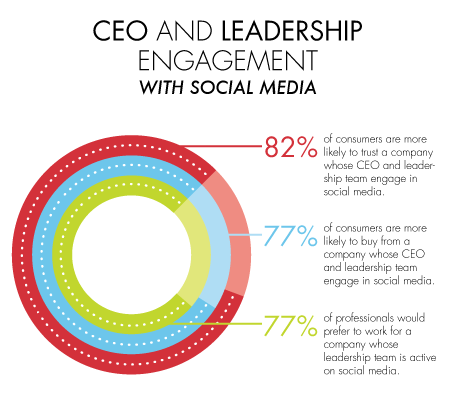
So you want to be a connected CEO? You want to take the plunge?

Great! But where do you actually start?

Corporate social media 101

  1. Make sure your company has a social media policy that both the PR and HR can agree and live with. Then stick to it. This may seem obvious, but depending on your industry, there can be some tricky areas to navigate when communicating via social media.
  2. Decide which social media platforms you want to “own” as the company’s CEO. There is a lot out there and it’s easy to get burned out. We recommend picking three to focus on and master. We also recommend checking with your PR/Marketing department to find which ones they believe to be the most effective for your company and industry.
  3. Be consistent! It would be better to not do social media or only use one social media outlet than to be sporadic. Set up yourself on a schedule for posting and/or blogging. Some social media platforms like Twitter take a lot more time and should have multiple posts a day to be effective, others like a blog could have one post a week.
  4. Establish and maintain a voice. Social media is just that, social. It is all about conversations. Be yourself and communicate the way you would naturally do with a friend or colleague. People want to connect with the real you, they are looking to feel connected to you and therefore the company you lead.
  5. Finally, we highly recommend having a least one person who can be a second pair of eyes to double check content, basic typos, or other things we might miss composing material. After we take the time to actually post, the last thing we want are typos in our material. Twitter is a little more difficult since it is probably the most casual and spontaneous of the social media outlets. But even so, if you’re responding to a PR issue or posting a response to a national or international crisis for instance, it is better to take the time and get the post proofed prior to sending it out.

Have questions? Schedule a free consultation today.
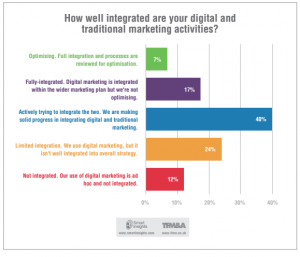
Meeting the challenge of integrating digital and traditional marketing…the struggle is real!

We can pretty much all agree that digital marketing is here to stay. Websites, SEO, social media marketing, blogging, pay-per-click, email marketing, digital ads, video content; it all comes together to form digital marketing. And many businesses are struggling to integrate their traditional marketing with their digital. So if you are overwhelmed, you are not alone.

How well integrated are your digital and traditional marketing activities?
Infographic courtesy of Smart Insights

The digital world and all of its rapid changes have disrupted the way we communicate and therefore market in a momentous way. This means we have to adapt or our marketing lags, which affects business and none of us what that. But should you jump 100% into digital marketing leaving traditional marketing methods goodbye? We say not really and not yet. Thought that leads us to the next question, what challenges do we face in pulling the two together? Here’s what companies polled by Smart Insights had to say…

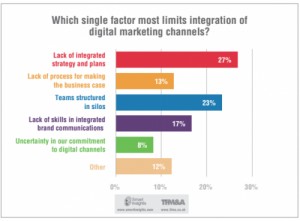
What single factor most limits integration of digital marketing channels?
Infographic courtesy of Smart Insights

As you can see, for the most part, companies struggle to have a plan for bringing the two sides together followed closely by the silo conundrum. So let’s have a look at these two problem areas.

First, Lack of Integrated Strategy and Plans:

We see this most in companies trying to do it all on their own. Often whoever has had the responsibility for placing ads (i.e., print, radio, TV, etc.) gets tasked with figuring out this whole digital thing and throwing some time and money at it. There are several inherent issues with this.

  1. Time may seem like a silly problem to start with, but it is often the one we see the most. While digital marketing is not rocket science, it takes much more of an investment of time that traditional marketing. In traditional marketing, an ad gets created and sent to the magazine or radio station to run its course. In digital marketing, fresh content has to be created every day, often multiple times a day to see a return. This is a total shift in the allocation of time and thought process.
  2. Research is also a big time sucker since digital marketing is evolving as rapidly as technology, so pretty much beyond the speed of light. Seriously, you’ll get whiplash trying to keep up with every new social media channel out there.
  3. Original content is the name of the game when it comes to digital marketing but where do you come up with all of that original content? It can be a real challenge to keep coming up with fresh, engaging content for your target audience.

The solution is to make sure enough time is devoted to creating quality content; which is true regardless of whether it is an in-house person or a marketing company who is doing the work. And enough time must include research into new trends as well as in the production of content. We recommend at least an hour per day just for research, which is what we build into our content creators’ and strategists’ daily schedules. Also having a team to brainstorm content ideas makes a huge difference in the quality of the content.

Second, Teams Structured in Silos

Now let’s say you decided to hire a separate person to tackle this whole digital marketing thing. While that often can sound like a good idea, in theory, most companies find that it creates more challenges that it solves. Here’s our take on it. Digital marketing is often intimidating because of how closely tied it is to technology and therefore how often it radically changes. Having two marketing specialists can create a disjointed marketing presence if each specialist is just focusing on their channels. Instead, it is more critical than ever before to make sure that your company’s marketing, it’s messaging is consistent across all channels, digital and traditional. Marketing is marketing, regardless of the channel used.

The solution here is to look at marketing as a whole. While different techniques must be used to implement the message depending on the channel, it is key to keep a special focus on the consistency of the story across the board. Often it takes a great deal of creativity to figure out how to best represent the message between the different mediums.

So it is vital to make sure your marketing staff or your marketing company can look at the whole picture of your marketing. They need to understand that it is critical to integrate your traditional and digital marketing to ensure efficient and effective marketing.

If you are interested in how we pulled the whole picture together at Beacon, we would love to have a chance to chat with you about how powerful integrated marketing can be. Give us a call at 907-563-6008 or shoot us an email at [email protected].

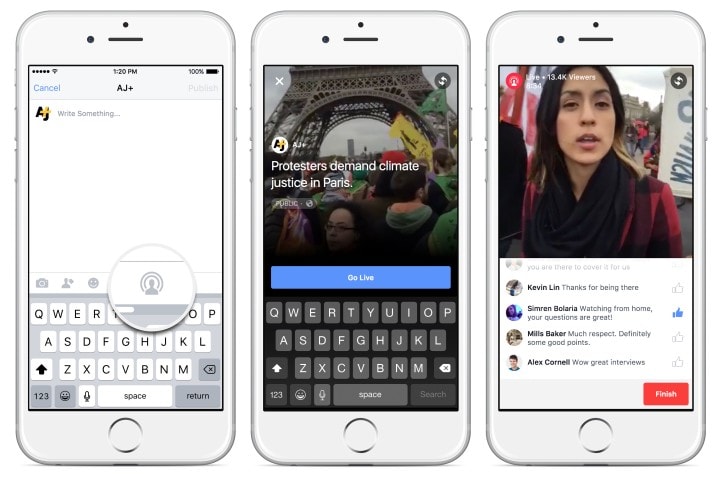
Facebook has been rolling out it’s live streaming video feature in waves for the last four months. Live let’s you connect with real-time video to your friends, fans, and followers on Facebook. It is currently available to people with an iPhone and has been available to celebrities, athletes and other verified public figures via the Mentions app since August. Live is consistent with Facebook’s increasing dedication to video as a medium.

“Video is one of the most engaging and immersive ways to tell your story. Whether capturing breaking news, a baby’s first steps, or rising to a friend’s challenge for charity, it is a remarkable storytelling medium. Video uploaded directly to Facebook is an increasingly important part of News Feed, and more people than ever before are sharing, discovering, and engaging with videos that they care about.”By Fidji Simo, Product Management Director, Video, Facebook

Though Facebook is late to the live-streaming scene behind companies like Blab, Periscope, and Meerkat the sheer volume of their user base gives them a leg up on the competition. For businesses, it means that the time invested in producing and distributing streaming video could have a much larger reach and a better ROI.

Facebook is currently testing live video with selected, verified, business pages and is suggesting that a roll out to all pages could come soon via their Pages app. We recommend companies start brainstorming now on creative ways to integrate this powerful new tool into their social media marketing strategy so they are ready to roll out as soon as it’s available.

Facebook Live

Here are a few suggestions for how to be effective using Live for your marketing.

  1. Use effective headlines: When your followers are making the decision to follow your live video stream, all they will have to go off of it the title. Make it interesting and catch their eye.
  2. Have a plan: Know what you are going to talk about before hand. This doesn’t mean script every second of the broadcast, in fact casual and “real” is more effective. But have a topic and a goal in mind before you start.
  3. Do a Q&A: Invite people who are following to ask you questions and answer them live. Or get a list of questions before hand and answer them live.
  4. Behind the Scenes: Show live video from “behind the curtain.” Do a quick snap shot of a day in the life, or how your team brainstorms creative solutions.
  5. Show and Tell: Show your expertise by walking through how to do a technique or make a product in simple, easy to follow steps.

If you are interested in Facebook Live and want to talk about how it could be a creative solution to marketing your business, we would love to talk with you. Give us a call at 907-563-6008 or email me at [email protected].

How is Pinterest Changing the Online Shopping Game?


You may be aware that earlier this year Pinterest went from being a dangerous time warp, to an addictive online shopping experience, with the addition of buyable pins. The page has just added a new feature that will affect the wallets of Pinners all over the world. If you are someone who cannot pass up a good deal, be warned, Pinterest now can send you app notifications and emails when the price drops on your pinned items. Retailers are able to add this “buy” button to their pins which enables the users to purchase straight through Pinterest.

Pinterest is continually evolving their website’s usability, creating a new kind of shopping experience. The “buy” button feature is targeted toward a customer that may not make impulse buys, but would rather monitor the product and wait for a killer sale. However, the impulse shoppers are not forgotten; if a Pinner enters in their credit card information and address, they are able to make instant purchases anywhere on the app. Turning online shopping into a quick, affordable, and fun experience. 

This buyer friendly feature also entices the customer to return to their pins over and over, which increases the site visits for Pinterest. The shopping experience is a changed game and Pinterest is on the forefront of it. Companies and retailers should take advantage of this creative site and its 70 million users. This can be done by creating profiles and boards to advertise their products and services.

The more creative you make your posts, the more pins and shares they will likely get. Before you know it your product could be posted on thousands of users’ boards, with a strong likelihood of high conversions due to the addition of the new “buy” button.