SEO + Content Marketing

Chart The Waters

Explore insights on SEO, AI, and digital marketing strategies designed to help your business grow, stay visible, and adapt in a constantly evolving online landscape.
Beacon_Icon_resouse

Content marketing is a powerful marketing tool for a few reasons.

For one thing, it’s an effective way to add combinations of keywords to your website to boost your SEO, building awareness. For another, it’s a great way answer questions and educate people about why your products and services are the best option for their needs, generating leads. Content lets your brand personality shine, which ensures people have a positive experience while interacting with your business.

Content marketing comes in lots of different forms, but for the purposes of this post, we’re going to talk about nailing the humble blog. Blogging may sound a bit silly at first – after all, how is an article tucked away on your website going to boost your business? Truthfully, it’s an essential component of an inbound marketing strategy, and when it’s done well, it will work hard for you for a long time to come.

If you’re new to writing, it can be a bit intimidating. The truth is that you can follow a really simple formula. It’s a bit like a recipe – if you know what ingredients you need, you can just mix them together and know that you’re creating something that will work. Here’s a five-step method that we use for all our own blog posts.

Looking to outsource this? Schedule a free consultation.

Step 1: Know your goal

Every piece of content should serve a specific purpose, so the most important thing is to figure out exactly what you’re trying to achieve by writing the blog post. This will make sure you stay on track. For example:

  • Are you trying to build awareness of your brand and attract a new audience?
  • Do you want to win people over to your viewpoint or opinion?
  • Are you promoting your product or service?
  • Are you educating people or raising awareness?
  • Are you reporting on a new and important piece of news that is relevant to your industry?
  • Are you answering questions and looking to increase your reputation as an expert?

Having a clear goal will also help you choose a topic that addresses a specific issue. This is really important for SEO purposes, but also readability, because it will stop you from rambling and losing people’s interest.

Read more: Seth Godin is still right, content marketing is the only marketing

Step 2: Define your audience

Once you know what you’re trying to achieve, think carefully about the target audience. This will impact the way you present your information, because you’ll need to identify the tone and style of content most likely to resonate with them. Think about things like location, age, income level, education level, and pain points.

Read more: What are buyer personas and how can they convert leads?

Step 3: Research

There are three key components to researching a new blog post: competition, keywords and facts.

Research your competition

What are your competitors doing? Scope them out before you start to write your piece, so you can see what’s already being done and look for gaps in the market that your content can fill. Regurgitating content everyone else is doing is essentially a waste of time, because it will be really hard to make your content stand out in order to build your brand and start driving traffic to your website. Instead, look around and see if you can find a niche, and use this as the basis of your content marketing strategy. If people are looking for information on that topic, and you’re the only one providing helpful information, you’ll start capturing attention for all the right reasons.

Research your keywords

Once you’ve identified your goal, defined your audience and found your niche, it’s time to research the most popular search terms on that subject. This will make sure people can find it when they’re looking for answers on this subject through search engines such as Google. There are lots of tools available to help with this. Google Keyword Planner and Google Trends are the obvious ones, but we also recommend SEM Rush and KeywordTool.io. They’re also a good way to identify any topics that are trending in your industry.

Read more: Pump up your SEO efforts in 2020 with these simple tricks

Research your facts

Check, and double-check, every piece of information your share on your blog. One of the biggest challenges of content marketing is the abundance of false information available online, and it will be really embarrassing if you’re ever called out for accidentally relying on a “fact” that isn’t actually true. Do your homework and trace facts back to their source. You can even link to them in your blog post, so people can check for themselves. Always make sure you’re sharing high-quality information. A little bit of research at this stage will go a long way to building your brand’s credibility and establishing its authority as a thought-leader in your field.

Step 4: Write your post

Now that you’ve assembled your ingredients, it’s time to follow the recipe.

Google’s reputation depends on its ability to fine high-quality content that quickly answers search queries. As such, there are a few simple things you can do to improve the chance the algorithm will find and rank your post.

  • Use the goal you identified in Step 1 to make sure your content stays on track. Convenience is important in attracting and sustaining the interest of modern consumers, because they have a wealth of information available at their fingertips. They want answers quickly, so it’s best to get straight to the point.
  • Use the keywords you identified in Step 3 to provide structure. You should aim to find 3-5 related keywords to incorporate into your blog post, to maximize its chance of showing up in search results. The most popular search result should form the title of your blog, while the next few will form the subheadings, and then you’ll color in the gaps in between. See what we mean about following a recipe?
  • Keep sentences simple. You’re not trying to write an award-winning novel, you’re trying to help the good folks of the internet, so make sure your writing is clear. When it comes to structure, you might find bullet points to be a helpful aid (like what we’re doing here) to help break things into bite-sized chunks.
  • Aim to write about 1,200-1,300 words on your topic. Search engine algorithms are programmed to favor longer posts, because these are more likely to answer search queries in sufficient detail.
  • Always run a spell-check to make sure your copy is sparkling clean.

Read more: Starting a blog (an expert guide to content marketing)

Step 5: Build your funnel

Great, you’ve written your blog post! You’ve picked a topic that meets your goal, optimized content for your target audience, found a niche in the market and packed it with searchable keywords, and created well-written copy. You’ve done all the hard parts, but it’s not time to put your feet up just yet. You need to incorporate that blog post into your sales funnel to ensure you maximize its value over time. Put that baby to work!

  • Share the post on your social media channels, and promote it through Facebook Ads and Digital Ads. This will build awareness of your brand. It will also educate clients about why they need you.
  • Link back to your post in future blog posts, to help educate customers about certain topics and explain why you can help solve their problems. This is really persuasive in the consideration phase.
  • Always incorporate a strong call-to-action that makes it clear exactly what next steps are required to proceed to the conversion phase of the path to purchase. For example, ask readers to schedule a free consultation, or direct them to a dedicated landing page that invites them to proceed.
  • Finally, keep blogging. Consistency is an essential part of every content marketing strategy, because each blog will build upon the good work of the last one, to create a comprehensive long-term strategy.

Blogging isn’t a “build it and they will come” scenario. Yes, a stream of fresh content will help your website rank higher in search; yes, keyword-optimized posts are likely to boost your spot on Google’s results page.

However, it’s capable of doing a lot more to help you. Integrating your content marketing strategy into your sales funnel will ensure you get the maximum impact for the time you invest in creating each post. This will go a long way toward building awareness, generating leads, and ultimately converting sales to grow your business.

Ready to get started? Schedule a free consultation.

Originally published on June 19, 2018. Updated on May 25, 2020.

Shopping has changed a lot since smartphones were invented. Remember the good old days? All you had to do was see a TV commercial or hear a recommendation from a friend and know you were about to get a great deal. Today’s customers need a little more persuasion.

According to Think With Google statistics from January 2018, 53% of shoppers say they always do research before they buy to ensure they’re making the best choice possible. What’s more, nearly 2/3 of shoppers say online video has given them ideas that inspired their purchase.

It makes sense, right? Smartphones put all the answers right at their fingertips. They don’t have to blindly trust that a product is good; they can read the reviews, compare prices, and find out what the brand’s competitors are doing. Consumers are much more empowered.

There’s no way to ignore the numbers. The whole buying process has evolved, and if you want to stay profitable, you need to be changing right along with your tech-savvy consumers. They’re looking for educational material, reviews, and testimonials.

To stay on top, you need to provide them with that information.

Too hard basket? Try outsourcing! Schedule a free consultation.

Evolution of the SEO blog

Blogs have long been a powerful tool that businesses use to educate the public, in order to capture their attention, solve their problems, and gently guide them along the path to purchase. They’ve gone up and down in popularity over the years, but we say the humble blog is here to stay.

In the early days of blogging, all you had to do was write 400-odd words about your products and you’d be set. Various combinations of keywords would naturally boost your SEO, and it was an almost effortless way to start driving traffic to your website. Then other businesses caught on to the trend, and the floodgates burst open. Today, SEO is a fiercely competitive game.

Marketing strategies change all the time as technology and consumption habits evolve. The industry has moved away from traditional outbound marketing methods to new inbound marketing methods. The idea is not to force your brand messaging down the throats of the unsuspecting public, but to make yourself easy to find when they’re looking for your products and services.

Blogs are a critical part of this strategy, because the first thing anyone with a problem wants to do is find answers. Educate your prospective customers. Tell them tips and tricks, publish how-to guides, answer frequently asked questions. Try to help; don’t try to sell. Remember, today’s customer is tech-savvy, which means if they can’t find the answers on your digital assets, they’ll look elsewhere.

Give them a good experience, however, and they might stick around to learn more. They’ll browse a related blog article, or click through to your “about” page, or check out your products or services. If you strike the right note, they may even reach out and ask more questions.

Blogging has evolved a lot over the years, but it’s still an essential marketing tool.

Read more: Pump up your SEO efforts in 2020 with these simple tricks

What does modern blogging require?

Blogging is more than just blogging now, and it has been for a while. Consumers still can’t seem to get enough content and us content marketers are hard pressed to provide enough. Customers are demanding not just written blogs, but a variety of types of content.

Remember the statistic we shared about video? Two-thirds of online customers told Google that video has inspired them to purchase. A modern blogging strategy should include:

  • Videos: Short-format content, ranging from 30 seconds to about three minutes, can be a great way to convey information quickly and help your prospective customer.
  • Infographics: Significant amounts of content presented in a visual, easy-to-digest format.
  • Podcasts: Free audio files, usually offering informative content, delivered in subscription form that can be downloaded and listened to on the move.
  • eBooks: Longer format educational information, including how-to guides, can go a long way to boosting your credibility by presenting you as a thought-leader.

Read more: What is StoryBrand marketing and how can it help my business?

How does blogging actually help?

Another Think With Google article, published in June 2018, notes that modern consumer paths are becoming increasingly complicated. The average computer user will use 3.4 touchpoints before committing to a purchase, whereas a smartphone user will have an average of 2.9 touchpoints.

This means they interact with a variety of sources while researching their purchase before making a decision. The first touchpoint for the average smartphone user looks like this:

  • Web search: 22%
  • Store/manufacturer website: 18%
  • Price comparison website: 12%
  • Conversation with friends: 13%
  • POS/in-store visit: 7%
  • (A whole bunch of little ones fit here, including social media)
  • Video streaming website: 4%.

As you can see, web search and business websites are the two key sources of potential consumers – right off the bat. This means your SEO strategy needs to be on point, and your website needs to be in tip-top shape, if you want to catch people’s attention for the right reasons.

Blogs form a key part of this strategy, because they naturally contain more keywords than webpages, so they typically rank higher in search. A consistent stream of new posts also keeps your website fresh and up-to-date, which appeals to modern consumers.

Remember, this is just the first touchpoint in the process. For smartphone users, there are still another 1.9 touchpoints to come, and you want to be sure they find you.

Read more: Seth Godin is still right, content marketing is the only marketing left

Where do your clients consume content?

Most people start their research on Google, but many are also exposed to brands for the first time on Facebook and other social media channels. According to statistics from Facebook, published in 2018, there are 2.45 billion monthly users. About 247 million of these are based in the United States and Canada. More than half of these admit to checking the platform “more than a couple of times a day.”

Blogs make great fodder for search and social. Your Google Ads can drive traffic to blog posts; your Facebook and LinkedIn ads can share information for people to read, comment about, and (hopefully) share with their friends. They key is to be consistent, and keep ’em coming.

One of the foundational parts of running a 21st-century business is interacting with your customers. It’s as vital today as having a working business phone. In order to do that successfully, and capitalize on it, you need to figure out where they’re spending time online. You can make assumptions about this based on a couple of things – for example, where do you interact with most customers now? How old are your customers? Where are they based? Are you targeting consumers or businesses?

HubSpot is a leading American software developer, specializing in marketing and sales products. It compiles a report every year telling marketers what demographics are using different social media platforms, which is incredibly helpful when it comes to targeting the right people:

  • Facebook: The most popular age range of users is 18-29, at 81%. About 75% of users are based in urban areas, and 90% access the site via mobile devices. College graduates make up about 77% of adult users, and the median income is between $30K-$49K. Helpful, right?
  • Instagram: About 42% of Instagram’s users are college graduates. It’s a smaller number because it appeals to a younger audience, with 72% of users aged 13-17. However, it’s very powerful, because 60% of users say they discover new products on the platform.
  • LinkedIn: LinkedIn is a primarily business-to-business platform, and it has about 165 million users in the United States. The average age of users is higher: 36% are aged 18-29, while 34% are aged 30-49. As you might expect, many of these are college graduates.
  • YouTube: About 81% of American internet users aged 18-25 watch YouTube videos. It’s no surprise, then, that about 15% of all YouTube traffic comes from the United States. About 62% of YouTube users are male, who spend an average of 44% more time on the site than women.

See what we mean? Each platform attracts a different audience. You obviously already know who your target customer is, so you need to keep this in mind when you’re trying to reach them. The tone and style of your blogs will need to adjust to appeal to different demographics; so does the platform on which you share them. This really is about working smarter, not harder, in sharing your message.

Read more: Google judges your website based on mobile friendliness

It’s now called content marketing

Blogging emerged as a way to answer a need for content, boost SEO rankings and keep websites fresh. After all, it’s much easier to type out a quick blog post than re-think your website every week. As Google’s algorithm has changed, we’ve learnt to incorporate searchable keywords; as Facebook’s algorithm has changed, we’ve learnt to improve visuals and include video when we can.

However, blogging is no longer a standalone digital marketing strategy. Rather, it’s a critical part of a digital ecosystem. Modern marketing strategies might incorporate blogging as follows:

  • Problem: A business wants to increase brand awareness and generate leads
  • Solution Part 1: You create an editorial calendar – including how-to guides, frequently asked questions or hot topics in your industry – aiming for 2 x new blog posts every month for six months. You incorporate strategic keywords, which naturally boost your SEO.
  • Solution Part 2: Blogs are shared on Google Ads, either as a search ad (which appears at the top of the Google results page for a search of like keywords) or a display ad (which appears on Google’s many other internet properties). This drives traffic to your website.
  • Solution Part 3: Blogs are shared on social media, either as organic posts (which are designed to encourage community engagement) or Facebook Ads (which are designed to boost awareness). They’re tailored for your target audience. This drives traffic to your website.
  • Solution Part 4: Every blog post includes a strong call-to-action with a clear next step. It might be signing up for an e-newsletter, scheduling a free consultation, asking for a free assessment, etc. It prompts the customer to engage once they’re on the page.
  • Solution Part 5: Congratulations! You’ve just generated a new lead.

Remember, the whole point is to make it as easy as possible for people to find you when they need you. When content marketing, social media marketing and digital advertising work together to create an effective digital marketing strategy – well, it’s a beautiful thing to behold.

As you can see, blogging is as important in 2020 as it was in 2015. The way we do it has changed, and the digital infrastructure that supports it has changed, but the essence is unchanged. You’re here to serve your customers. Modern customers are demanding information, so you need to adapt your strategy and ensure that need is met. That’s the key to generating leads. When all the pieces come together, content marketing is a powerful tool for organizations and business alike.

Inspired to create a killer content marketing strategy? Schedule a free consultation.

SEO is essentially the dark arts of digital marketing, because the rules constantly change as search engines like Google update their algorithms. New tips and tricks that will help you find optimize your content for success are guarded as closely as the Chamber of Secrets (any other Potter fans out there?).

Here, we’ll run you through the basics that will help you Ravenclaw your way out of obscurity (okay, sorry, we couldn’t resist) and onto the first results page for your target keywords. It’s a really competitive arena, but the truth is simple: identify your keywords, analyze Google’s results, and create something better.

Oh, and make sure your website is working better than a Nimbus 2000.

Ready to add some magic to your strategy? Schedule a free consultation.

Identify your keywords

Keywords are at the core of every good SEO strategy, because they help people find you. The easiest way to start is by creating a list of what your business does, including all your products and services. HVAC? Insurance services? Flightseeing tours? Then list a couple of words that explain why you’re the best choice for each of those keywords. Certified? Local? Experienced? You’re already on your way to a winning SEO strategy.

There are two ways you can incorporate keywords into your content: short-tail (e.g. new furnace) and long-tail (e.g. Where to buy a new furnace in Reno, Nevada). Both are important, but because they’re more specific, long-tail keywords tend to be less competitive than short-tail keywords. It makes sense if you think about it, because rather than trying to compete with every other HVAC service in North America to make your “new furnace” page rank on Google, you’re instantly cutting the competition down to other local services. This will help your webpage skyrocket up the list of results, while qualifying any leads generated to those in the local area.

Read more: 3 ways to boost traffic to your website

Analyze Google’s results

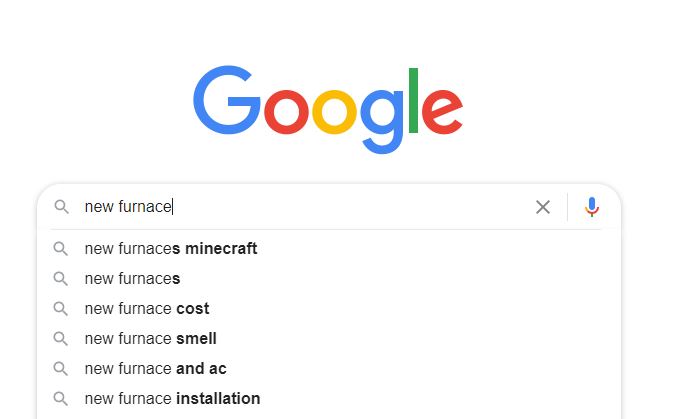
Once you’re confident that you’ve chosen the right keywords to summarize your business, go ahead and type them into Google. As soon as you enter some words into the search bar, Google’s autocomplete function will let you know what’s trending on that topic. This is really helpful, because it may help you tighten your strategy:

Google Results

To continue using HVAC as an example, assuming we disregard “new furnace minecraft” straight away (LOL), you can see that people are most interested in how much a new furnace costs, whether they can get a deal on a new furnace and new air-conditioner, and installation services. These are great topics that you can address in long-tail keywords to hone in on the questions people are asking in real-time. The more specific, the better.

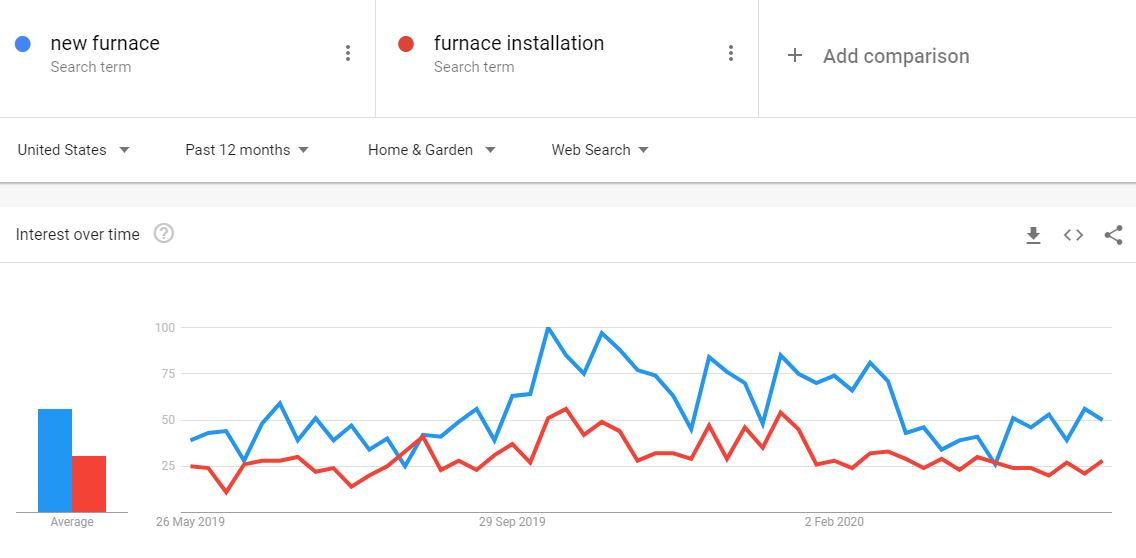
If you’re stuck between two terms, you can use the Google Trends tool to see which is performing better. Here’s an example, which compares all searches for “new furnace” and “furnace installation” in the United States for the past 12 months. It’s immediately clear that “new furnace” is a stronger search term.

Google Results

Now that you’ve tightened up your list, go ahead and actually search those terms.

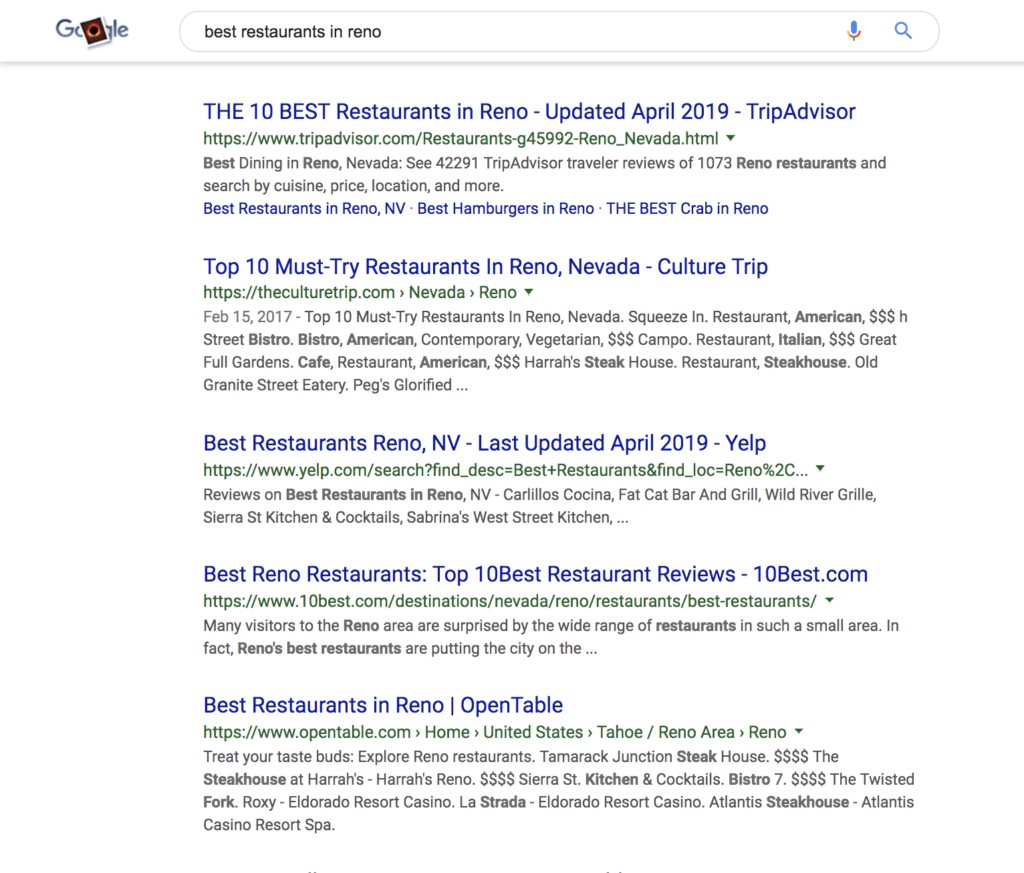
Here are the results for “new furnace cost Nevada”.

Google Results

Desert Valley HVAC has jumped straight to the top of the list. Why? It’s the only one that actually includes prices in its excerpt. The others are vague, talking about “lots of things to consider,” “maintenance and repairs costs,” and “free quotes.” These are all great things to talk about in the blog post itself, however, when people want answers… they want answers. Simple and direct responses are likely to help you jump up the list.

This is just a random example, but it’s a helpful reminder that no-one is here to play a game of hide-and-go-seek. They want things to be as clear and easy as possible, so providing information upfront is actually more likely to drive traffic to your page. If people click through, and have a good experience, they may come again.

Read more: What should I track on Google Analytics?

Create something better

This is obvious, right? As soon as you’ve seen what your competitors are doing, look for strengths and weaknesses and do what you can to exploit them. Do something differently, like adding pricing details. Add a hook, like a special offer. Make it look as good as it can, with snappy wording and sparkling clean copy.

Let’s talk through another example, this time looking at the tourism industry. Beacon Media + Marketing has an office in Reno, Nevada, so let’s go with “Lake Tahoe bike rental.”

Google Results

This is a different game. The first spot (which isn’t shown in the picture), is snapped up by an advertisement from Anderson’s Bicycle Rental. This is an incredibly powerful tactic to boosting traffic to your page, because Google Ads work on a pay-per-click method based on a bidding system. If none of your competitors are advertising for the exact combination of keywords you’re using, you can put yourself right at the top of that food chain.

Read more: Do Google Ads work for marketing your business?

The next three results on the page are taken by Google My Business listings. Every business automatically has a Google My Business listing, so it’s really important you go ahead and claim yours as soon as possible. Just type your business name into Google and click the “Own this business?” link on the right-hand side.

Once you’re in, you can optimize your listing by adding details about what you do, opening and closing hours and special offers. Importantly, you can also respond to all reviews and comments filed by the public. If you have great reviews, awesome! Keep doing what you’re doing. If you have negative reviews, respond calmly. Thank the person for their feedback and explain how you’re planning to fix the situation. You may find it’s beneficial to take this conversation offline, so invite them to call or email you to discuss the problem.

If you check out the three listings in the image, you’ll note Anderson’s Bicycle Rental is at the top of the list, followed by Tahoe Bike Company and Over the Edge. Click into each business’s profile and check out what they’re doing that you’re not. This is a really simple way to implement best practice.

Read more: Google My Business is the perfect tool for tourism marketing

Tidy up your tech

The other essential is to make sure your website is optimized and running smoothly. Even the best strategy in the world won’t help if your website is a mess! If you’re new to the world of websites, the Google Webmasters have published a really handy Search Engine Optimization (SEO) Starter Guide. It’s a really helpful DIY tool for anyone looking to give their SEO strategy a boost from the back-end of their website.

We’ve spoken about some of the technological aspects that can boost SEO before. For example, backlinks, headings and sub-headings, metadata and images (you can read more about that here). We’ve also talked about the ways in which Google judges your site based on mobile-friendliness (that blog post is here).

However, Google’s guide will run you through current best practice on things like:

  • Helping Google find your content
  • Managing your appearance in Google search results
  • Organizing your site
  • Optimizing your content
  • Activating your images for SEO

It’s worth a look, as you may find there are a lot of easy wins hidden in your website.

One example is making sure your pages are titled correctly – for example, a page titled “furnaces and boilers” will do exponentially better than a page titled “page three.” Similarly, an image titled “Lennox furnace” will do you many more favors than an image titled “IMG_1234.” In a game as competitive as SEO, it’s worth investing the time to take care of the easy wins so that customers will come knocking on your digital door.

Want to ask the professionals? Schedule a free consultation.

Originally published on July 3, 2018. Updated on May 15, 2020.

The world of SEO can be complicated. It’s always changing, so it’s easy to get frustrated and overwhelmed, because strategy can evolve just as you feel like you’re getting the hang of it. That said, SEO (a common acronym for the practice of “search engine optimization”) is a core component of every successful digital marketing strategy. It makes you searchable, meaning customers will look to you for information when they need your products and services, which drives traffic to your website and ultimately generates leads.

Before we get into some specific tips to improve your blog, let’s first touch on the technical side of SEO. According to Webopedia, it means this:

Search engine optimization is a methodology of strategies, techniques and tactics used to increase the number of visitors to a website by obtaining a high-ranking placement in the search results page of a search engine (SERP) – including Google, Bing, Yahoo and other search engines.

While not an exhaustive list by any means, today’s blog is going to focus on some of the strategies, techniques, and tactics to improve the ranking of your blog and therefore your website. We’ll run you through the essentials of keywords, backlinks, headings and sub-headings, metadata and images. Ready? Let’s dive in.

Want to skip to the part where we help you? Schedule a free consultation.

Keywords

Tip 1: Focus on incorporating long-tail keywords in all of the content published on your website.

What does that mean? Keywords are the search terms people are likely to type into Google when they’re looking for an answer to something. A long-tail keyword is searchable phrase, for example, “what does SEO mean,” “SEO strategy for beginners,” or “how to use SEO on my website.” All of these phrases use the keyword “SEO,” but they also specifically target probable search phrases. Getting this right can go a long way toward increasing your changes of showing up at the top of the results page, because it targets a niche search.

Narrowing the focus of your search terms mean you won’t have to compete against as many other websites to catch Google’s attention. Take the examples below for example – there is a difference of 958,620,000 search results between the two! Your likelihood of being in the first couple of pages in the search results are significantly better when you use long-tail keywords, because these answer specific questions.

keyword examplelong-tail keyword example

The key to using these in practice is to remember that less is more. That might sound strange, since we’re trying to convince Google that your content is the perfect match for the search query, but it’s really important not to just stuff your webpages and blog posts full of keywords at the expense of readability. The Google algorithm, in its current form, is designed to scan the internet for quality content. Google’s business model relies on its ability to find the best information on the website to answer your questions, which is why readability matters.

Try to focus on 1-2 long-tail keywords per blog, and naturally work them into the blog where it makes sense and fits with the flow. It is effective to use them multiple times in each blog, but again, don’t over-use them. It will make your content seem inauthentic and unhelpful, which could put it at the bottom of the pile.

Read more: What is StoryBrand marketing and how can it help my content?

Backlinks

Tip 2: Link to your own webpages and blog posts when you publish new content.

Backlinks open the door to the SEO chamber of secrets. Their definition is pretty straightforward: they are incoming hyperlinks from one web page to another. The more backlinks you have, the more “popular” your site is, and SEO bots will judge this favorably, because they’re programmed to assume that page is an authority on whatever topic it’s about, and increase its ranking.

The easiest way to start is by back-linking your own content, to boost your own digital ecosystem (see what we did with the “read more” link above?). However, backlinks from other people’s websites are even more authoritative – it’s like being vetted by a third-party. Unfortunately, there’s no easy way to do this, other than to publish great content that other people find interesting and valuable and ensure you’re constantly networking (both online and offline) with other reputable businesses in your industry. For example:

  • Identify leaders in your industry or niche.
  • Subscribe to their blogs and follow them on social media.
    • Start a relationship by leaving thoughtful comments on their posts.
    • Share their posts and link to their blogs when relevant in your blogs.
  • Ask to be a guest blogger on their website, with a link back to your website in your bio.
  • As you build the relationship, you can ask them to backlink to your content in other blogs.
  • This process will get easier and more backlinks will follow over time.

It’s important to mention here that you should never buy backlinks. You may see articles or receive comments from services offering to backlink to your website for a price, but search engine operators are aware of this and the algorithms they design do not look favorably upon mountains of links from dodgy websites. In fact, it may even lead to your website being black-listed. Quality links from reputable sites are worth the investment of time.

Read more: How to create a show-stopping SEO strategy

Headings

Tip 3: Use long-tail keywords in your headings and keep them short and simple.

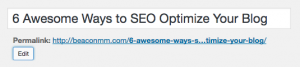
Headings are a great way to incorporate keywords in a natural way, because they’ll introduce the topic, as well as all the related sub-topics, you’ll cover on your webpage or in your blog post. The trick is to keep them short, simple and clear. Ideally, you want to keep your title to about 65 characters and use a subtitle in the first line of your blog if you want to enhance or build on the title its self. Also, make sure to remove any “extra” words like a, an, the, etc. from the permalink.

Permalink Example for SEO Optimized Blogs

Create headlines that grab people’s attention by making them interesting and distinct. The word “awesome” in the sample above is a great example, because it adds a flash of personality. Remember, headings need to stand out among a lot of titles all competing for the same views.

Read more: What’s in a headline? How to write to get attention

Metadata

Tip 4: Don’t forget metadata! This is a really easy win when it comes to adding SEO.

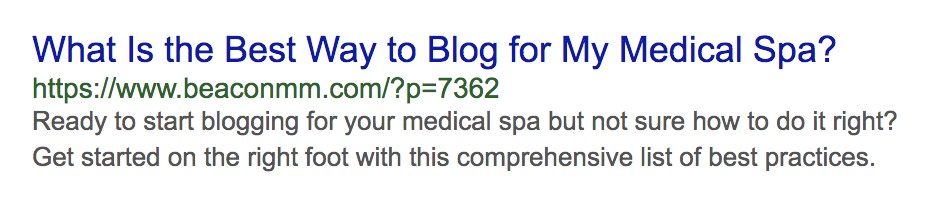
Metadata, also known as meta descriptions, refers to the snippet of information that represents your webpage on search engines. Typically, it includes a short heading and an excerpt that give a searcher a quick overview of the content within to help them decide whether to click or not.

Meta Description example for SEO optimizing blogs

If you don’t fill it out, Google will usually just pull the headline and first few lines of text from your article. However, optimizing your metadata is a sure-fire way to boost your SEO. It’s a great way to reinforce keywords, so make sure you include one in the heading and one in the article, because this will ensure the algorithm recognizes what your article is about. It also provides an opportunity to make most of the space you’re given to ensure your webpage or post sounds absolutely irresistible.

Read more: Do Google Ads work for marketing your business?

Images

Tip 5: Search engines can’t see images, so fill out the alt-text descriptions of pictures.

This is another really easy way to pump up your SEO, because search engines primarily analyze text. Every time you upload an image, there will be a box that pops up with space to add a title or caption, and most importantly, an alt-text description. Here’s an example of what that looks like.

Strong man photo illustrates SEO blog optimization

When you take the time to put descriptions in this space – especially descriptions that include your keywords – you give the search engine context, so it can understand the context of the image to the blog. That helps it sort and rank the image, which is another simple way to boost your ranking.

Other quick tips

Tip 6: Make sure your website is well-organized and fast-loading.

There is a lot of information available online about optimizing your site, so we won’t go into all of it here. However, once your webpage or blog post ranks on Google, and you capture the attention of passing internet users, it’s critical to ensure your website works well.

Once people click a link, you only have a few seconds to capture their interest. If all that precious time is spend waiting for your page to load, you can bet your bottom dollar they’ll click away and look elsewhere. Make sure the virtual nuts and bolts of your site are well-maintained and that everything is running as it should so that your page springs up and gives them the answers they need.

It’s also critical to ensure your template is responsive, meaning it can be viewed seamlessly on phones, tablets, laptops and desktop computers. Modern internet users won’t waste time zooming in and out to read all the tiny words on the page; again, they’ll click away and look elsewhere.

Ready to call in the professionals? Schedule a free consultation.

Originally published on July 5, 2016. Updated on May 13, 2020.

Wouldn’t it be great if generating leads online was as simple as building a shiny new website? Of course, a shiny new website helps. In fact, the first step to any successful online marketing campaign is to create a website, because it will form the foundation of the rest of your strategy. It ties in important elements like branding, content, search engine optimization (SEO), landing pages and calls to action into one tidy package, and all of these things will ultimately increase your chance of digital marketing success.

Once your website is live, you need to help people find it. This will allow you to start connecting with prospectives, giving them information, solving their problems and guiding them along the path to purchase until they decide to become a client or customer. Obviously, SEO is essential. It’s the practice of optimizing content – including web pages and blog posts – so it ranks on Google when people search for keywords and related terms.

Internet Live Stats estimates Google processed about 40,000 queries every second, or about 3.5 billion searches per year, in 2019. The top of the first results page is prime digital real estate, because it’s where most people will look to find answers to their questions. It can be a tremendous source of traffic, due to the daily search volume, as well as a great way to get qualified leads, because you already know people are interested in your solutions.

But what else can you try? As you might expect, SEO can be fiercely competitive, so it’s worth investing in a multi-pronged strategy to ensure you’ve covered all your bases.

Here are three options to help your message reach the right people:

Want to chat to a real person? Schedule a free consultation.

Blogs

Blogging may sound a little bit strange at first. How can a series of posts, published on your website, help people find you? They’re a slow-burn strategy, but they’re great for a number of reasons.

The first one is obviously SEO, because long-form blogs (1,000+ words) will inevitably include lots of long-tail keywords, which will boost your rankings. Google’s algorithm will also look favorably on the length because it will assume you’re an expert on the topic (which, obviously, you are). Often, individual blog posts will rank higher in search than your homepage because they lend themselves so naturally to SEO.

The second one is because it paves the way for you to get active on other platforms, like social media. Blogs on topical issues, industry issues, frequently asked questions and how-to guides that will help people solve common problems they’re facing are all incredibly clickable. This makes them perfect for grabbing attention in digital ads, because once the headline draws them in, they’ll click through to your website for answers.

Once someone has entered your digital ecosystem, you need to keep them there and gently nudge them along the path to purchase. That means your content has to be good: well written, well structured, and filled with valuable information that will genuinely help someone. This isn’t the time to try and sell. It’s like the first date in the customer-brand relationship where they’re just getting to know who you are and what you’re about.

For this reason, it’s important to include a strong call to action in every blog post in case they decide they like what they see and they choose to move forward with you and schedule a second.

Read more: What’s in a headline? How to write to get attention

Social media

Social media is a powerful tool to drive traffic to your website. When it’s done correctly, the people who visit your site will be qualified leads because they’ve found you by following links, ads or offers that have interested them.

Different platforms have different strengths. Facebook is a great way to reach a lot of people effectively. LinkedIn shines in a business-to-business (B2B) setting. Instagram is wonderful for anything visual, particularly if it’s helpful or inspiring. It’s a great way to connect with people directly, because you’re essentially delivering your messaging directly into their hands, which is a great way to drive traffic to your website away from SEO. No matter the platform, the secret to making this work is to engage, engage, engage. Follow other local businesses in your area and like their posts. Reply to comments promptly. Follow up individuals and ask them questions.

The key to attracting attention on your own page is to include snappy copy and a headline that immediately addresses a pain point. What’s really in the air you’re breathing at home? Need to keep your job site going this winter? Looking for a second opinion on a medical diagnosis? Do you look at a pastry and gain a pound? Remember to engage with people on a personal level and don’t waste their time. Make sure everything you post has actual value, whether that’s helpful information, a special offer, etc., and a link to your website.

To use the date analogy again, it’s like bringing roses and putting in the work to research a nice local restaurant. Your prospective will appreciate the effort and remember the positive interaction.

Read more: 10 tips for optimizing your social media presence

Digital ads

Digital ads are a great option to put your website in front of people who have a genuine interest in the types of things you’re selling. You can do this through social media and search engines – every major social media platform has an ad manager, while Google Ads has taken a monopoly on search. It’s a simple process to set up a new account (you’ll need a new one for each platform you plan to use) and get started.

Ad managers are incredibly sophisticated, allowing you to select specific demographics – for example, gender, age, location, interests – to ensure you’re targeting the sorts of people likely to want your products or services most. They’re based on a cost-per-click method that works on a bidding system, which can make digital advertising a very cost-effective way to promote your website and generate qualified leads.

Blogs are great fodder for digital ads. Just like social media, it’s best to use snappy, attention-grabbing copy that immediately addresses a pain point because chances are this will match the search term. It’s worth trying a couple of different blogs to see what kinds of posts generate the most traffic, and updating the ads regularly with fresh content to ensure you’re making every dollar work as hard for you as it can.

Ready to ignite your marketing strategy? Schedule a free consultation.

Originally published on March 6, 2017. Updated on May 12, 2020.

The statistics are undeniable – these days, consumers look to the web for information before making a decision on where to spend their hard-earned money. Every day, your prospective customers are reading Google reviews and Facebook recommendations to find the business that is going to help them solve a problem.

The key to success is search engine rankings. Optimizing your website for search means your content will appear higher and higher up Google results pages until you land on page one. As far as digital real estate goes, this is gold. It’s the virtual version of being in the right place at the right time and the returns can be huge.

Small things can make a big difference, so here are 10 tips to help boost your rankings.

Just want to ask the experts? Schedule a free consultation.

1. Create long-form content

The length of your content matters for many reasons. Google considers longer content more authoritative, probably because anyone who takes the time to write 1,000+ words about a topic is genuinely interested in educating others and being helpful rather than just selling things. Longer sections of text also naturally provide a lot more space for keywords and avoid the keyword stuffing that often comes with shorter posts. sInternet users and search patterns both focus on long-tail keywords (think full question instead of just strings of search terms), which fits in perfectly with long blogs and page texts since you are more likely to answer those queries.

Read more: 5 content marketing tips to improve your SEO

2. Be original

Being original may seem like a no-brainer, but you would be surprised how often plagiarism happens. Write your own content, people! No-one knows your business like you do, so capitalize on that and write from personal experience, share the ins and outs of the products and services you offer, answer questions that your customers frequently ask you, address concerns that commonly occur in your industry. Don’t be afraid to tackle tough issues. It’s a pretty safe bet that your competitors aren’t doing it, which leaves it wide open for you to step in and potentially increase your market share.

Read more: How to create a show-stopping SEO strategy

3. Get your facts straight

The internet is full of rumors and weird stories. Make sure you fact-check what you post, especially if you’re going to quote statistics on your website or in a blog. We recommend seeing if you can find the same fact on at least three independent sites (trust us: you’ll definitely find some interesting information when you start trying to collaborate facts and stories!). It’s a bit scary how often the same fact is quoted by multiple sites, but hard to trace to an original source. Other times, you may find the original factoid has been misquoted or misrepresented. Research is vital to authenticity, which leads to greater trust, which leads to customer loyalty.

Read more: 6 expert ways to SEO optimize your blog

4. Write interesting posts

The key to creating good content is to write things people actually want to read. That means writing for the readers, not just stringing streams of SEO-friendly keywords together, because Google is constantly tweaking its algorithms to improve the consumer experience. It wants to make sure quality content is available for its users, so when your webpages and blog posts cover topics people like, Google will rank them higher. Resources like Google Keyword Planner make it easy to see what terms people are searching and create a strategy accordingly.

Read more: Why the SEO blog will never die

5. Keep SEO in mind

That said, you never want to forget SEO. The magic of good content is that it will both help your customers and increase your website’s ranking. Weave the keywords into the content you are writing for the reader, and when you look at Google Keyword Planner, focus on the words with medium competition. This means that lots of people are searching for them, but your chances of ranking are better when the competition isn’t super-fierce. Remember, digital marketing is about using the right bait for the right readers, not casting a wide net in the hope of catching a bite like traditional marketing methods.

Ready to get started? Schedule a free consultation.
6. Focus on the visuals

Visuals are really important when it comes to building trust with readers, because prospective customers like to see who they’re doing business with. It’s also important when it comes to conveying information quickly. Video, in particular, has become increasingly popular as time-poor internet users look for alternative ways to consume content. After all, it’s much easier to hit play and listen than it is to read a lengthy article! Focusing on visuals will ensure your business looks up-to-date and ready to assist customers with their questions.

Read more: Why video marketing is so important

7. Answer questions

When we searching the internet, we are usually looking for an answer. The sweet spot for business owners and marketers is figuring out the questions. Remember Jeopardy? You have the answers; your customers have the questions. Your job when you are generating content is figuring out the most important issues to address. Here are some ways to make sure you are answering the right, real questions.

  • Talk to your sales people. What questions do they routinely answer during their meetings with clients?
  • Talk to your customer service staff. What persuades people to become clients?
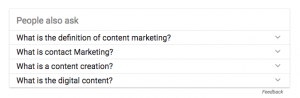
  • Type in a question to Google. What are people also asking?

Read more: What is StoryBrand marketing and how can it benefit my business?

8. Be helpful

When you are answering questions your customers and prospects want answers to, make sure you are useful and give them enough information to go on. Don’t be so vague that you aren’t saying anything at all. Many companies are afraid to give away too much information about what they do, and how they do it. However, that’s almost impossible. Obviously, you don’t reveal confidential data, but don’t be afraid to give insights into how you do what you do.

The other thing that’s worth noting is that people really don’t like to be teased. When they click on the link to your blog or web page, they want actual information. They do not want to click on the link and read a paragraph or two only to find out that you aren’t offering anything. We’re all familiar with this method: the teaser, followed by just enough to keep you on the line, but never really helpful information. Don’t be that company.

Read more: SEO is the top way to bring new people to your website

9. Use Case Studies

Accurate case studies are powerful tools when done correctly. They are an opportunity for you to highlight your product or service and how it impacted your client. The format usually goes something like this:

  • Challenge: Summary of why the client came to you and the problem they needed you to solve
  • Method: Explain your solution to the problem and the steps you took to implement it. Include a timeframe if possible.
  • Results: Include details and statistics whenever possible, describe how what you did was successful.
  • Call to action: Provide the reader with a way to contact you and some kind of action to take while they are excited about what they just read.

Read more: Read our case studies for an example of what works

10. Publish how-to guides

How-to blog posts are popular because it answers some of the most frequently-searched questions online: “How do I…” Start with the problems your business solves on a daily basis. How to ignite a pilot light? How to teach kids to brush their teeth? How to cure headaches? Then write a step-by-step guide.

Again, don’t worry about giving too much information. More often than not, if the person is a really into DIY, they’re going to learn a lot and have positive things to say to others about you. Word of mouth is an incredibly powerful marketing tool. However, if they see all the steps and feel overwhelmed, it’s also really likely they’ll give you a call. You’re an expert, after all, so you can easily help solve their problem.

Summary

There’s a lot of information here, we get it. While everything on this list will help, you don’t necessarily have to do it all. Start with one or two things, and make sure you do them consistently. For example, even just getting a solid stream of fresh content up on your site on a regular basis will help improve your website rankings.

Of course, you can also call the professionals. Schedule a free consultation.

Originally published on July 5, 2018. Updated on April 15, 2020.

We’ve all heard, at some point in our lives, someone tell us: “Words can’t hurt you!” Oh, but they absolutely can, my friend. Words can implode relationships, ruin careers, and even destroy a business.

There have been far too many stories online about the person who tweeted an insensitive joke and suddenly lost their whole career after a massive public outcry, or a business owner who responded to a negative Yelp review with angry curses and insults and soon found themselves without any customers.

Words DO matter, and in an online world you never know who is watching and reading. Just as words can break you down, they can also build you up and help you soar – okay, we’re getting a little too excited here.

Want to skip to the part where we help you? Schedule a free consultation today.

How to deal with bad online reviews

We know that many consumers read online reviews when they’re making a decision on what and where to buy. It can be easy for you, the business owner, to feel like you must do everything you can think of to keep customers from ever seeing negative reviews of your business, but don’t let that fear bring you down! Negative reviews may be scary or disheartening, but they don’t have to be the Mark of Death. I’ll tell you why in a minute.

Truthfully, if someone is looking up your business online and they see no negative reviews whatsoever, their first thought is likely going to be, “Ooooh I get it, they’re just deleting all the negative ones.” Modern consumers are smart and cynical, and they’ll absolutely judge you like a gang of junior high mean girls.

If they see a negative review and see that you’ve responded with name-calling, cursing, customer shaming, or outright out-of-control rage, it gets even worse. They will instantly want no part of whatever you’re selling. They’ll gladly take their business elsewhere to someone who has shown their ability to remain professional.

The truth is it’s possible to use bad reviews to your advantage.

How? We’re so glad you asked.

Read more: The evolution of marketing.

Make your online reviews work for you

1: Pay attention to social media.

Social media can be both good and bad. Don’t just focus on comments let on Yelp, Google and Facebook. Think of it like high school – if you only pay attention to the rumors they write on your locker, you’re going to miss out on all the great rumors they’re starting about you in the lunch room at that table where the cool kids sit.

If you’re not sure where else to look, we highly recommend using tools like Google Alert to find out when your business is being talked about online. This will send you emails when a news site, a blog, or any public page mentions your product and service. You can gain so much valuable information by keeping an eye on all of the online spaces where your business might be a topic of discussion. It might even give you new ideas!

2: Remember that it isn’t personal.

We’ll say it louder for the people in the back: THIS IS NOT PERSONAL. PEOPLE LIKE YOU. YOU ARE GREAT. YOU ARE A FIRECRACKER AND NO ONE CAN DOUSE YOUR MAJESTIC FLAMING – okay, sorry, we’re getting too excited again. Ahem. Seriously, people are going to talk about businesses, about products, about the service they received, the thing they ordered, and so on.

Yes, sometimes what they say will be negative. Sometimes it’ll be angry, or disappointed, or insulting. Yes, those words can hurt like a knife in the heart. A knife covered in lemon juice. That is also on fire. We feel you. We’ve all been there, we all understand that flaming lemon-knife in the heart. But please, whatever you do, don’t react in anger. Don’t let emotion write your words, because you can’t take them back.

Read more: Why it’s important for CEOs to connect on social.

3: Respond promptly, personally, and calmly.

When you’re calm, remember that many times customers can and do have a very legitimate complaint. Take your time to read the comment and think about what’s been said before you reply. Have a cup of tea. Put on some sitar music. There, feel better? Also, always keep in mind that Facebook will track business response times and display that as a badge on your page, so try to respond within an hour if you are able. This is your chance to do two things:

First, respond personally and start by acknowledging the person and their complaint (instead of a copy-and-paste canned response, which is like a neon sign saying “THIS BUSINESS REALLY DOESN’T CARE AND JUST WANTS YOU TO GO AWAY”). This will show your customers, and potential customers, that you listen and pay attention to their needs. Don’t build a fort out of sofa cushions and pretend you didn’t read it.

Second, make sure your response is calm and clear. Showing everyone online that you’re cool, professional, and respectful under tough circumstances can drive customer confidence through the roof. Your words on a public page are showing the customers who you are as a business owner, which builds trust. Figure out what the issue is and decide what you, or an appropriate employee, can do to resolve it. Let the customer know this, and give them an estimate of how long it will take to resolve it or to hear back from you.

IMPORTANT DISCLAIMER: In some cases, it is okay to hide or delete a complaint, such as when the complainer is using vulgarities or the complaint is not based on a product or service but is instead an attack against you or your business. On Facebook, it is easy to remove complaints. On Yelp, there are certain rules for which complaints you can remove and which you cannot. If you’re not sure, contact the platform to ask for help.

4: Show the customer that you care.

If the complaint arose because of a mistake, acknowledge it. Sometimes, mistakes just happen – and by honestly addressing the issue, you will raise people’s respect for you. Do not fall into the trap of arguing in public, because it will do nothing but reflect badly on you. If it turns out that the customer was wrong, that can be addressed in private messages. In public, show the world your most professional, concerned, and responsible face. It’s not always easy, but it will benefit you in the long run. Also, we strongly recommend against using free products to try to make the customer go away, because this habit absolutely will be abused.

Read more: Rise of the idealistic marketer.

5: Get the conversation away from the public eye.

Once you’ve publicly acknowledged the customer, offer to private message them, or talk about the resolution via email or by phone. In today’s world, the longer you try to converse in a public forum the more time there will be for trolls and troublemakers to jump in and try to start conflict. Let the customer know you heard their concern, publicly acknowledge that you are aware and working on a resolution, and then get it out of the public eye ASAP.

6: Follow through.

Responding and acknowledging is great, but that alone won’t solve the initial customer issue. It’s like staring intently at a pile of laundry on a chair, hoping it will become clean (oh man, it would be great if that actually worked!). You need to follow up with the customer to be sure that their issue was resolved satisfactorily. This assures the customer that your concern is sincere and that you value their business, and it also gives you an opportunity to get feedback that can help you develop your products or services in the future.

Of course, we can’t make everybody happy all of the time, but you and your business will only benefit if you take the time to make your customers feel heard, valued, and important. The more professionally you handle issues like negative reviews, the more you can demonstrate your caring, the more likely a customer is to return to you in the future, and recommend you to friends and associates. Word of mouth is still the best advertising you can ever hope to have, and a little effort on your part to protect your relationships with customers is priceless.

Want to turn your online reviews around? Schedule a free consultation today.

Originally published on November 27, 2015. Updated on February 6, 2020.

We wish we had a dollar for every time a client told us: “I don’t shop in the ad section when I shop on-line”, or “I just scroll right past the ads”. Seriously.

Google.com is the most popular website in the world. It’s been estimated that it handles as many as 7 billion searches a day, while a survey conducted in 2019 revealed that as many as 63% of internet users would click on Google ads. It’s no surprise, then that Google Ads (formerly known as Google Adwords) brings in as much as $100 million a day in revenue.

Let’s put it another way: Google reports that advertisers make $8 for every $1 they spend. Trust us when we say it can be a very powerful lead-generation tool for your business.

What Do Google Ads Look Like?

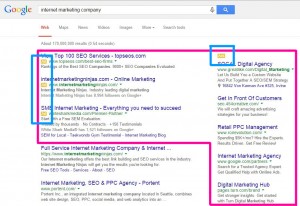
Before we go any further, it’s important that you understand what Google Ads look like and where they appear. Here’s a visual that shows you were the advertising places normally sit:

sem

The highlighted area is the paid ads on Google. Yes, other search engines offer advertising (including Bing and Yahoo), but since more than 90% of global internet searches are conducted through Google, we recommend focusing your efforts here.

It’s based on a bidding system, which basically means you can select the maximum amount you’re willing to pay for someone to click, see or engage with your advertisement. This means you can design a strategy according to your budget – but remember, the more you bid, the better your placement.

The good news is that you can dial it to specifically target your ideal customers – for example, people in your local area, people in a particular income bracket, and people with specific search interests.

This means it’s much more focused than traditional advertising methods, because you’re only talking to people who are likely to be interested in the products or services your business has to offer.

It’s also much easier to track their success, so you know whether they’re working or not. The best way to do that is by signing up for Google Analytics (you can learn more about that here), because this will show you who is clicking on your ads so you can refine them until you’re hitting the right target.

Designing A Google Ads Campaign

Balancing Organic Search and Paid Search

There are two ways Google can help generate leads for your business: organic search and paid search. Organic search is implemented through a process called Search Engine Optimization (commonly referred to as SEO). This post is going to focus on paid search, but if you’re interested in learning more about how you can use SEO to optimize your website, check out these blog posts:

It’s important to strike a balance between the two. Studies show when you place high organically as well as have effective ads you actually increase your click rate to your ads by 40-65%. In today’s world, that means they work hand-in-hand to help grow your business.

Google Ads Fundamentals

Here are seven essential tips to remember when setting up a Google Ads campaign:

1. Define clear goals.

The point of almost every campaign is to generate leads and grow sales, not to promote brand awareness. That means you need to be really specific in defining your desired outcome. For example, is your goal to have people fill out an online form? Call you? Make an appointment? Purchase one of your products? This will help you set up your ads so that they work as effectively as possible to achieve this outcome.

2. Keep your target audience in mind.

One simple way to do this is to use the marketing principle of AIDAS:  Attract, Interest, Desire, Action, Satisfaction. Basically, what this means is that you need to “attract” the searcher based on the search terms, raise their “interest” by offering a special, you need to convince them they “desire” your product, include a call to “action”, and then make sure to provide “satisfaction” when they choose your website. This is a really helpful framework when it comes to choosing the exact wording you’ll use.

3. Use specific keywords.

Keywords are the search terms people will use when they’re looking for a particular product or service. It’s important to be specific, because anything too broad will drown amongst all of the other suppliers – for example, if you’re looking to boost the duct-cleaning arm of your HVAC business, “Duct cleaning services” will be more effective than “HVAC services”. The other important keyword is to include your location, because this will generate quality leads. For example, “Lake Tahoe tandem bike rental” will do better than “tandem bike rental”. Using the right keywords will get the most from your investment.

4. Have a great landing page.

Website design has never been more important. Think of it as your best salesperson – in order to convert a successful sale, you need to make the right impression from the start. A “landing page” simply means the page your potential customers will see when they click through the ad, which serves two purposes: to give them the information they’re looking for and to help you track the success of your campaign. It needs to deliver on customers’ expectation – for example, if your advertisement featured emergency dental services or custom-build machinery, you need to provide that information upfront. If your website has brought in a new customer, they don’t owe you anything. They’re not going to put in any effort to find the right page. You need to make it easy for them.

5. Think about mobile audiences.

Google has reported that over 50% of the world’s searches will be done from some sort of mobile device, so make sure you factor this in when you’re designing your ad. Use a strong call to action in your ads like “Click to call today for 10% off”, make sure your contact details are easy to find, and ensure your landing page is optimized for mobile to give them a great user experience and increase your conversion rate.

6. Always do A/B testing.

When setting up your goal for your Google Ads campaign, make sure that you create multiple variations for your ads and then monitor their results, revise them, and then test them again! One word or tag line can make a huge difference in your ads. Running a few experiments early will help you get the hang of them and find out what works best for your intended audience. By doing the testing you will find which ones provide the best click rate, lowest cost per click, and also the highest conversion rate, which will make a big difference over time.

7. Monitor and tweak them as you go. Don’t forget about your ads! Checking in regularly will make sure your message is always optimized with the best keywords, because you’ll be able to tell who is clicking, from where, and what else they’re viewing on your website to identify future advertising opportunities. (If you’re not sure what metrics you should be tracking, you can check out this blog post we prepared earlier.) By knowing what works and doesn’t work, you will be able to run a successful Google Ads campaign, increase the number of leads you generate, and ultimately convert sales.

Still have questions? We’d love to talk to you about how Google Ads can help your business. Feel free to call us on 907-563-6008 or send us an email.

You may have heard that blogging is important to growing your business, and it is. Here, we are going to cover some of the reasons why it is a useful tool for marketing in the Arctic Tourism sector and give some tips and tricks on how to do it best.

The main thing to remember about blogging is this,

Consistency is key.

Why should I put in the time to blog about arctic tourism?

If you want to see results you’re going to have to commit to regularly providing quality content to people. If you don’t persevere with it, then the work you do put in will be wasted. How will you know if you’ve succeeded? Most people never look beyond the first page of Google with one study finding that only 0.78% of searchers clicked on something on the second page of Google. Clearly then, it is necessary to get on that first page, and ideally at the top of it. But how? In this post, we’re going to cover some of the methods used by our expert marketers to get our clients on the top of the Google search rankings.

Hopefully, we’ve convinced you that getting on the top page of Google is important, but why is it specifically important for arctic tourism? Tourism is one of the few growing industries in Alaska, according to a 2016 report. This is partly the result of a lessening of the severity of the climate (the arctic is warming twice as fast as the rest of the world) and so-called “last chance tourism.” As more people start to look north for their next vacation, it’s time to position your arctic tourism business right in their eye-line, at the top of their search results.

Case Study: The Beacon Blogs

If you’re not yet convinced, let us take some time to show you we know what we’re talking about.

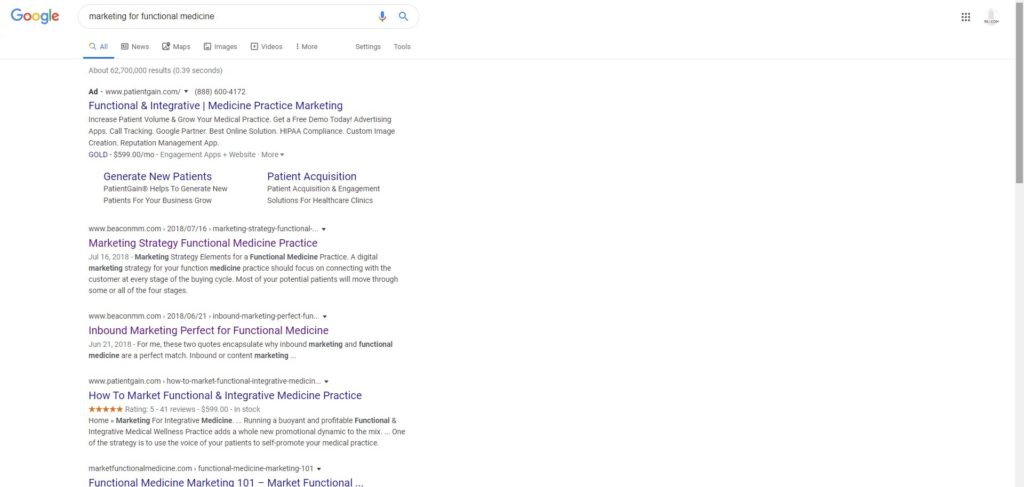
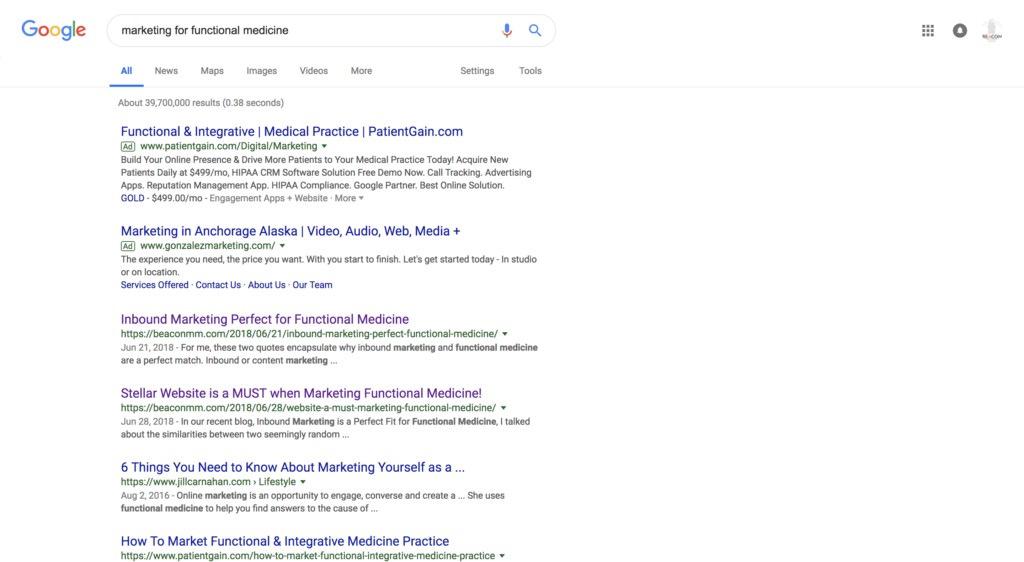
Two years ago we decided we wanted to move into the functional medicine industry, so, we started blogging about it. We wrote blogs about each of our services, heavily targeting the keyword “functional medicine”. Within a few months we had our blog posts ranking at both #1 and #2 on Google for the search “marketing for functional medicine”, and we’re still there. So, how did we do it?

We used a few simple tricks of the trade that you can also use on your own arctic tourism blogs. First, we wrote blogs of the specific length that works best for Search Engine Optimization (SEO), which we’ll discuss in more detail in a bit. Next, we had a focused keyword strategy. This involves writing certain keywords that you want to target in your text and headings. For the functional medicine blogs, these included “functional medicine,” “marketing,” “inbound marketing.” Finally, we ensured our posts were technically well optimized, they work on mobile, are fast-loading, and we’ve set the metadata. Metadata just means the information you provide Google about the contents of your blog so they can determine how relevant it is to searchers.

Although we ranked these two blog posts at the top of Google, that was only part of the goal. The main objective of this was to generate leads. By having these blogs at the top of Google, we generate more leads to our website which converts into more sales. These two blogs now constitute a key part of our sales funnel!

Case Study: The Mandanas Dental Blog

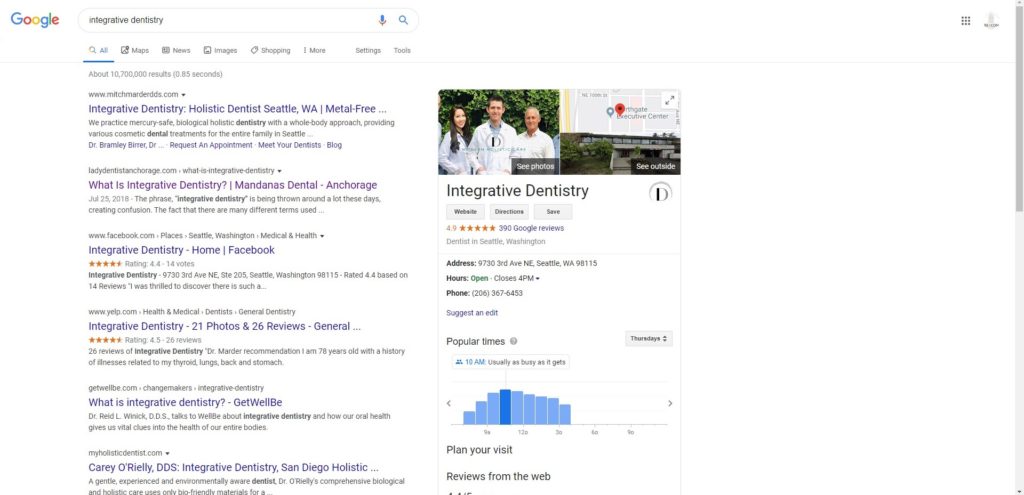
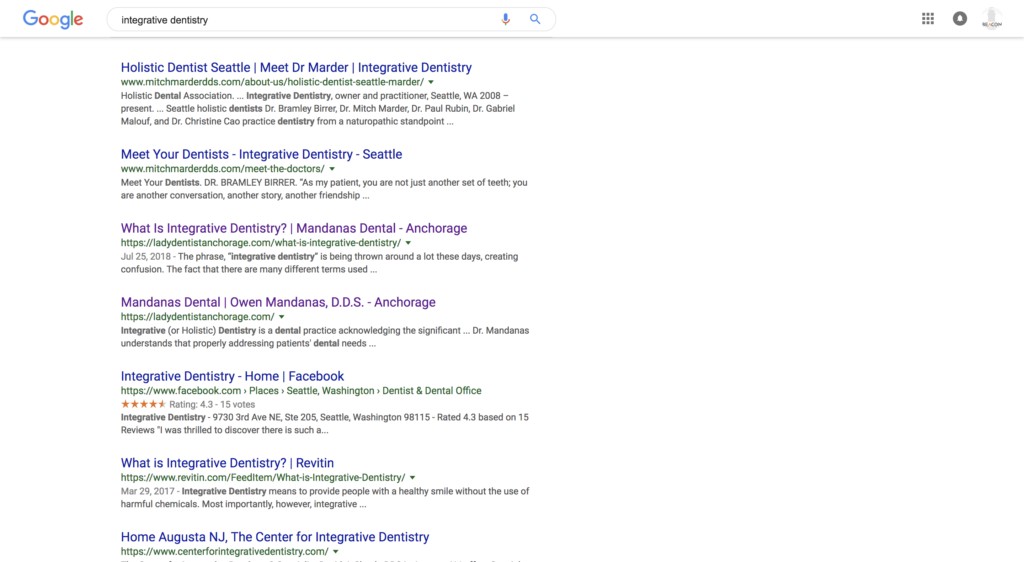
These techniques are not something we just keep for ourselves either! We’ve also used these strategies to help our clients find success. One of our longest-standing clients, Dr. Mandanas decided a few years ago that she wanted to start focusing on integrative dentistry. So we started blogging on the subject. Using the same techniques as for Beacon, we managed to rank Dr. Mandanas on the first page of Google. We were very happy to be able to achieve this for a valued client in a short time-frame.

This approach to blog writing uses the inbound marketing philosophy, which we’ll discuss in the next section.

Proven methods of blog marketing

In this section, we’ll discuss some proven methods for writing successful blogs, including the inbound philosophy, question answering, and the waterfall method. These are all techniques you can use in blogging for your arctic tourism business.

Inbound philosophy

The inbound marketing philosophy is a simple concept. People are online all day, every day–this means that putting quality content in front of them is easier than ever. The core tenet of the inbound philosophy is that if you consistently provide useful content to people, they will remember you and seek you out when they need your services. Imagine your customers are a cat. If you chase the cat it will run away from you, but if you have what the cat wants, it will come to you!

So, how do you go about enticing the cat? Begin by researching what your customers are interested in. There are tools available to help you find out what searches people are making on Google, we use one called Keywordtool.io. Once you’ve identified what people want to know, you can write blogs on it. People typically ask questions on Google, so answering these can be an effective way to provide quality content.

Answering Questions

We’ve established that people use Google to ask questions, so it’s super effective to answer them. If you’re the one people can rely on when they want to know something, they’ll remember you when they want to buy something. Here’s a quick rundown of our process for blog writing:

  • Keyword planning – We use Google’s own keyword planner to identify how many people are searching for certain things.
  • Finding questions – Next, we use Keywordtool.io to identify what questions people are asking about those topics.
  • Writing – The next step is the most obvious, write a blog answering that question!
  • Setting the metadata – We’ve mentioned this before, it’s basically the process of setting the title, description, and keywords in a format that Google can use to populate your result.
  • Schedule – It’s important to be consistent if you want the best results. We recommend to our clients that they blog at least 1-2 times per week, but even with a minimum strategy, you can see results in 6-9 months.

The Waterfall Method

The waterfall method of blogging is a highly successful, and slightly sneaky, trick for getting your posts to rank on Google! Google highly rates backlinks; that is, other credible websites linking to your blog. Links of this king act a bit like a referral, the website is letting Google know your post is reputable by sending people there. But it can be difficult to get links from other websites. So, we do what is called backlinking. This involves using your own website to provide links! A common way of organizing this, which you can use successfully for your arctic tourism business, is called the waterfall method.

Here’s an example of a waterfall we created for our mental health blogs:

As you can see, this looks a bit like a descending waterfall, with multiple layers all linked to one another (and to this blog too!).

Search Engine Optimization for blog marketing

Search Engine Optimization (SEO) can sound intimidating but really it’s a simple concept. SEO refers to the tools used to maximize your chances of getting highly ranked on Google. We make sure to set keywords that we know people are searching for. These are spread throughout the text and headers of the blog, as well as the URL of the page. It also means picking a title that is the perfect length, with certain power words that are shown to gain more clicks.

We hope this blog has given you an insight into how blogging can be a powerful tool for marketing your arctic tourism business. If you feel that you want to make use of our expert marketers for your business, you can schedule a free consultation. If you just want to get some more information, you can get in touch using our contact form. Thanks for reading, we hope to hear from you soon!

“The biggest mistake I see, is that people tend to give up…SEO (blogging) is a lifestyle, it’s a practice, it’s not a transaction…You just gotta keep going, you’re building your castle, you’re building your moat, it’s going to take time.”

– Sarah Bird, CEO of Moz

Ready to start blogging for your medical spa but not sure how to do it right?

Producing “content for content’s sake” is never a good idea.

It is better to start off on the right foot and blog well than to blog at all.

We have put together a comprehensive list of our best 1) reasons to blog, 2) philosophies of blogging, and 3) practices for blogging right.

So buckle up and enjoy the journey that is great blogging with us!

“The Why” Behind Blogging for Your Medical Spa

Why should you be blogging for your medical spa in the first place?

To state it simply: good blogging works.

Take a look at these case studies to see what we mean.

Case Study: Beacon Blog

In 2018, we (Beacon) decided that we enjoyed working with clients in the functional medicine industry, and that we would like to work with more.

What did we do to bring in more functional medicine clients?

We started blogging!

We addressed topics like social media marketing, website design, and other services from the perspective of a functional medicine practice.

In a matter of months, our blogs were ranking in the first two spots on the Google results page for the search, “marketing for functional medicine:”

Should I Blog for My Orthodontics Practice?

These blogs translate to many functional medicine sales leads for us!

Using tracking software, we are able to see how internet users come in through our blogs then make a step toward working with us by either filling out one of our contact forms or chatting with us through our chatbot.

Blogging can help you achieve very specific goals for your medical spa.

Case Study: Mandanas Dental Blog

In 2017, our client Mandanas Dental decided that she wanted to pursue integrative dentistry.

We were ecstatic!

Although general dentistry is a very competitive market in her location, integrative dentistry had yet to take much root in the area or online.

We got to work, blogging on popular topics and questions surrounding the integrative dentistry industry.

Once again, we were able to see results (first page of Google) within a matter of months:

Should I Blog for My Orthodontics Practice?

In two years, we have 100x-ed her traffic, from just under 60 visitors per month to well over 6,000.

Dr. Mandanas’s schedule is booked at maximum capacity pretty much all year long.

Blogging can help you take your medical spa in a new direction or solidify your presence in a particular market.

3 Proven Blogging Philosophies for Your Medical Spa

How do you make this blogging magic work for your medical spa?

There are a few things you should understand about why great blogging works the way it does before we dive into best practices.

Take a look at some of the top, time-tested blogging philosophies below.

1. The Inbound Blogging Method

Blogging is just one facet of a comprehensive marketing philosophy called “inbound marketing.”

The principle behind inbound marketing sounds something like this:

If you put yourself where people spend their time and provide value to them on their own terms, they will start coming to you (inbound).

Let’s break down this working definition for better understanding.

“…where people spend their time…”

Where do people spend most of their time today?

Easy answer: the internet.

Google is the most popular search engine in the world, accounting for 3.5 billion of our internet searches every day.

We spend our time online, and we do it on Google.

Let’s take a look at the next major point in our working definition.

“…provide value to them on their own terms…”

What is valuable to the people who are on Google?

Finding the online resources they are looking for.

Many Google searches come in the form of a question.

Although there are many ways to do great inbound marketing, of the best is to answer popular questions with helpful, comprehensive blogs.

In fact, this is another one of our best blogging philosophies!

2. Answer Questions for Medical Spa Prospects

How do you know what your medical spa prospects are asking?

You do your research.

A great tool for finding popular searcher questions is Answer the Public.

Using this tool, you can enter a topic like, “Botox” and receive a list of all the top questions searched by internet users.

Take a look:

What Is the Best Way to Blog for My Medical Spa?

This list may be a little hard to read, zoomed out as far as it is so you can see the whole thing, but it includes questions like:

  • Where can Botox be injected?
  • What does Botox do to your skin?
  • Can Botox be reversed?

Do you have answers to these questions? Great! You have the content you need for a great blog for your medical spa.

Let’s discuss one, final, important blogging philosophy before we get into more technical best practices.

3. Waterfall Blogging for Medical Spas

This is probably the most important piece of advice we can give you in this entire blog today…

Waterfall your blog.

What on earth does that mean?

It means create a structure with your blogs that makes it easy for internet users and Google to “flow” through them and understand what they are all about.

It is the practice of writing blogs for each of your services and linking them together as they relate to one another.

Waterfall blogging also goes by another name, “content clustering.”

Let’s consider an example.

Here is what the waterfall blog/content cluster that YOU ARE CURRENTLY IN looks like:

In a good waterfall blogging strategy, we take all of these sub-blogs that talk about the various aspects of digital marketing and we link them back to the main, digital marketing blog in the text where they are discussed.

If you visit the main “digital marketing for medical spas” blog and look for headers/hyperlinks that pertain to the sub-topics listed, you will see what we are talking about.

We may also link some of the sub-blogs to each other if the topics cross over.

This tells Google that these blogs are related, boosting their authority and rank.

It gives users an easy navigation path for more reading.

But enough with blogging philosophies–lets dig into the practical steps you can take to make this work for your medical spa.

Best Practices for Medical Spa Blogging

At first, you might think that great blogging boils down to “finding your voice” and writing in an engaging style.

You would be sorely mistaken.

Although style is important, arguably more important is making sure you have all of your technical blogging ducks in a row.

Getting the technical aspects of blogging right is what will get your blogs to rank.

If your blogs do not rank, no one will get to read your writing in the first place, no matter how eloquent.

Practice I: Choose Niche Blog Topics in the Medical Spa Industry

What was the common thread between the two case studies we mentioned at the beginning of this blog?

A niche.

For Beacon, we did not write about “digital marketing,” but “digital marketing for functional medicine.”

For Mandanas, we did not write about “dentistry,” but “integrative dentistry.”

There is a big difference.

The first terms are very general–in searches, they pull up results for these services across the nation and around the world.

You do not want to be competing with the nation, much less the world. You will not succeed.

By narrowing our topics down to a particular niche–like an industry, a location, or an approach–we have a better chance of making the first page of Google.

Find the niche that is most relevant to your medical spa and use it!

Practice II: Make Use of Blog Header Technology

In most content management systems (CMS), which is the software system you use to publish blogs to your website, you have the option to classify headers as “H1,” “H2,” “H3,” etc.

For example, “Practice II: Make Use of Blog Header Technology” is classified as a “Heading 3” tag.

These tags help Google know what your blog is about and how it is organized, boosting your rank–so use them!

Your title is automatically classified as “H1,” so make use of “H2” and “H3” tags as you write.

Another technology you should be using when writing your title and headers is CoSchedule’s Headline Analyzer.

This tool will tell you how your headline’s score against successful headlines across the internet.

When writing your title, aim for a score at or above 70 in this helpful software.

Practice III: Write Keyword Optimized Blog Content

We haven’t talked about it directly yet, but many of these best practices are important for the search engine optimization (SEO) of your blogs.

Search engine optimization (SEO) is formatting your blog in the best possible way for Google to crawl, assess the authority of, and rank.

A big, big part of optimizing your blog is selecting the keyword or keywords for which you want to rank.

For instance, if you were answering the question, “Where can Botox be injected?” your keywords would be “Botox” and possibly “injections.”

These keywords should be in your title, headers, metadata (which we will talk about next), and of course, the blog content.

If you are good about staying on-topic, the keywords you have chosen should flow naturally throughout your text.

If they do not, consider inserting them in places where they would make sense.

Having your keywords in all of these places reinforces what your blog is about to Google as well as to your readers.

Practice IV: Set Custom Blog Metadata

“Metadata” may look like a scary word but most content management systems make it very approachable.

Your system should have a form containing fields for you to set your blog title, URL, and description.

This is the information that populates on the Google results page:

What Is the Best Way to Blog for My Medical Spa?

There should also be a place to set a feature image for your blog and a location to enter your target keywords if you have SEO tools installed.

Do not leave this information up to the content management system to decide.

Set this data yourself to make sure it is accurate and looks great!

Practice V:  Develop a Consistent Blog Schedule

Last but not least, make a plan to blog regularly!

When you blog on a regular basis–once per month, twice per month, or once per week–you tell Google that you are relevant and happening, committed to writing content about your “cluster,” consistently.

You should plan on writing 400-600 words for a non-competitive topic space, 600-1,000 words for a moderately competitive topic space, and 1,500-2,000 for a very competitive topic space.

If you are following all of these best practices, you should see results in 6-9 months!

Many clients have seen results in as few as three.

Note: Don’t forget to include a call-to-action (CTA) at the end of your every blog! This is a statement that gives your visitors their next move, such as, “Are you interested in our services? Call us now at (123) 456-7890!” CTAs make working with you as easy and approachable as possible.

How do you feel?

That was a lot of information to cover in a short time!

We hope you feel equipped to launch the best blog in the medical spa industry.

If you do not have the time to put in the work or you would like more expert advice on blogging for the medical spa industry, you can schedule a consultation with us at no charge to you!

We would love to help you start seeing the results that great blogging can bring.

Originally published on January 19, 2016. Updated on May 30, 2019.

“Sticks and stones may break my bones, but words will never hurt me.”

That saying has been making the rounds on playgrounds for well over a century. It’s an adage that implies that words and insults can’t hurt whoever is the brunt of the comment.

If we’re being honest, it’s never really made any of us feel better, and that’s especially true in the age of digital marketing and social media. Words certainly can, and have, hurt plenty of companies over the years. Many people rely on social media reviews when they’re making purchasing decisions, so when they see a bad review that was handled poorly or ignored, they’re most likely not going to trust the company with their business.

Negative reviews aren’t all bad. Many companies have misguided fears and that result in an aversion to bad reviews, but that’s not the answer. It is impossible to make everyone happy, and if you’ve been in business for any length of time, you are going to have someone out there who is unhappy with something. Reasonable consumers understand this and will take it into consideration when scanning reviews. What do you do?

Take a bad review, handle it with respect and stellar customer service. Turn the situation around. You have the opportunity to mend any damage with the reviewer, build your reputation for making customers your top priority, and build trust with anyone that sees your response. Use negative reviews to your advantage!

Need help managing a marketing crisis? Schedule a free consultation today.

Bad reviews have been shown to improve conversion by 67%. If you handle them properly, having negative reviews can actually build trust with consumers.

Approach each negative review calmly

Make it a habit to check social media accounts for what people are saying about you. Don’t just rely on customers to post to your business page or to tag you, because many won’t. Choose a social media tool, such as Google Alert, that will tell you every time your name is mentioned on a blog, website, or in the news. There are other sites available that will also track social media sites for mentions as well.

Remember, it’s not you that the customer is upset with, it’s the situation. Take a few minutes to read through all of your reviews and mentions. Reply to the positive ones first. Then, when you’ve had a chance to process things, take a deep breath and go back to the negative ones. Facebook tracks business response times, displaying it as a badge on their pages, so try to reply within an hour of receiving a complaint.

Most importantly, never delete negative reviews. Customers want to know that you care about them and are reading what they have to say, discerning customers will notice an absence of negative reviews and may become suspicious – such is the nature of the Internet. Address each concern promptly, publicly and personally. (Of course, if they contain inappropriate language or are defamatory or otherwise offensive, then you should delete or report the comments. We definitely want you to be responsible social media users!)

“When you answer a negative review and address the upset customer, you are also speaking to the hundreds of other consumers that want to know how you conduct your business. Consumers understand that mistakes happen, so when they see a business trying to do the right thing, it builds trust.” ~ Phil Penton, President of Social Integrations.

Read more: Must-read tips to rocking your online reviews

Acknowledge the concern raised

Acknowledge the customer’s issue and let them know that it’s being looked into. Give them a sense of when and how they can expect a response. Don’t just copy and paste an automatic response to issues. Customers can spot those immediately, and they’ll feel as though they’ve been brushed aside. Keep your tone conversational, include their name, your position with the company (it gives you credibility), and mention their issue in your response.

Look into the issue and assign the appropriate person to handle it. Having an escalation plan for employees is helpful and will ensure more consistent customer service. The plan can tell staff who deals with various types of complaints, what can be done at each level to alleviate the issue, and who has the power to offer compensation.

Going the extra mile makes a big difference. People know that no business is perfect and that mistakes happen. Take ownership of what went wrong so that you recognize the problem and prevent further blame from being thrown at you. Owning the issue will allow you to focus on finding a solution instead of stemming a flood of anger.

It is vital to make sure to keep your tone conversational and natural and come across as genuine. It takes time to build trust with a customer but only seconds to lose it. Empathy and honesty (without blaming the customer) can fix almost every situation. You don’t have to have the answers, but you need to be willing to find them.

Read more: The future of marketing

Take your response offline

Don’t rely on free products and services to fix problems raised in negative reviews. You’ll find your policy will be abused if this is your first line of defense. Helping them find an answer or fixing the original problem should be your default action. Offering coupons, vouchers, or replacements can go a long way toward earning you a second chance. Follow up by encouraging the client to update their review if their second experience is better.

After your initial response to a complaint, see if you can take further conversations out of the public eye. This will give you a chance to work with the customer one on one, be more personal, and avoid other commenters from dog piling on top of you. Private messages, email, or even a phone call are ideal ways to continue the conversation.

Finally, always follow up.

Don’t assume that an issue is resolved just because you responded to it. Follow up with the customer to make sure that they’re satisfied. Taking the extra time to touch base is a personal touch that lets them know that you really do care about them and their relationship with you in the future. It also provides you with an opportunity to gain some feedback about your processes and make changes to prevent future hiccups.

You can’t make everyone happy all of the time, but you can be honest and open with your customers and you can make them feel valued. If you take the time to make amends with customers who have had a negative experience, then you’re more likely to get their business again, and they’re also more likely to recommend you to others.

Let’s develop a strategy to improve your online reviews. Schedule a free consultation!

“The biggest mistake I see, is that people tend to give up…SEO (blogging) is a lifestyle, it’s a practice, it’s not a transaction…You just gotta keep going, you’re building your castle, you’re building your moat, it’s going to take time.”

– Sarah Bird, CEO of Moz


Publishing a blog may be the biggest thing you do for your Reno business this year.

No, really.

Blogs are cash cows when done right.

A lot of our clients go for the “quick fix”–the “easy money” and fast results achieved by paid advertising.

There is nothing wrong with that. In fact, we encourage it!

But a well-crafted blog–one that has “made it” on the first page of Google–is there to stay.

We’re talking no additional ad spend, just results–Reno internet users pouring into your website through a top-ranking blog and converting to leads.

At least, that is what we have seen in our marketing for our clients and ourselves!

Find out more about what we are seeing in the blogosphere, how we make it work, and the proven blogging strategy behind the curtains.

Warning: It may take some time and intentionality to get this down.

Why Publish a Blog for Your Reno Business?

Great question. Let’s start where we always do at Beacon: the results.

Case Study: Beacon Blog

Last year, our team came up with a plan to work with more functional medicine clients in the future.

We started a blog on digital marketing for the functional medicine industry.

Our writers began covering topics like social media, website design, and more, using “functional medicine” as a keyword in all of our blogs.

Just months later, we were ranking in the first two spots on Google for the phrase, “marketing for functional medicine:”

Should I Blog for My Orthodontics Practice?

This was not a mere coincidence.

In all of our blogs, we were intentionally placing the keywords “functional medicine” and “marketing” (or “web design,” etc.) in key places for search engine optimization (SEO), such as the title, H tags, and metadata.

We will talk about SEO in a moment.

The point is, these blogs bring in many of our functional medicine sales leads.

Through tracking software, we are able to see the exact blog URLs that internet users clicked before they reached out to us.

I cannot tell you the number of times we have had clients work with us after first discovering us through one of our blogs.

These blogs are a key part of our sales funnel.

Case Study: Mandanas Dental Blog

Two years ago, a local dental client of ours pivoted her practice to focus on integrative dentistry.

It had been challenging to rank for general dentistry terms in a competitive market up to that point.

With the new niche, we were able to rank her practice on the first page of Google for her industry:

Should I Blog for My Orthodontics Practice?

Whenever we get the opportunity to implement blogging strategies like these for our Reno clients, we are all for it.

We have seen the success of blog marketing and we want to share it with you!

How to Make Blogging for Your Reno Business Work

Let’s peel back the curtain on this proven process.

The Inbound Strategy of Blogging

Another popular term for digital marketing is “inbound marketing.”

The core tenant of inbound marketing is this concept:

If you go where people are and provide value to them on their terms, they will come to you.

Take a few moments to think about where you and most of your friends spend your time.

We’re not talking about work, home, or school.

It’s the digital age, and most of us spend more time absent on Facebook, Google, and other online services than present in any particular building.

Pretty much every moment of every day we are either acting on our last Google search or thinking about the next time we can check Facebook.

What does that mean for Reno businesses looking to enter the blogosphere?

It means that if we want to get in front of new customers, we have to be where our customers are.

And it isn’t enough to simply “be there,” we also need to provide value in those places.

The Power of Answering Reno Residents

How do we provide value?

Google is a search engine, so we answer searches–questions!

What kind of questions are your Reno customers asking?

If you are in the restaurant industry, maybe it is something like, “What are the best restaurants in Reno?”

How awesome would it be to rank a blog among these first several organic results?

At Beacon, we use a fantastic tool called Answer the Public to discover what people are asking about a particular topic.

The way people phrase a given question in search is often the exact title we give our blog.

Key Tactics for Blogging in Reno

Now that we have the inbound philosophy down, let’s give you the technical requirements for ranking a blog on the first page of Google in Reno.

Blog Topic – Must be Reno Relevant!

Remember the case studies we mentioned at the beginning of this blog, how they each required a niche to be successful?

In order to rank a Reno blog on Google, you are going to need to write on something more specific than just “x services.”

Instead, consider “x services in Reno” or “x services done x way,” like “integrative dentistry.”

Why does this matter? Competition.

General terms and phrases are more competitive than specific ones, because there is a broader range of businesses publishing content about those topics.

Niching your blog topic can mean the difference between competing with 100 million other blogs and 1 million.

Specificity matters.

Blog Headlines

There are three kinds of headlines that you need to worry about in a search engine optimized blog, the title (H1), subtitles (H2), and those subtitles, subtitles (H3).

H tags (H1, H2, H3) may come across as confusing, but really they are just designations you can set in any blogging software worth its weight.

For example, “Blog Headlines” at the top of this section was set as an H3 tag in our WordPress editor.

All three of these headlines should include your keywords throughout your blog for SEO.

It is especially important that your Reno blog title contains all of the keywords you are using.

That said, it shouldn’t read clunky.

At Beacon, we use CoSchedule’s Headline Analyzer to score our headlines, taking advantage of their algorithm of successful headlines across the internet.

You will want to shoot for a score at or above 70.

Blog Content

When most people start thinking about blogging, they get an idealized picture in their mind of perfecting their brand’s voice and writing show-stopping content.

Style is only a small part of the equation.

It is true that your content should be free of common spelling errors and grammatical mistakes–It also should be engaging enough to draw your customer in for the sale after the click.

That in mind, one of the most important parts of blogging for business in Reno is keyword optimization.

This means that whatever your keywords are, they are incorporated naturally throughout the text in a way that tells Google you are staying on topic.

Keyword optimization is an important part of getting your Reno blogs in front of people (on the first page of Google) in the first place.

Write clearly, with authority and authenticity to keep people engaged…

…use keywords to impress Google.

Note: Every blog you write should have one important ingredient at the end–a call-to-action (CTA). A CTA is a request for a client to make a particular step forward based on the information they have just read. You want to convert from your blogs, don’t you? Then include a gentle call-to-action like, “If you are in Reno and interested in partnering with us on (x services), give us a call at (775) 123-4567.”

Blog Metadata

What is “metadata?”

No, you did not just step into a sci-fi novel.

Metadata is the information you provide Google alongside your blog, to let the search engine know what you are trying to rank for, and how your Reno blog should appear on the results page.

This information includes a title, description, URL, feature image, and the keywords you are targeting.

Many blog software solutions auto-populate some of this information, including WordPress, but good Reno bloggers are intentional about customizing their metadata.

At Beacon, we install an intuitive WordPress plugin called SEOPress that allows us to set our blog metadata with easy-to-use form fields.

Here is what the title and description look like on the Google results page:

The feature image is important for when you are sharing the blog on social media, and the keywords are for Google’s use in ranking your blog.

Blog Schedule

An important part of achieving rank for your Reno blog is publishing consistently.

This lets Google know you are an authoritative site in your topic area, and that you mean business.

The current recommendation in the industry is 1-2 times per week, however, this can be too overwhelming for some of our Reno clients.

At a strategy of as little as 1-2 times per month, you can see some growth over time.

Word count depends on how competitive your topic area is.

On the low end, you should be writing 400-600 words each time. On the high end, 1,600-2,000 words.

With a decent strategy, you should see results within 6-9 months’ time.

The Waterfall Method of Blogging in Reno

We’ve saved the best for last.

One of the most important parts of turning your Reno blog into a cash cow is backlinking.

Backlinking involves associating affiliated content for Google using hyperlinked keywords.

Let me explain.

We are currently writing an entire series of blogs on digital marketing in Reno that looks something like this:

Do you see how these blogs cascade into one another, much like a waterfall?

Do you also see how they are all in the same topic space, e.g., “our services in Reno?”

We tell Google that these blogs are related by linking to them using relevant keywords in the text.

So the blog “Digital Marketing” has links to “Branding,” “Website Design,” “Social Media,” and “Google Advertising” currently.

The trick is that these hyperlinks in the first blog land on the very keywords we are trying to target in the second blog!

A backlink is like a referral, it tells Google that the blog it is linking to does indeed know what it’s talking about, boosting the blog’s rank.

That is, so long as all of the blogs in the waterfall system are related!

~

If you want to see the kind of traffic we are achieving for some of our clients, it’s time to start blogging.

This blog should get you started on the right foot as you begin to dominate your topic area in Reno!

Interested in hiring Beacon to get your Reno blog going?

We would love to chat!

You can schedule a free consultation with our President Adrienne Wilkerson directly using our Acuity scheduler.