Originally published on November 27, 2015. Updated on February 6, 2020.
We wish we had a dollar for every time a client told us: “I don’t shop in the ad section when I shop on-line”, or “I just scroll right past the ads”. Seriously.
Google.com is the most popular website in the world. It’s been estimated that it handles as many as 7 billion searches a day, while a survey conducted in 2019 revealed that as many as 63% of internet users would click on Google ads. It’s no surprise, then that Google Ads (formerly known as Google Adwords) brings in as much as $100 million a day in revenue.
Let’s put it another way: Google reports that advertisers make $8 for every $1 they spend. Trust us when we say it can be a very powerful lead-generation tool for your business.
What Do Google Ads Look Like?
Before we go any further, it’s important that you understand what Google Ads look like and where they appear. Here’s a visual that shows you were the advertising places normally sit:
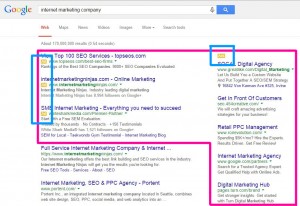
The highlighted area is the paid ads on Google. Yes, other search engines offer advertising (including Bing and Yahoo), but since more than 90% of global internet searches are conducted through Google, we recommend focusing your efforts here.
It’s based on a bidding system, which basically means you can select the maximum amount you’re willing to pay for someone to click, see or engage with your advertisement. This means you can design a strategy according to your budget – but remember, the more you bid, the better your placement.
The good news is that you can dial it to specifically target your ideal customers – for example, people in your local area, people in a particular income bracket, and people with specific search interests.
This means it’s much more focused than traditional advertising methods, because you’re only talking to people who are likely to be interested in the products or services your business has to offer.
It’s also much easier to track their success, so you know whether they’re working or not. The best way to do that is by signing up for Google Analytics (you can learn more about that here), because this will show you who is clicking on your ads so you can refine them until you’re hitting the right target.
Designing A Google Ads Campaign
Balancing Organic Search and Paid Search
There are two ways Google can help generate leads for your business: organic search and paid search. Organic search is implemented through a process called Search Engine Optimization (commonly referred to as SEO). This post is going to focus on paid search, but if you’re interested in learning more about how you can use SEO to optimize your website, check out these blog posts:
- 6 expert tips to SEO optimize your website
- Is the SEO blog dead? No. Here’s how they can help your business
- What’s in a headline? How to write to get attention
It’s important to strike a balance between the two. Studies show when you place high organically as well as have effective ads you actually increase your click rate to your ads by 40-65%. In today’s world, that means they work hand-in-hand to help grow your business.
Google Ads Fundamentals
Here are seven essential tips to remember when setting up a Google Ads campaign:
1. Define clear goals.
The point of almost every campaign is to generate leads and grow sales, not to promote brand awareness. That means you need to be really specific in defining your desired outcome. For example, is your goal to have people fill out an online form? Call you? Make an appointment? Purchase one of your products? This will help you set up your ads so that they work as effectively as possible to achieve this outcome.
2. Keep your target audience in mind.
One simple way to do this is to use the marketing principle of AIDAS: Attract, Interest, Desire, Action, Satisfaction. Basically, what this means is that you need to “attract” the searcher based on the search terms, raise their “interest” by offering a special, you need to convince them they “desire” your product, include a call to “action”, and then make sure to provide “satisfaction” when they choose your website. This is a really helpful framework when it comes to choosing the exact wording you’ll use.
3. Use specific keywords.
Keywords are the search terms people will use when they’re looking for a particular product or service. It’s important to be specific, because anything too broad will drown amongst all of the other suppliers – for example, if you’re looking to boost the duct-cleaning arm of your HVAC business, “Duct cleaning services” will be more effective than “HVAC services”. The other important keyword is to include your location, because this will generate quality leads. For example, “Lake Tahoe tandem bike rental” will do better than “tandem bike rental”. Using the right keywords will get the most from your investment.
4. Have a great landing page.
Website design has never been more important. Think of it as your best salesperson – in order to convert a successful sale, you need to make the right impression from the start. A “landing page” simply means the page your potential customers will see when they click through the ad, which serves two purposes: to give them the information they’re looking for and to help you track the success of your campaign. It needs to deliver on customers’ expectation – for example, if your advertisement featured emergency dental services or custom-build machinery, you need to provide that information upfront. If your website has brought in a new customer, they don’t owe you anything. They’re not going to put in any effort to find the right page. You need to make it easy for them.
5. Think about mobile audiences.
Google has reported that over 50% of the world’s searches will be done from some sort of mobile device, so make sure you factor this in when you’re designing your ad. Use a strong call to action in your ads like “Click to call today for 10% off”, make sure your contact details are easy to find, and ensure your landing page is optimized for mobile to give them a great user experience and increase your conversion rate.
6. Always do A/B testing.
When setting up your goal for your Google Ads campaign, make sure that you create multiple variations for your ads and then monitor their results, revise them, and then test them again! One word or tag line can make a huge difference in your ads. Running a few experiments early will help you get the hang of them and find out what works best for your intended audience. By doing the testing you will find which ones provide the best click rate, lowest cost per click, and also the highest conversion rate, which will make a big difference over time.
7. Monitor and tweak them as you go. Don’t forget about your ads! Checking in regularly will make sure your message is always optimized with the best keywords, because you’ll be able to tell who is clicking, from where, and what else they’re viewing on your website to identify future advertising opportunities. (If you’re not sure what metrics you should be tracking, you can check out this blog post we prepared earlier.) By knowing what works and doesn’t work, you will be able to run a successful Google Ads campaign, increase the number of leads you generate, and ultimately convert sales.
Still have questions? We’d love to talk to you about how Google Ads can help your business. Feel free to call us on 907-563-6008 or send us an email.