Sabrina Martinez

Chart The Waters

Explore insights on SEO, AI, and digital marketing strategies designed to help your business grow, stay visible, and adapt in a constantly evolving online landscape.
Beacon_Icon_resouse

No-one could have foreseen the closure of the tourism industry, but restrictions are lifting and consumers are eager for a change of scenery. Many businesses in this sector have experienced significant challenges, but it comes with an unprecedented opportunity to grow market share.

The industry has changed, big time, and every tourism business is starting from zero. Customers will be looking to travel differently than they did before. Local trips will be popular as the public emerges from isolation, as will experiences that provide genuine human connections.

It’s important to start working on your marketing plan now.

Yes, it’s still quiet, but tourism will rebound. You can bet your bottom dollar that as soon as each state gets an all-clear, every tourism office and every brand will be competing for guests. Marketing is the key to staking your claim in the “new normal” of tourism and protecting the future of your business.

Here, we’ll run you through the essentials you’ll need to be ready.

Want to skip ahead and ask the experts? Contact us and schedule a free consultation.

Embracing the new normal

Has anyone else found themselves strangely craving the airport? Just us?

Standing in long lines, removing your shoes for the TSA, drinking questionable airport coffee and racing to make the gate change on the other end of the terminal used to be annoying. They’re still annoying, but now they come with a dose of nostalgia. How easy it is to take things for granted!

Jet-setting is temporarily on hold, and it will continue to be that way for a while yet. That means there has never been a better opportunity for small businesses to market to their local communities. People will ease out of isolation gently, which means they’ll be looking to start with short, regional trips – for example, road trips, outdoor adventures, local lunches, that sort of thing.

If you live in a state that typically sees a high volume of international travelers, like Alaska or Nevada, it means you will have to adjust your strategy to appeal to a different target audience.

Who are your ideal customers in this new normal? What are their names? Where are they from? How old are they? What are their interests? Do they travel solo or as a couple or family?

It might sound strange, but creating a buyer persona will help you customize your marketing to ensure you’re sending exactly the right message to the right people. That’s the best thing about digital marketing – we can use customized bait instead of casting a wide net and hoping for a bite like traditional marketing methods.

Here’s an example. The way you market to Bill and Jean, a retired couple from Milwaukee aged in their 60s, will be very different to the way you market to Ben and Jessica, a professional couple from Los Angeles who will be traveling with their two young kids. Knowing the difference will help optimize your strategy.

Want to learn more? Click to read about best practice in digital marketing.

Tourism Marketing

Trading on genuine connections

Isolation is tricky, and while some people have thrived, most of us have found it to be incredibly challenging. You know it’s getting bad when shopping for groceries is the highlight of your week.

Once the tourism industry re-opens, people will be looking for genuine human connections. The days of racing from landmark to landmark, snapping a quick selfie at each site, are behind us – at least, for a little while. That means your strategy needs to have emotion at its core.

The best way to do this is through StoryBrand marketing. The driving thought is this: your customers don’t really care about your business (sorry!), but they do care about themselves. They want your business to solve a problem and make them feel better about something.

In this case, most is feeling lonely and unmotivated. They want to get to know new people and find inspiration. Inspiration is a powerful motivator. Rather than focusing on the features of each of your products or services, focus on the benefits. How will it make them feel if they choose you?

It doesn’t matter exactly what your business is. Stand-up paddle-boarding on Lake Tahoe? Inspiring. Fishing on the Kenai River? Inspiring. Shopping in Reno? Inspiring. Eating handmade chocolates in Homer, Alaska? Inspiring. The key is to find an inspiring angle to share with your customers.

Don’t be afraid to show your face. People like doing business with people, and if they feel like they know you, they’ll be more likely to work with you. If you’re passionate about what you do, whether that’s guided backcountry hikes or action-packed ATV tours, share it. It’s part of your story.

Once you’ve found the right angle to appeal to your target audience (remember Bill and Jean, and Ben and Jessica?), it’s time to develop a content marketing strategy. At a basic level, this includes three arms: SEO, social media and blogging. However, we strongly recommend adding video. If a picture tells a thousand words, a video shows a whole chapter. Adding this to your tool box will help people get to know you quickly, while creating an impression that will influence their purchase.

Now is not the tame to take a conservative approach. If you want to claim your part of the market share, you need to be strong, clear and consistent. This means posting regularly, developing a clear process by which customers will find you and engage with your business, and creating a consistent messaging theme and style that you will share across your website and social channels.

Want to ignite your content marketing strategy? Here’s how storytelling can help.

Tourism Marketing

Making the most of the news

The past few months have hammered home the fact that we need good information. Rules and restrictions are changing all the time, there’s been a lot of confusion about what is and isn’t allowed, and the status quo is constantly being updated. Keep this in mind when things re-open.

This is important for a few reasons, which we’ll break down below.

Stay up-to-date

Make sure the information on your website and social channels is up to date, such as your opening hours and your special offers. This will ensure you start your relationship with each customer on the right foot and saves you from having to make any awkward clarifications or cancellations.

An important aspect of this is your Google My Business profile. Every business has a listing, based on publicly available information, which means your profile already exists. It’s up to you to claim it and manage it. This is a really powerful tool, because it makes it easy for people to find you. Today’s customer is well-educated and tech-savvy, and they’ve probably spent a lot of time daydreaming about all the fun things they’ll do when isolation is over. Keeping this updated means you’ll spring to the top of the list when people search for business types like yours. Your website will win them over.

Address customer needs

Hygiene and cleanliness will continue to be hugely important once this blows over, because customers will want to know they’re in safe hands.

The best way to address this is to be transparent and proactive. Add a section to your website or share a message on social media giving a quick overview of your new protocols and assuring customers you’re complying with CDC recommendations.

The same goes for any other topical concerns that pop up. Address each issue quickly and calmly, remembering that all customers are going to be a little skittish to start with. The main thing is to be reassuring while reminding them of the benefits we discussed above.

Share what’s new

Finally, keep customers posted with the latest things going on in your area. The experience of the whole trip is just as important as the experience you provide. It’s symbiotic, because every local business will benefit when tourists have a good time in your area. Lift each other up and don’t be afraid to collaborate or cross-promote. The rush is coming and we’re all stronger together.

Feeling inspired? Schedule a consultation and let’s talk about sharing that with your customers.
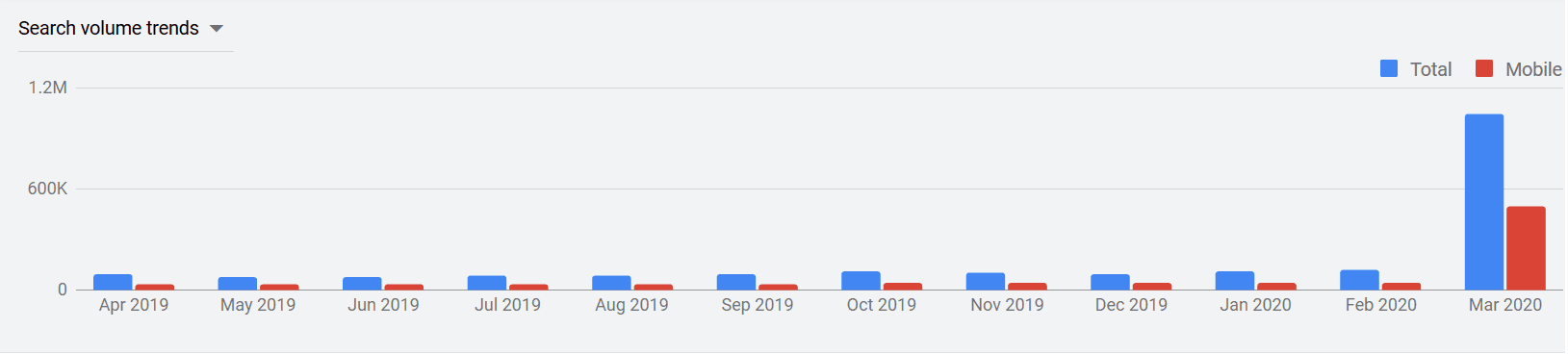
Eight hundred percent. Let’s say that again: 800%. That’s the increase in search volume for the terms “telemedicine” and “telehealth” in just the last month. It shows remarkable growth.

This year has turned many industries on their heads. Some have reaped huge rewards. Some have tackled unprecedented struggles. Telemedicine, clearly, is in the first category. 

Increase in search volume for “telemedicine” and “telehealth”, from Google Keyword Planner.

The reason for this is obvious. People all over the United States are being encouraged not to visit physical medical practices in order to slow the spread of COVID-19. As a result, many people are making greater use of telemedicine services. 

In recent weeks, some have begun suggesting that social distancing will need to be extended beyond the end of 2020, with one study from Harvard University even going as far as suggesting that some measures will need to be continued until 2022.

This is going to lead to a new normal, in terms of how people go about their daily lives. 

Even after the end of social distancing, telemedicine is likely to remain the new normal, for good reason. It provides lots of advantages to both providers and patients, including: 

  • Lower chances of spreading infections among sick people 
  • Sick people are more comfortable at home, don’t have to travel 
  • Less space required for examination rooms, therefore less rent  
  • Coverage can be extended to people in rural and remote areas

How can your functional medicine practice capitalize on the surge in demand? It’s simple: marketing! Here are five steps to launching a successful marketing campaign for telemedicine.

Step 1. Identify the target market

One of the most critical elements in marketing is to identify your target audience. If you don’t know who you’re aiming your product or service at, you simply can’t target them. Knowing who you want to reach with your telemedicine service will influence how you market it. 

For example, if you want to increase telemedicine bookings at your functional medicine practice from environmentally-minded millennials, you might point out that it reduces travel, thereby reducing vehicle emissions.

However, if you’re targeting those with young families, it may be more effective to mention how much less hassle it is to have a check-up in your own home, rather than convincing four rowdy children to get in the car and sit in a doctor’s waiting room. 

A few simple questions can help define your target market:

  • What is their demographic? Think about age, income, location. All of these affect people’s relationships with their medical practice. 
  • Where are they located? In rural areas, people may have less access to a doctor, while in busy cities people may want to avoid the hassle of travelling.
  • What time of day do people want appointments? Telemedicine is a great way to extend your hours and reach people who can’t schedule appointments during the day.

Step 2. Make telemedicine easy to access 

This part is vital to the success of any new technology. If it isn’t more convenient than the current options, people won’t take advantage of it. What does this mean in practice? 

Simply put, it means making it as easy as possible for your pre-existing functional medicine patients to sign up for the online service, or even remove the need to sign up at all! (From personal experience, even the online appointment booking system at my practice took too much time to sign up for, so I never used it and just picked up the phone instead.) 

If you make telemedicine easy, people will be more likely to use it. 

This ease of access should also be clear in your marketing. If your ads take people directly to a quick sign-up process, or if you provide an easy sign-up from your website homepage, you’ll get more conversions. It also helps if you make it obvious that the sign-up process is quick and easy. 

Step 3. Know the market demands 

This step is closely linked to the previous two. The telemedicine service at your functional medicine practice will be most successful if you know what the needs of your target market are so that you can design it around what will work best for them and leverage their needs to make conversions.

For example, some of the most common reasons patients choose telemedicine include:  

  • Rural location 
  • Time constraints 
  • Travel 

Knowing why people are using your service allows you to create a marketing campaign around those factors. It’s like having a pet cat (bear with us for a second here). If you are trying to entice a cat, chasing it will just make it run away; however, if you have what the cat wants, it will come to you.

The cat represents your patients; if you want to get more patients using your functional medicine practice’s telemedicine service you need to provide it in a way that adds value to their lives. It summarizes the basic philosophy of inbound marketing (you can click here to read more).

Step 4. Integrate existing marketing 

This one is kind of obvious, but using your existing marketing to show the benefits of your service is a winning strategy. Social media is a great way to distribute your functional medicine practice’s messaging cheaply and effectively. Utilizing multiple platforms also allows you to target different demographics, for example, Facebook tends to be used by older users, while Instagram tends to have more of a millennial user-base. You can learn how to optimize your social media here.

Another useful online tool which is really gaining prominence is Google My Business. This allows you to claim your Google Maps listing and allows you to post in the Business box that appears in people’s search results. It makes is really easy for people to find your services when they need you.

Finally, make sure your website is polished and up-to-date. This is where patients come already to find your contact details or make online appointments, so it’s an important tool to encourage people to take up telemedicine services instead of in-person appointments.

Step 5. Hire a marketing company! 

If you really want to capitalize on the current surge in demand and gain market share for the future, it might be better to take advantage of the expertise a professional marketing team could bring. This will allow you to get information about your telemedicine service out there as quickly as possible, in a way that is sure to gain results.  

If you own or run a functional medicine practice and would like to work with an expert partner to market your telemedicine service, give us a call. We have years of experience working in the field of health and wellness that we would love to share with you and your practice.

The days when reputation management consisted of press conferences are long gone.

These days, anyone can report on what companies are doing. They can take to any number of social media platforms or review forums to express their views, good or bad. In some ways, this has leveled the playing field for everyone, putting small companies on the same footing as big ones. This means it’s more important than ever to be proactively involved in online reputation management.

Reputation management refers to the practice of influencing how prospective students and parents perceive your school. In the fast-paced media environment in which we find ourselves in 2020, the main way this is done is by influencing the information people can find about your school online.

Online reputation management is especially important and fast-changing for schools because your students are so immersed in documenting their lives online. They will be filming your school, inside and out, at all times. This means that if you can influence the perception of current students, they will pass that on to potential new students who are watching social media.

Of course, there are other things you can do directly on social media to put content out that reflects the school as you want it to be seen. Read on to learn more.

Want help with online reputation management? Schedule a free consultation.

DIY marketing for private schools

The goal of social media marketing is essentially to promote positive stories about your school. While doing this, it’s also important to effectively manage negative feedback. (Often, a well-reasoned and polite response to a negative review or comment reflects better than a 5-star review!)

There are four main elements to include in a marketing strategy to create and promote positive content about your school. We recommend a model called PESO, which stands for:

  1. Paid Media – Pay-per-click advertising such as Facebook or Google Ads.
  2. Earned Media – This refers to publicity gained through promotional efforts, organic media and word of mouth. Basically, this means publicity you don’t pay for or own.
  3. Social Media – We’ll focus our attention here in this blog.
  4. Owned Properties – Your digital assets, which includes your website and your content. You can read more about web design and blogging on our website.

All of these elements pay an important role in bolstering your school’s reputation.

So how can you best use social media to your advantage?

Reputation management for private schools

1. Establish your school’s reputation

When trying to assess what your current online reputation is, it’s usually a good idea to start with your offline reputation. Asking competitors, current students, current parents, and associated schools can really help to find out how the community perceives your institution. If you then look online and look through the comments you get on your school’s social media channels, and compare these to those of your competitors, you can get a good idea of how your private school is perceived.

We would then recommend that you hold a meeting with your staff and discuss what you want your reputation to look like. This should include looking at what you want to be known for, whether it’s science programs, sports, community service or other extracurriculars, to name a few.

2. Draft a social media policy

Having determined what your reputation is, it’s important to protect it! We recommend creating a policy document to make sure your staff keep consistent and regular with posts – for example, you can create rules such as “never publish personal student information without consent.”

Use your policy document to set the professional tone for your staff. It’s also important that you include on your social media that your private school reserves the right to edit or delete any content that could be harmful to your reputation and you delegate a person to be in charge.

3. Create your marketing strategy

The first step in developing a strategy is to identify your goals. Once you’ve done that, you can create a road map to achieving them. This will include topics and subjects you’ll focus on, important themes, keywords, as well as platforms and media types you’ll use. The goal with this is to provide a clear, foundational document that can be referred to regularly. In addition, it’s a good idea to include in this document the person or people responsible for posting and responding to comments.

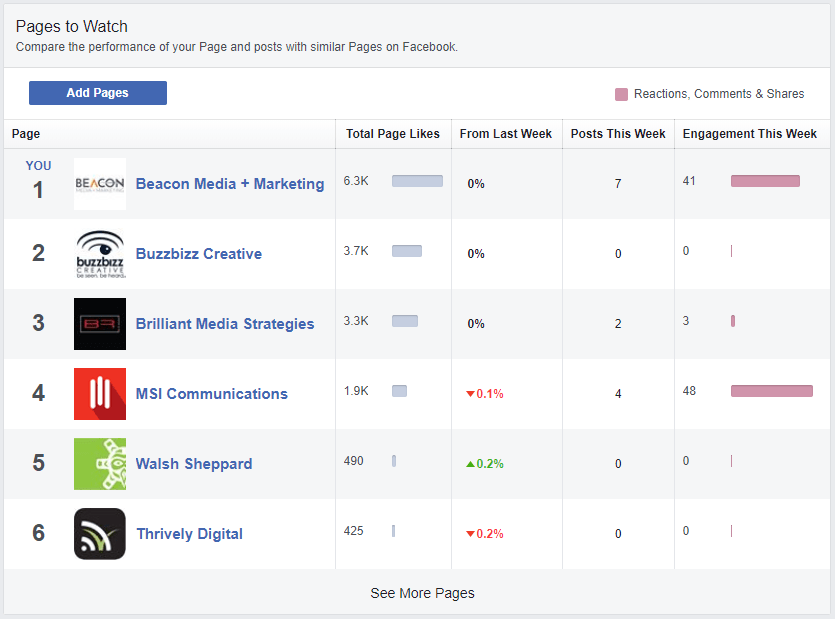
Regular posting is vital to a successful social media campaign. We recommend at least 3-4 times per week. It’s also worth watching the competition! Looking for techniques that work well for competitors can provide useful inspiration. A great tool that Facebook Insights provides is called “Pages to Watch,” which can help you identify your main competitors (if you’re not already sure).

For example, at Beacon Media + Marketing, these are our main competitors:

Not sure how to develop a marketing strategy? Our social media experts can help.

In your strategy, include the types of posts that encourage your followers to engage positively, such as questions, quizzes, and calls-to-action, like, “Book now, for our upcoming open day!” Also, include posts that highlight the positive things about your private school. The reason you are publishing content is to proactively create a positive perception about your school that pushes any negative perceptions that prospective students and parents may have out the door.

4. Engage with followers

Responding to, and having dialogue with, the people who engage with your content is a vital aspect of online reputation management! It shows that you are active and listening, but also allows you to show that you care about your students, parents, and the community.

It helps to think of social media as an extension of your current communication systems. If your private school never answered the phone or replied to emails and letters it wouldn’t reflect well. The same applies to social media. One survey found that, on social media, 32% of followers expect a response within 30 minutes and 42% within 60 minutes.

Therefore, your social media guidelines should include regular checks on your private school’s social media platforms throughout the day and prompt response to comments and messages as they come. Make sure your responses are as friendly, transparent, and human as possible.

5. Optimize your profiles

A really easy way to look credible on social media to be consistent. If all your accounts all have the same look and feel and match your wider branding, it gives a sense of professionalism and quality.

It’s also important to have all the elements in place, make sure you have a profile photo, a cover photo, an up-to-date bio and about section, and contact info.

6. Monitor and adapt

Remember that all plans are subject to change. Even if you think you’ve developed the perfect social media strategy for your private school, you still need to monitor it and adapt as necessary.

Tastes and fashions change quickly, especially on social media, so you need to make sure you keep abreast of current best practices. Social media platforms also provide loads of analytics support for businesses, so you can easily track what resonates with your audience and what doesn’t, allowing you to refine your tactics and increase your engagements along the way.

There are a couple of really effective tools you can use to monitor your online reputation in addition to the tools available on your social media platforms. You can set up Google Alerts to tell you when anyone is publishing content about your business, your competitors, or your industry. Meanwhile, social media management tools like Hootsuite allow you to view posts, comments, and messages that mention you or use keywords or hashtags about your practice on all of your platforms.

A Note on the Negative

No private school is going to be able to avoid negative feedback, and although it can be upsetting to deal with, it can also be used as an opportunity to generate a positive outcome.

After years of working in the social media space, we have learned a few things about how to respond to negative reviews, posts, and comments. Here are some pieces of advice:

  • Don’t take it personally. This can be particularly difficult, especially because more than likely you had the best of intentions.  However, many people treat social media messaging as an opportunity to go direct to the “organization” in general, and don’t appreciate that they’re talking to a real person.
  • Use the 20-minute rule. Leaving a post for 20 minutes if it is particularly upsetting can allow you to make a reasoned response. Keeping your private school’s reputation intact is very important!
  • It’s okay to hide, delete, and report. In some cases, especially where vulgarities and disparaging language are being used or the commenter is trolling your page, you should absolutely hide that comment from your wall and possibly report it. Use your best judgment.
  • Be willing to improve. If the negative feedback being given touches on the truth and is a real service issue that you need to take care of, be willing to make changes to your practice and demonstrate that you are taking feedback to heart on social media! This is also important for those reading comments, as a good response to a negative comment can really make a good impression.
  • Focus on the positive. Be kind and friendly and look for opportunities to turn negative feedback into a positive interaction.

If your private school would like to work with an expert partner on your social media, give us a call!

How to get your tourism business on Google My Business

You’ve probably seen the business panel on the right-hand side of your Google search results, this is Google My Business. It gives searchers and customers many options for interacting with your tourism business.

Here we’ll go through the process of how you can set up your Google My Business for best results, all the way from claiming your listing to interacting with reviewers. We’ll also consider some of the potential pitfalls.

If you’re not sure about whether Google My Business is for you, consider this: your Google My Business listing already exists. You need to claim yours and maintain it, otherwise, someone else could claim it and cause damage to your tourism business by providing incorrect information.

Claiming your listing on Google My Business

The first step to making the most of Google My Business for tourism marketing is to claim your listing. If you are an established business, it likely already exists and you just need to claim it.

You can do this by heading to https://www.google.com/business/ and following the instructions there.

If your business is new, you may need to create a listing yourself, but Google makes it easy for businesses to get online, as it adds value to their search engine.

Once you’ve claimed your listing, this isn’t the end of the process, in fact, it’s only the beginning!

You then need to provide all the information requested by Google, and it is important that this is as exhaustive as possible, as everything you provide will be used by Google to work out what your company does. This information allows them to more accurately suggest your business to customers.

Getting your tourism business on Google Maps

Getting on Google Maps is a simple as claiming your Google My Business listing! Literally, you just claim your listing and add your address and Google automatically adds you to Maps.

It is important to be consistent with your address across the internet, so decide whether you’re using abbreviations, like St., or the whole word, Street. This helps Google understand that Google My Business, your website, mentions on other websites, etc. are all actually the same business.

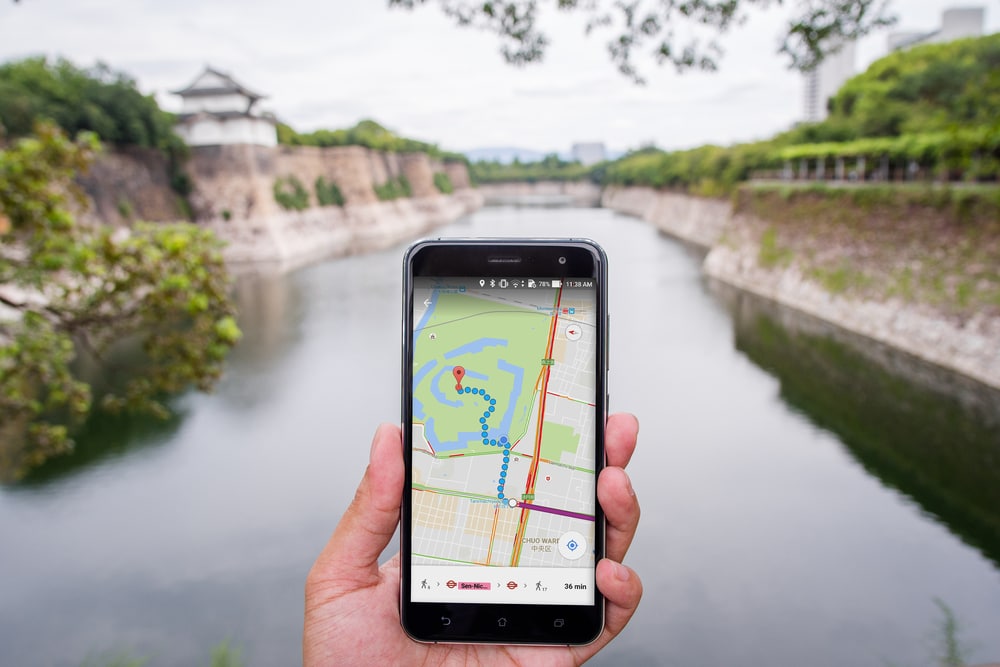
It should be no surprise that being on Google Maps is vital to running a successful tourism business. Many people use Google Maps, rather than Google Search to find places to eat, or activities to take part in. Google Maps has a function that allows users to search for, for example, “ski rental” in the area immediately around them. They are then presented with all the businesses nearby that provide that service, along with their business hours, links to services and prices, time to get there, directions, and reviews!

If all this is available to customers, why would they use, and trust, a tourism business that either doesn’t show up at all or has a poorly maintained listing?

Many consumers, especially young people, will be put off by the appearance of a business not being tech-savvy.

Posting on Google My Business

Posts on Google My Business are somewhere between ads and social media posts. They will show up in the Google My Business listing on Google search, as well as in Google Maps.

You can have a lot of fun with posts on Google My Business! They can be used to post information about events, images, a call-to-action, or you can use it to link to another site.

For example, if you run a restaurant you could use your Google My Business posts to talk about an upcoming happy hour, to encourage people looking for your type of food to come in!

If you were to post an hour or two before it starts, then people who are looking for somewhere to eat that night might be convinced.

Alternatively, if you run a rental business for outdoor sports and you have a new product in, you could use your Google My Business posts to advertise that!

Posting is even more significant to mobile searchers as it shows more prominently on the screen. In fact, Google My Business listings can fill the whole screen of a Google Search results page on mobile! Compare this with the box on the right-hand side of your results page on a browser and it’s clearly more noticeable for customers.

Of course, it’s important to make sure your postings are regular, otherwise, your business will look unprofessional and possibly lazy. If the most recent post is about a months-old special, it will reflect badly.

Bookings on Google My Business

A great asset to your customers is being able to see the relevant information at a glance, as well as being able to take any actions they want, all in one place.

The most common things people look for on Google are hours, directions, and in the case of restaurants, menus. If you display all this on Google My Business and then provide a quick booking form for people to book a table at your restaurant, a tour with your company, or a day renting your equipment, it makes it much easier to do business with you!

Connecting with customers on Google My Business

One of the more surprising features of Google My Business is the ability to have people send you text messages!

This allows you to directly connect with customers, allowing for a better experience for them. It also gives your reputation with Google a boost, as they love community engagement.

The messaging feature allows you to receive these messages as texts on your phone, or to have them sent to Google’s own app, Allo, so you can keep personal and professional messages separate.

Reviews on Google My Business

It may be no surprise that reviews are important!

If you regularly use Google to look up businesses when comparing who to use, you’ll know how disconcerting a low star rating or prevalence of reviews can be.

Equally, the number of reviews is important as well. If a business has lots of reviews it suggests that they have a good number of customers, whereas businesses with fewer reviews may be struggling to find custom.

Reviews and star ratings are highly visible on Google My Business, making them a useful distinguisher between competitors.

There are some fascinating statistics out there about the usefulness of reviews.

BrightLocal’s Local Consumer Review Survey 2018 found that:

  • 86% of consumers read reviews for local businesses (including 95% of 18-34 year-olds)
  • Consumers read an average of 10 online reviews before being able to trust a local business
  • 40% of consumers only take into account reviews written in the past 2 weeks
  • 57% of consumers will only use a business of it has 4+ stars
  • 80% of 18-34 year-olds have written online reviews – compared to just 41% of consumers over 55
  • 91% of 18-34 year-old consumers trust online reviews as much as personal recommendations
  • 89% of consumers read businesses’ responses to reviews

This clearly demonstrates the importance young people place on reviews, and this importance will only grow as these people, and even younger consumers, grow older and make up a larger share of the population.

Particularly relevant for business owners is the statistic about responses to reviews. It’s not enough merely to provide good service, you should thank people when they give good reviews and also make sure to write a good response to bad reviews.

A response to a bad review that addresses the concerns of the reviewer and explains how those issues are being improved can count as much as a good review in deciding whether to trust a business.

Services and menus for tourism businesses

If you run a restaurant, many times people are looking you up online to find your menu. It is therefore really useful to have your menu as easily accessible as possible.

This also applies to lists of services that you might want to advertise if you run a rental business, for example! Do you rent out bicycles or kayaks? Have multiple offers with different pricing options? Having your price list on google my business makes it easier than ever for customers to decide that they want to use you, rather than your competitors.

Things to be aware of with Google My Business

Hopefully, this insight has persuaded you that Google My Business is an invaluable tool for your tourism business. However, it is important to bear some things in mind when managing your listing.

  • If you don’t claim your listing, someone else can.
  • Suggest an Edit button – anyone can “suggest” an edit, but often these “suggestions” go live without notifying you, so people could use this to cause harm to your business
  • Know this place? Answer quick questions button – Google uses this to gain extra info about businesses, but it is potentially open to exploitation as anyone can use it to give false information about your business.

Therefore, it is important to make sure you not only claim the listing yourself but also maintain it and regularly check to make sure the info is still correct.

If you’re convinced of the benefits of having a well-maintained Google My Business listing but want to make sure it’s well crafted and receives regular checks, schedule a free consultation with us today!

We at Beacon Media and Marketing have extensive expertise in running online marketing for tourism businesses, including Google My Business!

Every year, as your school is recruiting the next incoming cohort of students, you’re competing with many other schools to attract the best and brightest. It’s important to have a strong online presence.

The key factor which links both your online and physical marketing is your brand.

At Beacon Media + Marketing, we’ve been creating strong brands for our clients for years. We’re going to show you our 5-step process, so you can start working on branding your private school.

Step 1: Understanding what branding a private school means

Before you start out creating a brand, it’s vital to understand what a brand is and what you want it to do. Your brand is your identity given a visual form – it is what comes to mind when people think about your private school. For that reason, it should accurately reflect your reputation and be consistent with what people think of you.

We recommend three main things that you should aim to do with your brand:

  • Capture: If you already have a good reputation, it’s important to capture that and build upon it. Write down your school’s strengths and use this to focus your brand.
  • Discover: If you aren’t sure how people perceive you, you should aim to find out and build around that. The easiest way to do this is simply to start asking the school community!
  • Pivot: If you’ve had some reputational struggles, then it may be possible to use a rebrand as an opportunity to present your private school in a new light

In the following sections, we’ll show how you can make use of branding to influence how prospective students, and their parents, perceive your private school.

Step 2: The brand discovery process for private schools

Brand discovery is a fundamental foundation on which the success of the rest of the process depends. We recommend you have a meeting with your whole team and get creative working out what your brand means within the education sector.

When doing this with our clients we like to guide them with a series of questions:

  • Describe your business in two sentences or less. What is your “elevator pitch?”
  • A brand is a promise. What are you going to deliver to your students?
  • What is the current perception of your school? What do you want it to be?
  • How do you want to position yourself in the marketplace? Are you thought leaders? Providing value? An innovative experience? The highest quality? A “tried and true” method?
  • What is your big-picture mission? What do you want to look like in five years?

One of the main goals of this part of the process needs to be identifying your competition and how you can differentiate your private school from the others. You also want to identify prospective students and what they’re looking for so you can work out how best to appeal to them.

Step 3: Choosing the right name for your private school

Naming

For many private schools, a name is a legacy. However, if you’re opening a new school or considering a rebrand, choosing the right name is very important. Sometimes naming can come naturally, but other times it can be the hardest part of the process, so here’s the process we recommend:

  • Take a look at what your competitors and private schools out-of-state are naming themselves. Obviously, don’t copy but use these names as a starting place for your own, unique thoughts.
  • Consider using the name(s) of your owner(s) or founders.
  • Decide if you want to use your location (city, region, state) in your name.
  • Think about any nouns or adjectives that struck a chord with who you are when you had your discovery meeting.

Sometimes even using a thesaurus can help! Search some of the top words from your discovery meeting, and see where that takes you and which words inspire you most.

Tagline

A tagline is an opportunity to communicate more about your private school than just what comes across in the name. Often the name is the result of narrowing down a longer concept. This concept can form the basis for creating a catchy tagline. Alternatively, work up from your name and expand into a message that fits with the culture of your private school!

The tagline is important as it is going to pull together all the messaging of your brand. Everything else you write should tie back into this. It should be short, simple and inspiring.

Step 4: Choosing iconography, colors and fonts that represent your school

Using visual means to communicate ideas can be challenging for those without training in art or design. In this section, we’ll try to give a few hints, so you can get started with thinking in the right way. A lot of what works here is due to human psychology and how we perceive objects, both emotionally and mentally.

Iconography

The icon is the part of your brand that most people think of when they talk about the “brand” or the “logo” of your private school. It is the part of your brand where you can get your creative juices flowing and use form, rather than text, to communicate your brand.

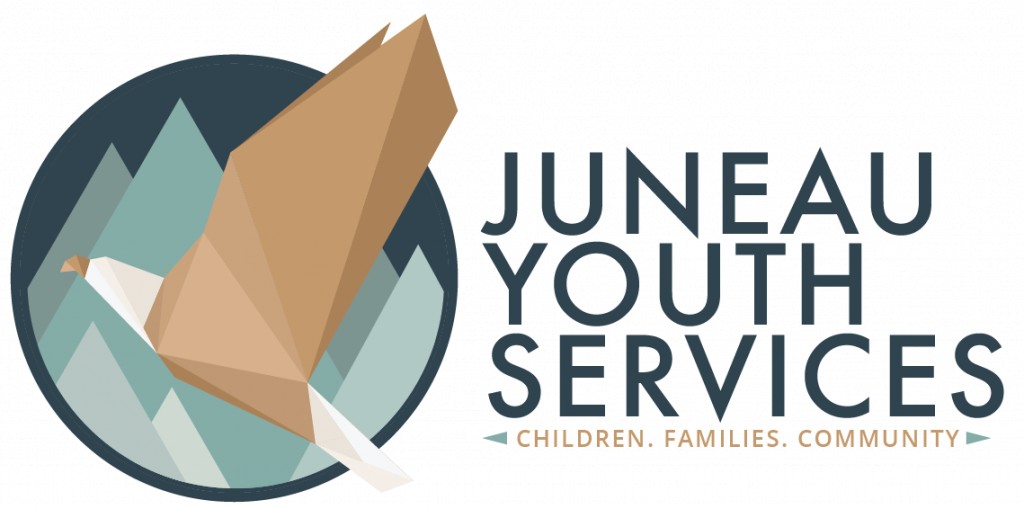
It can be used to represent the name, location, and mission of your private school in a quick and easily accessible manner. A strong example of this is the icon we designed for our client, Juneau Youth Services. This is a company that aims to inspire hope and freedom in young people, for the present and the future.

5 Steps to Build a Strong Brand for Your Arctic Tourism Business

We used the mountains to communicate their location and the bald eagle to represent their message of freedom.

Icons are of course more versatile than the full logo and can be used on promotions, watermarks, and more. When creating an icon, you might find it helpful look at those used by other private schools and education providers for reference and ideas.

Colors

Color is a vital aspect of branding, which we have covered in more detail here.

As you learn more about color associations, it becomes clear that some are more appropriate for associating with private schools and education than others. Some, in fact, are totally inappropriate.

  • Red – Red comes in a variety of shades, each with their own distinct meaning! Red could say “temptation,” “stop and pay attention,” “warning” or “danger,” “celebration,” “love,” or “femininity.”
  • Orange – Mmm, orange. We often associate this color with tasty food! A gentler version of red, orange can also communicate qualities like “light” and “life.”
  • Yellow – Just like orange, yellow can mean light and warmth. Like red, it can catch attention too. Yellow in the form of gold represents wealth, luxury, and rank. In other shades, yellow can mean joy, optimism, or comfort.
  • Brown – Brown portrays earth, wholesomeness, the outdoors, organic products, and all-natural ingredients.
  • Blue – No, blue does not just mean “sad.” Blue tells our emotional minds to be at peace, reminding us of tranquillity, mystery, depth, and strength. It is also frequently used in the health and wellness industry to evoke a sense of being calm.
  • Green – Green can be a hard color to get right. It comes in the most shades of any color in the world and it has a wide range of emotional associations! Green can mean anything from new beginnings to relaxation, depending on which hue you choose.
  • Purple – A mix of red and blue, purple can take on the attributes of both! If it leans in the direction of red, purple communicates energy and intensity. If it leans blue, purple takes on a calmer and loftier feel.

If you’d like to delve into this a little bit further, Adobe has a great tool for identifying complementary colors, which you can use to ensure a consistent look across your branding.

Typography

The typeface of your brand is an important component of a brand which most people don’t really think about until they have to make decisions about it. However, it is important to make a choice that conveys the feeling you want to inspire in prospective students and their parents who see the brand of your private school.

Contrast the font used to advertise a horror movie with one used in an online publication.

The first is probably scratchy, broken, and sharp-looking. The second is probably clean, neat, and professional-looking. This is important to remember, as you want to choose a font that portrays your school in the way you want to be seen.

The font should also be matched to the other elements of your logo and tie in with the overall theme of education, and specifically private schooling. Google has a useful font tool you can use to explore different typefaces a further here.

Step 5: Manage your private school brand

Once you’ve determined what the brand for your private school is, that isn’t the end of the process. It is vital to maintain and protect that brand! A well-managed brand is a symbol of authority which earns and respects the trust of its target audience. A mismanaged brand, on the other hand, can become messy and inconsistent, which dilutes its effectiveness.

At Beacon, we provide clients with a style guide that informs staff of what logo, colors, and fonts to use and how to use them. Hopefully this article will be a useful guide while you’re first starting out! Are you ready to give it a go? You can schedule a free consultation here.

Regularly redesigning your website is important for a successful online presence.

Why? Experts recommend a redesign every 2-3 years because things like products, staff, fashions, and best practices all change so rapidly in business and online.

We’re going to take you through the process we use, here at Beacon Media + Marketing. We have 20 years of experience in the marketing industry and a proven process for web design. Hopefully, when we’re done, you’ll feel confident trying it out for your private school.

Let’s get into our 5-step process for beautiful website design.

Step 1: Meet with your private school team

The very first thing you should do before you even start on the design, is to understand what you want to create. This includes what you want to say about your school, what your goals are, and how you want to present your private school.

We recommend gathering all the key people at your school into one room and asking yourselves questions so that you can understand what you want your website to achieve. We recommend looking at competitors’ websites to determine what aspects of their website you like, and what you don’t.

Here are some sample questions we ask our clients when looking for what they want to create:

  • What are the primary and secondary purposes of your website? What do you expect your website to accomplish?
  • What information do you want potential students to find quickly on your website? What are the most important things?
  • Of the website designs that you like the look and feel of, which features do you like most and why?

Step 2: Map-out your private school website design

Now that you have an idea of what you want your website to look like, and you have some concrete features you’ll need, you can create an outline.

At Beacon, we produce two documents for our clients which provide a guide for the website: a site map and a wireframe.

A site map is really simple. It is just a fancy name for a flowchart or bullet list of all the pages on your website and the order in which they link to one another.

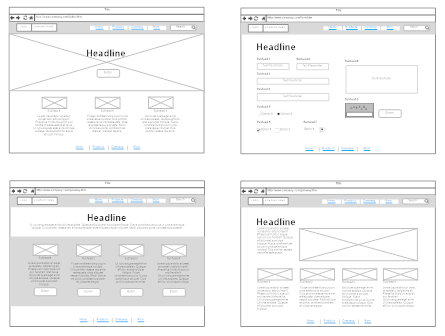
The site map then provides the basis for the wireframe. The wireframe for your private school’s website is a set of images in which you show the elements you want on each page.

Despite the technical name, a wireframe is just a rough sketch of what you want your website to look like and where you want the elements to be.

Beautiful Website Design Can Boost Your Private School
Source: SmartDraw

A good wireframe includes the location of each image, header, content paragraph, buttons, or form field on each page. There are great tools available such as MockFlow which you can use to create your own professional looking wireframe.

Step 3: Write the content for your school’s new website

Once you’ve created your wireframe, and determined where you want your written content to go, now you need to start writing. We recommend three best practices for content writing, which will allow you to produce attention-grabbing and engaging content.

1. Keywords

The design of your website is important, but if no one actually sees it, it’s all wasted effort. So, how to make sure people see it?

The best way to be seen is to rank at the top of people’s search results on Google. This is because most search engine users use Google, and almost nobody ever looks at the second page.

Here at Beacon Media + Marketing, we’re experts on SEO optimization. We’re going to let you in on a secret: keywords. This is essential to helping all our clients to rank on Google.

Every time you search something online, search engines trawl the internet for matching keywords. Using the right keywords for private schools in your local area will help people find you. Importantly, you should also make sure you use keywords in your headings and sub-headings.

2. Headings

Writing your headings is also an important part of the content writing phase for your private school’s website. It’s common for people to skim over text and read only the headings, looking for content they’re interested in. Catchy headings are critical if you want people to slow down and read all the great content you’ve been publishing.

As you may have noticed in this blog (hey, we practice what we preach!), it’s really useful to put your keywords in the headings as well. This helps Google to identify what your webpages are about and helps your website to rank on Google.

3. Quality

Obviously, users will appreciate good content, but you may be surprised at how much Google likes quality content too. The reason for Google’s insistence on well-written content is that they want to remain the most popular search engine in the world, and they can do this by keeping up their reputation.

People will continue reading and pay attention to what you’re saying about your private school when your content is well written, and this helps your website to rank on Google. Google will reduce the ranking of pages with a high bounce rate, i.e. people who click on your website and quickly leave again.

As you can tell from reading this post, it’s effective to address the reader in the second person, as “you!” It’s also useful to put yourself in the reader’s shoes so you can write in a way that makes it clear why your private school will be a good fit for their child.

In marketing, we always say the best sell is to make it clear how your products add value to someone’s life. It is no different when you’re trying to recruit new students to your private school, show how you can provide a valuable education to prospective students.

We recommend that at the end of each web page, you include a “call-to-action.” This is a request for the user to take action on what they have just read, for example: “Call (123) 456-7890 now for a free inquiry!”

Step 4: Develop your private school website

The final step in designing a new website for your private school is development. This is the culmination of all your hard work, where the site map, wireframe, and content are all tied together.

The first step in developing your website is deciding which software to use to build it. At Beacon, we use WordPress for all of our education provider clients. WordPress has packages at multiple tiers that you can choose from, so you can purchase a cheap package when you start, and add functionality as necessary. (You can read why we recommend it here.)

You should choose a package that best fits your needs, taking into consideration your site map, wireframe, content, and the list of concrete features and specifications that you came up with during your initial meeting. WordPress has really intuitive software so you should easily be able to build your site once you’ve chosen your package and created your account.

When building your website, be sure to stick to your brand guidelines! A well-managed, and cohesive brand is vital for a good-looking website. You can learn more about branding here.

Step 5: Go live!

When you’ve finished developing your website, it’s time to set it live.

But first, you need to make sure you’re ready. We have a checklist we go through with all our private school clients, here are some examples from that list:

  • Page-by-page, go through the entire website clicking all links to make sure they send users to the correct locations.
  • If you have a contact form, submit a “test” entry to make sure it sends to the correct email address.
  • Enter the URL for your website in all the popular browsers including Chrome, Firefox, and Safari to make sure it looks good.
  • Visit your website on mobile to make sure it is properly mobile optimized.

With WordPress, you can point the domain name from your old website to your brand new one. At that point, your private school’s new website is ready for visitors!

Is your private school ready for a new website?

We hope that you’ve found this glimpse into our work helpful, but if you feel like you want to hire us to take care of the whole process for you, you can book a free consultation. Alternatively, you can read more of our blogs, in which we discuss all aspects of digital marketing, here.

Jen Motyka has a unique perspective when it comes to running a business during a crisis. She has two of them, and she says they’ve responded very differently to the lockdown.

She owns Blitz Promotions, an event planning and business consulting service that aims to empower local businesses in Anchorage, Alaska. She’s been running it for about three and a half years and says the transition to an event-free world has been very challenging.

She’s also a founding stylist at Color Street, a beauty brand that specializes in colorful nail art, which she does from home. She says things with this business have been “really easy.”

The difference, she says, comes down to one simple thing.

Marketing 101: Solve problems

“Right now, finding really innovative ways to still connect with your customer base, obviously while following social distancing guidelines and being safe, is the key,” she says.

“My home-based business hasn’t had a glitch. If anything, it’s really taken off because it’s nail polish. A lot of people are having to grow-out their nails, they can’t go to the salon right now so they’ve been [looking for alternatives]. I think with any business, it’s about problem-solving. That’s Marketing 101. You want to provide a solution for your customers, so how are you going to do that?”

She already had a website in place, which means she’s able to continue operating without having to leave her home to do any deliveries or expose herself to any health risks.

Things with the event-planning business, on the other hand, have been “very difficult.”

The lack of physical events means Jen has been looking for ways to pivot and find new ways to connect with people. She says it’s amazing how creative the industry has been, from organizing virtual events to drive-ins, where everyone attends while staying in their cars, a safe distance from one another.

“We’re finding better ways to connect. A positive to come out of this, if we can find them – and I think it’s important that we do – is really nurturing those personal connections. We’re not sending mass texts anymore, it’s ‘How are you doing? How’s your family doing? How can I help you?’ It’s really reinforcing and nurturing those relationships.”

Looking for a way to help your business pivot? Have questions about digital marketing in a crisis? Simply need a sounding board for new ideas? Join our Facebook group.

Nurture connections with others

One of the most interesting things to come out of this period, Jen says, is the stories.

“Stories are such an authentic way to connect with other people and say, ‘Hey, it’s OK to be scared – I’m also scared. It’s OK to be overwhelmed – I’m also overwhelmed. Here’s how I’m helping, here’s what I can do, here’s something to make you feel a little bit better about where you’re at,’” she says.

“Connections keep us safe, keep us healthy, keep us occupied. I think those have been the key, for me, to help me keep moving forward because it’s really easy to just get complacent.”

It’s important to be patient with yourself, and allow yourself a little grace, while you’re figuring out the next step. She notes it’s equally important not to be afraid to ask for help.

“I suggest looking up YouTube Tutorials, reaching out to other businesses – if you have a friend you know does a lot of videos on Facebook, for example, you can ask them for help. Even now, when I see my face on the screen, I’m like “Oh!” even though I’ve done tons of videos. It doesn’t matter how many you do, there’s always that sort of stage fright – I don’t want to say the wrong thing or touch my face! It’s about having a little grace,” she says.

“Mistakes are going to happen and that’s OK. We’re all in this together. You’re not alone in not knowing or being scared.”

Allowing yourself some grace

It would be impossible to count the number of times we’ve heard the word “unprecedented” in recent weeks. None of us have experienced this before, so cut yourself some slack.

Jen says in her experience, the little things have made a big difference – no matter how silly they may seem. She laughs as she cites her conversation with us as an example, explaining she actually really enjoyed the chance to let out her “mom bun” and do her hair.

“Women are trying to figure out how to home school and run our businesses and cook three meals a day and it’s this long laundry list. Our personal self-care goes out the window, because we have all these other things to do. How do we find a little happiness? It might be superficial, but if you look good, you do feel good. Even today, I put on some mascara and I was like, ‘Oh yes, that’s right!’”

With this in mind, she’s currently working on a series called In Between Beauty, which she hopes to release in coming weeks. It will feature a range of different people giving home beauty tips to tide them over until they can resume supporting local business and return to their favorite salons.

“It will be tips to keep you going in that in-between time, because that’s what this really is. It’s an in-between time that we’re stuck in. People need to remember that. There was a time before coronavirus and there will be an after.”

For more stories about businesses finding ways to pivot, as well as crisis communication tips, digital marketing advice and a sounding board for ideas, join our Facebook group.

It’s a tough time to be in business. We know it. You know it. Your customers know it.

Many sectors are going through a period of uncertainty as the latest public health advice requires them to fundamentally change the way they trade. Businesses all around the United States are scrambling to adapt and find new ways to secure their revenue streams.

With the right digital marketing strategy, however, it could be a real opportunity for growth.

The secret to success? Simply stop selling.

Tip 1: Shift your focus

“Wait a second,” we hear you thinking. “What did you just say? Aren’t you a digital marketing company? Isn’t the whole point of marketing to convert sales?”

Yes it is. You’re not wrong, but bear with us for a moment.

Ken Okonek is the Director of Sales and Marketing at Beacon Media + Marketing. He says current circumstances are perfect for building genuine and lasting connections within your local community. The trick is putting your sales initiatives on hold and shifting your focus to the people around you.

“We need to come from a place that is empathetic and grateful. We can’t just capitalize and try to get every dollar that we can, because that comes through in the wrong way,” he says.

“Right now, you should not be trying to sell anything. You should be branding your vision of where you want to be and what you want to do. Dollars will eventually come, but they will stem from a relationship. That’s what you want to have with your people, a long-term connected relationship.”

Anchorage businesswoman Lorie Hardin, who runs Birch Dispute Resolution, is one example. She provides certified divorce coaching, mediation and parenting services. In recent weeks, however, she has found herself leading a group of 3,300 sewers from all around Alaska who are donating a lot of time to stitching surgical-style masks to assist healthcare providers.

Looking for a way to help your business pivot? Have questions about digital marketing in a crisis? Simply need a sounding board for new ideas? Join our new Facebook group.

Tip 2: Stay relevant

Many businesses are facing tough times, there’s no doubt about it. However, Ken says shifting your focus from the short-term to the long-term can help you build the momentum to push through.

He says the key to long-term success from a digital marketing perspective is simply to make sure you’re relevant.

“This thing that we’re dealing with is a short-term time frame. The long-term is so much more important. Knowing how to speak to an audience, create content that has value, build your brand, build your awareness, building engagement within your community is so important right now.”

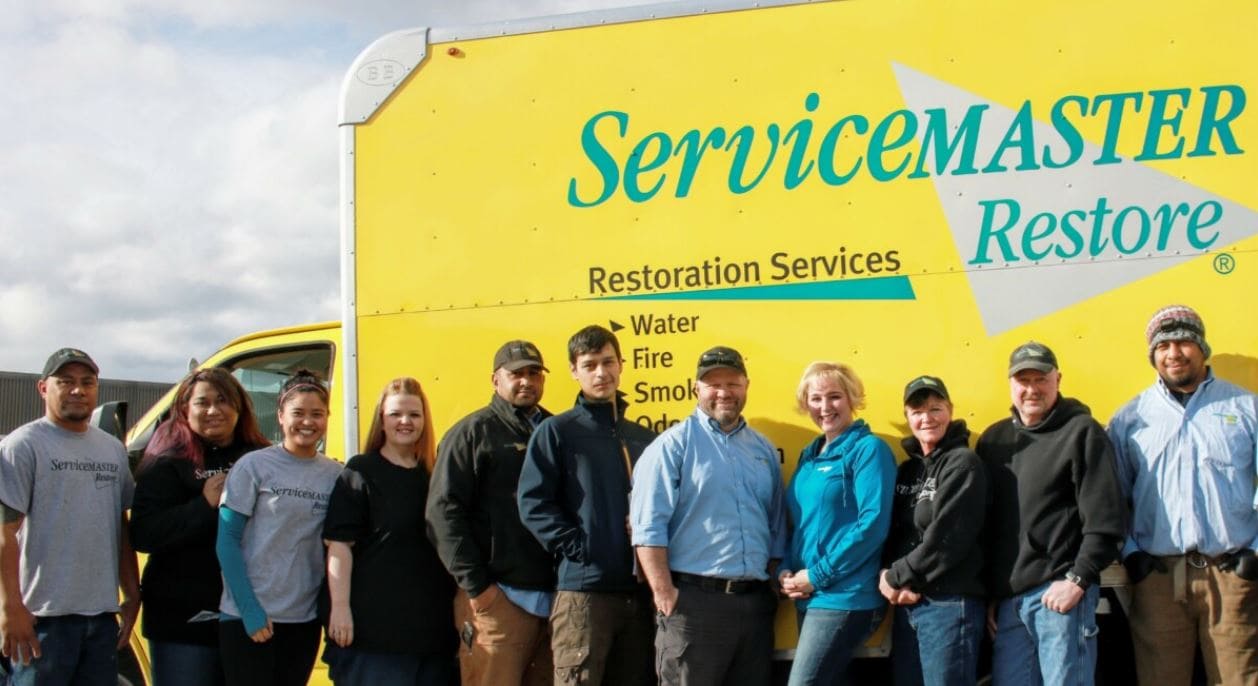
Businesses everywhere are keeping tabs on what their local communities need and springing into action to help. ServiceMaster of Alaska is one example. It’s a home restoration business that typically assists clients with things like water removal, fire damage, mold damage and odors.

Right now, however, a dedicated crew has stepped up to help local businesses disinfect their premises in a bid to keep their workers safe and slow the spread of the COVID-19 virus.

Tip 3: Get creative

There has never been a better time to think outside the box and start trying new things.

In some ways, the fact that it’s a tough time for businesses across the board presents a perfect opportunity to take some risks. Ken explains that revising your digital marketing strategy and reassessing your strengths and weaknesses now may help your business become more solid than ever.

“Right now, you have an opportunity to maybe diversity or spread out your [streams] of income. That way, when we do get into this new normal where we can all get outside and engage with people again, you might have a different revenue stream, or a couple of revenue streams, that you didn’t have before,” he explains.

“We have a unique opportunity right now because of the market to be able to pivot, to shift some perspective in the way we’re helping people in the marketplace. This could be a huge opportunity, not just for you to be able to get through these tough times – because believe me, we all understand that there is tough time we’re dealing with right now as a country.”

Tip 4: Help others

Once incredibly positive thing us that we’re all going through this together. We all have something in common and it’s in everyone’s best interests that our businesses survive.

Jennifer Christensen is a co-founder and the Vice President of Marketing at Beacon Media + Marketing. She says it’s critical that we help each other transition into the “new norm.”

“I talked to somebody recently who is working with their competitors for the first time because they recognize that hey, if we can all work together and help each other get through this, we’re all going to end up being better off at the end,” she explains.

“We want to help everybody rise up. If we can all be successful – well, successful right now means something different. It means helping people through it,” she explains.

Beacon Media + Marketing is a digital marketing agency with top-tier remote working capabilities and a passion for helping businesses grow. This is definitely one of those areas where you really have to walk the talk, which means we always take our own advice.

We’re offering three giveaways to help you adapt to working from home:

  1. FREE Chatbox installation. The first 10 businesses to respond will receive a chatbox installation on their website. A chatbox is the easiest way for customers to reach out to you with questions and concerns and it will make staying on top of enquiries a breeze.
  2. FREE Zoom training. Zoom is a video conferencing tool that will make it easy to touch base with your team and run staff meetings as normal. Not only does this make sure your business can run as normal, but regular contact can ensure everyone copes with the change.
  3. FREE Livestream training. Facebook livestreams are a great way to connect with your customers to keep them informed of what’s happening and make sure you’re still responding to their needs. Our videographer can answer all your questions.

Contact us at [email protected] and we’ll help you get started.

For more stories about businesses finding ways to pivot, as well as crisis communication tips, digital marketing advice and a sounding board for ideas, join our Facebook group.

For a lot of people, advertising on Google seems like a no-brainer, but many people may wonder how effective it really is. In this blog, we’ll show you that Google Ads really are effective. It’s a very powerful tool to help your school reach new students.

If you don’t already believe that Google advertising is can help, consider this: Google users account for 77% of all search engine usage. That’s more than 1 billion people!

It’s also important to remember that most people will never look at the second page of their Google results. Many won’t even scroll to the bottom of the first page. This is why Google Ads are so effective, it puts your business right in people’s eye-line at the top of their search results.

How should private schools set up Google Ads?

Google Ads come in two types: search ads and display ads. You’re probably familiar with both types as they are anyone who uses Google search will have seen both kinds.

Search ads are the paid search results that appear right at the top of the results list. Usually, one or two ads appear here, but for competitive industries this section can be as much as half the results page. Search ads can be distinguished from “organic” results by the presence of the word “ad” in a green box next to the URL.

Display ads allow a lot more creative freedom. These are the ads that appear on websites, and typically come as a banner on the side of the webpage, or across the top or bottom of a page. They provide an opportunity to draw people in using both graphics and text.

Pay-per-click

Google advertising uses a payment model called pay-per-click (PPC). This means that you’re only charged when someone clicks on the ad. The amount you are charged each time someone clicks is called the cost-per-click. The cost is determined by the following equation:

Next Highest Ad Rank / Quality Score + $0.01 = CPC*

As you can see, this means that the higher your quality score, the lower your cost will be. This is because Google has its own financial incentive to provide users with good quality content.

Navigating the Google Ads algorithm

The word algorithm has started to enter common language much more in recent years as people become aware of the ways in which their content is delivered to them.

In terms of Google Ads, the algorithm used to determine the rank of your ad is actually very simple. This rank then determines who sees your ad, and how effective it will be. We’ll discuss the algorithm itself in a bit, but first let’s talk about how Google uses it.

In the moments between you hitting the search button and Google providing your results, a huge amount happens. In that split second, Google takes an inventory of all the ad accounts that contain the keywords or phrases used in the search.

For example, perhaps your private school is trying to rank for the keywords “Best high school for college acceptance.” When someone searches “What schools in my area have the best college acceptance rates?” your advertising account will be included in Google’s inventory.

In order to tell Google what keywords and phrases to rank your website against, you bid a monetary amount that you would be willing to pay if someone clicked on your ad, hence the name pay-per-click.

This process works a bit like an auction, with the winner determined by two factors:

  • The maximum bid you have set for your keyword
  • The quality score of your advertisement

The second point here we’ve already touched on. Google is here to make money, and the best way to do that is to be the search engine with the biggest user base. The main reason that Google has such a massive market share is because it has a reputation for providing the most relevant results.

Therefore, it is more likely to show your ad, and your content, if it’s of good quality and relevant to its users. Therefore, you should take special care to remember this when creating your ads.

The quality score of your advertisement is itself determined by two factors:

  • Past performance of your ad, ad group, and your account in general
  • The relevance of your chosen keyword, ad (title, URL, and description), and landing page to the search and to each other

Don’t worry if you’re not familiar with the terms “ad group” and “landing page.”

An ad group is a group of keywords that you are trying to rank your ad for, and your landing page is the webpage that your ad sends people to when they click on it. Both the ad itself and the landing page should be relevant to each other, use the same keywords, and be well-made and fast-loading.

All these factors add up to a single equation that determines the rank of your ad:

CPC Bid x Quality Score = Ad Rank

For display ads, the process is slightly different. Instead of bidding on keywords, you bid on ad groups. There is also the option to bid on impressions rather than clicks. Impression in this context just refers to when your ad is displayed to someone on a webpage, every time it is “seen.”

For this reason, it’s called “cost-per-impression” or “CPM” bidding.

Can Google Ads really help private schools?

Yes, they can!

However, there are factors which mean that this can never be a guarantee.

One of the most significant of these factors is competition. This varies by area and high competition will mean your ads have a lower chance of winning the “auction” we talked about earlier. Competition also varies by industry. For example, the legal industry in Anchorage, Alaska (where we are based), has seen costs-per-click as high as $50!

This is obviously not going to be the case for all industries, but it does mean that Google advertising could be a poor choice as without high profit-margins you could make a loss overall. This is especially true when you consider that not all clicks convert to new clients/income.

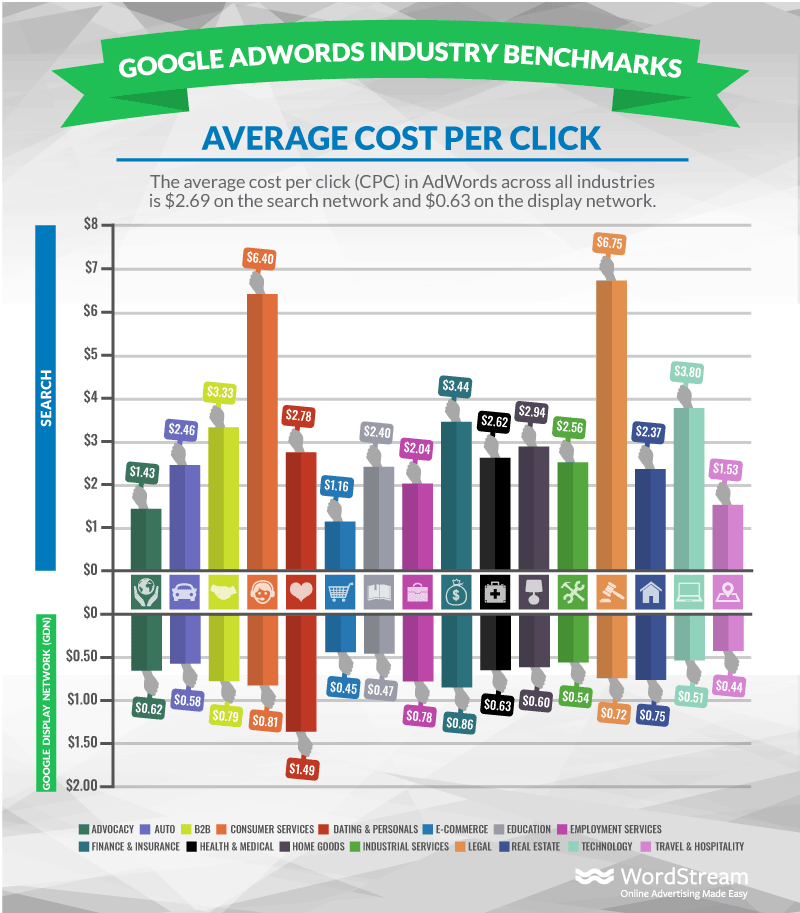
We can determine the level of competition in an industry using industry benchmarks.

Source: WordStream (8/27/2019)

As you can see, education (in grey) has a relatively low cost-per-click compared to other industries, indicating a lower level of competition. Obviously, this isn’t taking location into account, but as a general category you will be competing with fewer schools.

This doesn’t mean that what we said about quality can be disregarded however! You should still aim to create quality ads to ensure you are ranking highly.

Our Google Ads specialists at Beacon Media + Marketing are regularly able to achieve below-average cost-per-click for our clients, saving them lots of money.

How do we do it?

  • For every service we want to advertise, we use a budget of at least $300 per month, usually more. This translates to our minimum recommended cost-per-click budget on each keyword in 1-3 ad groups.
  • We always find some way to find a niche for the services we are advertising, using nuanced keywords. We do this so that we can use keywords that are low competition but capture the internet users who search for them. For example, we market for a holistic dentist in Anchorage. When we create her Google Ads, we do not target “family dentistry,” but rather, “holistic dentistry,” because there is lower competition around this keyword, which makes the market easier to capture. We have seen incredible results for this client.
  • Our team makes it a priority to create quality, relevant ads and landing pages. There are few things better for boosting the success of your Google advertising campaign than this. Write clear, concise, compelling ads that point people to the pages that they would expect with the right keywords.

We hope this post will be helpful for you getting started with your own Google advertising!

If you want to learn more about digital marketing, you can read more of our blogs, here. Alternatively, if you’re interested in working with us, you can schedule a free consultation.

Consistency. 

If there is one word that encapsulates the secret to education marketing, it’s consistency. 

We at Beacon Media + Marketing recommend that a weekly blogging strategy is best, but many of our clients have seen success with a minimal schedule of one blog per month! Although you can see results with this more minimal strategy, it will probably take longer for you to start ranking on Google, which, as we’ll explain, is one of the main goals of blogging. Here, we’ll explain some of the education marketing strategies we use to drive traffic to our clients’ website and ensure their blogs rank on Google.

Prefer to chat to a real person? Give us a call today.

What education marketing strategies will help my blogs rank on Google?

When we talk about ranking on Google, what we mean is the position of your website or post in people’s search results. There is extensive research that shows that most people don’t ever click on the second page of Google, and many won’t even scroll down the first page. One study found that only 0.78% of searchers clicked on something on the second page of Google. Clearly, it’s necessary to get on that first page, and ideally at the top of it. But how?

The answer is simple: a comprehensive, and well-researched, education marketing plan. Here are some of the methods our expert marketers use to get our clients on the top of the Google search rankings. 

Case study: Beacon blogs

Let us take the time to discuss a couple of case studies that show our success with this strategy. Obviously, we’re a digital marketing agency, but these principles are universal, and they’ll definitely work for education marketing.

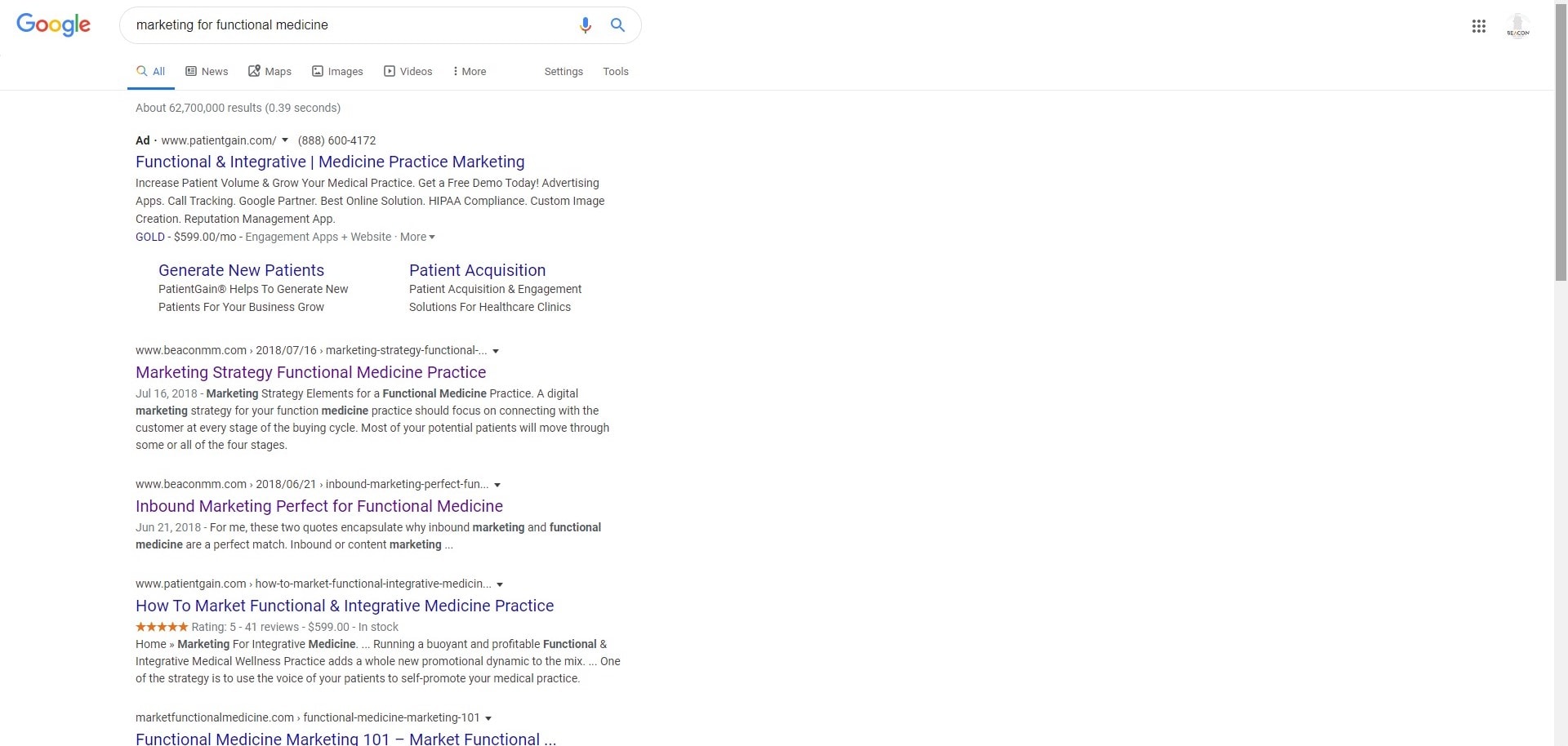
Two years ago, we decided we wanted to move into the functional medicine sector. Our first steps in this direction were to start blogging about it. We wrote blogs about each of the services we offer, targeting the keyword “functional medicine”. Within a few months, we had our blog posts ranking at both #1 and #2 on Google for the search “marketing for functional medicine”, and we’re still there today.

Education Marketing

So, how did we do it? 

We used a few simple tricks of the trade that you can also use for education marketing.

  1. First, we ensured that the blogs we wrote were of the specific length that works best for Search Engine Optimization (SEO). This changes every so often, depending on updates to Google’s algorithm, so make sure you research it now and then so you’re up-to-date.
  2. Second, we had a focused keyword strategy. This involves writing certain keywords that you want to target in your text and headings. For the functional medicine blogs, these included “functional medicine,” “marketing,” and “inbound marketing.”  
  3. Finally, we ensured our posts are well optimized, work on mobile, are fast-loading, and have correctly set metadata. Metadata just means the information you provide Google about the contents of your blog, so they can determine how relevant it is to searchers. 

Although we ranked these two blog posts at the top of Google, that was only part of our goal. The main objective of this was to generate leads. By having these blogs at the top of Google, we generate more leads to our website which converts into more sales. These two blogs now constitute a key part of our sales funnel! As you can see, these strategies are super simple and effective, so make sure you include them in your education marketing plan.

Case study: Mandanas Dental blogs

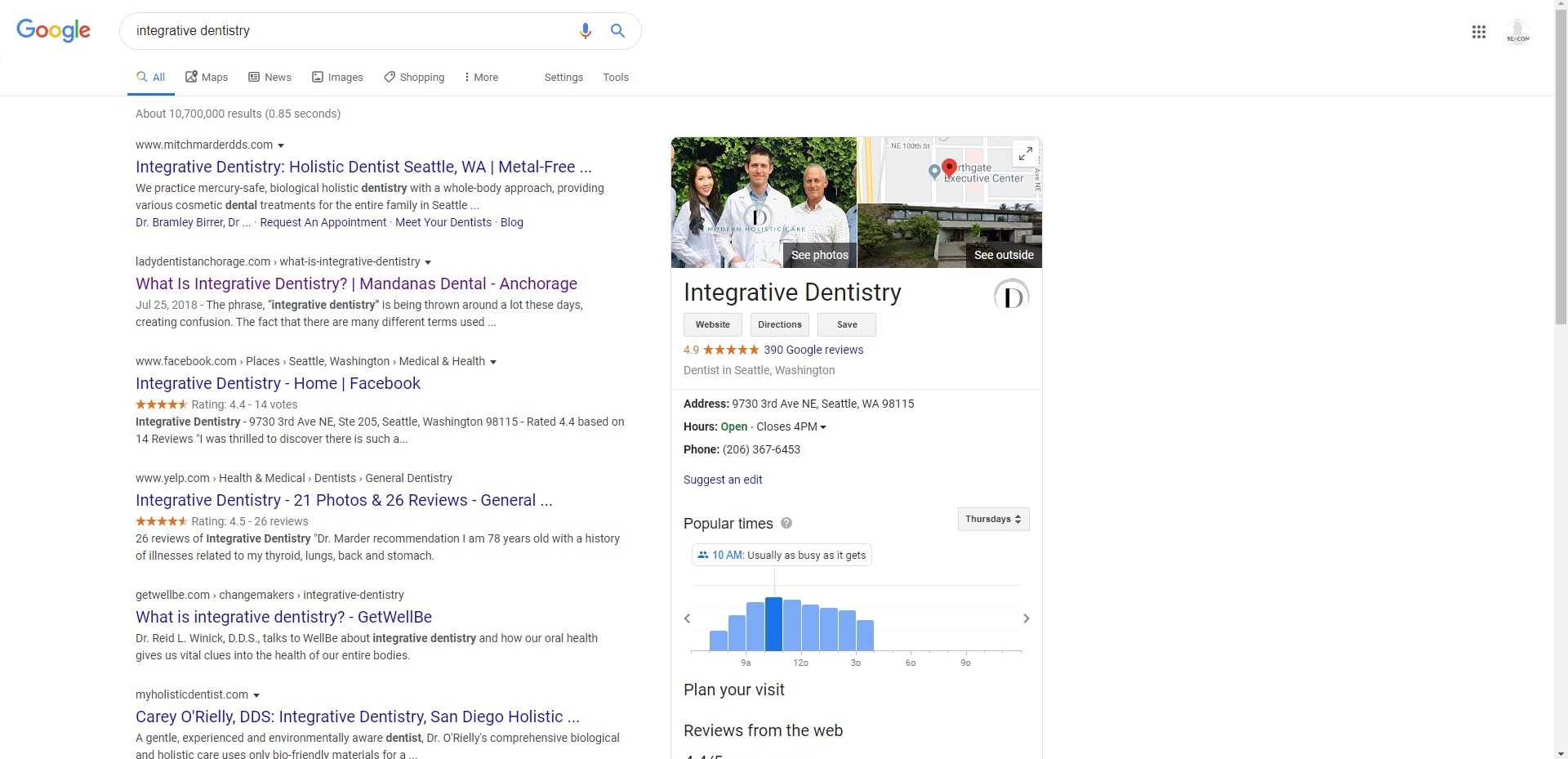
We don’t just keep our secrets to ourselves, either! We’ve also used these strategies to help our clients find success. One of our longest-standing clients, Dr. Owen Mandanas, decided a few years ago that she wanted to shift her focus to include integrative dentistry. Naturally, we started blogging on the subject!

Using the same techniques as for Beacon, we managed to rank Dr. Mandanas on the first page of Google. We’re so happy to have been able to achieve this for such a valued client. This approach to blog writing uses the inbound marketing philosophy, which will form the backbone of your education marketing strategy.

We’ll discuss in the next section. 

Education Marketing


Have we persuaded you? Let’s talk strategy.

Proven methods of education marketing

Okay, by now you’ve got a sense of the power of blogs and the impact they can make on your education marketing strategy. Next, we’re going to discuss some proven methods for writing successful blogs, including the inbound philosophy, question answering, and the waterfall method. These are all techniques you can use when writing your own blogs – whether you’re marketing a private school, a home school, or a specialty program.

Inbound philosophy of education marketing

The inbound marketing philosophy is a simple concept. People are online all day, every day, which means putting quality content in front of them is easier than ever. The core of the inbound education marketing philosophy is that if you consistently provide useful content to people, they will remember you and seek you out when they need your services. Imagine your customers are a cat. If you chase the cat it will run away from you, but if you have what the cat wants, it will come to you! So, how do you go about enticing the cat?

The first step to developing your education marketing plan is to researching what your customers are interested in. There are tools available to help you find out what searches people are making on Google (we use one called keywordtool.io). Once you’ve identified what people are researching, you can write blogs on it. People typically ask questions on Google, so answering these can be an effective way to provide quality content. 

Use education marketing to answer questions

We’ve established that people use Google to ask questions, and that answering them is a highly effective method of providing quality content through your education marketing plan. If your blog is what people are relying on when they want to know something, they’ll remember you when they want to buy something.  

Remember: Be there for them when they want to know something, and they’ll be there for you when they want to enrol in something.

Here’s a quick rundown of our process for blog writing: 

  • Keyword planning – We use Google’s keyword planner to find out what the most searched topics are, and what kind of competition there is for answering those questions. 
  • Finding questions – Next, we use Keywordtool.io to identify what questions people are asking about those topics. 
  • Writing – The next step is the most obvious, write a blog answering that question! When doing this it is important to include your keywords frequently, while flowing naturally. 
  • Setting the metadata – We’ve mentioned this before; basically, it’s the process of setting the title, description, and keywords in a format that Google can use to populate your result. 
  • Schedule – It’s important to be consistent if you want the best results. We recommend to our clients that they blog at least 1-2 times per week, but even with a minimal strategy, you can expect to see results in 6-9 months. 

Want to apply this to your marketing plan? Our team can help.

Waterfall blogging is perfect for education marketing

The waterfall method of blogging is a highly successful method of getting your posts to rank on Google. One important thing to factor into your strategy is the inclusion of backlinks. Backlinks are links to your website from other credible websites. Google highly rates backlinks, so we can set up links to other posts in our own blog posts. This is a great way to organize posts, which you can use successfully for your education marketing strategy.

Here’s an example of a waterfall we created for some recent mental health blogs: 

As you can see, this looks a bit like a descending waterfall, with multiple layers all linked to one another (and to this blog too!). You can use this to discuss your programs, teaching style, student services, and more.

Link between SEO and education marketing

Search Engine Optimization (SEO) is the practice of using tools to help blogs your produce as part of your education marketing strategy rank on Google. This involves setting the keywords that we have chosen to target, and which we have used throughout the blog. We make sure to use them in the text, in the headers, and in the URL. We also set a featured image, as this boosts Google ranking, and write a custom excerpt which is displayed on the results page, this ensures that the text is displayed fully, and doesn’t end with an ellipsis. 

In addition, we chose a title of the length that is shown to be most effective in catching people’s attention and using certain power words that have been shown to gain clicks. We hope that this has been a useful insight into some of the tips and tricks that we use to drive engagement with our blogs. If you’d like to learn more you can check out other posts we’ve published on digital marketing. 

Ready to talk to the experts? Schedule a free consultation today.

Alaskan businesses are facing unprecedented times. Many have been forced to temporarily close their doors. Many have transitioned to working from home as best they can. Many are looking outside the box to see how they can keep trading in the midst of a health crisis.

Some have found themselves able to help their communities in new ways.

ServiceMaster of Alaska is one of them. The home restoration business, based in Anchorage, has always prided itself on being local. They know, for example, what it’s like to experience a bust pipe at 2:00 a.m. or find your not-so-friendly neighborhood bear or moose wreaking havoc on your property. It normally deals with things like water removal, fire damage, mold damage or odors.

Right now, however, it’s bidding for jobs to help Alaskan businesses disinfect their premises in a bid to slow the spread of COVID-19, a highly infectious illness also sometimes referred to as coronavirus.

It’s not the front line of the crisis, but it’s a pivot designed to better serve the community.

“We have a dedicated crew that has stepped up, and they’re ready and trained for COVID cleaning,” says Kara MacDonald, Vice President and Director of Communication of ServiceMaster of Alaska.

“We’ve sent out quite a few generic bids to a lot of companies preparing to be proactive, just in case. We’re actually finishing up a job today that was our first larger-size COVID disinfect clean-up for a company. We’re very good about privacy, this is a sensitive topic. We take this very seriously.”

RELATED: Alaska business owner thinks outside the box to make a difference

Embracing new technologies

Like many Alaskan businesses, ServiceMaster of Alaska is actively embracing new technologies as it looks for new ways to support its client base. In recent weeks, team members have actually used FaceTime to talk to customers about upcoming projects.

Kara says sometimes you have to be a little creative in the way you solve problems.

They’re also delivering products at people’s doors and doing everything they can to help their customers stabilize their properties until the crew can get in to begin the restoration.

“We’ve gotten very familiar with FaceTime and other technology,” she says.

“We’ve actually been called on to help our adjustors because a lot of them are saying their companies won’t let them go into homes to do inspections right now.”

Looking for a way to help your business pivot? Have questions about digital marketing in a crisis? Simply need a sounding board for new ideas? Join our Facebook group.

Pivoting Your Business

Maintaining company values

The change of direction reflects the business’s goal of restoring peace of mind to Alaskans. They’ve been doing it for the past 50 years, so it makes sense that they’ve been so quick to respond.

“I always say hopefully you never need us, but if you do, you know who you need to call. This is one of those times we’ve had to set up quickly,” says Kara.

“Our crew, they’ve been so good about following the CDC guidelines and making sure we’re safe and our customers are safe. That’s first and foremost. We’ve also had support from our corporate office, making sure we’re following the right protocol and doing the right procedures and that our products are approved on the right EPA and CDC lists.”

The United States now has the third-highest rate of infection, behind Italy and Spain. At the time of writing, there have been at least 143 confirmed cases of COVID-19 in Alaska.

RELATED: Setting yourself up for success while working from home

Supporting other businesses

Businesses are taking it very seriously and doing what they can to help slow the spread. Kara says it’s been amazing to see how the business community has come together.

“I joke that we’re all frenemies, but we’re in this together,” she laughs.

“You know what? We’re Alaska strong. We’re going to get through this. We’re contacting other fellow industry owners and we’re sharing and communicating. I think that’s only making us better. I lean on my team. I lean on my faith and my family and other female entrepreneurs of Alaska.”

She says it’s important to continue thinking outside the box, embracing technology, and focusing on what you can to do better help your clients through this period of uncertainty.

“For us, the key is education – staying true to what we do and who we are – and giving information to the public. We let them determine what they need from us and what we can do to help them.”

For more stories about businesses finding ways to pivot, as well as crisis communication tips, digital marketing advice and a sounding board for ideas, join our Facebook group.

The past few weeks have radically transformed the way Americans work. Working from home has been steadily increasing in popularity as internet infrastructure improves and increasing numbers of employers accept the idea as a way to decrease overheads, retain talent and boost morale.

U.S. Census data indicated that about 5.2 per cent of Americans worked from home in 2017. Of course, it’s not possible for everyone. Statistics from the Department of Labor, calculated during 2017-2018, indicate that it’s really only possible for 29 per cent of the population.

Adjusting to working from home

We don’t yet have any available statistics to share about the number of people who have started working from home since the World Health Organization declared a pandemic.

However, we’ve seen a spike in the number of our friends, co-workers and customers who are doing their best to run their businesses from home. We feel confident in assuming that, at this stage, everyone who is capable of working from home is doing so as they follow the latest public health advice.

Working from home is vastly different to working from the office.

Sure, you still communicate with your team members every day. You still generate new leads. You still meet your deliverables. You still start and finish at the same time.

But it’s different.

In many ways, it’s positive. No commute! Work in pajamas! Abundant snacks! Unlimited cuddles with your cat! Unlimited cups of coffee! The last one, at least, explains all the exclamation points.

It can also be challenging. You may be feeling lonely and isolated. Perhaps your motivation has taken a dip. You might find yourself getting distracted frequently or hitting mental blocks.

Need help? Here’s a remote working survival guide for small businesses.

Looking for a way to help your business pivot? Have questions about digital marketing in a crisis? Simply feeling a bit isolated and looking to connect with others in the same boat? Join our new Facebook group.

Setting up a home office

The Beacon Media + Marketing team has offices in Reno, NV, and Anchorage, AK. However, we’ve been set up to support remote working for a few years now. We’d love to share some tips and tricks, as well as glimpses of some of our own home workspaces, to help you find your working from home mojo.

Working From Home

1. Michelle, Account Manager:

“To keep myself productive, I’ve kept my schedule the same as if I were still going to the office. That means waking up early, getting my workout in and keeping my morning routine that I love! Also, I sit on a ball to keep myself comfortable. My dog loves sitting next to me and helping.”

Working From Home

2. Jake, Videographer:

“Trying to keep a very regular schedule has been big for me. I also make sure my family knows my work hours so I can get things done without distractions.”

Working From Home

3. Ken, Director of Sales + Marketing:

“I make a list the night before with the timelines I’d like to achieve or work on throughout the day so make sure I stay on track and get everything done.”

4. Sarah, Social Media Manager:

“Having a warm beverage, like coffee or tea to sip on, and usually some music or video playing in the background really helps me stay focused.”

5. William, Account Manager:

“Setting boundaries between ‘work time’ and ‘personal time’ has helped. Also, letting others know when I’m ‘on the clock’. Lilly Grace keeps my soul happy – she’s the best work aid I have!”

Working From Home

6. George, Google Ads Specialist:

“Staying hydrated and taking a short walk whenever I hit a roadblock really helps me get back on track, especially when I’ve been feeling tired or unmotivated.”

Working from home

7. Beth, Art Director:

“When I have a lot of things to do, I find that turning off text messaging and turning off alerts for social media helps make sure I get everything done on time.”

Working From Home

8. Sara, Bookkeeper:

“I’ve only worked this job from home, never from the office. I try to have fairly set times that I dedicate to getting work done. Mostly, my mornings are work times, then after that I try to stay off the computer as much as possible.”

If you’re interested, you can meet everyone in #TeamBeacon here.

Working from home tips

It’s really important to acknowledge the fact that your day at home will flow differently to you day at the office. Some days, you might find yourself super-focused and free of distractions, burning through your whole day’s work in four hours. Other days, you might find yourself side-tracked by snacks, laundry, your neighbor’s obnoxiously loud weed whacker, or literally any of a million other things.

That’s okay. You will have good days and bad days, just like you would in your normal routine.

You never know, you might have a flash of inspiration and end up starting a movement like this local business owner in Anchorage, AK. We’re finding a new norm, so let’s not rule out any possibilities.

One thing we wholeheartedly recommend is making sure you collaborate with your co-workers. Reach out to them frequently via instant messages and emails and schedule time for phone calls or video calls when you can, just to touch base and connect with someone.

Sometimes, it’s the little things that make all the difference.

For more stories about businesses finding ways to pivot, as well as crisis communication tips, digital marketing advice and a sounding board for ideas, join our Facebook group.