Jennifer Christensen

Chart The Waters

Explore insights on SEO, AI, and digital marketing strategies designed to help your business grow, stay visible, and adapt in a constantly evolving online landscape.
Beacon_Icon_resouse

We’re seeing some great results for our clients, specifically in Anchorage, using a new geo targeting technology that the brilliant folks at Facebook have developed. It’s called Local Awareness Ads, and it’s designed to bring customers right to your door.  The ads are created to target Facebook users that are within a certain radius near your office or facility. The ad itself provides directions to your location, a phone number for their convenience, and Facebook users are able to send a message to your company if they have a question.

Do you have multiple business locations?

Not a problem!

Facebook is able to scale the campaign to promote multiple business locations. However, we’ve found that it’s better to optimize the ad performance by creating individual campaigns for the different locations.

Step #1:

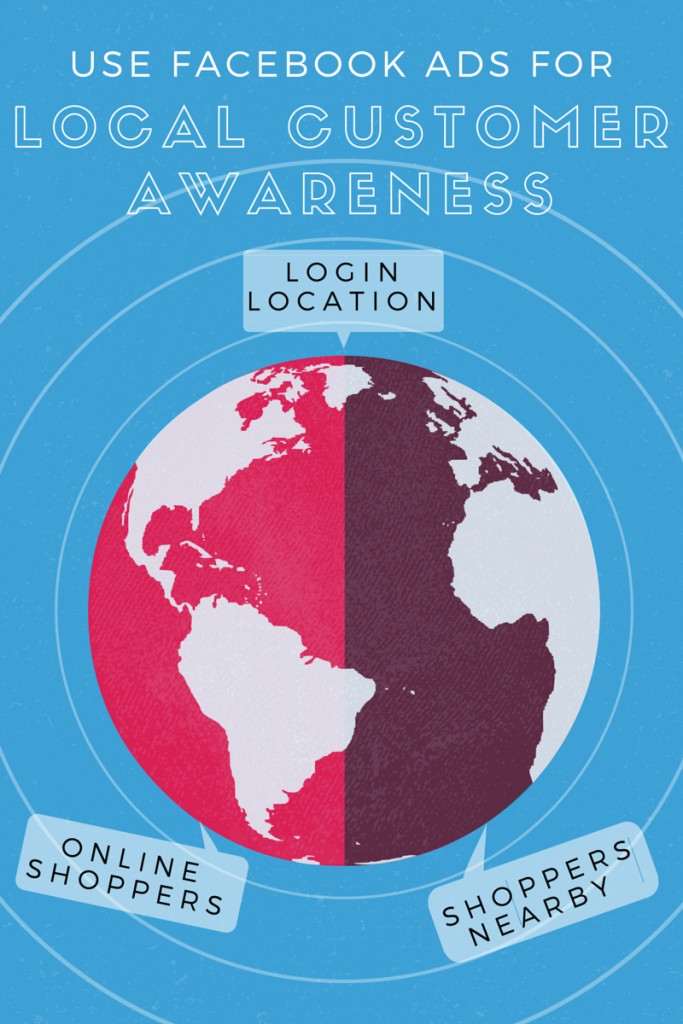
The first, and most important, step in creating one of these location ads is to define your target audience. The ad should follow two main parameters: the ideal target geographic location and the target audience.You can use different combinations of targeting methods, all of which should be closely monitored to see which combination perform the best. The audiences can be found by the user’s location when they log into Facebook,  the location of their recent shopping habits, even the online shopping location.

Location Awareness Ads

Step #2:

The next step is to create an incentive for your customer to physically show up at your door or contact you. Incentives could include promotions, sales, or giveaways. The key is to also include a clear call-to-action statement.

Step #3:

The last step is creating the ad design itself. The visuals should represent the Alaskan culture and be relevant to your community and needs to also fall within the brand guidelines of your company and the purpose for Facebook ad. For example, if you are promoting a sale, it would be a good idea to include an image of a sale tag on a product or in the store. If your multiple business locations look different, it would be beneficial to match each location ad to a visual of the storefront or building. We highly suggest A/B testing your ads so that you can get the best ROI for your advertising dollars spent.

It’s All About The Money:

Boosting your page’s posts and creating other Facebook ads can increase the engagement to your page, however, the Local Awareness Ads are proven to create the greatest return on its investment. Test it out for your business and share your results.

Before we share our three secrets to success with Inbound Marketing, It’s important that one has a basic understanding of what Inbound Marketing is and how it differs from, “Old School” or “outbound” advertising.

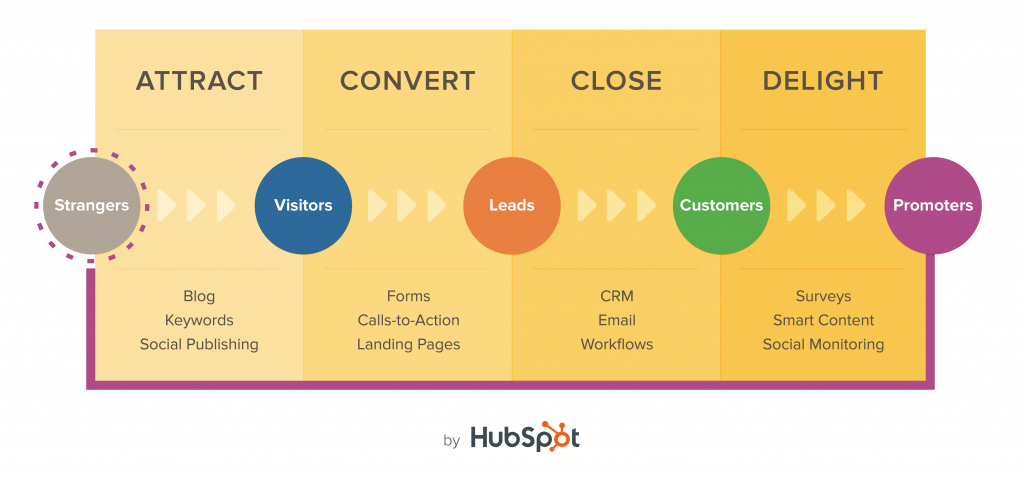
The concept of Inbound Marketing all boils down to common sense. It refers to online marketing activities that direct visitors to you (Inbound), rather than marketers having to go out to get a prospects’ attention (Outbound). Inbound Marketing earns the attention of customers, makes the company easy to be found, and instantly includes your company in the clients conversation of their needs. The Inbound approach draws customers to your website by engaging clients with interesting and valuable content.

“The Inbound Methodology is: The best way to turn strangers into customers and promoters of your business.” Hubspot explains.

When businesses begin to think like their potential customers, that’s when the lightbulb goes on. The statistics are overwhelming. 86% of the buying population no longer trust “outbound advertising” no longer are the days when a business can put out a message about themselves that doesn’t match what the client feedback and experiences are. At best, the message is ignored, at worst, it’s refuted publicly through social media channels. For example, GAP’s attempt last year to present a new logo and image was blasted by followers and fans alike until GAP actually pulled the new branding campaign and reversed its position.

Inbound Marketing

If potential customers don’t trust your business’ “outbound” message, you might ask what’s the point of marketing at all? This is exactly the point- the same people who don’t trust your advertising message do trust their friends reviews and recommendations at a whopping 77% and interestingly they trust Google’s recommendations even more at 92%… That’s where Inbound Marketing comes in. You are delivering information to people that they really are interested in, making sure your reviews and targeted placements are showing up in the correct searches so that they share it and recommend you to their friends. Basically, you are meeting your current and potential new clients where they are at instead of telling them to meet you  on your terms.

You may wonder how you can start applying this to your business.  Here’s Our Three Secrets to Success that have helped us grow our business over 300% and many other businesses in Alaska and beyond using Inbound Marketing.

  1. Learn about your customers. Its not just their demographics, but their interests, and their preferences. How can you start providing helpful information if you don’t know what they are interested in? If you are selling running shoes, your target demographic may be very interested in what the best running trails are in the area. If you are providing those answers and solutions to your clients deeper interests and needs- you will have raving fans indeed.
  2. Be More Helpful! When your potential client interacts with you whether it be on your website, Facebook or Instagram- Are you more helpful than your competitors? Is your website user friendly and easy for them to find what they need? Do you have videos explaining your product or service? Do you respond to questions on social media when they are asked? Being more helpful and easy to work with is a natural extension of the Inbound Marketing process. You’ve already gotten their attention by providing the information they are interested in- now convert them to clients by making it easy to do business with you.
  3. Master Your Niche and Delight Your Fans! If you really want to be successful using Inbound Marketing you need to know your stuff. Work to become an expert in your field and then share that information freely. At first, it seems counterintuitive to give away your expertise, but when you realize that it’s in the the very act of giving away helpful and useful information that establishes you as the expert and the person/company they want to do business with- then- it’s worth it. We’ve put this into practice in our own industry. We founded the Alaska Inbound Marketing Summit, which brings to Alaska the best of the best in the industry from Facebook, Google, Hubspot Partners, LinkedIn, Pinterest & more. This one day annual event with knock your socks off with Inbound Marketing knowledge. We’re giving away our knowledge, connections and best practices to potential clients and competitors alike. Our efforts in putting this event together have produced an incredible fan base, new clients, awards and speaking engagements all over the state. We’ve established our niche and hope to continue to delight our fans for many years to come.

I hope these three secrets of our success inspire you to jump in to this new world of Inbound Marketing. There’s no question that Inbound Marketing is winning the battle in the advertising and marketing world- more and more dollars are being spent on these methods and the stats show that the return on investment yields a triple return from traditional advertising. That’s great news for all my small and medium business friends- saving money on marketing and increasing sales is always a good thing!

If you have questions on how Inbound Marketing can or will help your business – send us a message, tweet, Facebook message, email or even a phone call (907-563-6008). We are truly thrilled and excited to help Alaska become a leader in Inbound Marketing’s best practices!

This week, we shared a video to our Facebook page about the elements of a successful Facebook ads campaign. This blog is a further breakdown of the metrics and best practices we discussed, containing graphs and images. We hope you enjoy!

What to Look For

When you open Facebook Ads Manager in the morning, there are two places that your eyes should go to first: click-through rate and cost per link click. These are, arguably, the two most important indicators of a successful Facebook ads campaign. Let’s dig into these metrics a little deeper–What they are and what numbers to expect.

Click-Through Rate (CTR)

Click-through rate (also known as CTR) is the percentage of people who clicked through to your ad after seeing it online. In the video, we opened the ad account of one of our clients–Brooklyn Birthing Center (BBC). Let’s use this account as an example once more.

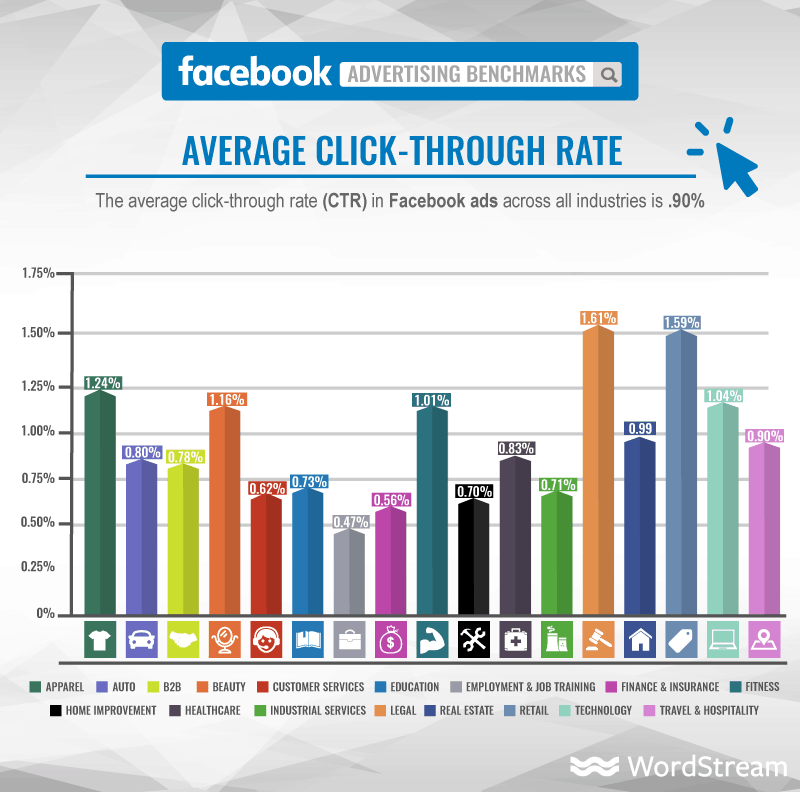
BBC falls within the healthcare industry. According to client research performed by WordStream, a search marketing company, the average CTR for the healthcare industry is 0.83%. The average across all industries is 0.90%.

Facebook Ads Manager: What to Look for and How to Make It Work

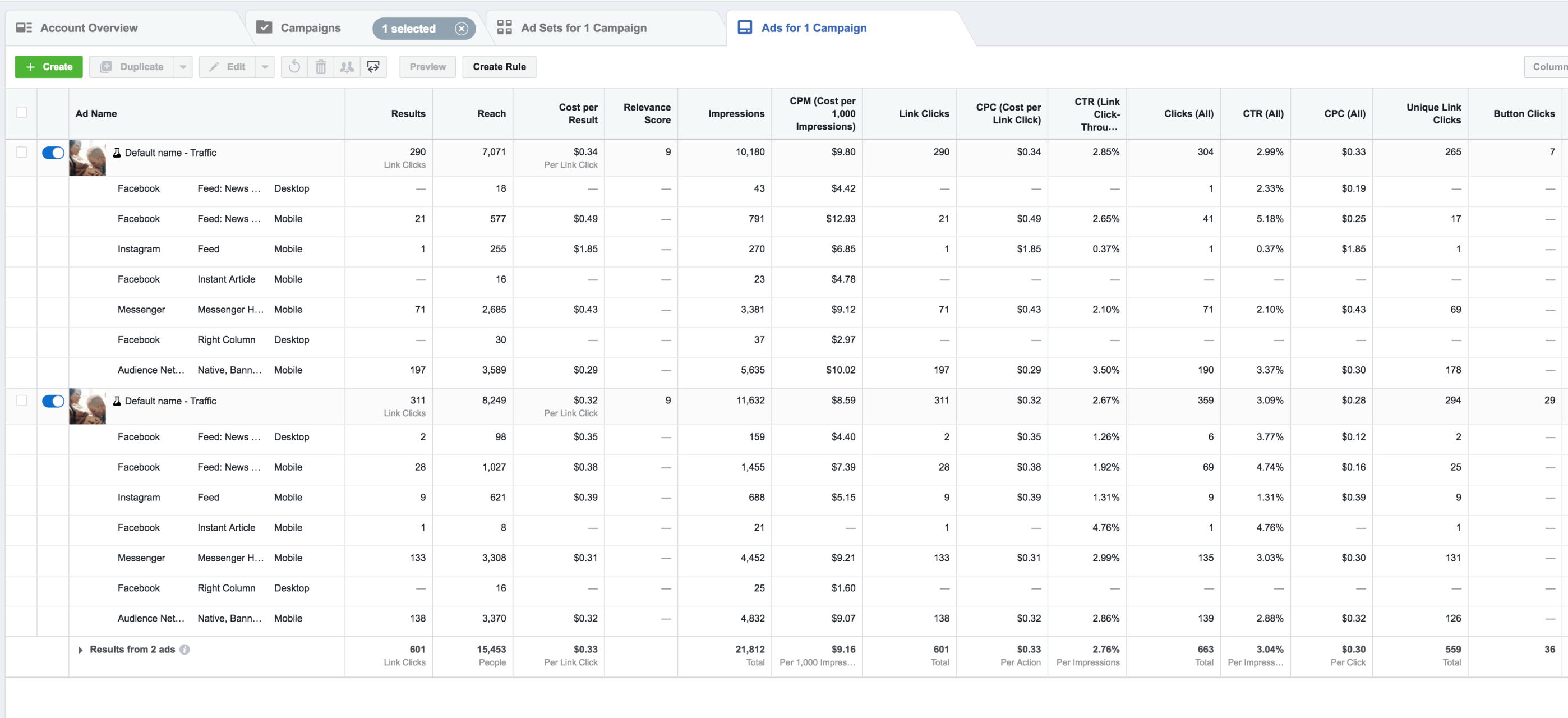
Taking a look at the ad account for BBC, you can see that our client’s ads outperformed industry averages by almost 3X (select image to zoom):

Facebook Ads Manager: What to Look for and How to Make It Work

A higher CTR is always better because it means that more of your target audience clicked on your ad rather than letting it pass by. Now let’s take a look at another important metric for the success of an ads campaign–Cost per link click.

Cost Per Link Click (CPC)

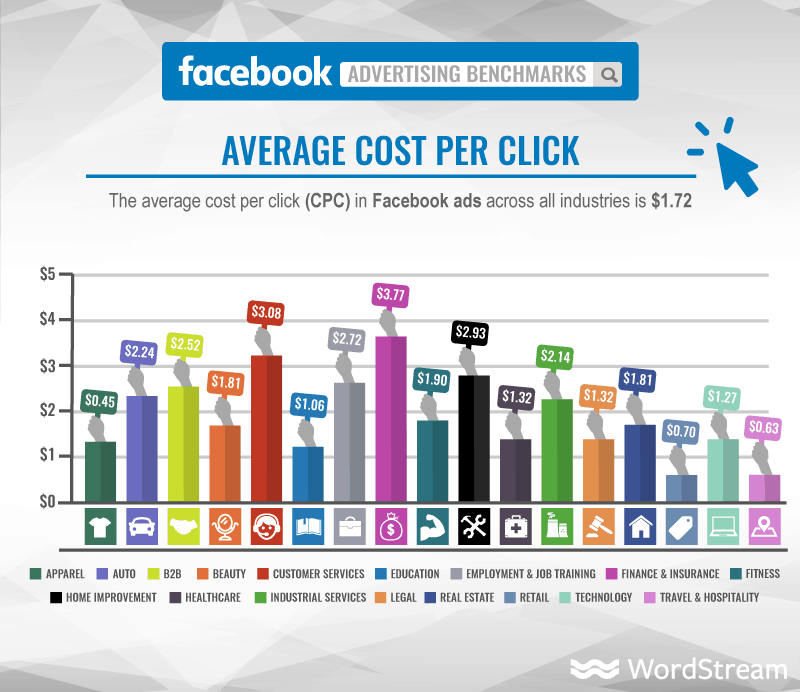
Cost per link click (CPC) is calculated by taking the budget set on the ad account and dividing it by the number of clicks received. A lower CPC is better because it means that you are getting more bang for your buck–More clicks for your budget. According to WordStream, the average CPC for the healthcare industry is $1.32. The average across all industries is $1.72.

Facebook Ads Manager: What to Look for and How to Make It Work

BBC is once again streaming past industry averages with CPCs of slightly over $0.30 (select image to zoom):

Facebook Ads Manager: What to Look for and How to Make It Work

Both CPC and CTR are great metrics to look at to judge the success of an ads campaign, but what if you’re just getting started, or your ads aren’t making the cut? Next we’ll discuss the elements of BBC’s ads campaign and what drove the numbers we are seeing.

How to Make It Work

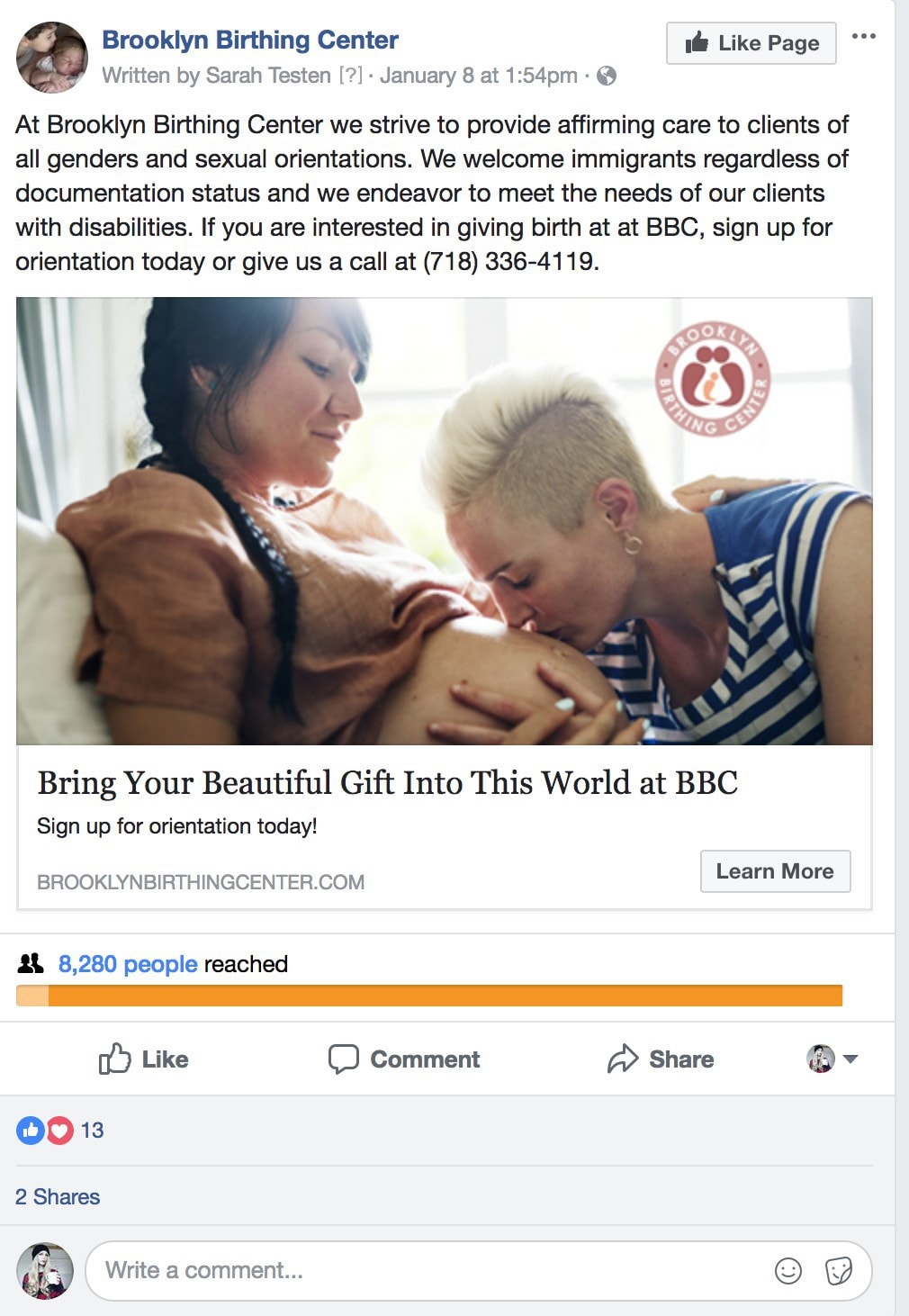
The ads we created for BBC were produced with a very specific target audience in mind–The LGBTQ community of Brooklyn. Having a well-defined target audience is one of the first steps toward success in any marketing endeavor. After we defined our target audience, we made sure that our ad contained the following content, all tailored to LGBTQ:

  1. Heartwarming imagery that they can relate to. The image in our ad (below) contains a lot of color, light, and a pregnant, lesbian couple–Perfect for our target audience!
  2. An actionable but digestible headline. Instead of saying: “Come have your baby here!” We chose a friendlier headline: “Bring Your Beautiful Gift Into This World at BBC.” Our headline is still a call-to-action (CTA), but it strikes a softer tone.
  3. As much information as possible, without the overwhelm. The content on our BBC ad is relevant (“we provide care to clients of all genders and sexual orientations”) and direct (“if you are interested, sign up today”). The goal is to give the target audience the information they need to proceed without drowning them in content.
  4. A couple options for contact. On our ad, we provide two ways to get in contact with BBC–a phone number and a link to their website (“Learn More”). We want to make sure that we don’t miss anyone because we didn’t provide their preferred method of contact.

Facebook Ads Manager: What to Look for and How to Make It Work

We hope that this breakdown helps you succeed with your Facebook ads campaign. May your click-through rate be high and your cost per click low! If you have tried everything and you are still stumped, give us a call. We would love to talk with you about how we can help you win at Facebook marketing. Cheers!

Inbound marketing operates on one basic principle: engage with your potential customer, and offer them value. While that “value” can be almost anything, for many businesses, it’s information. Even with the advent of search engines like Google, finding specialized information from a reputable source can be difficult. When that information is given out seemingly for free, there’s a lot of value there. White papers are a concise, visually appealing way of taking your specialized information and putting it together in a nice, value-driven package. All it takes is a simple landing page with a call-to-action for their email, and your white paper can generate lead after lead.

But what makes a white paper more valuable than others? Why are the best practices when writing and designing a white paper?

Don’t Make the White Paper About Your Product or Service

The number one mistake companies make when writing a white paper is that they use the white paper as marketing collateral. White papers are not intended to inform customers about your services or your company; they’re first and foremost to educate. If a white paper just talks about how great your program or service is without actually offering up valuable information that the reader can use, it’s worthless. The inbound way is ultimately about reaching out in good faith and giving away something for free. But by giving away some of that knowledge you’ve acquired over the years, you’re establishing a strong, positive relationship with future customers (aka generating a lead). So make sure to avoid using a writing style that’s too sales-y, and always emphasize being informative.

Gear Your White Paper Towards Your Target Audience

Because of their educational nature, white papers assume a certain level of knowledge on the reader. That knowledge level might be low, average, or specialized – it’s important to know which and write accordingly. Your target audience will strongly dictate how in-depth your white paper will be, how much technical or industry-specific jargon you use, and how casual or friendly your tone is.

Don’t Slack on Grammar or Design

A white paper is, ultimately, mostly made up of words. To ensure you don’t alienate readers (and thus nurture your potential leads), always ensure your writing is as strong as possible. Edit your white paper thoroughly, and instead of relying on your writing software’s spell checker, have a friend or colleague comb it for grammatical mistakes. Be sure and reference any material or information you borrowed from outside sources. For more formal or technical white papers, always use third-person when writing, avoiding the use of “I” and “me” which sounds more casual.

Of course, a visually-appealing white paper with strong layout design and applicable infographics will speak volumes on the quality of the content, as well. Though it may seem a waste of time to make your white paper more visual, it’s ultimately a fantastic excuse to brand the white paper. Use your company’s colors and fonts when possible to give your white paper a coherent look. Remember, if the information is useful, you want to associate that value with YOU as much as possible.

Ultimately, a white paper is only as valuable as you make it – and the quality and quantity of leads generated by it will match that value. Yes, you’re giving away something for free, but it’s that willingness to share knowledge and expertise that attracts loyal, life-long customers.

Friday was a great day for our business and one of our client’s business. The Inbound Marketing strategy we have put in place for this particular client has been paying off handsomely for their bottom line. In an industry that is ever changing, that is more about trial and error and a/b testing than proven formulas – wins that happen right off the bat are rare, but I’m noticing something interesting… they are becoming more common.

 We met with a relatively new client ( working together three months) to go over their stats. Here’s what we tend to look for in the area of meaningful numbers for our clients: 

1. Marketing efforts – How many people are we reaching through our marketing efforts? We had some great stats for that part of the conversation- About 18,000 a week through Facebook and Google targeted ads alone.

2. Click Throughs – How many of the targeted people we are reaching are clicking through to the landing pages? We also had some solid numbers on that as well – We had about 620 people clicking through to the landing pages on the website from those targeted ads per month.

3. Conversions – How many leads were being generated and how many are converting to new patients? Between their data and ours, we were able to verify an additional 20 new phone inquiries per week or 80 + per month.  Most of these calls were converting into new patients! 

4. Cost – What’s the cost per new patient generated, including ad costs and Beacon’s services? In this case, the ROI is staggering: $36 per new patient, each valued at over $1,300 annually. 

So how do great numbers like this happen in a short period of time and why am I seeing it happen more often? 

Based on our experience in working with over 100 digital and online campaigns in the past 3 years, all the stars need to line up for this to happen quickly. What are the key ingredients for the stars to line up? 

1.  Buyer Persona – The right message delivered to the right audience. Basically research, research and more research. Do we know who the target demographic is and what their pain points are? Have we accurately created the correct graphic and content in the right medium to send the right message to that targeted audience? *** Remember Inbound Marketing isn’t really about you, it’s about the audience for which you are providing a solution. 

2.  A great website –  Does the website have content that is meaningful, helpful and intuitive for the consumer? Will they actually want to do business with the client after clicking on the website? *** Your website is the foundation of your Inbound Marketing efforts. Without a solid website, you are wasting money to drive traffic there.

3. Conversion – Once you have reached the right target, provided the correct message and sent them to a solid landing page on your website – then what? Make it easy for them to do business with you. Provide good references and reviews that build credibility. Avoid long forms that require your potential client  to fill out just to communicate with you. Make sure your social feeds are connected to your website and that they can communicate with you there. Most importantly-that your phone number and map information is easy to find and accessible. Conversion is much more than a call to action. It’s about meeting the needs of your potential client, or patient in this case, before they even pick up the phone to call you. 

So, I mentioned above that we are seeing these types of fast results happen more often in the past 6-9 months then the last few years combined. I’m convinced the reason is twofold.

1.  Education- Business owners are becoming much more educated on the value of Inbound Marketing. There is an entirely different understanding in 2017 than even a few years ago. Instead of just budgeting for one of the stars to line up, like Facebook advertising or a new website- they are more willing than ever to put budget into their social media plans, websites and content management. They understand that meaningful results are based on a complete, Inbound marketing strategy, not just one piece. In fact, according to Forbes, 48% of national marketing budgets have shifted to Inbound efforts, from less than 20% 4 years ago.  

2.  Marketing Technologies – The rate in which digital media and targeted advertising has advanced in the past 6 months is mind blowing. Being able to target, on Facebook alone, people who are within 3 miles of your business, who have a certain income level, with interests that match your products etc. is a game changer – and that’s just ONE of the changes that we’ve seen. 

If your interested in the particular case study I’m referencing in this article, or if you want to build revenue from your website and social media presence- drop me a line at  [email protected], or check out our website .

Do you know how many people visit your website in a year, month or even a day? We’ve been tracking many of the websites that we’ve created over the last year and have some interesting results from Alaskan as well as global users. First, some general usage facts: 12% of the world’s population that lives in North American and Western Europe can account for 60% of the world’s private spending (www.worldwatch.org). As of 2015, internet usage has penetration the population of the US by 87.9%. For perspective, the average internet usage penetration worldwide is only 46.1% (internetworldstats.com). On the local sites we tracked, visitors came from 15 countries and 16 states.

One question that we ask is where are our visitors spending most of their time and how do they navigate the website? On average, our Alaskan visitors spend about a minute longer than the average user on each site. Home pages still rank very high on visits, but with limited time spent there. Consistently, the most visited pages of the sites we track are About Us and Contact Us. Most of our visitors are spending one to three minutes on the About Us page; this is quite a long time given that the overall average time a person spends on one page is under a minute.

Users’ attention span is shortening so your website needs to be a space where your visitors want to stay, — rather than move on to your competitor’s site. Creating a positive brand experience through a website can result in new connections and, in turn, business.
When creating new websites, we use a grid system, which is a framework for a dynamic and engaging design that isn’t too busy. Whether users know it or not, the grid is a key factor in creating that positive experience, or “aesthetic-usability effect.” Rob Szumski’s blog says it best: “the Aesthetic-Usability effect is the perception that more aesthetically pleasing interfaces are easier to use than less aesthetically pleasing ones.”

By tracking our visitors’ locations, time spent on a site and specific pages, and by creating captivating website designs, we ensure that our users are finding more valuable sources online, so we’re all getting results!

LinkedIn has become one of the most widely used Social Media platforms for many professionals. Unfortunately, we still notice that people, especially in the insurance fields, aren’t fully utilizing the tools that LinkedIn provides to make their profiles really stand out.

Some numbers for you to consider:

60,000 – Humans process visuals 60,000 times faster than text.

300% – The increase of links that posts get when they contain videos instead of just plain text.

67% – The percentage of consumers that believe that an image speaks more powerfully than product image or customer ratings.

40% – The percentage of people that will respond faster and more positively to visual information.

The numbers are pretty clear. Visual content is really, really powerful.

Facebook, Instagram, YouTube, and Pinterest are widely acknowledged as visual social media platforms. A lot of people make the mistake of thinking of their LinkedIn profile as a text focused platform and ignore its visual potential. The fact that LinkedIn purchased SlideShare- a visual content creator- in 2012 should tell you how much they value visual content. Their commitment to the “Don’t just say. Display it.” concept is solid.  Thanks to the introduction of Professional Portfolio on LinkedIn, you now have a wide variety of ways that you can add visual content to your profile.

No two professionals are alike and your profile should set you apart. Here are a few of the ways that you should be using visual content in your LinkedIn profile.

  • Your Profile Photo.

This one seems obvious, after all, it’s one of the first things they ask you to add when you sign up. But many people skip it with the intention of coming back to it later. Your profile picture is your online first impression though so don’t skip it! Make sure to choose a photo that shows you clearly and in a way that is consistent with the professional image you want to convey.

  • The Background Image

The background image that you choose creates an overall visual impression for profile visitors. This is a great way to make a statement about what you love or are passionate about. From your city’s skyline to your company’s brand, your options are limitless.

  • Publisher Articles

Articles are a lot like blogs. They’re a fantastic way to showcase your knowledge and expertise. But, without a strong image, your article is likely to be passed over. The last three articles that you publish will be highlighted on your profile. Make sure to choose header images for them that clearly reflect the topic of your article and stay true to your brand.

  • Summary

This is where you can highlight your experience and interests. You can easily add videos, photos, and slideshows in a way that will quickly become an online portfolio that anyone can see. This is a fantastic way to showcase your talents and accomplishment in an eye-catching and effective way. You can say you’re great at something as loudly as you want, but seeing is believing for many people and this is a great place to show them what you can do.
Another great way to use this section is to provide social proof of your skills. Screenshots of tweets referencing you or your company, awards, speaking engagements, online reviews….the sky’s the limit here.

  • Experience

This is very similar to the Summary section and works in the same way. But this is where you can show your journey and progress while highlighting what you’ve accomplished at each step of your journey. Sometimes the companies that you’ve worked for and learned from can be very powerful. Many company logos are instantly recognizable so be sure to use them.

  • Skills and Endorsements

Don’t just skim over this section. The first ten skills you list are shown with a small thumbnail of the first twelve people that endorse you. That means you can potentially have 120 images of smiling people saying that you’re good at what you do. Now that’s some indisputable social proof!

  • Recent Activity

When you upload a photo to LinkedIn, it’s added to your Recent Activity section. The more visual content you have in this area, the more powerful your profile becomes. This is the ideal area for you to show the world what you and your company are all about and let them get to know you. Photos taken at events, examples of what you or your co-workers are creating, staff highlights, or favorite clients are all great ideas. These images will make a strong impact on your brand identity so make sure to choose pictures and videos that highlight you in a professional way.

To begin sharing your professional achievements and increasing your LinkedIn presence, just select “edit” on your profile and then follow the prompts that are given in each section. LinkedIn is a powerful way to market yourself and therefore your insurance company.

If you want to learn more about using social media platforms to increase your insurance business and boost your marketing reach, keep an eye out for our classes or give us a call at 907-563-6008.


Beacon Media + Marketing, a leading Inbound Marketing Agency in Anchorage, Alaska, is delighted to announce the launch of their new brand identity and office locations.

In conjunction with celebrating the company’s 4th milestone anniversary, Beacon Media + Marketing elected to assess the viability of the current brand amongst marketing trends and company position. The key objective of the research was to understand how Beacon Media + Marketing could better reflect and communicate the innovation, creativity and company values through our brand. The result is a clearer positioning of Beacon Media + Marketing that reflects its evolution of the company in growth, size and innovation.

The new brand identity reflects Beacon Media + Marketings’ commitment to be on the cutting edge of marketing trends, best practices and design.” Courtney Moses, Art Director

“Beacon Media + Marketing has experienced some exciting growth in recent years, and our product and service offerings have evolved and expanded accordingly,” said Adrienne Wilkerson, President. “ We felt that as we approached more expansion and growth in 2016 that we needed a refreshed story to help us fully demonstrate our internal growth and innovative research and development team.”

The launch of the new brand coincides with moving offices into an expanded space at 3201 C street #302, Calais Building 1 and an additional Beacon Media + Marketing office scheduled to launch in August 2016 in Ohio.

Beacon Media + Marketing, founded as Beacon Publishing & Design, LLC in 2001 as a one person graphic and web design firm, expanded in 2012 into a powerhouse digital agency located in the heart of Anchorage, Alaska. We offer variety of proven solutions for our local and national clients including custom website design, search engine optimization, social media, content marketing, PPC, email marketing, app development, video production, photography and award winning graphic design, just to name a few.

Realizing the inconsistencies and lack of accountability business owners face when dealing with various mediaand marketing platforms, Beacon Media + Marketing was created with one purpose in mind – to create and implement successful marketing solutions that attract, convert and retain your customers.

Our, in-house, exceptionally talented team of 10+ is comprised of a mix of  tech savvy, business minded and creative people working together to ensure our clients success and growth in business! We love to “shine a light” into the world of  Marketing. We provide classes to educate on best practices, clear reporting to showcase the results of our marketing efforts and founded and sponsor the annual Alaska Inbound Marketing Summit to bring further awareness to our community.

This winning combination allows us to create marketing plans that are results driven and has led to many awards, including the 2015 Alaska Marketing Association’s Marketing Visionary of the Year. Most importantly it’s led to extremely happy clients!


Beacon Media + Marketing Announces New Partner, Lisa Brest

ANCHORAGE, ALASKA – Beacon Media + Marketing, Alaska’s Inbound Marketing Agency, announces a new partner and addition to the executive team, Lisa Brest.

As the new VP of Finance, Lisa will be responsible for the financial control and planning for Beacon Media + Marketing. Lisa brings with her an extensive history of owning, managing and scaling an Alaska company. Lisa has a degree from the University of Anchorage Alaska in Mathematics.

“I’m excited for this new venture in joining the Beacon Media + Marketing team. I’m impressed in the quality of the team, clients and the results of the product being offered. We have some audacious goals moving forward, and I look forward to being a part of them.” Lisa Brest, SVP Finance

“We are thrilled to welcome Lisa as our newest partner at Beacon Media + Marketing. We have grown, on average, over 100% per year over the past four years and Lisa brings with her the knowledge of scaling a company, financial planning, and experience that will help us achieve our vision of continuing to grow Beacon Media + Marketing locally and nationally.” Adrienne Wilkerson, Founder and President.

Beacon Media + Marketing, founded as Beacon Publishing & Design, LLC in 2001 as a one person graphic and web design firm, expanded in 2012 into a powerhouse digital agency of 12 located in the heart of Anchorage, Alaska. We offer variety of proven solutions for our local and national clients including custom website design, search engine optimization, social media, content marketing, PPC, email marketing, video production, photography, graphic design and award winning marketing.

To learn more about the company, visit their website here: https://www.beaconmm.com/

Contact: Jennifer Christensen
Phone: 907-563-6008
Email: [email protected]

This app is gaining popularity daily and has an incredible subscribing rate for users. Welcome to Snapchat. Maybe you’ve heard of the simple picture sending messaging app and its main audience of mainly millennials? Whether you’ve discovered this selfie centered app, or seem stuck using just one social media platform; you’ll soon see this app isn’t going away anytime soon. With over three hundred million users this app has quite the potential to help some businesses grow! However, before we get ahead of ourselves, how does Snapchat work?

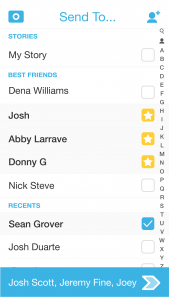
There are two basic parts to the app interface. First is the friends list. best_friends_new-591789648This tab categorizes your followers into a simple list so that you can keep in organized contact with them. Second is the Snapchat story.
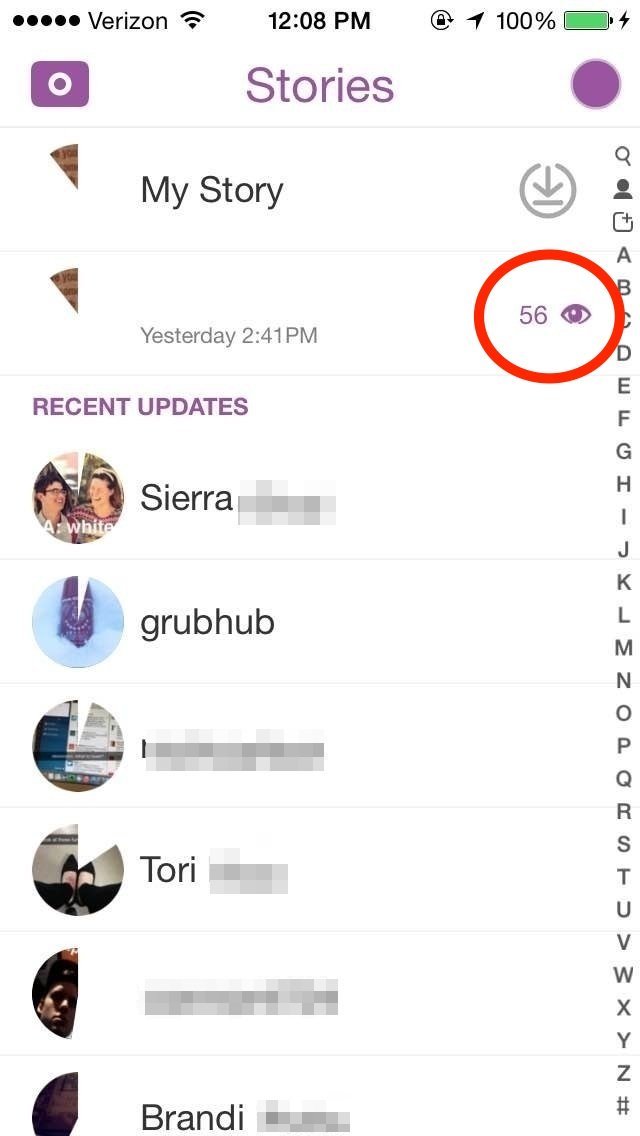
The Snapchat story tab is the unique feature that your business will focus on. Here you can post pictures or snaps to your story, which is a picture img_3675-6for all of your followers to view. However, this post only lasts for 24 hours; so constant maintenance of your business’ story is recommended. The story allows you to advertise a product to your customers. Here’s an example: If a café owner is running a business, they might take a picture of their latte of the day to draw in customers. Depending on the amount of followers your business has, you gain more views for the snap of your latte, which promotes your business.

To recap, Snapchat is new, fast moving social media channel targeting the millennial generation. Its ability for easy responding and free advertising options make it a very usable and powerful marketing tool. The downside is that it will take a significant time commitment to learn and leverage the tool and while it is growing rapidly, it is still has limited audience reach in terms of age demogaphics. However, with very few businesses taking advantage of the technology, it is a chance to be a marketing leader and try it out? If you are interested in talking about if Snapchat is right for your business, give us a call or drop us an email. We would love to sit down and chat with you.


What is a landing page and how can it benefit your medical practice’s website?

You may have a beautifully crafted website that contains valuable content and educational blogs; however, it is easy for visitors to get lost in all the noise. Creating landing pages is the best way to avoid visitors bouncing off of your website. You want to keep visitors’ on your site, exploring the services your clinic offers.

There are two main types of landing pages:

1) Click Through Landing Pages: The purpose of this page is to encourage visitors to click through to another page. A common example is a product or service page that provides information to the visitor that can lead them to towards making a purchase. The next page would be a shopping cart or registration page. Having the landing page, a step before the shopping cart, increases conversions by providing information that helps the visitor make an informed decision.

Screen Shot 2015-12-02 at 1.28.36 PM

2) Lead Generation Landing Pages: These pages are used to capture useful visitor information. The form can be as simple as asking for their name and email address. From there you can create a connection via email to continue future marketing. The forms are strategically tailored to gain personal data without damaging the conversion rates.

Screen Shot 2015-12-02 at 1.35.46 PM


What are the benefits?

The visitors can find the landing pages through a Pay Per Click ad on Google, a Facebook ad, or a sponsored/promoted post, leaning them to your site. The addition of these product/service pages will not only create a better user experience for your visitors but will also increase the conversion rates for your products or services, nothing but a “win-win” for both parties.

At Beacon we work with a variety of medical clinics to develop landing pages that help convert leads and increase calls to your offices. Give us a call at 907-563-6008 or email us at [email protected] and we’ll chat.

So, there’s the question. It’s one client rarely asks us out loud, but are often thinking about. “Am I paying too much for this online SEO stuff and how can I find out?”  To best answer that question, I want to explain my background a bit and why I am so fascinated by and love studying, learning and becoming an expert in this field.

My background in sales has given me a strong appreciation for performance and accountability. I started out in commission sales at 19 years old in the furniture and design industry. The commissions helped pay for college and provided a fantastic lifestyle for a 19-year-old student.  I loved the concept that my paycheck was directly related to my performance. There was no one else to blame if I didn’t close a sale and it was certainly a great feeling to be rewarded for providing a good solution for a client. At the same token, I was often suspicious of the marketing/advertising side of the equation in our industry. It seemed harder to measure the value of their performance.

When the ‘internet” age of digital marketing came into being my interest was peaked. Between pay per click advertising (PPC) and website ranking (SEO), I started to see a clearer path to measure performance and success for marketing efforts. It’s one of the reasons that I love digital marketing today. It’s performance based with incredible data provided for our clients and is easy to measure, adjust and improve month over month. For example, with A/B testing, we can measure the copy and style of our ads, website pages, and even graphic design. What language best appeals to a specific audience? For small businesses, where every dollar counts- this type of data and accountability is enormously important and helpful in growing their business.

In fact, for some of our top clients now, we are even using AI (artificial intelligence) to analyze the data results from their Google and social campaigns to provide an in-depth analysis. (You can imagine for a hardcore Star Trek geek in high school, how cool that is for me! )

Let me give you an example of what this means for our clients and how we can answer the question concerning what they are paying for digital marketing. Today provided a perfect real-life example of how we can measure this.

At 10 a.m this morning I had a pre-scheduled client meeting to go over their current digital marketing plan, PPC, social media, SEO, reputation management etc. We’ve been offering these services over the past year and have developed a good rapport and trust with our client.  We regularly go over the monthly reporting on web traffic, sources of clicks through and conversion rates from the generated traffic.

Today, we talked about an opportunity they were presented with to renew a contract outside of our services. They presented the numbers the vendor provided for the past year so that we could measure the effectiveness. The annual numbers showed 26,500 impressions for the advertising category, and 153 click-throughs to their website. We verified the 153 referrals from that source through Google Analytics. From the 153 referrals there was only 1 conversion ( click through to lead) The cost of the advertising placement was $900 per month/$10,800 annually. To determine to direct value of this particular digital advertising- we divided $10,800 by 153- That was an astonishing $70.82 per click through to their website, and with one conversion, $10,800 per lead.

In comparison to their other digital efforts: Facebook, Pinterest, PPC, and blogging are producing clicks through to their website at an average of $1.61 per click with conversions at $40-$82. Being able to measure and understand the numbers allowed them to track their success, compare results from different sources and make good marketing decisions. In this case, they decided the $10,800 was far too much to pay for that digital advertising plan. The monies would be better spent in an area that is getting over a 1000% better return.

This real-life example provides a solid foundation for answering the question “Are you paying too much for your digital marketing” The great thing about numbers is they don’t lie. If you know what you are looking for: cost per impression, cost per click and cost per conversion, then you can evaluate the effectiveness of this type of digital marketing for your business. For every business it’s different, a lead could be worth $200, $2,000 or $20,000. Now you have a way to measure the effectiveness of the money you spend to get the lead.

One note of caution, measuring clicks through to your website and conversions is just one part of your digital marketing plan. There is a strong value of creating a community on Facebook, generating a strong referral source, and reputation management where you ask clients to review your services on Google. I used the example that I did today because it is one very clear metric that you can use as a solid foundation for measuring your effectiveness in digital marketing campaigns.

Our goal, at Beacon Media + Marketing, is that all of our clients would understand the metrics and feel confident that they can make good decisions in spending their hard earned marketing dollars. If you want an independent analysis of your current digital marketing efforts- contact us for a free evaluation and an 8-12 page report provided by a Google Certifed team member. www.www.beaconmm.com or call 907-563-6008 and ask for Jennifer.