Skip to content


Prospective patients rarely make behavioral health decisions based only on what a practice says about itself. They may also read reviews, scroll through local Facebook groups, visit Reddit threads or ask for recommendations in online communities before contacting a provider.
These conversations can introduce someone to a practice they had never considered or shape the questions they ask during their research. A patient may see the same organization recommended several times, read about another person’s experience with a particular type of treatment or notice recurring concerns about scheduling and communication.
Behavioral health organizations cannot manage every public discussion, but they can pay attention to the questions people are asking and make reliable information easier to find. When a recommendation or conversation leads someone to research the practice, the information they encounter should help them understand their options and feel confident about the next step.
Do prospective patients find clear and credible information when your practice comes up in online conversations? Talk with Beacon about strengthening your behavioral health organization’s digital presence.
The Quick Take
- Patients often use online communities to learn from people with similar experiences.
- Recommendations and personal stories can influence which practices and services someone researches.
- Public discussions can reveal common questions and barriers to seeking care.
- Accurate website content, listings and profiles help patients verify what they have heard elsewhere.
- Practices should approach public conversations with respect for patient privacy and the purpose of the community.
Why Do Patients Turn to Online Communities?
Behavioral health decisions are personal, and a provider’s website may not answer every question a prospective patient has. Someone considering care may want to hear how other people approached treatment, what the intake process felt like or how they found a provider who understood their concerns.
Online communities give people access to personal experiences that are usually absent from formal service descriptions. Participants may ask for recommendations, compare treatment options, discuss challenges with insurance or learn from someone who has faced a similar decision.
Research published through the National Library of Medicine found that patients and caregivers often use information from online health communities as a starting point for further research and conversations with providers. Participants valued peer-generated information about treatment options, self-care and questions they could bring into a medical appointment, while recognizing that personal stories are anecdotal rather than clinical evidence.
For behavioral health organizations, this research reinforces the importance of understanding how patients gather information. A prospective patient may enter the formal intake process with expectations and concerns that were shaped by several online sources.
How Do Online Conversations Shape Patient Decisions?
An online recommendation may provide the name of a therapist, psychiatrist or treatment program for someone to research. The prospective patient may then visit the practice’s website, check reviews, look at provider profiles and compare insurance or location information before deciding whether to reach out.
During this process, consistency becomes especially important. When the website, directory profiles and reviews generally support what the patient has heard, the practice becomes easier to understand. Conflicting descriptions or outdated information can create doubts about whether the recommendation is still relevant.
Personal stories can also shape expectations about the care experience. Someone who reads several discussions about difficulty reaching behavioral health providers may pay close attention to how clearly a practice explains its intake process. Another person may be looking for signs that the organization understands their age group, identity, diagnosis or treatment goals.
Practices cannot confirm the accuracy of every personal account, but they can reduce confusion by clearly explaining their services, providers and patient process across the channels they control.
Where Are These Conversations Happening?
Online conversations about behavioral health take place across a wide range of platforms. The most relevant spaces depend on the practice’s audience, location and services.
Online Support Communities
Condition-specific forums, peer-support platforms and mental health communities allow people to discuss experiences that may be difficult to raise elsewhere. Members might ask about treatment approaches, managing symptoms, communicating with providers or finding local resources.
These communities can provide emotional and informational support, although the quality and accuracy of individual posts may vary. Practices should assume that patients may encounter a mix of personal experience, useful guidance and incomplete information while exploring these spaces.
Local Social Media Groups
Neighborhood groups, parenting communities and local resource pages often include requests for provider recommendations. These discussions tend to focus on practical concerns such as location, insurance, availability and whether a clinician works with a particular age group or condition.
Repeated recommendations may create valuable name recognition, but patients will generally look for additional confirmation before contacting the practice. An active website, current listings and clear provider information help support that next stage of research.
Reddit and Discussion Forums
Reddit and similar forums host both broad mental health conversations and communities focused on specific diagnoses, treatments or locations. Because many discussions are indexed by search engines, a thread can continue influencing readers long after the original participants have moved on.
The information in these spaces is often personal and may lack important context. Even so, the language people use and the questions they ask can reveal what prospective patients are trying to understand.
Reviews and Directory Profiles
Reviews give prospective patients access to other people’s impressions of communication, scheduling, billing and the general care experience. One review may have limited influence, but patterns across several reviews can shape how dependable and approachable the organization appears.
Patients may also use directory profiles to compare providers by specialty, insurance, location and availability. When those profiles are incomplete or outdated, they can undermine the confidence created by a positive recommendation.
Offline Recommendations Followed by Online Research
A physician, school counselor, employer, family member or friend may recommend a practice during an offline conversation. Most patients will still search for the organization afterward to learn more.
This makes the practice’s wider digital footprint an important part of referral marketing. The information people find online can either reinforce the recommendation or introduce new questions that make them hesitate.
What Can Practices Learn From Public Discussions?
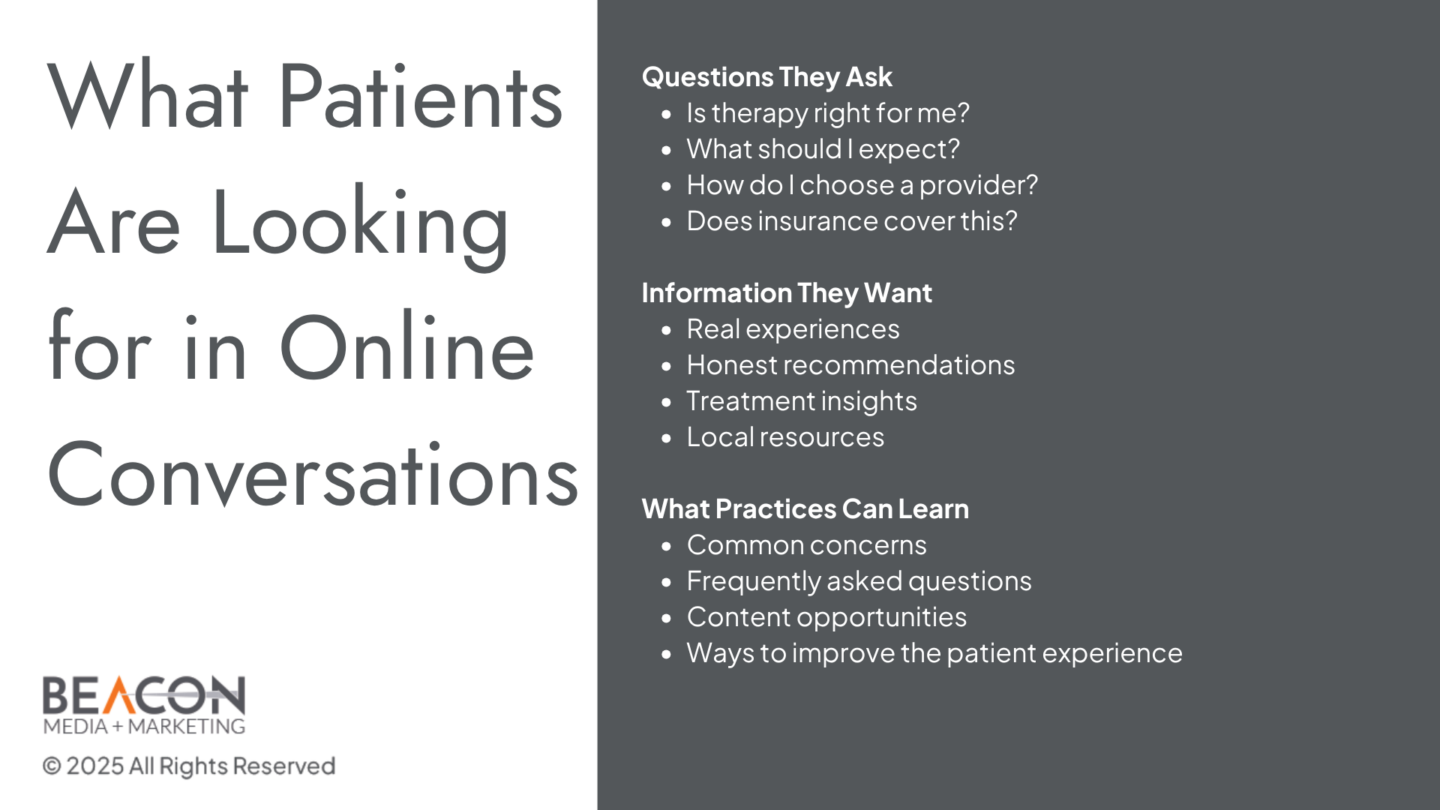
Public conversations can offer useful insight into how people describe their needs and what makes the process of seeking care difficult. Marketing teams should use these insights to improve general communication without identifying or tracking individual participants.
The Language Patients Use
Patients may describe constant worry, emotional exhaustion, trouble concentrating or feeling unable to cope rather than using a formal diagnosis. Understanding this language can help practices create service pages and educational content that feel relevant while remaining clinically accurate.
This doesn’t mean replacing appropriate terminology. Instead, practices can connect clinical concepts with the words prospective patients are likely to recognize from their own experiences.
Common Questions About Care
Public discussions frequently include questions about what happens during an initial appointment, whether therapy or psychiatry is the better starting point, how insurance works and whether telehealth is available.
When the same questions appear repeatedly, the practice can address them through frequently asked questions, videos, social posts and service pages. Clear answers make the research process easier for prospective patients and can also reduce repetitive inquiries for the intake team.
Barriers to Reaching Out
People may delay care because they are concerned about cost, privacy, availability or whether their needs are serious enough. Others feel overwhelmed by the number of providers and treatment options available.
Content cannot resolve every concern, but it can make the process feel more manageable. A clear explanation of intake, insurance verification, appointment availability and what to expect during the first visit gives patients practical information they can use.
Gaps in the Patient Experience
Reviews and public feedback may identify recurring issues with phone response times, billing communication or outdated directory information. When several people mention the same concern, the underlying problem may require coordination between marketing, operations and patient access teams.
These conversations can help organizations identify where the experience differs from the expectations created by their marketing.
How Should Behavioral Health Organizations Participate?
Behavioral health practices should approach online communities carefully because participants may be discussing private, emotional or sensitive experiences.
Respect Community Boundaries
Peer-support groups and discussion forums are primarily spaces for their members. Entering those conversations solely to promote the practice may feel intrusive and can damage trust.
When professionals are invited to participate, they should be transparent about their roles and provide general educational information. Public conversations should never be used to diagnose an individual, discuss treatment details or imply that a clinical relationship has been established.
Respond Thoughtfully to Reviews
Review responses should acknowledge feedback without confirming whether the writer is a patient. A brief response can express concern, invite the person to contact the organization privately and explain the appropriate channel for resolving the issue.
Prospective patients also read these responses. The tone and level of care shown by the organization can influence how they expect the practice to handle communication and criticism.
Correct Information Through Official Channels
When inaccurate information appears online, the best response may be to strengthen the information on the practice’s own website and profiles. If the error appears on a directory, referral page or community resource website, the organization can request a factual correction from the platform owner.
This approach gives future readers a reliable source they can use to verify what they have seen elsewhere.
Turn Recurring Questions Into Content
Questions appearing across reviews and public discussions can help shape the content calendar. A practice might create articles about insurance verification, differences between levels of care or what patients can expect during intake.
This allows the organization to respond to real information needs without inserting itself into personal conversations.
How Can Practices Strengthen Trust Across the Web?
A behavioral health organization’s reputation develops across its website, listings, reviews, social profiles and the recommendations shared by patients and community partners. Those channels should present a consistent picture of who the practice serves and how someone can access care.
Provider biographies should reflect the current clinical team, service pages should explain which patients and concerns each program supports and location profiles should include accurate contact information. Educational content can give prospective patients a dependable resource when they want to verify something they have read in a discussion.
Community partnerships can also expand visibility in a credible way. Schools, referral sources, professional associations and local organizations may introduce patients to the practice through educational programs, resource guides or direct recommendations. These relationships are most effective when they are built around useful information and genuine access to care.
What Will Patients Find After the Conversation?
Online discussions, recommendations and personal stories often begin the patient’s research process. The information provided by the practice determines how easily that person can continue.
Organizations that pay attention to recurring questions and concerns can improve their website content, directory profiles, intake communication and overall patient experience. When someone searches for the practice after seeing it mentioned online, they should find accurate information that helps them decide whether the organization fits their needs.
Beacon helps mental and behavioral health organizations build credible digital footprints that support patient discovery and trust across search, social media and online communities. Contact our team to strengthen your practice’s visibility beyond its own website.