January 30, 2020

Chart The Waters

Explore insights on SEO, AI, and digital marketing strategies designed to help your business grow, stay visible, and adapt in a constantly evolving online landscape.
Beacon_Icon_resouse

Originally published on November 24, 2015. Updated on January 30, 2020.

Welcome to the dark side. We have cookies.

Back when Facebook Ads were first invented, they used to be called “dark posts.” They were designed so they wouldn’t show up on your business page’s normal Facebook news feed, but in the news feeds of the people who you chose to target. They were launched in 2007 and they were revolutionary.

As you can imagine, they’ve come a looooong way since then. Today, Facebook Ads are some of the most sophisticated digital marketing tools businesses can use, because they allow you to maximize your budget by specifically targeting the people most likely to go on and become leads.

In other words, you shouldn’t be afraid to embrace the dark side.

Why use Facebook Ads?

The biggest advantage to using Facebook Ads is the fact that you can be very specific about your target audience and you can deliver your key messages directly into their hands (or pocket, as the case may be).

For example, if you run an HVAC business, you want to target homeowners in your local area who have the means necessary to pay for boiler and furnace replacement and repair. You wouldn’t want to waste your budget pursuing improbable leads like people who are renting or still in age brackets that are likely to live at home.

The Facebook Ads Manager allows you to drill down and be very specific. Facebook collects an enormous amount of data about its users, which means you can optimize your ads to appeal to people in a certain location, in a certain age bracket, or with certain interests. In that sense, it’s much more effective than traditional advertising methods that cast a wide net in the hope or capturing the interest of a few potential leads.

To continue with the HVAC example, you could optimize your ad to specifically appear in the news feeds of people living in Anchorage, aged 30-60, with an interest in renovation. It’s really quite amazing.
Facebook Ads

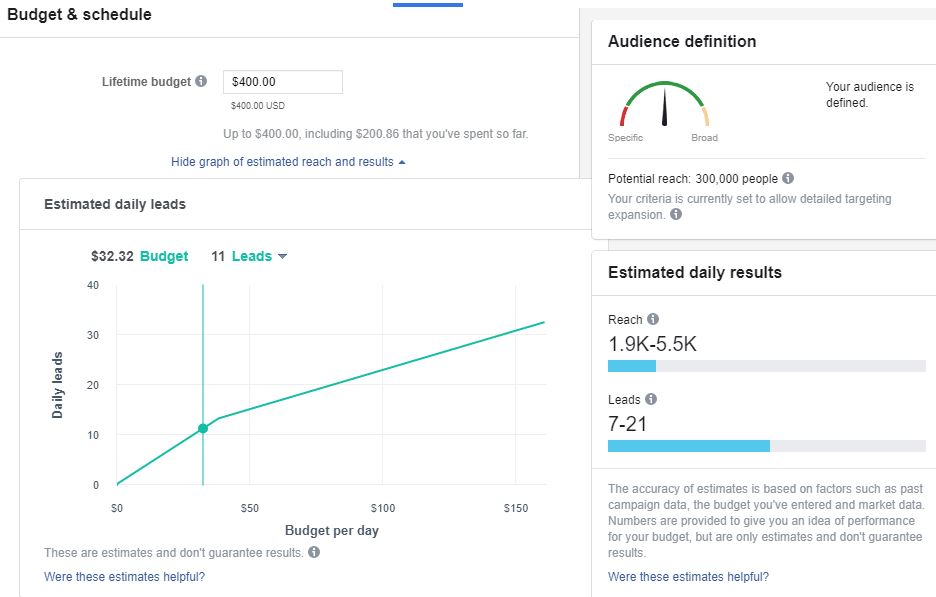
Facebook Ads are based on a bidding system. Each time you set up an ad, you can set a campaign budget and then set the maximum amount you’re willing to pay for your campaign goal, and Facebook will give you an estimate of what your daily leads will look like. It’s essentially a cost-per-click model, which means you have a lot of control over the amount of money you are spending and the way in which you’re spending it.

You can also tweak advertisements to achieve specific campaign goals. Perhaps you want to raise awareness, in which case you may simply want to make impressions. Perhaps you want to build your community, in which case you may want to target engagements. Or perhaps the thing that’s of highest value is direct clicks through to your website. These are all options you can tailor according to your campaign objectives.

Trust us when we say it’s a powerful tool that should be included in every digital marketing strategy.

Convinced? Great. Call us today to set up a free consultation.

Optimizing Facebook Ads

Another great thing about Facebook Ads is that they’re agile. You don’t have to “set and forget” them as you would with traditional advertising methods, spending huge amounts of money on TV commercials, radio spots or full-page newspaper advertisements. You can jump back into the back end at any time and tweak your advertisement to optimize its effectiveness.

It’s important to remember that your audience has to come first. You might have a bunch of great ideas to raise awareness and generate leads, but if you start spamming your target audience, you may put them off and potentially lose them. At best, they can scroll straight past your ads. At worst, they can unlike your page or even select the option to start hiding your ads.

With great power comes great responsibility, so use it wisely.

(OK, we have to admit we’re actually quite enjoying the superhero puns.)
Facebook Ads

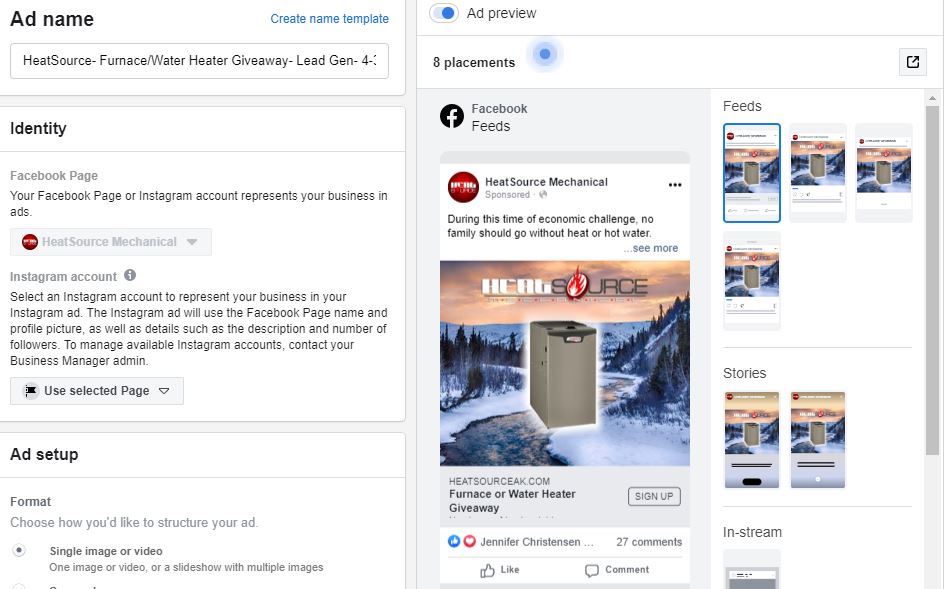
When you’re first starting out, you may find it helpful to try A/B testing. This is essentially when you try different variations of headlines, images, text and calls to action to see what’s going to work best.  Running two advertisements concurrently also allows you to target different audience sectors, which will help you find the “sweet spot” in the market that you can target in future campaigns.

It’s amazing how much the semantics of different combinations of words can impact the way your brand is perceived, and it may take a few tries to identify the perfect combination. A/B testing helps cut out a lot of the guesswork, because Facebook Ads Manager provides very clear reports both during and after each campaign that let you know exactly where you stand.

Not sure where to start? We offer social media marketing packages that will help you launch your campaign on the right foot. Set up your free consultation to learn more.

Understanding Facebook reports

Facebook really pushed advertising into the 21st century by taking the guesswork out of advertising. It’s no longer a matter of just placing a commercial in traditional media and waiting by the phone to see if it worked or not.

The Facebook Ads Manager homepage has a clear breakdown of results for each advertisement, looking at key metrics like results, reach, impressions, cost per result and amount spent. It makes it easy to see what’s working and what’s not so you can update your strategy and optimize your results.

(If you haven’t already guessed, managing a Facebook Ads campaign is a pretty hands-on process!)

Facebook 3

As you can see, it’s very clear and easy to understand.

This sample shows results for the “ad set”, but you can also click the different tabs to get an overview of how the campaign is performing as a whole and how each ad is performing individually.

If you’re a new company looking to advertise for the first time, or you’re new to the world of digital marketing, this is a great way to make sure you’re getting the maximum amount of bang for your buck.

Make sure you stay on brand

With all types of marketing, it’s important to keep messaging “on brand.” This means maintaining a consistent tone and style so your customers can feel like they are getting to know you. This is essential to building trust.

The other thing to remember is that social media is ultimately a fun and playful platform. It’s something people typically turn to in their spare time, not as part of their workday, so the information you provide needs to be valuable and entertaining. You’re targeting people, after all, not robots – don’t be afraid to inject some personality.

Hopefully this post answered most of your questions about Facebook Ads.

To quickly summarize the key points:

  • Facebook Ads are an incredibly powerful marketing tool.
  • Run A/B tests to see which combination of words and images is most effective.
  • Pay attention to your results and tweak things as you go.
  • Make your ads helpful and personable.
  • Remember the dark side is always much more fun.

Still have questions? Our friendly neighborhood social media experts would be happy to help you develop a strategy to grow your business through Facebook Ads. Schedule a free consultation.
We may not be able to take you skiing, camping or hiking, but we can help you grow your outdoor clothing and equipment shop so you can help others get out there! Read on to find out how Google ads put you right in front of your customers.

Google ads put your business at the top of the search results page, on the most used search engine in the world. Google accounts for 77% of search engine users and the first five results receive 67.6% of clicks, according to Forbes.

This means that if you want your business to be seen you need to be at the top of Google, otherwise it’s like you’re not on the internet at all. Here we’ll explain what Google ads are, and how they can help you get your business right in front of customers. We’ll also tell you what you need to know to get started yourself!

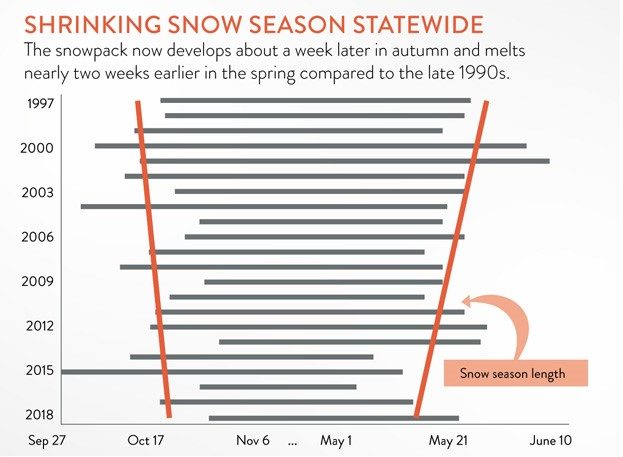
Since the outdoor equipment industry has been identified as an emerging sector for Alaska, now is the perfect time to grow your business. The sector is growing significantly due to a lessening in the severity of the climate. The Arctic is warming twice as fast as the rest of the world, and this has the result of reducing the length of the snow season in Alaska. As most visitors to the state come in the summer months, and many take advantage of the great Alaskan outdoors, you can expect to see an increase in visitor participation in outdoor activities.

What are Google ads?

That’s enough data for now! Let’s move on to what Google ads are, then we’ll look at how they can be useful for the outdoor equipment industry specifically.

Most people are familiar with the spooky feeling of seeing an ad about something you were only just thinking about. This happens because you’ve been targeted by something called “remarketing”.

Remarketing is the practice of having advertisements for websites or products follow you around the internet.

These ads can be generated because you visited a website, or because Google has determined your interests from tracking your online activity. As a business owner using Google ads, you can make use of this kind of advertising power.

There are two types of google ads:

  • Display ads: these pop up on websites, they are usually a graphic or image and can be identified by grey “advertisement” text above them.
  • Search ads: these appear at the top of your search results page and can be identified by a small green box with “ad” to the left of the URL.

Clicking on these ads charges the business who runs them, hence the name “pay per click” or “PPC”, which we’ll get into in more detail in the next section.

Paid ads are generally at the very top of the search results page, below them are the “organic” results. Here at Beacon, we recommend strategies for both paid ads and organic ranking for our clients.

Google search ads comprise only three parts: headline, URL, and description. Display ads, on the other hand, can come in up to 16 combinations of logos, graphics, headlines, and descriptions!

How do Google ads work?

When starting to look into Google ads, it is important to understand the algorithm, bidding structure, and cost. This is all managed through GoogleAdwords, which you will want to create an account for, which you can do here.

The Algorithm

You may have heard this magical-sounding term “The Algorithm” which has come to public prominence in recent years, related to platforms like Facebook and Twitter. Here we’ll explain what is meant by the word algorithm in the context of Google ads.

Google uses an algorithm to determine which ads you see when you search. In the fraction of a second after you press search, google takes an inventory of all the ad accounts that contain keywords or phrases used in your search.

Say you search for “outdoor clothing and equipment shop near me”. A business trying to increase their outdoor equipment sales will have ads on google which are included in the inventory search.

But how did they get it included in the inventory?

The business will have bid a monetary amount that they are willing to pay every time someone clicks on their ad. This makes it a sort of auction, and the winner is determined by two factors:

  1. The maximum cost-per-click (CPC) bid you have set
  2. The quality score of your advertisement

The second point here is very important.

Google is a business, they want to make money. The best way for them to do this is to provide quality content so that people come to trust and rely on their service. They have a near-monopoly on search engine use which they built by providing the best content to people.

The quality score is determined by two factors:

  1. Past performance of your ad, ad group, and account in general.
  2. The relevance of your chosen keyword, ad (title, URL, and description), and landing page to the search and to each other.

Let’s just explain the terms “ad group” and “landing page”.

An ad group is the group of keywords that you are trying to rank your ad for. The landing page is the page users “land” on after they click on your ad. The ad you write and the landing page should both use the keyword you are targeting and be focused on the topic you are discussing.

The factors we just discussed culminate in a simple equation that determines your ads final rank on the results page:

CPC Bid x Quality Score = Ad Rank

Google display ads work slightly differently, with bids made on ad groups, rather than keywords. You also have the ability to bid on impressions rather than clicks. Impressions are the number of times your ad was delivered, i.e. how many times it was “seen” by searchers. In this case, we talk about “cost-per-impression” or “CPM”.

How much will Google ads cost my outdoor clothing and equipment shop business?

We’ve mentioned that you will be charged every time someone clicks on one of your outdoor equipment business’s google ads.

The equation to determine the cost per click is:

Next highest ad rank/Quality Score + $0.01 = CPC

This means that the higher your quality score, the lower your costs. Again, this is due to Google’s own self-interest in providing quality to users. It is important to note that the CPC will never go above your maximum bid.

Can Google ads grow my outdoor clothing and equipment shop business?

Ok, we’ve covered the ways google ads works, but can they really grow your business?

The answer is, absolutely!

But it is not guaranteed.

It is important to understand the level of competition in the area you are targeting. Some industries, in certain locations, have more competition than others. For example, the CPC in the legal industry in anchorage, at Beacon HQ has been as high as $50!

Spending this amount per click is unlikely to be worthwhile unless you have very high profit margins, especially as a click is not necessarily a customer.

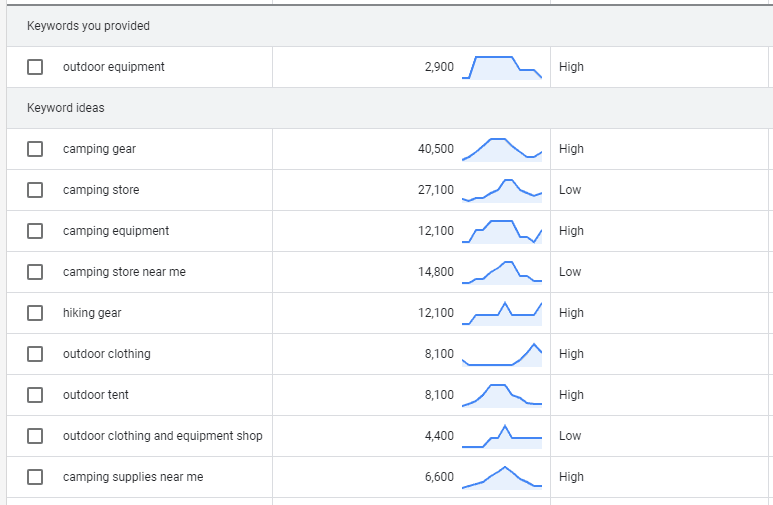
Keywords for “outdoor equipment” have quite high competition in our area, although the prices are still relatively low. We might instead choose to use “outdoor clothing and equipment shop”, which has low competition while retaining high search volume. Remember, you may find that the situation is different where you are.

A competitive industry shouldn’t discourage you, however!

We at beacon excel at creating quality ads, and that goes a long way to reducing costs and ranking your ads higher than the competition.

So, how do we do it?

  • For every service we want to advertise, we use a budget of at least $300 a month.
  • We always find some way to differentiate the services we are advertising by using more nuanced keywords.
  • Our team makes it a priority to create quality, relevant ads and landing pages.

Are you ready to give it a go? We hope this article will serve as a handy reference while you’re getting started!

On the other hand, our team is Google Partner Certified and we are constantly working to achieve the best results for our clients.

If you are interested in hiring Beacon to tackle advertising for you, you can schedule a free consultation, here!

You may have heard that blogging is important to growing your business, and it is. Here, we are going to cover some of the reasons why it is a useful tool for marketing in the Arctic Tourism sector and give some tips and tricks on how to do it best.

The main thing to remember about blogging is this,

Consistency is key.

Why should I put in the time to blog about arctic tourism?

If you want to see results you’re going to have to commit to regularly providing quality content to people. If you don’t persevere with it, then the work you do put in will be wasted. How will you know if you’ve succeeded? Most people never look beyond the first page of Google with one study finding that only 0.78% of searchers clicked on something on the second page of Google. Clearly then, it is necessary to get on that first page, and ideally at the top of it. But how? In this post, we’re going to cover some of the methods used by our expert marketers to get our clients on the top of the Google search rankings.

Hopefully, we’ve convinced you that getting on the top page of Google is important, but why is it specifically important for arctic tourism? Tourism is one of the few growing industries in Alaska, according to a 2016 report. This is partly the result of a lessening of the severity of the climate (the arctic is warming twice as fast as the rest of the world) and so-called “last chance tourism.” As more people start to look north for their next vacation, it’s time to position your arctic tourism business right in their eye-line, at the top of their search results.

Case Study: The Beacon Blogs

If you’re not yet convinced, let us take some time to show you we know what we’re talking about.

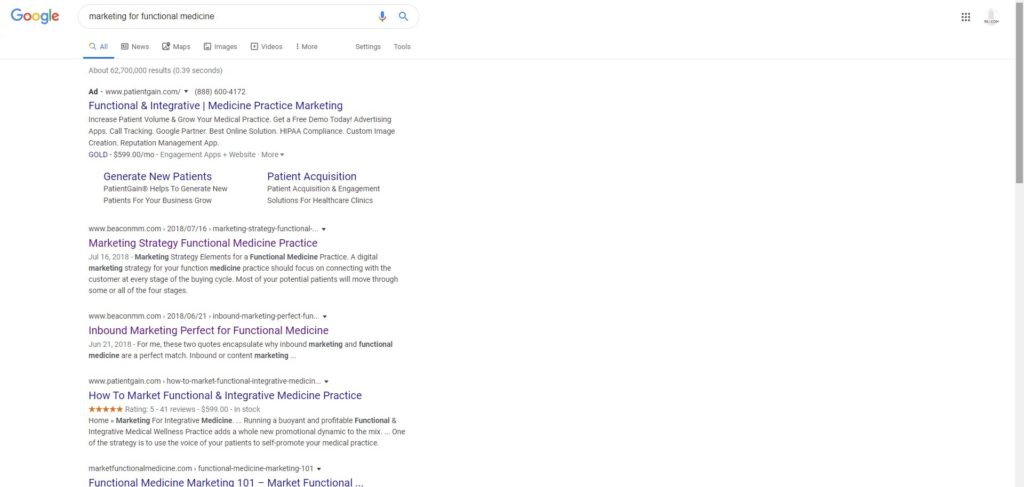
Two years ago we decided we wanted to move into the functional medicine industry, so, we started blogging about it. We wrote blogs about each of our services, heavily targeting the keyword “functional medicine”. Within a few months we had our blog posts ranking at both #1 and #2 on Google for the search “marketing for functional medicine”, and we’re still there. So, how did we do it?

We used a few simple tricks of the trade that you can also use on your own arctic tourism blogs. First, we wrote blogs of the specific length that works best for Search Engine Optimization (SEO), which we’ll discuss in more detail in a bit. Next, we had a focused keyword strategy. This involves writing certain keywords that you want to target in your text and headings. For the functional medicine blogs, these included “functional medicine,” “marketing,” “inbound marketing.” Finally, we ensured our posts were technically well optimized, they work on mobile, are fast-loading, and we’ve set the metadata. Metadata just means the information you provide Google about the contents of your blog so they can determine how relevant it is to searchers.

Although we ranked these two blog posts at the top of Google, that was only part of the goal. The main objective of this was to generate leads. By having these blogs at the top of Google, we generate more leads to our website which converts into more sales. These two blogs now constitute a key part of our sales funnel!

Case Study: The Mandanas Dental Blog

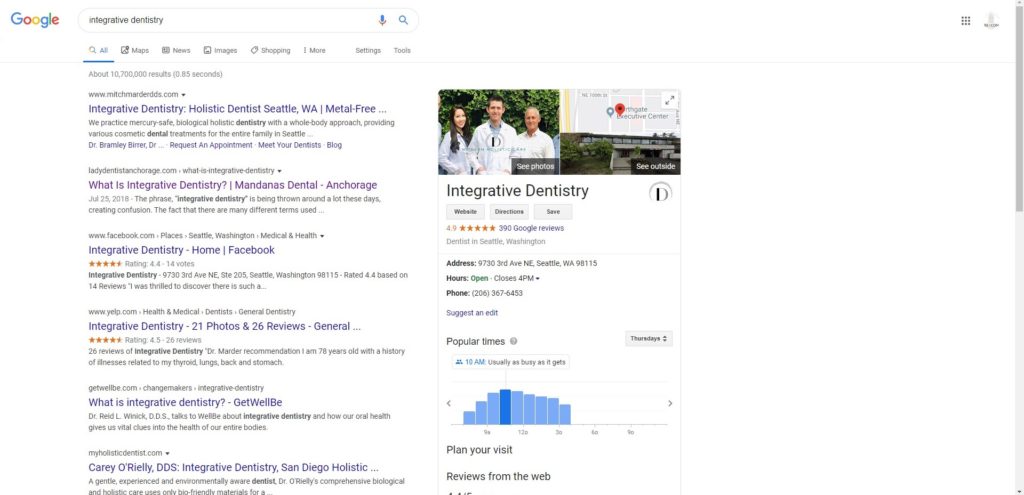
These techniques are not something we just keep for ourselves either! We’ve also used these strategies to help our clients find success. One of our longest-standing clients, Dr. Mandanas decided a few years ago that she wanted to start focusing on integrative dentistry. So we started blogging on the subject. Using the same techniques as for Beacon, we managed to rank Dr. Mandanas on the first page of Google. We were very happy to be able to achieve this for a valued client in a short time-frame.

This approach to blog writing uses the inbound marketing philosophy, which we’ll discuss in the next section.

Proven methods of blog marketing

In this section, we’ll discuss some proven methods for writing successful blogs, including the inbound philosophy, question answering, and the waterfall method. These are all techniques you can use in blogging for your arctic tourism business.

Inbound philosophy

The inbound marketing philosophy is a simple concept. People are online all day, every day–this means that putting quality content in front of them is easier than ever. The core tenet of the inbound philosophy is that if you consistently provide useful content to people, they will remember you and seek you out when they need your services. Imagine your customers are a cat. If you chase the cat it will run away from you, but if you have what the cat wants, it will come to you!

So, how do you go about enticing the cat? Begin by researching what your customers are interested in. There are tools available to help you find out what searches people are making on Google, we use one called Keywordtool.io. Once you’ve identified what people want to know, you can write blogs on it. People typically ask questions on Google, so answering these can be an effective way to provide quality content.

Answering Questions

We’ve established that people use Google to ask questions, so it’s super effective to answer them. If you’re the one people can rely on when they want to know something, they’ll remember you when they want to buy something. Here’s a quick rundown of our process for blog writing:

  • Keyword planning – We use Google’s own keyword planner to identify how many people are searching for certain things.
  • Finding questions – Next, we use Keywordtool.io to identify what questions people are asking about those topics.
  • Writing – The next step is the most obvious, write a blog answering that question!
  • Setting the metadata – We’ve mentioned this before, it’s basically the process of setting the title, description, and keywords in a format that Google can use to populate your result.
  • Schedule – It’s important to be consistent if you want the best results. We recommend to our clients that they blog at least 1-2 times per week, but even with a minimum strategy, you can see results in 6-9 months.

The Waterfall Method

The waterfall method of blogging is a highly successful, and slightly sneaky, trick for getting your posts to rank on Google! Google highly rates backlinks; that is, other credible websites linking to your blog. Links of this king act a bit like a referral, the website is letting Google know your post is reputable by sending people there. But it can be difficult to get links from other websites. So, we do what is called backlinking. This involves using your own website to provide links! A common way of organizing this, which you can use successfully for your arctic tourism business, is called the waterfall method.

Here’s an example of a waterfall we created for our mental health blogs:

As you can see, this looks a bit like a descending waterfall, with multiple layers all linked to one another (and to this blog too!).

Search Engine Optimization for blog marketing

Search Engine Optimization (SEO) can sound intimidating but really it’s a simple concept. SEO refers to the tools used to maximize your chances of getting highly ranked on Google. We make sure to set keywords that we know people are searching for. These are spread throughout the text and headers of the blog, as well as the URL of the page. It also means picking a title that is the perfect length, with certain power words that are shown to gain more clicks.

We hope this blog has given you an insight into how blogging can be a powerful tool for marketing your arctic tourism business. If you feel that you want to make use of our expert marketers for your business, you can schedule a free consultation. If you just want to get some more information, you can get in touch using our contact form. Thanks for reading, we hope to hear from you soon!