From The CEO

See Our Blogs

Explore insights on SEO, AI, and digital marketing strategies designed to help your business grow, stay visible, and adapt in a constantly evolving online landscape.

Beacon_Icon_resouse

I’ve been running one business or another since 2001, and there are a few things I’ve learned the hard way over the years. One of them is just how much a business challenges you to grow into a better version of yourself. Don’t get me wrong- you can start, grow, and run a business without allowing it to change you. You can be stubborn and force the company and the people in it to conform to you and your way of doing things. But if you let it be, there is so much more to it than that.

Running a business, a department or a team involves many challenges and dynamic professional and personal growth opportunities. As each one comes up, you’ll have the chance to embrace it and grow, or avoid it and probably have to keep repeating the same challenge over and over and over again. Perhaps that is the difference between people who just run a business and those who lead. People who lead want to grow, change, and become better versions of themselves. And you can find leaders in every layer and with every title imaginable in any business. Because, sadly, you can run a business and not be a leader. You can be a manager and not be a leader.

One of the hardest lessons I’ve learned over the years is admitting that I was wrong! I’m happy to admit that something isn’t working, and we need to pivot. I’m great at pivoting, but I don’t like to have to do it because I made a mistake. Talk about having to go around and around the mountain before I learned this one. There is nothing like leading people and running a business to expose every mistake you’ve ever made! In my younger years, I got pretty good at always explaining why that thing went the way it did, and I could usually skirt around the fact that I made a mistake. However, with some valuable help from friends and my business partner, I realized I was spending a lot of energy trying to come up with explanations to justify the mistake.

Let’s face it: running a business is about making mistakes, and that was a mindblower for me. There seem to be a couple of different types of business leaders that fall into this category. Some don’t want to decide because they fear making mistakes. So, they stay in the information-gathering stage and never seem to get enough information actually to move forward with any action. Others will also be afraid of making wrong decisions, so they refuse to and instead force or manipulate others into making the final call so they always have a scapegoat. Then others do what I did and find a way to explain away the mistake through outside circumstances or people. I’ve also seen the manager or business owner who is more than willing to make a decision, and if it goes wrong, they pivot and move on as fast as possible and hope no one remembers that they were the ones who made the call in the first place. They often gloss over mistakes and focus on the next step in the next phase.

Regardless of which one of the above resonates with you, let me share that one of the most significant areas of growth we have to make as leaders is to embrace making mistakes. As leaders of a business, a department, or a team, we make A LOT of decisions daily. Facing decision burnout is a real thing. In fact, it’s such a thing that leaders like Steve Jobs and others wore the exact same thing every day to eliminate a decision they had to make that day. They recognized the importance of the limited number of decisions “in them” on any given day and worked to maximize their focus on the ones that mattered.

So, we make a lot of decisions every day. What happens when we make the wrong ones and failure occurs? For me, I had to grow and shift the entire way I looked at mistakes and failures.

The story goes that once someone asked Thomas Edison if he was daunted by how many times he had failed at creating the light bulb, he responded, “I have not failed. I just found 10,000 ways that don’t work.”

Some people seem born with this mindset; I had to learn it. I had to start with three words that were some of the hardest for me to say… “I was wrong.” Or “I messed up.” Either version was oh so hard, but to be honest, I found freedom in owning the mistakes instead of investing so much energy in trying to explain them away. I embraced Edison’s mindset and even his words. I started realizing I could own that I messed up and acknowledge that it didn’t work, and I could try again; it wasn’t the end of the world.

Talk about a game-changer!

It felt like a muscle that got stronger the more I worked it, the more often I said, “I messed up, and that didn’t work. Let’s try again. Let’s try a different way.” And it became more like second nature to own my mistakes and failures and to be able to learn from them and move on to something even bigger and better!

Dr. Nelson Mandela said it well, “I either win or I learn.” And trust me, when building a business and running a team, you will learn a lot.

The more I owned my mistakes and failures and looked for ways to grow, the more incredible things started happening in Beacon. My team also started feeling free to own their mistakes and failures. Instead of judgment, we found a new level of respect for each other. Because guess what? We all knew when someone messed up, and we usually knew who it was and why. So many times, it’s only you who thinks no one else knows that you messed up. But when someone, especially the leader, won’t own up to a mistake or failure, it handicaps the entire team and limits everyone from learning and growing. Many leaders believe they will lose the respect of their team if they admit they made a mistake. I’ve not found this to be accurate; if you have, then you probably have the wrong team, or it will take a while to shift your internal company culture. But that shift has to come from us first as the business leader. It takes courage to be the first to own failure, but the reward is so worth it.

Another profound outcome was that we all started making more mistakes. I know that it sounds counterintuitive to call that profound, but it was. Why? Because we were making more mistakes because we were trying more new things, we were innovating and pushing our boundaries. When we let go of the fear of failure and mistakes, we found the freedom of expression, adventure, and the unknown that led us to incredible new places and discoveries. But if we are so bound by our fears, failures, and mistakes that we won’t try coloring outside the box, we will forever be bound by the box and our mistakes! And that is a miserable, dead-end place to be.  

It is worth pointing out that there are different kinds of mistakes. Some come from pushing the limits and growing, and then there are the mistakes that come from laziness, fatigue, burnout, incompetence, a heavy client load, and more. They are similar but oh so different, and when a company is growing fast and/or there is a lot of change in an industry, it can be hard to tell the difference between the two. The first step is owning the mistake, then you can identify if it was the result of innovation or negligence, then you can figure out what you and your team need to learn and adapt to.

It is our responsibility as leaders to create a culture of learning and innovation, which means we must encourage mistakes and failures. They will always go hand in hand. As leaders, we get to be the first to step up and own our mistakes. We must have the courage to say, “I messed up. Here’s what I learned, and here’s what we’re going to do differently next time.” And when we lead this way, we hold space for our entire team to do the same. Commit to this type of change and watch it transform your company, team, or department!

One of the biggest challenges visionaries and founders often face is the transition to President or CEO. According to a Harvard article “By the time the ventures were three years old, 50% of founders were no longer the CEO; in year four, only 40% were still in the corner office; and fewer than 25% led their companies’ initial public offerings.” Those are some pretty sobering numbers, even if you never expect your company to go public. So why is it so hard for founders to transition to being CEO’s? We’re going to tackle this in several parts, so welcome to part 1 where we explore what it means to be a founder.

What does it take to be a good founder?

In my experience, there are two basic types of founders. The first are those who have already been making a product or providing a service at another company and they decided they could do it better on their own, these are often the technician or production founders. The other is someone who sees a need or a problem they believe they can fix so they set out to do that-the how is almost irrelevant, these are the visionary founders. Both types of founders want to provide quality and value to their clients and both want to make a difference in the lives of others.

In either case, it is important to know that flexibility, innovation, and adaptation are key elements that make a good founder. Regardless of whether you’re already an expert at creating the widget or you’re figuring out a better way to solve a problem, you will have to innovate, test the market, and adapt.

So what does it actually take to start a company? When I think about the early years of Beacon and what got Jennifer and me through I think of the following skills:

  • Scrappy: We were always willing to do whatever it took to make things work and since we were self-funding our own growth we never had enough cash flow. This forced us to get scrappy and creative. We had to do many of the early office renovations ourselves and enlist the help of friends, family (thank God for my husband’s construction skills), and employees. We all pitched in to assemble and move furniture, paint walls, and whatever else needed to happen.
  • Innovative: This one is similar to scrappy but different in my mind. Innovative has more to do with generating creative solutions to challenges the industry was throwing at us. We were first to market in Alaska as a digital marketing agency and there weren’t a lot of models to follow so we made it up as we went along. For example, we realized that since social media marketing was a new concept to Alaska, we had to do a lot of education as part of the sales process, and that education didn’t stop after the client signed. So we started offering marketing classes to the public and made them free to our clients. We taught them how to do what we did. This quickly increased the understanding of the public on the benefits of digital marketing and improved our clients’ understanding of what they were paying us to do every month.
  • Perseverance & Grit: Starting a company is hard. It just is. Anyone who tells you differently is trying to sell you something. Don’t get me wrong, it is one of the most rewarding things you’ll ever do, but almost nothing outside of raising kids will leave you so frustrated and sleep-deprived. To start a company you have to have grit, that willingness to do the hard things, and the perseverance to do it day in and day out. There are really big highs and truly deep lows and you honestly have to be seriously stubborn and refuse to stop working toward your dream.
  • Naïve: This might sound weird to some, but if you’ve ever started a business before you’ll relate. There is a strange, blind naïve that comes with being a founder. You’re just sure everything is going to work out. Just because it didn’t for that other person…well you’re sure it will be different for you, because it’s you. There is a blind faith amongst entrepreneurs that we will achieve our vision, even if we can’t tell you exactly how. This was certainly true of Jennifer and I as founders. We started Beacon in 2012 with no money, just the belief that this was a huge opportunity for small businesses and we were the ones to help!
  • Visionary: This is one of the hallmarks of a good founder….vision! When Jennifer and I merged businesses it was because we had a vision for how much digital marketing was going to disrupt traditional advertising and how it could transform marketing for small businesses. We could see the change that was coming and we wanted to bring that change to bear for small businesses.

Being a Founder

Starting a company is often something that comes as a response to a need or a problem, rarely do any of us founders start a business because we want to get rich. Money is a helpful tool but it isn’t the why that drives most of us to start a business. The founding years are times of a lot of hard work and investment of time because we believe in our cause. This is why the list of traits for a founder are so important and you’ll notice the desire to make money isn’t on that list. Yes, we all need to make money, it keeps the lights on and enables us to feed our families and pay our employees (very important things), but it won’t get us through the early challenges and sleepless nights.

What does get founders through is a cause bigger than themselves, a knowledge that they are making a difference. The belief in this cause is what fuels us to push through situations that would stop most people in their tracks. A new company needs a founder who can inspire people to come and join the cause. A person who can see the vision and who is willing to try new things, fail, learn, and try again…over and over again. Founders tend to create a company around them; their vision, their style of communication, their working style, and typically the founders know everyone in the company. This works great when a company is just starting but there will always come a time when a founder needs to decide what the next step is for their company. Come back for part 2 as we explore what happens when a company starts to out-grow its founder.  

How does it effect a company culture when it’s leaders are willing to “jump off the cliff and build the airplane on the way down?” 

Entrepreneur: Someone who jumps off a cliff and builds a plane on the way down.

I can’t remember where I first saw or heard this quote, but I’m pretty sure it was on Pinterest back in the day when Jennifer and I first merged businesses. Needless to say, it resonated and it is something I’ve used a lot over the years in an attempt to explain our crazy culture.

To say Jennifer and I are comfortable with risk is the understatement of the decade, especially when we started in 2012. There is a blissfully naïve element to every entrepreneur, we’re sure we can make it work—no matter what. We’re sure we can overcome whatever obstacles building a business throws at us and as our Chief Revenue Officer, Ken Okonek, says—we always bet on ourselves.

I’ve heard it said that if an entrepreneur really knew what it was going to take to start a business then they probably would never do it; that our naivety is really the only reason we think it’s reasonable to build the plane on the way down, but call it what you will: eternal optimism, naivety, blissful ignorance…whatever: it doesn’t change the fact that being willing to “jump off the cliff and build the airplane on the way down” applies to so much more than starting a business, it is about building the business too. To scale a business, especially scale it aggressively, you are going to have to be constantly innovating. This means you and your teams are going to have to jump off the cliff again and again and again.

Bold. Innovative. Courageous. Daring. Visionary. Pioneering. Resourceful. Driven. Motivated. Determined. Adventurous. Risk-taking.

These are all words that inspire us. We like watching movies where the hero is all of the above and triumphs against all adversities and obstacles. It inspires thoughts of being a part of something greater than ourselves; of making a difference in our world. I have come to realize there is both a light and a dark side to this level of comfort with risk. There are challenges of course but benefits as well.

What are the cons or the challenges we’ll face?

Uncertainty: Embracing this approach means operating in a highly uncertain environment, which can lead to unpredictable outcomes and risks.

Resource Constraints: Building the airplane on the way down requires significant resources. Resources don’t just mean funding, thought that is usually the most important. Resources also means getting the right team togther as well as all of the other resources necessary to build a product or offer a service.

Adaptability: Companies must be able to pivot quickly and consistently in response to changing circumstances and new information.

Risk of Failure: People must be prepared to accept and learn from failure, and there is always a high risk of failure in this approach.

Pressure and Stress: The high-stakes nature of this approach can lead to significant pressure and stress for company leaders and employees.

Lack of Structure: Operating in a highly uncertain environment can lead to a lack of structure and clarity, which can be challenging for leaders and employees to navigate.

What are the pros? Are there benefits?

Rapid Innovation: Embracing uncertainty and taking bold risks often leads to rapid innovation and the development of groundbreaking products or services that can improve people’s lives.

Adaptability: Companies that embrace this approach are often highly adaptable and able to pivot quickly in response to changes.

Competitive Advantage: The bold and unconventional nature of this approach provides a competitive advantage and the ability to differentiate in a marketplace, even a busy or overcrowded one.

Learning and Growth: Embracing uncertainty and taking bold risks can lead to significant learning and growth opportunities.

How does that affect your team?

Here are some of the things we’ve struggled with and worked on improving and addressing over the years.

How do you find the right people who are willing to jump with you? Is always a significant challenge for several reasons. Firstly, people who are willing to jump and build the airplane with you are rare. Finding people as comfortable with risk as you are is understandably hard. There is a saying that if it was easy, anyone could do it. The fact that it is hard is part of the reason it is the select few that succeed at it. So have some grace with the people you recruit if they are less risk-tolerant than you. In fact, it is good to surround yourself with people who are a little more hesitant to jump than you. My co-founder, Jennifer, and I have always laughed that while we are both willing to jump off the cliff, she is usually first and I’m usually right behind her after I grab a few things or at least make sure I throw some tools down before me. It is actually vital to the success of any endeavor to have a balanced team and make sure to staff your weaknesses.

First, you have to identify and own your strengths and weaknesses as well as those of your team and then you have to staff them. The key is a balanced team. You want people with various levels of comfort with risk and change. If you have an entire team who is all rushing to be the first one over the edge there is a very strong chance you won’t have any tools or assets to build anything on the way down. A balanced team increases the chances you will have enough of both to make a pretty passable airplane before you hit the bottom. The challenge with a balanced team is that you are combining people with opposing strengths and skills to create balance and that can create friction. Now don’t get me wrong, I believe friction can be a good thing. But if you haven’t created a team that is comfortable with constructive conflict and has enough shared values to find the most creative and effective solution as a result of that conflict, then you will just have friction and nothing will get solved.

In an article published in the Harvard Business Review, Dr. Amy Edmondson coined the term “psychological safety” and it is a concept that has gained a lot of traction in recent years. While even Dr. Edmondson owns that it is more art than science, the idea of creating an environment that is safe for people to express their ideas, concerns, and to even try and fail is paramount to high-functioning teams. I would say that without creating an environment of psychological safety it is virtually impossible to have constructive conflict. Instead, you will have avoidance and a lot of drama going on under the surface that undermines the team’s ability to build that airplane, let alone be comfortable with jumping off the cliff.

Balance is imperative to every high-functioning team, but it is also important that you have the right combination of people and you understand each person’s comfort with change otherwise you risk burnout.

Our employees who are less risk-averse have told us over the years that they often feel a little more intimidated to raise their hands in various situations because they don’t want to hold the team back or be the wet blanket as it were. So as leaders, it falls to us to go the extra mile to seek out their thoughts and perspectives. We need to make a point of making sure they are heard.

Having a company culture that values risk-taking and pivoting frequently also leads to the potential for high burnout rates. Often the burnout first shows up in those less comfortable with risk and they are your warning sign of trouble ahead. I have found that when you have leaders who like to jump first and figure it out on the way down, sometimes they are halfway down before they realize half their team isn’t there with them, they are burned out at the top of the cliff. Leaders need to take steps to plan for the inevitable burnout for themselves and the team.

One of the ways to keep burnout from taking over is to keep the vision alive and your why in focus. There needs to be a very good reason why you are taking the risks and bringing everyone else along for the ride. If it is just the adrenaline rush of taking risks everyone is going to burn out, you included, and for what? What was the goal? What was the purpose for all of the stress and sleepless nights? As leaders, we must keep our why in focus for ourselves and our team lest we lose everything in the rush.

Most founders tend to be the type of people comfortable with a lot of risk, otherwise they wouldn’t have started a company in the first place. Keep in mind that you need to hire some balance into your team to be able to build a company that is successful in accomplishing the goal. As founders who are natural risk-takers, we need to own our weaknesses and hire to balance them out. Once you get the right team in place make sure you stay hyper-aware of the pros and cons and how a company culture that is comfortable with risk can lead to burn out.

Originally published on August 3, 2013. Updated on May 31, 2019.

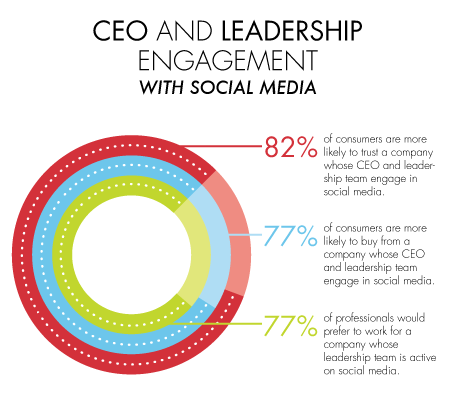
So you want to be a connected CEO? You want to take the plunge?

Great! But where do you actually start?

Corporate social media 101

  1. Make sure your company has a social media policy that both the PR and HR can agree and live with. Then stick to it. This may seem obvious, but depending on your industry, there can be some tricky areas to navigate when communicating via social media.
  2. Decide which social media platforms you want to “own” as the company’s CEO. There is a lot out there and it’s easy to get burned out. We recommend picking three to focus on and master. We also recommend checking with your PR/Marketing department to find which ones they believe to be the most effective for your company and industry.
  3. Be consistent! It would be better to not do social media or only use one social media outlet than to be sporadic. Set up yourself on a schedule for posting and/or blogging. Some social media platforms like Twitter take a lot more time and should have multiple posts a day to be effective, others like a blog could have one post a week.
  4. Establish and maintain a voice. Social media is just that, social. It is all about conversations. Be yourself and communicate the way you would naturally do with a friend or colleague. People want to connect with the real you, they are looking to feel connected to you and therefore the company you lead.
  5. Finally, we highly recommend having a least one person who can be a second pair of eyes to double check content, basic typos, or other things we might miss composing material. After we take the time to actually post, the last thing we want are typos in our material. Twitter is a little more difficult since it is probably the most casual and spontaneous of the social media outlets. But even so, if you’re responding to a PR issue or posting a response to a national or international crisis for instance, it is better to take the time and get the post proofed prior to sending it out.

Have questions? Schedule a free consultation today.