Written by JD Dawley, updated and revised by Sara Jokela 3/18/25.
Vetting digital marketing agencies for suitability, fit and value for money isn’t the easiest of tasks. Especially if you’re not a marketer. Knowing what to look for and what questions you should be asking plays a significant role in finding the right marketing partner for your business. We curated this FAQ list to provide you with a foundational framework for what you should be looking for and to help you feel confident saying, “I made the right choice. “
Have questions about selecting a great digital marketing agency? We’d love to answer them. Contact us today and ask about our process.
1. How do I evaluate a digital marketing agency when I don’t know what I’m looking for?
Choosing the best digital media strategy and marketing agency for your company is a high-stakes endeavor — especially in today’s competitive online environment. The rules of what works and what doesn’t (seem to) change by the second. As such, partnering with a solid digital marketing agency partner just makes sense when your business needs marketing subject matter experts.
You know the drill: Select the ‘right’ agency partner with a proven track record and you’re a hero. Select the ‘wrong’ agency partner and well… (no one wants to think about that.) You want to make a good long-term investment and you need to see measurable success — that’s a given. Therefore, it is crucial to continuously evaluate the agency’s performance to ensure it aligns with your business goals and marketing strategies.
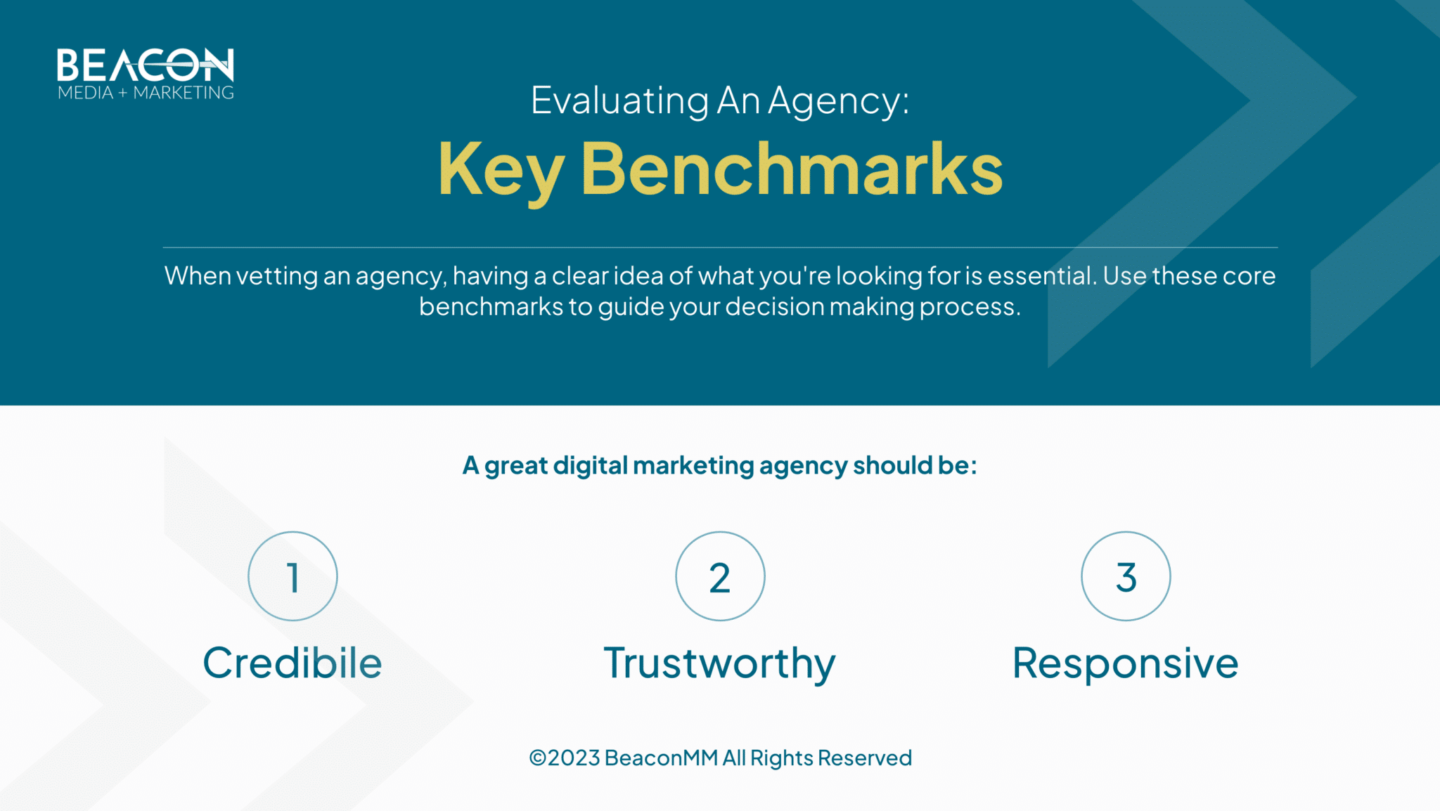
The three categories below provide good indication benchmarks. The questions listed under each of the three subject headings will help you with your due diligence and streamline your research when working through the vetting and evaluation process:
Credibility
Is the digital agency credible? Does their first impression inspire confidence? Do they have proof of work in the form of case studies, client reviews, and their own digital presence? Do others acknowledge the agency and marketing manager’s expertise? Have they made a notable impact on their existing and previous clients? Have they received any awards or special recognition for their marketing efforts?
Trustworthiness
Do they provide real solutions that make a measurable difference to other clients? Do they do what they say they will do, when (and how) they say they’re going to do it? Are they transparent and clear in their communications? Do they keep their clients in the loop while executing a digital strategy? Do you have a good feeling when interacting with them directly?
Responsiveness
Can you easily get in touch with them by phone, email, or other means? How responsive are they when you reach out? Do they respond in a reasonable time frame after your first attempt to connect? Or are multiple attempts required before someone responds? Will time zones or language barriers be problematic? Does their work demonstrate they’re listening to your marketing needs? Are they capturing the heart and essence of your brand?
2. What are some must-ask questions during a digital marketing agency partnership vetting process?
Asking the right questions at the right time and having them answered is critical when vetting an agency for a potential business partnership. These are our favorite must-ask questions and we recommend adding them to your list:
- What are your agency’s core values? How do you demonstrate them to your clients and business partners?
- Who are your most successful clients? Why?
- How do your most successful client-agency relationships function?
- Why have past clients left or moved on from a partnership with your agency? Was there an internal fix required?
- How do you manage new client expectations?
- Do you operate on a 12-month contract or something else?
- Can you explain your pricing structures? Why are deliverables and services priced the way they are?
- Can you provide a detailed overview of your digital marketing services and how they align with our business goals?
- Is there a quality or service guarantee? If yes, what are the terms?
- Do you have a formal client onboarding process? What is it? How long does it take?
- When can I expect results? How is reporting delivered? How often? What data is included?
- How do you measure your digital marketing agency’s performance and ensure it aligns with our business goals?
- What’s your agency’s communication cadence? How quickly do you get back to clients when they reach out? What communication tools do you use?
- Do you have a project management system? What is it?
- Who’s doing the work? What’s their experience? Is the work done in-house or outsourced? Where is your team located?
- Will I be assigned an account manager? Can I interview my account manager before signing a contract?
- Is anyone on your team knowledgeable or experienced in my industry and niche?
- Is my company a good fit for your agency’s expertise, culture, and processes? And who wouldn’t be a good fit for you?
- How confident are you that your agency can help me reach my business marketing goals?
Curious how we’ll answer these questions at Beacon Media + Marketing? Get in touch! We’d love to connect.
3. How do I know if a digital agency is ‘the right fit’ for my business? Aren’t they all the same?
No. Not all agencies are the same. Agencies often specialize in one specific (or a few related) industries. Industry specialization allows an agency to go deep and identify the best marketing strategies for connecting clients with their unique target audiences.
Seeking out digital agencies that specialize in your industry is a great starting place when searching for the right digital marketing agency.
In addition to showing and proving their expertise in a specific industry, great digital marketing agencies will intentionally build a foundation of trust between themselves and their clients. They’ll encourage questions, keep their clients informed and take their client-agency relationships seriously.
Determining whether a digital agency has good business partner potential also hedges upon how informed you are. Preparing a list of questions to ask the agency in advance is an excellent way of evaluating a digital marketing agency for fit.
4. What red flags should I look for when evaluating a digital marketing agency?
When evaluating a digital marketing agency, there are several red flags to watch out for that can indicate potential issues down the line. Here are some key warning signs to be aware of:
- Lack of Transparency: If the agency is not clear about their methods and strategies, it’s a major red flag. Transparency is crucial for building trust and ensuring that you understand how your marketing efforts are being managed.
- Unrealistic Promises: Be wary of agencies that make grandiose claims about instant results. Effective digital marketing takes time, and any agency promising overnight success is likely not being honest.
- No Understanding of Your Business Goals: A reputable digital marketing agency should take the time to understand your business objectives and tailor their strategies accordingly. If they don’t, it’s a sign they may not be able to deliver the results you need.
- Lack of Industry Experience: Experience in your specific industry or with similar businesses is important. An agency without this may struggle to create effective marketing strategies for your niche.
- Poor Communication: If the agency is slow to respond or fails to keep you updated, it can lead to misunderstandings and missed opportunities. Good communication is key to a successful partnership.
- No Clear Metrics for Success: An agency should have clear benchmarks and key performance indicators (KPIs) to measure the success of your campaigns. Without these, it’s difficult to gauge the effectiveness of their efforts.
- Inability to Adapt: The digital marketing landscape is constantly evolving. An agency that doesn’t stay up-to-date with the latest trends and technologies may not be able to keep your campaigns competitive.
- Data Security Concerns: Ensuring the security and integrity of your data is paramount. An agency should have clear protocols in place to protect your information.
- Compliance Issues: The agency should be knowledgeable about relevant laws and regulations, ensuring that your marketing efforts are compliant.
Additionally, it’s wise to check for any negative reviews or testimonials from previous clients and investigate any disciplinary actions taken against the agency by regulatory bodies. This due diligence can help you avoid potential pitfalls and choose a trustworthy digital marketing partner.
5. What red flags I should look for when evaluating a digital marketing agency?
Some excellent red flag questions you can use to evaluate a digital marketing agency are:
- Do they employ high-pressure sales tactics?
- Do they promise instant results?
- Do they have obscure pricing structures?
- Is their communication poor? Are clientele expectations poorly managed?
- Do they fail to listen? Or fail to acknowledge a client’s questions, cares, or concerns?
- Does their website display properly formatted copy, grammar, and/or punctuation?
- Is their website customized or cookie-cutter? Does it have low-quality images, broken links, etc?
- Does their agency website have proof-of-work and case studies? Is their portfolio web page only showing ‘straight-out-of-the-box’ templates?
- Do they have SSL certification on their agency website?
- Does their website display profile photos and bios of their team?
- Do they have a comprehensive contract? Are the terms and conditions clear? Does their contract lock you in for more than one year?
- Do they specialize in one or a few related industries? Do they claim to specialize in everything?
- Does their portfolio showcase work on their website in your specific industry (or a related one?)
- Do they have reputable reviews or testimonials on their website as well as outside sources? (Such as: Google Reviews, Glassdoor, Facebook Page, Clutch.co, etc)
For more in-depth reading on ‘red flags’ to watch out for, our part 1 and part 2 guides have some excellent pointers.
6. I’ve found what looks like a great marketing firm but, something isn’t clicking. What should I do?
Press pause. Take a step back. Do your best to identify what’s missing. Then, review what you’re really looking for in a digital agency.
Having a solid connection with the team you’re evaluating for help with your online marketing efforts is vital to your overall success.
Here at Beacon, we believe there’s a marketing partner for everyone and it’s vital both parties make the match a good one. In fact, we’re first to admit, “We’re not the right partner for everyone.”
It’s not uncommon to find ‘the right agency’ yet, feel something about the connection is just off. On paper (and online) they’ll look fantastic, have impressive case studies, run successful marketing campaigns, specialize in your field and yet something just won’t click.
There are myriad reasons for this. What’s crucial is: recognizing when your connection with an agency isn’t working.
This is one of the most important partnerships a business will make. Because of this, it’s critical to go slowly and get the match just right.
The bottom line is: You need a marketing partner you can trust. You should enjoy working with them as they help your organization attain the next level of growth. Slowing down and getting to know and evaluate a few different agencies will help you hone in on ‘the one’ best suited to your unique business needs and capable of crafting effective digital marketing strategies.
7. After hiring a digital marketing agency, should I expect to be involved?
Yes. You can and should expect involvement. However, how much or how little is a two way street. The clearer and more explicit you are regarding how much (or little) you expect to be involved, the better. In fact, this is a major key to finding a marketing agency capable of accommodating you.
Keep in mind: Some agencies happily accept client input while others prefer having full control.
If you’re accustomed to doing everything on your own, new to the agency experience or previously had a poor experience then, handing over control of your brand can be unnerving— especially at first. Each marketing agency has their own approach and preferences regarding client involvement. Understanding this is helpful when choosing one that aligns with your partnership ideals.
- A good marketing firm will build your confidence in their ability to deliver while addressing your questions and concerns.
- A great digital marketing agency will ensure you understand their processes upfront and provide a clear framework for what you can expect from them as well.
8. How long should I expect a contract with a digital marketing agency to last?
The answer varies. However, any contract locking you in longer than 12-months is suspect. It’s vital you know exactly what you’re agreeing to, why you’re agreeing to it and how your company will benefit from an agency’s partnership.
Longer term contracts should be reviewed with a fine-tooth comb. Conversely, agencies claiming to deliver ‘instant results’ are equally suspect. In such cases it’s worth asking, “If the results are instant, why is a contract necessary?”
At Beacon Media + Marketing, our standard contracts are for 12 months.
9. Are guarantees standard practice for digital marketing agencies?
No. This is not standard practice however, some online advertising agencies do offer guarantees. A digital marketing agency who offers its clientele a guarantee is confident in their team’s capacity to deliver. Agencies like this typically run top-tier, high level operations and are worth considering as a business partner.
A good guarantee is:
- specific
- clearly outlines the terms and conditions
- spells out what is or isn’t included in the your contracted service and deliverables package
If they have one, a great digital advertising or marketing agency will take the time to walk you through their guarantee and respond to any questions or concerns you have.
10. Other than an agency’s website, where can I find reviews or testimonials about their services and work?
While most digital agencies include client testimonials on their websites, we recognize that in today’s world, that’s not always enough. Here are a few other places you may want to include when evaluating a digital marketing agency:
- The agency’s Google Business listing reviews
- The agency’s Glassdoor company page reviews
- The agency’s Facebook Page reviews
- Clutch.co (An online marketplace helping users search, find, and decide on business service providers)
- Yelp.com (May prove handy when searching for a locally based marketing firm)
Tracking the effectiveness of digital marketing campaigns is crucial to ensure your investment is yielding the desired results.
11. How can I tell if my marketing investment is a good value for the money?
If working with a digital marketing agency is a new experience for you (or it’s been awhile,) the cost of services and deliverables may be mysterious or surprising. Not understanding what you’re paying for naturally gives rise to questions (as well as eyebrows.) You have every right to know exactly where your money’s going and what kind of results to anticipate. Tracking the agency’s performance through specific metrics and goals can provide insights into their effectiveness and help in making necessary adjustments to improve overall marketing strategies. Contracts, fee structure and billing should be clearly explained with nothing hidden.
A competent and trustworthy digital marketing agency will be transparent when discussing their pricing structures. They’ll keep you well informed and ensure you understand the cost breakdown of each project phase before moving forward.
They’ll be willing to explain their strategies and walk you through their reasoning. They’ll also demystify unfamiliar acronyms, terminology or jargon. More importantly, they will treat you like a valued partner.
You should feel confident that your marketing investment is well allocated and producing positive outcomes. Specifically, that your ROI will result in the largest possible impact across your target audience. An excellent digital marketing agency will:
- Openly share their results with you through regular reporting processes.
- Show you exactly how your marketing budget is achieving your goals.
- Help you build a strong, well-strategized online presence.
For further reading on what investing your marketing budget with specific services from an agency includes, go here.
For help evaluating your overall marketing budget, here’s a great place to look.
If you want to ask us here at Beacon Media + Marketing any of the questions you’ve read above, we’d love the opportunity to chat. Connect with us here for a free consultation.
12. Understanding the Role of a Digital Marketing Agency
What is a Digital Marketing Agency?
A digital marketing agency is a company that specializes in providing a wide range of digital marketing services to businesses, organizations, and individuals. These services encompass various strategies and techniques designed to enhance online visibility, drive traffic, and achieve marketing goals. Key services offered by digital marketing agencies include search engine optimization (SEO), pay-per-click (PPC) advertising, content marketing, social media management, email marketing, and conversion rate optimization. By leveraging these services, a digital marketing agency helps its clients navigate the complex digital landscape and achieve their marketing objectives.
Why Partner with a Digital Marketing Agency?
Partnering with a digital marketing agency can be a game-changer for businesses looking to improve their online presence, increase website traffic, generate leads, and boost sales. A reputable digital marketing agency brings a wealth of expertise, resources, and support to the table, enabling businesses to develop and implement effective digital marketing strategies. By collaborating with a team of experienced professionals, businesses can gain valuable insights and access to cutting-edge tools and techniques. This partnership allows businesses to focus on their core operations while the digital marketing agency works to enhance their online visibility and drive measurable results. In essence, a digital marketing agency acts as an extension of your team, dedicated to helping you achieve your marketing goals and grow your business.
13. Agency Operations
Agency Culture
The culture of a digital marketing agency plays a pivotal role in its overall success. A positive agency culture promotes open communication, collaboration, and innovation, creating a work environment where employees are motivated to deliver their best work. When evaluating a digital marketing agency, it’s essential to consider its culture and values. An agency with a strong culture is more likely to provide excellent service, deliver high-quality work, and build long-term relationships with its clients.
14. What is the primary function of a digital marketing agency in achieving marketing goals?
The primary function of a digital marketing agency is to help businesses achieve their marketing goals through the strategic use of digital channels. These agencies offer a range of services designed to increase online visibility, drive traffic, generate leads, and ultimately boost sales. Here’s a closer look at what they do:
- Developing Digital Marketing Strategies: A digital marketing agency will work with you to create a comprehensive strategy that aligns with your business goals. This includes identifying target audiences, setting objectives, and choosing the right digital channels.
- Content Creation and Distribution: Content is king in digital marketing. Agencies create engaging content tailored to your audience and distribute it across various platforms, including blogs, social media, and email.
- Website and Social Media Management: Maintaining a strong online presence is crucial. Agencies build and manage websites and social media profiles to ensure they are optimized for user engagement and search engine visibility.
- Search Engine Optimization (SEO): SEO is a critical component of digital marketing. Agencies optimize your website and content to improve search engine rankings, making it easier for potential customers to find you.
- Search Engine Marketing (SEM): This includes managing pay-per-click (PPC) advertising campaigns on platforms like Google Ads. Agencies optimize these campaigns to maximize ROI and drive targeted traffic to your site.
- Analytics and Reporting: Understanding the effectiveness of your marketing efforts is essential. Agencies analyze data and provide detailed reports on campaign performance, offering insights and recommendations for improvement.
By leveraging these services, a digital marketing agency helps businesses navigate the complex digital landscape, ensuring that their marketing efforts are effective and aligned with their overall business objectives.
15. How do I assess a digital marketing agency’s performance and track record?
Evaluating a digital marketing agency’s performance involves analyzing relevant metrics tailored to your business needs and goals. Here are some steps to help you evaluate their capabilities:
- Review Their Portfolio and Case Studies: Look at examples of their past work to see the types of projects they’ve handled and the results they’ve achieved. This can give you a sense of their expertise and success rate.
- Check Their Online Presence: Visit their website and social media profiles to see how they present themselves and engage with their audience. A strong online presence is a good indicator of their digital marketing skills.
- Ask for References and Testimonials: Speak with previous clients to get firsthand accounts of their experiences. Positive testimonials and references can provide valuable insights into the agency’s reliability and effectiveness.
- Evaluate Industry Experience: Ensure the agency has experience in your industry or a similar niche. This can be crucial for understanding your specific needs and challenges.
- Review Certifications and Credentials: Certifications from reputable organizations, such as Google Analytics or HubSpot, can indicate a high level of expertise and commitment to professional development.
- Understand Their Approach and Methodology: Ask about their strategies and how they measure success. A clear, well-defined approach is essential for achieving your marketing goals.
- Assess Communication Style: Evaluate how responsive and clear they are in their communications. Good communication is key to a successful partnership.
By following these steps, you can gain a comprehensive understanding of a digital marketing agency’s performance and track record, helping you make an informed decision.
16. What approach and methodology should I expect from a digital marketing agency?
A reputable digital marketing agency should have a clear and structured approach to achieving your marketing goals. Here’s what you should expect:
- Understanding Your Business Goals: The agency should start by gaining a thorough understanding of your business objectives and what you hope to achieve through digital marketing.
- Target Audience Analysis: Identifying and understanding your target audience is crucial. The agency should conduct research to determine the needs and preferences of your potential customers.
- Developing a Digital Marketing Strategy: Based on their research, the agency should create a comprehensive strategy that aligns with your business goals. This includes selecting the right digital channels and tactics.
- Content Creation and Distribution: The agency should have a clear plan for creating and distributing content that resonates with your audience. This includes blog posts, social media updates, email campaigns, and more.
- Search Engine Marketing (SEM) Management: A well-structured approach to managing and optimizing search engine marketing campaigns is essential. This includes both SEO and PPC strategies.
- Analytics and Reporting: The agency should provide regular reports on the effectiveness of your digital marketing efforts. This includes analyzing data and offering insights and recommendations for improvement.
- Ongoing Learning and Adaptation: The digital marketing landscape is constantly evolving. The agency should be committed to ongoing learning and staying up-to-date with the latest trends and technologies.
A good digital marketing agency will be able to explain their approach and methodology in clear and simple terms. They should also be flexible and willing to adapt their strategies as needed to meet your changing needs and goals. This ensures that your marketing efforts remain effective and aligned with your business objectives.
If you want to ask us here at Beacon Media + Marketing any of the questions you’ve read above, we’d love the opportunity to chat. Connect with us here for a free consultation.