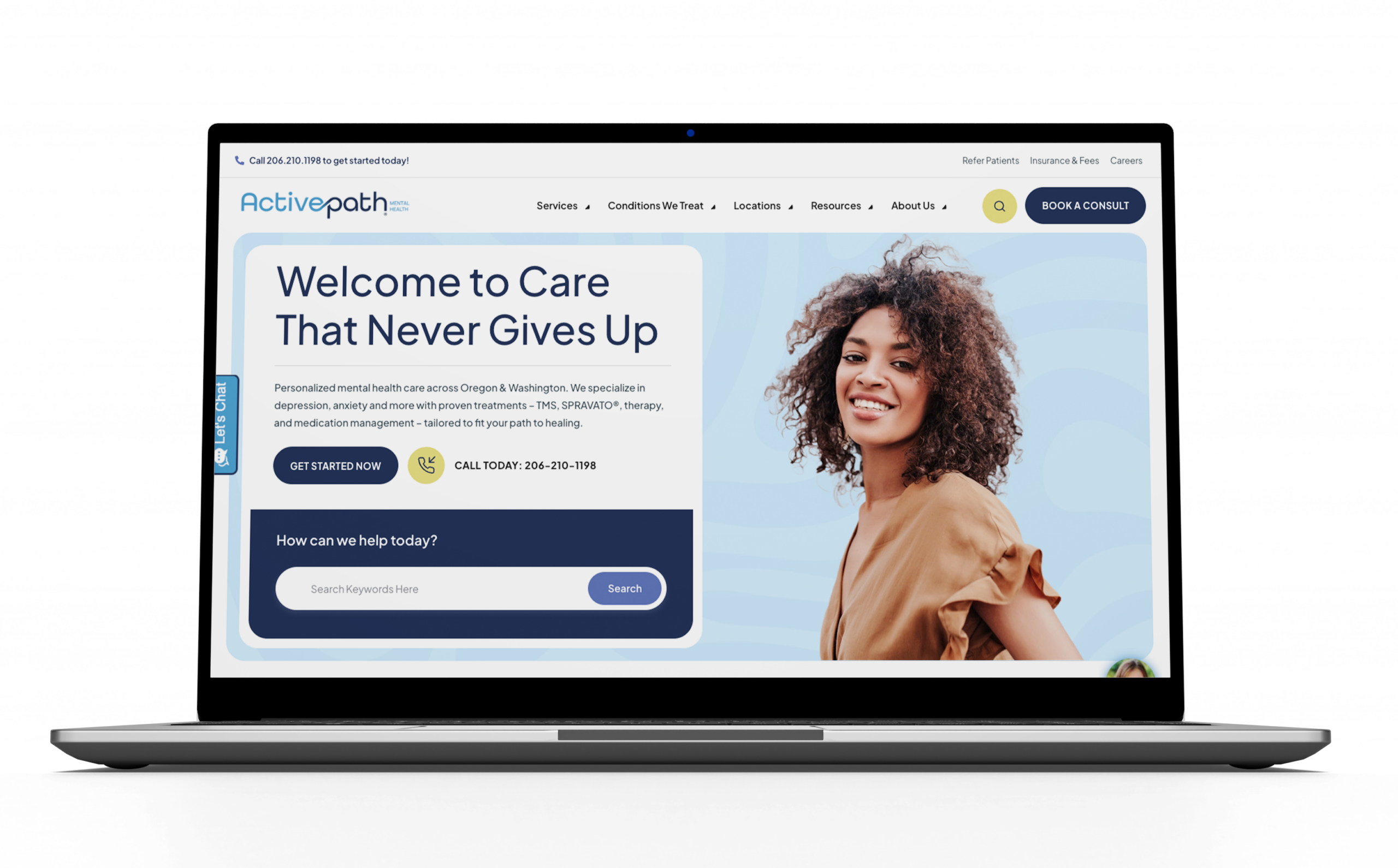
Mental + Behavioral Health Website Design Services

Make Your Website Easy to Use + Hard to Ignore

Elevate your website to the top of search engines and effectively reach + convert your target audience with an SEO + AI-optimized website.

Driving Sustainable Growth

0 +

Years of Experience

0 +
Mental + Behavioral Health Clients Served

Award

Winning Marketing Team
Why Choose Beacon For Social Media

Why Isn’t Your Website Turning Visitors Into Leads?

Your website is often the first impression potential patients have of your practice, and it’s crucial that it makes a positive impact. A high performance website not only looks visually stunning but also provides a seamless user experience.

Start With Strategy

We begin with your goals, audience, and services, building a clear structure that guides every design decision toward conversions, not just aesthetics.

Design With User Behavior in Mind

We map how people actually navigate your site, creating intuitive paths that guide visitors and increasingly AI-driven users from first click to confident action, without confusion or friction.

Build for Speed and Performance

We optimize load times, mobile responsiveness, and technical performance so your site feels fast, smooth, and reliable across every device.

Continuously Test and Improve

We monitor performance and refine key elements over time, improving user experience, increasing conversions, and keeping your site aligned with evolving behaviors.
logo

Climb Aboard With a Customized Marketing Plan 

Are you ready to take your mental or behavioral health practice to its next stage of growth? Let’s partner up and build a strategy that gets you there now.

Ken_Headshot

Does Your Website Feel Outdated or Ineffective?

Website SEO Content

We create SEO and AI-optimized web content that helps your site rank higher in search results. Our team of copywriters and SEO + GEO experts craft compelling, keyword-rich content that resonates with your audience and drives conversions

UX Design & Development

Our design team creates user-centered websites that are intuitive, accessible, and visually stunning. We focus on creating a seamless user experience that guides visitors through your site and encourages them to take action.

Custom Web Development

Every website we build is custom-designed to meet your unique business needs. We don't use cookie-cutter templates — instead, we create a website that accurately reflects your practice and brand identity.

Hosting & Maintenance

We offer reliable hosting services and ongoing website maintenance to ensure your site stays fast, secure, and up-to-date. Our team monitors your site for performance issues and handles updates and backups.

What Our Clients Say About Us

Explore Our Insights

Take a closer look at the tools, tips, and strategies that help your practice grow with confidence.

The About page is consistently one of the most visited pages on a mental health practice website. It’s also consistently one of the most misused.

Most About pages do one thing: they describe the practice. They cover when it was founded, what licenses the clinicians hold, what modalities are offered, and sometimes a brief mission statement that sounds indistinguishable from every other practice in the city. That’s not nothing. But it’s also not what a patient who clicks on the About page is actually looking for.

A patient visiting the About page of a mental health practice isn’t looking for a history. They’re looking for evidence. They’re trying to answer a question that no credential list or founding story can answer directly: are the people here trustworthy? Would I feel safe being vulnerable with them? Is this practice what it says it is?

The APA’s revised Ethics Code emphasizes that psychologists build trust through authenticity, integrity, honesty, and transparency in all professional relationships. Those same principles, applied to an About page, are what transform it from a practice biography into a patient acquisition asset.

Want to know what your About page is actually communicating to first-time visitors? Get a fresh perspective from Beacon, and let’s look at it through a patient’s eyes.

What You Need to Know

  • The About page is not about the practice. It’s about the patient’s experience of the practice, and every element of it should be chosen with that distinction in mind.
  • Patients visit the About page to answer one question: are the people here trustworthy enough for me to be vulnerable with them? Every design and copy decision should serve that question.
  • Authenticity outperforms polish on mental health About pages. A page that sounds like real people wrote it about real work they care about will consistently outperform a page that reads like a professional bio template.
  • The About page should build momentum toward contact, not serve as a dead end. Every well-designed About page ends with a clear, warm invitation to take the next step.
  • Mission statements are almost always the weakest element of an About page, because they say what every practice says. What builds trust is specificity, personality, and the evidence of genuine values rather than statements of them.

What Is a Patient Actually Looking for When They Visit an About Page?

Not a history. Not a credentials list. Not a mission statement.

They’re looking for the people behind the practice, and for enough genuine human signal to decide whether those people are the kind of people they could trust with the most private parts of their inner life.

The Five Questions an About Page Needs to Answer

  • “Why does this practice exist?” — not the founding story, but the genuine reason the people here do this work, told in a way that makes the motivation feel real rather than rehearsed
  • “Who actually works here?” — real people with real personalities, not credential summaries attached to professional headshots
  • “Do these people share my values?” — evidence of the practice’s actual approach to care, its cultural competency, its openness to different kinds of patients and presentations
  • “Is this practice legitimate?” — credentials and affiliations, presented in accessible terms that build confidence rather than clinical distance
  • “What would it feel like to be a patient here?” — the tone, warmth, and energy of the page itself is the most direct answer to this question, before any content has been read

A practice that answers all five of those questions clearly and warmly on its About page has given a cautious patient most of what they need to make the decision to reach out. A practice whose About page answers only the fourth question — credentials and legitimacy — has done the bare minimum and left the most important questions unanswered.

Why Do Most Mental Health About Pages Fail the Patients Who Visit Them?

Because they’re written for the wrong audience. They’re written to impress a professional reviewer rather than to connect with a nervous patient.

The Most Common About Page Mistakes

  • Leading with history instead of humanity. “Founded in 2009 by Dr. [Name], our practice has grown to serve hundreds of patients across the greater [City] area” is accurate and tells a patient almost nothing that moves them toward trusting the practice.
  • Credential-forward, personality-absent bios. A bio that lists license type, years of experience, and therapeutic modalities without conveying anything about the person’s actual warmth, curiosity, or approach to the work is a missed opportunity every time someone reads it.
  • Mission statements that sound identical to every other practice. “We are committed to providing compassionate, evidence-based mental health care in a safe and supportive environment” is a sentence that means nothing because it’s true of every ethical practice and therefore differentiates none of them.
  • No connection to what a patient is experiencing. An About page that talks entirely about the practice without ever acknowledging the patient’s perspective misses the emotional bridge that most patients need before they feel seen enough to reach out.
  • No clear next step. An About page that ends without a warm, specific invitation to contact the practice is a page that builds connection and then leaves the patient with nowhere to put it.

What Should the About Page’s Opening Section Actually Say?

Something that makes a patient feel recognized before they’ve been evaluated.

The opening section of an About page is doing the same work as the first minute of a first session. It’s establishing whether this is a safe place to be honest, whether the people here understand what it’s like to be the person seeking help rather than the person providing it, and whether the energy of this environment matches what the patient needs.

What Strong About Page Openings Have in Common

  • They acknowledge the patient’s experience first, not the practice’s history or achievements — a sentence or two that names what the people who typically come to this practice are going through, and makes it clear that this is a place that understands that experience
  • They articulate a genuine “why,” not a polished mission statement but an honest account of why these specific people chose this work and what drives them to keep doing it
  • They establish tone immediately, because the voice of the opening paragraph tells a patient whether the rest of the page is going to feel warm and human or professional and distant
  • They avoid starting with “we,” which immediately centers the practice rather than the patient and sets the wrong frame for everything that follows

How Should Clinician Bios Function on the About Page?

As introductions, not resumes. This is the single most important distinction in mental health About page design, and it’s the one most practices get wrong.

What a Resume Bio Looks Like

“Dr. [Name] is a licensed clinical psychologist with 12 years of experience specializing in CBT, DBT, and EMDR for anxiety, depression, and trauma. She received her doctorate from [University] and completed her internship at [Institution]. She is a member of the APA and the [State] Psychological Association.”

Every word of that is accurate. None of it helps a patient decide whether they’d feel safe in a room with this person.

What an Introduction Bio Looks Like

An introduction bio answers different questions:

  • Who is this person beyond their credentials? What drew them to this work? What do they find meaningful about it? What do they notice about the patients they connect with most?
  • What is their actual approach? Not the modality list but what it feels like to be in a session with them — their pace, their warmth, their way of meeting a patient where they are
  • Who do they work best with? Being specific about who a clinician serves best is not limiting. It’s reassuring. A patient who reads “I work especially well with people who’ve been told they’re too much, or not enough” knows immediately whether this person might understand them
  • What makes them a real person? A single, genuine detail about who someone is outside the clinical role, done briefly and appropriately, does significant work for the human signal that builds pre-session trust

Format Considerations for Clinician Bios

  • Lead with personality, close with credentials, not the reverse — the patient needs to connect before they need to verify
  • Use the first person wherever possible, since third-person bios create unnecessary distance between the reader and the person they’re evaluating
  • Keep bios to 150 to 250 words for most clinicians, long enough to be substantive and short enough to be read completely rather than skimmed
  • Use a real, warm, current photo that looks like the person a patient would actually meet, not a formal headshot that could belong to any professional in any field

What Else Should a Mental Health About Page Include Beyond Clinician Bios?

Several elements that most practices either skip entirely or bury where patients rarely find them.

Practice Values, Done Specifically

Not a list of words like “compassion, integrity, growth” with no elaboration, but a brief, honest description of what those values look like in practice. What does the practice actually do differently because of its commitment to inclusivity? What does it mean specifically that this practice is trauma-informed? Values stated without evidence are just claims. Values illustrated with specific behaviors are trust signals.

A Statement on Who the Practice Serves

  • The patient populations the practice is specifically equipped to serve, described in accessible language that helps a patient self-identify as belonging here
  • Any specific communities the practice has clinical expertise with, including LGBTQ+ patients, BIPOC patients, first-generation immigrants, veterans, or other groups whose mental health needs benefit from culturally informed care
  • An honest acknowledgment of who the practice may not be the right fit for, since practices that are honest about their scope build more credibility than those that claim to serve everyone equally well

The Practice’s Approach to Care

  • A brief, plain-language description of what the overall therapeutic environment feels like, not a list of modalities but a description of the pace, style, and relational approach that characterizes sessions at this practice
  • Any commitment to collaborative care, to the patient’s active role in their own treatment, or to transparency about the therapeutic process that distinguishes this practice from a more directive or prescriptive approach

A Warm, Specific Closing CTA

The About page should end with an invitation to take the next step that feels like a natural continuation of the connection the page has been building rather than a jarring pivot to sales language. Something as simple as “if any of this resonates with you, we’d love to hear from you” does the job without undermining the warmth of everything that came before it.

How Does Beacon Approach the About Page for Mental Health Practices?

As one of the highest-priority pages on any mental health website, not an afterthought populated after the “important” pages are done.

At Beacon, we treat the About page as a trust architecture project. It’s not enough to write accurate content about a practice. The page needs to be sequenced, toned, and structured so that every element a patient encounters moves them closer to the feeling of safety that precedes a contact form submission.

What Our About Page Process Includes

  • A discovery conversation about the practice’s genuine “why,” because the most effective About pages are built from authentic material, and that material has to be uncovered rather than invented
  • Bio interviews with individual clinicians to surface the specific, human details that turn credential lists into introductions patients actually want to read
  • Patient perspective review at every draft stage, specifically asking whether each element would make a first-time visitor more or less likely to reach out
  • Structural sequencing that mirrors the patient’s evaluation process, so the page moves from emotional connection to practical information to next-step invitation in the order that feels natural rather than the order that felt convenient to write

Our website design team and our marketing strategy team work together on About page development because it requires both design sensibility and deep understanding of the patient journey. The practices that invest in getting it right consistently see it reflected in the quality and volume of their patient inquiries.

Your About page is often the last thing a patient reads before deciding whether to reach out. Make sure it’s doing the work it needs to do. 

Reach out to Beacon today, and let’s turn your About page into one of your strongest patient acquisition assets.

A person visiting a mental health practice website for the first time isn’t just evaluating services. They’re asking a much more fundamental question: is it safe to be vulnerable here?

That question is answered in the first few seconds of a visit, before the copy has been read, before the clinician bios have been evaluated, before the services page has been found. It’s answered through a rapid and largely unconscious assessment of visual signals, tone, structure, and the overall feeling of the digital environment a patient has just walked into.

The APA’s 2024 Work in America Survey on Psychological Safety defines the concept as the ability to bring your whole self forward without fear of repercussion or judgment. That’s exactly what a patient needs to feel before they’ll reach out to a mental health practice. And it’s exactly what a well-designed mental health website can either create or destroy in under three seconds.

Understanding what generates that feeling of safety, and what quietly undermines it, is one of the most practically useful things a mental and behavioral health practice can apply to its website.

Wondering whether your website feels safe to someone visiting it for the first time? Let’s walk through it together and see what a first-time patient actually experiences.

Before You Keep Reading

  • Safety is a felt experience, not a checklist. It’s built from the cumulative effect of visual design, photography, copy tone, structure, and the way a website handles the most sensitive aspects of the patient journey.
  • The first three seconds matter most. A patient’s vulnerability assessment begins the moment the page loads, before they’ve consciously evaluated anything. Color, imagery, and visual hierarchy do significant work before words do.
  • Warmth and professionalism are not opposites. The most effective mental health websites project both simultaneously, and the ones that sacrifice warmth for professionalism lose patients who needed to feel seen before they could feel confident.
  • Transparency is a safety signal. Practices that are clear about their process, their pricing, their approach, and what a first session looks like communicate trustworthiness in a way that vague or incomplete websites cannot.
  • Every design decision is a message. Font choices, color palettes, photo selection, white space, and copy length all contribute to whether a site feels like a place a nervous person would trust or a place they’d quietly leave.

Why Does Safety Matter So Much More on a Mental Health Website Than on Other Practice Sites?

Because the stakes of the vulnerability are fundamentally different.

A patient evaluating a physical therapist is assessing competence and convenience. A patient evaluating a therapist is assessing something much more personal: whether the people at this practice would hold their inner life with care. That assessment is happening before any contact has been made, based entirely on the signals the website sends.

What a First-Time Visitor Is Actually Asking

  • “Will I be judged here?” — answered through the tone of copy, the warmth of imagery, and whether the language assumes the patient is already broken or simply human
  • “Do real, caring people work here?” — answered through photos, bio language, and whether the site has any visible human personality or feels entirely corporate
  • “Will my information be safe?” — answered through visible privacy statements, HIPAA language, and the overall credibility of the site’s technical presentation
  • “Is this place for someone like me?” — answered through specialty specificity, inclusive language, and whether the imagery and copy reflect a range of human experiences or feel narrowly targeted
  • “What happens if I reach out?” — answered through clear next-step information, response time statements, and the warmth of the contact experience description

Every one of those questions is answered by design choices, not just content choices. And most mental health websites are answering several of them poorly without realizing it.

What Visual Design Elements Create or Destroy the Feeling of Safety?

Visual design is the first layer of the safety assessment, and it happens faster than conscious thought.

Color and Its Emotional Weight

Color is one of the fastest trust and safety signals a website sends. In mental health specifically, the palette choices carry significant emotional weight:

  • Blues and greens consistently register as calming, trustworthy, and professionally appropriate for mental health contexts
  • Warm neutrals, creams, soft taupes, and warm whites convey approachability and warmth without sacrificing professionalism
  • Overly saturated or high-contrast palettes can feel energetically aggressive or clinical in a way that increases rather than reduces visitor anxiety
  • Dark or heavily monochromatic designs, while visually striking, can feel heavy or foreboding to a patient who arrived in a vulnerable emotional state

The goal isn’t to follow a rigid formula. It’s to choose a palette that a nervous person would find genuinely soothing rather than one that was selected because it looked interesting in a design mockup.

Photography and the Human Signal

Photography does more work on a mental health website than on almost any other type of professional site, because it’s the primary vehicle for answering the question “do real, caring people work here?”

  • Real photos of actual team members consistently outperform stock photography for trust-building, because patients are evaluating whether they’d feel safe with these specific people, not with actors playing therapists
  • Stock photos of people looking sad or distressed are among the most consistently counterproductive choices a mental health website can make, amplifying the negative emotional associations a patient is already managing
  • Nature, light, and calm environmental imagery can work well as supporting visuals when they reflect the actual environment of the practice rather than generic stock scenes
  • Diverse, representative imagery signals to patients from underrepresented communities that this practice is a place where they belong, which is itself a powerful safety signal
  • Overly posed or staged team photos can undermine warmth as effectively as no photos at all, since authenticity is what creates the parasocial familiarity patients need before reaching out

White Space and Visual Breathing Room

A cluttered, text-heavy, visually dense mental health website is an anxiety-amplifying experience for a patient who arrived already feeling overwhelmed. White space isn’t wasted space. It’s the design equivalent of a calm, unhurried voice. It signals that the practice isn’t rushing anyone, that there’s room here, that this is a place where someone could slow down rather than feel more pressured.

How Does Copy Tone Create or Undermine a Sense of Safety?

The language a mental health website uses is a direct preview of the language a patient might encounter in a session. And patients read it that way, whether they realize it or not.

Language That Signals Safety

  • Second-person, patient-centered language that speaks directly to the reader’s experience (“if you’ve been feeling…”) rather than describing services in the third person
  • Validation language that normalizes the experience of struggling and the decision to seek help, without dramatizing either
  • Plain, accessible descriptions of therapeutic approaches that explain what sessions actually feel like rather than listing clinical modalities that mean nothing to a non-clinician
  • Specific, honest statements about who the practice serves best and who might be better served elsewhere, since honesty about scope is itself a trust signal
  • Non-pathologizing language that treats the patient as a full human being navigating difficulty rather than a diagnostic category seeking intervention

Language That Erodes Safety

  • Clinical jargon that creates distance and implies the patient needs to already speak the language of mental health to belong here
  • Generic wellness language that’s so broad and inoffensive it fails to make any real connection (“we help you live your best life”)
  • Crisis-forward framing that leads with the most severe presentations a practice treats, which can make a patient with moderate symptoms feel like their experience isn’t serious enough to warrant care
  • Passive or bureaucratic phrasing in calls to action and intake descriptions that makes the process feel administrative rather than human

What Structural Elements of a Website Reinforce or Undermine the Feeling of Safety?

Structure is the skeleton that holds everything else together, and a poorly structured mental health website creates anxiety through confusion even when the visual design and copy are both strong.

Navigation That Removes Uncertainty

  • Clear, labeled navigation items that use patient language rather than internal practice terminology, so “anxiety and depression” appears in the menu rather than “clinical services”
  • A visible path to the contact page from every page of the site, so a patient who is ready to reach out never has to hunt for the next step
  • A logical page hierarchy that mirrors how a patient naturally moves through the evaluation process: who you are, who you help, how you help them, what it costs, and how to get started

Transparency Elements That Build Confidence

  • Clear information about fees, insurance, and sliding scale availability, since financial uncertainty is one of the most consistent safety-eroding elements on mental health websites
  • A “what to expect” section that walks a patient through the intake process step by step, removing the fear of the unknown that prevents many people from completing the contact form
  • Visible credentials and licensure information presented in accessible terms rather than credential strings that communicate nothing to a non-clinical reader
  • HIPAA and privacy statements that are easy to find and written in plain language, since a patient considering sharing their mental health history needs to know their information will be protected

Social Proof in the Right Places

  • Patient reviews or testimonials near the top of the homepage, since social proof is most effective when encountered early in the evaluation rather than after the patient has already formed skepticism
  • Specific, descriptive review excerpts rather than generic five-star ratings, since a review that describes an experience a prospective patient recognizes in themselves is significantly more trust-building than a numerical rating alone
  • Professional affiliations and credentialing organization logos placed contextually near clinician bios rather than buried in a footer where they’re rarely seen

How Does Beacon Design Mental Health Websites Around the Safety Experience?

By treating psychological safety as a design brief alongside aesthetics and functionality, not as an afterthought.

Every mental health website Beacon builds begins with a patient perspective audit: what does a first-time visitor experience when they land on this site, and does that experience make them feel more or less safe to reach out? That question shapes decisions at every level of the design process.

What That Looks Like in Practice

  • Palette selection grounded in emotional context, not just brand aesthetics, so the color choices are tested against how a nervous patient would experience them rather than how they look in a design presentation
  • Photography direction that prioritizes authenticity, helping practices produce real, warm images of actual team members rather than defaulting to stock photography that undermines the human signal
  • Copy review at every stage of the design process, specifically evaluating whether the language would make a vulnerable patient feel seen or overlooked
  • Structural decisions based on patient journey mapping, so every page’s placement and content reflects where a patient is likely to be in their decision-making process when they encounter it
  • Transparency frameworks built into every site, including fee information architecture, what-to-expect content, and intake process descriptions that reduce the unknown before a patient ever submits a form

Our website design team builds mental health websites around the patient experience from the first pixel to the final confirmation email. And our content marketing team ensures the copy on every page reflects the warmth, specificity, and psychological safety that moves a first-time visitor from evaluation to inquiry.

What Can a Practice Do Right Now to Evaluate How Safe Its Website Feels?

Run the empathy audit. It’s the most important website evaluation most practices have never done.

The Empathy Audit: Five Questions to Ask

  • Open your website on a mobile phone and spend 30 seconds on the homepage without scrolling. Ask honestly: does this feel like a place a scared person would trust, or does it feel like a place designed to impress a professional reviewer?
  • Read your homepage headline and first paragraph as someone who has never heard of your practice. Does it speak to their experience, or does it describe your services in language that assumes they already know what they need?
  • Look at every photo on your site. Do the people in those photos look approachable and real? Or do they look like stock photos, overly posed headshots, or images of people in obvious distress?
  • Try to find your fee and insurance information without already knowing where it is. If it takes more than two clicks or isn’t on the site at all, a patient who needs that information to feel safe is going to leave without finding it.
  • Read your contact page and confirmation message as a patient who just did something scary. Does it feel warm and welcoming? Or does it feel like an administrative acknowledgment that their inquiry was received?

Every “no” in that audit is a patient who arrived ready to consider your practice and left feeling less safe than they did before they found you. In mental health, that’s not just a lost lead. It’s a person who needed help and encountered a barrier where they were hoping to find a door. The good news is that every barrier identified is a design decision that can be changed, and most of them don’t require a full rebuild to fix.

Your mental health website should feel like the first step toward care, not another obstacle to it. Reach out to Beacon today, and let’s make sure every patient who finds your practice feels safe enough to take the next step.

Social media often gets treated like the lighter side of a behavioral health marketing strategy.

It’s where practices share team photos, awareness-month graphics, inspirational quotes, and the occasional educational post. Those efforts may support brand recognition, but really only scratch the surface of how social platforms influence prospective patients.

For many people, social media has become part of the way they search for information, learn about mental health and decide which sources they trust. They may watch a therapist explain a symptom, save a post about treatment options or repeatedly see content from a local practice before they are ready to seek care.

By the time that person visits your website or submits an inquiry, social media may have already shaped how familiar, credible and relevant your organization feels.

Are your social channels helping prospective patients understand and trust your practice? Talk with Beacon about building a stronger behavioral health social media strategy.

At a Glance

  • Social media can influence patient decisions long before someone contacts a practice.
  • Educational content helps prospective patients understand symptoms, treatment options and what seeking care may look like.
  • Consistent, useful posts can make a practice feel familiar when someone is ready to choose a provider.
  • Different audiences use different platforms, so the right strategy depends on who the practice serves.
  • Strong social content can continue appearing through search results, shares and other online platforms after it is originally posted.

Prospective patients may not always open Instagram, TikTok or YouTube and type “behavioral health provider near me,” but they do use these platforms to look for answers.

People search for information about anxiety, depression, trauma, relationships, parenting, substance use and treatment. They follow clinicians, listen to personal experiences and save content that helps them make sense of what they are feeling or decide whether professional support may be helpful.

Research continues to show that social media plays a role in how people find and use health information. One recent study found that many participants in an under-resourced community used social platforms to access health information, with Instagram, Snapchat and TikTok associated with researching health topics before and after receiving care.

Patients shouldn’t rely on social media as a replacement for clinical guidance, but behavioral health organizations still need to recognize that these platforms are part of the research process. A practice that consistently shares accurate, accessible information has an opportunity to help prospective patients better understand their needs and available care options.

What Role Does Social Media Play in the Patient Journey?

Social media may influence several stages of the patient journey, even when it’s not the final source attached to an inquiry.

It Helps People Recognize a Need

A person may come across a post describing signs of burnout, trauma responses, or symptoms of anxiety that they had not previously understood.

These interactions can gradually make treatment feel more relevant and approachable. A single post may not lead directly to an inquiry, but it can become one of several moments that move someone closer to seeking support.

It Introduces the Practice

Prospective patients may first encounter your organization through a shared post, short video, clinician profile or local community account. They may follow the page, save the content or simply remember the practice’s name for later.

That early interaction still matters because it gives the patient a starting point. When they encounter the practice again through search, a directory or a recommendation, the name may already feel familiar.

It Helps Patients Decide Whether a Practice Feels Approachable

Behavioral health websites need to communicate a large amount of information, including services, credentials, insurance, treatment approaches and locations. Social media gives practices more room to present that information in a way that feels personal and accessible.

A clinician answering a common question on video can help someone understand how that provider communicates. A post explaining the first appointment can reduce uncertainty, while a thoughtful response to a comment can show that the organization is attentive and respectful.

Together, these interactions help prospective patients form an impression of the practice before they ever speak with a staff member.

It Reinforces a Decision

A patient may discover the practice somewhere else and check its social profiles before making contact.

They may look for signs that the organization is active, credible and aligned with what they need. Recent posts, consistent messaging and helpful information can reinforce that they are considering a legitimate practice.

An inactive or neglected profile can create the opposite impression, especially when the information is outdated.

What Type of Social Content Builds Patient Trust?

Posting consistently helps, but consistency alone does not make content useful.

The strongest behavioral health content answers real questions, reduces uncertainty and gives the audience a clearer understanding of the practice.

Educational Content

Educational posts can help people better understand symptoms, diagnoses and treatment options without overwhelming them with clinical language.

A helpful post might answer questions such as:

  • How can anxiety show up physically?
  • What is the difference between stress and burnout?
  • What happens during a first therapy appointment?
  • How does outpatient treatment work?
  • When should someone consider seeking professional support?

Content like this gives prospective patients useful information while showing that the practice understands their concerns.

Content That Explains the Care Experience

Many people delay contacting a behavioral health provider because they don’t know what to expect.

Practices can make the process feel more manageable by explaining:

  • How intake works
  • What information patients need to provide
  • How insurance verification is handled
  • What the first appointment may include
  • How telehealth appointments work
  • What happens after someone submits a form

These topics may feel basic to the practice, but they can make a significant difference to someone seeking care for the first time.

Clinician-Led Content

Clinician-led posts can put a knowledgeable and human face behind the practice. Short videos, written insights and answers to common questions give prospective patients a sense of a provider’s expertise and communication style.

The content doesn’t need to be heavily produced to be effective. Clear audio, a focused topic and a natural delivery often feel more approachable than a video that seems overly polished or scripted.

Clinicians should remain within appropriate ethical and privacy boundaries, but they can still share useful information in a way that feels warm, clear and credible.

Content That Reflects the People You Serve

Generic mental health content can make it difficult for a practice to stand out.

Social posts should reflect the populations, conditions and communities the organization actually serves. A practice specializing in adolescent care should sound different from one focused on older adults, couples or substance use treatment.

Specific content helps the right audience recognize that the practice understands their experiences.

Trends can help content reach more people, but they shouldn’t determine the entire strategy.

Behavioral health organizations have a greater responsibility than many other brands to protect credibility and communicate with care. A format that works well for a restaurant, retail brand or personal creator may feel inappropriate when applied to a sensitive mental health topic.

Before using a trend, consider whether the format genuinely supports the message. A popular video structure may offer a clear way to address a misconception, while a trending audio clip may distract from the topic or make it feel less serious than intended.

Practices should choose formats that feel natural for the brand and respectful of the people they serve. Over time, a steady stream of clear, relevant content will usually create more value than reacting to every trend that appears.

How Does Social Media Support Broader Online Visibility?

Social media content does not always stay within the platform where it was originally posted. Posts may be shared, linked to, discussed in online communities or surfaced through search engines.

Videos from YouTube, TikTok and other platforms can appear in search results, while patients may encounter social profiles when researching a practice’s name. A post may also be shared by a community organization, clinician or patient advocate, introducing the practice to people who were not already following it.

This broader reach makes social media part of the practice’s overall digital footprint. Every public channel contributes information that patients and digital platforms can use to understand the organization.

Accuracy and consistency matter across all of those touchpoints. Provider names, services, locations, links, and contact information should align with the website, directories, and other online profiles. When the information matches, patients can move between platforms without questioning whether they have found the correct practice.

What Should Behavioral Health Marketers Prioritize?

A strong social media strategy starts with clear goals and a realistic understanding of the audience.

Choose Platforms Based on Your Audience

Social media use varies significantly by age, demographics and personal preferences. YouTube and Facebook continue to reach broad audiences, while Instagram, TikTok and Reddit are especially common among younger adults.

Those differences should shape the strategy. A practice serving adolescents and young adults may prioritize different platforms and formats than one focused on older adults, caregivers or families.

Trying to maintain the same level of activity everywhere can quickly stretch a marketing team too thin. Your time is better spent building a consistent presence on the platforms your audience actually uses and understanding how each one contributes to awareness, trust and patient discovery.

Build Content Around Patient Questions

The best content ideas are often already sitting in intake calls, frequently asked questions and conversations with clinicians.

Pay attention to what patients ask before scheduling, what they misunderstand about treatment and what makes them hesitate.

Those insights can become educational posts, short videos, graphics and longer-form content.

Create a Consistent Experience

Social media should feel connected to the rest of the practice’s digital presence.

The information in the bio should match the website. Service descriptions should be accurate. Links should work. Visuals and messaging should feel like they belong to the same organization.

Patients should be able to move from a social post to the website without feeling like they have reached a completely different practice.

Measure More Than Likes

Likes and follower counts can provide some information, but they certainly don’t tell the whole story.

Behavioral health marketers should also pay attention to:

  • Saves
  • Shares
  • Video completion rates
  • Profile visits
  • Website clicks
  • Direct messages
  • Branded searches
  • Assisted conversions
  • Qualified inquiries

A post with a modest number of likes may still be valuable if people save it, share it privately or return to the practice later.

Social media often supports decisions over time, so its impact may not appear in one simple metric.

Are Your Social Channels Helping Patients Take the Next Step?

Social media can shape how prospective patients understand behavioral health, how they discover your organization, and how comfortable they feel reaching out.

That influence often develops gradually.

A person may see several posts before remembering the practice’s name. They may visit the website weeks later or return when their need for care becomes more urgent.

The practices that benefit most from social media understand that every post contributes to a larger picture. Helpful content builds familiarity. Consistent information supports credibility. A clear and approachable presence makes the path to care feel less uncertain.

Contact our team at Beacon Media + Marketing today to build a stronger presence across the platforms your patients use.


Real People. Real Perspective.

Every idea comes from someone with a point of view. Meet the team behind the work.

Jagger Czajka
Hannah Lollis team
Stephanie Melsheimer
Andrew Herrick

Website Design FAQs

Why do I need a website for my mental or behavioral health business? 
A website is the foundation of your online presence and the hub for all your digital marketing efforts. A well-designed, informative site can attract new clients, build trust, and showcase your expertise. With a strong SEO strategy, your website may be the first place people discover your brand—whether through search engines, social media, ads, or other channels that ultimately lead back to your site. It also provides a convenient way for visitors to learn about your services, contact your team, and take the next step, while ongoing updates and fresh content help you continue attracting and engaging clients over time.

While you may have heard of other web companies that ask their clients to write their own web copy, at Beacon we take care of all phases of your website. Our copywriters have the expertise and experience necessary to create effective, brand-centric content that resonates with your target audience. Additionally, marketing copywriters understand how to create copy that ensures a smooth user experience, is optimized for search engines, and guides web visitors to convert.

Also, we understand and value the unique insight you have to offer as a healthcare provider or business owner! No one knows your business better than you do, and we get that it can be difficult to convey your ideas and expertise. Rest assured that our intention is not to push you out of the process. In the first phases of our website process, we get as much information from you as possible. Early on, we’ll provide you with a website questionnaire covering the basics. And for all of our custom website packages, we’ll set up a meeting with you and key members of your staff and our web team to discuss your goals, brand and messaging, website structure, and any other details that we need to get started.

Once your website is written and on a staging server, you’ll have the chance to review it and provide us with any edits.

UX/UI website design refers to the process of designing a website with the user experience (UX) and user interface (UI) in mind. This involves creating a website that is easy to navigate, visually appealing, and optimized for conversions. UX/UI design is all about creating a website that effectively communicates your message to your target audience while providing a seamless and enjoyable user experience.

A UX/UI designer will work closely with you to understand your goals and target audience, and then create a design that aligns with your brand and marketing strategy. This involves creating a website that is visually appealing, easy to navigate, and optimized for conversion. UX/UI design can help you attract and retain more patients, increase engagement, and establish your practice as a reputable and reliable healthcare provider.

Website hosting is an essential aspect of website performance and user experience. It refers to the process of storing website data on a server that is accessible to the internet, making it available for users to access from anywhere. While all hosting services may seem similar, the level of service, security, and expertise can vary greatly. It’s incredibly important that you have a reliable hosting provider to ensure that your website is available, fast, well-performing, and accessible at all times.

A dedicated server, as opposed to a shared server, can provide more resources for a website, ensuring faster loading times and a better user experience. In addition, caching software can be installed to further optimize website speed. Another important factor in website hosting is security. With a dedicated server, there is less of a risk of hacking or malware since the server is not shared with other websites. It also allows for more control over security measures that can be implemented to protect the website and its users.

When you partner with Beacon Media + Marketing for dedicated hosting services through WP Engine, you get access to invaluable support, incredibly fast load times, monitoring, security updates, and frequent back-ups.

Technical SEO refers to the process of optimizing your website and server to improve the website’s ranking on search engine result pages (SERPs) by making it easy for search engines to crawl, index, and understand the content. Technical SEO is best combined with on-site SEO (such as SEO-optimized content, meta descriptions, and other elements found on webpages) and off-site SEO techniques (such as link building) to increase your website’s visibility in search engine results, drive more traffic, and ultimately generate more leads.

Technical SEO helps search engines understand the content of your website, making it easier for them to rank your website higher in SERPs. A well-optimized website will also have a faster load time, which is crucial in improving user experience and reducing bounce rates. Additionally, technical SEO ensures that your website is secure and free from errors, making it more trustworthy to search engines and users alike.

Does Your Website Make a Strong First Impression?

If not, it’s time for an upgrade. We design experiences that build trust from the moment someone lands.